
SEO Tier List: The Strategies to Do First, and the Ones to Skip (2027)

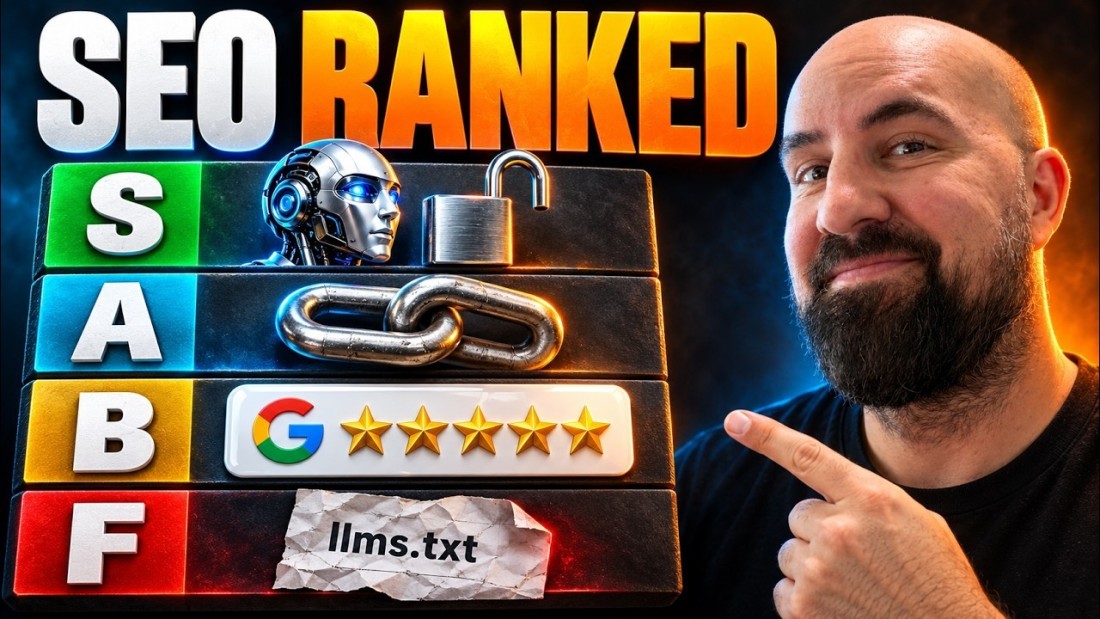
Most sites do not fail at SEO because they are missing a tactic. They fail because they spend their time on the wrong ones. So instead of another list of things to do, this is a tier list: eight tactics ranked from F to S, with the two that waste your time at the bottom, one that is fine but overrated, and one that you must have before anything else counts.
The ranking is the one I built for the video below. The short version: stop chasing a domain authority score, skip the llms.txt file, treat page speed as a fix-the-basics job, and make sure every crawler you care about can read your pages, because without that none of the rest matters.
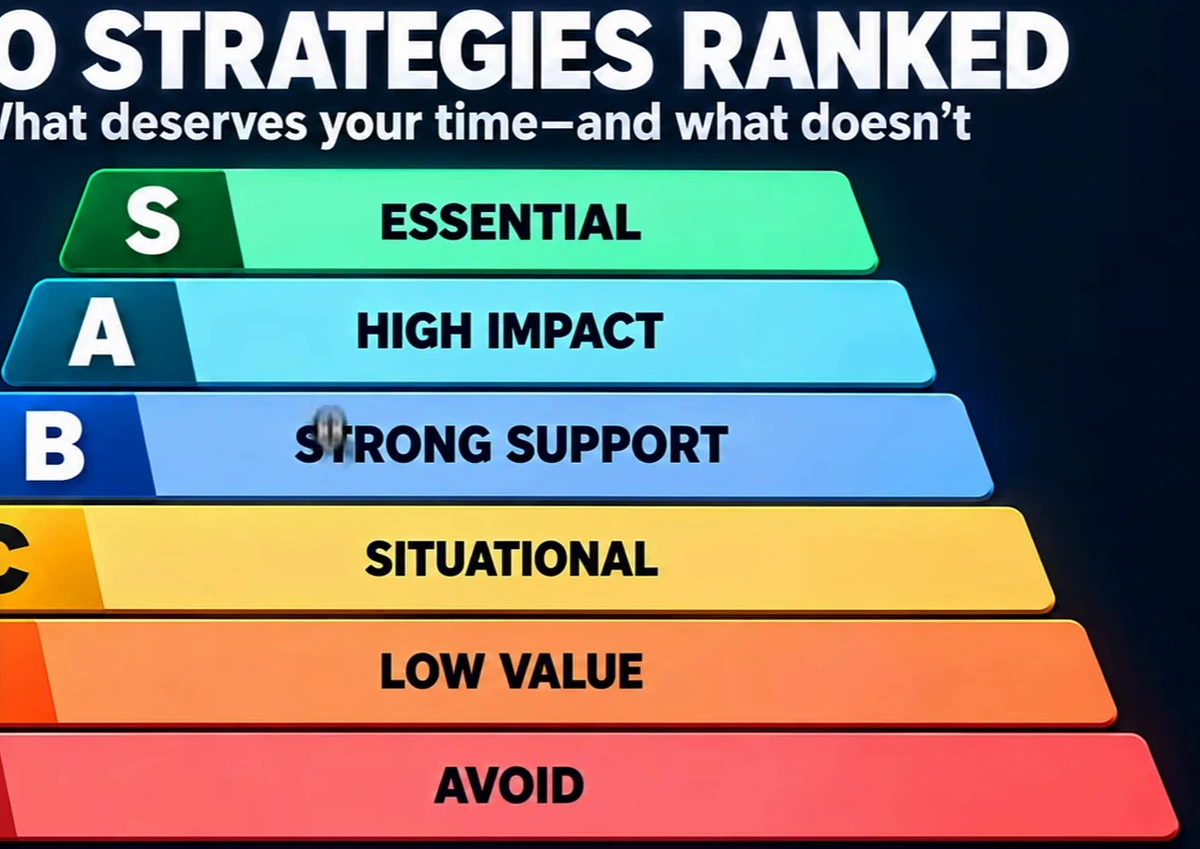
The SEO tier list at a glance
| Tier | Tactic | Why it sits there |
|---|---|---|
| S (prerequisite) | AI crawler access | If Google and the AI crawlers cannot read the page, nothing below applies. |
| A (high-value levers) | Backlinks | Still the clearest trust signal for algorithms and for AI answers. |
| A | Internal linking | Directs the authority you already have to the pages you want to rank. |
| B (useful basics) | Content structure | Answer the question in the first sentence; service and city before the story. |
| B | Real reviews | Expected by customers and by the AI models that recommend businesses. |
| C (situational) | Nothing | I left it empty on purpose. See below. |
| D (low value) | Page speed | Fix the obvious problems once, then stop tuning. |
| F (avoid) | Domain authority | A third-party score that lags everything else you do. |
| F | llms.txt | No evidence the AI systems you care about use the file. |
The tiers are about where your time goes, not whether a tactic is "real". Page speed is real; it is just not where another hour belongs once the basics are fixed. And everything in A and B feeds the thing people chase in F: do the links, the structure and the reviews, and the authority score moves on its own.
F tier: the two tactics to stop doing
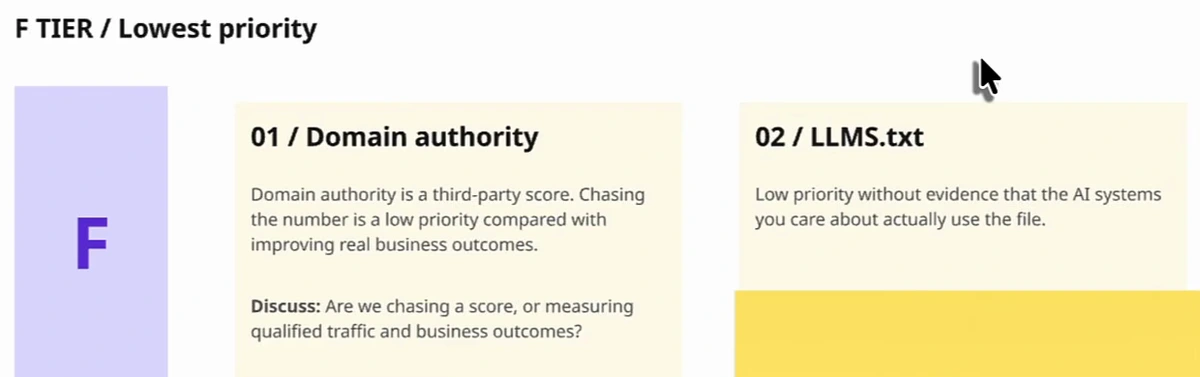
1. Chasing domain authority
Domain authority is a third-party score, and Google does not use it. Chasing the number is a low priority compared with improving real business outcomes, and the part most people miss is that it is a lag measure. It moves after the fact, as a result of the links and the content you build. You cannot push the score directly; you can only do the A-tier and B-tier work and watch it follow.
That is also why the score is a bad target: a site can gain a lot of referring domains and raise its DR without a single extra customer. We looked at what a rising rating does and does not buy you in how to increase domain rating, and the honest answer is that the number is a by-product, not a goal.
2. Adding an llms.txt file
There is a common belief that AI systems need an llms.txt file before they can read a site. That is not true. They read your HTML the same way Google does. Google's own documentation on AI features in Search says it plainly: "You don't need to create new machine readable files, AI text files, or markup to appear in these features." Google's John Mueller has gone further in public, calling the file purely speculative and noting that no AI platform has required it from any site. So the card says "low priority without evidence that the AI systems you care about actually use the file", and that is the whole argument. Creating one does no harm. It is just time you could spend on tiers A and B.
D tier: page speed, once
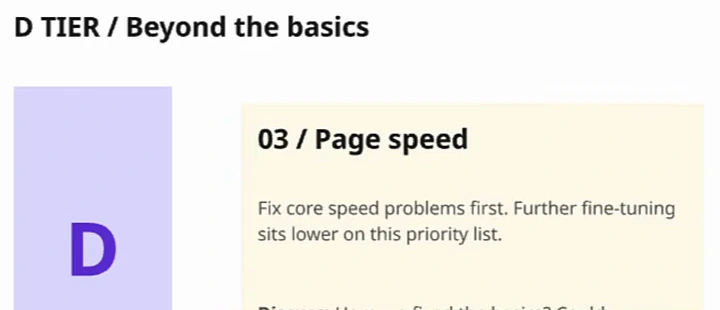
Page speed is a D because it passes, but only just. Google does use Core Web Vitals in its ranking systems, and its page experience documentation says so, but the same page says Search "always seeks to show the most relevant content, even if the page experience is sub-par." So if you are slightly slower than the competitor above you, speed is not the reason you are below them. Relevance, links and structure are.
What you should fix is the obvious stuff. Most hosts let you set up caching and image compression in an afternoon. The single most common self-inflicted problem I see is an autoplaying video in the homepage hero. It looks snazzy and it slows the page down for everyone. Use a picture, or if you insist on the video, do not autoplay it. Then stop. Every further hour spent shaving milliseconds is an hour not spent on a link or a service page.
C tier: deliberately empty
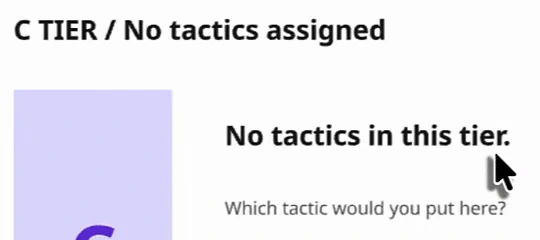
Nothing landed in C, and that was not an oversight. Once the basics are fixed, the remaining tactics are either clearly worth doing or clearly not; there was no "situational" middle I could defend. If you want a candidate from our side, it would be schema markup: useful on review and FAQ pages, irrelevant on most others.
B tier: the useful basics
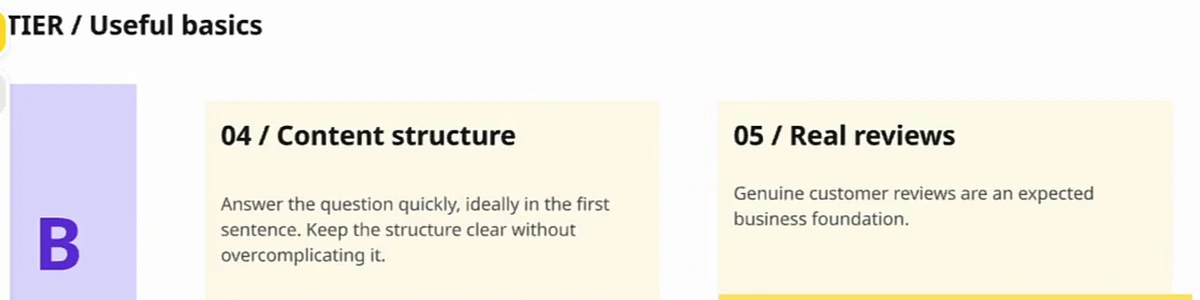
4. Content structure: the answer goes first
Answer the question quickly, ideally in the first sentence, and keep the structure clear without overcomplicating it. With AI reading pages at scale, the fluff at the top of a typical page has become a cost: the about-us paragraph, the founder's story before the service is named. People do not want it, and neither does a model deciding whether your page answers the query.
The rule changes by page type. On a page targeting a local service, the service and the city go first, then the call to action, then the detail. On a blog post written for a keyword, the answer goes in the first couple of sentences and the sections underneath expand on it. On a homepage, the order that converts and that builds trust is: title tag, service, location, reviews, then the call to action. We covered why this structure wins with AI shoppers in optimising a website for AI agents.
5. Real reviews, everywhere
If you run a service business, genuine reviews are an expected foundation, not a bonus. Put them everywhere: embed the Google Business Profile reviews on the site, show them on the service pages, mention them near the top of the homepage. The AI models can see them, and they recommend businesses with few or low reviews far less often. For the five separate signals a review sends, and why your replies are the only review text you control, see Google reviews and SEO.
A tier: the high-value levers
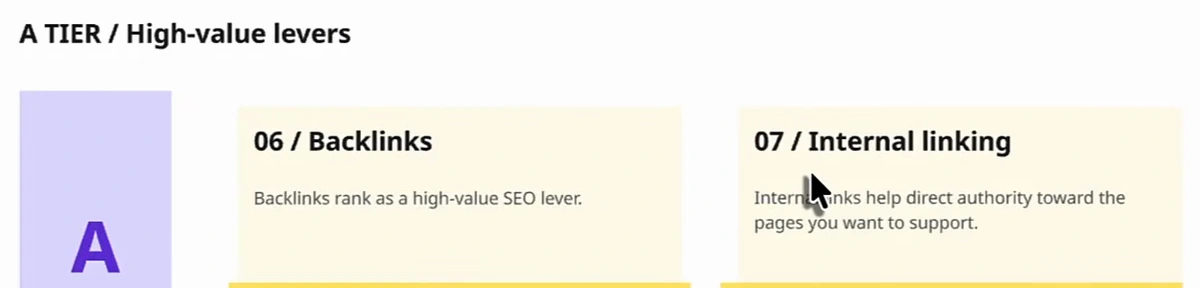
6. Backlinks
Backlinks are probably going to matter forever, because they are the clearest way a third party vouches for you. They build trust with customers, with algorithms, and with the AI models that cite sources. Valuable content earns links on its own over time, but you can also go and get them: a charity donation that comes with a sponsor link, guest posts, and the sites that already link to your competitors. The free methods are in how to get free backlinks; the charity route, including which sponsor links are actually followed, is in donation backlinks; and the guest-post prospecting workflow is in how to find guest post opportunities.
7. Internal linking
Internal links direct authority toward the pages you want to support, which is why they share the tier with backlinks: one brings authority in, the other decides where it lands. Everything should connect. The homepage links to the service pages. The service pages link to the blog posts that support them. The blog posts link back to the service pages and the homepage. Your social profiles link to all three. A site where every page is reachable from every other relevant page is a site where a new link to any page lifts the rest. The evidence for how much this moves, including the test on a page with 4,225 links, is in our internal linking strategy.
S tier: AI crawler access, the prerequisite
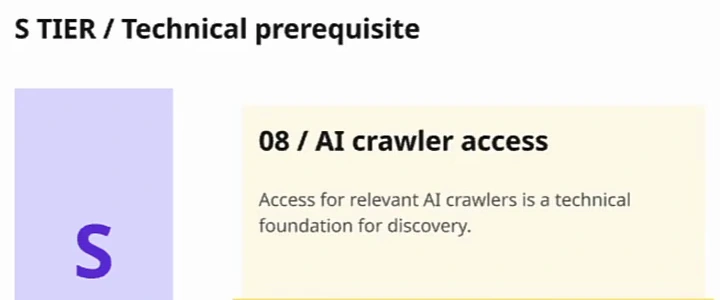
This is the one you must do no matter what: make sure your site can be crawled by Google and by the AI crawlers you want to be cited by. It is a prerequisite rather than a lever. If a page cannot be crawled, it cannot be indexed; if it is not indexed, it cannot appear in Google, in AI Overviews, in AI Mode or in a ChatGPT answer, and no amount of A-tier work changes that.
Checking it is simple. If Google Search Console shows the page as indexed, it is crawlable by Google, and Google's documentation lists exactly one condition for AI features: a page "must be indexed and eligible to be shown in Google Search with a snippet", with "no additional technical requirements." For the other crawlers, read your robots.txt and make sure you are not blocking GPTBot, ClaudeBot, PerplexityBot or OAI-SearchBot by accident, and that your CDN or host is not returning errors to them. You can paste the robots file into ChatGPT or Claude and ask what it blocks. Then keep checking it: every new page and every new post should be indexed, which means it should be crawlable. The rest of the checks that go with this one are in our SEO audit checklist.
Why this order beats most of your competition
None of these are hard. The reason the tier list works is that most of your competitors are not doing the A and B tiers consistently. They get busy, they get sidetracked, they spend a week on a speed score or a month wondering why their DA has not moved. If you do the eight things above in the order shown, you are already ahead of the business that did the opposite, and the gains show up as rankings, traffic and AI mentions.
If you want the "how" for each tactic rather than the "which first", our nine SEO strategies that actually work walks through the execution. This article is the ordering; that one is the playbook.
Where software takes the tiers over
I use Arvow to keep up with the A and B tiers for myself and for clients, because it covers most of the list in one place. The blog writer uses a knowledge base of your own files, case studies and URLs so the articles match your brand instead of reading as generic, and it links new posts to your service pages from your sitemap, which is the internal linking tier done for you. The automatic backlink network places links from other users' articles as they publish, which is the easiest way to keep the backlink tier moving every week. The Google Business Profile connection automates review replies and posts, which keeps the review tier alive. And the Site Optimizer audits the technical layer and lets you apply the fixes in one click.
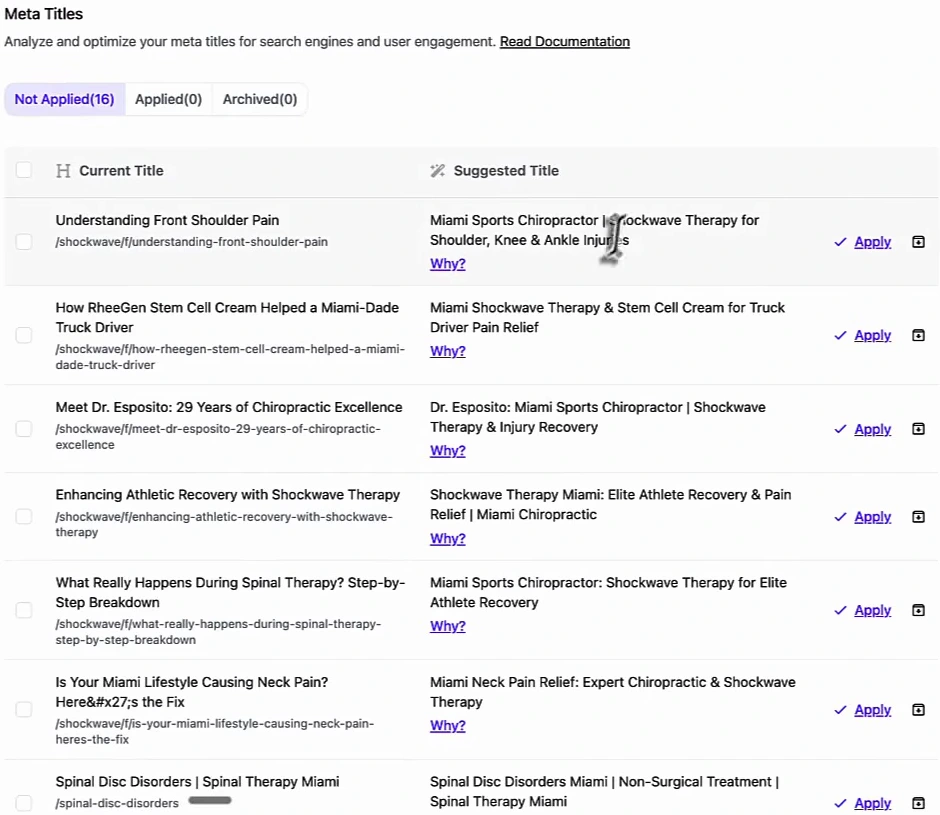
Want the A and B tiers running without the weekly to-do list? Ask Arvow's AI SEO chat to audit your crawler access, find backlink opportunities and write the next article.
FAQ
Is domain authority a Google ranking factor?
No. Domain authority, domain rating and authority score are third-party estimates from Moz, Ahrefs and Semrush. Google does not use them. They rise as a consequence of links and content, which is why chasing them directly is an F-tier use of time.
Does llms.txt help SEO?
Not that anyone has shown. Google states that no special AI files are needed to appear in AI Overviews or AI Mode, and no major AI platform has said it reads the file. It does no harm, but it does no measurable good either.
Does page speed still matter for SEO?
Yes, as a basic. Core Web Vitals are a ranking signal, but Google says relevance wins even when page experience is poor. Fix caching, images and autoplaying video, then move your time to links, structure and reviews.
What is the most important SEO strategy in the list?
Crawler access. It is ranked S because it is a prerequisite: a page that cannot be crawled cannot be indexed, and a page that is not indexed cannot rank anywhere, in Google or in an AI answer.
Generate, publish, syndicate and update articles automatically
The AI SEO Writer that Auto-Publishes to your Blog
- Cancel anytime
- Articles in 30 secs
- Plagiarism Free