
How to Optimize Your Website for AI Agents (2026)


Two things happened to search in the last year, and most SEO advice has not caught up with either. Locally, the map pack answers the query before anyone reaches a website. For research queries, an AI answer reads the websites for the user and reports back. In both cases the human never arrives — but a machine does, and it is reading your pages very closely.
That is the argument in the video below, and it is worth taking seriously without taking it literally. Your website is not becoming irrelevant. Its audience is changing. This article works through the evidence on screen, then gets specific about what that changes in practice — including a method for seeing the exact queries an AI fires at your site behind the scenes.
Case one: the local pack already answered the question
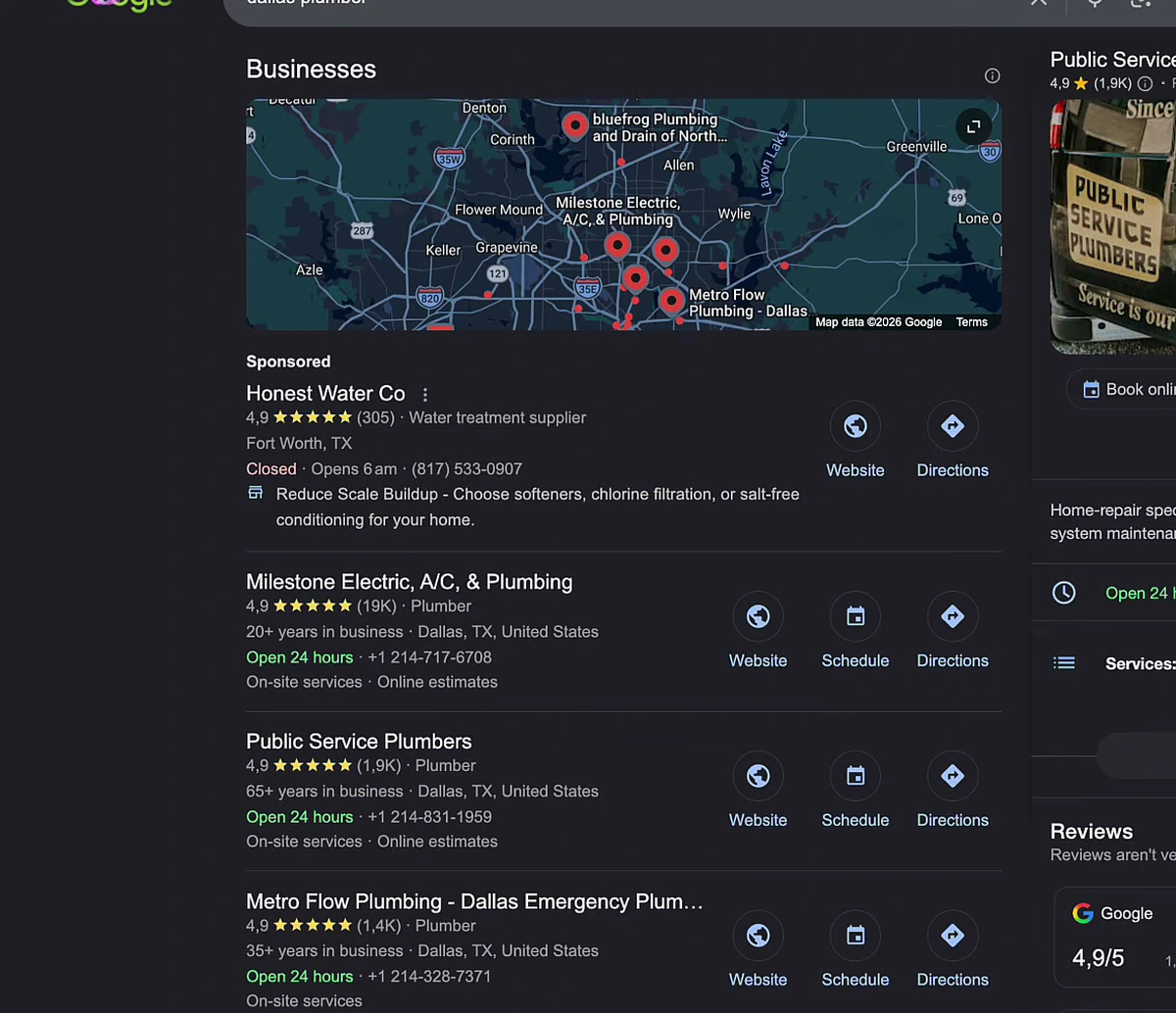
Search "dallas plumber" and you get four businesses, each with a star rating, a review count, opening hours, a phone number and a Schedule button. Nothing on any of those companies' websites improves on that. The phone number is right there; on their own sites it is in the header on one, a floating bar on another, and buried under a contact form on a third.
The video's point is blunt and correct: for a service where the buyer mostly wants price and availability, the listing is the destination. The website's job has shrunk to being the thing Google reads to build and rank that listing — which is why your Google Business Profile now carries more commercial weight than your homepage, and why ranking in the map pack is the actual local SEO objective.
Worth noting where this stops. This holds for high-substitutability services — a plumber, an emergency call-out, a nearby restaurant. It holds far less for a considered purchase where the buyer genuinely wants to evaluate you. The video draws the line itself: "services where I don't really care who's coming to my place."
Case two: the AI does the shortlist
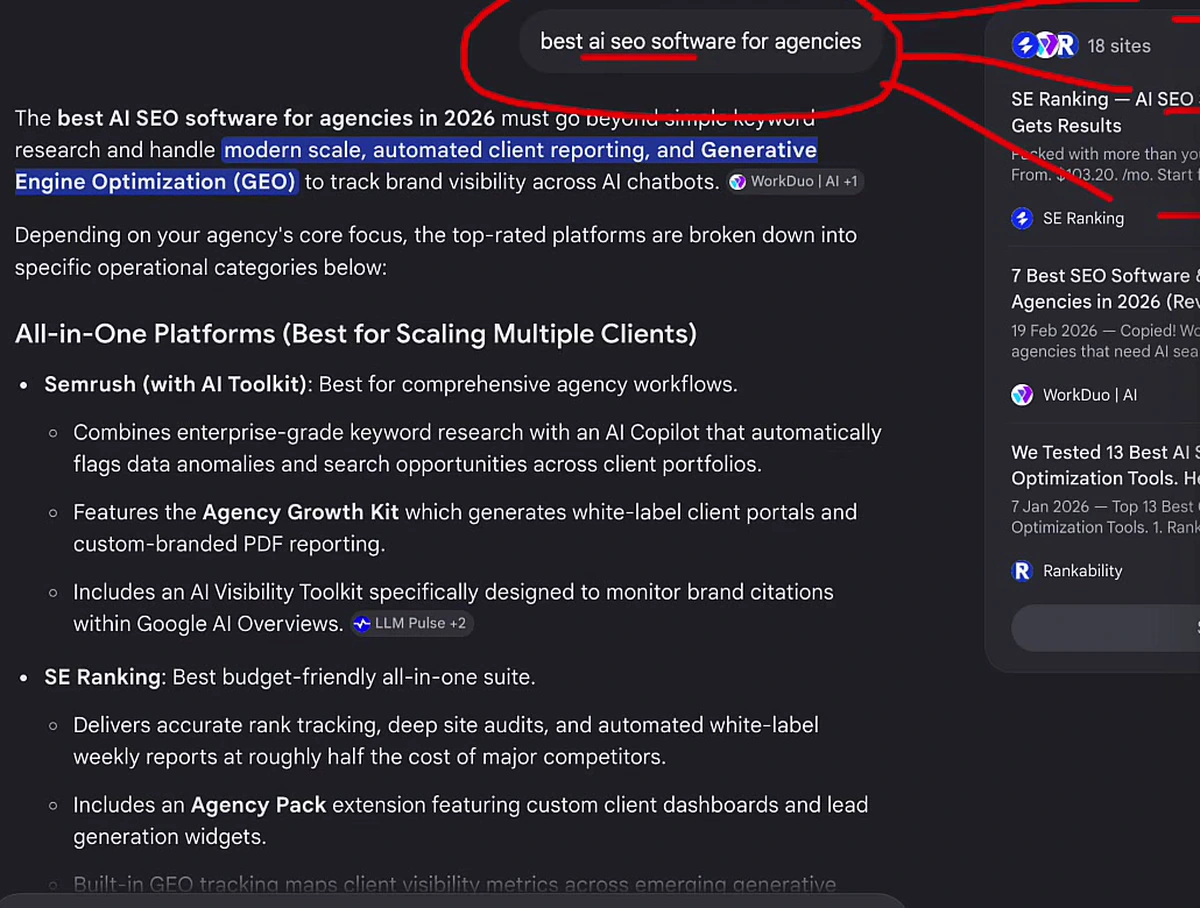
The same query a year ago meant opening eight tabs: three listicles, a Reddit thread, a couple of YouTube reviews, two vendor sites. Now the model does that pass and returns a structured comparison. The source panel says 18 sites — eighteen pages read, zero visited by a person.
Two honest observations about that screenshot, both of which matter more than the thesis.
First: the answer names Semrush and SE Ranking, and does not name Arvow — on a query Arvow explicitly wants to rank for, in a video made by Arvow's own founder. That is the real state of play, not a hypothetical. Being read by the model is not the same as being recommended by it.
Second: look at what the model quoted. Not brand copy. Specific capabilities — white-label client portals, custom-branded PDF reporting, rank tracking at roughly half the cost of major competitors. The pages that made it into that answer were pages that stated concrete, checkable facts about what the product does and what it costs.
The follow-up is where it gets ruthless
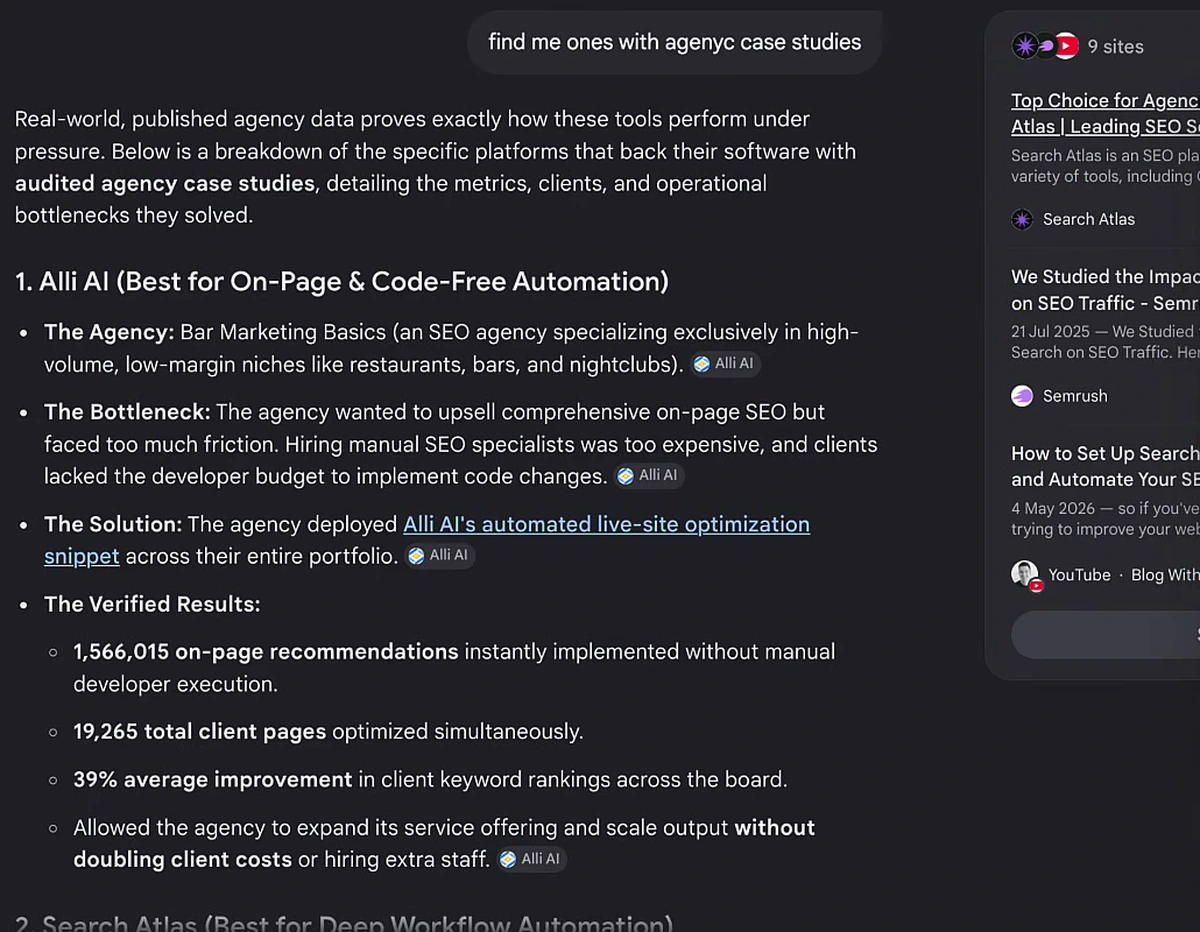
This is the part that should change what you publish. The user narrows — "find me ones with agency case studies" — and the model goes back out, reads nine more sources, and returns vendors that actually have published, auditable case studies with numbers attached.
If your site has no case study with real figures on it, you are not in that answer. Not because you ranked badly, but because you had nothing that satisfied the follow-up. Every narrowing question is a filter, and the filters are all made of specifics you either published or did not.
How to see the queries an AI actually fires
Here is the most useful thing in the video, and it takes about ninety seconds. When you give ChatGPT a prompt, it does not run one search. It expands your prompt into several — commonly called fan-out queries — and searches all of them. Those queries are visible in the browser.
- Send your prompt in ChatGPT, then open DevTools (right-click → Inspect).
- Go to the Network tab and filter by the conversation ID from the URL.
- Refresh the page, open the main conversation response, and search it for
queries.
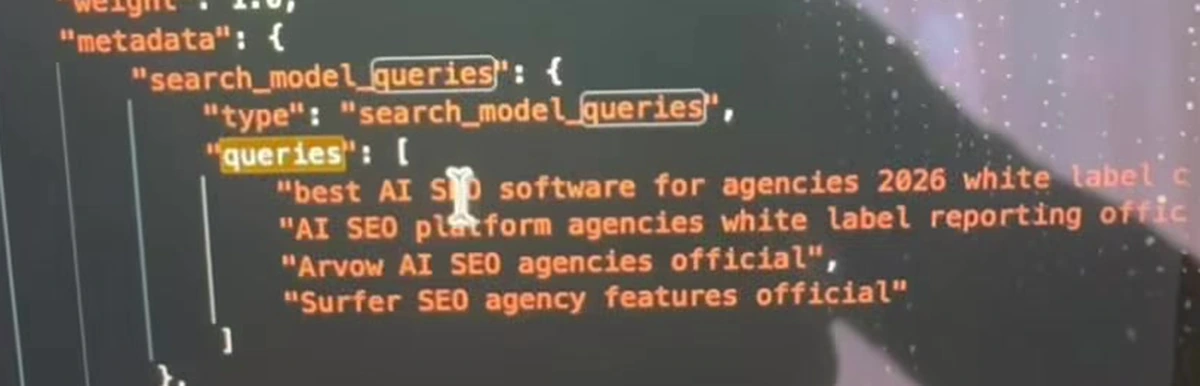
search_model_queries object in ChatGPT's network response. One prompt about the best AI SEO software for agencies expanded into four searches — two descriptive, and two brand-verification queries naming specific vendors.Read what it expanded into. Two queries are descriptive: "best AI SEO software for agencies 2026 white label…" and "AI SEO platform agencies white label reporting offic…". The other two are different in kind — "Arvow AI SEO agencies official" and "Surfer SEO agency features official". Those are brand-verification queries. Having formed a candidate list, the model went looking for each vendor's own authoritative page to check its claims.
That is a concrete instruction for what to publish. You need a page that reads as the official, factual answer to "what does [your brand] actually do" — features, pricing, who it is for — because when a model shortlists you, that page is the one it goes to verify against. This is the same mechanic behind getting cited by ChatGPT, seen from the query side.
One caveat: this is an undocumented view into a product's internals. The exact tab, key name and payload shape will change whenever OpenAI ships a frontend update, and the method may stop working entirely. The behaviour it reveals — prompt expansion into descriptive plus brand-verification searches — is the durable part.
The page that wins is not the pretty one
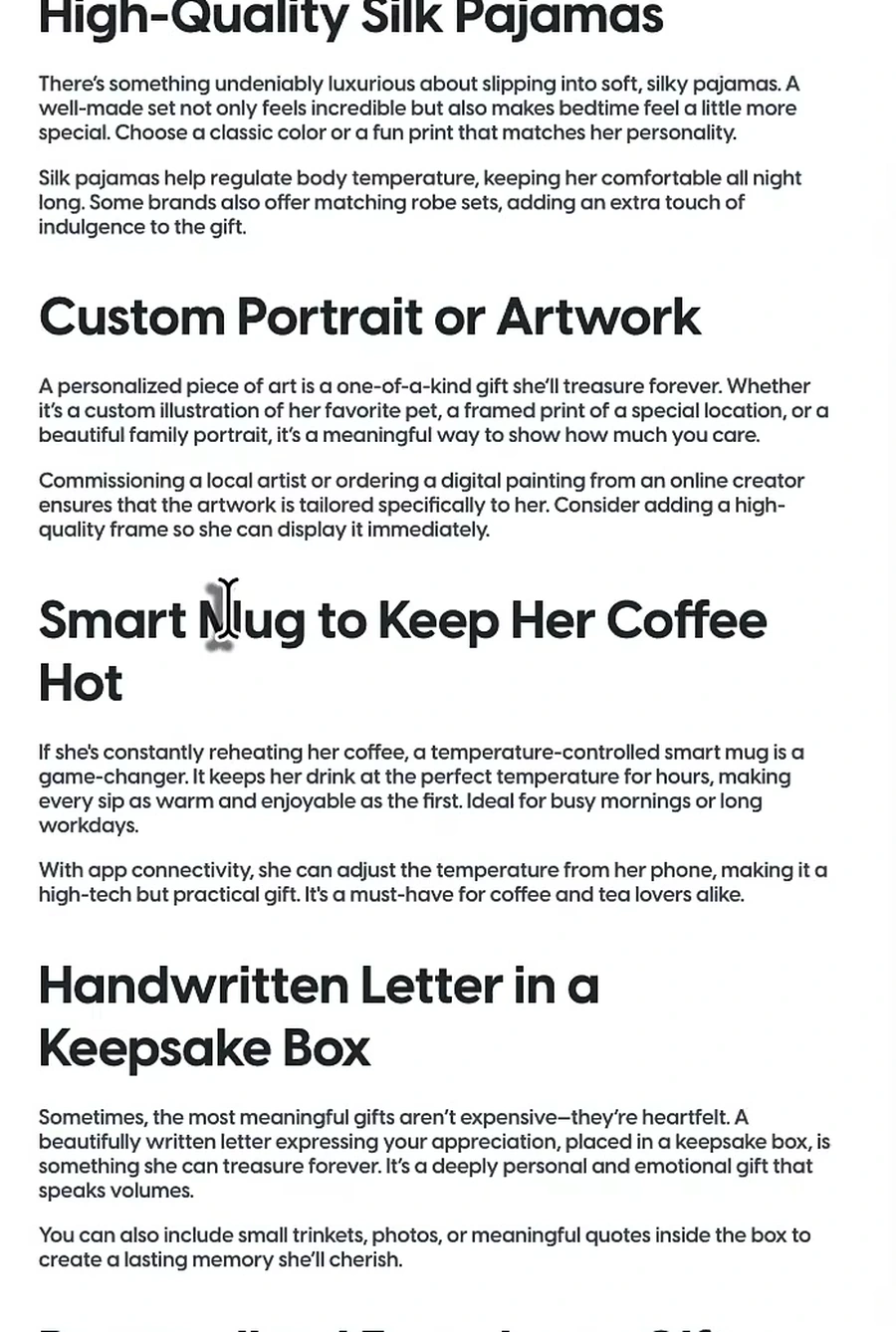
Asked for gift ideas, AI Mode returned a curated set of suggestions. The page behind them is the one above: unstyled, imageless, structurally plain. It won because each item has a clear heading and two paragraphs that say what the thing is and why it suits the occasion — exactly the shape a model can lift a passage from.
The uncomfortable implication is that design and brand polish, which are how you persuade a human, do very little to persuade a retrieval system. That does not mean ship ugly pages — humans still convert, and the ones who arrive after the AI recommendation are the highest-intent traffic you get. It means stop treating visual quality as a proxy for content quality. A beautiful page that never states a price, a number or a specific capability is invisible to the layer now doing the shortlisting.
What this does not mean
The video's framing — websites become "100% irrelevant" in six to twelve months — is deliberately provocative, and its own author invites disagreement. Two places the strong version does not hold up.
In-chat checkout is not settled. The video points to the OpenAI–Shopify partnership as evidence that even the transaction leaves your site. That partnership is real: Instant Checkout launched in February 2026, built on the Agentic Commerce Protocol. But it was scaled back around March 2026 over product-data accuracy and multi-item cart problems, and by mid-2026 only a few dozen Shopify merchants had in-chat purchase completion live. For nearly every merchant, the product surfaces in ChatGPT and the buyer still finishes on the store's own site. The direction of travel is right; the timeline in the video is ahead of the facts.
"Optimising for AI" is not a new discipline. The video is right that SEO, GEO and AEO are largely the same work under different labels — retrieval still rewards pages that answer a query precisely and credibly. If you want the distinction drawn properly rather than dismissed, we did that in SEO vs AEO. The tactical differences are real but narrow; the fundamentals did not move.
What to actually change
- Publish the boring authoritative page. Features, pricing, who it is for, in plain language on your own domain. That is what brand-verification fan-out queries go looking for.
- Put real numbers on your case studies. The follow-up filter is "show me ones with case studies" — vague testimonials do not survive it.
- Answer one question per section, with a heading that names it. The plain gift article beat better-designed pages on exactly this.
- Run the fan-out check on your own money query. If the model is firing brand-verification queries for your competitors and not for you, that is your gap, stated precisely.
- For local, treat the profile as the landing page. Hours, phone, services and reviews belong where the answer is delivered, not two clicks past it.
- Stop reading raw sessions as the health metric. If AI reads your page and recommends you, that visit never appears in analytics. Track whether models mention and recommend you, because traffic will keep falling while performance improves.
That last point is the one that catches people out. The video's prediction is not that your business declines — it is that your traffic chart declines while your business does fine, and the two stop being the same signal. Measuring only sessions in 2026 means watching the wrong number go down and drawing the wrong conclusion, which is why AI Overview visibility is now a separate thing to track.
Want to know whether models actually recommend you on your money queries? Arvow tracks your visibility and sentiment across ChatGPT, Claude, Gemini, Perplexity and Google AI Mode — and writes the pages that fix the gaps.
The short version
Humans are stopping earlier: at the map pack for local, at the AI answer for research. Your site still gets read, just by a machine that expands one prompt into several searches, verifies your claims against your own official page, and filters on specifics you either published or did not. Optimise for that reader — concrete facts, real numbers, one clear answer per heading — and stop grading yourself on a sessions number that is measuring a shrinking share of the actual demand.
For the underlying numbers on how often generative engines cite and recommend brands, see our GEO statistics roundup.
Generate, publish, syndicate and update articles automatically
The AI SEO Writer that Auto-Publishes to your Blog
- Cancel anytime
- Articles in 30 secs
- Plagiarism Free