
Google Reviews SEO: Why More Reviews Won't Rank You Higher in 2026

Every local business owner has been told the same thing: get more reviews. So they grind for years, pile up a thousand of them, then watch a competitor with a third of that count sit above them in the map pack. It happens constantly.
The reason is simple once you see it. Google does not treat "reviews" as one number it sorts by. It reads at least five different things off your review section — and review count is the one most owners optimise, and the one that discriminates least.
The search that kills the "more reviews" theory
Here is a plain "plumber dallas" search in Google Maps, recorded in August 2026. Tribeca Plumbing sits above Dallas Plumbing & Air Conditioning. Tribeca has 436 reviews at 4.8 stars. Dallas Plumbing has 1,238 reviews at 4.6 — nearly three times the volume, and it ranks below. Roto-Rooter, sitting under both, has 1,108.
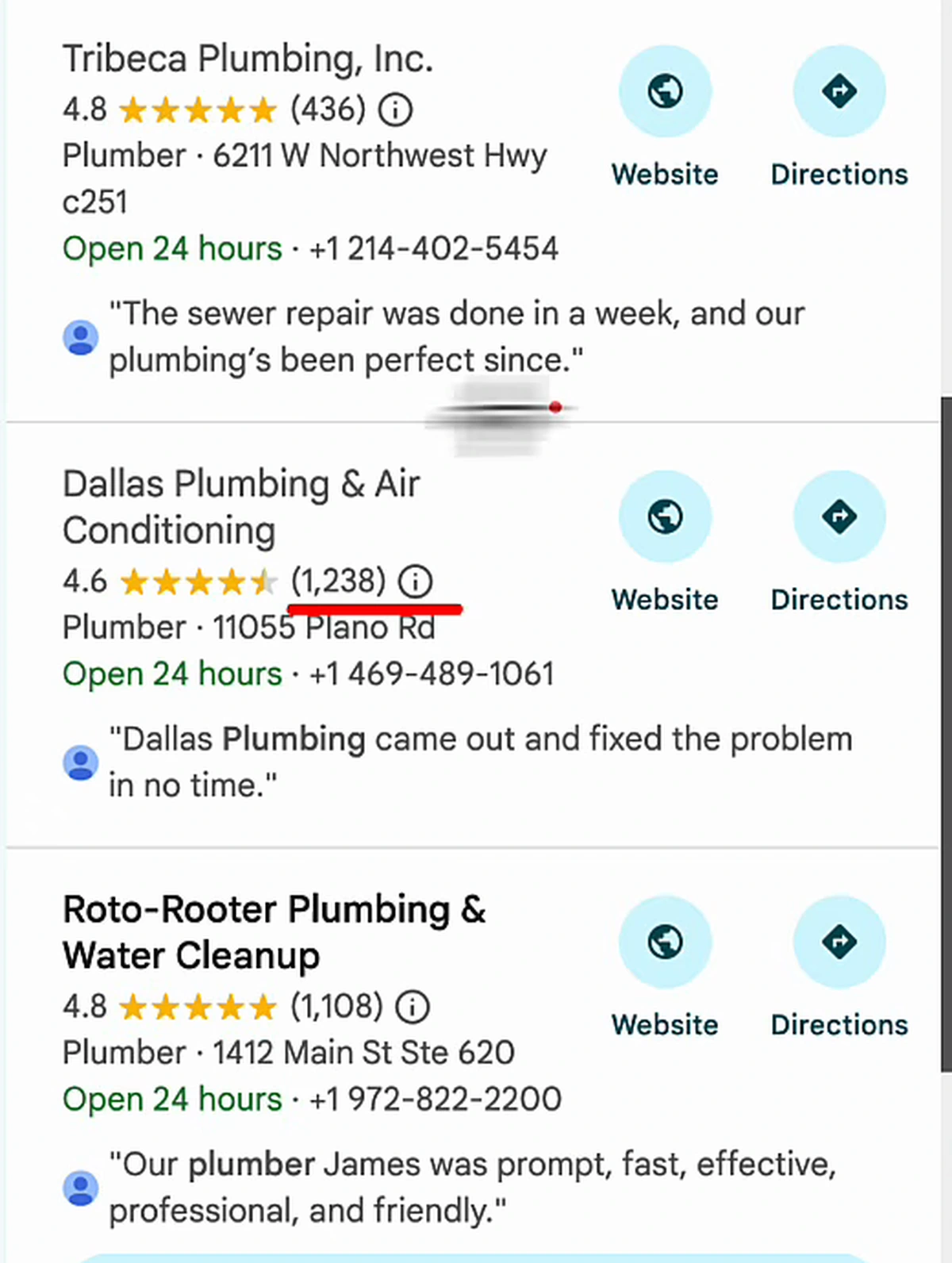
Being honest about what this proves: it is one search on one day, and Maps results shift with proximity, search history and a long list of other factors. What it does establish is the negative claim, which is the useful one — review volume alone does not decide the order. If it did, this result would be impossible.
Reviews are five signals, not one
This is the whole framework, and it fits on one line each:
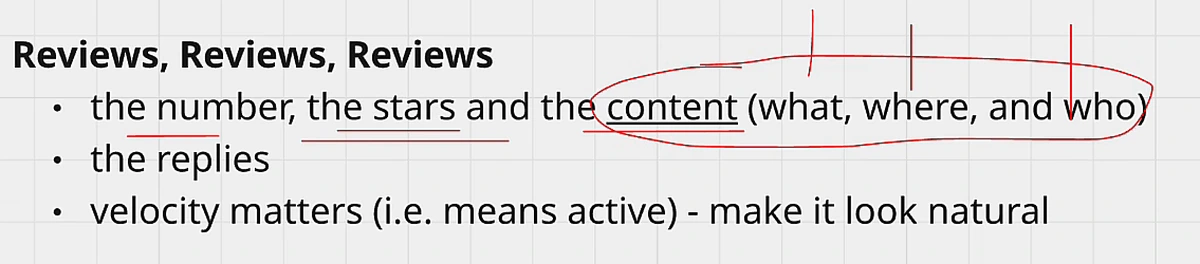
| Signal | What it is | How hard it is to move |
|---|---|---|
| 1. Number | Total review count | Slow, and everyone is already doing it |
| 2. Stars | Average rating | Mostly a function of your actual service |
| 3. Content | What the review text says — the what, the where, the who | Influenceable today, almost nobody tries |
| 4. Replies | Whether and how you respond | 100% under your control |
| 5. Velocity | The cadence new reviews arrive at | A habit, not a project |
Signals 1 and 2 are where all the effort goes. Signals 3, 4 and 5 are where the ranking difference lives, because they tell Google what you are relevant for rather than just how liked you are. For the wider process around this — categories, posts, photos, the website side — see my full Google Maps ranking process.
Signal 3: the what, the where and the who
"Great service, five stars" is a rating with words attached. A useful review contains the what (the service performed), the where (the neighbourhood or city), and the who (your business name, ideally the technician's).
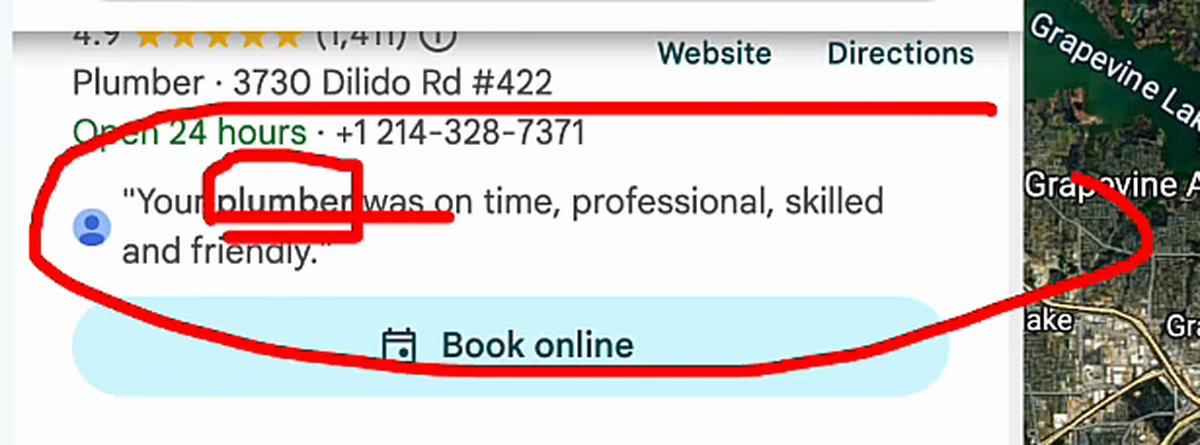
That text does not stay buried on your profile. Google lifts a line out of it and prints it in the results under your listing, where it is the last thing a customer reads before choosing — with the searched keyword bolded inside it.
What a review that ranks looks like
The weak version: "Great service, thank you." The strong one: "Great plumbing job — the team at [brand] came out to [neighbourhood] and fixed our burst pipe the same morning. Only charged $300, much less than I expected." Same customer, same five stars. The second names a service, a location, a brand and a price — every one of them a term someone else might search for.
How you actually get them
You cannot script a customer, but you can prompt one, and almost nobody does:
- Ask, every time. Email or SMS the direct review link after the job is done. Most businesses skip this entirely, and it is the whole ballgame — if you do not ask, you do not get.
- Add one line of instruction. "It really helps if you mention which service we did." Once a customer has been asked to mention one specific thing, they tend to mention several — the service, the technician, what they paid.
Two accelerators: reviews with photos attached get read more, and reviews from Local Guides — accounts Google badges for reviewing consistently across many businesses — appear to carry more trust. Google does not confirm the second, so treat it as a working assumption. Either way you cannot pick who reviews you, only how many chances you create.
Google already turns your review text into structured data
This is the part that convinced me the content signal is underrated. Open a profile's review tab and Google has mined the review corpus into filter chips — actual service terms with counts attached: camera inspection (6), sewer line repair (3), quick fix (9), water damage repair (2).
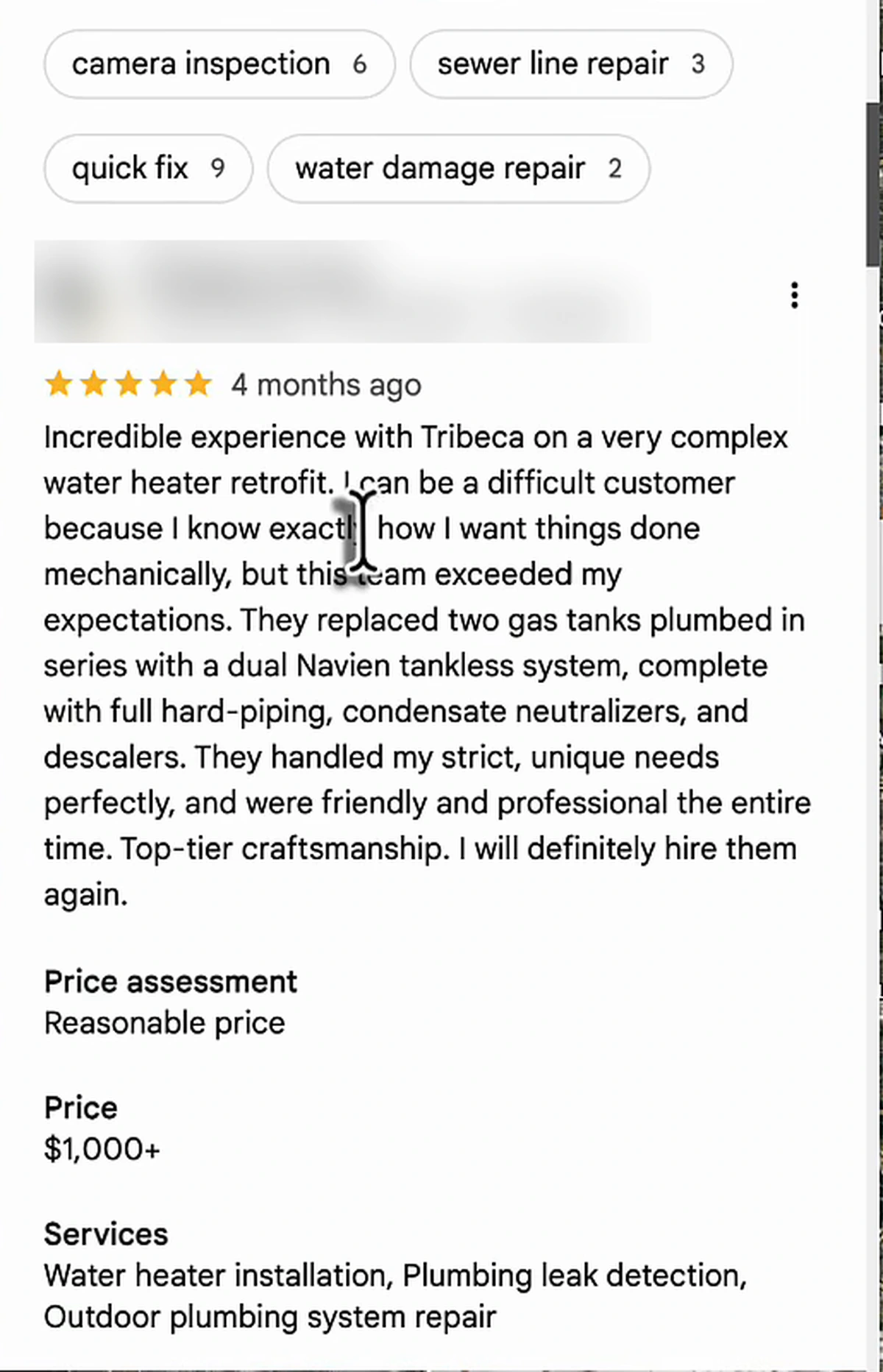
Scroll further down that same review and it gets more explicit. Google has extracted a Price assessment: Reasonable price, a Price: $1,000+, and a Services list — water heater installation, plumbing leak detection, outdoor plumbing system repair. None of that was entered by the business owner. It was derived from what customers wrote.
Now picture someone asking ChatGPT or AI Mode for "a plumber in Dallas who can fix a burst pipe same day for under $500." A profile whose reviews say "came out in 20 minutes, charged $180, fixed the leak" can answer that. One with 1,200 reviews that all say "great service" cannot. Volume does not help here — specificity does, which is the same logic behind how AI assistants pick a local business to recommend.
Signal 4: your replies are the only review content you fully control
Here is the leverage nobody uses. You cannot write your reviews. You can write every reply — and the reply sits on the same profile, in the same text corpus, indexed the same way. So a reply of "Thanks!" is a wasted slot. "Thank you for having us out to your place in Plano — glad the team swapped the water heater the same afternoon, and that the $300 came in under what you expected" puts the service, the location, the brand and the price on the page, in your own words.
Baseline first: reply to every review, one-star ones included. An unanswered negative review is the version of your business a prospect reads with nothing beside it. For the wider list of things that quietly sink a listing, see the Google Business Profile mistakes post.
Doing it at volume without sounding like a robot
Replying by hand is the reason most businesses stop. This is a solved problem now — full disclosure, the tool I use is my own, so weigh that accordingly. What matters more than the tool is the shape of the rules, because a naive "auto-reply to everything" setup is worse than replying to nothing. I run a rule per star rating rather than one global setting:
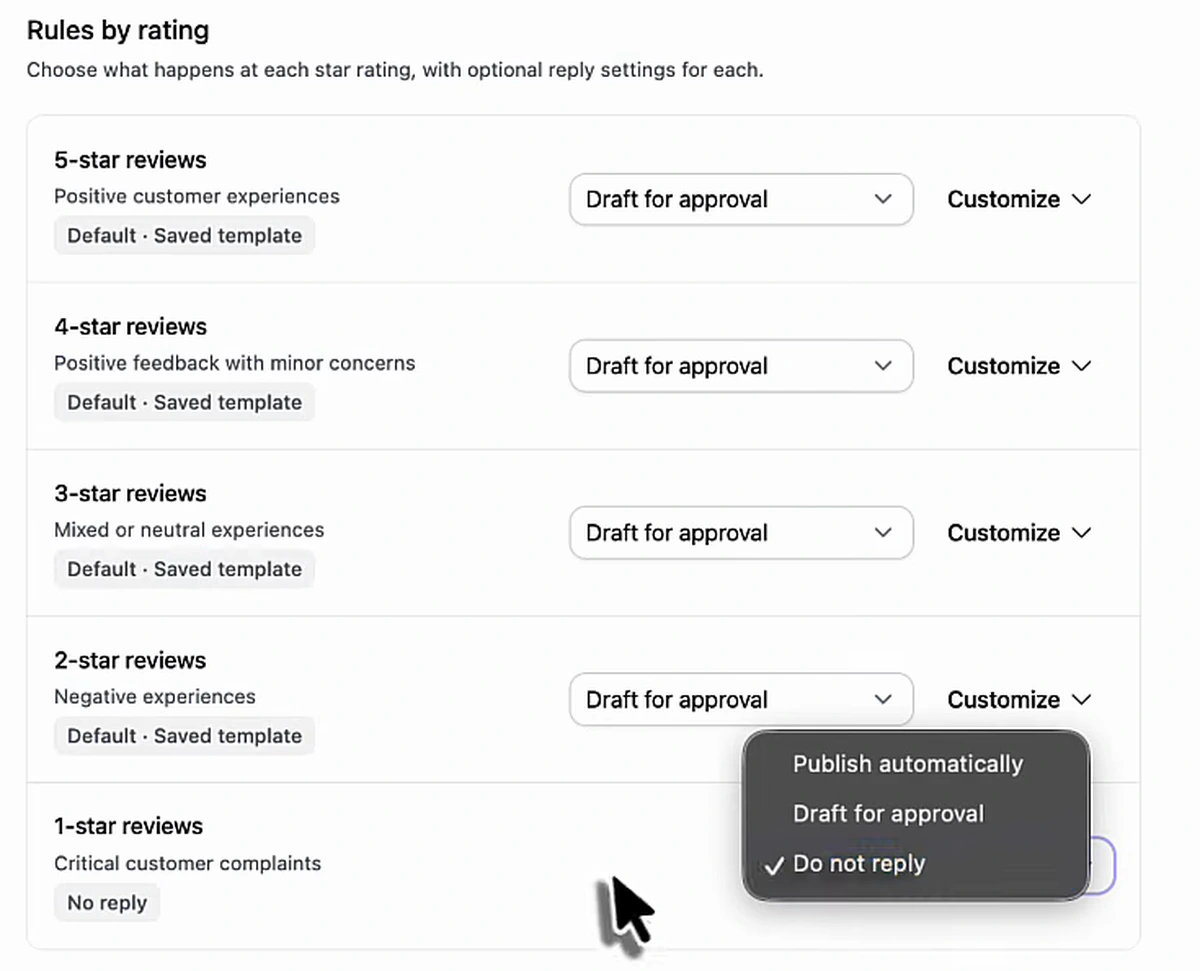
Four- and five-star reviews can publish on their own. Anything at three or below I hold as a draft and approve by hand, because that is where a tone-deaf automated reply does real damage. The settings that stop replies reading like a template: tone, a two-to-three-sentence cap, automatic language matching, and an hour's delay so responses do not arrive suspiciously fast. Then the guardrails, which I would not run without:
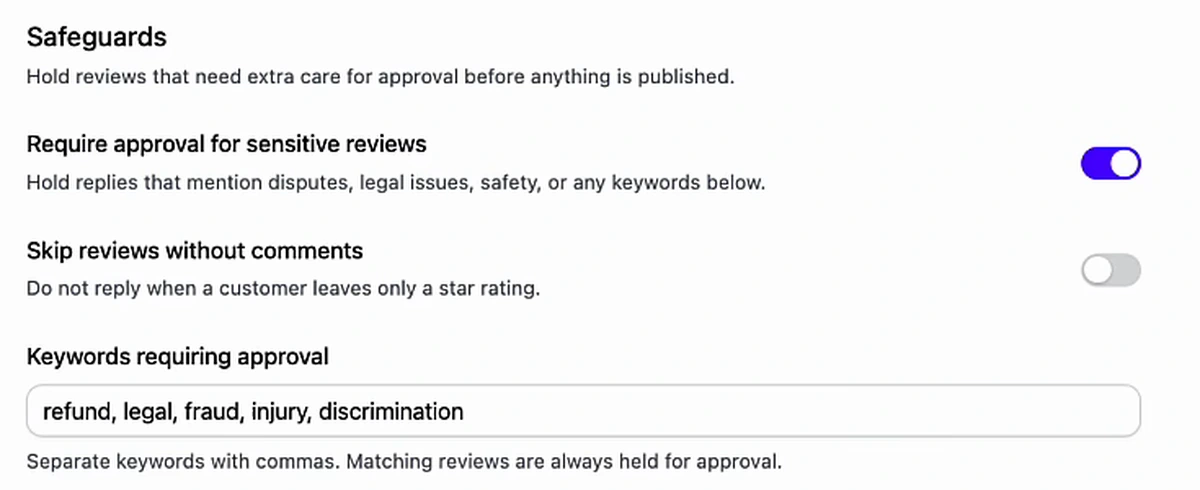
One trick that costs nothing: paste your own notes on how you want to sound into the writing-guidance field. It is the difference between a reply that is technically correct and one that sounds like you.
If you want this running without touching it, Arvow's Google review automation is the exact setup in the screenshots above — per-rating rules, approval drafts, keyword safeguards, your tone of voice.
Stop leaving your reviews stranded on Google
A business with 1,200 reviews is sitting on thousands of words of customer-written copy about its services, locations, staff and pricing — and leaving all of it on a Google property.
Put it on your own site. A /reviews or /testimonials page carrying your reviews and your replies does two jobs: it makes your site more relevant to the exact services and neighbourhoods you serve, and it puts that text where language models crawl. AI assistants read listings, but they read websites too. It is also the cheapest content page you will ever build, because you did not write it.
Signal 5: velocity, the one you cannot fake in a weekend
The model that ties the rest together: your listing is a living entity, and Google keeps checking whether it is still alive. Plenty of businesses on the map quietly closed years ago and nobody updated the listing — Google cannot afford to send customers to ghosts.
Reviews are the strongest proof of life available, because unlike photos and posts you cannot manufacture them alone. A business getting ten reviews a week is visibly trading. A business whose last review was in March is not, whatever its total says. That is why cadence beats totals.
Which reframes the job: collecting reviews is not a campaign you run once, it is a step bolted onto the end of every job, permanently. If you want the rest of the routine that keeps a profile looking alive, my free local SEO course walks through it.
The order I would do this in
- Turn on replies today — every review, every rating, with approval drafts for anything under four stars.
- Rewrite your ask. Add the one-line instruction about mentioning the service. Send it after every job, by email and SMS.
- Make the ask automatic. If it depends on someone remembering, it stops within a month.
- Build the reviews page on your own site and let it grow.
- Then chase volume — now every new review arrives carrying the service, the location and the brand, instead of just adding one to a counter.
None of this guarantees the top spot; nothing in local SEO does, and proximity alone can outweigh a lot of good work. It raises your likelihood, which is the only thing these levers honestly offer.
FAQ
Do more Google reviews mean higher Maps rankings?
Not on their own. In a "plumber dallas" search recorded in August 2026, a listing with 436 reviews at 4.8 stars ranked above one with 1,238 at 4.6. Count is one input among many — proximity, rating, review text, replies, cadence and how well the site ranks in classic search all feed in.
What should a customer mention in a Google review?
Three things: the service performed, the location, and the business name. Price and the technician's name are bonuses. "They replaced our water heater in Plano the same day, $300" is worth far more than "great service" — Google indexes that text, prints lines from it under your listing, and mines it into service and pricing data.
Does replying to Google reviews help SEO?
Yes, and it is the only review text you fully control. Replies sit in the same indexed corpus, so a reply naming the service, the neighbourhood and your brand adds relevance to every review you have received. Reply to all of them, negative ones included.
What is review velocity and why does it matter?
Velocity is the cadence at which new reviews arrive, rather than the total. Google treats a Business Profile as a living entity and looks for proof the business is still trading. Reviews are the hardest proof to fake because they need real customers, so a steady weekly flow signals more than a large total that stopped growing a year ago.
Should I put my Google reviews on my website?
Yes — a dedicated reviews or testimonials page, including your replies. It makes your site more relevant to the services and areas you serve, and puts that customer-written text where language models crawl. Most local competitors leave this content sitting on Google alone.
Is it safe to automate Google review replies with AI?
With guardrails, yes. Publish automatically for four- and five-star reviews, hold anything lower as a draft for approval, and set a keyword list — refund, legal, fraud, injury, discrimination — that forces human review regardless of rating. Cap replies at two to three sentences and add a delay so they do not post instantly.
The businesses that win the map pack are rarely the ones with the biggest review count. They are the ones whose reviews say something specific, whose replies say something specific back, and whose review feed never went quiet.

Generate, publish, syndicate and update articles automatically
The AI SEO Writer that Auto-Publishes to your Blog
- Cancel anytime
- Articles in 30 secs
- Plagiarism Free