
How to Find Guest Post Opportunities in 2026 (a Free Claude Skill, and What Those Sites Really Charge)

Finding guest post opportunities is a search problem before it is an outreach problem. Every site that accepts outside articles says so on a page, those pages use the same dozen phrases, and Google will hand you hundreds of them in a niche if you ask with the right operators. This guide covers the operators, a free Claude skill that runs about twenty of them at once and ranks the results, what the pages you'll land on actually ask for (and charge), and the automated alternative we use when we don't want to pitch anyone at all.
Everything below is from an Arvow walkthrough recorded on August 21, 2026, with the two "write for us" pages it opens re-read live on October 9, 2026, and the pricing it quotes checked against the current page.
The search operators that surface guest post pages
Sites that accept guest posts advertise it with a small, stable vocabulary: "write for us", "guest post", "submit your article", "become a contributor", "guest post guidelines". Put your niche in quotes, add one of those phrases in quotes, and Google returns the pages themselves rather than articles about guest posting. Here is the search for HVAC:
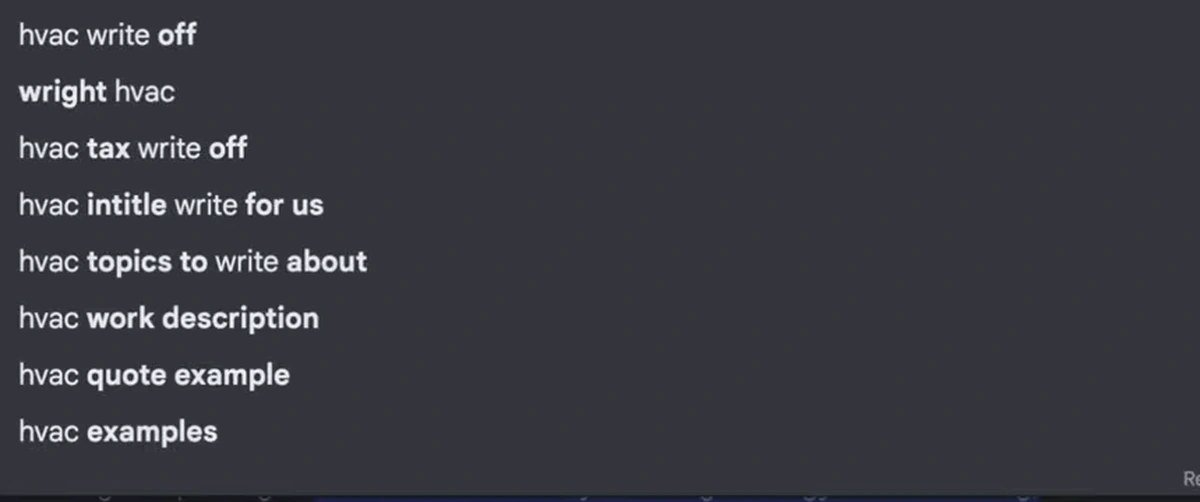
The same two-term pattern works in any niche. The walkthrough runs it for SaaS and gets a software directory, a venture firm's blog, a tools site and a status-page vendor on the first page, plus a listicle of "write for us" SaaS sites that is itself a shortcut to twenty more.
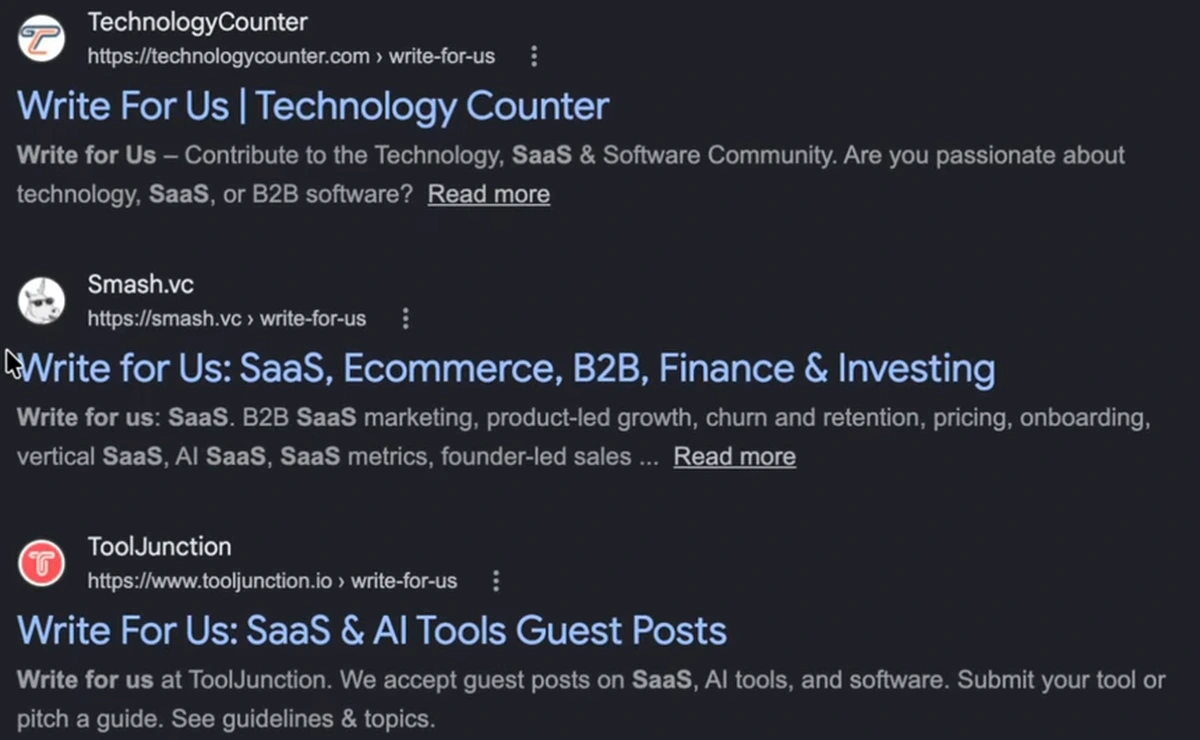
Two things to read on a results page before you click anything. The URL path: a page at /write-for-us or /guest-post-guidelines is a standing invitation; a blog post that happens to contain the phrase is not. And the snippet: "Submit guest post" and "contributors" are what you want; an "HVAC contractors email list" vendor and a "truth about buying HVAC leads" article both matched the words and neither is an opportunity. Google's own AI Overview for the HVAC query suggested inurl:write-for-us "hvac", which is a sharper version of the same idea.
The Claude skill that runs twenty searches at once
Doing this by hand means twenty searches per niche, ten results each, and a spreadsheet to deduplicate hostnames. The walkthrough packages the whole loop as a Claude skill called guest-post-finder: a folder with two Python scripts (one for competitor backlinks, one for guest post enrichment) and a README, uploaded through Claude's Settings → Skills → Add. Once installed you type /guest-post-finder in a chat, give it your site and a couple of competitors, and it does the rest.
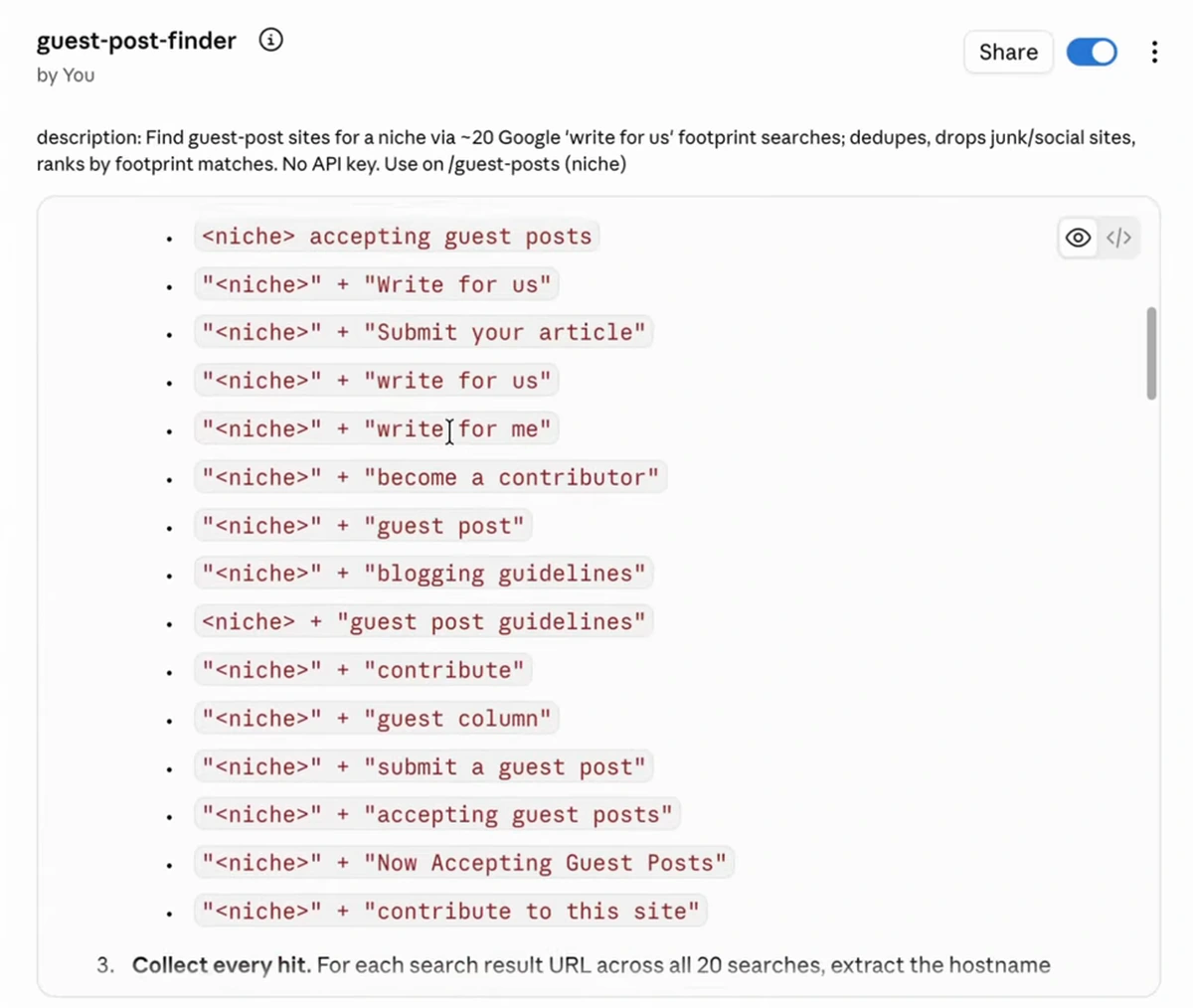
The footprint list is the useful part even if you never install the skill. Fifteen of the twenty phrases are visible on screen, and they're the same phrases we use in Claude Code for the prospecting half of our AI backlinks comparison, which also covers the step this skill leaves to you: enriching every surviving hostname with domain rating and organic traffic, and setting a floor on both before you talk to anyone. If you'd rather build your own, our Claude Code SEO skills guide covers the skill format.
A note on getting the file: the presenter gives the skill away to people who comment on the video. We haven't reproduced the scripts here; the screen shows what they do, and the footprint list above is enough to run the searches yourself.
What the pages ask for
Open any "write for us" page and you'll find the same structure: a list of dos and don'ts, a submission email or form, and somewhere near the bottom, the terms. The first HVAC result, Galones a Litro, is a textbook example.
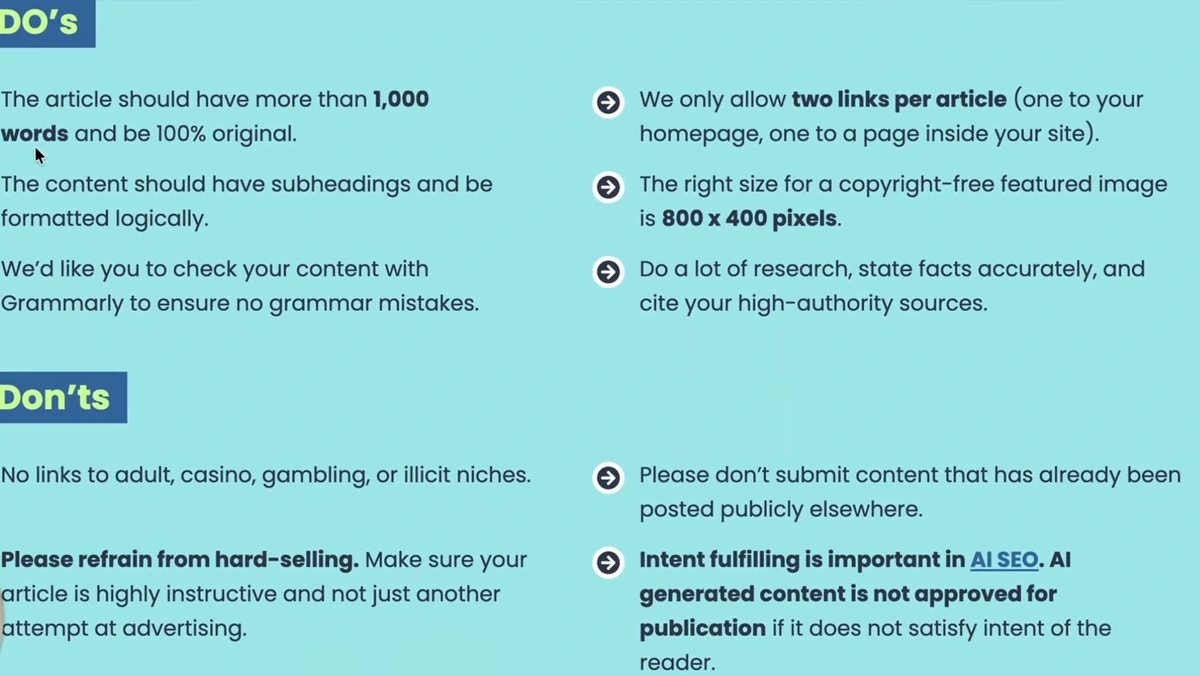
The requirements to send are a Word document or Google Doc, a meta title and description, the image, a clear indication of your one or two links, and an author bio. That's the whole brief, and it's the brief you'll hand to Claude in a moment. But first, read the terms, because this is where the walkthrough glosses over the most important line on the page.
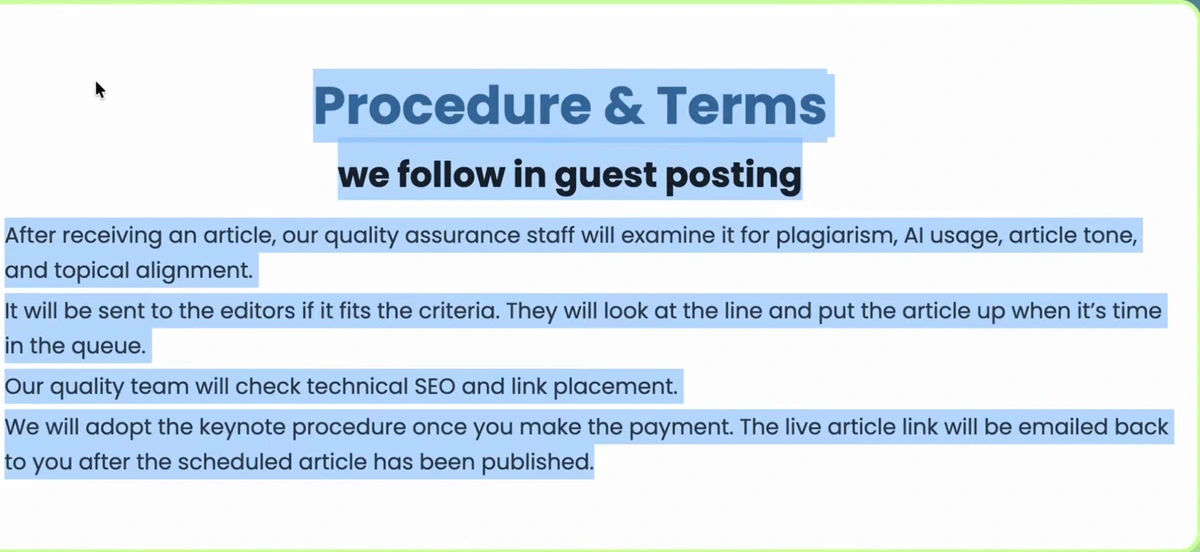
The presenter says it plainly in the voiceover: these sites accept guest posts "in exchange for money", each has its own price, and "some of them really are expensive". He's right, and it matters for two reasons. The first is cost, which the second half of this article is about. The second is that Google's spam policies class buying or selling links that pass ranking credit as link spam; a paid placement that doesn't carry a sponsored or nofollow attribute is a risk the site is taking with you. We went through this in more detail in what a $500 backlink gets you, where a "price" turned out to be the outlet paying writers, not the other way round. Always read who pays whom.
The second result is the opposite kind of page
HomeServiceBlog, the second HVAC result, also has a contributor page, a form, and content standards. It also says, in a box, what you don't get: payment, guaranteed publication, final approval over edits, promised rankings, exclusivity. And what you do: a byline, one brand mention, one contributor link to your business website or primary social profile, and editorial review at no cost. Its live page adds that HSB "does not pay contributors, and contributors do not pay HSB", and does not accept paid placements or sponsored content.
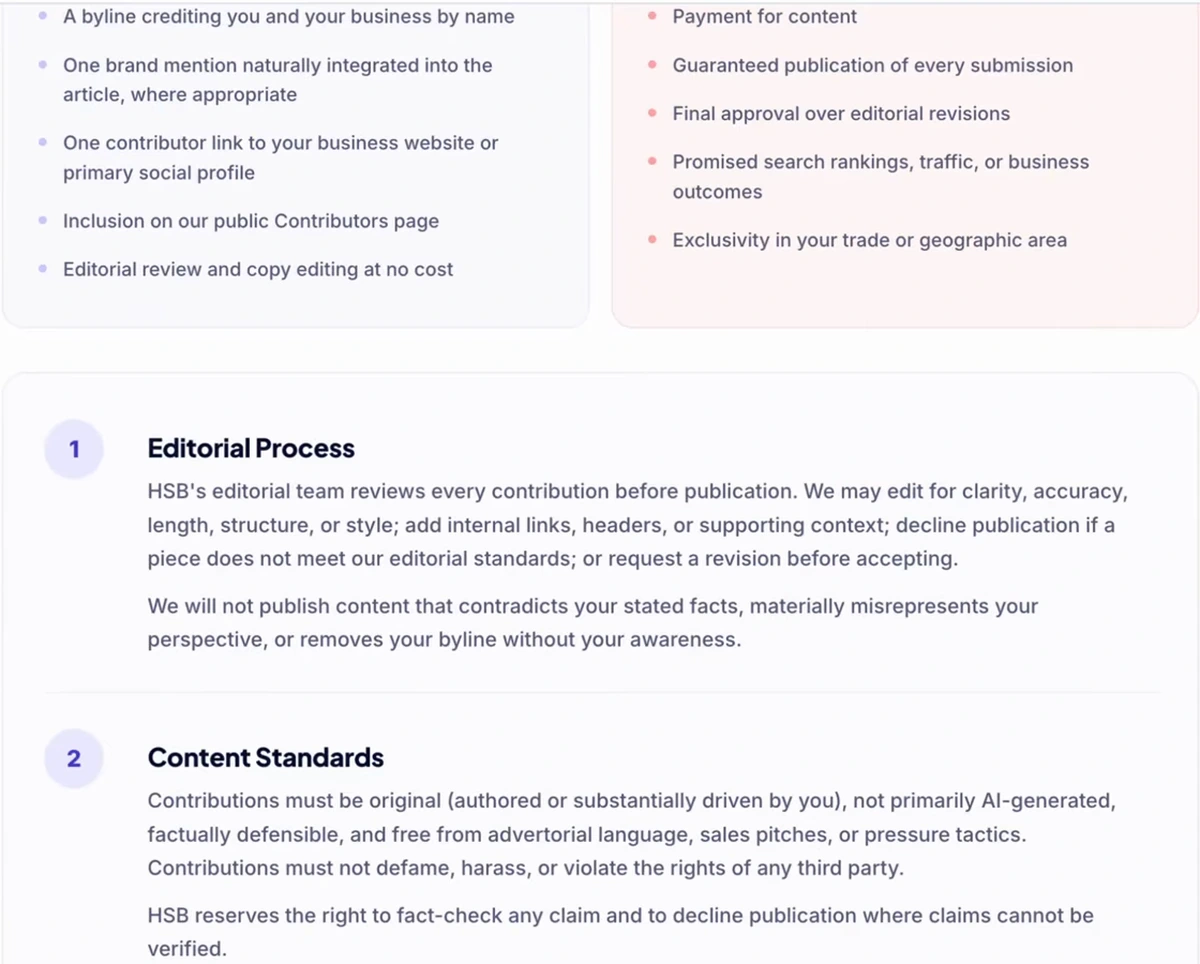
So the first page of one search contains both kinds of site, and the only way to tell them apart is to read the terms. A fair working rule from the walkthrough's own examples: pages that lead with a price list and a quick-review promise sell links; pages that lead with what you won't get are editorial. Both are "guest post opportunities". They are not the same opportunity.
Writing the post: paste the brief, not the vibe
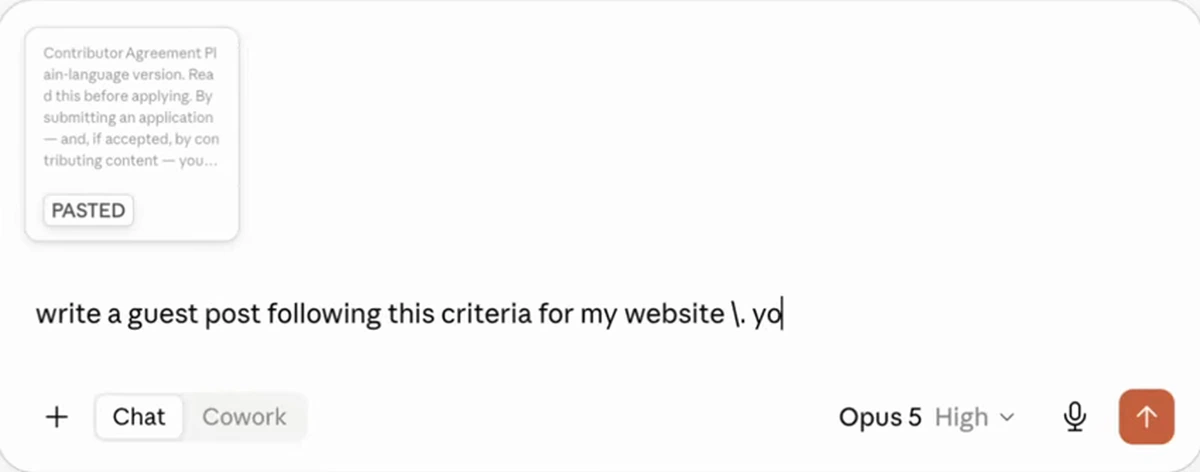
Once you've picked a site, the drafting step is short. The presenter copies the entire guidelines block, pastes it into a Claude chat with the prompt "write a guest post following this criteria for my website", adds his domain, and lets the word count, link count, subheadings and tone constraints come from the pasted text rather than from memory.
Two cautions, both from the pages above. Galones a Litro screens for "AI usage" and rejects AI content that doesn't satisfy reader intent; HomeServiceBlog requires work that is "not primarily AI-generated" and reserves the right to fact-check any claim. A pasted brief gets you a compliant structure. It does not get you the first-hand detail that makes an editor accept the piece, and on the free sites that detail is the entire price. Add it before you send.
The cost, and the automated alternative
Here is where the walkthrough changes its recommendation. Method one, done manually, is hundreds of sites, a contact form or email for each, a price negotiation on the paid ones, and a 1,000-word article per placement. The presenter calls it "very time-consuming", and the paid placements "a fortune" at the top end. His method two is Arvow's automatic backlinks: when any site in the network publishes an article with external links enabled, the links go to other network sites in the same niche, and the same happens in reverse for you. The Arvow dashboard on screen shows the result for arvow.com itself.

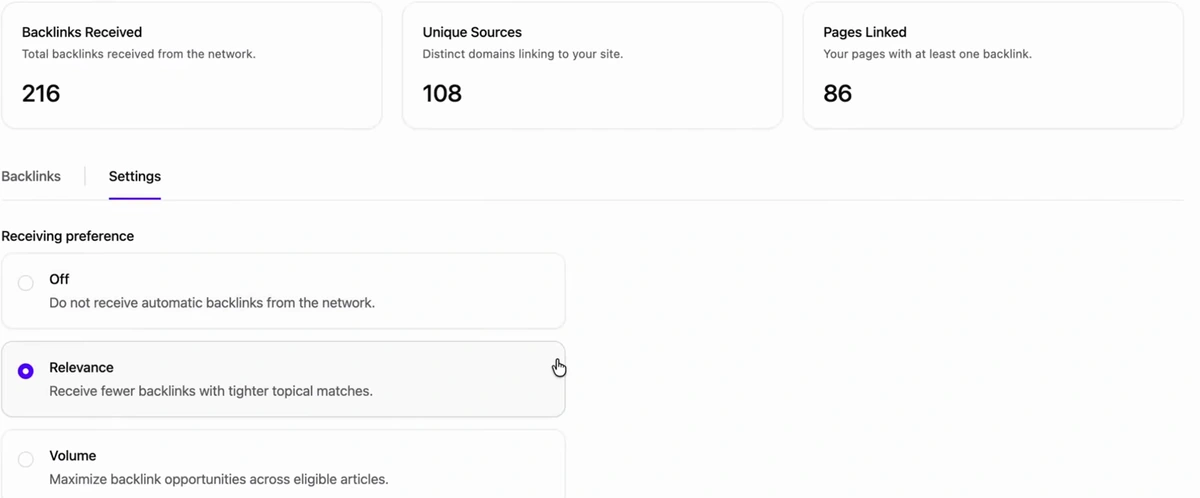
Three honest qualifiers on those numbers. First, 216 total and 55 last month are the counts the network itself verified; the page says it only counts links from articles published through Arvow, "so your real total may be higher", and we have no way to show you a higher number. Second, the quality is not uniform: when we audited this same set of links in automated agents vs. Claude Code, the placements ran from DR 66 down to DR 15, all of them guest-post-style links inside articles. The presenter's "majority of websites using Arvow already have some DR" is a fair summary; the video description's "DR40+" is not something the dashboard shows, so we're not repeating it. Third, the settings matter: Relevance gives you fewer, tighter links; Volume gives you more; the NSFW block and a sitemap URL are there to keep the network from linking to the wrong pages; and the screen notes that additional verified backlinks beyond the free daily quota cost 10 credits each.
On price, the voiceover says "I think $149". On October 9, 2026 the pricing page lists Automatic Backlinks under the Business plan at $169 a month billed monthly, or $69 a month on the limited-time yearly rate, with five websites included. Compare that with one paid guest post, which on the pages above is a per-site negotiation before you've written a word.
Which one to use, and when
| Guest post prospecting (manual or Claude skill) | Automatic backlinks (network) | |
|---|---|---|
| Finding sites | 20 footprint searches per niche; dedupe; enrich with DR and traffic | None; matching is by niche and content |
| Cost per link | Free on editorial sites (your writing time); negotiated per site on paid ones | Included in the Business plan; extra verified links 10 credits each beyond the daily quota |
| Control | You pick the site, the anchor and the page | You pick Relevance or Volume and block categories; the network picks the site |
| Risk to read for | Paid placements that pass ranking credit without a sponsored tag | Links from lower-DR network sites; counts only what Arvow can verify |
| What you learn | Which editorial sites in your niche take pitches, which is reusable | Nothing about your niche's publishers |
Our own answer is both, in that order of effort. Run the footprints once (by hand or with the skill), keep the editorial sites like HomeServiceBlog for the handful of placements where a byline and a brand mention in front of the right readers is worth a real article, and let the network handle volume. If you only have time for one, the walkthrough's pick is the network, and after writing up the manual process in full we don't disagree, with the caveat that a link you never chose is a link you should check: quality versus quantity is still the question, whoever placed it.
The steps, in order
- Pick the niche phrase a blog in your space would organise around, not your brand name.
- Run the footprint searches: "niche" + "write for us", "guest post", "submit your article", "become a contributor", "guest post guidelines", and the rest of the list above. Collect hostnames; rank by how many searches each appears in.
- Drop anything that isn't a standing invitation: email-list vendors, lead-gen articles, directories of directories.
- Read each page's terms before its dos and don'ts. Sort into editorial (no payment either way) and paid. Decide whether you'll do paid at all; if you do, ask whether the link will carry a sponsored or nofollow tag.
- For each site you keep, paste its full guidelines into Claude with your domain and let the draft inherit the constraints. Then add the first-hand detail the editors are screening for.
- Submit through the site's form or email, one site at a time, with the one or two links they allow and nothing more.
- For volume, turn on automatic backlinks with Relevance selected, add your sitemap, and audit what arrives.
The whole first half of this is also in our older guide to building backlinks with AI for free, written before Claude had skills; the operators haven't changed, the tooling has.
Generate, publish, syndicate and update articles automatically
The AI SEO Writer that Auto-Publishes to your Blog
- Cancel anytime
- Articles in 30 secs
- Plagiarism Free