
How to Increase Domain Rating: What 51 Backlinks Did to a DR 40 Site (+3,959% Traffic, 2026)

How to increase domain rating is usually answered with a list of tactics. This article answers it with one site: an auto transport company that went from about 500 organic visits a month to a 29k peak — a +3,959% campaign on the case board — after 51 backlinks built between August 2024 and January 2025, alongside a steady increase in published pages. The video below walks through the Ahrefs data, opens the linking domains one by one, explains why the DR number compounds and where that logic stops, and ends with the three ways to build links like these. The point of the article is the mechanism: what actually moves DR, why it takes as long as it does, and what DR does and does not buy you.
The case: 51 links, DR 40, and a year of compounding
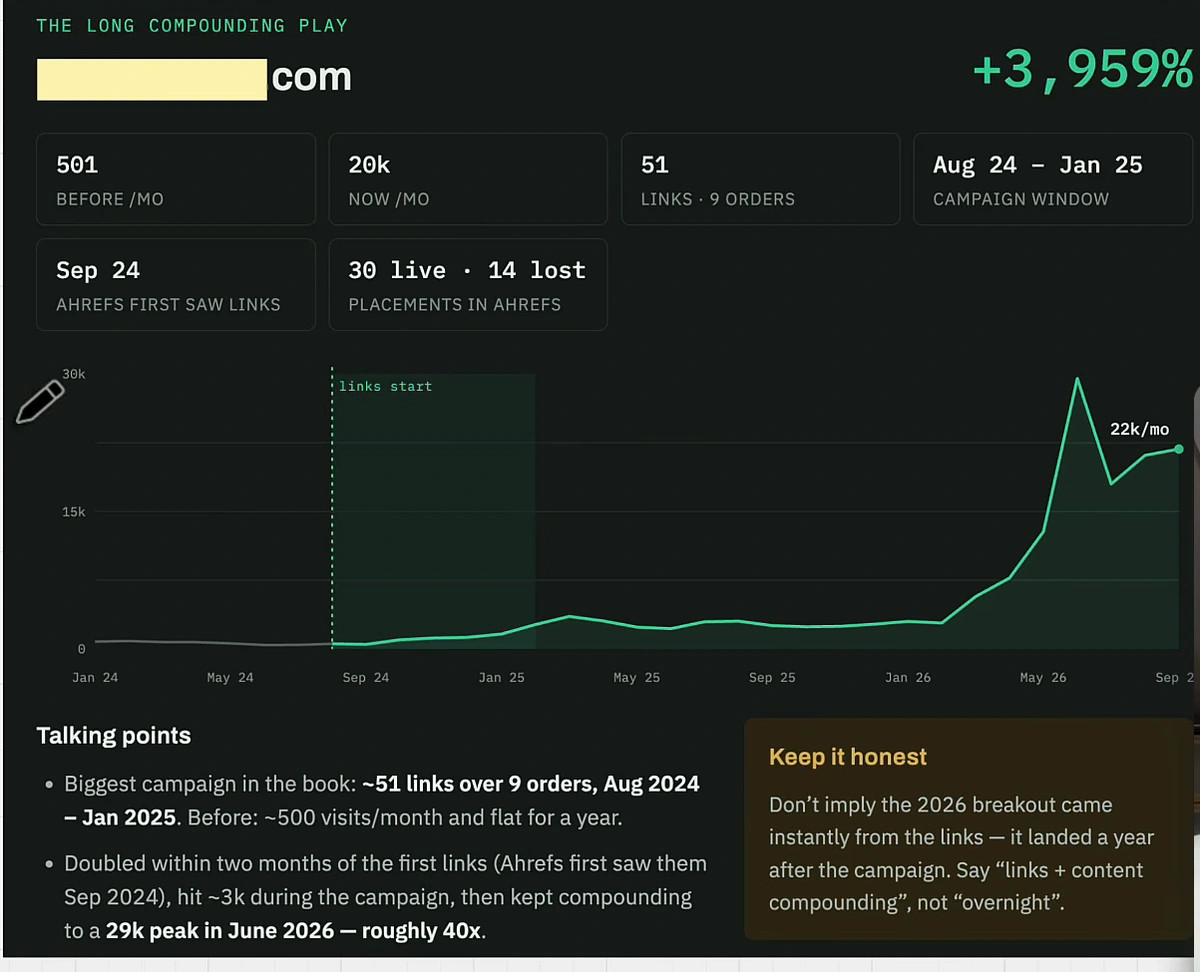
The card is the same format Vasco uses for every client result: numbers pulled from the team's backlink order sheet (this domain appears 16 times in it) and from Ahrefs, assembled into one honest summary. Before the campaign the site was doing about 500 visits a month and had been flat for a year. Fifty-one links went out across nine orders between August 2024 and January 2025; Ahrefs saw the first of them in September 2024. Traffic doubled within two months, reached about 3k during the campaign, and then kept compounding through 2025 to a 29k peak in June 2026 — roughly 40x. Of the 51 placements, 30 were still live in Ahrefs and 14 lost at the time of the card. The card's own caveat is the one to carry through the rest of this article: the big 2026 breakout landed a year after the campaign, so the right description is "links plus content, compounding", not "overnight".

In Ahrefs the site now shows DR 40 with 2.9K referring domains, 1.4K organic keywords and 42.9K organic traffic, plus 976 appearances in AI responses — the brand is being cited across the AI engines, not only ranked in Google. DR 40 is not a dramatic number. It is, however, the number this article is about, because it is the one that compounded.
What actually increases domain rating
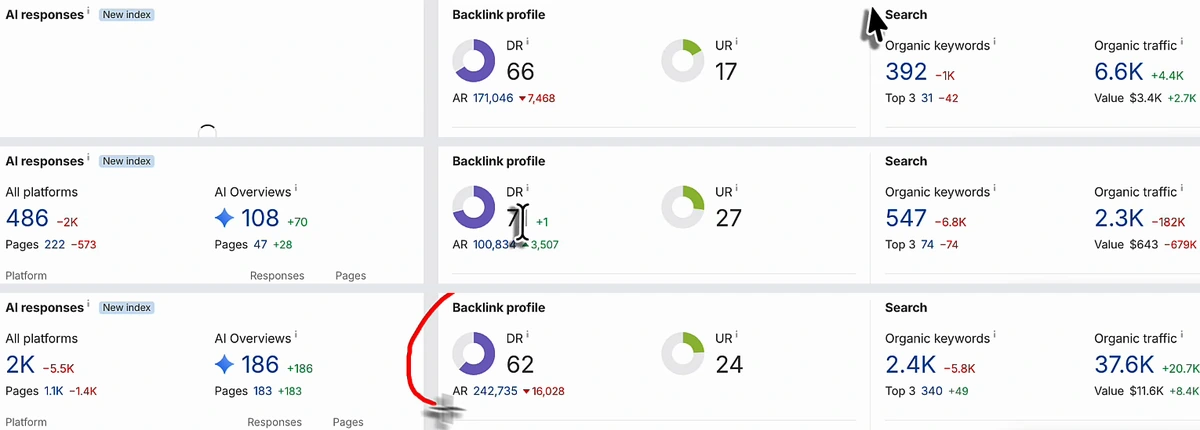
DR is Ahrefs' estimate of the strength of a site's backlink profile, and the video's simplified version of how it moves is accurate enough to act on: the more sites with a higher DR that link to you, the higher your DR goes — to some extent. Each of the links in this campaign came from a domain like the three above, opened live from the delivery tab: DR 66 with 6.6K monthly organic visits, DR 71 with 2.3K, DR 62 with 37.6K and 2.4K ranking keywords. Vasco picks them at random on camera precisely so the viewer can see they are not cherry-picked; a DR 46 and a DR 50 came up in the same draw. Those domains are why the DR number went up and stayed up: authority passes from real sites with real traffic and their own AI mentions, and 51 of them compound.
Two rules follow from that mechanism. First, DR is not the only metric. The linking site has to look real — organic traffic, ranking keywords, mentions across the AI models — because DR without traffic is a padded number, and Google is not fooled by it. That is the distinction we work through in backlink quality vs quantity. Second, expect to lose some. Fourteen of the 51 placements dropped, which is normal over 18 months — pages get pruned, posts get edited, sites die — and the campaign still compounded. Sizing a campaign so the losses do not matter is covered in how many backlinks you need.
Links did not do it alone: the pages chart
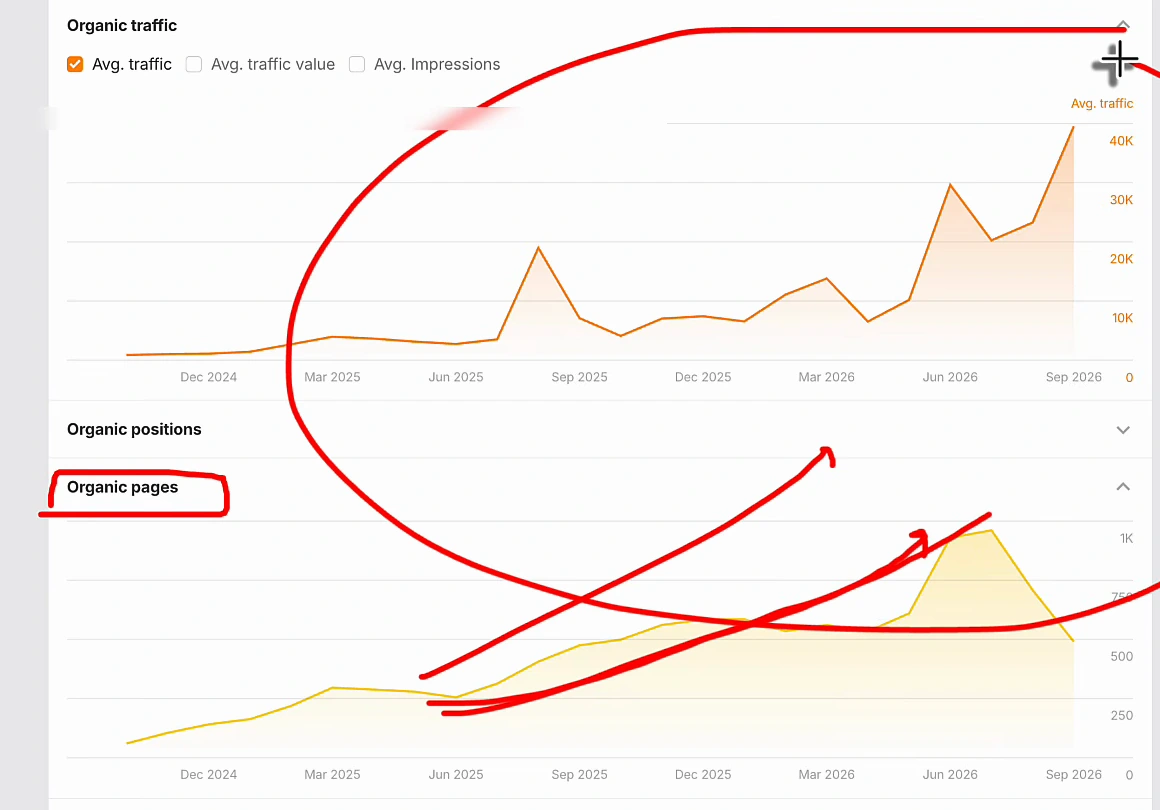
Scroll down the same Ahrefs report and the organic pages chart climbs over the same period as traffic. The video is explicit that the links cannot take all the credit: the site kept publishing — blog posts, product pages, service pages — and there is a correlation between how much content you put out, the links you build, and the traffic you get. The logic is simple. Backlinks raise the domain's authority; that authority only turns into traffic if there are pages to rank and to be cited. A DR 60 site with ten pages ranks for ten pages' worth of keywords. This client's DR 40 went a long way because it had 1.4K keywords' worth of pages to spend it on, which is the practical version of what we describe in building topical authority fast.
What DR buys you, and what it does not
The video draws the line clearly. There is a correlation between a higher DR and the likelihood of ranking for more keywords — so you want to push the number up in the safest way possible, which is high-quality links. But DR 99 does not rank you first for everything, and the team has sites with lower DR outranking sites with higher DR on specific queries. Do not blindly trust the metric; treat it as a rule of thumb about how much authority you can spend, not a ranking guarantee. Whether the effort is worth it at all is the question do backlinks still work answers with a second client, and how much backlinks increase traffic puts a range on the outcome.
Three ways to build links that move DR
The video ends with the three routes, and is candid about the trade-off between them.
1. Build them yourself, free
Two long tutorials on the channel — one 15 minutes, one 56 — teach the exact outreach process the team runs for clients, with nothing held back. We have both written up: how to get free backlinks and how to build backlinks with Claude. The cost is your time; the links are the same DR 60-plus domains you saw above.
2. Hire the team
Order through the backlink service page, and the order goes into the same sheet as this client's; delivery takes about 14 days because the placements are manual. The guarantee is a minimum of DR 40 and at least 1,000 monthly organic visits per linking domain — which is why the service costs more than the automated option below, and why the DR 66, 71 and 62 examples are typical rather than exceptional.
3. Automate it
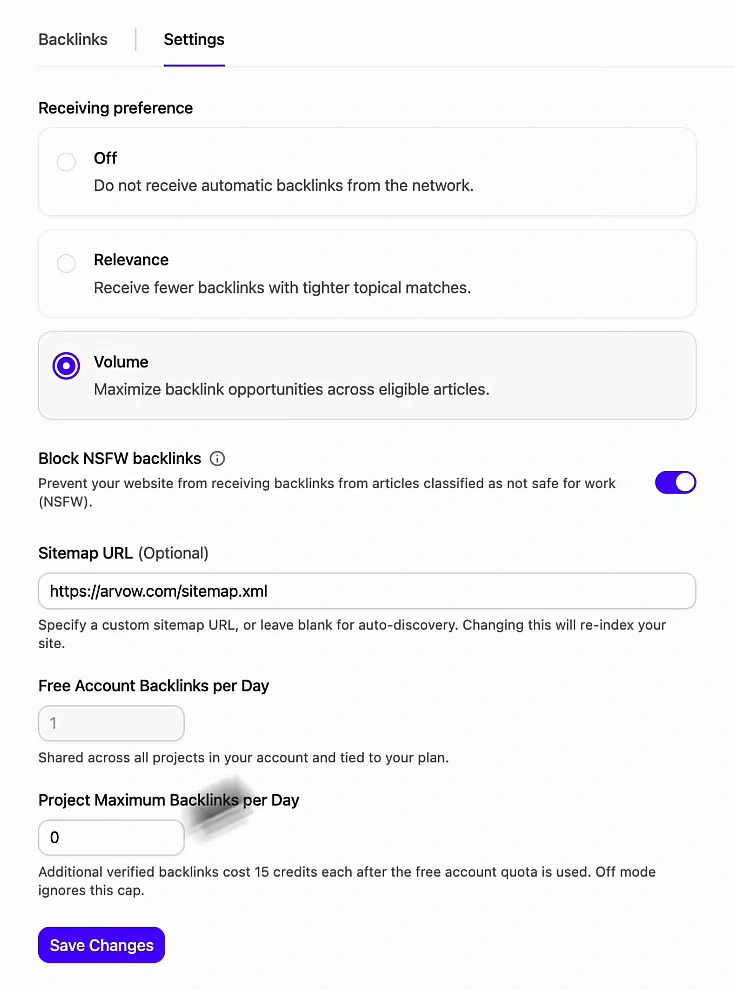
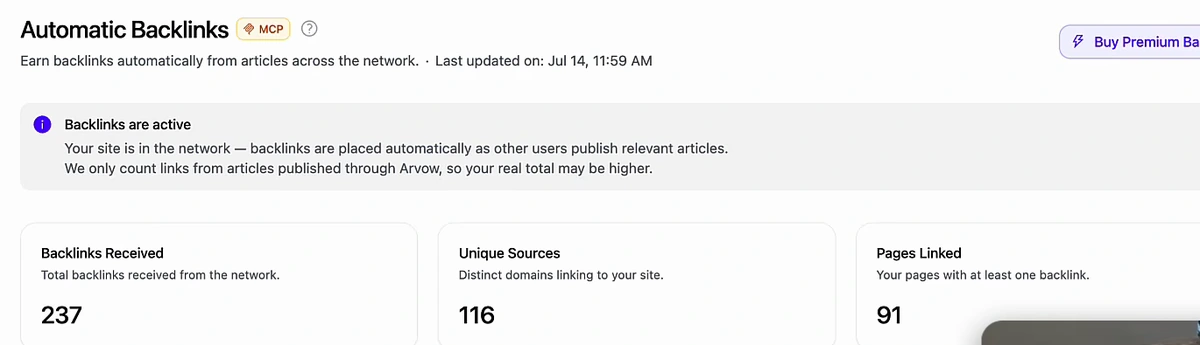
Inside Arvow, Automatic Backlinks places links to your site inside relevant articles that other users of the network publish. You enable it, choose Relevance (fewer links, tighter topical matches) or Volume (as many eligible placements as possible), optionally block NSFW sources, set a sitemap and a daily cap — free accounts get one a day, extra verified links cost 15 credits each. The dashboard for arvow.com's own project shows 237 links received from 116 unique domains across 91 pages, and the list in the video runs DR 47, 23, 13, 43, 18, 63. That spread is the honest trade-off: it is automated, so it is cheap and constant, and not every link will clear the DR 40 floor the manual service guarantees. How the automated and manual routes compare on link quality is the subject of AI backlinks: automated vs manual.
Which route, and what to expect
- Pick by time, not by ambition. If you have hours, build them yourself — the process is fully public. If you have budget, order. If you want a constant trickle to a whole portfolio, automate. Many teams do two of the three.
- Check the linking domain, not just its DR. Organic traffic, ranking keywords and AI mentions are the tells of a real site. A high DR with none of those passes little.
- Keep publishing while you build. The pages chart is not optional. Authority with nothing to rank is a number in a dashboard.
- Judge DR movement in quarters and traffic in years. This site's DR climbed with the campaign; the traffic breakout came a year after it. Both are what compounding looks like from the inside.
- Do not read DR as a rank. It tells you how much authority you can spend; the pages decide where it goes.
Arvow builds the DR 40+ links in this case study manually, or places automatic backlinks from the network while you publish. See the backlink service, or start with the free methods above.
Generate, publish, syndicate and update articles automatically
The AI SEO Writer that Auto-Publishes to your Blog
- Cancel anytime
- Articles in 30 secs
- Plagiarism Free