
Internal Linking Strategy: What a $50,000 Test Actually Found (2026)


Most internal linking advice is a rule of thumb: three to five links per post, keyword in the anchor, don't overdo it. The video below is about the rare case where someone paid to find out. A site owner reported spending more than $50,000 over a year testing internal links across 15 websites, and the results cut against several of those rules — no ranking decline at 20+ links per page, a five-link threshold for indexing, and a correlation between links that get clicked and pages that rank. Put next to a 2012 experiment on a page with 4,225 outbound links and a Google patent that weights links by their probability of being clicked, it adds up to a usable internal linking strategy. Here is what the evidence says, what it does not, and how to act on it.
What an internal link is for
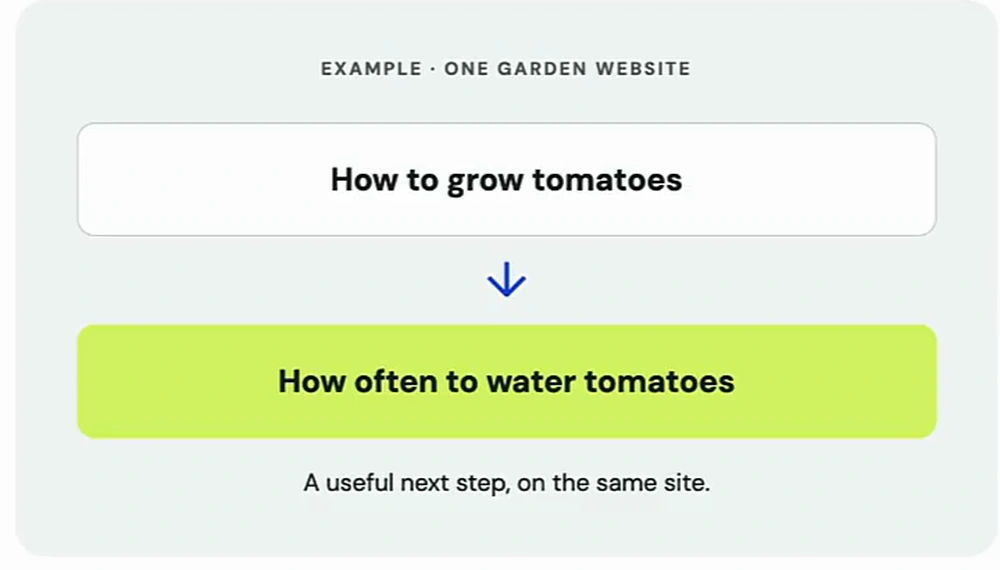
An internal link takes a reader from one page to another on the same site, and it does two jobs at once. For the reader it is the next useful step — you are reading about growing tomatoes, and the link goes to how often to water them. For the search engine it is how pages get discovered and how their relationships get understood: which page is the hub, which pages support it, and what each one is about. The presenter's picture for it is a book, with the links as the page directions. Everything below is about making those directions worth following.
The $50,000 internal linking test
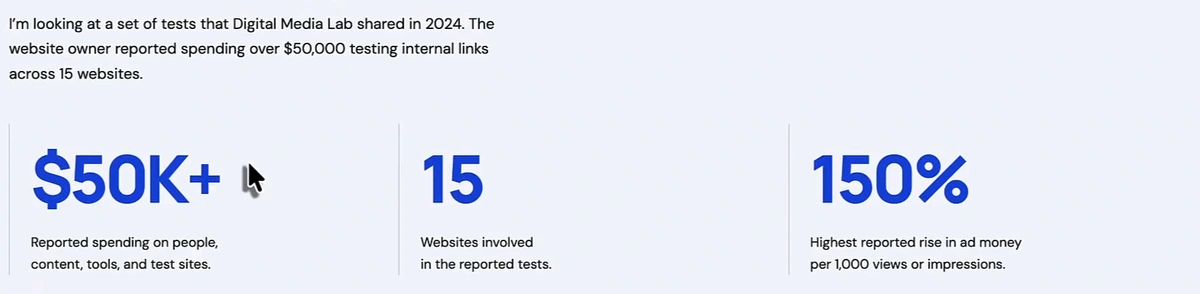
First, the provenance, because it matters. The study is not an academic paper. It is a write-up posted on the Black Hat World forum in 2024 by a user called Digital Media Lab — a content-site owner who says they have been in SEO for nine years, ran internal linking experiments across their own portfolio and friends' sites (15 websites in total), and spent over $50,000 on virtual assistants, content, an SEO specialist, software and new test sites to do it. The poster was also building an internal linking tool at the time. The findings were brought to a wider audience by Edward Sturm, whose episode on the experiment is the source the video above summarises. Treat the numbers as one owner's report, not as a controlled study — the presenter says the same on screen: clues, not promises.
With that caveat in place, the reported findings:
- Up to 150% higher ad RPMs with a stronger internal linking structure and a higher volume of links — the poster's minimum became ten or more internal links per page. On content sites monetised with ads, that is the finding that paid for the test.
- No upper limit found. Pages went from three or four internal links to 20+ with no ranking decline. The poster had not yet tested past 30.
- Indexing problems went away. "Crawled – currently not indexed" stopped happening once every post had at least five internal links pointing to it and from it. Five was the threshold they settled on.
- Earlier links carried more weight. Links placed higher on the page influenced rankings more than links placed lower. In the thread comments the poster clarified what "higher" means: relative order, not position in the introduction. They number the links on each page; link number one can sit in the middle of the article if nothing links above it.
- Clicks went with gains. The poster tracked clicks on each internal link and saw a clear correlation between links that got clicked and pages whose rankings improved. Correlation, not proof — the page that gets the clicks is also the page readers wanted.
- Similarity beat categories. Linking by topical similarity across the whole site outperformed restricting links to the same category or tag, because the pool of candidate pages is larger.
- Same tab vs new tab made no difference to rankings; the poster keeps the same tab.
Could one link still help on a page with 4,225 links?
The "no upper limit" finding runs into the oldest objection in the book: PageRank dilution. Every link on a page shares the page's authority, so more links should mean less per link. The counter-evidence the video reaches for is Dan Petrovic's 2012 PageRank split experiment. A sub-page on debian.org carrying 4,225 followed outbound links pointed at an intermediate page, which linked to a test site. The test site, tracked at position 79 in late August, climbed into the top three within weeks and settled at number two, where it held for three months. Petrovic's own conclusion was that a link from an authoritative page is still worth having even when that page already has thousands of outgoing links.
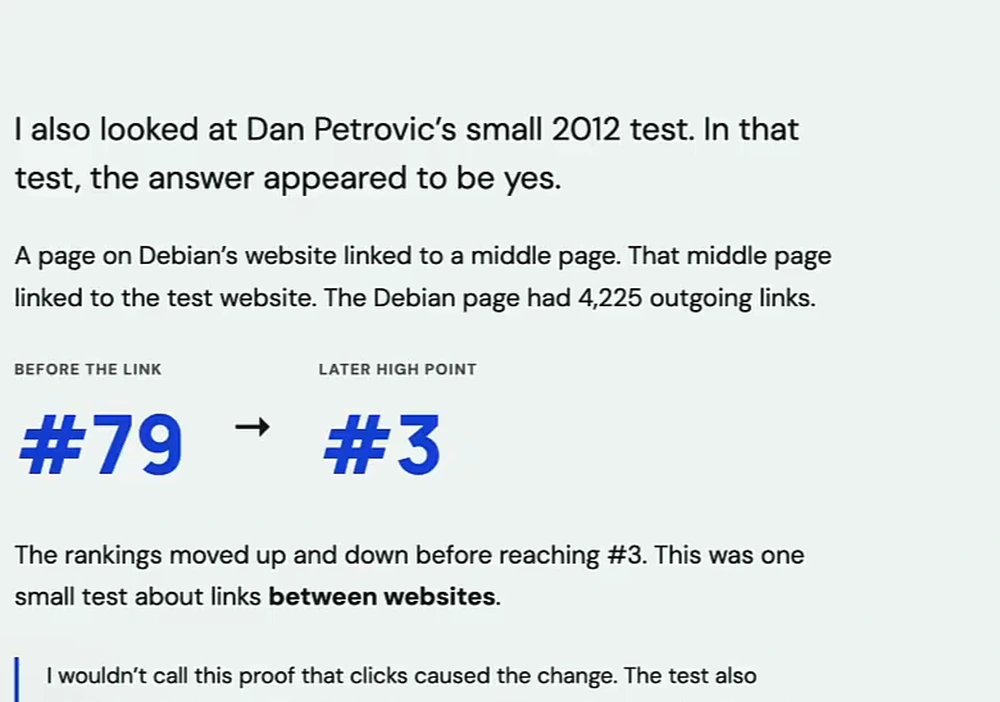
Two honest limits. It is one test, and it is about a link between websites rather than within one. It does not show that adding links can never reduce the value of each one. What it does show is that "thousands of links on the page" did not stop a single link from moving a site from page eight to the top three — which is hard to square with an evenly divided budget.
Why some links may count more: the Google patent
The mechanism that would explain both results is in a Google patent titled Ranking documents based on user behavior and/or feature data — the "reasonable surfer" patent, granted in 2010 as US 7,716,225 and continued as US 9,305,099, the version shown on screen (inventors Jeffrey Dean, Corin Anderson and Alexis Battle). Its central idea is that links on the same page do not deserve the same weight. The system assigns each link a weight that reflects the probability the link will be selected, predicted from features such as its words, its position on the page, the topic, and past clicks.
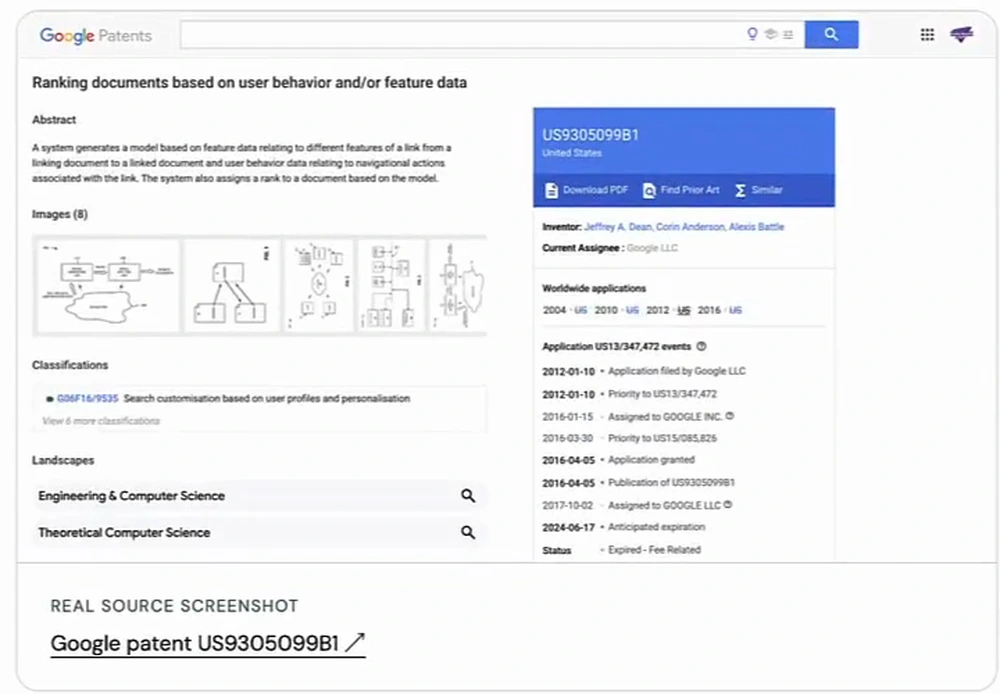
The patent describes where the click data would come from — "a web browser or a browser assistant associated with clients" that records which documents a user accessed and which links they selected — and gives a worked example: if page W links to X, Y and Z, and users click W→X twice and W→Z once, those are recorded as positive click instances and used to train a model that predicts which links are likely to be clicked. Position, anchor text, context, source and target page, and whether the link stays on the same domain are all features.
Two things to keep straight. The patent is expired, and a patent is not a confession of what the ranking system does today. But Google's reliance on click behaviour elsewhere is documented (the Navboost system that surfaced in the 2023 antitrust testimony measures clicks on search results), and a model that weights links by expected clicks is exactly what would produce the forum poster's findings: earlier links carry more, clicked links correlate with gains, and a page with thousands of links can still pass real value through the one link people use.
The internal linking strategy that follows
The presenter's takeaway is one sentence: every link should have a useful job. The strategy is four habits, and none of them involve counting to five.

- Match the topic. Connect pages that answer related questions. Judge by what each page is actually about, not by its category or tag — the study's similarity finding, and the reason site-wide linking beats siloed linking.
- Put it where it helps. Place the link where the reader needs the next answer. Do not force it into the first sentence; "earlier" in the study meant earlier than the other links, not in the introduction.
- Check the path. The link works, and the next page gives the reader what the anchor promised. A descriptive anchor ("see how to water tomatoes") is both the click-through and the promise.
- Learn from readers. Watch which links people use. Test clearer words or a better spot for the ones they ignore. Treat ranking changes as clues, not proof.
Two numbers from the study are worth adopting as floors rather than rules: at least five internal links to and from every post you want indexed, and no fear of going past ten when each link has a job. If pages are stuck at "crawled – currently not indexed", links to them are the first thing to add; our guide on blog indexing covers the rest of that diagnosis, and adding links to existing blog posts is the retrofit version of this strategy for a back catalogue.

Doing it at scale
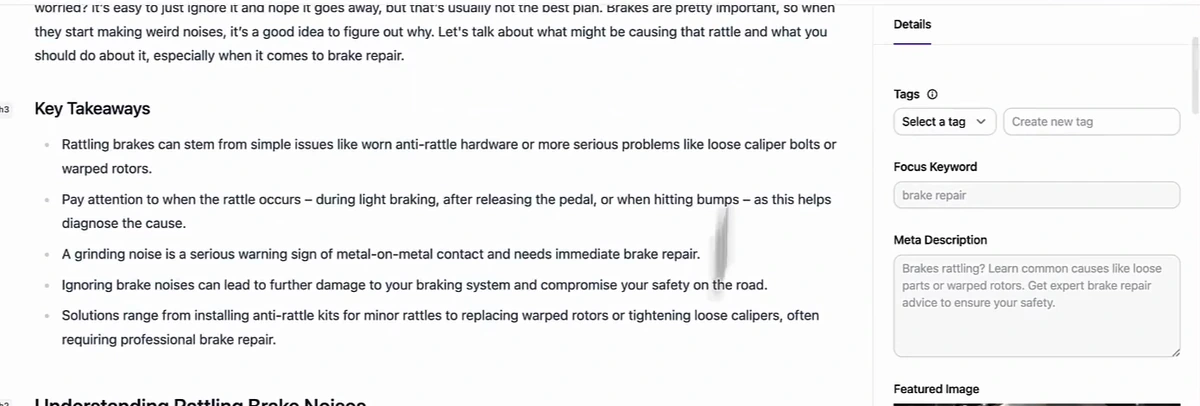
The reason the forum poster started was that manual internal linking was, in their words, inefficient — they went from a spreadsheet to Python and the ChatGPT API before deciding to build a tool. That is the honest cost of this strategy on a site with hundreds of pages: the linking has to happen at writing time or it does not happen. The presenter's answer is to bake it into the article template. In Arvow's SEO Article template, the Linking tab takes your sitemap so the generator can link to your service and money pages, lets you whitelist specific URLs to include, and can add automatic external links to trusted sources. Every generated article then arrives with internal links to related pages already placed where the text calls for them, alongside the meta description, headings and alt text.
If you would rather keep writing by hand and link afterwards, the options are compared in our roundup of internal linking tools, and WordPress users have a plugin route in WordPress automatic internal links. Whichever way you build them, the study's checklist still applies to the output: topical match, a helpful spot, a working path, and a look at what readers actually click.
Arvow places internal links to your money pages as it writes: add your sitemap to the article template once, and every article, blog post and Business Profile post it generates links to the next useful step on your site.
Generate, publish, syndicate and update articles automatically
The AI SEO Writer that Auto-Publishes to your Blog
- Cancel anytime
- Articles in 30 secs
- Plagiarism Free