Does Ranking #1 on Google Still Matter in 2026? The Data

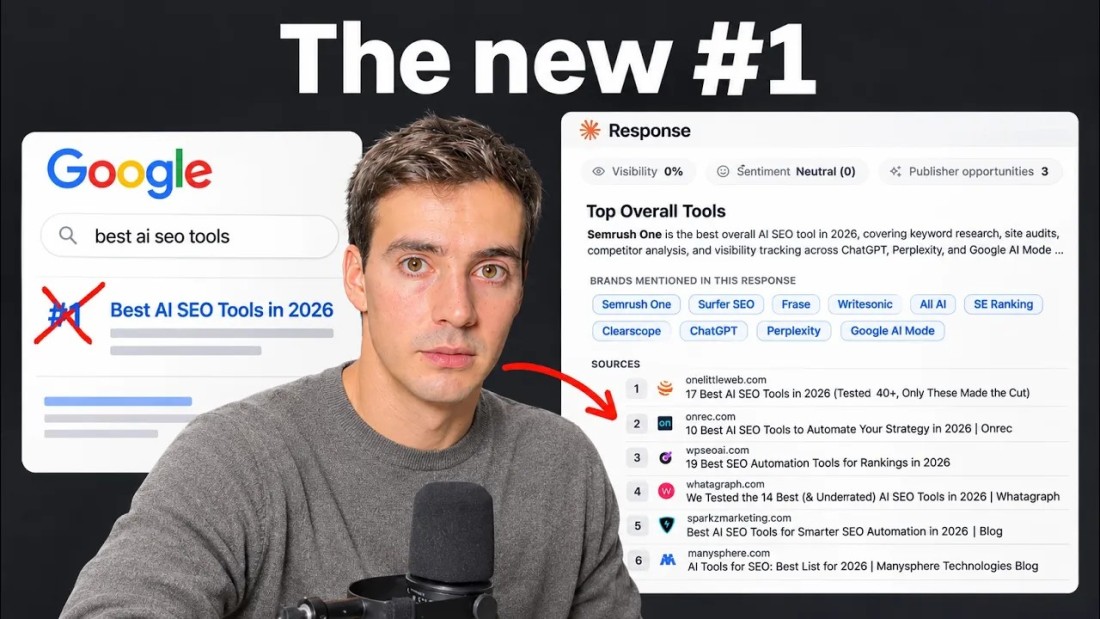
Ranking #1 on Google still matters, but much less than it used to, and only for the right keywords. A top ranking now earns fewer clicks because AI answers sit above it, and a click was never the same thing as a customer. In this article I walk through why I called ranking first "pointless" in my latest video, what the click data says in 2026, when a number-one ranking is still worth chasing, and what I track instead.
The short answer
| Question | Answer |
|---|---|
| Does ranking #1 still bring clicks? | Yes, but fewer. One 2026 study puts the top result at 22.6% of clicks with no AI answer on the page and 3.6% when an AI answer is present. |
| Does ranking #1 mean more sales? | No. It depends on the keyword's buying intent and on whether your page converts. |
| When is it still worth it? | For high buying intent keywords, local searches, and searches where no AI answer shows. |
| What should you track next to rankings? | How often AI tools mention your brand for the prompts your buyers type, and which sources those answers cite. |
Why I said ranking #1 is pointless
For years the SEO industry was built around one metric: being first on Google. Rank first, get the traffic, make the money.
My argument is that two things break the road from ranking to customer. The first is old: many number-one rankings are for keywords that never lead to a sale. The second is new: AI answers now take a large share of the clicks the top result used to get.
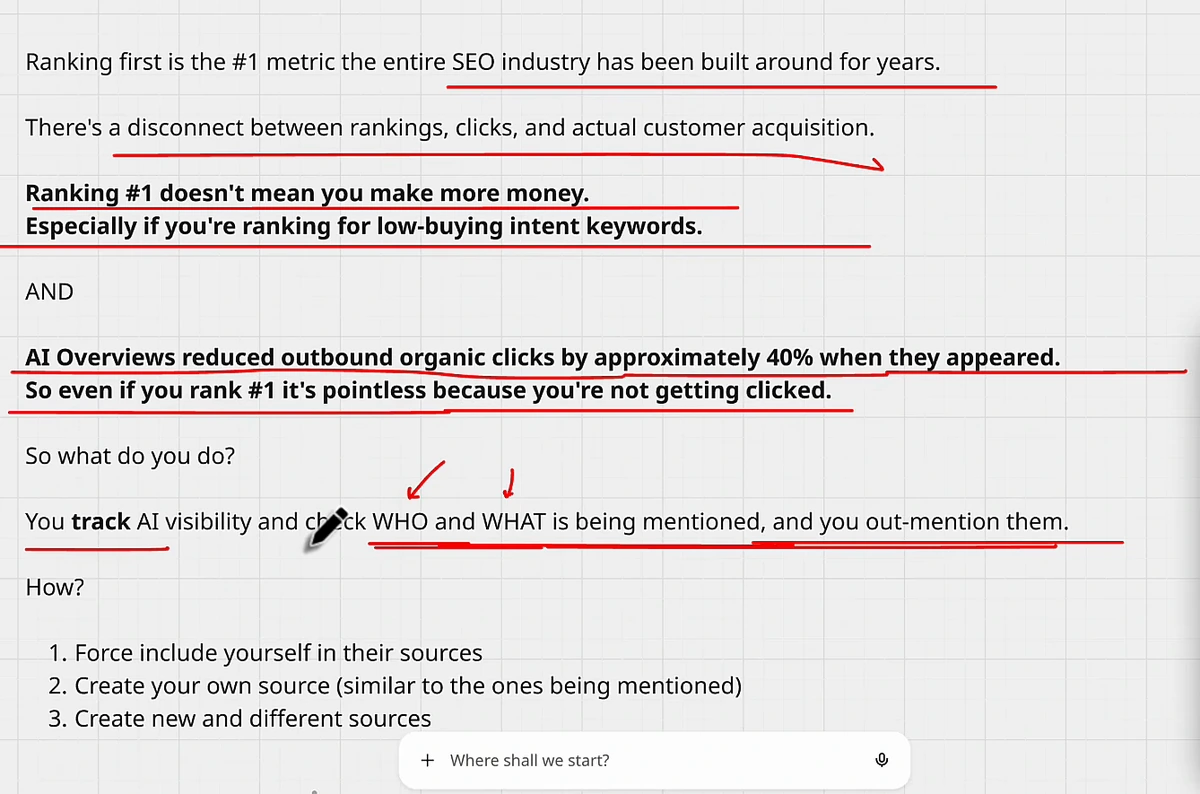
"Pointless" is the strong version. The fair version: a number-one ranking is worth exactly what it sends to your bank account.
What a #1 ranking gets you in 2026
My board says AI Overviews cut outbound organic clicks by about 40% when they appear. I checked that number and the other main studies before writing this. They use different methods, so they do not agree on one figure, but they all point the same way.
| Source | What it found | Date and method |
|---|---|---|
| Agarwal and Sen (working paper) | Organic clicks fell 39.8% when AI Overviews were shown | Randomized field experiment, early 2026, reported by Search Engine Journal on 1 July 2026. Not yet peer reviewed. |
| Ahrefs | An AI Overview goes with a 58% lower click-through rate for the top-ranking page. The same study measured 34.5% in April 2025. | Published 4 February 2026. 300,000 keywords. A correlation, not an experiment. |
| First Page Sage | Position 1 gets 22.6% of clicks with no AI answer, 3.6% with one, 7.1% blended | Published 22 September 2026. 1,184 domains, March to August 2026. |
| Pew Research Center | People clicked a normal result in 8% of visits with an AI summary and 15% without. 1% clicked a link inside the summary. | Published 22 July 2025. 900 US adults, March 2025 browsing data. |
| SparkToro | 68.01% of US Google searches ended without a click | Published 9 June 2026. January to April 2026, Similarweb panel. Google's mobile app is not included. |
So the 40% on my board matches the one randomized experiment we have. The other studies range from a bit lower to much higher. The Pew study is the easiest one to read if you want to see the method.
The top spot is not worth zero. With no AI answer on the page it still takes about one click in five. The loss is biggest on informational searches, which were already the furthest from a sale.
Rankings were never the same as revenue
This part of the problem is older than AI. Ranking first does not mean you make more money, least of all when the keyword has low buying intent.
Say I sell MagSafe wallets, the kind that clip to the back of an iPhone. Or say I am a plumber in New York. These are the keywords I used in the video:
| Keyword | Buying intent | Why |
|---|---|---|
| best MagSafe wallet for iPhone | High | The searcher knows the product and is choosing which one to buy. |
| best plumber NYC | High | The searcher needs a plumber and is picking one. |
| how does a MagSafe wallet work | Low | The searcher is still learning what the product is. |
| what's the best material for wallets | Low | I might talk them into leather, and then into my leather wallet, but it is a long way to the sale. |
I would much rather be close to the transaction than far from it. This is why you see sites that pull in a lot of traffic, and a lot of AI mentions, and still make very little money. It should never have been about the traffic. I cover how to find the right terms in my guide to buying intent keywords.
The right traffic still has to convert
Even with the right keyword, a ranking only delivers a visitor. If the site is slow, looks bad, or makes it hard to buy, that visitor leaves.
Take the plumber again. Thousands of people a month could land on the site from "plumber NYC". If they cannot find a phone number, or the only way to reach the business is a contact form, most of that traffic is lost. Someone with a leak wants to call now.
AI is now the one visiting your site
Here is the newer problem. When I type "best MagSafe wallet" into an AI tool, I do not visit six websites. The AI does. It reads them, pulls out what it needs, and hands me a short list.
So your page can do its job and still never be seen by a person. I wrote more about that in how to optimize your website for AI agents and in our zero-click search strategy guide.
People have not stopped visiting websites. The studies show fewer clicks, not none. But the question is changing from "do I rank?" to "am I in the answer?"
When ranking #1 is still worth it
The video makes the case against. The numbers above also show where the top spot still pays, so here is the other side.
- High buying intent keywords. "Best X", "X near me", "X pricing" and "X vs Y" searches are close to a purchase. A click from them is worth many informational clicks.
- Searches with no AI answer. The top result still gets roughly 22% of clicks there, on the 2026 First Page Sage data.
- Local searches. Someone looking for a plumber wants a phone number, not an essay.
- As a source for AI answers. AI tools build answers from pages they can find. In the example below, every source the AI cited was an article written to rank for that topic.
That last point is why this is not bad news. The work that ranks you on Google is mostly the same work that gets you mentioned in AI search. My guide on how to rank #1 on Google still applies. Just pick the keywords with care.
What I track instead: AI visibility
My answer on the board is one line: track AI visibility, check who and what is being mentioned, and out-mention them. "Who and what" matters because AI tools mention people, companies, products and services.
In the video I open a monitor inside Arvow that follows five prompts for our own brand.
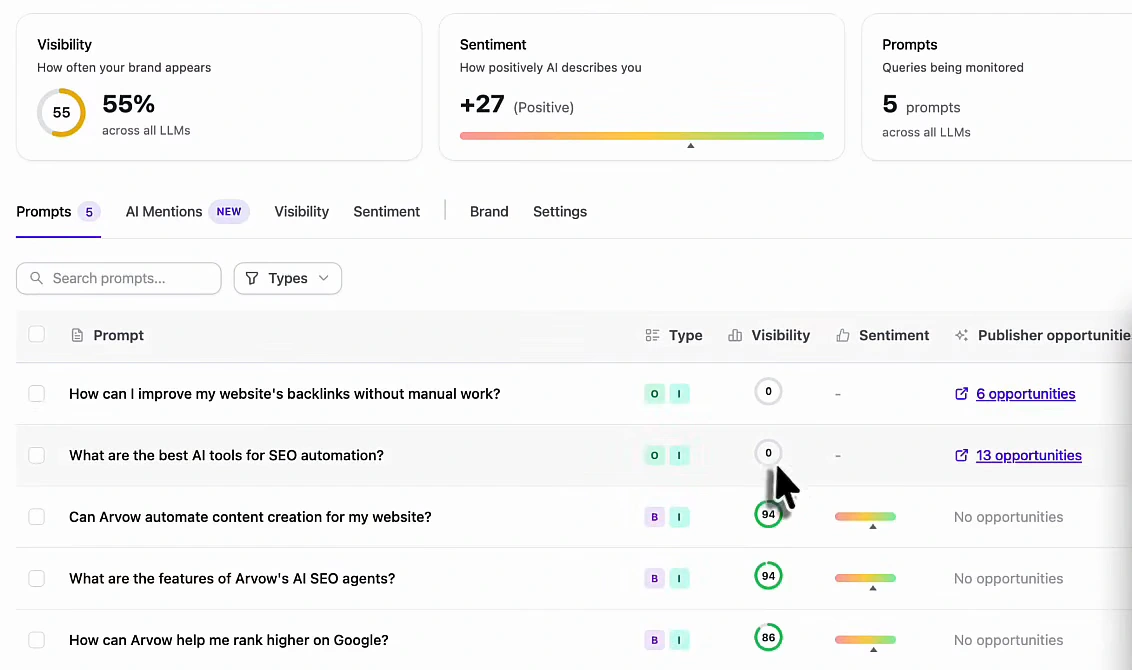
Look at the five rows, because the headline number hides something:
| Prompt | Type | Visibility |
|---|---|---|
| How can I improve my website's backlinks without manual work? | No brand name | 0 |
| What are the best AI tools for SEO automation? | No brand name | 0 |
| Can Arvow automate content creation for my website? | Names Arvow | 94 |
| What are the features of Arvow's AI SEO agents? | Names Arvow | 94 |
| How can Arvow help me rank higher on Google? | Names Arvow | 86 |
The 55% is the average of three prompts that contain our name and two that do not. Of course an AI mentions Arvow when the question is about Arvow. In the video I look at those high scores and say they do not really make sense as a win. The two prompts a new buyer would type both score zero.
The lesson: judge AI visibility on prompts that do not include your brand name. Branded prompts make the score look better than it is, the same way branded keywords make a rankings report look better than it is.
Open the prompt you are losing
I click into "What are the best AI tools for SEO automation?". Five AI models answered it. We appear in none of the five answers.
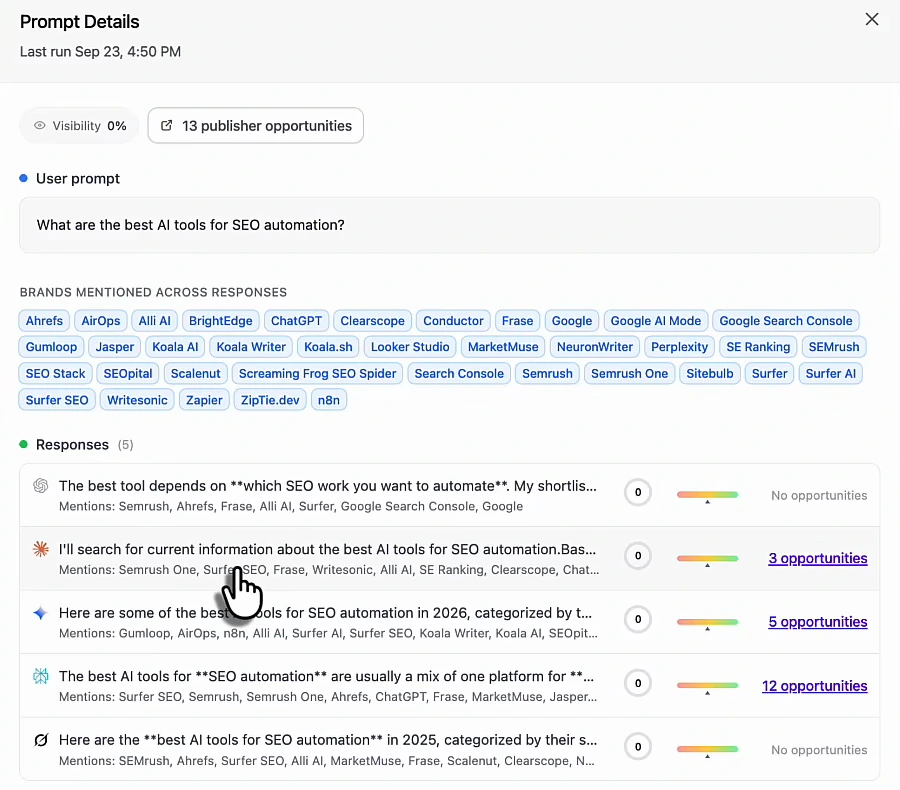
More than thirty brands are named across those answers. The useful question is why they are there.
Read the sources, not just the answer
I open one of the five answers. It names ten brands. Under it are the six pages the AI cited.
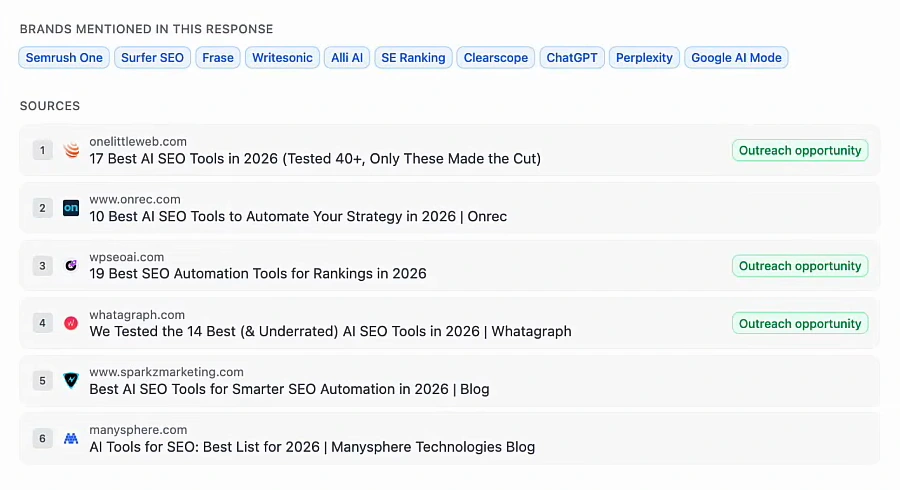
The brands are in the answer because they are in the sources. That is the whole mechanism. No person read those six articles. The AI did, and the buyer decided from the summary.
Notice what the sources have in common: all six are list articles, and all six say 2026 in the title. That pattern tells you what to build.
Three ways to get mentioned
These are the three options from my board. I keep them short here because our guide on how to get mentioned in AI search covers the method in full.
1. Get included in the sources already cited
Contact the sites behind the answer and ask what it takes to be added to the list. My expectation, stated in the video, is that a few will take payment and others will agree to an exchange: they add you, and you publish a post on your site that mentions them. I call it a mention exchange. It works like a backlink exchange did.
That is my estimate, not something the video shows happening. A paid placement should be labelled as sponsored.
2. Create your own source, similar but better
If none of them will add you, study what the cited pages share and build a stronger one. Keep the same format. If the sources are list articles, write a list article. If they are YouTube videos, make a video.
Ways to make it better, from the video:
- Publish the 2027 edition while every cited page still says 2026.
- Add a short video demo for each tool on the list.
- Add a comparison table.
- Add customer reviews or testimonials for each brand.
"Better" means the page that best answers the prompt. If you go this route, read our notes on self-promotional listicles first.
3. Create new and different sources
Sometimes a similar page does not get picked up. The AI may judge that the current sources already give it everything it needs. Then you test other formats: a YouTube video, a LinkedIn article, a Reddit thread.
We do this ourselves for prompts where we could not get a new page into the cited set. YouTube videos and LinkedIn articles have worked well for us. Reddit works too, with its own rules, which we cover in Reddit AI mentions. Different AI tools also lean on different sources. In my experience Perplexity cites YouTube more often than the others.
What to measure instead of position
| Old metric | Better metric |
|---|---|
| Position for any keyword | Position for high buying intent keywords only |
| Organic traffic | Leads, calls and sales from organic traffic |
| Number of keywords ranked | Conversion rate of the pages that rank |
| Overall AI visibility score | AI visibility on prompts that do not contain your brand name |
| Being in the answer | Being in the sources the answer cites |
Frequently asked questions
Is SEO different from AEO?
Not much. Whether you call it AEO, GEO or AI SEO, the principles are the same: publish the page that best answers the question, and be present in the sources that get cited. See SEO vs AEO for the differences that do exist.
How do I check if AI tools mention my brand?
Pick the questions a buyer would ask before they know your name. Run them in ChatGPT, Claude, Perplexity and Google's AI Mode. Note which brands are named and which pages are cited. A tracker does this on a schedule and saves the history.
See who AI recommends instead of you. Arvow's LLM visibility tracker shows your visibility per prompt, the brands mentioned in each answer and the sources behind them. In the video I also offer a free 30-minute call with me to anyone who takes a yearly plan. Details are on the pricing page.
Generate, publish, syndicate and update articles automatically
The AI SEO Writer that Auto-Publishes to your Blog
- Cancel anytime
- Articles in 30 secs
- Plagiarism Free