
Buying Intent Keywords: How I Find Them with One Claude Code Prompt (2026)

Buying intent keywords are the searches people type when they are about to pay someone: "where", "how much", "best", "X vs Y", "X alternative". They are the opposite of "how to" searches, where the person wants to do the job themselves. If I run an iPhone repair shop, I don't want to rank for "how to repair an iPhone". I want "iPhone repair near me" and "how much does iPhone screen repair cost", because those people want to pay me. Traffic is nice; traffic that turns into money is the point.
This article shows how I find those keywords for my own business in one Claude Code prompt, what the prompt actually returned when I ran it on arvow.com, and what it got right and wrong. It is week one of a four-week plan I recorded in July 2026; the video is below and the other three weeks are covered at the end.
What counts as buying intent, and what doesn't
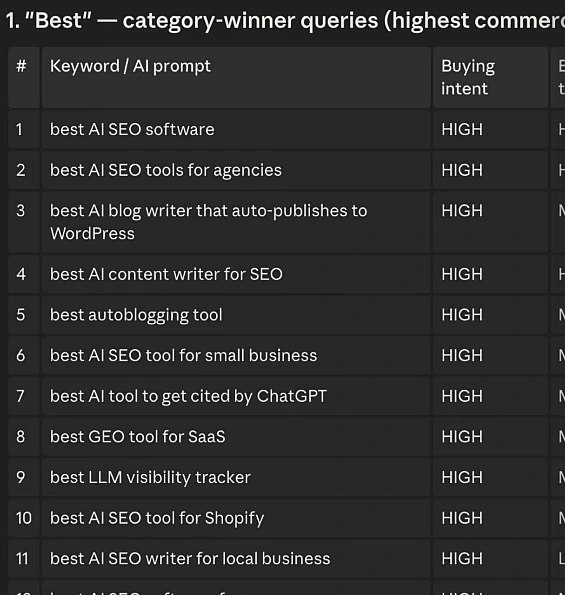
The prompt I use defines it in one line: keywords and AI prompts your ideal customer searches when they are close to buying (where / best / how much / X near me / X vs Y), not informational "how to" queries. When Claude Code ran it for Arvow, it sorted the results into six clusters, which is a useful checklist for any business:
| Cluster | Pattern | Example from my run |
|---|---|---|
| Best | "best [category] for [segment]" | best AI SEO tools for agencies |
| Versus | "[tool A] vs [tool B]" | Surfer SEO vs Jasper |
| Alternative | "[competitor] alternatives" | Koala Writer alternatives |
| Pricing | "cheapest", "under $100/mo", "how much" | cheapest AI SEO tool |
| Use case | "[category] for [platform or job]" | best AI SEO tool for Shopify |
| Conversational AI prompts | The question someone types into ChatGPT or Perplexity | "What's the best AI SEO tool for a marketing agency?" |
Two things about this list. First, a comparison page that says "these two are great, here's why ours is better" is about as high-intent as content gets, because the reader already knows what the products do. Second, the last cluster has no search volume in any keyword tool, because nobody measures prompts. It still belongs on the list: those are the questions where you want an assistant to name you, and our guide to how to get recommended by AI explains how to work with that.
The flip side is content format. "How to tie a tie" is a keyword I used in the video to make the point: what ranks for it is images and short videos, not articles. Knowing a keyword is not enough; you need to know what kind of page wins it, which is why the prompt does a SERP analysis right after the keyword list.
The prompt: three jobs, three files
The week-one prompt gives Claude Code three jobs and asks it to save each one to its own file inside your project folder.
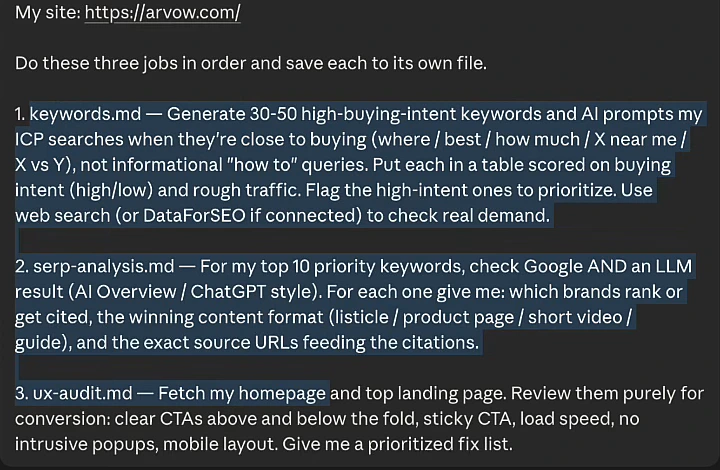
- keywords.md: 30 to 50 high buying intent keywords and AI prompts, each in a table scored on buying intent (high or low) and rough traffic, with the high-intent ones flagged. It is told to use web search, or DataForSEO if that MCP server is connected, to check real demand.
- serp-analysis.md: for the top 10 keywords, check Google and an LLM-style answer. For each one: which brands rank or get cited, the winning content format (listicle, product page, short video, guide) and the exact source URLs feeding the citations.
- ux-audit.md: fetch the homepage and top landing page and review them purely for conversion: clear calls to action above and below the fold, a sticky CTA, load speed, no intrusive popups, mobile layout. Return a prioritised fix list.
The full text of all four weekly prompts lives on our prompts page: 30 Day Claude Code SEO Plan. Copy week one from there rather than retyping it from the screenshot.
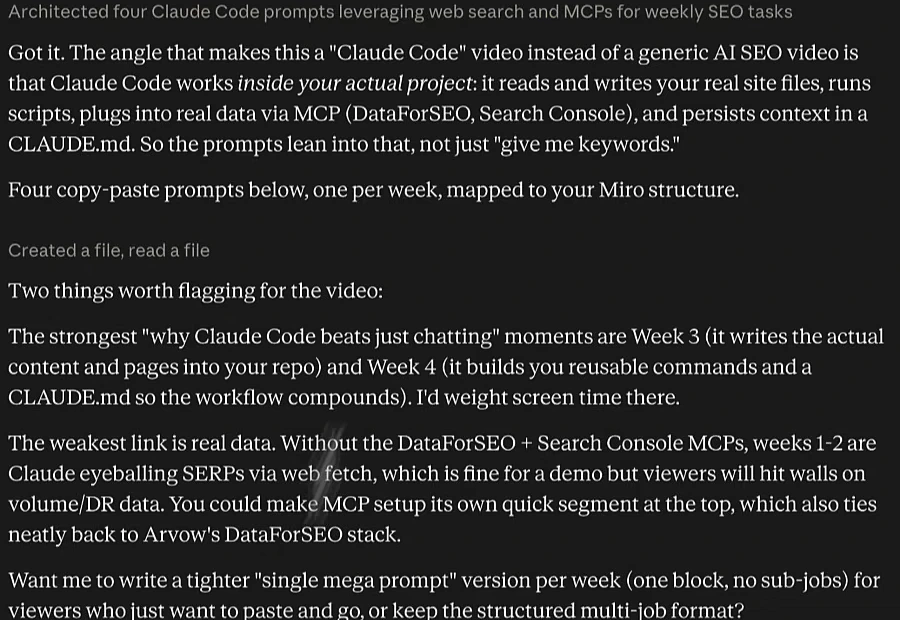
I should say how the prompts were made, because it is visible in the video. I drafted the four weeks with Claude's help, and its design note is worth reading: it leaned the prompts into what Claude Code can do that a chat window can't (read and write your real site files, run scripts, pull live data through MCP servers, keep context in a CLAUDE.md file), and it flagged that the weakest link is real data. Without the DataForSEO and Search Console MCPs, weeks one and two are "Claude eyeballing SERPs via web fetch", fine for a demo, but you will hit walls on volume and domain-rating data.
Running it
Open a new Claude Code session in a fresh folder (the files it writes go there), paste the week-one prompt, fill in the four blanks and press enter. For arvow.com I wrote "AI SEO software for marketers and agencies" as the business. I ran it on Opus 4.8 with effort set to high; a cheaper model and lower effort is faster, and the output is correspondingly thinner. This run took a few minutes, during which it browsed the web in several batches, wrote keywords.md, filled SERP gaps for the remaining priority keywords, wrote serp-analysis.md, fetched the homepage and the top product page, and wrote ux-audit.md.
What came back for arvow.com
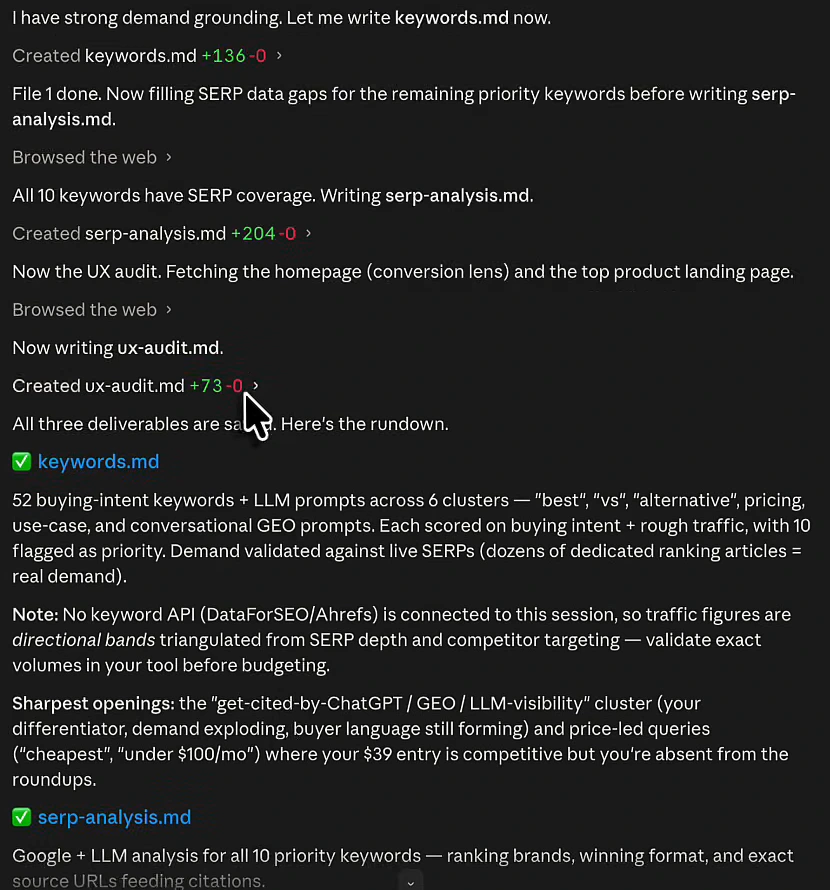
The keyword file came back with 52 buying intent keywords and LLM prompts across the six clusters above, each scored on intent and rough traffic, with 10 flagged as priority. It validated demand against live search results ("dozens of dedicated ranking articles = real demand") rather than a keyword database, and it said so: no keyword API was connected, so the traffic figures are directional bands (high ≈ 1k+/month, medium 200 to 1k, low under 200) triangulated from how many ranking articles exist and how competitors target the term. Its own advice was to validate exact volumes in a keyword tool before budgeting, and I'd repeat that.
It also named the two sharpest openings for us: the "get cited by ChatGPT / GEO / LLM visibility" cluster, where demand is growing and buyer language is still forming, and price-led queries like "cheapest" and "under $100/mo", where our entry plan is competitive but we were absent from the roundups. That second one is the kind of finding a volume-sorted keyword list never surfaces.
Who ranks, who gets cited, and in what format
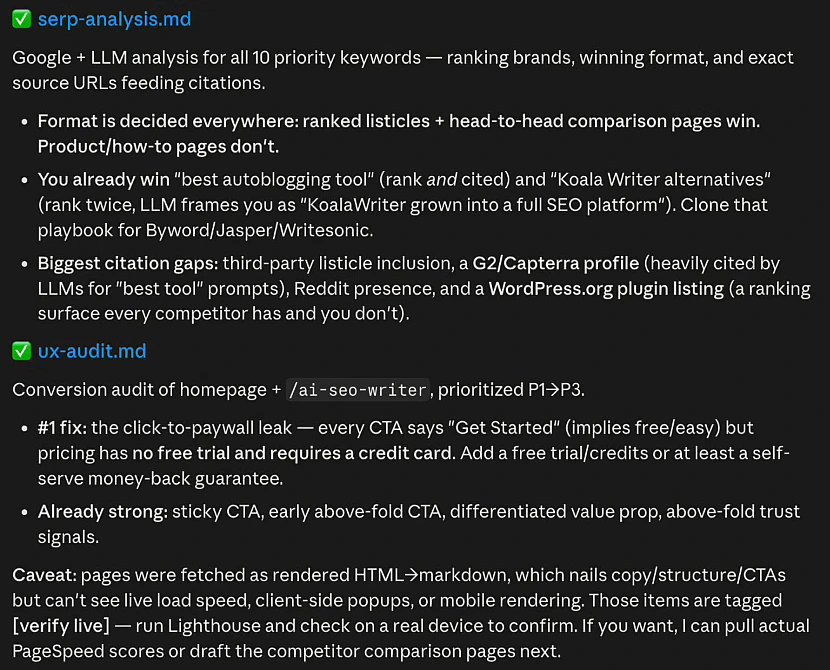
The SERP file is where the prompt earns its keep. For each of the 10 priority keywords it listed the brands on page one of Google, the brands an LLM answer names, the format that wins, and the exact URLs the citations come from. Three conclusions held across all ten:
- Format is decided everywhere. Ranked listicles and head-to-head comparison pages win; product pages and how-to pages don't. If you want a "best X" keyword, you need a list, or you need to be on someone else's list.
- We already win where we have the right format. "Best autoblogging tool" (ranked and cited) and "Koala Writer alternatives" (ranked twice, with the LLM describing Arvow as "KoalaWriter grown into a full SEO platform"). Its instruction: clone that playbook for Byword, Jasper and Writesonic.
- The biggest citation gaps are not content. Third-party listicle inclusion, a G2 or Capterra profile (heavily cited by LLMs for "best tool" prompts), Reddit presence, and a WordPress.org plugin listing, "a ranking surface every competitor has and you don't".
| Priority keyword | What wins | Where Arvow stood (July 2026) | Suggested move |
|---|---|---|---|
| best AI SEO software | Listicles from high-authority publishers | Not present. "Hardest of the 10" | Don't lead here; earn placement inside third-party listicles and win the narrower agency and auto-publish variants first |
| best AI SEO tools for agencies | Listicle with an "AI SEO stack" angle; LLMs name Semrush, Ahrefs, Surfer, SE Ranking | Already on page one with our own listicle | Strengthen the white-label and agency sub-accounts angle, refresh for 2026, then pitch inclusion in the third-party lists |
| best AI blog writer that auto-publishes to WordPress | Mix of WordPress plugin pages and "tested 5 plugins" listicles | Competing against plugin listings | The WordPress.org listing gap from above |
The page it found us ranking with is our own 12 best SEO tools for agencies list, which is a fair illustration of the "be the list" rule. The mechanics of why LLMs cite listicles and review profiles so heavily are in our data study on how to get cited by ChatGPT.
The UX audit told me something I didn't want to hear
The third file reviewed arvow.com's homepage and the AI SEO writer landing page purely for conversion. Its number one fix was what it called the click-to-paywall leak: every call to action says "Get Started", which implies free or easy, but the pricing page had no free trial and asked for a credit card. Its recommendation was a free trial or free credits, or at least a self-serve money-back guarantee. It listed what was already strong (a sticky CTA, an early above-the-fold CTA, a differentiated value proposition, trust signals above the fold) and then kept going: trust signals were shallow ("20,000+" and anonymous avatars rather than named testimonials with results, or G2 and Capterra ratings), the "Limited Time Offer" badge on every pricing tier reads as artificial if it is evergreen, and the pricing page had no cost-per-article or competitor anchor for price shoppers.
Its suggested test order, by expected return: clarify the CTA and add a trial, credits or guarantee; run and fix Lighthouse; make the mobile hero CTA visible and add a sticky bottom bar; put quantified hero copy and a named testimonial above the fold; verify there is no intrusive popup, cookie or chat overlap. It was also honest about its limits: the pages were fetched as rendered HTML converted to markdown, which captures copy, structure and CTAs but cannot see live load speed, client-side popups or mobile rendering, so those items were tagged "verify live".
For transparency: when we checked in October 2026 the homepage's main button still said "Get Started" and the "20,000+" trust line was still there. Some of this list is still open. I'm including it because the point of the exercise is that the audit is only useful if you act on it or consciously decide not to.
Why you still have to read it
Claude did the week's work in minutes, and I still read every file. SEO is a marketing strategy you are putting time and money behind, so you need to understand what is being recommended, and some of it may be wrong for your business. Push back when it is: tell it a cluster doesn't make sense and have it re-evaluate. The UX audit in particular needs a human at the end of it, whether that is you or the person who built your site. If you don't know what the AI is doing, it can do the wrong thing with great confidence, and a keyword list with directional traffic bands is exactly where that happens.
Where this fits in the 30-day plan
Week one is research. The reason it comes first is that nothing in weeks two to four works if the model has no context on what you sell, who buys it and which keywords matter. The other three weeks each have their own prompt, and the rule I'd insist on is one prompt per week: run week one on a Monday, read it, act on it, and run week two the following Monday. Running all four in a day produces more output than anyone can act on, and that is how people quit.
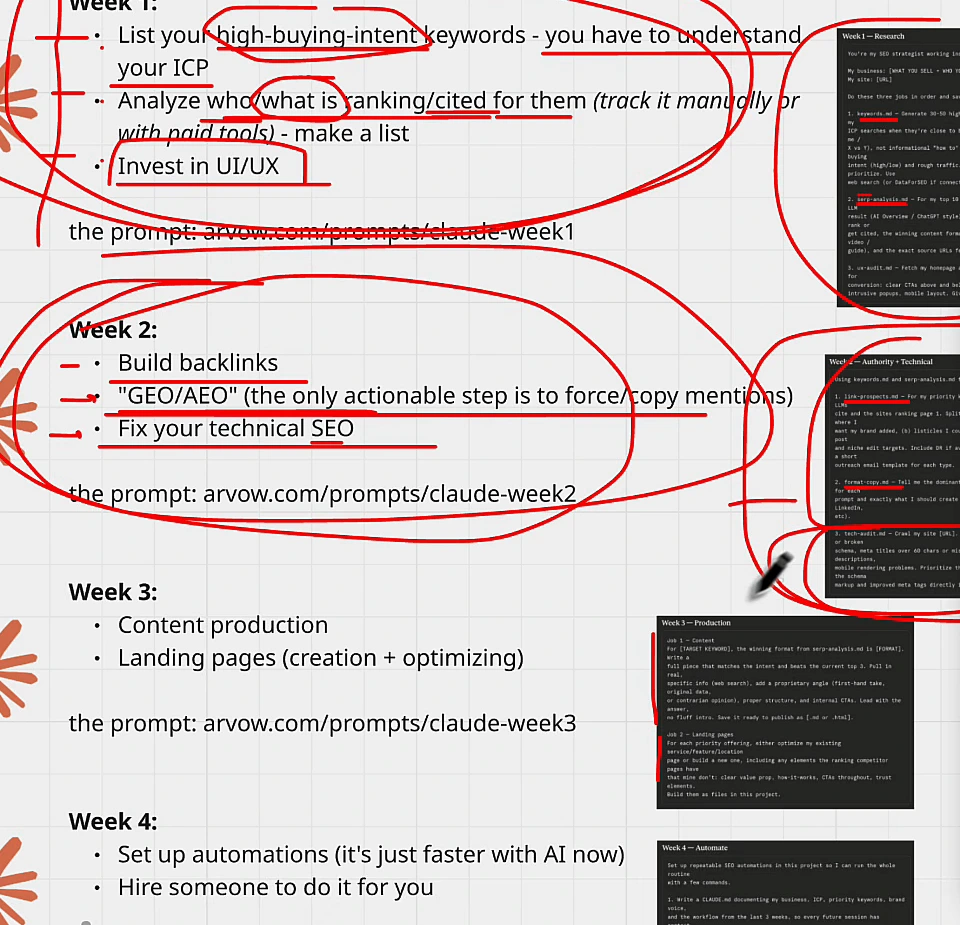
- Week 2, authority and technical: using keywords.md and serp-analysis.md, build a link-prospect list split into pages where you want your brand added, listicles you could pay or swap into, and guest-post and niche-edit targets; work out the dominant content format per prompt and where to replicate it; then crawl the site for PageSpeed, schema, meta title and mobile issues and, where it can, write the fixes into your files.
- Week 3, production: write the content and landing pages the research pointed to. Claude Code writes them into your project; publishing them to your CMS is still your job.
- Week 4, automate: turn the recurring parts into reusable commands and a CLAUDE.md so the workflow compounds, or hire someone to run it.
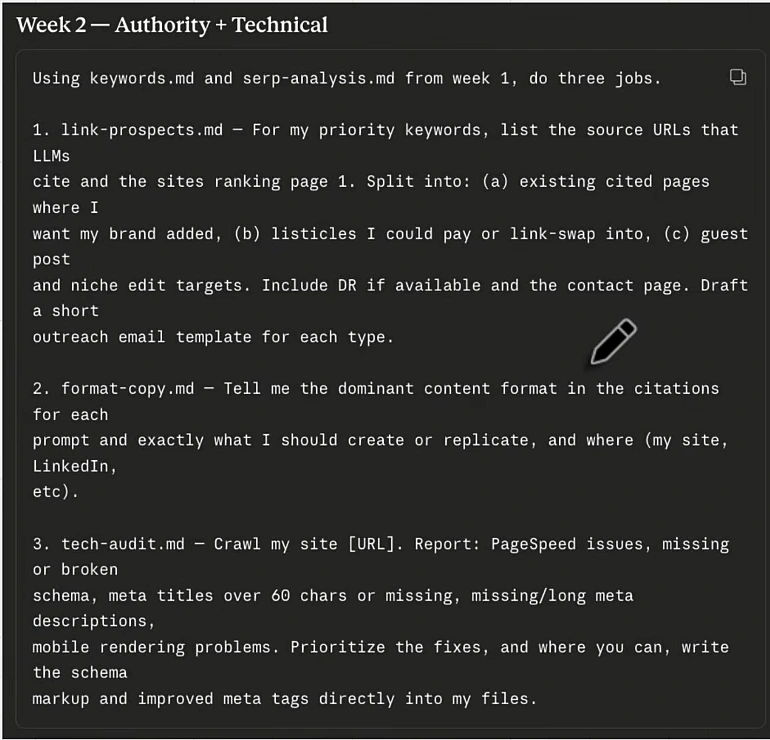
If you would rather do the same four weeks without Claude, the manual version is our 30-day SEO plan. If you want the wider set of Claude Code workflows beyond this plan, start with the Claude Code SEO guide, and the earlier three-prompt version of the content and backlink steps is in Claude Code SEO prompts. Week two's technical crawl overlaps with the manual SEO audit checklist if you want to sanity-check what it reports.
If you don't have the time
Two options I mentioned in the video, both stated as they were in July 2026. My team runs this as a done-for-you service with a guarantee of a 25% increase in Google traffic in 90 days or you don't pay (with the honest caveat that 25% of zero is zero, so a site with no traffic needs a different arrangement); it started at $2,000 a month. The software route was Arvow from $39 a month on a yearly plan, which automates the content, the automatic backlinks and the technical fixes that the week-two audit can only report. Prices change, so check the pricing page rather than this paragraph.
Want the research, content, links and fixes handled for you instead? See how Arvow automates SEO.
FAQ
What are buying intent keywords?
Searches made by people close to a purchase decision: "best [category]", "[A] vs [B]", "[competitor] alternatives", "how much does [service] cost", "[service] near me". They convert far better than informational "how to" searches because the searcher wants to pay someone rather than learn to do it themselves.
How do I find buying intent keywords without a paid tool?
Give an AI assistant your business, ideal customer and URL and ask for the six clusters above, scored on intent, with demand checked against live search results. That is what the week-one prompt does. Treat its traffic numbers as directional until you validate them in a keyword tool or connect one through an MCP server.
Why check LLM answers as well as Google?
Because a growing share of buying research happens in ChatGPT, Perplexity and AI Overviews, and the sources those answers cite are different from the pages that rank. In my run the citation gaps were a G2 or Capterra profile, Reddit and a WordPress.org listing, none of which a Google-only analysis would have raised.
Do I need Claude Code specifically?
No. The prompt works in any capable assistant. Claude Code adds the parts that matter later in the plan: it saves the files into your project, can connect to DataForSEO and Search Console for real numbers, and in weeks two and three it writes fixes and pages directly into your site files.
How long does week one take?
The run itself took a few minutes on Opus 4.8 at high effort. Reading the three files and deciding what to act on is an hour or two, which is the part you should not skip.
Generate, publish, syndicate and update articles automatically
The AI SEO Writer that Auto-Publishes to your Blog
- Cancel anytime
- Articles in 30 secs
- Plagiarism Free