
Is SEO a Good Career in 2026? What Anthropic's $320K SEO Lead Job Post Tells You

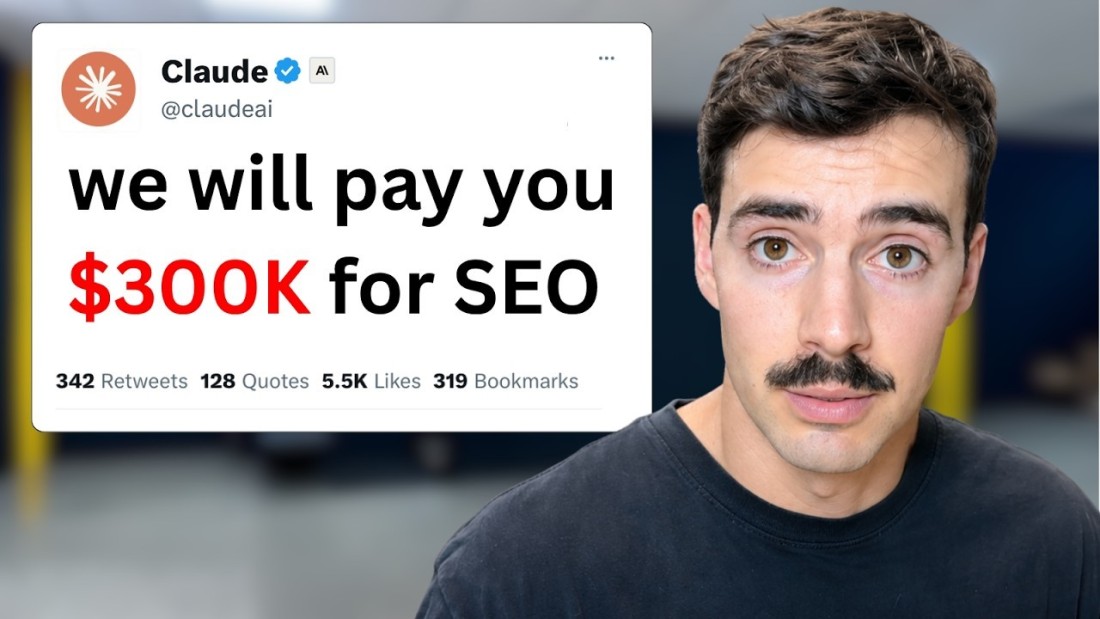
In June 2026, Anthropic, the company behind Claude, advertised for an SEO Lead with a salary range of $255,000 to $320,000 a year. I made a short video about it at the time, because it bears on a question SEO people keep asking: is this still a career worth choosing when AI is rewriting search? My answer is yes, with conditions. This article goes through what the job post actually asked for, how that salary compares with normal SEO pay, and what I would do if I were starting or re-skilling today. I own an SEO software company, so read my optimism with that in mind; I have tried to put the numbers ahead of the opinion.
The short answer
SEO is a good career in 2026 if you are moving toward the parts of the job that companies are now paying a premium for: technical infrastructure, measurement, and visibility in AI answers as well as in Google. It is a weak career if your plan is to sell the parts that software now does in minutes, such as keyword lists, generic blog posts and checklist audits. The Anthropic post is useful because it shows, line by line, which side of that split a company at the centre of AI wanted to hire.
What the Anthropic job post said
The role was listed on Anthropic's careers page under Marketing and Brand, based in San Francisco or New York City.

The description is specific about scope. The SEO Lead would own organic search strategy and technical SEO infrastructure across claude.ai, docs.anthropic.com and anthropic.com, making sure products and developer resources are "discoverable, performant, and well-positioned in an evolving search landscape".

Three details matter more than the headline number.
It was an individual contributor role. The post calls it a "high-impact, hands-on individual contributor role" who would "independently define and execute the technical SEO roadmap". Not a manager of an agency relationship. Someone who does the work.
It was mostly technical. The first block of responsibilities is headed Technical SEO Strategy & Infrastructure, and the list reads like an engineering ticket queue:
| Responsibility in the post | What it means in practice |
|---|---|
| Sitemaps, structured data (JSON-LD), canonical tags, redirects and robots.txt across multiple domains | The plumbing that decides what gets crawled and indexed |
| Site speed, mobile performance and Core Web Vitals across documentation and marketing properties | Performance work alongside engineers |
| Crawl efficiency, indexing status and search performance using Google Search Console | Measurement, not guesswork |
| SEO observability and monitoring with automated alerting | Knowing something broke before traffic drops |
| An SEO playbook for international expansion, including hreflang | Multi-language, multi-market architecture |
| A content roadmap for developers and enterprise decision-makers; documentation rankings and information architecture | Content strategy tied to product, not volume |
AI search was written into the job. The description says the hire would help define strategy for "emerging search experiences like AI Overviews and answer engines". The requirements ask for an understanding of Answer Engine Optimization and Generative Engine Optimization for LLM-powered search, and experience optimizing for AI Overviews, featured snippets and entity-based results.

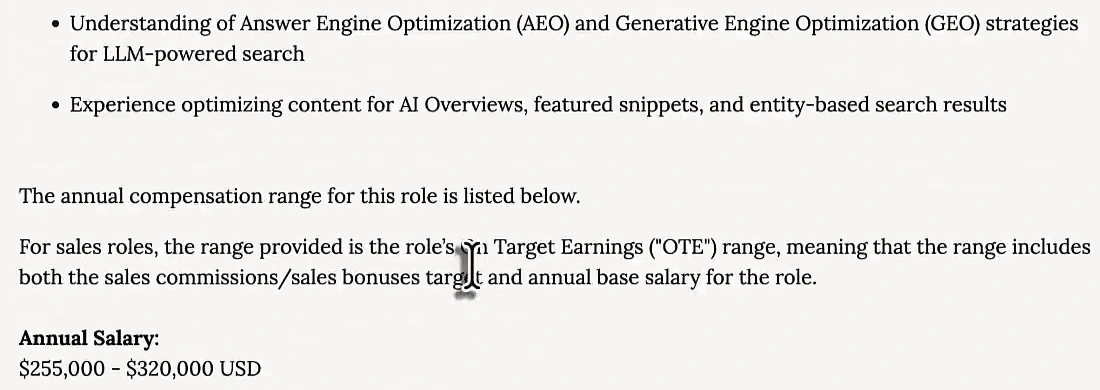
The logistics section asked for a bachelor's degree "or an equivalent combination of education, training, and/or experience", and expected staff in the office at least 25% of the time. So a degree was not a hard gate; a track record was.
Status check: the listing is closed. When we re-checked on 5 November 2026 the link to the post redirected to Anthropic's list of open roles, and a mirror of the post on an investor job board showed it as posted on 6 June 2026 and no longer accepting applications. Treat the numbers here as a record of what was offered, not a live vacancy.
How $255K to $320K compares with normal SEO pay
In the video I say the top of the range works out to about $27,000 a month, which is right ($320,000 divided by twelve is $26,667). It is also nowhere near typical, and anyone choosing a career on the strength of one job post should see the rest of the market first.
| Benchmark | Figure | Source and date |
|---|---|---|
| Anthropic SEO Lead | $255,000 to $320,000 | Job post, June 2026 |
| Senior SEO roles (Head, Director, VP, Lead), US median | $130,000 | Semrush analysis of 3,900 Indeed listings, published March 2026 |
| All other SEO roles, US median | $71,630 | Same study |
| SEO Manager, US average | $114,773 | Salary.com, as of 1 November 2026 |
| Market research analysts and marketing specialists, US median | $78,760 | Bureau of Labor Statistics, May 2025 (a broader category that includes SEO) |
The bottom of Anthropic's range is roughly double the median for senior SEO listings in the Semrush job market study. That gap is partly employer (a frontier AI lab in two of the most expensive cities in the US), partly seniority, and partly the skill mix. The same study found that 31% of senior SEO listings mention AI, but only 6.3% mention AEO or AI search by name. The Anthropic post asks for both the deep technical stack and the AI search layer. Few people can show both, and that is what the premium pays for.
The honest reading: most SEO jobs pay a solid professional salary, not a spectacular one. The Bureau of Labor Statistics projects 7% growth from 2025 to 2035 for the wider marketing-analyst category, which it describes as much faster than average. The ceiling is high for the people who combine skills that are still rare.
Why companies still pay for SEO
My argument in the video is about leverage. Marketing works when you have an advantage other people have not caught up with, and it stops working when everyone does the same thing. One billboard on an empty highway gets every driver's attention; a hundred billboards get ignored. I went through that idea in detail in is SEO dead, so I will not repeat it here.
What matters for a career is where the leverage is now. Search is changing shape. Google is no longer ten blue links, and a growing share of questions go to assistants that answer in a conversation and cite a handful of sources. Nobody has a settled playbook for that yet, and uncertainty is where a skilled person is worth the most. A company whose product is itself an AI assistant looked at that landscape and decided it needed a dedicated, highly paid specialist to make sure its own pages are found. If any employer were going to conclude that SEO is finished, it would be that one.
There is a caveat I should state plainly. One job post is one data point. It tells you the top of the market exists, not that the middle is comfortable.
Who SEO is a good career for, and who it is not
| Good fit | Poor fit |
|---|---|
| You like technical problems: crawling, rendering, site architecture, speed | You want a fixed checklist that stays true for years |
| You are comfortable with data and can connect work to revenue | You plan to sell deliverables (keyword lists, generic articles) rather than outcomes |
| You are curious about how AI assistants choose sources | You see AI search as a threat to wait out |
| You can work with engineers, writers and analysts | You want to work alone on content only |
The right-hand column is where the pressure is. Tools, including the one my company sells, now produce keyword research, drafts and basic audits quickly and cheaply. Interchangeable output is what I have called commodity content, and a career built on producing it is exposed. The Semrush data points the same way: the most requested skills in senior listings were project management, communication and experimentation, not writing.
The skills the job post tells you to build
If I were planning the next two years of learning, I would work backwards from that post.
- Technical SEO you can do yourself. Sitemaps, canonicals, redirects, structured data, Core Web Vitals, Search Console. Start by auditing a real site with our SEO audit checklist, then fix what you find.
- AI search visibility. Learn how assistants pick and cite sources, how to track mentions, and how to change them. Our guides on increasing AI visibility and ranking in Google AI Overviews cover the practical side.
- Measurement and experimentation. The post asks for someone to "drive site experimentation and conversion optimization". Being able to say what a change earned is what separates a lead from a specialist.
- Working with AI tools, not against them. The people who will be paid well are those who direct agents and check their output. See AI agents for SEO for what that looks like day to day.
- A public track record. A site you grew, with numbers, beats a certificate. The post accepted experience in place of a degree for a reason.
The career paths, briefly
- In-house. The most stable route and the one the Anthropic role represents. Pay rises with scope and with how technical the product is.
- Agency. The fastest way to see many sites and problems early. Lower starting pay, steep learning.
- Freelance or consulting. Works once you have a specialism and proof. Newer services, such as AI visibility reports, are easier to sell than generic retainers because few people offer them yet.
- Your own sites or products. The riskiest and the only one with no salary cap. It is also the best training, because you carry the result yourself.
If you are on the hiring side of this question, our guide on how to hire an SEO expert covers what to look for.
FAQ
How much do SEO professionals earn?
In the US, a 2026 Semrush analysis of 3,900 job listings put the median at $130,000 for senior roles and $71,630 for others. Salary.com lists the average SEO Manager at $114,773 as of November 2026. Roles at large technology companies can pay far more; Anthropic's June 2026 SEO Lead post listed $255,000 to $320,000.
Will AI replace SEO jobs?
It is replacing tasks, not the function. Routine work such as keyword lists and first drafts is largely automated. Demand is moving to technical SEO, measurement and visibility in AI answers, which is exactly what the Anthropic post asked for.
Do you need a degree to work in SEO?
Usually not. Even the Anthropic post asked for a bachelor's degree or an equivalent combination of education, training and experience. A documented track record carries more weight than a qualification.
Want to learn the AI search side of the job? Start with our free AI SEO course, then practise on a site you control.
Generate, publish, syndicate and update articles automatically
The AI SEO Writer that Auto-Publishes to your Blog
- Cancel anytime
- Articles in 30 secs
- Plagiarism Free