
AI Agents for SEO: 5 Tasks I've Automated and What They Actually Did (2026)

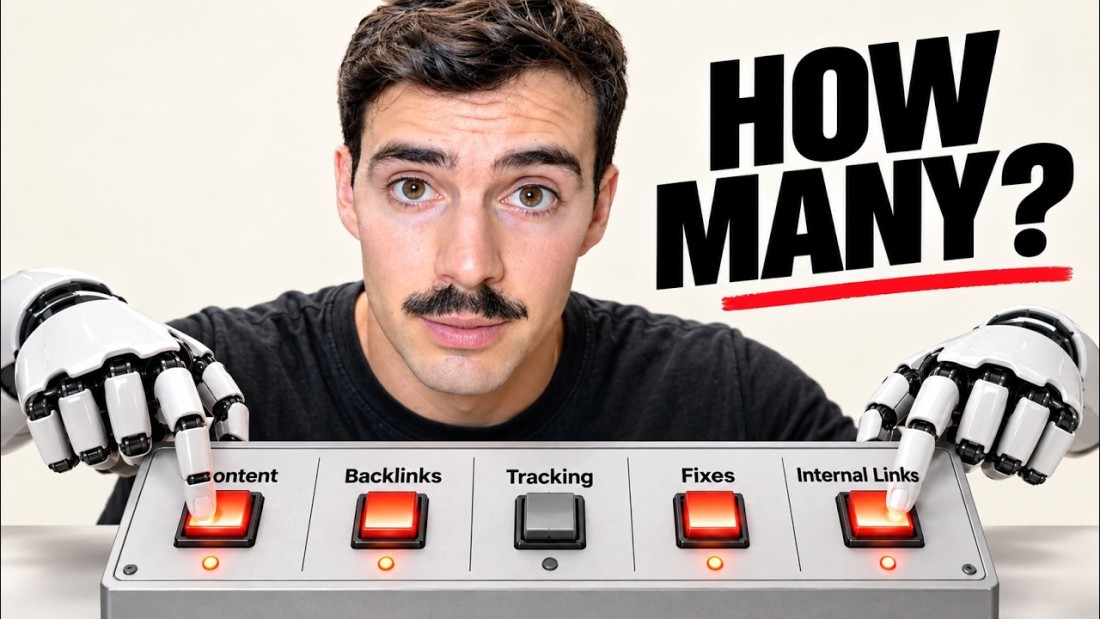
Can AI agents actually do SEO, the kind that brings in money? Not "write me a blog post" in a chat window, but work that keeps running when you close the laptop: building links, reading your real data, fixing pages. I've handed five SEO tasks to AI agents so far. In the video below I walk through all five. This article is the written version, with the numbers from my own screens, including the ones that look less impressive than the voiceover.
The five SEO tasks AI agents handle for me
An AI agent is different from an AI chat in one way that matters here: it can act. It has tools (a browser, an inbox, an API, write access to your site) and it keeps going without you typing the next message. Here's what I run with agents today, and how far each one goes on its own.
| Task | What the agent does | What still needs me |
|---|---|---|
| 1. Backlink building | Registers on directories, verifies the emails, submits the listing, reports every few hours | Choosing what kind of links are worth it, checking what actually went live |
| 2. SEO analysis with real data | Pulls Search Console, keyword and competitor data, reads the SERP, writes a prioritised plan | Deciding which recommendation to act on |
| 3. Conversion rate optimisation | Reads analytics, changes page layout in code, measures the effect | Approving the changes and the test design |
| 4. Technical SEO | Finds missing internal links, alt text, schema, meta titles; applies the fix on click | Reviewing each suggestion before hitting Apply |
| 5. Content | Researches, writes and publishes on a schedule | The strategy and the brand voice it works from |
Everything below is one section per task, in that order.
1. Backlink building on autopilot
This is the one I showed last week. In our team Slack there's a channel where an AI agent posts a digest every six hours: which sites it submitted Arvow to, which listings went live, and a running total. I run it on Grok, because Grok has its own computer. A chat in ChatGPT or Claude stops when you close your laptop (unless you set something up in the terminal). An agent with its own machine doesn't. It keeps working until you tell it to stop.
The setup is simple. Give the agent a dedicated email address (we used a Fastmail inbox) and a browser. With those two things it can do what a person does to build a profile link: register on the site, open the verification email, click the link, fill in the listing. You can also give it a card with a spending limit if you want it to handle paid submissions. The full setup is in my AI backlink agent walkthrough.
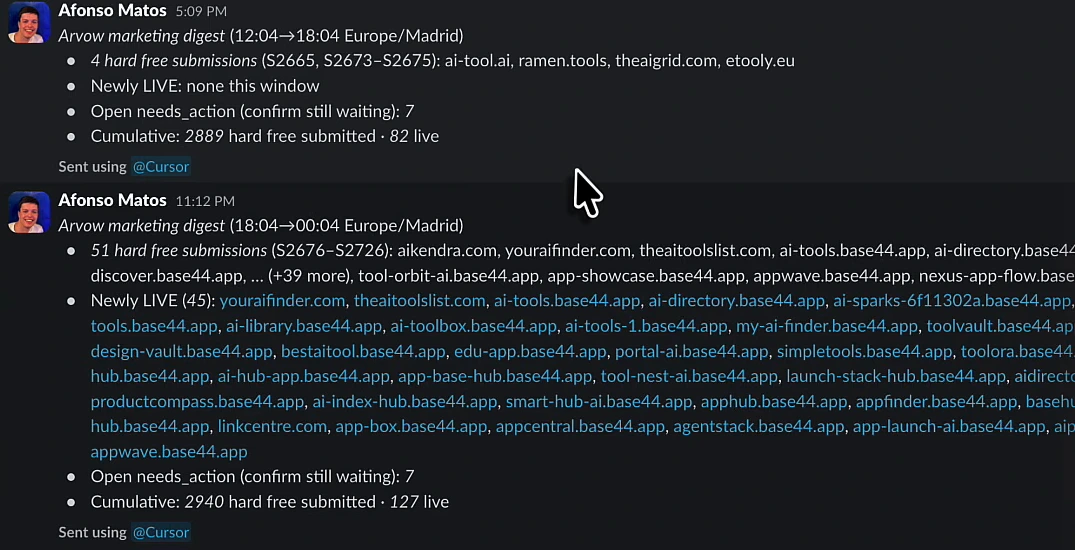
Look at the cumulative line, because that's the real result. 2,940 submissions, 127 live listings. That's about 4%. Most submissions go nowhere: the site never approves the listing, wants payment, or the confirmation never arrives. The agent doesn't mind, which is the whole point of giving the job to an agent. Nobody would do 2,940 submissions by hand to get 127 links.
Also look at the newly-live list in the second digest. Most of those 45 domains are subdomains of base44.app, an AI app builder. They're small directories other people built quickly with AI. They count as live listings, but they're not the same as a listing on an established directory, and I wouldn't count them as 45 good links.
The digests are posted from my co-founder's Slack account and carry a "Sent using @Cursor" footer. That's the integration the agent reports through, not a person typing.
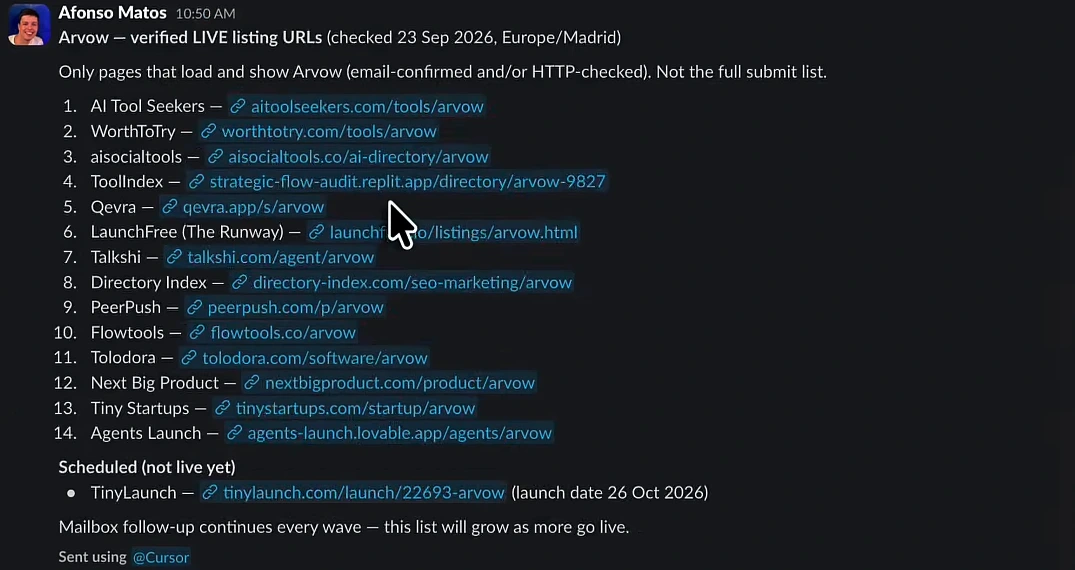
This message is the most useful thing the agent produces. It's a separate check: open every listing URL and confirm it loads and shows us. "Submitted" and "live" are different numbers, and an agent that only reports submissions will make the job look ten times better than it is. If you build one of these, make it audit its own work like this.
Check what a "DR 76 link" actually is
In the video I open one of these listings, PeerPush, in Ahrefs to show the authority.
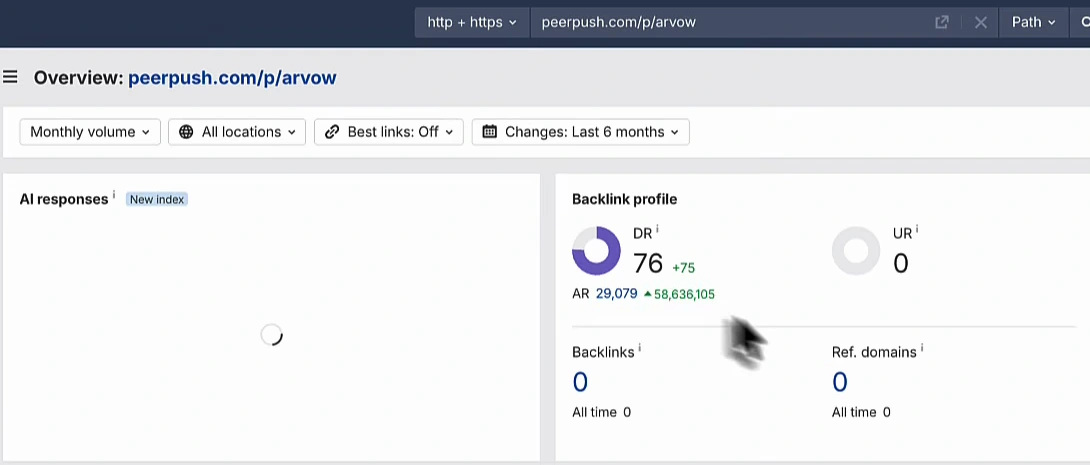
DR 76 is the domain's rating, not the page's. Our listing page has a UR of 0 and no links pointing at it, and the domain's DR went up by 75 points in the last six months. A fast rise like that happens to launch platforms that collect thousands of profile links. The listing still helps: it's a real, indexed page that mentions us, and AI assistants read these directories. But it's a profile link, not an editorial one. I compare the two properly in automated vs manual AI backlinks.
So what can AI fully automate today? Profile and directory links, yes. Editorial links, not yet. I'm sure that will change, but that's where it is in October 2026.
The same idea inside Arvow
You don't have to run your own Grok setup. Arvow has the same kind of agent built in, under Automatic Backlinks.
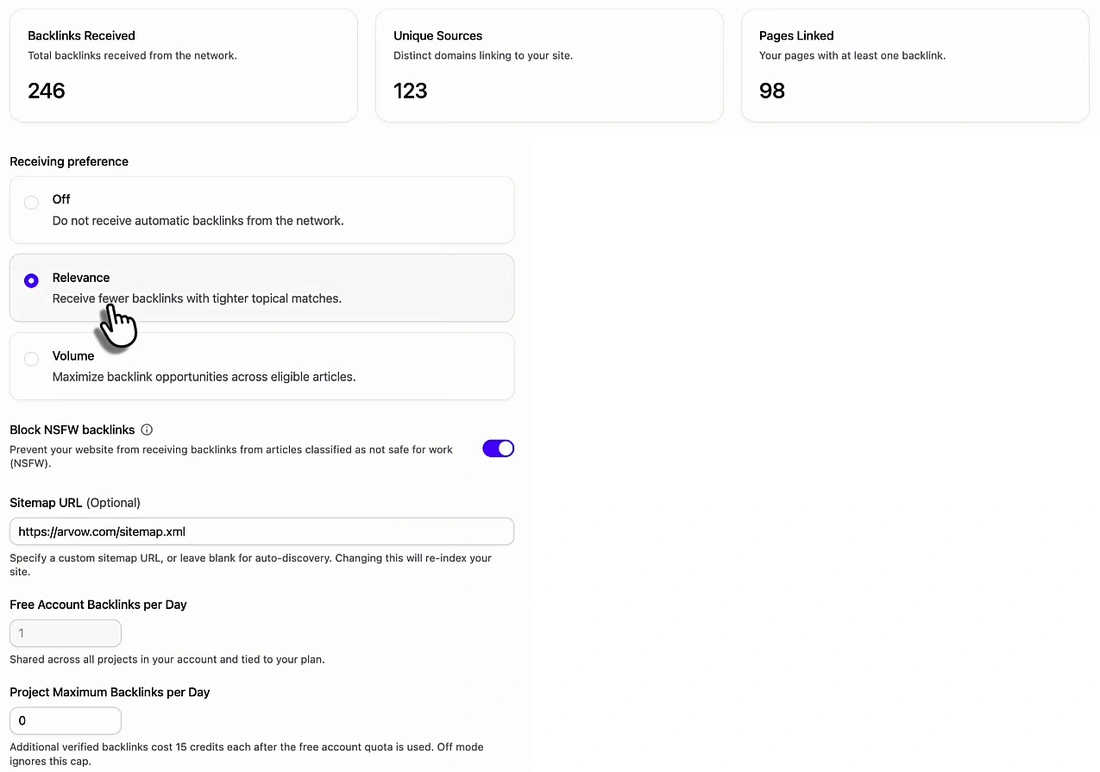
The setting I'd point you to is the receiving preference. "Relevance" gets you fewer links with tighter topical matches; "Volume" maximises the count. We run Relevance. The free quota is one link a day per account, and extra verified links cost 15 credits each. The individual linking domains appear in the Backlinks tab (blurred in the video).
2. An AI chat that has your real SEO data
You can already ask ChatGPT "I want to rank my site first on Google, my competitors are X, Y and Z, what do I do?" The answer won't be terrible, just generic, because the model has no data. It doesn't know your Search Console numbers, which keywords your competitors rank for, or what the SERP looks like right now.
That's why we built Arvow Chat the way we did: it connects to the data first and answers second.
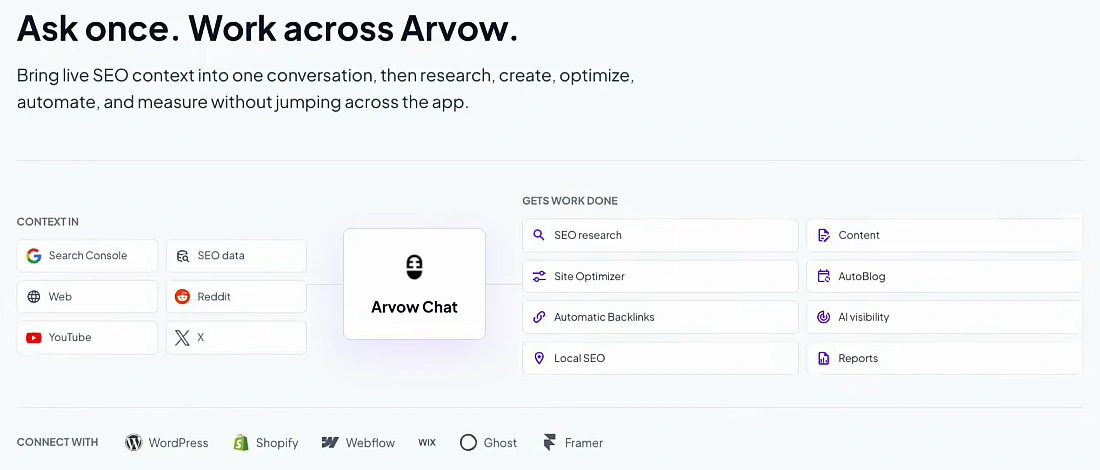
On the left: Search Console, third-party SEO data (domain rating, keyword difficulty, rankings), the web, Reddit, YouTube and X. On the right: the parts of the product it can hand work to. It's expensive to run, because every question pulls several paid APIs. We can only afford it because the cost is spread across a lot of users.
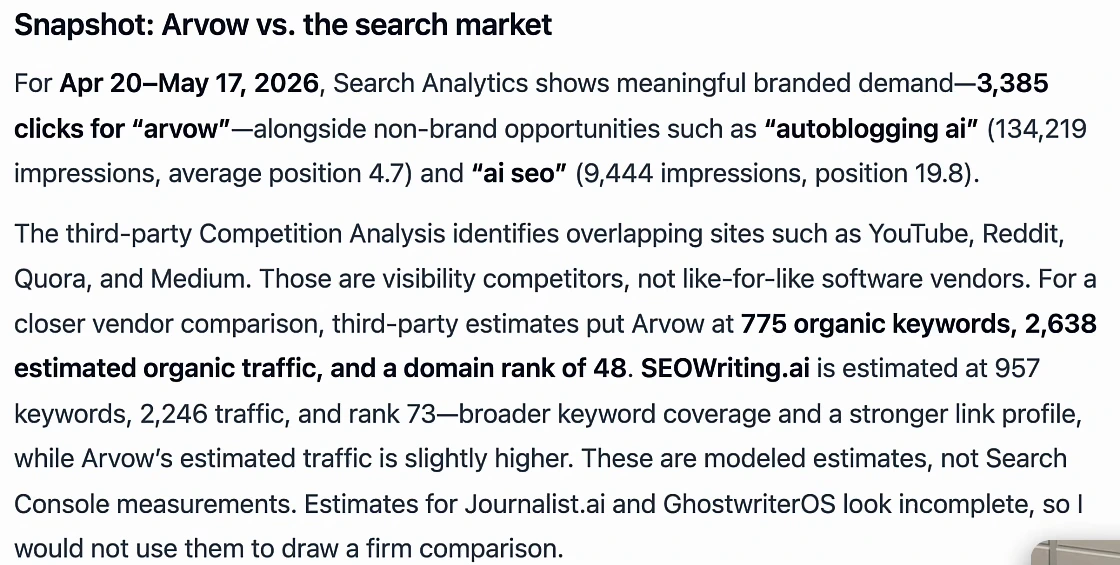
Two things in that answer are worth copying for any SEO agent you build or buy.
- It finds the problem in the numbers. Our /autoblog page had 172,709 impressions and 74 clicks at an average position of 4.7. That's a click-through rate of about 0.04% on a page ranking near the top. The answer flags a likely title or intent mismatch, and that's a specific fix you can act on.
- It labels its own uncertainty. It says outright that the competitor numbers are "modeled estimates, not Search Console measurements" and that two competitors' data looks incomplete, so it won't compare them. Without real data a chat would just state those numbers confidently.
From there you can give it a task, for example "find backlinks with a DR above 30 that my competitor has and I could build right now". It looks up the competitor, pulls their backlinks, filters to the ones you can realistically copy, and sorts by DR. It can't build those links itself yet. We're working on it. For a longer live run of one prompt end to end, see agentic SEO, shown live, or try Arvow's AI SEO chat.
3. Conversion rate optimisation by changing page layouts
This one isn't on screen. I went to show it and realised I wasn't recording, so here is the method in words. The two tools are PostHog and Codex.
- PostHog is product analytics, like Google Analytics but more detailed: visitors, conversions, funnels, heatmaps, experiments.
- Codex is OpenAI's coding agent, their version of Claude Code. It connects to your GitHub repository and can make real changes to your site.
Put them together and the agent can base layout changes on data. It sees how many people visited in January, February and March and how many converted. It changes something: moves the main button, pulls the testimonials higher, changes a colour. Then it checks what happened to clicks and conversions. If the result is positive it keeps iterating; if not, it rolls back and tries something else. A person can do the same loop, but much more slowly.
If you try this, set a few guardrails first. Change one thing at a time so you know what caused the result. Let each change run long enough to collect a meaningful number of visitors before judging it. Review the agent's code changes before they go live, and keep a way to roll back. Conversion data on low-traffic pages is noisy, so an agent that iterates every day on 40 visitors is mostly reacting to chance.
4. Diagnosing and fixing technical SEO
In a world full of agents, there's no reason a person should be hand-writing alt text or working out which page should link to which. Arvow's Site Optimizer (we should probably rename it "AI agents") crawls your pages, tells you what to fix and why, and fixes it when you hit Apply.
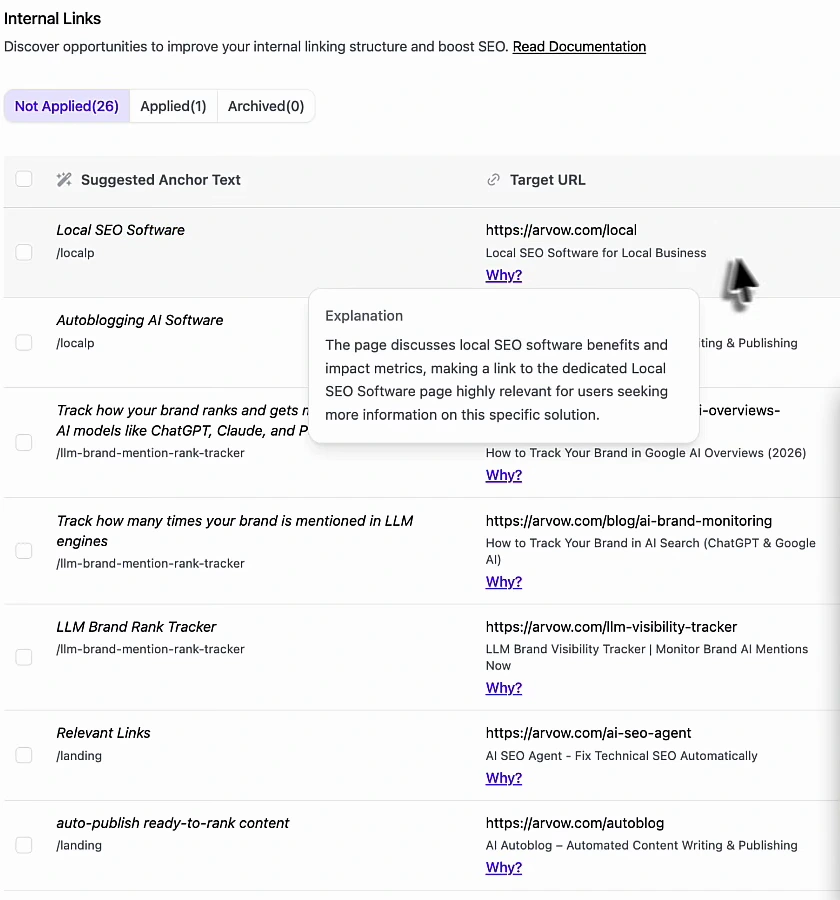
Each suggestion shows the source page, the anchor text, the target and an explanation. You can apply them one at a time or in bulk. The same screen handles image alt text (it applied 20 in one go in the video), meta titles, meta descriptions, canonicals, FAQ schema and article schema.
Still read the list before you bulk-apply. Most suggestions are good: "Local SEO Software" from a local SEO page to our local SEO product page is exactly right. But "Relevant Links" as anchor text isn't an anchor you'd ever choose, and "Autoblogging AI Software" on a local SEO page is a stretch. The agent saves you the hours of finding the opportunities; deciding which ones to apply still takes a minute of judgment. Our approach to the structure behind it is in our internal linking strategy, and the alt-text side is covered in bulk alt text for SEO.
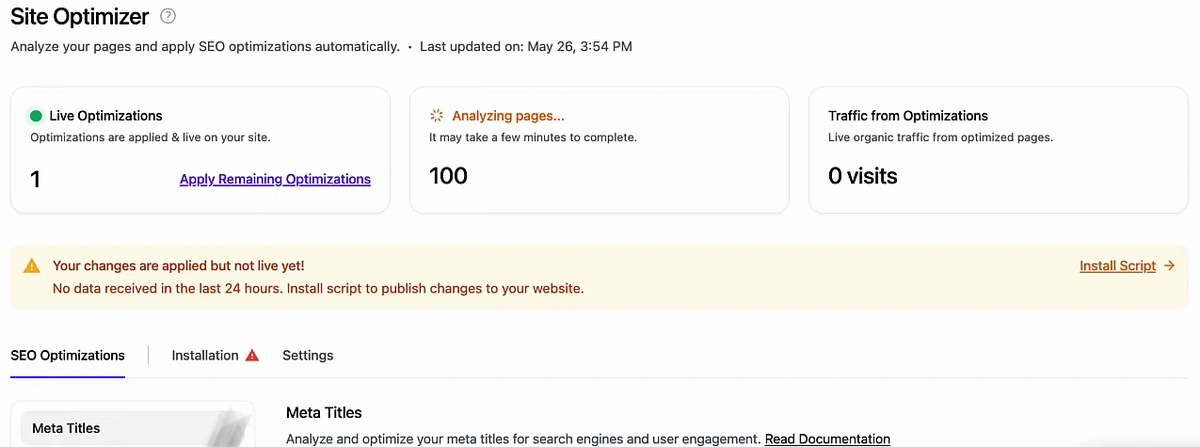
A note on our own numbers. On arvow.com, Site Optimizer shows one live optimisation, 0 visits from optimisations, and a banner saying changes are "applied but not live yet" because the script hasn't reported in 24 hours. On our own project the script simply isn't reporting. Applying a fix in the dashboard isn't the same as having it live. If you use any tool that changes your pages through a script, check that the script is actually reporting before you judge the results. Our AI SEO agent page explains how the fixes are applied.
5. Automated content: research, writing and publishing
The fifth task is the one people most often say doesn't work: fully automated content, where an agent researches the topic, writes the article and publishes it (news, YouTube-to-article and regular blog posts). It still works, and it still gives you a lot of leverage. I made a whole video on how I do it, and it's written up in how to rank #1 on Google. The setup side, from templates to publishing, is in how we automate content creation.
What AI agents for SEO can and can't do yet
All five follow the same pattern: an agent, plus real data, plus permission to act, plus you reviewing the output. Leave out the data and you get generic advice. Leave out the action and you get a report nobody implements. Leave out the review and you get 2,940 submissions you think are 2,940 links.
- Can do on their own today: profile and directory links, data pulls and diagnosis, internal links, alt text and meta fixes, scheduled content.
- Can do with a person approving: layout changes for conversion, which pages to fix first, which suggestions to apply.
- Can't do yet: editorial links that need a relationship or a pitch, and judging whether a "live" link is worth having.
My view is that this is where SEO is going: you as the brain, moving agents around and deciding where they work. The tools will get better. Checking what they actually did, the way the agent's own "verified live" list does, stays your job.
FAQ
Can AI agents do SEO on their own?
Parts of it. Today agents can build profile and directory links, pull and interpret SEO data, fix internal links, alt text and meta tags, and publish content on a schedule. Editorial link building and the strategy behind it still need a person.
What's the difference between an AI agent and an AI chat for SEO?
A chat answers the question you typed. An agent has tools, such as a browser, an email inbox, API access or write access to your site, and keeps working without you. The difference shows when you close your laptop: the chat stops, the agent doesn't.
Are backlinks built by AI agents safe?
The ones agents can build today are mostly profile and directory listings, the same links people have always built by hand. Their value varies a lot. Check each listing's page authority, not just the domain's DR, and keep an eye on how many submissions actually go live.
Which AI agents do you use for SEO?
Grok for the autonomous backlink work (it has its own computer, so it never stops), Codex with PostHog for conversion changes, and Arvow's agents for SEO data, technical fixes, backlinks and content. The principle matters more than the tool: give the agent data and a way to act, then check its work.
Want the backlink, technical SEO and content agents without building them yourself? See Arvow's AI SEO agent.
Generate, publish, syndicate and update articles automatically
The AI SEO Writer that Auto-Publishes to your Blog
- Cancel anytime
- Articles in 30 secs
- Plagiarism Free