
Is SEO Dead in 2026? Why I'm "Quitting" SEO (and What I'm Doing Instead)

Short answer: no. SEO is not dead in 2026. It is still bringing arvow.com most of its traffic and most of its customers. What is dying, faster every year, is the thing that made any single SEO tactic worth doing: leverage. Once everyone can do what you do, at the press of a button, you are back where you started.
That is why I opened the video below by saying I'm quitting SEO. I'm not, and I say so at the end. I'm quitting SEO the way it has been done for years, and this article is the reasoning, with my own dashboards on screen, including the numbers that don't flatter me.
Where I'm starting from
This isn't a "my traffic died" story. Here is the Ahrefs overview of arvow.com as it was on screen at the start of the video, with six-month changes:
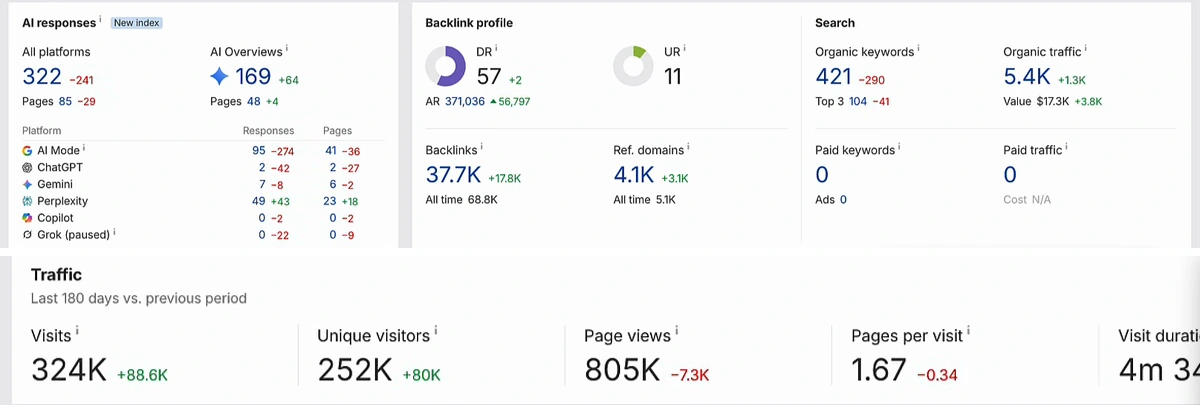
Read the whole thing, not just the green. Organic traffic is up (5.4K, +1.3K), referring domains are up (4.1K, +3.1K), backlinks are up (37.7K, +17.8K), DR is 57 and Ahrefs' estimate of total visits is 324K over 180 days, up 88.6K. Also on the same screen: organic keywords are down 290 to 421, and the number of AI responses Ahrefs sees us in is down 241 to 322, almost all of it in Google's AI Mode. Perplexity went the other way (+43). In the video I say we have "a ton of mentions across all these LLMs"; the card says we have fewer than six months ago. Both are true, and the second one is the point of this article: a channel that was giving us leverage is giving us less of it.
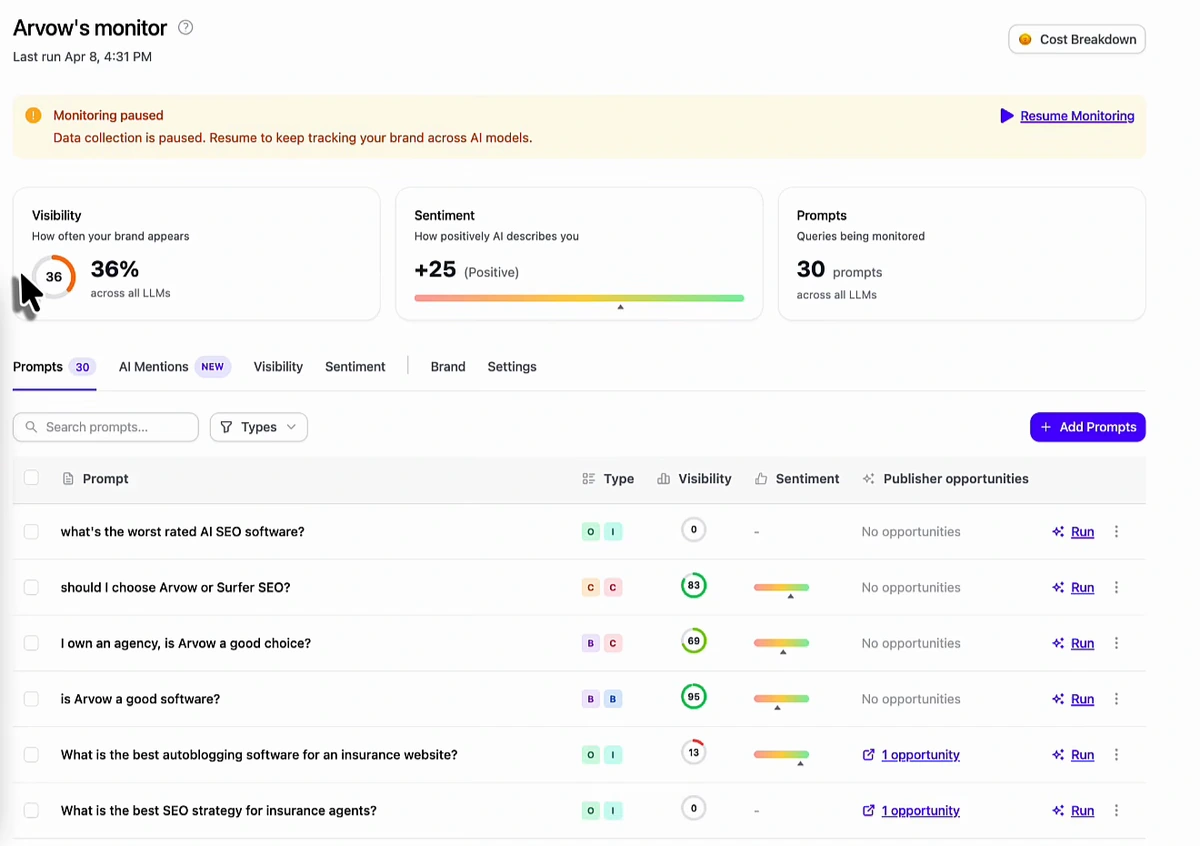
The brand monitor tells the same story at prompt level. Across the 30 prompts I track, Arvow appears in 36% of AI answers, with a +25 sentiment score. (That dashboard's last full run was April 8, 2026, so treat the 36% as a spring number, not a current one.)
1. Everyone can't win
The Miro card I put up at the start of the video has three lines on it, and the rest of the argument hangs off them:
everyone can't win, to have winners we need losers – everyone can't rank #1
the more automated it gets, the more the real business matters
people are competing for the wrong prize
For me to rank first, my competitors have to rank second or third. For my brand to be the first one an AI assistant names, somebody else's has to be named second. There is one top slot. Any strategy that promises "everyone who does this will rank" is describing a strategy that, once everyone does it, ranks nobody. That is not pessimism, it's arithmetic.
2. The billboard analogy
Picture a highway with a thousand cars a day and one billboard beside it. Every car sees that billboard. The company that owns it has leverage: attention nobody else is competing for.
That billboard was Google Ads in 2010, at two cents a click. It was TikTok five years ago, YouTube ads three years ago, SEO ten years ago, flyers before any of that. Then the other companies selling the same thing notice the billboard is working, and they put up billboards on the same highway. The original one gets less attention. Add enough billboards and drivers stop looking at any of them. The channel is saturated, and the people who had leverage have two choices: quit, or find leverage somewhere else.
| Channel | When it had leverage | What saturation looks like now |
|---|---|---|
| Google Ads | Around 2010, about 2 cents a click | The same clicks at $5 to $10; e-commerce brands losing money on the first order and hoping lifetime value covers it |
| Cold email | When a personalised Loom video was rare | Everyone sends AI-personalised video; the prospect gets ten of them a week |
| Private blog networks | Roughly a decade ago | Worked so well and so widely that Google classed it as link spam |
| GEO listicle placement | A few months ago | I get around ten emails a day asking to be added to listicles on our site |
| Push-button AI backlinks | Now | If I have the button, so do my competitors |
The rows are the examples from the video; the numbers in them are my recollection on camera, not a study. You can make the billboard bigger, add lights, make it jump up and down. Each of those buys you time, and each of them gets copied too.
3. Marketing is leverage, and leverage expires
Cold email is the cleanest example I've lived through. To sell our LLM rank-tracking software, I could buy a list, record one Loom walkthrough, and have AI turn it into hundreds of "personalised" versions that said each prospect's name. It worked, for a long time, because I was the only video in their inbox. Then it stopped, not because the tactic got worse but because there were ten of us in the inbox doing the identical thing. Nothing about my email was unique any more.
That is the whole mechanism. If you have leverage, a channel works. When you lose it, the channel stops working. The tactic is irrelevant; the scarcity is everything.
4. What happens when everyone uses AI
This part applies to my own product, so I'll say it plainly. Arvow's promise is that AI agents build your backlinks, write your content and track your mentions so you rank higher on Google and get recommended in AI search. The customers who see results with it today see them largely because they are competing against businesses that are still doing this by hand, or not doing it at all. Software like ours is leverage.
Now imagine every business owner with a website uses a tool like it. Everyone has the backlinks. Everyone has the content. Everyone loses leverage, and we're back to line two of the Miro card: the more automated the marketing gets, the more the real business matters. Who actually has the better product, the better reviews, the better reputation. That's a good place for the market to end up. It is a bad place to be relying on a tactic.
5. The SEO treadmill, and the GEO version of it
SEO has always had a fresh tactic every six months, and every one of them follows the billboard curve. Private blog networks are the textbook case: they got penalised because they worked and everybody used them. I say in the video that they still work; I'll add here that Google's spam policies list them as link spam, so "works" and "safe" are different questions, and I'm not recommending them.
The current version is GEO, getting your brand recommended in AI answers. The tactic that was new a few months ago: track the prompts you want to be named for, open the answers you're missing from, notice that the sources are almost always listicles, and email the listicle owners asking what they charge to add you as item six. Here is what that looks like on one of my own prompts.
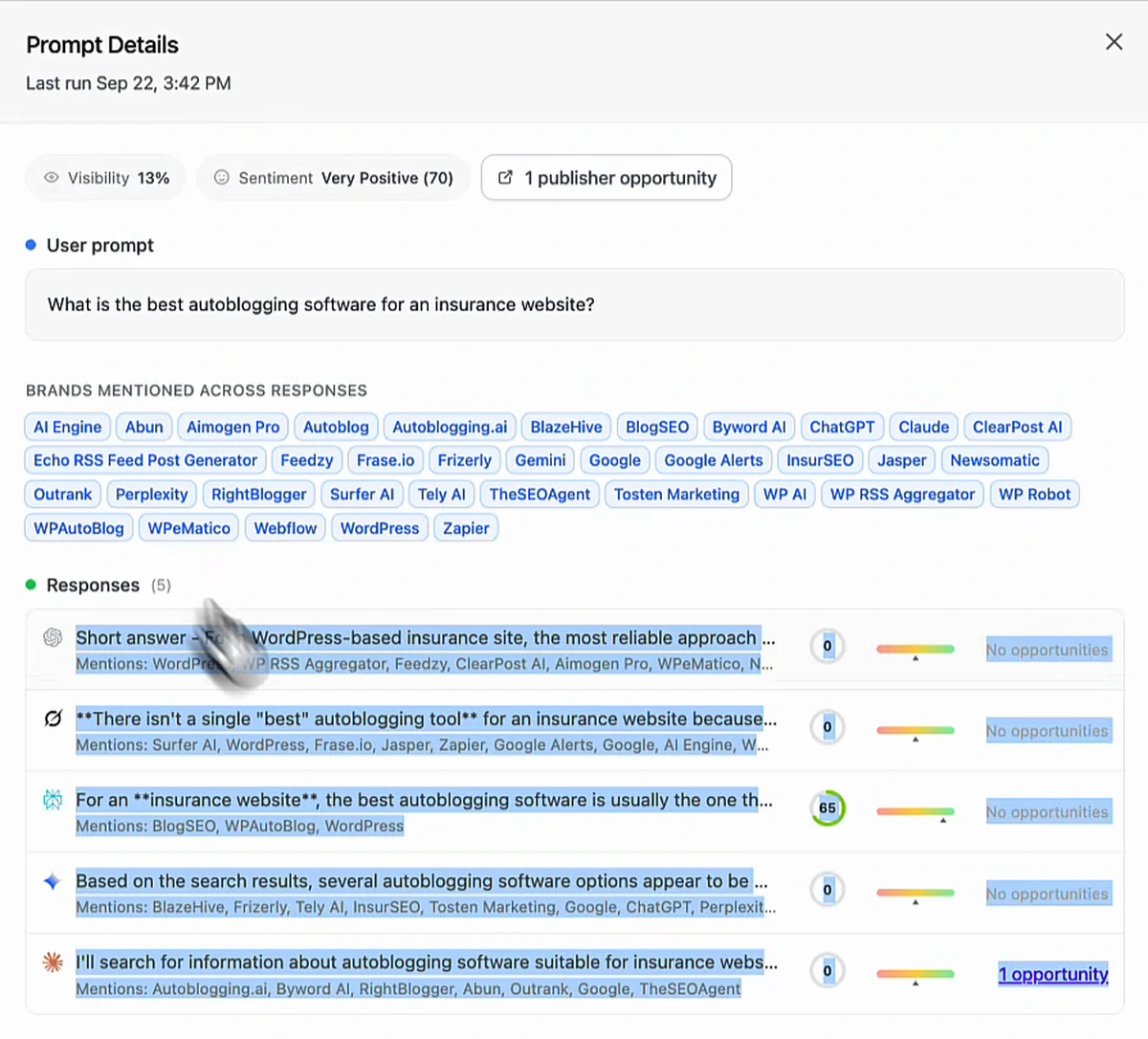
Five assistants answered "What is the best autoblogging software for an insurance website?" and between them named 36 brands. Arvow is in one answer. Open that answer and look at what it cites:
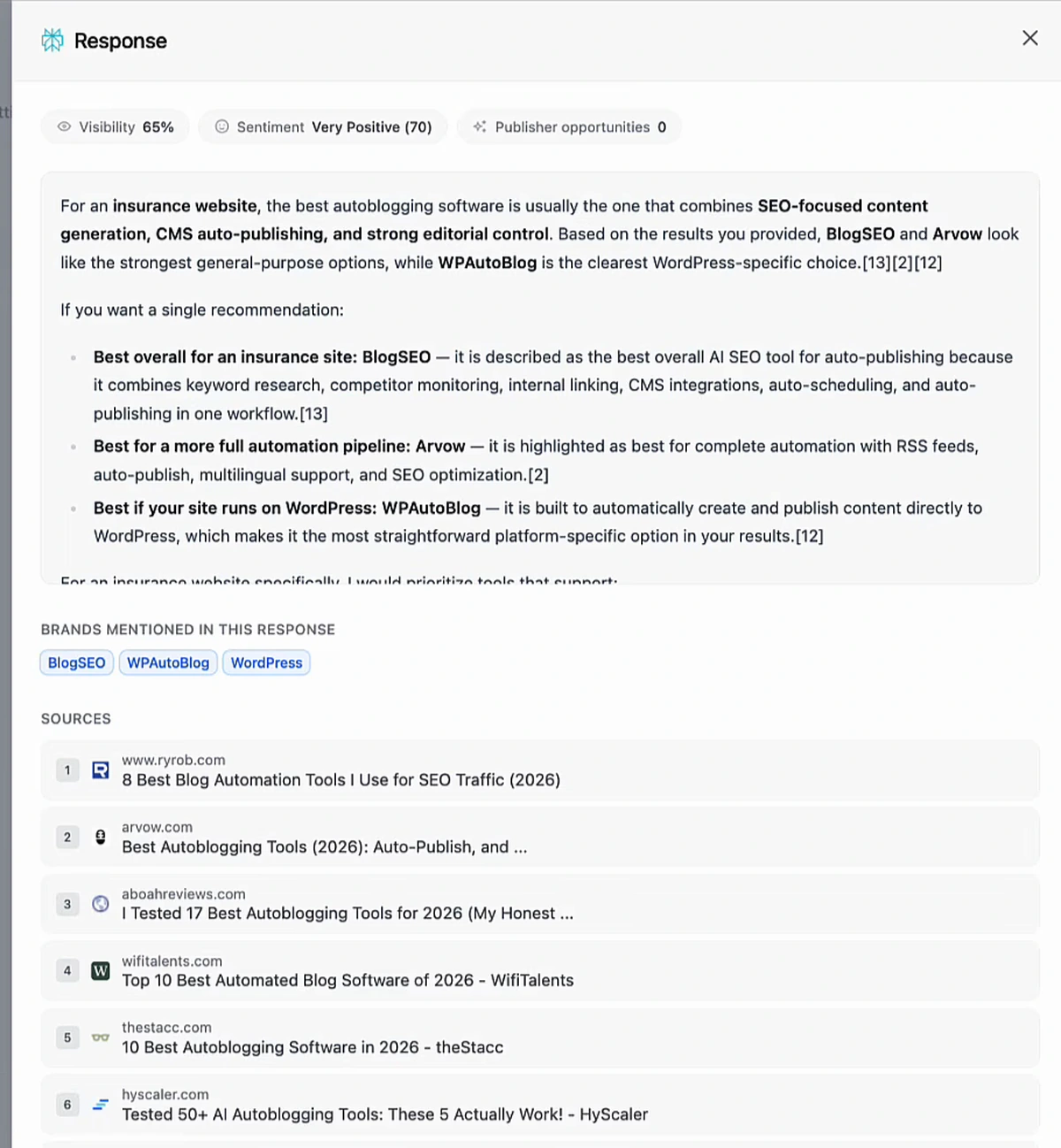
Six sources, and every one is a "best X tools" listicle. Being in those lists is what gets you named. So people pay to be in them, and I get the emails asking to be added to ours. It still works today, the way a road with two billboards still works. When every brand is in every listicle, no brand is in any listicle, and the assistants will weight something else. One more honest note on that screenshot: source number two is our own listicle. Publishing your own comparison page is a legitimate, durable version of the tactic, and I'd rather you did that than paid for item six. For the mechanics, see how to get mentioned in AI search.
6. AI makes the cycle faster
My previous video showed an AI agent building DR 60 to 70 backlinks for us on autopilot, every day, without me touching it. It's a genuine push-button solution. And that's the problem: if I can have the button, you can have the button, and so can every competitor I have. If we all press it, we all move up together, which is the same as nobody moving. The leverage I had the day I built it is already decaying, and AI means every new tactic will be copied in weeks rather than years.
7. What I'm doing instead
The classic SEO loop, build links, publish content, optimise pages, still works and will keep working. Our own chart keeps going up on it. If you want steady, compounding growth, do it and don't stop; our piece on whether backlinks still work has the data. But steady isn't the same as leverage, and I can't afford to be complacent and wait for a new tactic every six months. So, concretely:
- Test new strategies at a much higher frequency, and budget time and money for tests that fail. Most billboards go up on roads that then get closed. The one that pays for the rest only shows up if you keep building them. This is how I worked in 2016, buying domains and trying things, and it's how I'm working again.
- Look for the places competitors haven't found yet. The three plays I'm currently running are in how to rank #1 on Google and AI search: automated niche news, charity backlinks, and getting into the pages AI answers already cite.
- Keep some things to myself. I'll be transparent about this: not everything we do appears on this channel, because the moment I publish a strategy, its leverage starts draining. If I share it, it's usually because we've already had our run with it.
- Measure the leverage, not the activity. The two dashboards above are the scoreboard. If AI responses keep falling while backlinks keep rising, the backlinks aren't the lever any more, and I need to know that from the numbers rather than from a feeling. How to increase AI visibility covers what to change when the AI side slips.
What this means if you're not me
- If you're asking "is SEO dead" because your traffic fell, check which lever stopped working before you abandon the channel. Organic keywords down and organic traffic up on the same screen (see above) is a change in what ranks, not a dead channel.
- If you're asking because a tactic stopped working, it probably got saturated. That is the normal life cycle of every tactic, in every channel, and the answer is a new lever, not a new channel.
- Every automation you can buy, your competitors can buy. Use it, because not using it means losing to those who do, but don't mistake it for an advantage that lasts.
- When everyone has the same tools, the real business decides. Reviews, product, reputation, the things an AI assistant can't be bought into saying.
See where your brand is and isn't being named across ChatGPT, Gemini, Perplexity and the rest, prompt by prompt. Try the LLM visibility tracker.
FAQ
Is SEO dead in 2026?
No. It is still the main traffic source for arvow.com, and the site's organic traffic, referring domains and estimated visits were all up over the six months before this was recorded. What's dead is the lasting advantage from any single tactic: once a method is widely copied, it stops being a lever.
Did AI kill SEO?
AI changed two things. It created a new surface (AI answers) to compete for, and it shortened the time between a tactic working and everyone using it. Neither kills SEO; both make standing still more expensive.
Do backlinks still work?
Yes, and the Ahrefs card above shows ours rising alongside organic traffic. The caveat is that if backlinks can be built at the press of a button, so can your competitors', so they stop being a differentiator on their own.
Is GEO the new leverage?
It was, briefly. Paying to appear in the listicles AI assistants cite is already a crowded tactic, which you can see in the volume of placement requests site owners receive. Publishing your own comparison pages and earning genuine mentions is the durable version.
So should I stop doing SEO?
No. Keep the compounding work going, treat every automation as table stakes rather than an edge, and spend a fixed share of your time testing things that might not work. That is the only way to find the next lever before everyone else does.
Generate, publish, syndicate and update articles automatically
The AI SEO Writer that Auto-Publishes to your Blog
- Cancel anytime
- Articles in 30 secs
- Plagiarism Free