
How to Sell AI Visibility Reports: A $200–$650/Month Service (2026)

Most business owners have no idea whether ChatGPT recommends them. Not "they rank badly" — they have never checked, because until recently there was nothing to check. That gap is the whole business here: you find out for them, put it in a report, and charge a monthly fee for it.
The pitch is deliberately small. You are not fixing anyone's AI visibility to start with — you are measuring it. The fixing is the upsell, and it's where the money eventually is, but it's not what gets you your first client. Here's the full walkthrough from a July 2026 breakdown on Vasco's SEO Tips: the deliverable, what it costs you to produce, what to charge, and how to get the first three people to say yes.
Why a business will pay to know this
Ask ChatGPT for a family-friendly Indian dinner in Dallas and you don't get ten blue links. You get four named restaurants, ranked, with reasons:
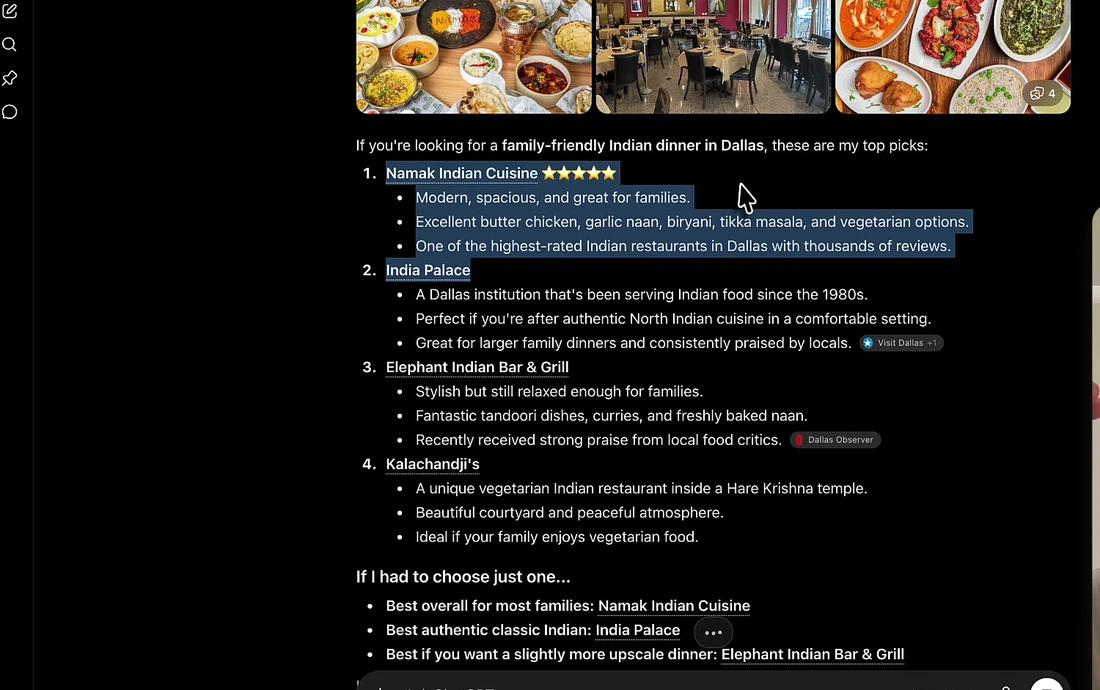
Four businesses get named. Every other Indian restaurant in Dallas does not exist in that conversation. The same structure runs for "best slim wallet", "plumber near me", "gift ideas for my dad turning 50" — a finite set of prompts a real customer would actually type, and a short list of brands that come back.
That's the sales conversation, and it doesn't require you to be an SEO expert. It requires you to be the first person to tell a business owner which list they're on and which they're missing.
What you're actually selling
The service is reporting on a business's AI search mentions: which prompts their customers would plausibly ask, whether the brand shows up for each, and whether the models describe them positively or negatively. Delivered weekly or twice a month.
It works for e-commerce, local businesses, agencies and software — anything with customers who ask an assistant for a recommendation. The reason it's a good first service is that it is pure measurement. You are not promising a ranking. You are not on the hook for a result. You are selling visibility into something the client currently cannot see at all.
Building the deliverable
Setup is a monitor per client. Paste the client's URL, let it read the site, and it proposes the prompts worth tracking — a mix of branded and unbranded:
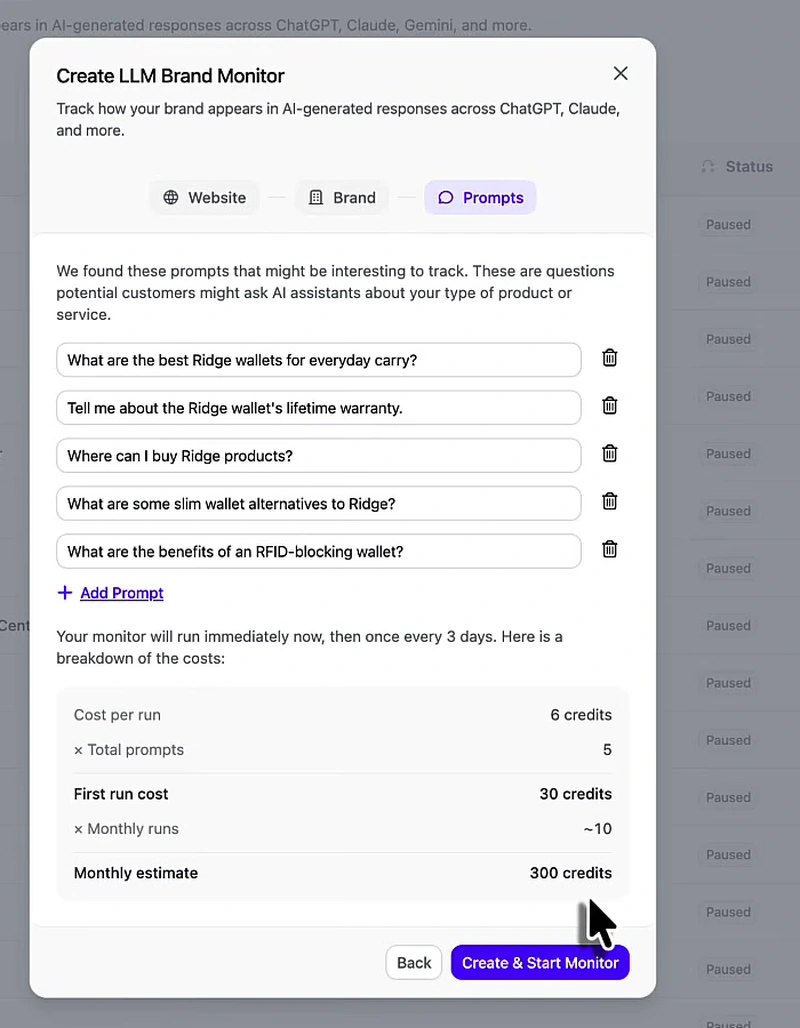
Two things to get right here. First, prompt selection is the actual skill in this job: there are infinite possible prompts, but only a small set a real buyer of this business would type. A plumber doesn't need 40 prompts; it needs the six that precede a phone call. Second, keep a deliberate mix — branded prompts ("where can I buy X") to prove the tool works in the pitch, unbranded category prompts ("best slim wallet") because that's where the client is actually losing.
The monitor then runs on a schedule — every three days in this walkthrough — so the weekly report writes itself from a running dataset rather than a one-off snapshot.
What the report says
The headline numbers are visibility and sentiment across all the major models:
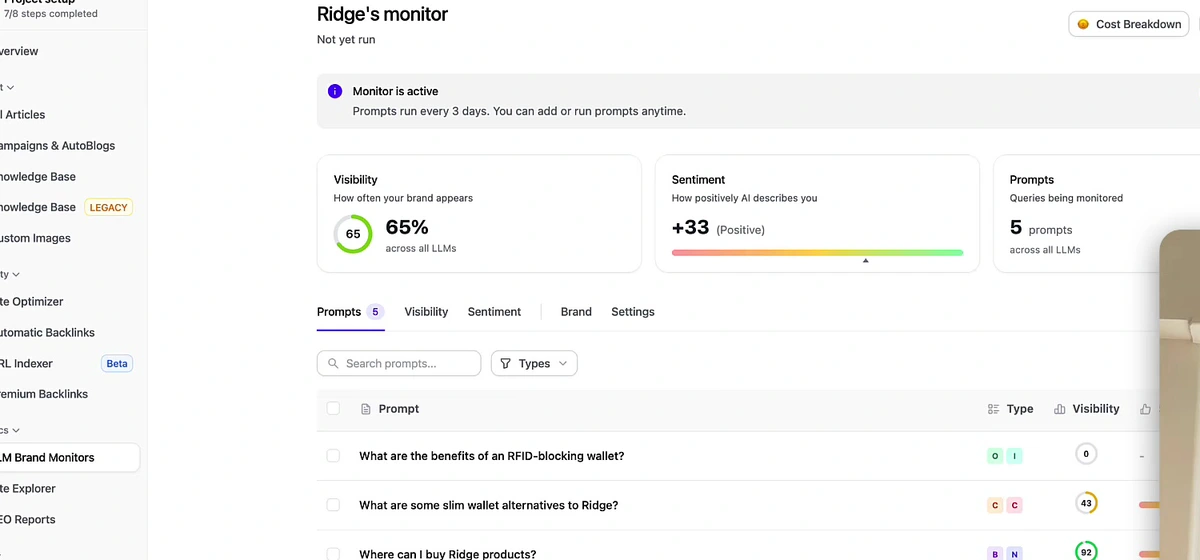
Then the part that actually sells the upsell — per-prompt scores. Look at the spread:
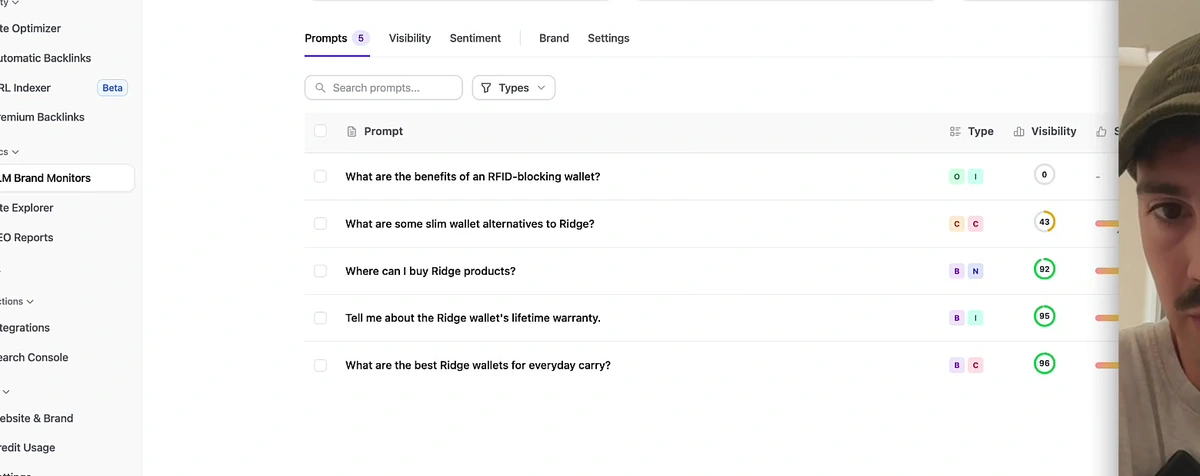
Read that table the way a client will. Ridge dominates every question that already contains the word "Ridge" — which is worth nothing, because those people had already decided. On the one prompt describing the product category itself, and RFID blocking is one of Ridge's own headline selling points, they score zero. Competitors get named there instead.
That contrast is the entire consulting pitch, and you didn't have to argue for it. The client's own data made the case.
Sentiment splits by model too, which matters because visibility without sentiment is half a picture — a brand can be mentioned everywhere and described badly:
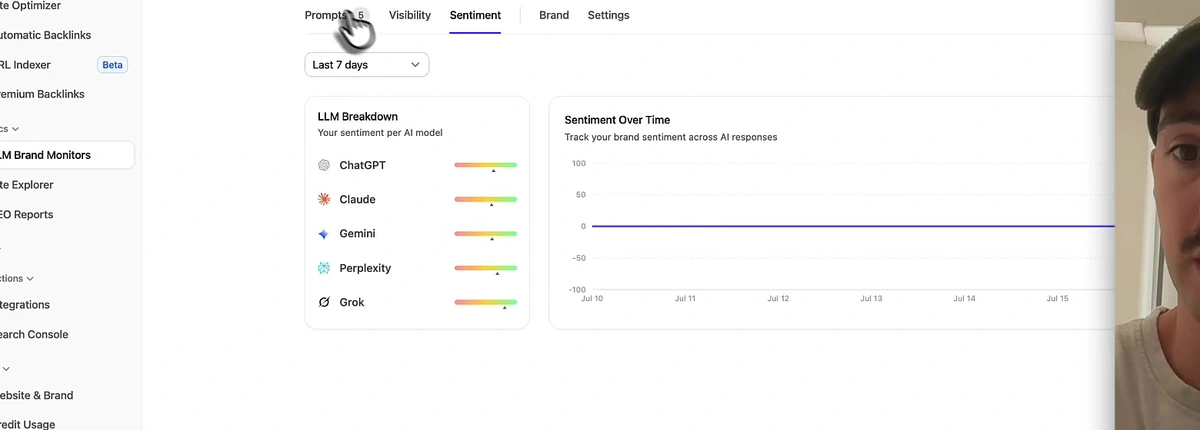
If sentiment is negative anywhere, the sources behind that response are the report's most valuable page: you can show the client exactly which pages taught the model to describe them that way. Our AI brand monitoring guide and the fuller AI visibility tracker walkthrough cover the mechanics in more depth than a client report needs.
What to charge
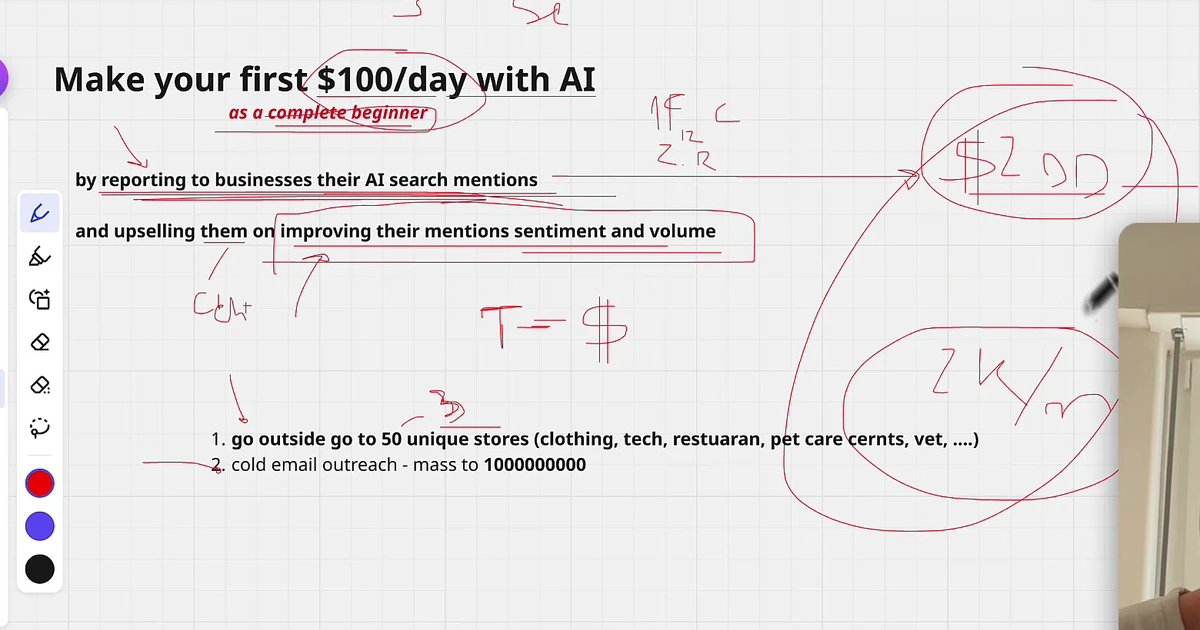
The figure given in the walkthrough is $200 to roughly $650 a month per client for the reporting alone, depending on the business. Ten clients at $200 is $2,000 a month. Treat those numbers as the creator's estimate rather than a surveyed market rate — but do the margin arithmetic, because that part is checkable: at roughly 300 credits a month to run a five-prompt monitor, the delivery cost per client is small against a $200 floor. This is a high-margin service precisely because the work is measurement, not labour.
One firm piece of advice from the walkthrough: don't do the reporting for free. A free report positions the whole thing as a lead magnet and makes the upsell conversation harder, not easier. Charge a small fee, deliver something real, then expand.
Getting the first three clients
Two routes, and the counterintuitive one is better if you're starting from zero.
Walk into physical stores. Clothing, tech, phone repair, vets, pet care, restaurants — every one of them sells online now, and almost none has checked whether AI recommends them. Go in with a report already made. Run one or two prompts on their brand beforehand, print it, and open with what you found rather than with what you sell. The suggestion in the video is 50 stores; the claim that at least three will say yes is the creator's confidence, not a measured conversion rate, so treat 50 as the effort level rather than a formula.
The reason this works is friction. Nobody wants to leave the house and talk to strangers, so nobody does — which means the in-person channel is uncrowded in a way cold email hasn't been for years.
Cold email at volume. Scalable, and genuinely mass-market, but you're buying lists and sending software, you're competing with everyone else doing the same thing, and it's a worse first move for a beginner. Use it once the offer is proven, not to prove the offer.
The branded prompts earn their place here. A prompt containing the client's own name will almost always return a mention — that's not an achievement, but it is a live demonstration that the tracking is real, in the room, on their brand. Use it to open the door, then show the unbranded prompt where they score zero.
The upsell is the actual business
Reporting gets you in and pays the bills. The money is in what comes after: getting the client mentioned more often, and described better. That's a bigger engagement, priced accordingly, and you've already proven you can measure the result — which is the hard part of selling any visibility work.
Sequence matters. Lead with reporting, deliver it for a month or two, then propose the fix using their own trend line as the argument. Pitching the fix first means asking a stranger to trust a claim; pitching it second means pointing at a number you've been sending them for six weeks. When you get there, increasing AI mentions and getting cited by ChatGPT are the two playbooks that work, and if you're running this across a roster, LLM visibility tracking for agencies covers the multi-client setup.
Honest limits
Three things worth knowing before you sell this.
It's a service business, not leverage. You are trading time for money, deliberately — that's what makes it beginner-friendly and also what caps it. Ten clients is a real income; it is also ten reports a month with your name on them.
Prompt choice is where you can be wrong. Track the wrong prompts and the report is worthless regardless of how good the dashboard looks. This is the part that takes judgement about the client's actual buyers.
The measurement is a sample, not a census. Model answers vary between runs and between users. A visibility score is a directional signal on a set of prompts you chose — useful, and honest to present as a trend, misleading if you present it as a ranking.
FAQ
What exactly do I deliver to the client?
A recurring report — weekly or twice monthly — showing which prompts you track, whether their brand appears for each, how positively the models describe them, and which competitors appear where they don't. Screenshots of the per-prompt table and the sentiment trend are the substance of it.
How much should I charge for AI visibility reporting?
The walkthrough suggests $200 to about $650 a month per client for reporting alone, scaling with the size of the business. That's an estimate rather than a market survey, but the margins support it: running a five-prompt monitor costs on the order of 300 credits a month.
Do I need SEO experience to sell this?
No, and that's the point of leading with reporting. You're measuring and presenting, not optimising. SEO judgement becomes necessary at the upsell stage, when you're being paid to move the numbers rather than report them.
Which prompts should I track for a client?
A small set a real buyer would type, mixing branded prompts ("where can I buy X") with unbranded category prompts ("best slim wallet", "family-friendly Indian dinner in Dallas"). Branded prompts demonstrate the tool in the pitch; unbranded prompts are where the client is actually losing business.
Is walking into stores really better than cold email?
For a beginner with no case studies, usually yes — the channel is uncrowded precisely because it's high-friction, and you can hand over a printed report on the spot. Cold email scales further but puts you in the same inbox as everyone else running the same play.
Want to build the deliverable this week? Arvow runs the LLM brand monitors behind this service — visibility and sentiment across ChatGPT, Claude, Gemini, Perplexity and Grok, per prompt, on a schedule — so your client report is a screenshot rather than a research project.
Generate, publish, syndicate and update articles automatically
The AI SEO Writer that Auto-Publishes to your Blog
- Cancel anytime
- Articles in 30 secs
- Plagiarism Free