
Commodity Content: What Google Means and How to Avoid It (2026)

Commodity content is Google's name for the page anyone could have written: common knowledge, repackaged. Google's own example is "7 Tips for First-Time Homebuyers". Non-commodity content is the page only you could have written, because it comes from something you did, saw or measured. Google's example of that is "Why We Waived the Inspection & Saved Money: A Look Inside the Sewer Line".
The term comes from Google's guide to optimizing for generative AI features in Search, published in May 2026. In my video I use one real site, a no-code app builder, to show what happens when a blog is built mostly from commodity articles, and how to make AI write the other kind. This article is the written version, with the screens from the video and some things I checked on the live site afterwards. One of those checks changes the story, and I'll say plainly where.
What Google actually says about commodity content
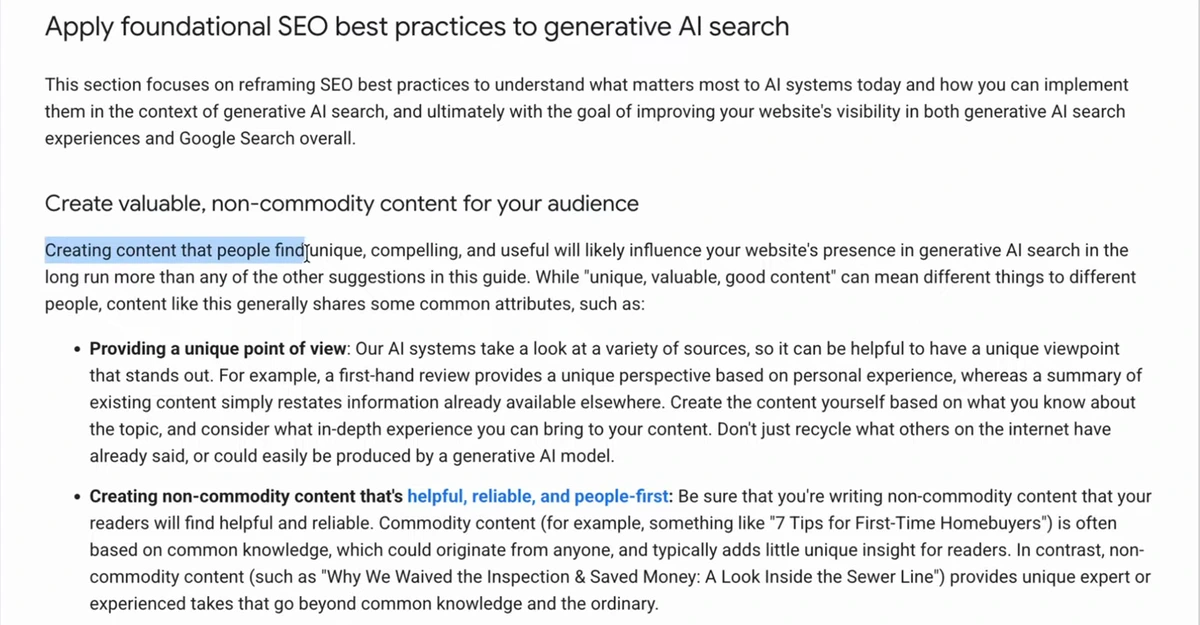
The passage sits in a section called "Create valuable, non-commodity content for your audience". Google says content people find unique, compelling and useful will likely influence your presence in generative AI search over time more than anything else in the guide. It then lists what that kind of content has in common, and two of the points do most of the work:
- A unique point of view. A first-hand review gives a perspective from personal experience, while a summary of existing content only restates what is already out there. Google tells you not to recycle what others have said, or what a generative AI model could easily produce.
- Non-commodity content that is helpful, reliable and people-first. Commodity content is "often based on common knowledge, which could originate from anyone". Non-commodity content gives "unique expert or experienced takes".
Two things about this guide matter for the rest of the article. First, it is advice, not a penalty notice: the word "penalize" doesn't appear in it, and nothing in it says sites lose traffic for publishing commodity pages. Second, it doesn't tell you to stop using AI. It tells you not to publish what AI could produce on its own. Those are different instructions, and the second one is what the rest of this article is about.
The case: a site that climbed, crashed and came back
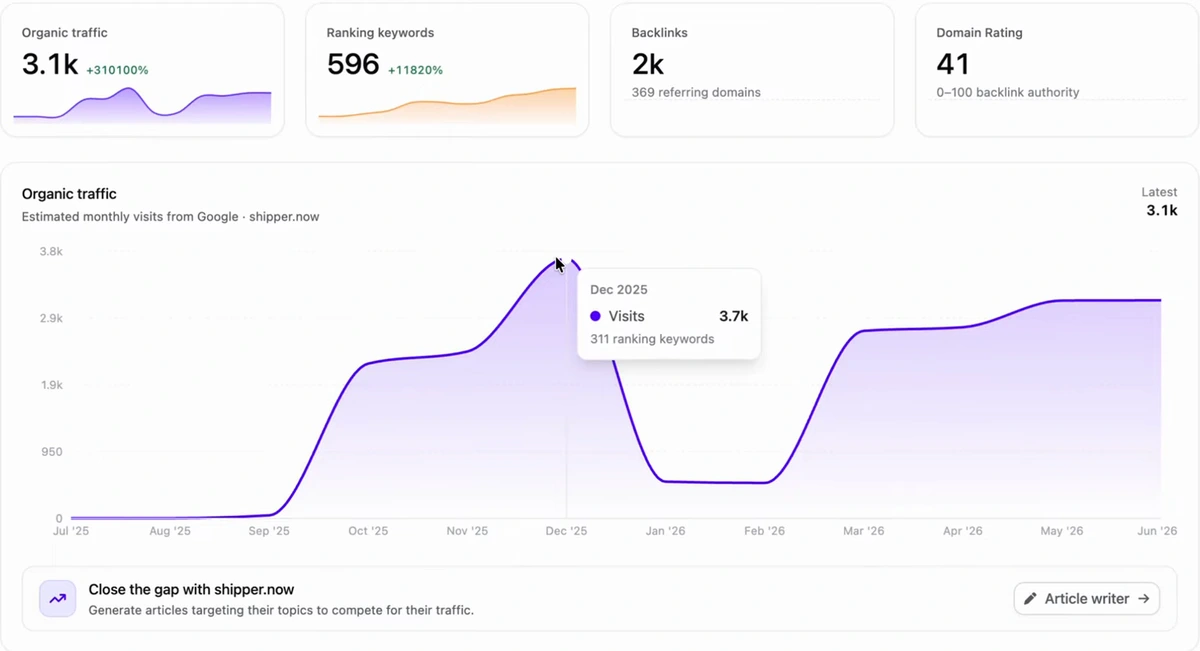
The example is shipper.now, an app that builds apps by chatting with AI, in the same space as Lovable. It is a young product competing with very well-funded tools, so organic search was its main growth channel. These are the numbers from the video, recorded in June 2026, for US traffic only:
| Month | Estimated US visits | What was happening |
|---|---|---|
| Sep 2025 | Near zero | The SEO push starts |
| Dec 2025 | 3.7k (311 ranking keywords) | Peak |
| Jan to Feb 2026 | About 520 | The crash |
| Jun 2026 | 3.1k (596 ranking keywords) | Recovered |
My explanation in the video is that the site grew the old way, with fast generic AI articles published in volume, got caught, and then came back by switching to first-hand content. I still think the direction of that advice is right. But having gone back to the site since, the story is messier than "Google's new guideline penalized them", and you should know where.
What the live site adds to the story
The timeline doesn't allow the guide to be the cause. Google published the generative AI guide on May 15, 2026. The crash happened in January 2026, four months earlier. Whatever hit the site, it was not that page. The guide puts into words what Google's systems were already rewarding, which is why it is still a useful reference, but it is not an update and it did not cause the drop.
The "old way" is visible in the site's own sitemap. On October 17, 2026 shipper.now's sitemap lists 150 blog posts and 811 pages under /build/, all last modified in November and December 2025. They are template pages along the lines of "Build Your Bird Marketplace App", "Hat Marketplace App" and "Dog Marketplace App". That is a textbook commodity pattern: hundreds of pages that differ by one word, built in the two months before the crash. They are still live today. We can't see from outside whether they caused the drop, but if I owned that site they would be the first thing I'd look at, well before the blog.
The recovery is mostly the brand. This is the screen from the video that matters most, and I didn't stop on it long enough.
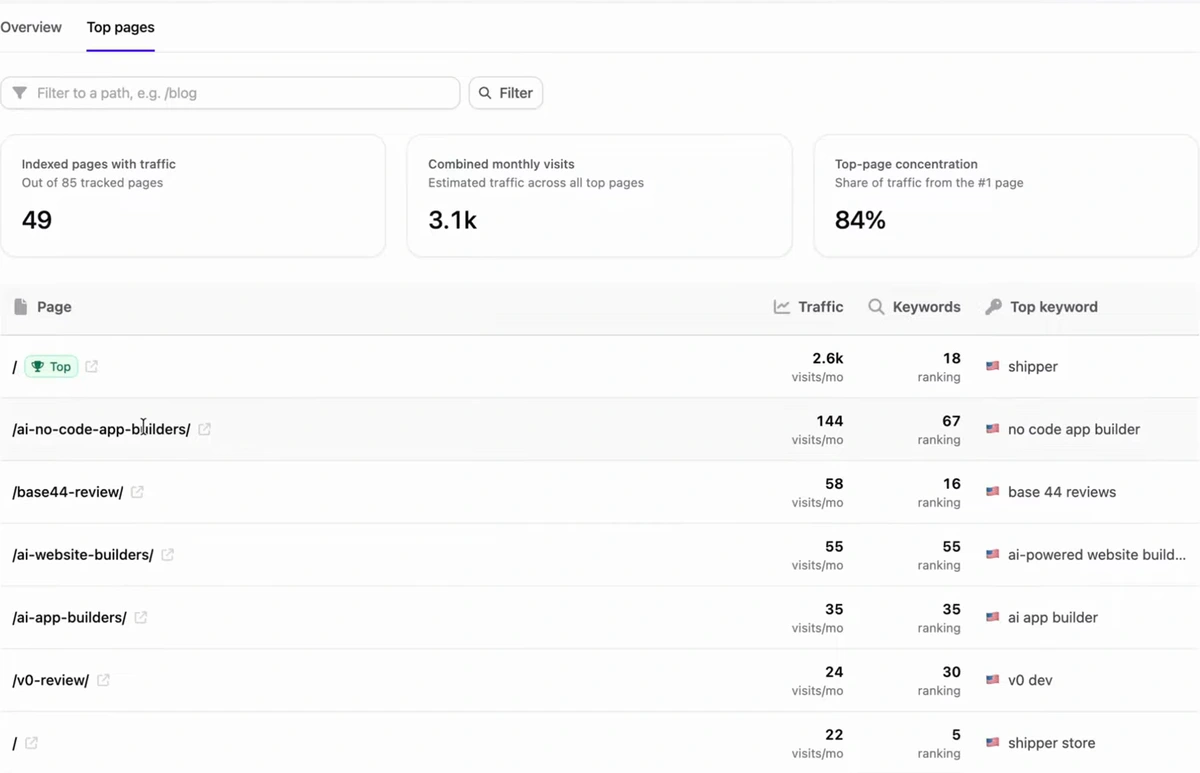
Of the 3.1k monthly visits, 2.6k land on the homepage, and its top keyword is "shipper", the brand name. The first-hand review article I use as the example of the new way brings 144 visits a month. The next pages bring 58, 55, 35 and 24. So the recovery chart is mostly people searching for the product by name. That is good news for the business, but it isn't proof that first-hand articles brought the traffic back.
One more detail from the live page: the article I hold up as the new way, "Best AI No-Code App Builders in 2026: Tested & Reviewed", was first published on November 12, 2025, before the crash, and last updated on August 28, 2026. So it existed on both sides of the drop.
None of this makes non-commodity content a bad idea. It means this site is a weak proof of it, and I'd rather you know that than build a strategy on a chart that is mostly branded traffic. If your own traffic fell off a cliff, start with our guide to diagnosing a Google traffic drop before you rewrite anything.
What first-hand content looks like on the page
What the site gets right is the voice of its best pages. The no-code builders article opens by naming the problem with its own category: most "top AI app builder" lists are written by AI. Then it says what makes this one different, in concrete terms the writer can be held to.
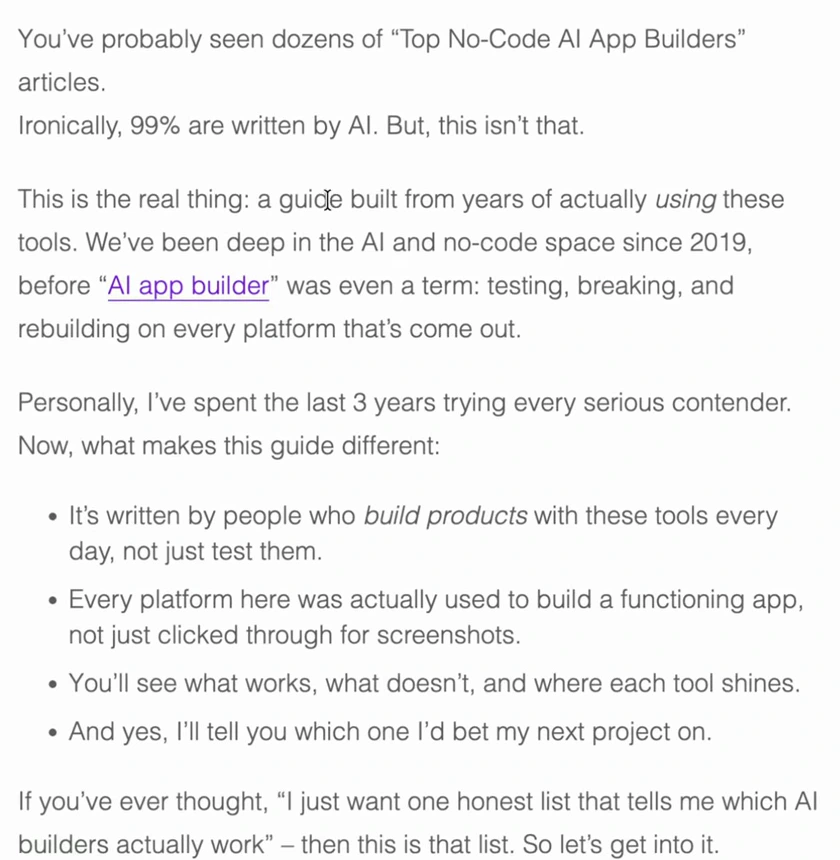
The titles across the blog follow the same pattern: "v0 vs Cursor: I've Used Both So You Don't Have To!", "Replit vs Base44: I've Used Both & Here's My Take", "Lovable vs Base44: I've Tried Both For You". A generic comparison and a first-hand one can target the same keyword. The difference is that the second one makes a promise only someone who did the work can keep.
The checks behind those promises are what make them worth something to readers: which version you tested, for how long, what broke, what it cost, what you'd pick. A title that says "I tested" with nothing behind it is still commodity content, just with a different headline.
How to make AI write non-commodity content
You can still use AI here, and Google's guide doesn't say otherwise. The rule is that the material has to come from you. AI does the structure, the drafting and the formatting. You supply the part a model cannot know.
The way I do it in the video is with Arvow's custom templates. Most article generators take a keyword and a title. A custom template lets you write the whole generation prompt and outline yourself, and define variables that have to be filled in every time you create an article.
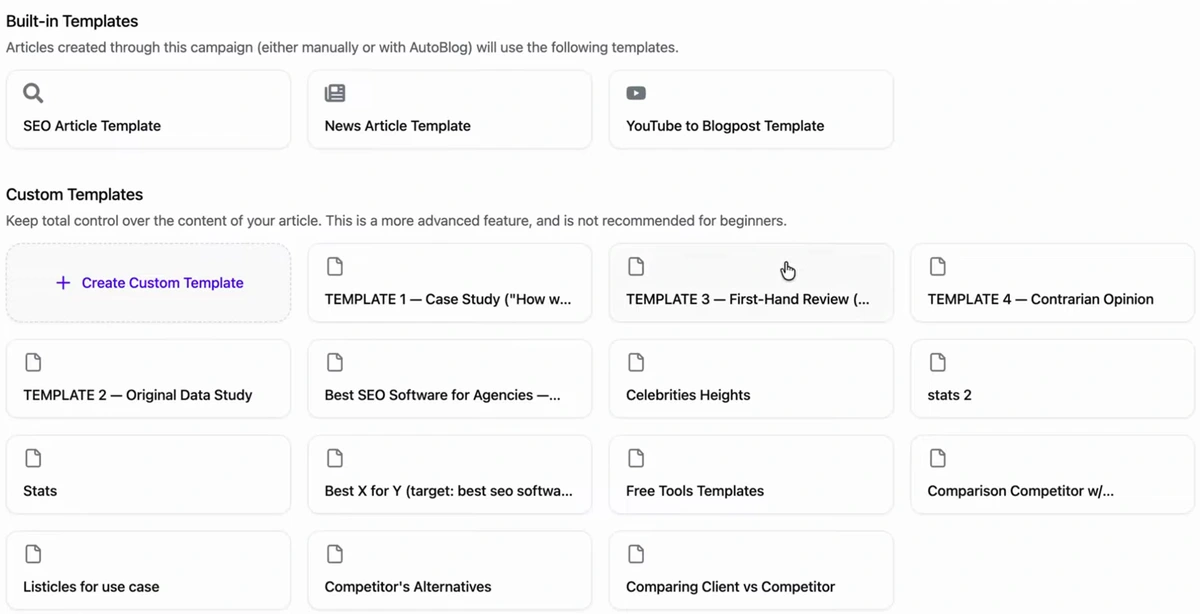
The four numbered templates are a good starting set, because each one forces a different kind of input a model can't make up:
| Template | What only you can provide |
|---|---|
| Case study | A real before and after, with the numbers and dates |
| Original data study | A dataset you collected or a count you ran yourself |
| First-hand review | What you tested, how, and what stood out |
| Contrarian opinion | A position you hold, and the experience behind it |
Here is the first-hand review template opened up. It has three variables, thing_tested, how_i_tested and what_stood_out. The prompt starts by stating that the writer actually used the thing, that spec-sheet reviews are commodity content, and that the model must not invent test results.
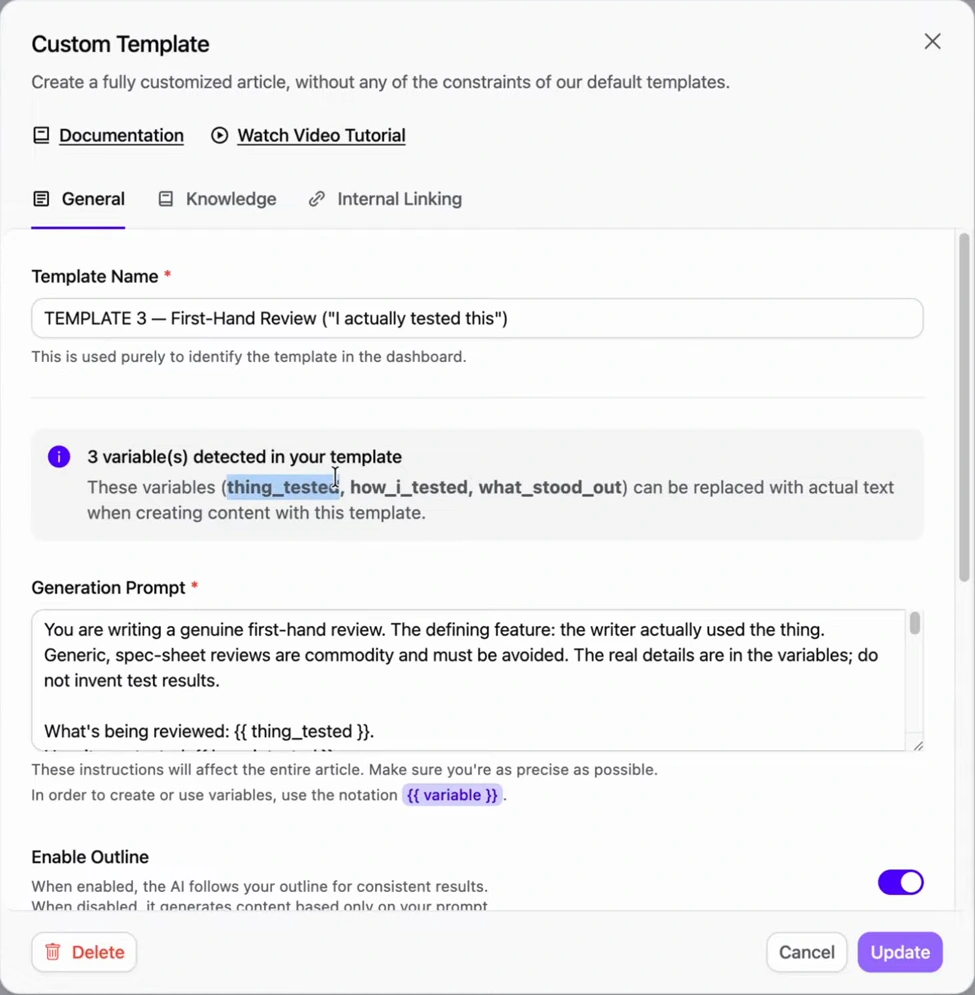
When you create an article from this template you don't just get a keyword box. You get one field per variable. That is the whole trick: the template makes it impossible to generate the article without giving it something first-hand.
The catch: the template is only as first-hand as your input
In the video I demo it with AirPods Pro 2. I fill in "used them for four months straight" and a few things that stood out (battery, sound quality), and I say on camera that I'm not an earphone reviewer and don't have a strong opinion on them. The generated review comes back far more detailed than what I typed. I point out that the AI added context I hadn't given it, and that includes a specific battery anecdote about a full work block of listening.
That is the exact failure the template's own prompt tells the model to avoid. When the input is thin, a good model still fills the gaps, and the gaps get filled with plausible experience that never happened. Published under a "tested" headline, that is worse than a commodity article, because it presents invented experience as first-hand.
So treat the template as a form, not a shortcut:
- Fill every variable with specifics. Model numbers, dates, durations, settings, prices paid, what went wrong. "Battery is good" is commodity; "lasted a full day of calls on the second week, not by month three" isn't.
- Add proof you can show. A photo, a screenshot, a test result. If you have nothing to show, the article probably shouldn't say "tested".
- Read the draft against your notes. Delete every specific claim that didn't come from you. This takes five minutes and it's the step that makes the page honest.
- Keep the fixed parts of the template clean. Anything hard-coded in a template repeats on every article. We've written about a template that shipped one city's facts on another city's page; the same audit applies here.
Commodity vs non-commodity: a quick test
Before you publish, ask of each page: could a model with no access to me have written this? If yes, it's commodity content, however good the formatting. Some quick signals:
| Commodity | Non-commodity |
|---|---|
| "7 tips for…", "What is…", "Best X" lists assembled from other lists | "What happened when we…", "I tested X for four months", "Our numbers from…" |
| Facts anyone can look up | Facts only you have: your data, your results, your mistakes |
| No author perspective, or a vague one | A verdict someone is accountable for |
| Hundreds of pages that differ by one word | Fewer pages, each with something new |
None of this means every page needs a personal story. Definitions and how-tos can rank. It means that in a search experience where AI summarises the common knowledge itself, the pages with something new in them are the ones worth citing. We go deeper on the AI side of this in does AI content rank on Google and is AI content bad for SEO.
FAQ
What is commodity content?
Google's term, from its May 2026 guide to generative AI features in Search, for content based on common knowledge that could come from anyone and adds little unique insight. Its example is "7 Tips for First-Time Homebuyers".
What is non-commodity content?
Content that gives an expert or experienced take beyond common knowledge: first-hand reviews, case studies, original data, opinions backed by experience. Google's example is "Why We Waived the Inspection & Saved Money: A Look Inside the Sewer Line".
Does Google penalize commodity content?
The guide doesn't say so. It describes what is likely to help you in generative AI search, not a penalty. Sites do lose traffic when they publish large amounts of low-value pages, but the guide was published in May 2026 and can't explain drops from before that.
Can I use AI to write non-commodity content?
Yes, as long as the first-hand material comes from you. Use AI for structure and drafting, feed it your own results through fixed fields or a template, and remove any specific claim it adds that you didn't give it.
Want article templates that require your own experience before they generate anything? See Arvow's plans.
Generate, publish, syndicate and update articles automatically
The AI SEO Writer that Auto-Publishes to your Blog
- Cancel anytime
- Articles in 30 secs
- Plagiarism Free