
How to Rank in Google AI Overviews: Google's Own Guidance, Decoded (2026)

For once, nobody has to reverse-engineer the algorithm: Google has been explicit about how ranking works in AI Overviews and AI Mode, and the message is almost anticlimactic — good SEO is good AEO is good GEO. Foundational SEO still decides who gets pulled into AI answers. The sites losing AI traffic aren't missing a secret; they're missing fundamentals — at a moment when AI Overviews already touch a huge share of queries.
In a walkthrough published this week, Nex Gen AI turns Google's guidance into a working checklist — what query fan-out means for your content, the structure AI answers actually reward, the technical "open door" checks, and the myths (llms.txt, magic word counts) worth ignoring. Here's the whole framework.
SEO, AEO, GEO: different names, one job
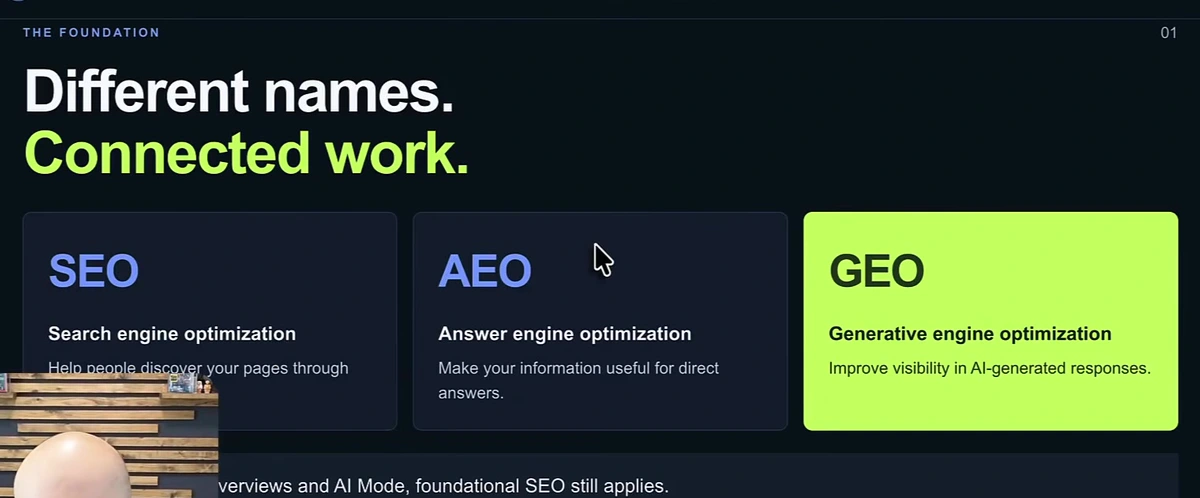
The industry keeps minting acronyms, but per Google there is no separate "GEO playbook" that replaces SEO — for AI Overviews and AI Mode, foundational SEO still applies. That's a relief operationally: you don't need three strategies. You need one strategy executed for a search engine that now reads like a researcher instead of a keyword matcher.
Query fan-out: one question becomes several searches
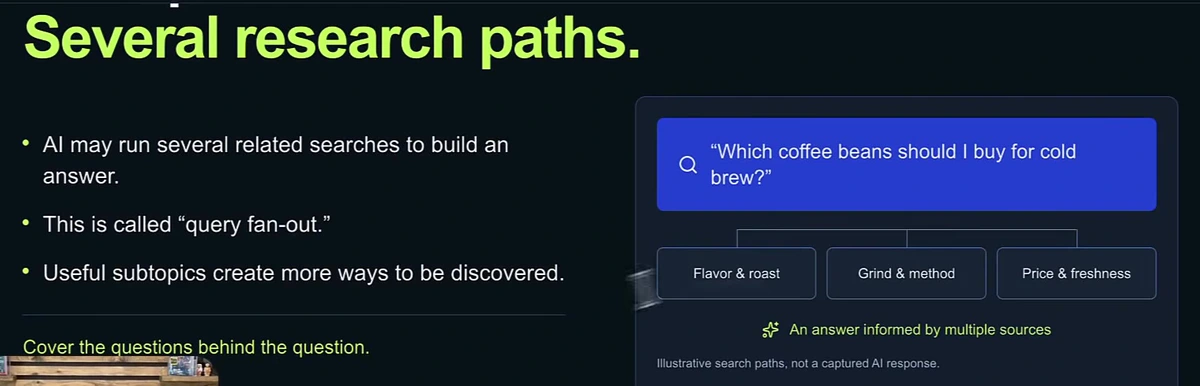
This is the one genuinely new mechanic to internalize. When someone asks an AI-powered search a question, it may run several related searches instead of one ("query fan-out") and assemble the answer from multiple sources. The practical consequence: useful subtopics create more ways to be discovered. A page that covers the questions behind the question — the comparison, the method, the price tradeoff — can get pulled into an answer through any of those side doors. Thin pages that answer only the literal query have exactly one door.
Content that answers: need first, words second
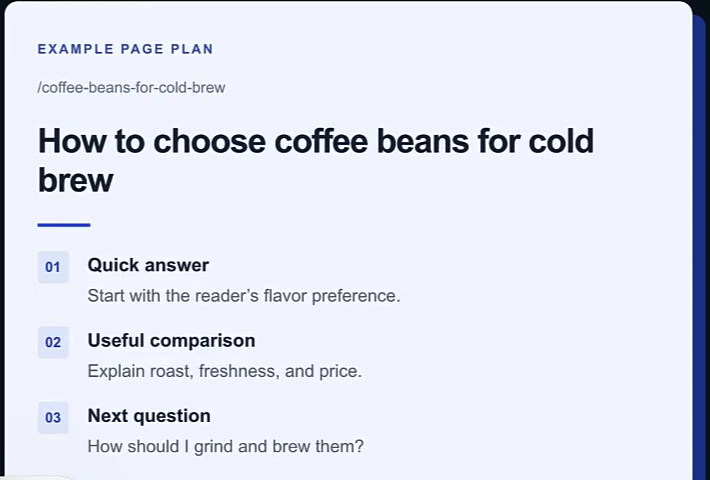
The structure Google's guidance points to is old-school featured-snippet discipline, upgraded: choose a real customer question, use natural wording in a descriptive title and heading, give the key answer early and then explain it, and keep the page address short and understandable. The most common miss is fluff before the answer — burying the payoff three paragraphs deep is how you get skipped by an engine that quotes whoever answers fastest and clearest.
Then comes the differentiator: show what you know and how you know it. A documented comparison — same recipe across several products, your own photos, your observations, the tradeoffs, who each option suits, a named author — is what the video calls non-commodity content. Its claim, worth taking seriously even as a paraphrase of Google's public stance on unoriginal content: commodity content ("7 tips for first-time home buyers") is getting flagged and losing visibility precisely because anyone can generate it. The value is in the evidence you add.
The open door: three technical checks
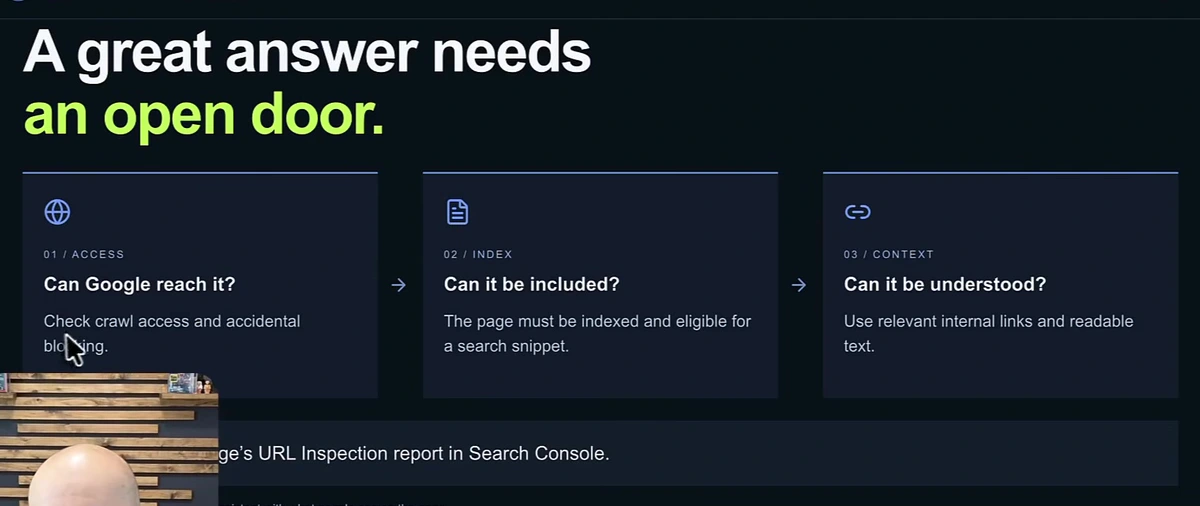
A great answer needs an open door: can Google reach it (crawl access, no accidental AI-crawler blocking in your site's back end), can it be included (indexed and eligible for a search snippet — check URL Inspection in Search Console), and can it be understood (readable text, relevant internal links, no video banners eating the context). None of this is new; all of it now gates AI visibility too.
The trust layer sits on top: fast readable mobile pages, genuine reviews, and consistent business information everywhere — the video's sharpest line is that discrepancies make AI less confident, and low confidence means you don't get shown. For local businesses that means a current Google Business Profile with regular posts and review replies (we mapped that half in Google Business Profile as your ticket into AI search); for merchants, Merchant Center data aligned with your site.
Two myths you can stop spending time on
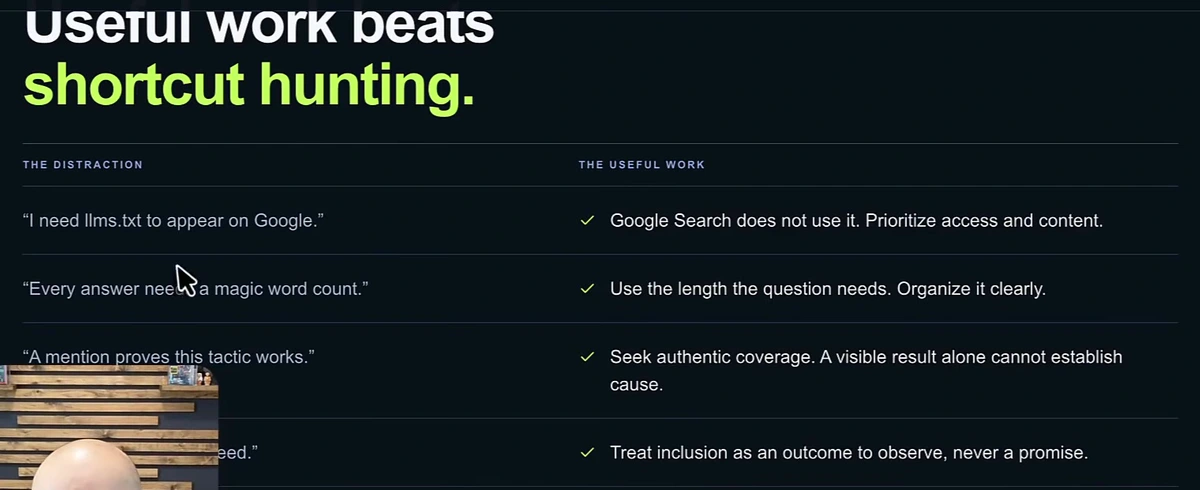
Two stand out. llms.txt: not required. Google Search doesn't use it — crawl access and content quality are what matter. Magic word counts: don't exist. Use the length the question needs; longer usually means more fluff and less visibility, not more authority. And a companion warning for tactic-sellers: a visible result alone cannot establish cause, and AI citations are never guaranteed — treat inclusion as an outcome to observe, never a promise.
Measure results, not just visibility
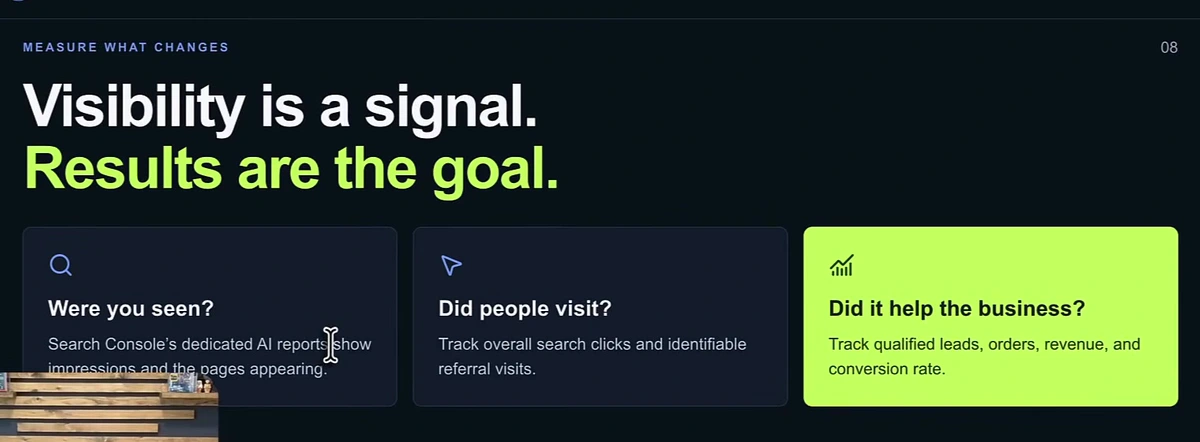
The closing discipline: visibility is a signal; results are the goal. Were you seen (track your appearances in AI answers — our guide to tracking Google AI Overviews covers the tooling), did people visit (Search Console, identifiable referral visits), and did it help the business (leads, orders, conversion rate)? Then run the loop on one page at a time: find a customer question your page answers badly, add original proof, clear the friction, record a baseline and watch the outcome.
Doing this at scale without going commodity
The tension in all of this: Google rewards non-commodity content, and most content automation produces exactly the commodity kind. The video's answer is template articles with variables — in Arvow you define a generation prompt and a markdown outline once, then inject your own variables (your data, your comparisons, your first-hand observations) so every generated article carries the original evidence AI answers select for:
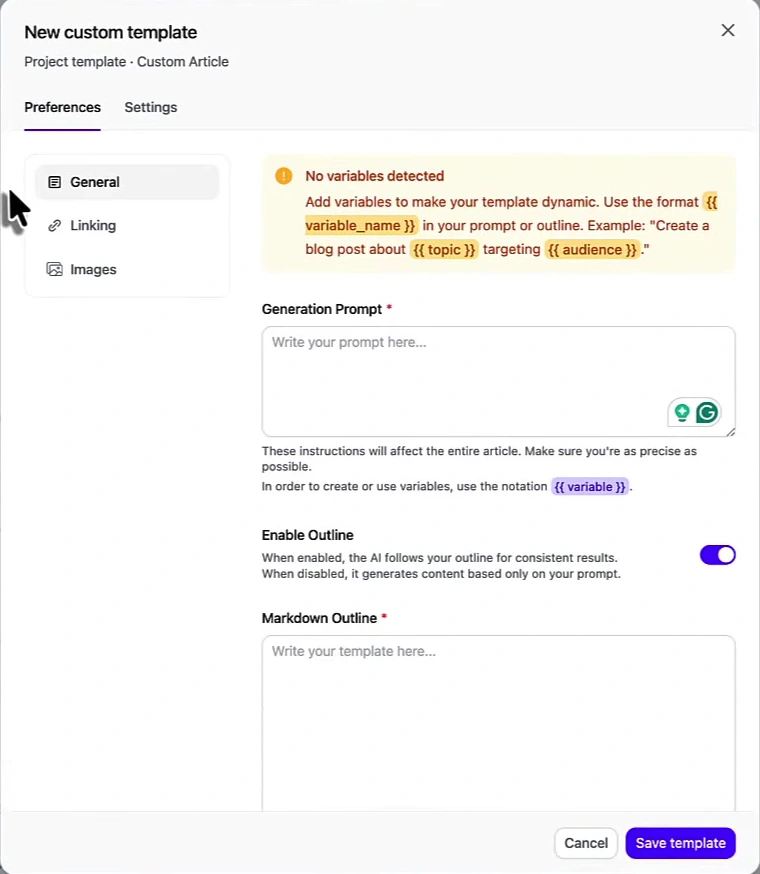
The same workflow closes the measurement loop: when the LLM brand monitor shows a prompt where your visibility is low, you generate a targeted article for that prompt, publish it with the technical layer already handled, and watch whether the answer changes. That's the whole game per Google's own guidance — one important page at a time, made worth trusting and useful to people, with the broader AI search ranking tips as the standing checklist.
Want the fundamentals handled at scale? Arvow generates answer-first, non-commodity articles from your templates and variables, tracks your visibility across LLMs prompt by prompt, and turns every low-visibility prompt into the next article.
Generate, publish, syndicate and update articles automatically
The AI SEO Writer that Auto-Publishes to your Blog
- Cancel anytime
- Articles in 30 secs
- Plagiarism Free