

Table of Contents
You've optimized your pages. You've built some backlinks. You've ticked all the technical SEO boxes — and you're still watching competitors sit comfortably above you in search results.
Here's what's almost certainly missing: topical authority.
In 2026, Google doesn't just evaluate individual pages — it evaluates your entire domain's demonstrated expertise on a subject. A site that covers its niche comprehensively, consistently, and in depth gets a trust multiplier that lifts all of its pages. A site with a few well-optimized pages but shallow overall coverage gets no such lift.
The problem? Building topical authority the traditional way — hiring writers, briefing content, editing and publishing consistently — is expensive, slow, and prone to breaking down. Most content strategies start strong and fizzle within three months.
This guide covers exactly what topical authority is, why it's increasingly the #1 ranking lever in competitive niches, and how to build it systematically without making content creation a second full-time job.
1. What Is Topical Authority (And Why It Matters More Than Ever)
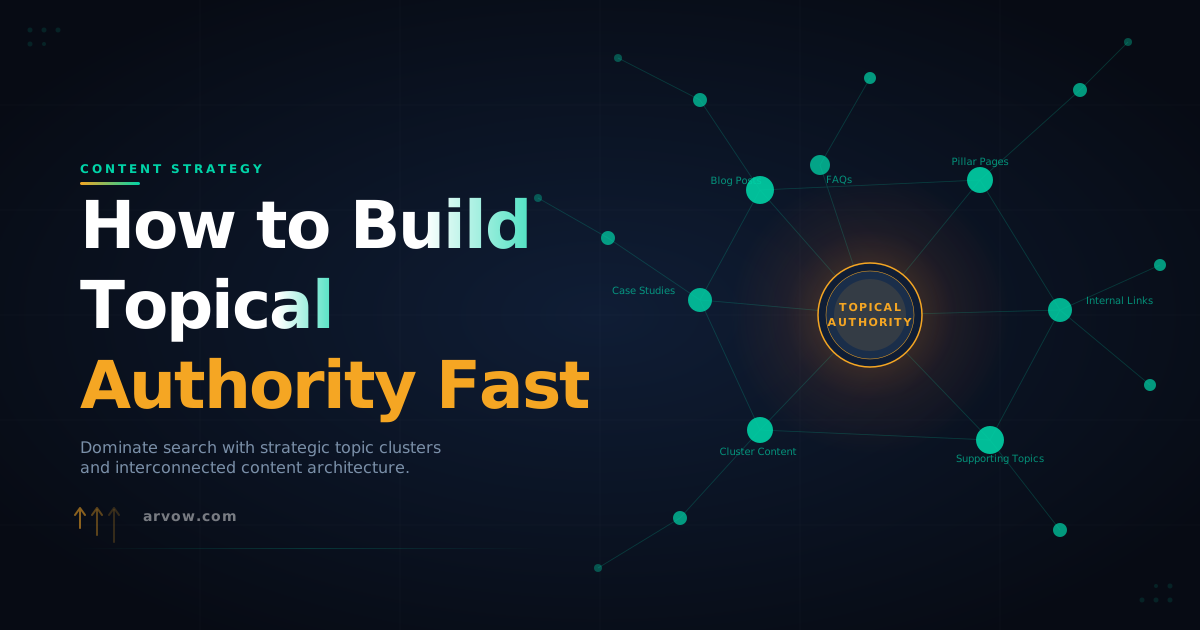
Topical authority is Google's assessment of how comprehensively and authoritatively your domain covers a specific subject area. The concept emerged from Google's evolution away from pure keyword matching toward semantic understanding of content — recognizing topics rather than just phrases.
Think of it like academic credibility. A professor who has published 40 peer-reviewed papers on machine learning has more credibility on that topic than someone with one well-written blog post — even if that one post is objectively excellent. Google applies the same logic to websites.
Key insight from search research: "A site with lower domain authority but strong topical coverage can consistently outrank bigger competitors. When your site focuses on one subject and answers all related questions, search engines see confidence and expertise." — ClickRank Topical Authority Guide, 2026
This shift has enormous practical implications:
Backlinks alone are no longer enough. A domain with strong topical authority but fewer backlinks regularly outranks domains with more links but shallower topic coverage.
New pages rank faster on topically authoritative domains. Google already trusts the domain on that subject, so new content gets indexed and ranked more quickly.
You rank for keywords you didn't explicitly target. Google infers topic relevance and extends it to related queries.
Your rankings compound. Every new piece of relevant content strengthens the authority that helps every other page on the domain.
The Numbers Behind It
The data makes the case clearly:
91% of marketers report that SEO positively impacted their website performance in 2024 — with topical content strategy cited as a primary driver (Conductor, via SE Ranking 2026)
Sites using AI tools produce 42% more content per month on average, directly compressing topical authority timelines (Ahrefs, 2025)
17.3% of pages in Google's top 20 results now include AI-generated content, up from just 2.3% in 2020 — showing the landscape has shifted decisively (Originality.ai, via SE Ranking 2026)
The top 3 organic results receive over 68% of all clicks (FirstPageSage, 2025) — meaning the authority advantage translates directly into disproportionate traffic
2. How Google Actually Measures Topical Authority in 2026
Google doesn't publish a "topical authority score," but through algorithm research, patent analysis, and ranking behavior, SEOs have mapped the key contributing signals:
Signal | What Google Is Looking For | How to Satisfy It |
|---|---|---|
Content breadth | How many subtopics within your niche you cover | Systematic content cluster coverage |
Content depth | Whether individual articles genuinely address their subject | Long-form, thorough articles — not surface-level posts |
Semantic co-occurrence | Whether your content uses the terminology, entities, and concepts of your niche | Natural use of niche vocabulary throughout your content |
Internal linking structure | How well your content cluster is interconnected | Deliberate internal links between related articles |
Publishing consistency | Whether new content is added regularly | Consistent publishing cadence — not burst-and-pause |
Content freshness | Whether your domain covers current events in your niche | News layer content responding to real-world developments |
User engagement | Whether visitors actually read and engage with your content | High dwell time, low pogo-sticking, return visits |
Backlink relevance | Whether links come from topically related sources | Niche-specific link building, not generic directory links |
The most important insight in this table is content breadth + consistency. You can write the best single article about "crypto DeFi protocols" and still lose to a domain that has 80 articles covering DeFi, crypto regulation, token launches, and protocol security — even if those articles are individually less polished than yours.
As SearchAtlas notes in their 2026 guide to domain vs. topical authority: "Search engines assess the co-occurrence of relevant n-grams, entities, and related terms within a semantic cluster. A site about 'SEO' that also covers 'crawl budget,' 'indexing,' and 'semantic search' demonstrates higher topical authority than a site with only surface-level articles."
3. Why the Traditional Approach Breaks Down
The standard content marketing playbook for building topical authority:
Hire a content strategist to map the keyword cluster
Brief writers on each topic
Edit, optimize, and publish
Repeat — forever, at scale
This works. But it's expensive, slow, and fragile. Here's what it costs to run a meaningful content operation manually:
Role | Monthly Cost |
|---|---|
Content strategist | $2,000 – $4,000 |
2x Freelance writers (niche-specific) | $2,400 – $6,000 |
Editor / SEO optimizer | $1,500 – $3,000 |
Designer (images, formatting) | $800 – $2,000 |
Total | $6,700 – $15,000/month |
And that's for modest output — typically 8–16 articles per month. Building serious topical authority in a competitive niche fast requires significantly more volume than that.
The consistency problem is even more damaging than the cost. Most content programs run at full speed for one quarter, then slow as budgets tighten, key people leave, or other priorities emerge. Google notices inconsistency — sites that publish in bursts and then go quiet lose topical trust signals over time.
The result: most businesses never actually build the topical authority their SEO strategy requires, because the operation needed to do it manually is unsustainable.
4. The 3-Layer Content Architecture That Builds Authority Fast
Understanding the structure of topical authority helps you build it intentionally. There are three content layers that work together:
🏛️ Layer 1: Commercial Core Pages
Your product pages, service pages, category pages, and landing pages. These exist to convert — and they need the other two layers to rank competitively. Most sites have this layer and only this layer.
📚 Layer 2: Evergreen Content Cluster
Long-form guides, comparison articles, how-tos, and explainers targeting the informational queries in your niche. These capture mid-funnel traffic and build thematic context around your commercial pages. Arvow's AI Article Writer is built specifically for this layer.
📰 Layer 3: Niche News Layer (The layer most sites skip)
Consistent, current coverage of news and developments in your niche. This is the most underused and most powerful layer for building topical authority fast, for three reasons:
It signals active domain engagement — Google sees a site that's monitoring and responding to its topic in real time, not just maintaining an archive
It captures trending searches at low competition — news queries often have very few competing pages, making rankings accessible even for newer domains
It creates an endless stream of internal linking opportunities — every news article connects back to your commercial and evergreen pages, building the internal link architecture Google uses to assess authority
This three-layer structure is what the fastest-growing sites in competitive niches are quietly building right now.
5. How AI Autoblogging Compresses the Timeline
The manual approach to building all three layers takes years and hundreds of thousands of dollars. AI changes this math completely.
Arvow's Autoblog is specifically designed to run the Layer 3 news content and Layer 2 evergreen content automatically. Here's what it does:
Monitors your niche via RSS feeds, keyword tracking, news events, and YouTube channels
Generates original, cited articles in your brand's voice — not generic AI filler, but properly structured, researched content with real source citations
Publishes automatically to your CMS (WordPress, Shopify, Webflow, Wix, Ghost, Blogger, Squarespace) on a schedule you set once
Submits to Google Search Console immediately after publishing — getting pages indexed up to 10x faster than waiting for organic crawling
Auto-posts to social media with custom copy and images after each article goes live
Adds internal links to your defined commercial pages automatically — building the link architecture that flows authority to your product and service pages
📹 Watch: Arvow Autoblog Demo
Watch the full product demo on Arvow's homepage → (Scroll to the "How It All Works" video section)
The demo shows the complete end-to-end workflow: from configuring your content source to seeing articles auto-published on a live site.
The cost difference versus a manual content operation:
Manual Content Team | Arvow Autoblog | |
|---|---|---|
Monthly cost | $6,700–$15,000 | Fraction of that |
Articles/month | 8–16 | 12–30+ |
Consistency | Depends on team | Perfect — never misses |
Internal linking | Manual | Automatic |
Google indexing | Depends on crawl | Submitted immediately |
Social distribution | Separate task | Automatic with each post |
6. Practical Example: Building Topical Authority in a Competitive Niche
Let's make this concrete. Say you run a SaaS product for HR teams and want to rank for commercial keywords like "best HR software," "employee onboarding platform," and "HRIS for small business."
Without topical authority: Your landing pages compete against established HR tech players with deeper content libraries and more links. You sit on page 2–3 despite solid on-page optimization.
With topical authority (Layer 3 news + Layer 2 evergreen):
Your Autoblog publishes 3 articles per week covering:
New NLRB rulings and labor law changes
HR tech acquisition news and market analysis
Remote work policy studies and data
Workforce trend reports from SHRM and LinkedIn
Compliance deadline reminders for HR teams
Over 6 months: 72+ articles, all reinforcing the same topical signals around HR, workforce management, and HR technology. Every one of them links back to your product pages.
Google's model of your domain evolves from "a SaaS company" to "an HR industry authority." Your commercial pages start ranking against competitors with 3x your backlinks, because your domain's topical trust has surpassed theirs.
Real result: Under30CEO went from 0 to 14,000 monthly organic visitors in 60 days using Arvow's automated content system. Read the case study →
7. The Right Way to Use AI Content for SEO Authority
AI content works for SEO authority building when it's done correctly. Here's the framework:
✅ What works
Feed context into the AI. Arvow's knowledge base feature lets you upload your brand voice, proprietary knowledge, customer personas, and product documentation. The AI incorporates this so articles reflect your expertise — not generic AI output.
Cover the full topic cluster systematically. Don't just publish whatever the AI suggests — map your niche's subtopics first and configure your autoblog to cover them deliberately.
Combine automated content with occasional flagship pieces. Let the autoblog handle the news layer and long-tail coverage. Invest your own time in 2–3 cornerstone articles per quarter.
Keep niche focus tight. Every article must be topically related to your core subject. Off-topic content dilutes your authority signal faster than no content at all.
Enable auto-indexing. Arvow's auto-indexing submits each new article to Google Search Console immediately — essential for news content where timing matters.
❌ What damages authority
Publishing off-topic content (dilutes topical signal)
Ignoring internal linking (breaks the cluster structure)
Burst publishing followed by silence (signals inconsistency)
Articles with no unique insight (fails Google's helpful content standard)
What Google's Guidelines Actually Say
Google has been explicit and consistent on this. Their 2023 guidance on AI content — which remains their standing position — states: "Our focus is on the quality of content, rather than how content is produced." They reward E-E-A-T (expertise, experience, authoritativeness, trustworthiness) regardless of whether a human or an AI wrote the content.
High-quality, well-cited, genuinely helpful AI content meets this standard. Thin, generic AI filler doesn't. Arvow is built specifically to produce the former.
8. Topical Authority Timeline: What to Expect
Topical authority builds slowly at first, then compounds. Here's a realistic view for a site publishing 3 articles/week using Arvow Autoblog:
Month | Content Published | What's Happening | Visible Impact |
|---|---|---|---|
1 | ~12 articles | Indexing, Google building trust signals | Minimal — don't panic |
2 | ~24 articles | First long-tail rankings appear | Small traffic gains |
3 | ~36 articles | Consistent traffic from content layer | Commercial pages begin improving |
6 | ~72 articles | Significant news + evergreen traffic | Noticeable ranking improvements across keywords |
12 | ~144 articles | Established topical authority | Compounding growth — new pages rank faster |
24 | ~288 articles | Deep topical moat | Extremely hard for competitors to displace |
The critical insight: The curve is exponential, not linear. Most people abandon their content strategy during months 1–2, right before the compounding starts. Automation solves this — the autoblog doesn't care whether you're motivated or not. It publishes on schedule regardless.
9. Your Action Plan
Here's how to get started systematically:
Week 1: Map your topic cluster List every subtopic, related question, and news category relevant to your niche. Aim for 50–100 topic areas. These become your content source configuration.
Week 2: Set up your CMS section and Arvow integration Create a dedicated blog or news section. Connect Arvow to your CMS — WordPress, Shopify, Webflow, and others connect in minutes.
Week 3: Configure your autoblog Define your content sources (RSS feeds, keywords, news events), set your publishing schedule (3x/week is the sweet spot), and configure internal links to your commercial pages.
Week 4: Activate and monitor Go live. Review performance monthly — which topics get traction, which keywords are gaining impressions. Adjust content sources accordingly.
Ongoing: Complement with flagship content Every 4–6 weeks, write or commission one comprehensive pillar piece that anchors your evergreen content cluster. The autoblog handles the volume; your flagship pieces handle the depth.
Start Building Your Topical Authority Today
The sites that will dominate search over the next three to five years are the ones consistently building comprehensive niche content right now. Every month of consistent publishing creates a compound advantage that's genuinely difficult for later movers to close.
The barrier to doing this has never been lower. The question is whether you start this month or wait until a competitor does it first.
Or explore the specific features that power topical authority building:
Generate, publish, syndicate and update articles automatically
The AI SEO Writer that Auto-Publishes to your Blog
- Cancel anytime
- Articles in 30 secs
- Plagiarism Free