
Backlink Quality vs Quantity: 3 Links vs 51, Both Measured (2026)


The backlink quality vs quantity argument usually ends in a shrug: "both matter, it depends." That is true and useless. What settles it is watching the same agency run both plays on real client sites and comparing what the graphs did afterwards.
This article works through one campaign where three links moved an e-commerce site from roughly 133 organic visits a month to 1.7k — a 1,155% increase — and then puts it next to a campaign from the same order book that needed 51 links to do its job. Same team, same sourcing standard, wildly different link counts. The gap between them is the actual answer to quality vs quantity, and it is more interesting than "quality wins".
The case: three links, +1,155%
The client is an adjustable-bed retailer. They placed one order for three links in June 2026. Before the campaign the site was doing about 130–133 organic visits a month and had been flat for a year — the chart runs along the floor from June 2025 through April 2026 without a wobble.
Ahrefs first saw the new links in June 2026. Traffic moved the same month, reached about 1.7k/month within three months, and the most recent point on the chart sits at 2.4k/mo.
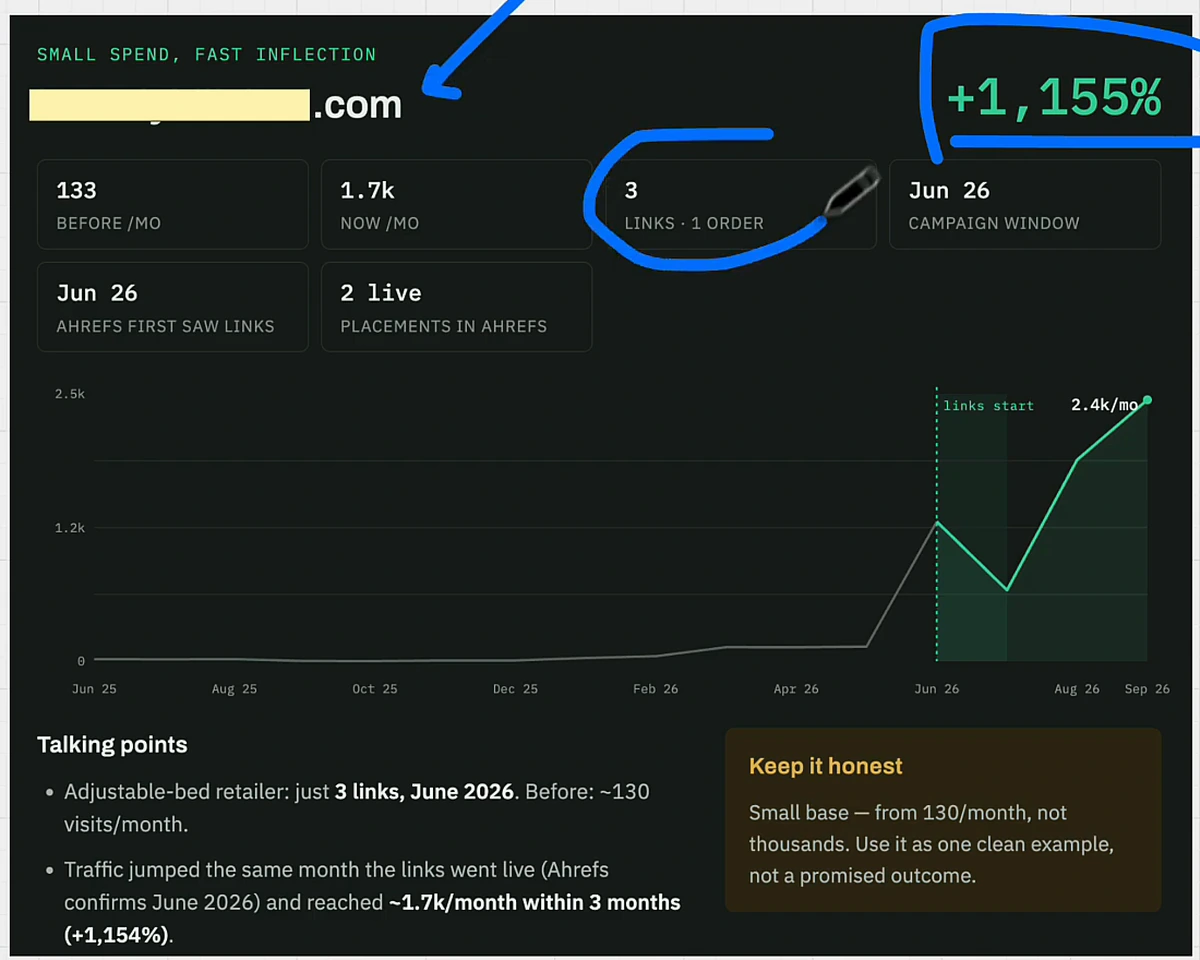
Two details on that card deserve more attention than the headline percentage.
The first is the honesty note the agency put on its own slide: "Small base — from 130/month, not thousands. Use it as one clean example, not a promised outcome." A 1,155% gain on a base of 133 is 1,530 extra visits. The same percentage on a site doing 40k/month would be a different universe of work. Percentage gains on small bases are real but cheap, and anyone showing you one without saying so is managing you.
The second is quieter and it is the reason this article exists: three links were ordered, two were live in Ahrefs. That is a 33% attrition rate on a brand-new campaign, printed on the agency's own scorecard. Hold that thought — it comes back later and it changes the arithmetic of the whole quality-versus-quantity question.
What "quality" actually meant on these three links
"High-quality backlink" is the emptiest phrase in SEO, so here are the three host domains from this campaign as Ahrefs reported them, with no adjectives.
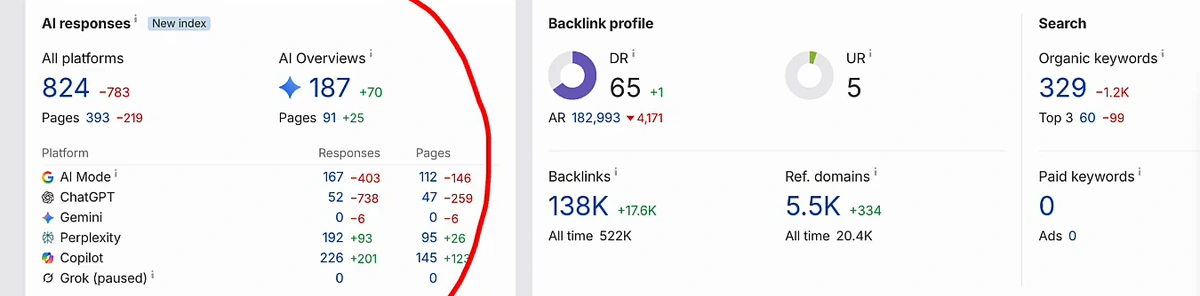
The first placement sat on a DR 65 domain with 138K backlinks and 5.5K referring domains, drawing its traffic mainly from the UK (68.3%) and the US (29.5%). Ahrefs also credits it with 824 AI-assistant responses and 187 Google AI Overview citations — including 226 Copilot responses, 192 from Perplexity and 167 from Google's AI Mode.
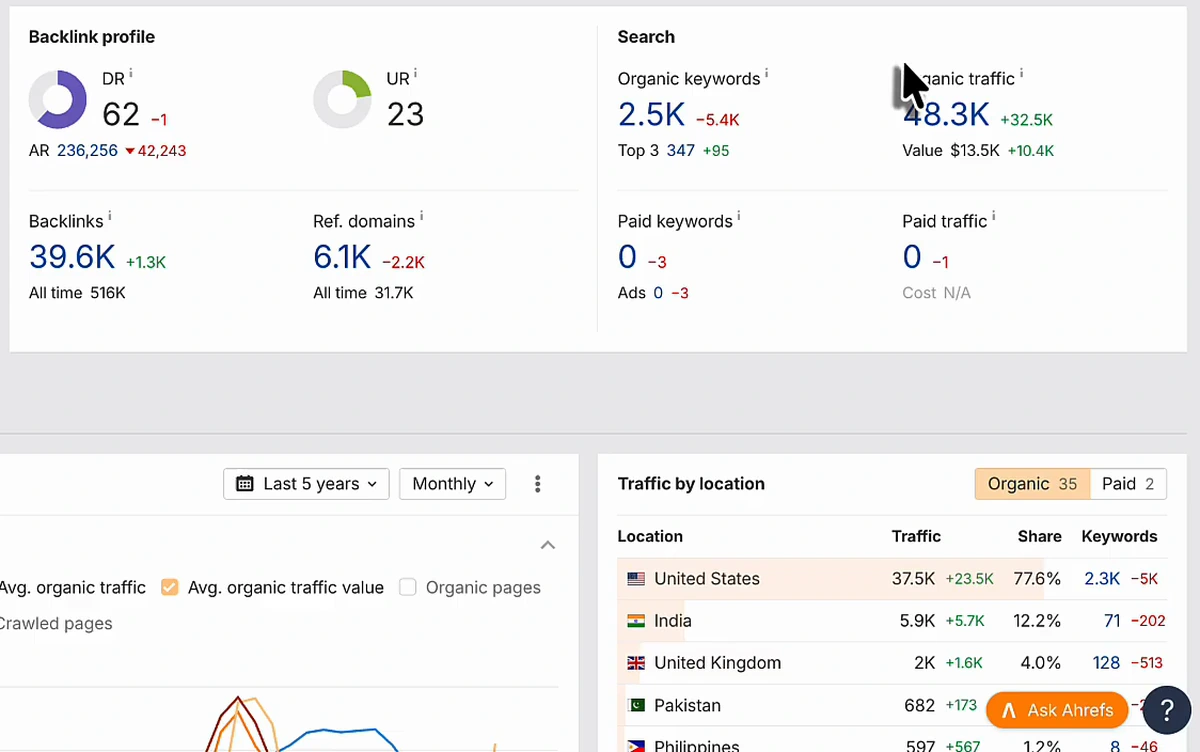
The second placement is the strongest of the three on the metric that matters most. DR 62, but 48.3K organic visits a month — up 32.5K over six months — with 77.6% of that traffic in the United States and an estimated traffic value of $13.5K.
The third was DR 61 with 200K backlinks, 3.2K referring domains and 4.8K monthly organic visits, rising by 1.7K over the same window.
| Host domain | DR | Referring domains | Organic traffic/mo | Top country | AI Overview citations |
|---|---|---|---|---|---|
| Placement 1 | 65 | 5.5K | 2.5K | UK, 68.3% | 187 |
| Placement 2 | 62 | 6.1K | 48.3K | US, 77.6% | 195 |
| Placement 3 | 61 | 3.2K | 4.8K | US | 515 |
Notice that the three domains sit within four points of each other on DR — 61, 62, 65 — while their organic traffic differs by a factor of nineteen. If you had bought these on Domain Rating alone you would have called them interchangeable. They are not. That is the practical content of "quality": DR is a filter, traffic and relevance are the decision.
Read the arrows, not just the numbers
Here is something the video does not dwell on and most link buyers never check. Set Ahrefs to show changes over the last six months and these "powerful" domains are not all moving the same way.
The DR 65 domain's AI citations are down 783 over six months. Its organic keywords are down 1.2K and its top-3 rankings are down 99. It is still a genuinely strong site — 824 AI citations and 138K backlinks are not nothing — but it is a site coming down from a higher place. The DR 62 domain is doing the opposite: traffic up 32.5K, traffic value up $10.4K, top-3 rankings up 95.
Both pass a "DR 40+, 1,000+ visits" screen. Only one of them is a site you would want to be permanently associated with. If you are paying for a placement that is supposed to earn for years, the trend line is worth as much as the snapshot, and it costs you one dropdown to look.
Why 100 cheap links do not do this
The counter-offer is always available: marketplaces will sell you a hundred links for the price of a coffee. The reason that trade fails is not moral, it is arithmetic.
A link passes value in proportion to the authority and relevance of the page it sits on. A hundred links from domains with no organic traffic are a hundred links from pages that no one visits, that rank for nothing, and that Google has already learned to discount — often placed on sites whose entire business model is selling links, which is a pattern that is trivially detectable at scale. You are not buying a hundred small votes. You are buying a hundred zeroes and a footprint.
The three links above worked because each host was a real publication with real readers in the client's market. Two of them were being actively quoted by AI assistants, which is increasingly its own distribution channel — a point covered separately in brand mentions are the new backlinks.
The honest version of the rule: a cheap link is not a weak version of a good link. It is a different object that happens to share a name.
The thing nobody screenshots: links die
Every case study you have read counts links at purchase. The scorecards from this order book count them twice — ordered, and still live in Ahrefs — and the difference is substantial.
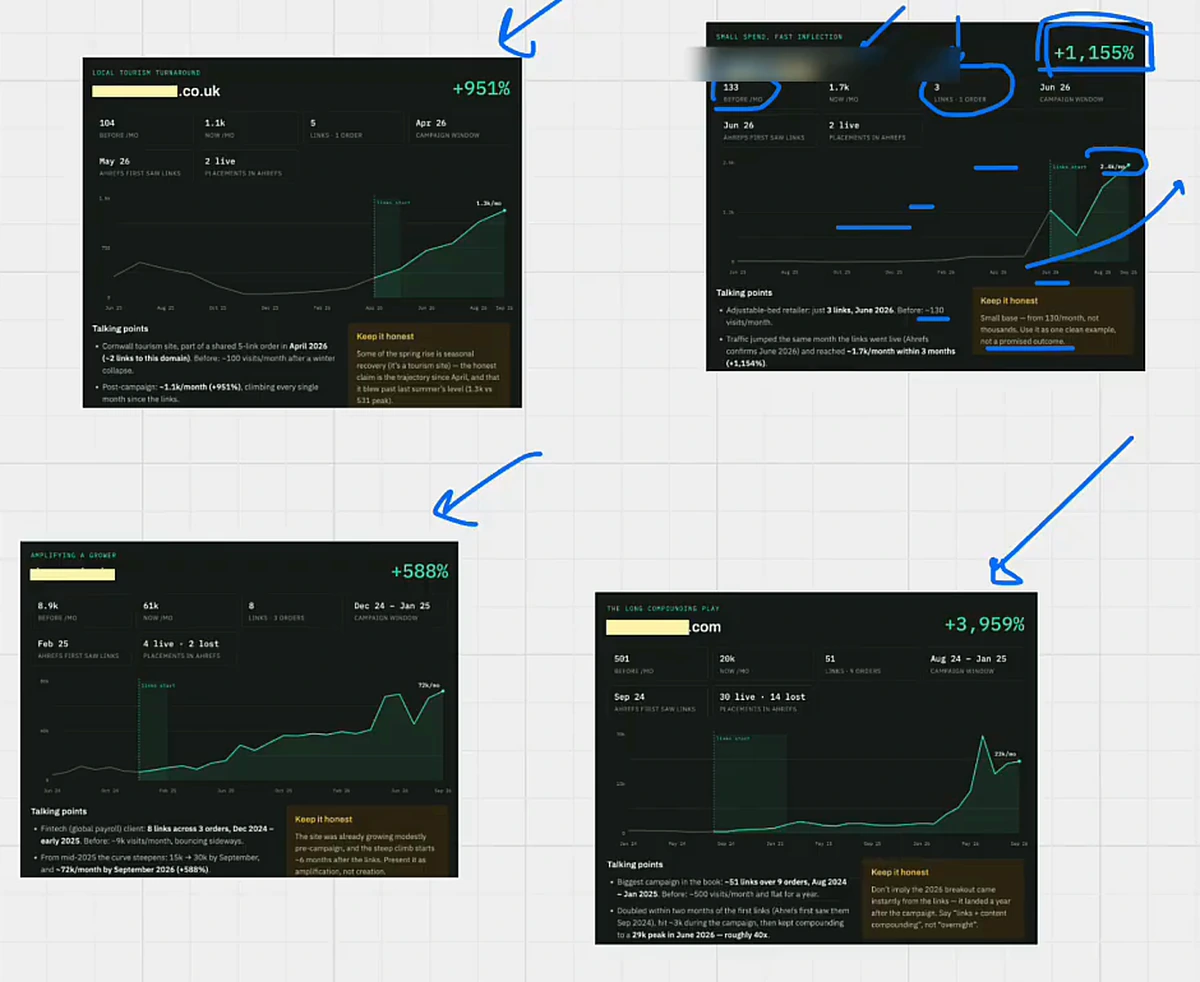
Across the campaigns on that board:
- The three-link campaign in this article: 3 ordered, 2 live.
- A Cornwall tourism site, +951%: 5 links in a shared order, 2 live.
- A fintech payroll client, +588%: 8 links across 3 orders, 4 live, 2 lost.
- The largest campaign, +3,959%: 51 links across 6 orders, 30 live, 14 lost.
Roughly a quarter to a third of purchased placements are not showing as live. Some of that is Ahrefs indexing lag rather than genuine loss, and the cards do not separate the two — but plan for it either way. It means the effective price per surviving link is meaningfully higher than the sticker price, and it means a "100 links" package that suffers the same attrition leaves you with a pile of dead cheap links instead of a pile of live cheap ones.
It is also the single best argument for quality over quantity that exists, and it is an argument from cost rather than from taste: when a third of what you buy evaporates, you want the survivors to be worth something.
When quantity genuinely does matter
Now the honest counterweight, because "three links is all you need" is not the lesson.
The biggest campaign on that board bought 51 links across six orders between August 2024 and January 2025. The site had been flat at about 500 visits a month for a year. It doubled within two months of the first links landing, reached around 3k during the campaign, and then kept compounding to a 29k peak in June 2026 — roughly 40x. The agency's own note on that card is worth quoting in full: "Don't imply the 2026 breakout came instantly from the links — it landed a year after the campaign. Say 'links + content compounding', not 'overnight'."
The fintech card carries a similar warning: the site was already growing before the links, and the steep climb starts about six months after them, so it is described as amplification, not creation.
Put those next to the three-link case and a rule falls out that is more useful than either slogan:
- A small number of strong links can produce a fast, visible inflection on a small, flat site — where a handful of links is a large proportional change to a thin profile.
- A large number of strong links is what moves a site that is already established — and it works slowly, over quarters, alongside content.
Quality is the entry requirement in both cases. Quantity is the dial you turn based on how big and how competitive the site already is. That is why how many backlinks you need has no single answer, and why the more useful question is whether links are the binding constraint on your site at all.
The vetting standard, written down
The agency publishes the screen it applies before buying a placement, which makes it checkable rather than a claim:
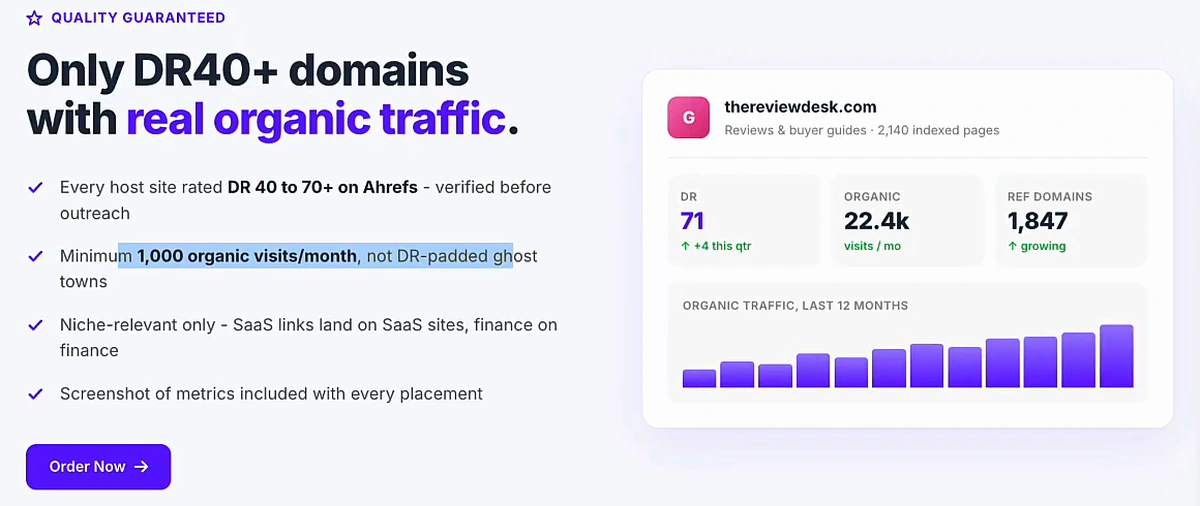
Four criteria, each of which you can apply yourself without buying anything:
- DR 40 to 70+, verified on Ahrefs before outreach. The ceiling is as deliberate as the floor — very high DR domains that sell placements are usually the ones with the worst link-to-content ratios.
- Minimum 1,000 organic visits a month, explicitly to exclude "DR-padded ghost towns" — domains whose rating was manufactured by links they bought rather than by anything they rank for.
- Niche relevance — SaaS links on SaaS sites, finance on finance.
- A screenshot of the metrics with every placement, so the buyer can audit the claim rather than trust it.
To that list, add the two things this campaign's own data argues for and the published standard does not include: check the six-month trend, not just the current numbers, and re-check your placements two or three months after delivery, because a quarter of them may not be there.
If you would rather build links than buy them, the manual and AI-assisted routes are compared in automated vs manual AI backlinks, and the fuller menu of tactics is ranked in 13 backlink building methods. The placements described here are manually pitched, which is precisely why they are neither cheap nor instant — the pricing and sourcing sit on the build backlinks page.
What this case does not prove
Four limits, stated plainly, because a case study that only points one direction is marketing.
It is one site. One e-commerce store, one order, one three-month window. It is evidence that this can happen, not a measurement of how often it does.
The base was tiny. 133 visits a month is close to a standing start. The percentage is arithmetically flattering and the absolute number — about 1,530 extra monthly visits — is the figure to plan against.
Correlation, timed well. The links landing and the traffic moving in the same month is a strong coincidence, and Ahrefs dating the placements makes it a good deal stronger than most attribution you will see. It is still not a controlled test. The site's own content, seasonality and any other work happening that quarter are not isolated.
Links are not the whole strategy. The video is explicit about this and it is worth repeating: none of it works without pages worth ranking and a site Google can crawl. Links amplify what exists. If the underlying pages are thin, three excellent links will amplify very little — which is the same conclusion reached from the other direction in do backlinks still work.
Want the short version? Buy fewer links from sites that have readers, check the six-month trend before you pay, and audit what is still live ninety days later. That single habit will beat any package sold on link count.
Generate, publish, syndicate and update articles automatically
The AI SEO Writer that Auto-Publishes to your Blog
- Cancel anytime
- Articles in 30 secs
- Plagiarism Free