
AI Backlinks in 2026: Automated Agents vs. Doing It with Claude Code


There are two ways to get AI to build you backlinks, and the honest version of the comparison is not the one that gets put in thumbnails. One path runs an automated network that places links while you do nothing. The other points an AI agent at the web to find sites that accept guest posts, and then hands the list back to you to go do the human part.
Both work. Neither is free. The interesting question is what each one actually produces, and this walkthrough has the numbers on screen for both.
Path 1: what the automated network actually placed
The first path is a link network that places backlinks automatically as other sites in it publish. No outreach, no email, no negotiation. The dashboard is the receipt, and it reads: 216 backlinks received, 108 unique referring domains, 86 of my pages linked.
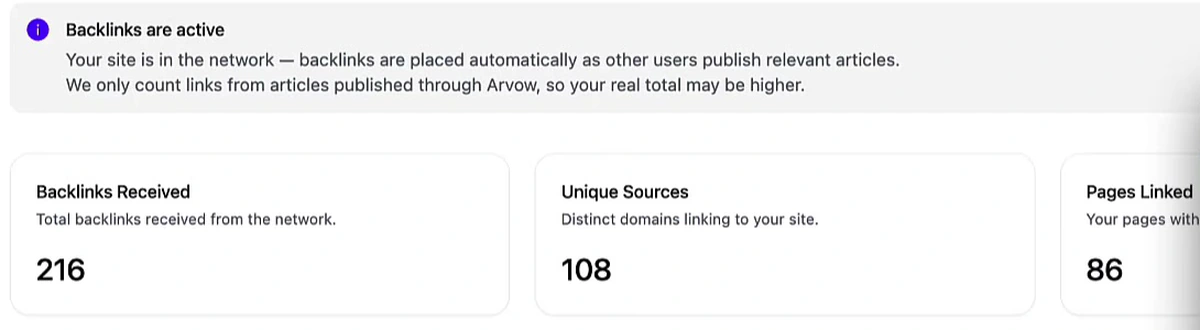
The number that matters more than the total is 108 unique sources. Two hundred links from ten domains is ten links. Two hundred from a hundred and eight domains is a referring-domain profile. Spread is the thing search engines count, and it is the thing that is hard to fake by hand.
On quality, the eight most recent placements he pulls up in the video run DR 66, 47, 43, 26, 15, 26, 24 and 15. That is not a wall of DR 80s, and it should not be — a profile made entirely of high-DR links looks bought, because it is. What makes the DR 66 worth having is that it came from a web design firm, which sits in the same marketing niche as the site receiving it.
Two settings do the steering. The first is a relevance-versus-volume toggle: fewer, tighter-matched links, or more of them with a looser topical fit. The second is a daily cap, set to one link per day in the video and adjustable up to ten. Running it at one a day for relevance is the conservative setting, and 216 links is what that patience compounds into.
Path 2: Claude Code as a prospector, not a link builder
The second path swaps the network for an agent. The setup is unglamorous: a folder on the desktop, a set of skill files inside it, a Claude Code session opened on that folder. The skill files are the whole trick — an empty folder and the instruction "build me backlinks" produces nothing useful, because the model has no procedure to follow.
With the skill loaded, the prompt is one line: run the guest post prompt for arvow.com. Here is what came back.
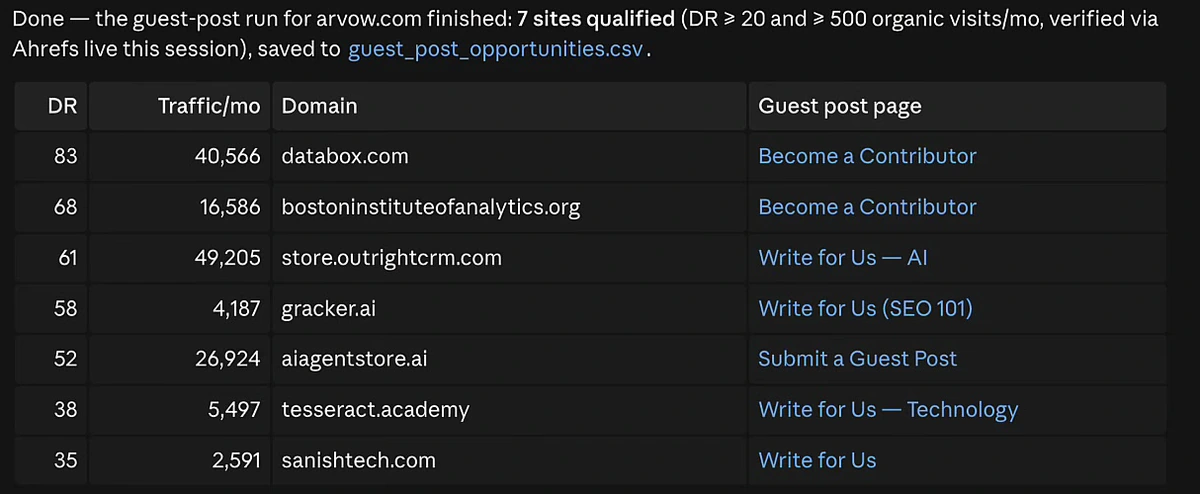
Seven sites, filtered to DR ≥ 20 and ≥ 500 organic visits a month, verified against live Ahrefs data during the session. Databox at DR 83 with 40,566 monthly visits leads it; store.outrightcrm.com carries the most traffic at 49,205.
The fourth column is the part that saves the afternoon. It is not a homepage — it is the specific "Become a Contributor" or "Write for Us" URL on each domain. Finding those by hand is the tedious half of prospecting.
The filter is the product
The list of seven is not the achievement. The achievement is the eleven that did not make it.
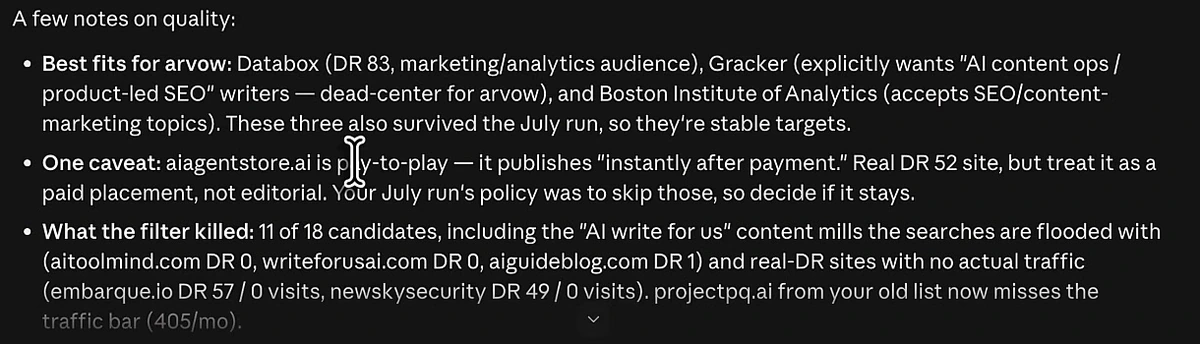
Two rejection categories are worth internalising, because they are the two ways a guest post list wastes your money:
- Zero-authority content mills. Search "AI write for us" and the results are flooded with sites built to rank for that phrase and nothing else — aitoolmind.com at DR 0, writeforusai.com at DR 0, aiguideblog.com at DR 1. They will happily take your article. The link is worth nothing.
- Real DR, no traffic. Harder to spot and more expensive to get wrong. embarque.io shows DR 57 with 0 organic visits; newskysecurity shows DR 49 with 0. The authority score looks fine on a spreadsheet. Nobody reads the site. A third domain, projectpq.ai, was on the previous run's list and now misses the traffic bar at 405 visits a month.
The agent also flagged aiagentstore.ai as pay-to-play — it publishes instantly after payment, which makes it a paid placement rather than an editorial link, and left the decision to keep or drop it to the human. That distinction is the sort of thing a scraped list will never tell you.
This is also why the DR-plus-traffic double filter matters more than either number alone. If you want the wider view of how guest posts stack up against every other way of acquiring links, I ranked them all in 13 backlink building methods, worst to best.
The twenty searches doing the work
Underneath the one-line prompt, the agent is running search footprints — the same operators a link builder types by hand, just twenty at once. Pointed at ridge.com, a wallet brand, it first reasons its way to the right niche keyword ("everyday carry" over "men's lifestyle" or "travel gear"), then fires the block.
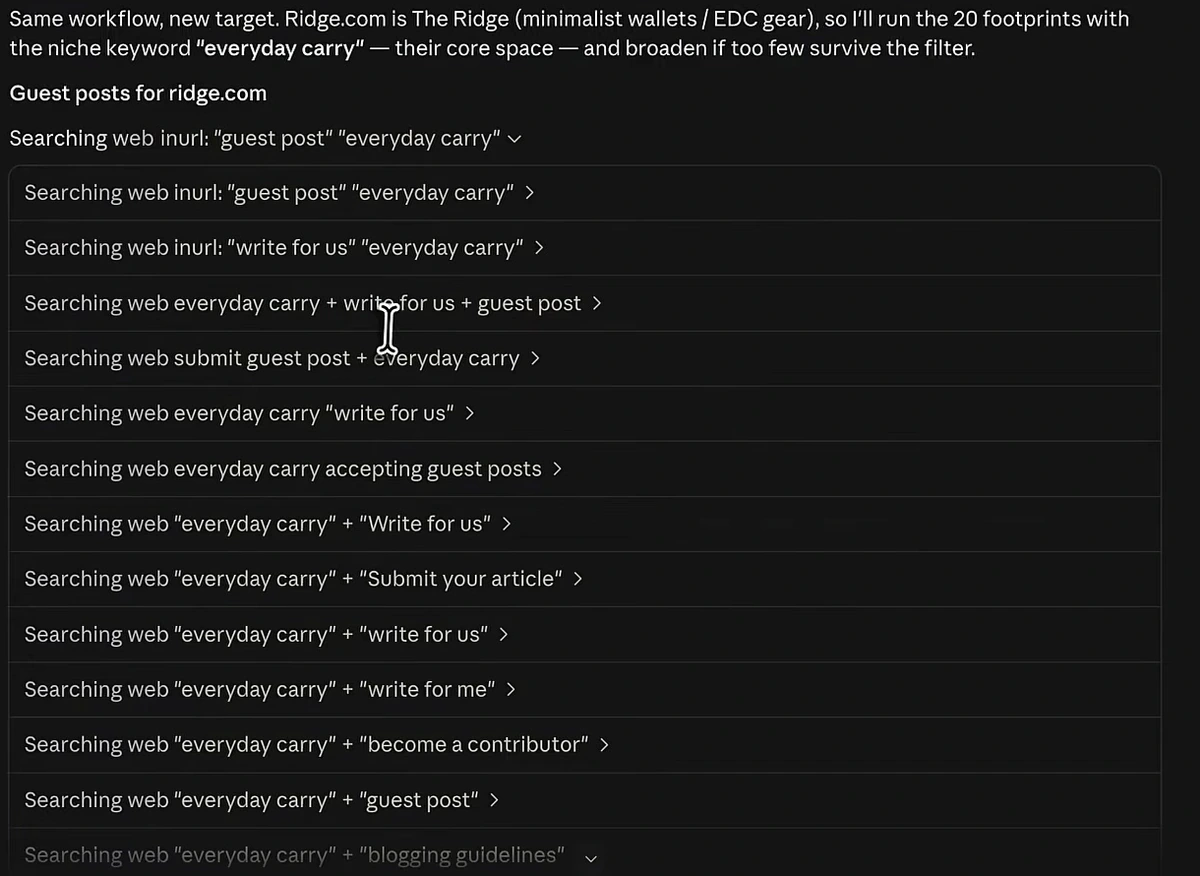
You can run any single one of these yourself in Google right now. inurl:"guest post" "plastic surgery" works, and so do the "write for us", "submit your article", "become a contributor" and "blogging guidelines" variants. The agent is not doing anything magic. It is doing twenty searches instead of one, deduplicating the results, and then enriching every survivor with live authority and traffic data — which is the step that actually takes a human all afternoon.
The model choice barely matters here. The run in the video used a top-tier model and he says outright it is overkill for the task; a free tier handles it. The skill file is what carries the quality, not the horsepower.
Always check the site's own numbers
Here is the habit that separates a good list from a good outcome. Sites that accept guest posts publish their own traffic claims on their write-for-us pages, and those claims are marketing copy.
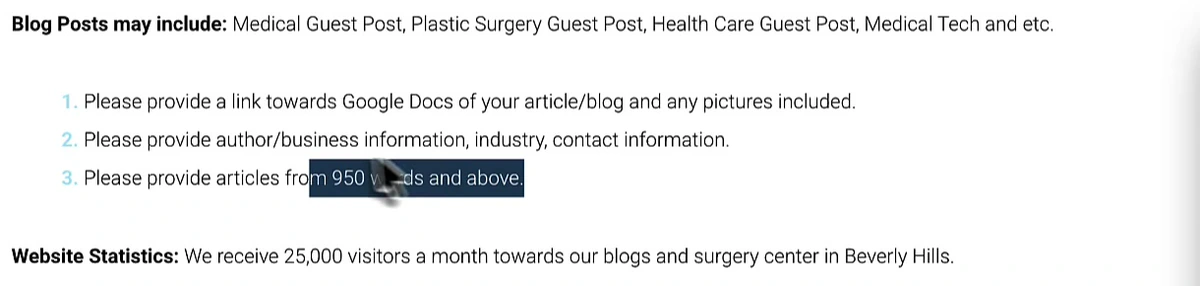
Twenty-five thousand visitors a month is a page worth a placement. Now the third-party view of the same domain:
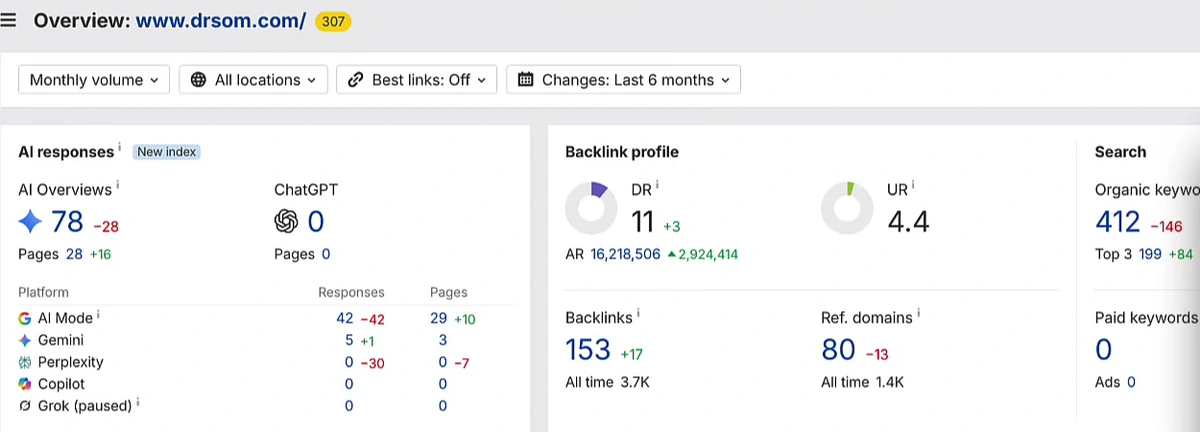
The gap is not necessarily a lie. A surgery clinic's "25,000 visitors" may well count every channel — paid, direct, social, and foot traffic to the booking page — while Ahrefs estimates organic search alone. But it is an order of magnitude apart from what a link on that page will actually put in front of anyone, and it is the number you would have negotiated against if you had not checked.
None of this makes a DR 11 link worthless. For another plastic surgery clinic in a different city, a relevant local link at that authority can be a perfectly sensible buy. It is only worthless if you paid DR 40 money for it.
Where the agent stops
This is the honest limit, and the video is direct about it: Claude finds opportunities, it does not build links. The output is a qualified list and a CSV. What happens next is a human writing an email, negotiating a price, writing 950 words to someone else's guidelines, and waiting.
Nor is the free path free. The sites on that list are not publishing your article out of goodwill. A DR 83 site with 40,000 monthly visitors knows exactly what its link is worth. Some publish their rates on the contributor page; most make you ask. The realistic options are paying, or arranging a link exchange where each side publishes for the other — and an exchange still costs you an article and a link out.
So the comparison is not "paid versus free". It is where the cost lands:
| Automated network | Claude Code prospecting | |
|---|---|---|
| What you spend | A subscription (plans start at $39/month) | Your time, plus whatever each site charges |
| What you get | Links placed for you, on a daily cap | A vetted list of opportunities |
| Control over targets | Relevance/volume settings, not site-by-site | Complete — you approve every domain |
| Effort per link | None after setup | Outreach, negotiation, writing, follow-up |
| Ceiling | Whatever the network holds | Any site on the web that accepts contributors |
The two are not really rivals. The network handles baseline velocity without occupying anyone; the agent goes and gets the specific DR 83 in your niche that no network will hand you. Running both is the obvious answer if the budget allows it.
Guest posts versus niche edits
Worth having the vocabulary straight, because the outreach differs. A guest post is a new article published on someone else's site containing a link to yours. A niche edit, or link insertion, is a link added into an article that already exists on their site — and, ideally, already ranks. Niche edits need no writing from you, which makes them faster and often cheaper to negotiate. Every one of the DR 66 through DR 15 links in the automated set is a guest post link.
Running this on your own site
The reproducible version, in order:
- Create a folder on your desktop and put your skill or prompt files inside it. Open a Claude Code session on that folder — the context lives there.
- Identify your niche keyword before anything else. Not your domain, not your product name — the phrase a blog in your space would organise itself around. This is the single decision that determines the quality of everything downstream.
- Run the footprint set against it:
inurl:"guest post", "write for us", "submit your article", "become a contributor", "blogging guidelines". - Deduplicate, then enrich every survivor with DR and organic traffic. Set a floor on both. DR ≥ 20 and ≥ 500 visits a month is a reasonable starting bar.
- Check each site's own traffic claim against the third-party number before you talk price.
- Then do the human part: pitch, negotiate, write.
If you want the full walkthrough of the writing-and-outreach half of this, including how to produce the guest post itself, that is covered in my guide to building backlinks with AI. And for a different flavour of the same prospecting idea — pointing the agent at nonprofit sponsor pages instead of guest post pages — see how I found a DR 77 link for $128 with Claude.
Why any of this is worth doing
The chain is short. More referring domains raises domain rating; higher domain rating correlates with ranking for more keywords; more keywords means more traffic; traffic that converts is revenue. Backlinks are one input among several — content and technical work matter just as much — but they are the input that compounds and the one competitors cannot copy overnight.
There is a second reason that did not exist a few years ago. The same authority signals that move search rankings appear to influence how often a brand gets surfaced inside AI assistants. A site that many relevant domains vouch for is a site that language models see referenced across the web. I dug into that relationship in brand mentions are the new backlinks.
Want the prospecting skill running against your own domain without assembling it yourself? See how Arvow handles link building — or book a call and I will look at your profile directly.
FAQ
Can Claude Code actually build backlinks for me?
No. It finds and qualifies opportunities, and it writes the pitch if you ask. Placing the link requires a human relationship with the site owner and, almost always, money. An automated link network is the only path here that places links without your involvement.
Are free backlinks real?
Not at any quality worth having. A site with real authority and real traffic knows what a link from it is worth and will charge for it. The closest thing to free is a link exchange, and that costs you an article plus a link out of your own site.
What DR should I filter for?
DR ≥ 20 paired with ≥ 500 organic visits a month is the bar used in this run, and the pairing matters more than the threshold. DR alone lets through sites with authority and no readers; traffic alone lets through sites with readers and no link equity.
Do I need a paid AI model for this?
No. The run in the video used a premium model and he calls it overkill outright. The quality comes from the skill file and the filter criteria, not the model tier.
Guest post or niche edit — which should I go for?
Niche edits are faster and usually cheaper, since you write nothing and the host page may already rank. Guest posts give you control over the anchor, the context and the surrounding content. If a site offers both, price them against each other.
Generate, publish, syndicate and update articles automatically
The AI SEO Writer that Auto-Publishes to your Blog
- Cancel anytime
- Articles in 30 secs
- Plagiarism Free