
How Much Do Backlinks Increase Traffic? 5 Links, +951%, Honestly Measured (2026)

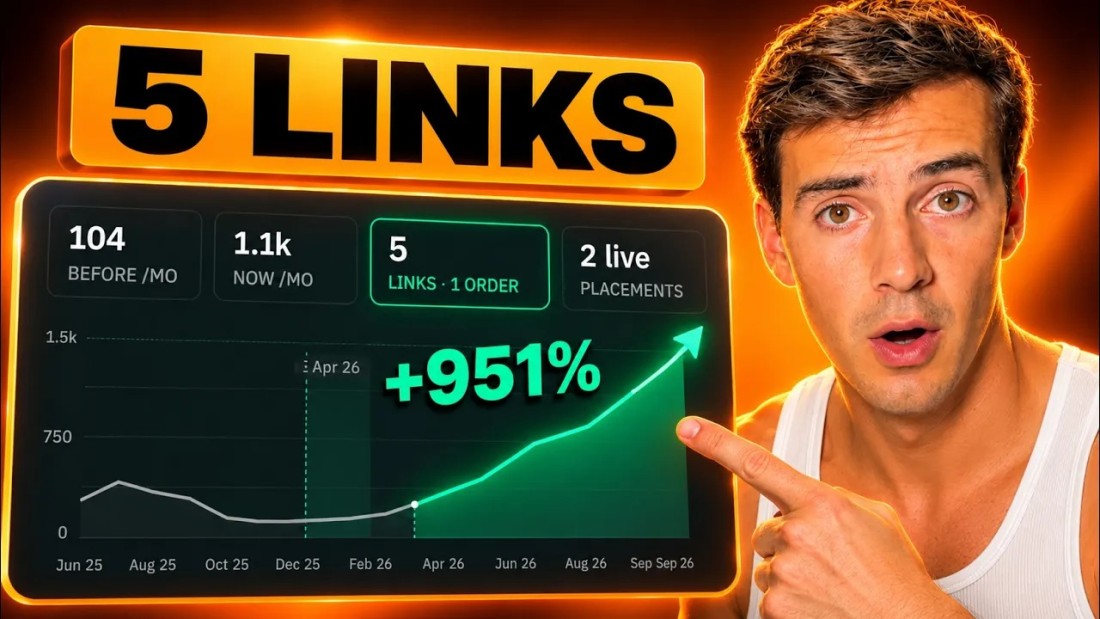
How much can a handful of backlinks actually move traffic? Here's one measured answer: a Cornwall tourism site went from roughly 100 visits a month to about 1,100 — a 951% increase — after a shared five-link order built in April 2026, with around two of those links pointing at this domain. No other work is mentioned — five links, one order.
The walkthrough comes from the Arvow channel, and it's unusually candid about the parts case studies normally bury: which gains are seasonal, why Ahrefs shows only two live placements, and why it saw the links a month after they were built. Vasco had Claude aggregate the Ahrefs data and the internal order sheet into the case card below, and the same honesty made it into the card itself.
The case, on one card
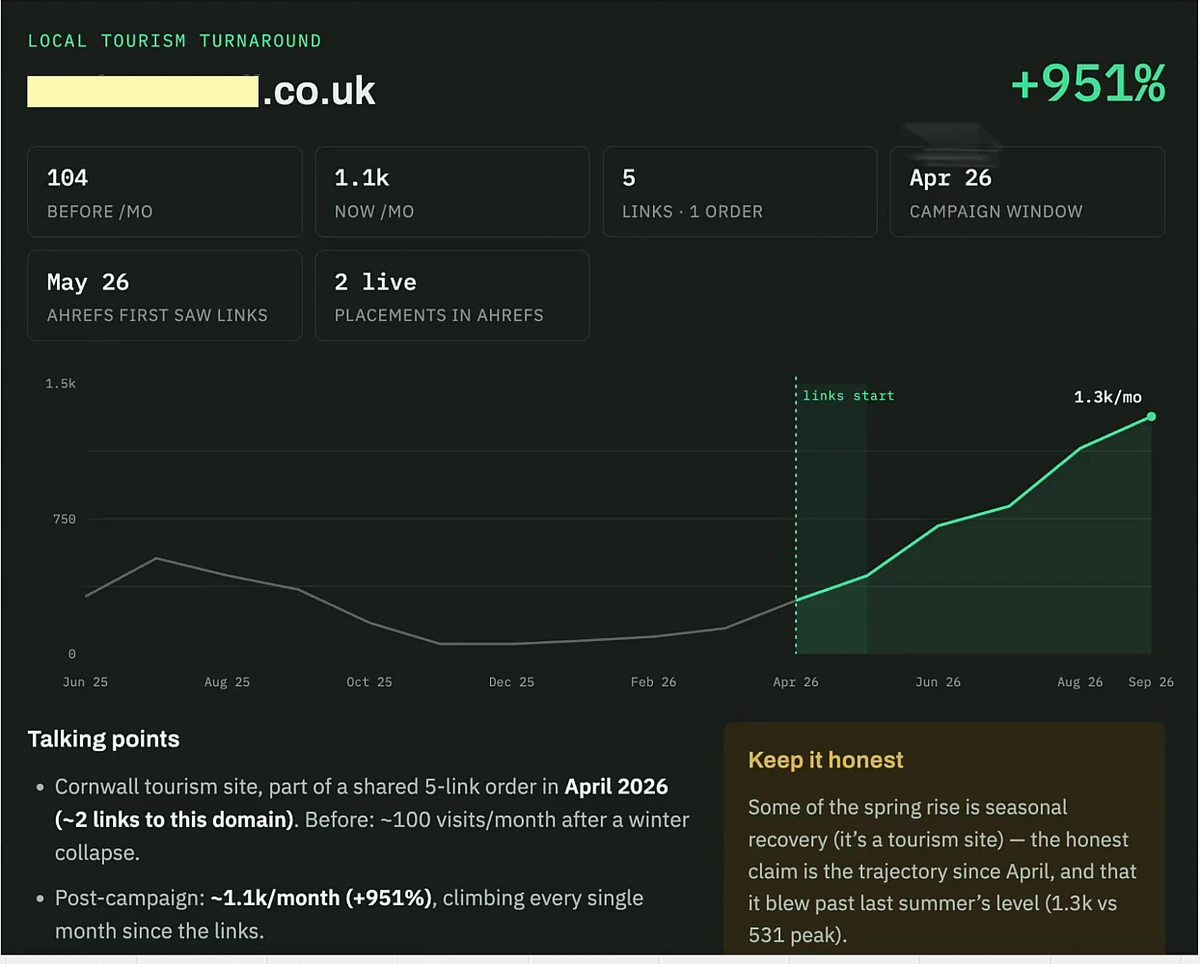
Read the tiles left to right and you have the whole story: 104 visits/month before (after a winter collapse), ~1.1K/month now, climbing every month since the links landed. The chart's "links start" marker sits at April 2026, and the line does what the sales page says it should — but the card's most interesting box is the brown one.
The "keep it honest" box
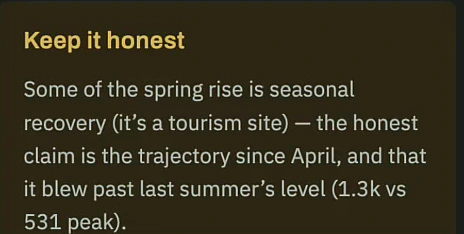
It's a tourism site, so some of the spring rise is seasonal recovery — pretending otherwise would be exactly the kind of case-study inflation this channel keeps calling out. The honest claim is comparative: the trajectory since April, and the fact that this summer blew past last summer's peak — about 1.3K/month against a 531 peak the year before. Seasonality gets you back to your old ceiling; it doesn't more than double it. The gap between those two peaks is the links' share of the story.
Why Ahrefs saw the links a month late — and rarely sees all of them
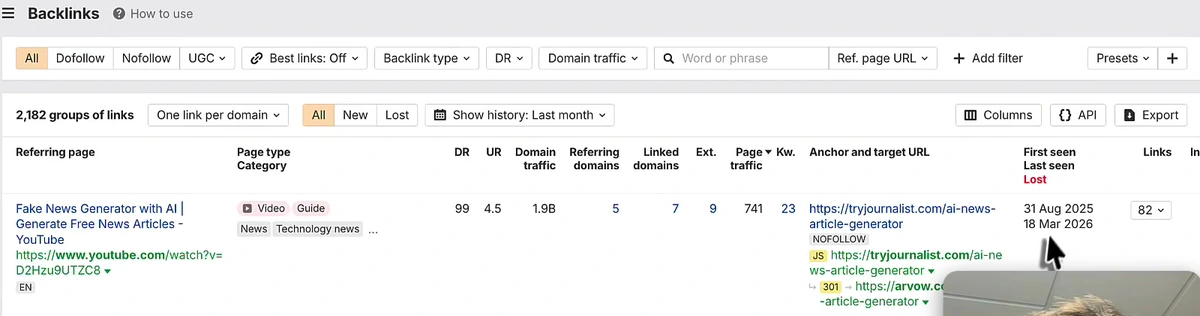
Two details that trip up anyone auditing a link campaign: the links were built in April but Ahrefs first saw them on May 26 — about a month's lag — and it shows just 2 live placements, with Vasco noting the tools often never pick up all the links the team builds. Third-party crawlers index links on their own schedule and never see everything; Google picks them up faster. So the "first seen" date in a backlink tool is a discovery date, not a build date, and a placement missing from Ahrefs isn't a placement that doesn't exist. If you're evaluating a link vendor by counting rows in Ahrefs a week after delivery, you're measuring the crawler, not the campaign.
What kind of domain does this
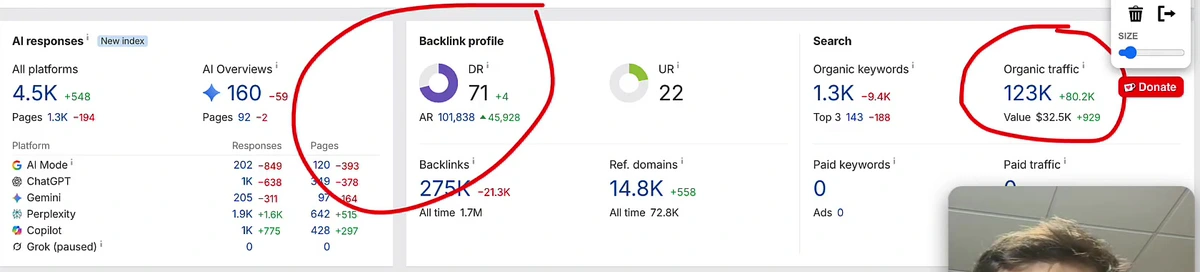
Pulled from the delivery sheet on camera: a DR71 domain with ~123K monthly organic visits, US-led traffic, thousands of AI-platform mentions. (Vasco notes he can't be sure this exact domain served this exact client — it's the type of domain in the pool the order drew from.) The reason five links can do what five hundred directory links can't is entirely in this panel: real domains transfer real authority, which is the same conclusion our teardown of what a $500 backlink gets you reached from the buying side.
So — how much do backlinks increase traffic?
The honest answer is a range, not a number, and this channel is now publishing the range: alongside the 951% tourism case, the upcoming case-study board shows +1,155%, +588%, +3,959%, +184% and +94% campaigns — different niches, different budgets, different baselines:
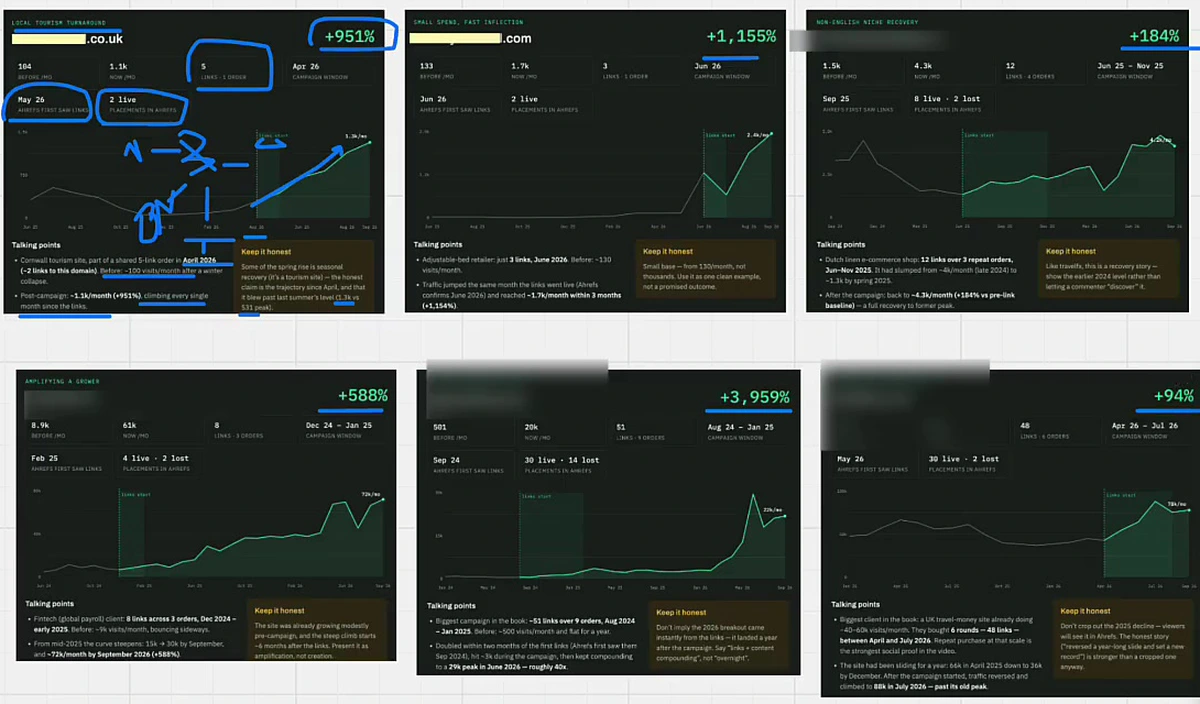
Three variables decide where a site lands in that range. The baseline — percentage gains are easiest from a collapsed baseline like this one's 104 visits, which is why the honest metric is absolute traffic against the previous peak. The other two pillars — as the video stresses, links are one of three; on-page content and technical SEO have to be able to absorb the authority (the 13-link case we published on the existence question made the same point with ~80% attribution honesty). And link quality — the DR71 panel above versus whatever $5 gets you. For how quality interacts with quantity, our data piece on how many backlinks you need covers the count side; the method comparison lives in 13 backlink building methods, ranked.
Measure yours the same way
The case card doubles as a template for auditing any link campaign honestly, and it's four numbers:
- Baseline month — traffic the month before the first link went live (here: 104).
- Current month — not the best month since; the latest one (here: ~1.1K, still climbing).
- Previous-year peak — the seasonality control. If your best month this year only matches last year's best, the season did it; here 1.3K vs 531 is what beating the control looks like.
- Links visible vs links built — expect the tool to lag by weeks and undercount; judge delivery by the placement URLs in the delivery sheet, not the Ahrefs row count.
Doing it, or having it done
The order flow behind this case is deliberately boring: the client fills the form, the order lands in the team's sheet, and the links are built manually — Vasco's standing line applies — "if I could automate the whole thing with AI, I would," but for this quality they can't, at least not yet. For sites that want the whole three-pillar job instead of just links, there's a full-service tier with a blunt guarantee:

Or build them yourself — the channel's own tutorials cover the manual route end to end. Either way, the takeaway from the Cornwall card stands: on a site whose content deserves it, a small number of real links, honestly measured, can multiply traffic — and the measurement should always subtract the seasonality first.
Want your own case card? Arvow builds the links manually — DR40–70+ domains with real organic traffic — and the full-service tier guarantees 25% more Google traffic in 90 days or you don't pay.
Generate, publish, syndicate and update articles automatically
The AI SEO Writer that Auto-Publishes to your Blog
- Cancel anytime
- Articles in 30 secs
- Plagiarism Free