ChatGPT Competitor Analysis: How to See Any Competitor's Traffic and Keywords (2026)

ChatGPT can run a competitor analysis for you if you connect it to a source of SEO data. You give it a competitor's website, and it reports which keywords the site ranks for, how much search traffic it gets, how many backlinks it has, and where it is weak. In a November 2026 video, Tim The SEO Guru does this with ChatGPT and the Arvow plugin on a Miami plumbing company. This guide follows his steps and shows what the report says, including one result the video title does not prepare you for.
ChatGPT competitor analysis at a glance
| Step | What you do | What you get |
|---|---|---|
| 1 | Connect an SEO data plugin to ChatGPT | ChatGPT can look up real keyword, traffic and backlink data |
| 2 | Pick a competitor | A website address to analyze |
| 3 | Ask ChatGPT to reverse engineer the site | Rankings, traffic estimate, backlinks, site structure, weak points |
| 4 | Ask for a content plan | Service pages and articles to write, in order |
| 5 | Write the pages with your own proof | Content a competitor cannot copy |
Why ChatGPT needs a plugin for this
On its own, ChatGPT cannot see how much traffic a website gets. It can read the site's pages, but it has no keyword database. If you ask it for a competitor's traffic without a data source, it will guess.
A plugin fixes that. Tim connects Arvow to ChatGPT, which gives ChatGPT access to ranking, traffic and backlink data. In the report, each number is labelled as coming from Arvow, and the Sources panel lists two inputs: web search and Arvow.
These numbers are estimates. The report says so itself: the figures cover "modeled organic search traffic", and Google Maps calls, direct visits and booked jobs are outside the estimate. Keep that in mind for local businesses, where much of the work comes from the map.
Step 1: connect the plugin
In ChatGPT, open the Plugins page, search for Arvow and add it. The video shows this under the label "Install MCP plugins". You need an Arvow account for the plugin to pull data. Once it is connected, a Plugins button appears under the chat box.
Step 2: choose a competitor
Tim searches Google for "plumber miami" and picks a business from the map results. He opens its website and copies the address.
For your own business, pick two or three competitors:
- One that shows in the map results for your main service.
- One that ranks in the normal results below the map.
- One you keep losing jobs to.
As you will see below, the first site you pick may not be the best one to learn from.
Step 3: run the competitor analysis prompt
The prompt is one sentence plus the website address.

ChatGPT calls the plugin, searches the web, and writes a report with four parts.
What actually ranks
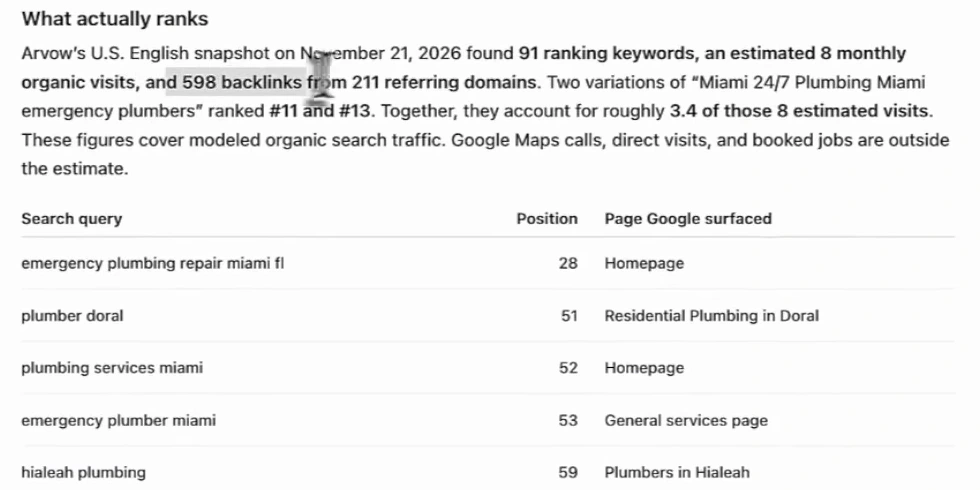
This is the surprise. The video title promises a competitor's traffic, and the answer is about 8 visits a month from organic search. The site ranks for 91 keywords, but almost all of them sit far down the results:
| Search query | Position | Page Google shows |
|---|---|---|
| emergency plumbing repair miami fl | 28 | Homepage |
| plumber doral | 51 | Residential Plumbing in Doral |
| plumbing services miami | 52 | Homepage |
| emergency plumber miami | 53 | General services page |
| hialeah plumbing | 59 | Plumbers in Hialeah |
Its best positions are #11 and #13, both for searches that include the company's own name. Those two account for roughly 3.4 of the 8 estimated visits.
This is a useful lesson. A business can show up in the Google map results and still have almost no traffic from the normal results. The two are separate. If you had copied this site's blog strategy because it "ranks on Google", you would have copied a strategy that brings in very little.
The report also spots a problem with two pages. "Emergency plumbing repair miami fl" ranks with the homepage, while "emergency plumber miami" ranks with the general services page, and the site has a 24-hour plumber page as well. Three pages are possible answers to the same search. ChatGPT is careful here and says this snapshot alone cannot prove the pages are hurting each other. We explain the issue in our guide to keyword cannibalization.
How the site is built to generate calls
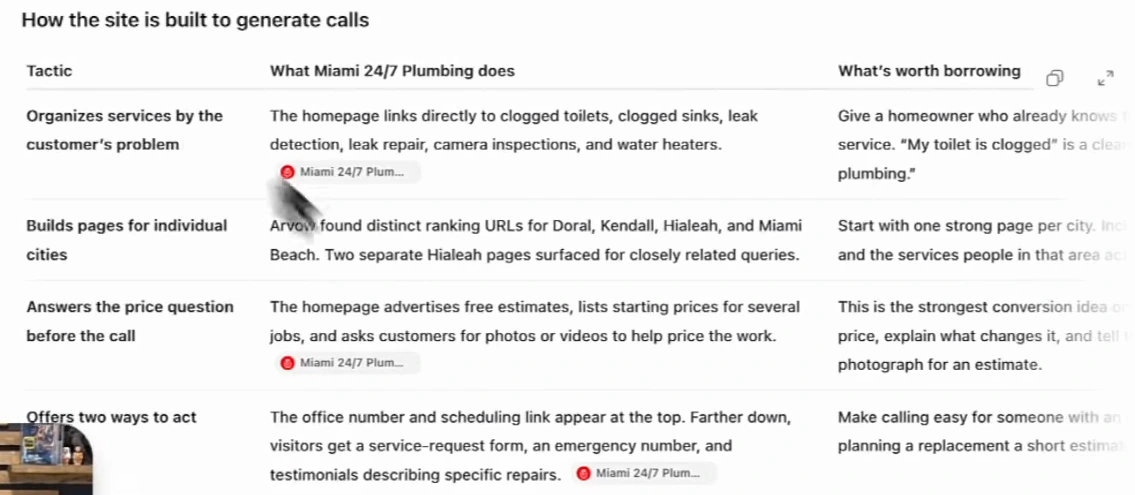
Low traffic does not mean there is nothing to learn. The report lists four things the site does well:
- It organizes services by the customer's problem. The homepage links to clogged toilets, clogged sinks, leak detection and water heaters. "My toilet is clogged" is clearer to a homeowner than a general plumbing page.
- It has pages for individual cities. Separate pages rank for Doral, Kendall, Hialeah and Miami Beach. See our guide to location pages.
- It answers the price question before the call. The homepage offers free estimates, lists starting prices, and asks for photos or videos to price the work. ChatGPT calls this the strongest idea on the site.
- It offers two ways to act. A phone number and a scheduling link sit at the top, with a request form further down.
Where a competitor could beat it
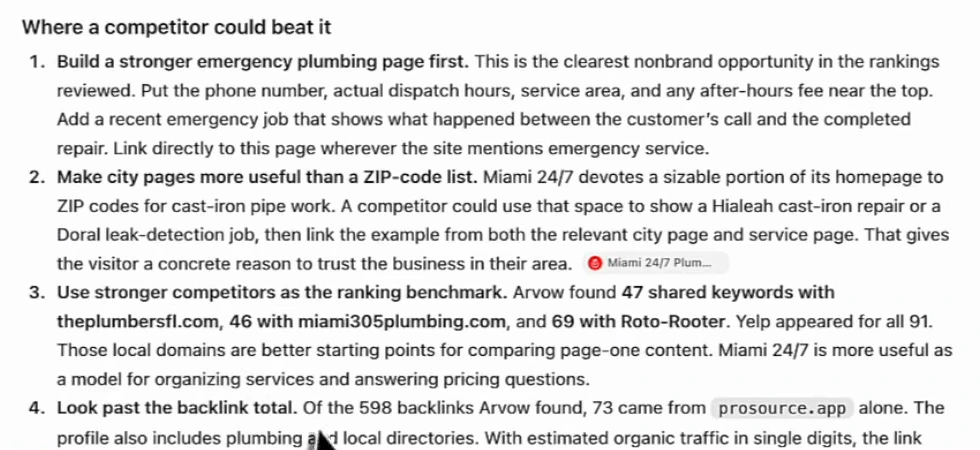
- Build a stronger emergency plumbing page. Put the phone number, real dispatch hours, service area and any after-hours fee near the top. Add a recent emergency job as an example.
- Make city pages more useful than a ZIP-code list. Show a real job from that city and link to it from the city page and the service page.
- Use stronger competitors as the ranking benchmark. The plugin found three sites that share keywords with this one: two local plumbing sites with 47 and 46 shared keywords, and Roto-Rooter with 69. ChatGPT says the local ones are better models for page-one content.
- Look past the backlink total. Of the 598 backlinks, 73 come from one domain. With traffic in single digits, the link count says little about what brings in customers.
Point 3 is the practical takeaway. Your first competitor analysis often tells you who to analyze next. Run the same prompt on the stronger sites it names.
Step 4: turn the analysis into a content plan
Next, Tim asks a follow-up question in the same chat: what would be a good SEO blogging structure and ideas for a content strategy, based on what is working and the gaps in the market?
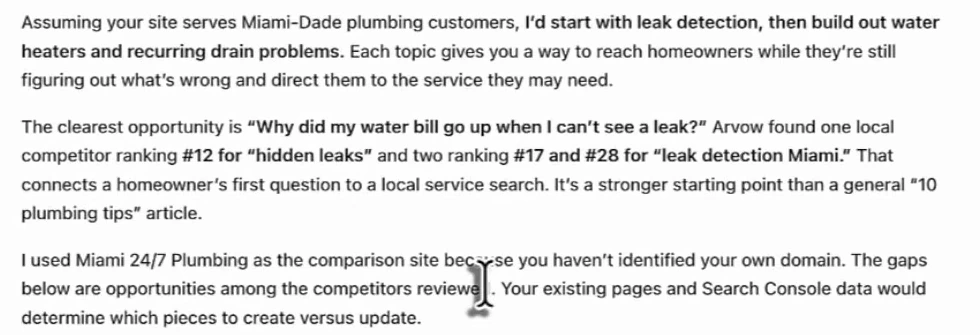
ChatGPT recommends starting with leak detection, then water heaters, then recurring drain problems. Its reason is in the data. One local competitor ranks #12 for "hidden leaks", and two rank #17 and #28 for "leak detection Miami". Nobody holds the top spots, so there is room.
The best opening it finds is a question a homeowner would type: "Why did my water bill go up when I can't see a leak?" ChatGPT says this is a stronger starting point than a general "10 plumbing tips" article, because it connects a real worry to a service you sell. That is the same idea as buying intent keywords.
One number comes with a warning. The plugin estimates 1,900 monthly US searches for "tankless water heater gas versus electric". ChatGPT notes that this is a national figure and should not be used as a Miami traffic forecast.
The site structure
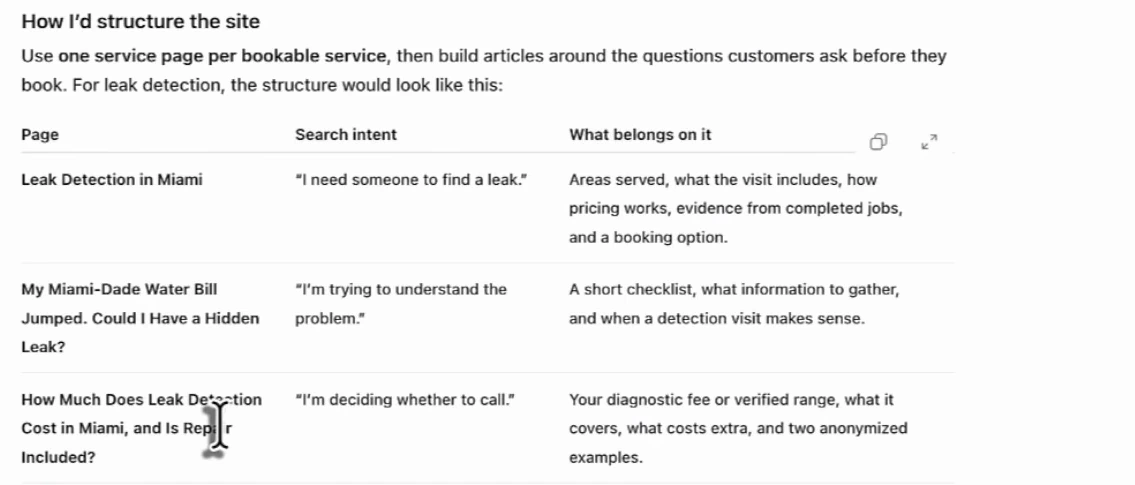
The rule ChatGPT gives is simple: one service page for each service a customer can book, then articles for the questions people ask before they book.
| Page | What the searcher is thinking |
|---|---|
| Leak Detection in Miami (service page) | "I need someone to find a leak." |
| My Miami-Dade Water Bill Jumped. Could I Have a Hidden Leak? | "I'm trying to understand the problem." |
| How Much Does Leak Detection Cost in Miami, and Is Repair Included? | "I'm deciding whether to call." |
Each article links to the service page at the point where a reader would want help. The service page links back to the cost guide near the pricing. Our internal linking strategy guide covers how to set this up.
The first articles to publish
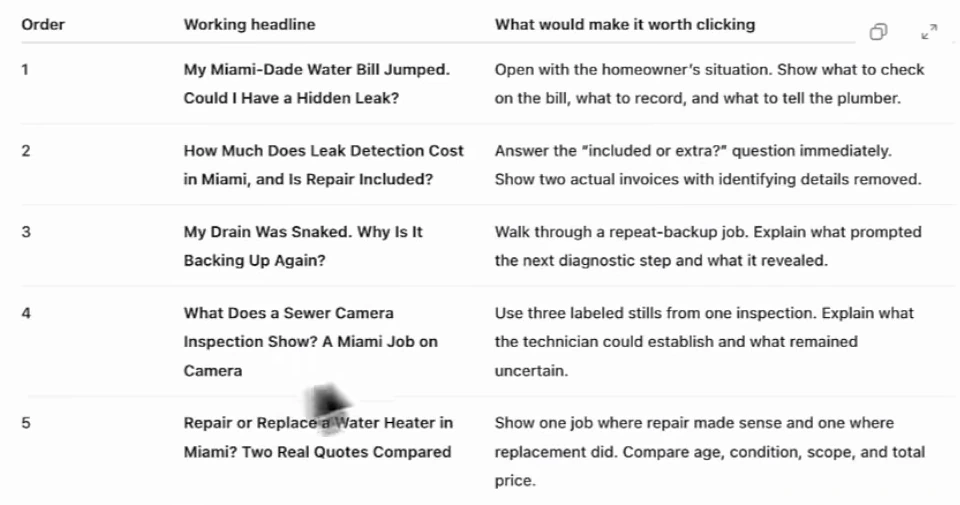
ChatGPT lists eight articles in order. Look at the right-hand column. Almost every row asks for something only a real plumber has:
- "Show two actual invoices with identifying details removed."
- "Use three labeled stills from one inspection."
- "Show one job where repair made sense and one where replacement did."
This is the part that makes the plan hard to copy. Anyone can ask an AI to write "how much does leak detection cost". Only you have your invoices, your photos and your jobs. Content without that proof is commodity content, and it is easy to outrank.
Step 5: write the pages with your own proof
In the last part of the video, Tim moves to Arvow to build the content. From the chapters and the screens, the steps are:
- Add your brand details and case studies. He opens the Knowledge Base, where you can upload files, add a web page or paste text. This is where invoices, job notes and guarantees go so articles can use them.
- Start with the service pages. Build the pages people book from, then the articles that link to them.
- Write the first articles from the plan. Each one links back to its service page.
- Connect your Google Business Profile and watch AI visibility. He ends on an LLM brand monitor, which tracks whether AI assistants mention the business.
The demo account on screen belongs to a sample chiropractic project and not to the plumber, so no published plumbing pages are shown. The video demonstrates the research and the plan. It does not show ranking results from carrying the plan out.
What this method cannot tell you
- Map traffic. The estimate covers organic search only. A plumber's calls from the Google map are not in it. For that side, see how to outrank local competitors.
- Exact numbers. Third-party traffic figures are modeled. Use them to compare sites with each other and to spot gaps. Only the site owner's Search Console has the real numbers.
- Your own starting point. In the video, ChatGPT points out that it used the competitor as the comparison site because no domain for "your" business was given. Tell it your website, and connect your own Search Console data if you can, so it knows which pages to create and which to update.
Frequently asked questions
Can ChatGPT check a competitor's website traffic?
Not by itself. It needs a plugin or connector that supplies SEO data. With one connected, it can report estimated organic traffic, ranking keywords and backlinks for any domain.
What prompt should I use for competitor analysis in ChatGPT?
The video uses: "Using the Arvow plugin, reverse engineer this website" followed by the address. Then ask a follow-up for a blogging structure based on what is working and the gaps in the market.
How accurate is the traffic number?
It is an estimate based on keyword positions and search volumes. It is good for comparing competitors and poor as an exact count.
Does this work for businesses that are not local?
Yes. The prompt is the same for any website. For a software or ecommerce site, see our walkthrough on how to clone a competitor's SEO strategy.
What if my competitor has almost no traffic?
That is useful to know. Use the list of sites that share its keywords, pick the stronger ones, and run the analysis again on those.
Run the same analysis on your competitors. Arvow's AI SEO chat uses the same ranking, traffic and backlink data, and can turn the gaps it finds into articles for your site.
Generate, publish, syndicate and update articles automatically
The AI SEO Writer that Auto-Publishes to your Blog
- Cancel anytime
- Articles in 30 secs
- Plagiarism Free