
Keyword Cannibalization: How to Find It in Search Console and Fix It Properly (2026)

Keyword cannibalization is the SEO problem everyone has an opinion about and few people diagnose properly. Tim The SEO Guru's video walks through an r/SEO thread where one practitioner wrote up how they find competing pages in Google Search Console, pick the page to keep, merge the rest and redirect, and where two other members push back on the whole premise. This article turns the thread into a working procedure, checks the contested claims against Google's own documentation, and adds the point Tim raises at the end: why this gets worse once you publish with AI.
What keyword cannibalization is, and what Google actually says
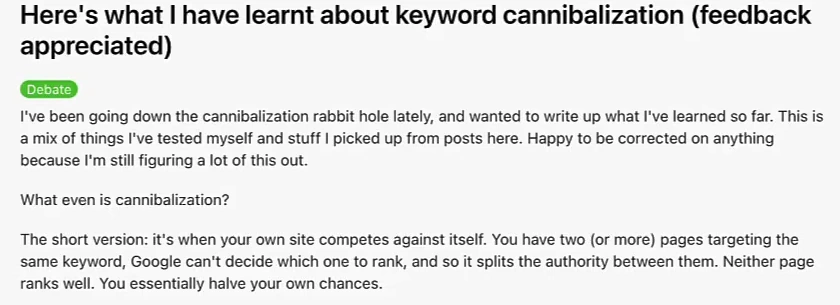
The thread's definition is the common one: your own site competes against itself. Two or more pages target the same keyword, Google cannot decide which to rank, the authority is split and neither page ranks well. The poster's summary is that you "halve your own chances".
Google is more careful than that. Its page on consolidating duplicate URLs gives four reasons to pick one URL for similar content: to choose which URL people see, to consolidate signals for similar or duplicate pages, to simplify tracking, and to avoid wasting crawl time. A 2008 Search Central post says there is "no such thing as a duplicate content penalty", that Google clusters duplicates and shows the one it thinks best, and that undetected duplicates "may dilute the strength of that content's ranking signals by splitting them across multiple URLs". So Google does describe signal splitting, but for duplicate and near-duplicate URLs, not for any two pages that mention the same keyword. That distinction decides what the fix actually does.
How to spot it in Google Search Console
The thread's detection method needs nothing beyond Search Console. Open the Performance report, filter by a query, then look at the Pages tab: if the same keyword returns several URLs from your site, that is the flag. Then watch for four symptoms.
| Signal | What it looks like | Why it matters |
|---|---|---|
| Several pages for one query | Query filter, Pages tab shows two or more of your URLs | Google is rotating between candidates instead of settling on one |
| Position volatility | A page bouncing between roughly position 20 and 80 | The thread's reading: Google is unsure which of your pages is the better answer |
| Impressions without clicks | High impressions, low clicks, across several pages for one query | Each page is shown some of the time, none in a position that earns clicks |
| A crowded site: search | site:yourdomain.com plus the topic returns three or four of your pages | More candidate pages than the intent needs |
None of these is proof on its own; a page can sit at position 40 because it is weak, not because a sibling is fighting it. The thread's answer is the SERP overlap test: search the query each suspected page targets and compare the ten results. Above roughly 70% overlap in the top ten, Google is treating the two queries as one intent and you want one page. Below it, the pages serve different intents and the fix is to sharpen each one, not merge them. Run the check before you touch anything.
Pick the page that survives
Once two pages are confirmed to chase one intent, one has to win. The thread's criteria are mechanical, which helps when the pages have different authors with opinions.
| Criterion | Where to read it |
|---|---|
| Which page ranks highest for the target query | Search Console, Query filter, Pages tab, average position |
| Which page earned the most clicks in 90 days | Same report, 3-month range |
| Which page has more backlinks | Search Console Links report, or any backlink tool |
| Tie-breaker: fewer incoming internal links to update | Your CMS or a crawl; simply less work |
One addition: check which page converts. A page that ranks slightly lower but ends in a quote form is the better survivor; apply the buying intent keywords lens before deciding.
Consolidate: the steps, in order
- Read every losing page and pull out anything unique the winner does not have. This step is what makes the merged page better than either original, and it is the one people skip.
- Set the losing pages to draft or delete them. A live duplicate keeps competing.
- 301 redirect each old URL to the winner. The thread's line is that a proper 301 is what moves the authority. Google's redirects documentation says it differently but points the same way: a permanent redirect signals that the target should become the canonical URL; a temporary one does not, and tends to leave the source in results.
- Update internal links that pointed to the losing pages so they reach the winner directly. Our internal linking strategy guide covers concentrating links on the page you want to rank.
- Request indexing of the winner and make sure the sitemap lists only the surviving URL.
On redirect versus canonical tag, Google's ordering is useful. Its consolidation page calls a redirect "a strong signal that the target of the redirect should become canonical", rates rel="canonical" as a strong signal too and sitemap inclusion as a weak one, and notes the methods "can stack". The practical difference is the visitor: a canonical tag leaves both pages live; a redirect removes the duplicate from the visitor's path as well as the index. When you have decided the second page should not exist, the redirect is the honest fix. The source is Google's guide to consolidating duplicate URLs.
Three mistakes the thread owns up to
- Creating new content before fixing existing cannibalization. If pages already compete, more pages add more competition.
- Year-specific URLs. "Best tools 2024" and "best tools 2025" as separate URLs compete with each other and with the evergreen version. One URL you update each year beats a new one every January; the year belongs in the title, never the slug.
- Treating canonical tags as the fix. Better than nothing, the thread says, but not a redirect. Google rates both as strong signals, so the real objection is practical: a canonical keeps the losing page alive, linked and crawlable, and someone will keep updating it.
What recovery looks like
The poster's timeline: week one is checking that every redirect resolves and nothing returns a 404. From week two, expect position volatility while Google re-evaluates; then the winner should settle above where either page sat, and total clicks for the keyword should rise. Google publishes no timeframe, so measure rather than wait, and measure at the query level rather than the page level, because the page URL has just changed and a page view will only show the loser falling to zero. If the winner settles below the better old position, the usual cause is that the losing page's unique material never made it in.
The pushback: "every page has its own authority"
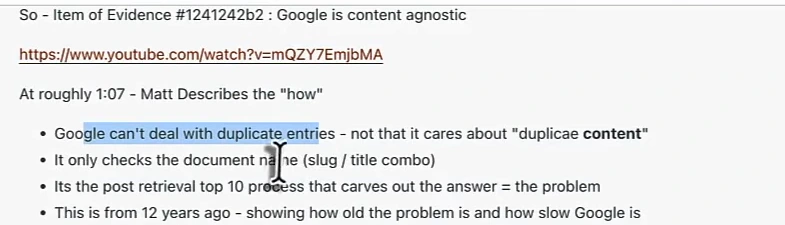
The replies are the reason the thread is worth a video. One of the subreddit's moderators posted a 2013 Google Search Central video, "How does Google handle duplicate content?", in which Matt Cutts explains the mechanism, and summarised it in four lines: Google can't deal with duplicate entries, not that it cares about duplicate content; it only checks the document name, the slug and title combination; the problem is the post-retrieval top-ten process that carves out the answer; and the video is twelve years old. The gloss: Google is content agnostic; duplicates are not spam, just unnecessary.
A second reply calls the original post flawed, starting with the idea that two pages split authority. Every page has its own authority, it argues; no page hurts another. What happens when you de-cannibalize is that you take two mediocre pages and create one good page: more semantically relevant, with more of what some people call information gain, and with consolidated internal linking. The merged page ranks higher because it is better, not because a penalty was lifted.
Tim's position sits between the two. He thinks you can cannibalize "a little bit", but that most of it comes down to page quality, keyword targeting and site structure: the weaker pages were getting scraps of traffic because of how they were built, and folding them into the quality page is right either way.
Our reading: both camps describe the same action from different ends. Google's 2008 post does say signals can split across duplicate URLs, which covers interchangeable pages; for two different pages on one topic, the reply is right that the merged page simply wins by being stronger. Either way the procedure above is what you do, and the measure is whether the survivor ranks and converts better than the pair did.
Why this gets worse when you publish with AI
Tim closes by pointing at AI content. Generation is cheap, so the volume problem arrives faster: two briefs on the same keyword, a news post and an evergreen post on one question, a service page and a blog post written a month apart. The pages are not duplicates in Google's sense, but they are interchangeable, which is the commodity content problem, and interchangeable pages are the ones Google rotates between. Three habits prevent most of it.
- One keyword, one URL, written down. Before an article is generated, its target query is checked against the pages already live and already planned. A topical content map is the simplest version; a spreadsheet works.
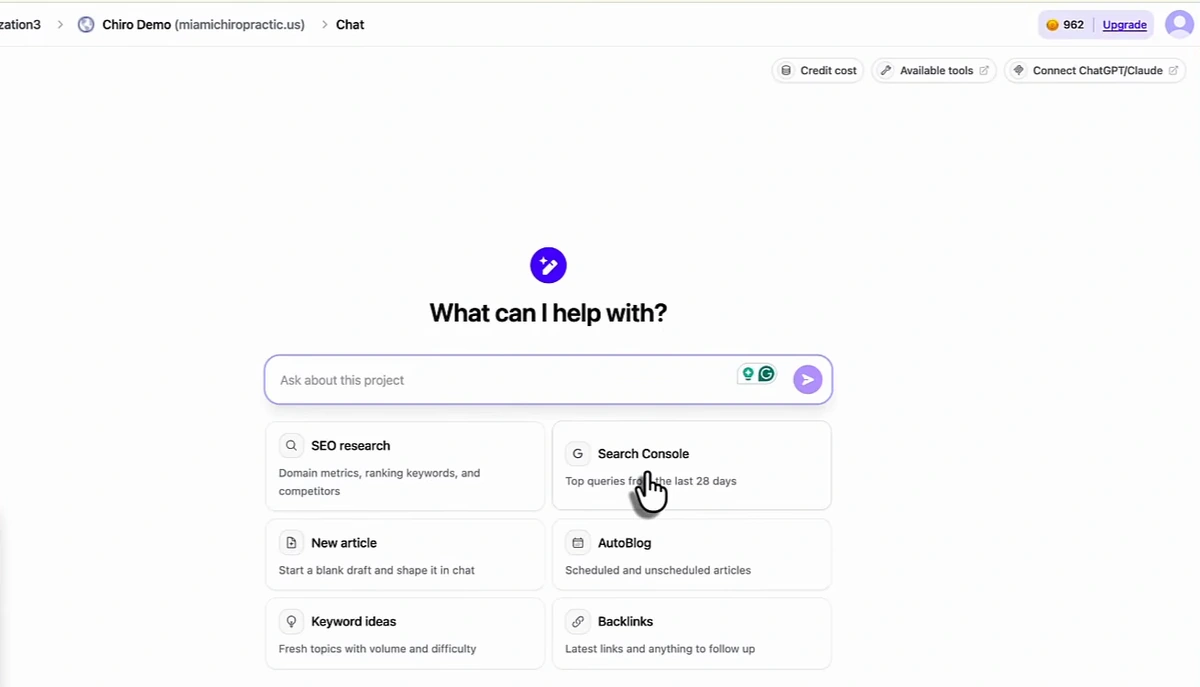
- Start from what already ranks. In Arvow, the Search Console card in the project chat pulls the top queries for the connected property, which is where this article's check starts. Asking which pages rank for a query before writing a new one is a one-line prompt.
- Give the generator something only you have. Tim's argument for a knowledge base is the dissenter's argument about information gain: a page built from your own documents and positions is not interchangeable with a competitor's, or with your own earlier post.

One thing to check in any title-rewriting tool
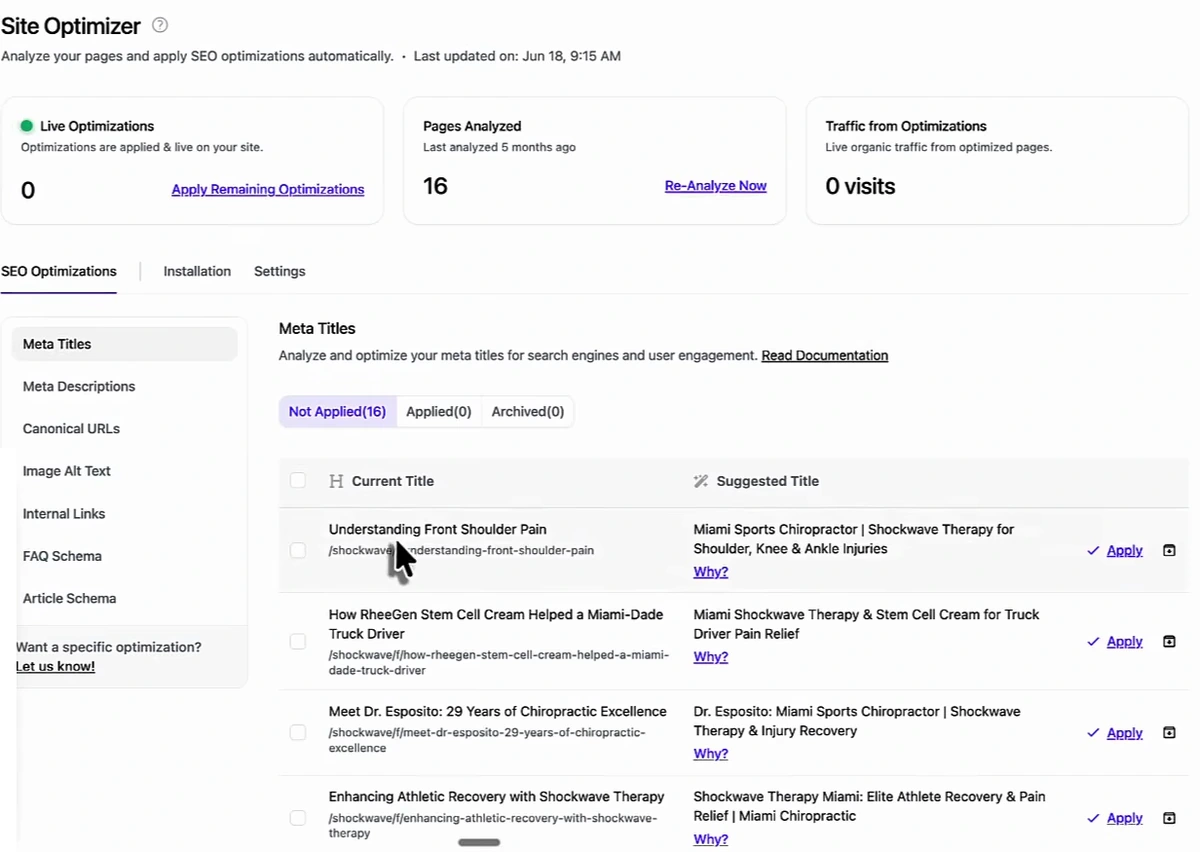
One frame in Tim's tour shows how cannibalization starts, although he does not pause on it. The Site Optimizer's meta title suggestions for his demo chiropractic site propose new titles for four different pages, and all four lead with a variant of "Miami Sports Chiropractor | Shockwave Therapy". Each is reasonable alone; applied together they would point four URLs at one query. That is not specific to this tool, it is what happens whenever titles are optimised one page at a time against the same keyword list. Review suggested titles as a set, keep one page on the head term, and give the others their own qualifier.
The checklist
- Pull the query list. Search Console, Performance, 3 months; for each important query, note every URL in the Pages tab.
- Shortlist the pairs with position volatility, impressions without clicks, or three or more URLs for one query.
- Run the SERP overlap test. Above roughly 70%, merge; below it, differentiate.
- Pick the survivor by position, 90-day clicks, backlinks, then conversion.
- Merge, unpublish, 301, update internal links, fix the sitemap.
- Measure at the query level for the following weeks and expect week-two volatility.
- Fix the intake. Add the one-keyword-one-URL check to every brief and run this audit with your quarterly SEO audit checklist.
FAQ
How do I find keyword cannibalization in Google Search Console?
Open Performance, add a Query filter for the keyword, then switch to the Pages tab. If more than one of your URLs appears, especially with positions that move week to week, you have pages to compare. Repeat for your most important queries.
Is keyword cannibalization a Google penalty?
No. Google has said since 2008 that there is no duplicate content penalty. It picks one of your similar pages to show, and that choice can change, so none of them builds a stable position. For near-duplicate URLs Google's documentation says signals can be split across them, which is why it recommends consolidating.
Should I use a 301 redirect or a canonical tag?
If the second page should not exist, redirect it: a permanent redirect removes the duplicate for visitors and signals the target as canonical. Use a canonical tag when both pages must stay published for users, such as filtered or print versions of one page.
Run the check before you publish, not after. Arvow's AI SEO chat reads your Search Console data, tells you which pages already rank for a query, and generates the new article from your own knowledge base so it does not compete with the last one.
Generate, publish, syndicate and update articles automatically
The AI SEO Writer that Auto-Publishes to your Blog
- Cancel anytime
- Articles in 30 secs
- Plagiarism Free