
How to Outrank Local Competitors Fast: A Live Map-Pack Audit of Four AC Repair Companies (2026)

The fastest way to outrank local competitors is usually not a new tactic. It is doing the handful of basic things the businesses above you are half-doing — and the way to find out which ones is to audit them. The video below does exactly that, live: a search for "emergency AC repair Sarasota FL", the three businesses in the map pack, the one sitting at number four, and what separates them. The gaps are ordinary — unanswered reviews, a title tag that just repeats the company name, an H1 that says nothing — and that is the point. As the presenter puts it, the bar is still surprisingly low. Here is the audit, what it found, and the checklist to run on your own competitors.
The only goal is the top three
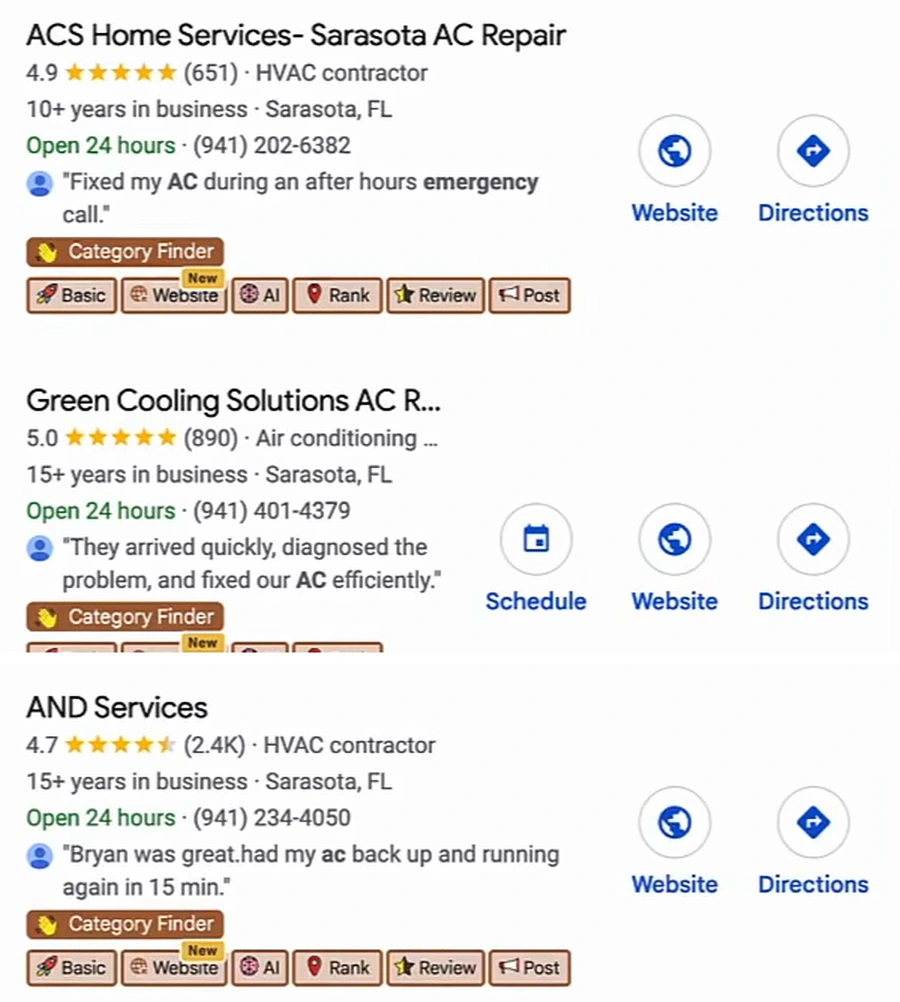
The first thing the audit skips is the sponsored results. Two paid listings sit above the map pack for this search, and the presenter ignores them: those businesses are paying to be there, and it tells you nothing about what ranks. What matters is the organic pack — the three profiles Google shows with the map. His argument for why is behavioural rather than technical. People searching "emergency AC repair" in Florida in September are not going to open ten listings; they look at the three, check the rating and the reviews, and pick. Some scroll to the organic links below, but the pack gets the majority of the clicks, so the whole exercise is about what it takes to be one of those three.
What the three winners have in common
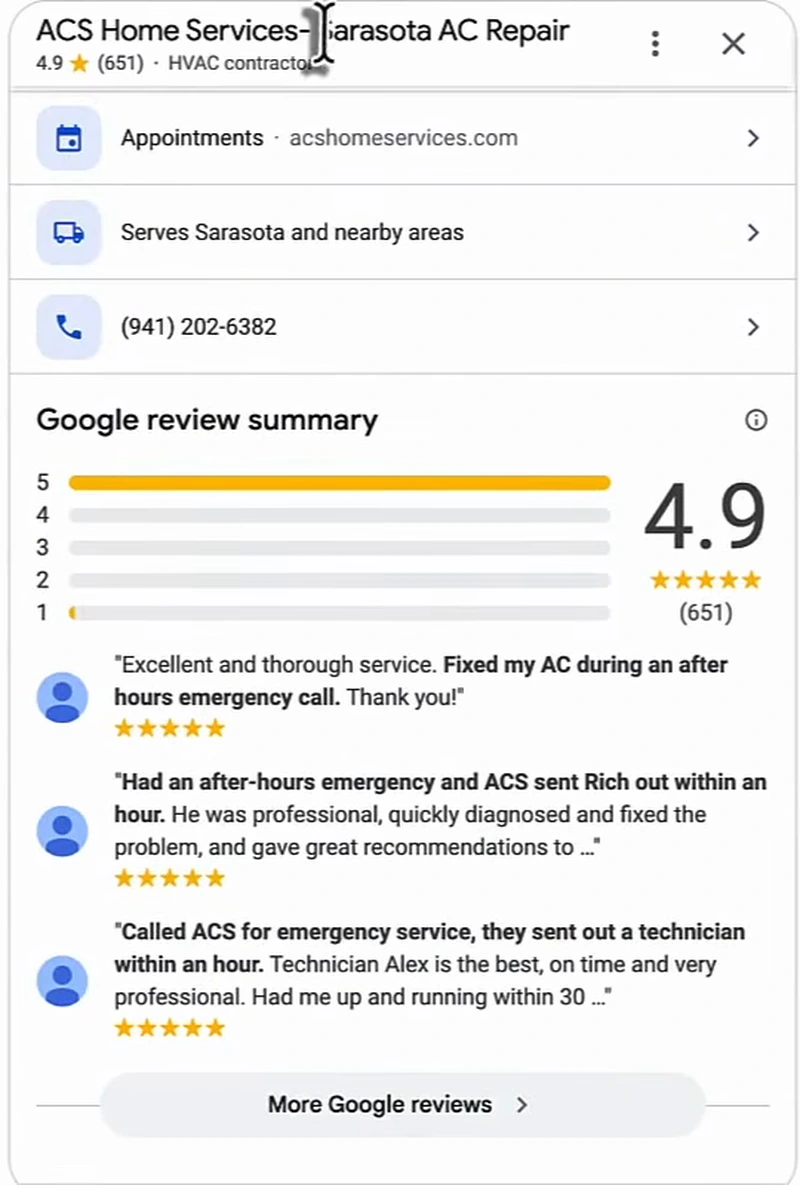
The numbers in the pack already tell a story. The business with by far the most reviews — 2,400, against 651 and 890 — is third, on a 4.7 rating. The presenter's read is that three review attributes drive the pack: how many you have, how often you get them, and whether you reply to them. Quantity is only one of the three, and a run of bad reviews in a short period hurts more than a large total helps. Number three is replying to its reviews, including the negative ones, but it has picked up "quite a few bad reviews in a relatively short amount of time", and he thinks that is what pushed it down from where 2,400 reviews would otherwise put it. This matches what we found in our own look at Google reviews and SEO: past a threshold, more reviews stop buying rank.
He also offers an opinion worth having in mind rather than a rule: a 4.9 often performs better than a 5.0. His reasoning is statistical — any business with hundreds of reviews will naturally collect a few bad ones, so a perfect score reads as less realistic. It is stated as his opinion in the video, and it stays one here.
Reply to every review, in an SEO-friendly way
Opening the reviews of each pack business shows the difference between a profile that is managed and one that is not. Number one replies to some reviews but not all; number two replies to what looks like every one; number three replies too. The presenter's template for a reply is short: thank the customer, put the technician's name back in if one was mentioned, and repeat the service — the keyword — in the response. What to leave out is just as specific: no customer names and no customer details, which can get you into trouble. For a bad review the instruction is to apologise, not argue, and give a phone number or email so the customer can reach you to put it right.
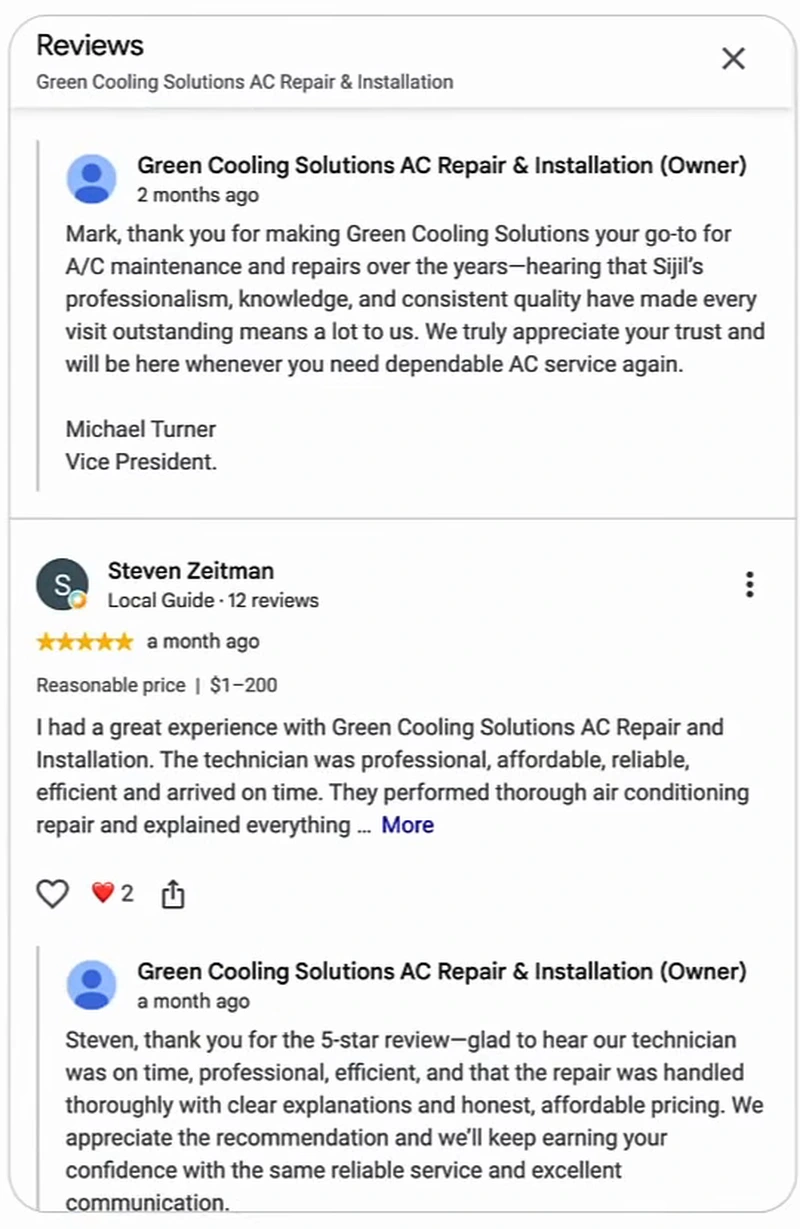
Replying to negative reviews has also become more consequential since Google added a way to flag owner responses; our note on the "report owner response" button covers what an argumentative reply now risks.
Fill in every field — and be honest about hours
The second thing the pack businesses share is a complete profile. Number one's listing shows a services list (A/C filter replacement, preventive maintenance, system dismantlement), a matching address, appointment link, service area and hours. The presenter's instruction is blunt: no missing categories, no missing information, everything filled in that can be. Consistency matters as much as completeness — the address should be the same everywhere it appears.
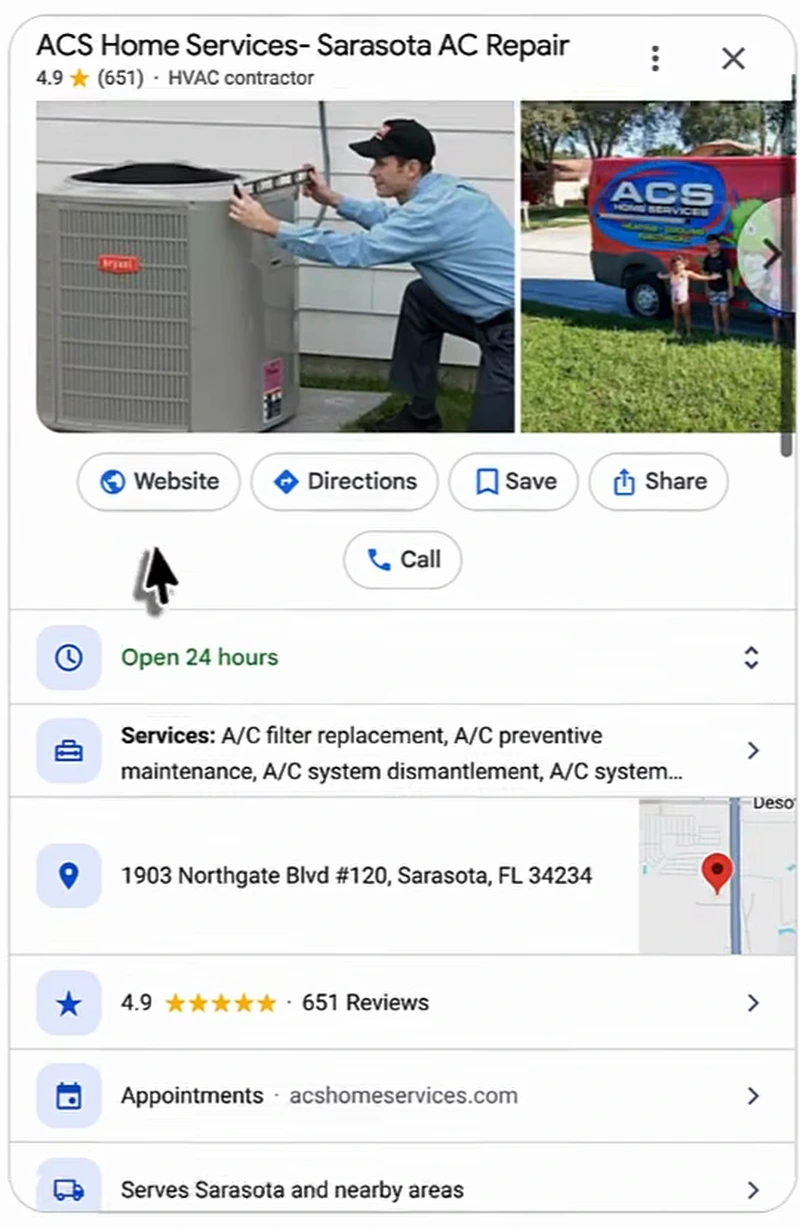
One field gets a warning. All three pack businesses show "Open 24 hours", and for an emergency-repair search that helps you show up more often. But you have to actually answer at 3 a.m. If you are open nine to five, say nine to five; if you claim 24 hours to rank and Google works out that you do not, it will hurt you. It is the same trade-off that runs through the rest of the audit: the fields exist to describe the business accurately, and the ranking benefit follows from that, not from gaming them.
Post routinely and connect your profiles
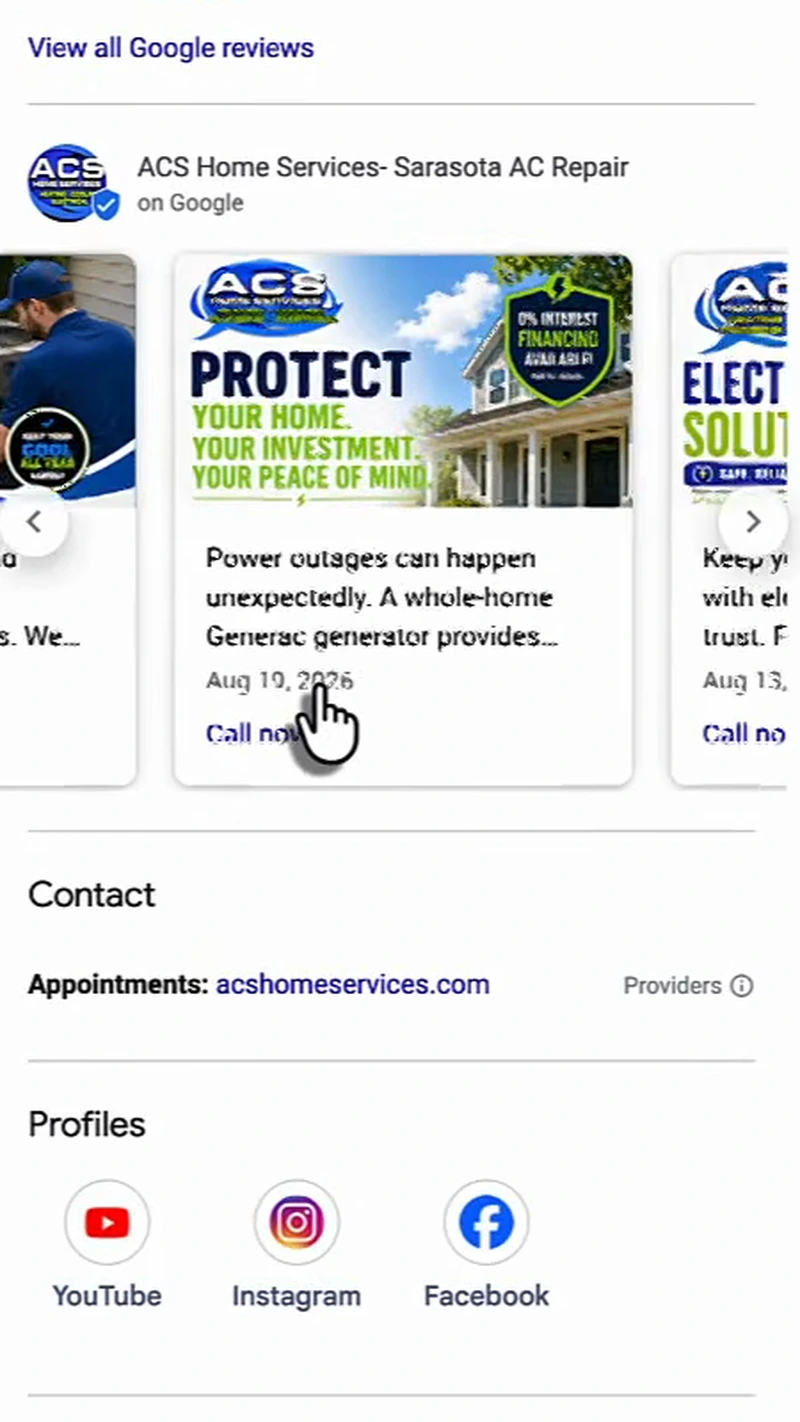
Number one is also posting updates to its profile regularly, with pictures, and has its YouTube, Instagram and Facebook profiles connected. The presenter's phrase for the effect is that the more engaged you are with the profile — updating it, keeping it accurate, posting to it in an SEO-friendly way — the more it helps you rank. Posts are the part most businesses abandon after the first month, which is why they are worth automating (more on that below).
The number-four audit: a strong profile held back by the website
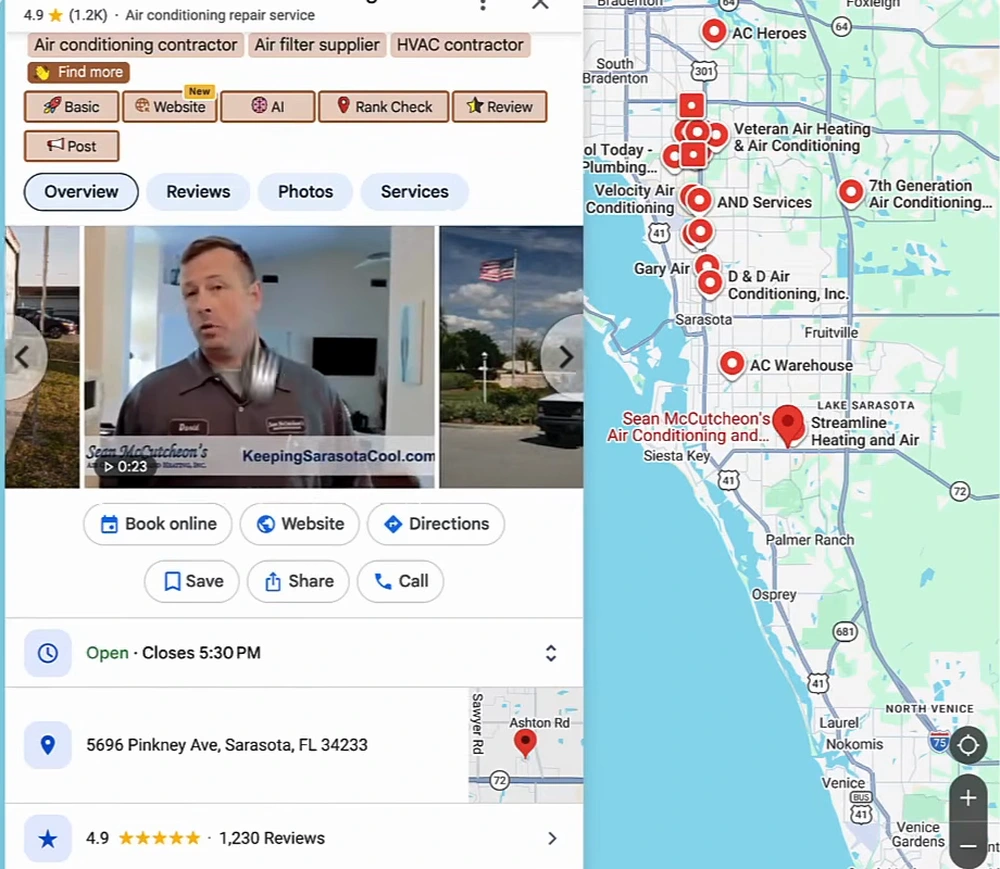
The most useful part of the video is the business just outside the pack, because it shows where the gap actually is. Number four has a 4.9 rating on 1,230 reviews, replies to them, has good photos of the team and its work, has posted videos, and is publishing Google posts. On the profile alone it looks like a pack business. So the presenter goes to the website, and the problem is on the first line of the search result: the title tag is the company name, twice.
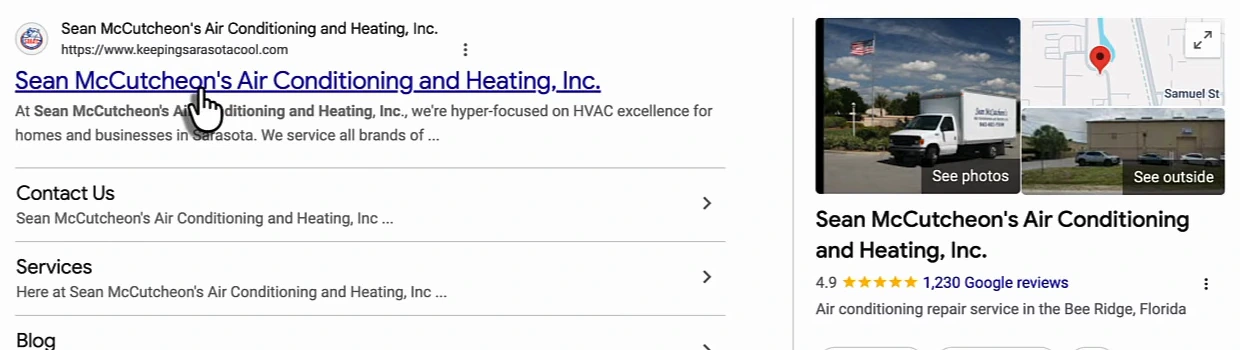
His fix is a title tag that says what the business does and where: "Emergency Air Conditioning and Heating Sarasota" if they want the emergency keyword, or "Air Conditioning and Heating Repair Sarasota" if they do not do emergency work. Generic is the word he uses for the problem — the tag is not giving Google the information it needs to move the site up. Then the homepage itself. The H1 reads "#1 choice for HVAC excellence, backed by honesty and integrity", and the presenter calls it weak for two reasons. It contains neither the service nor the location, and it uses the industry's word rather than the customer's: residential searchers say "AC repair", not "HVAC". His rewrite is "AC and heating repair Sarasota, Florida", with the honesty-and-integrity line kept underneath as the tagline.
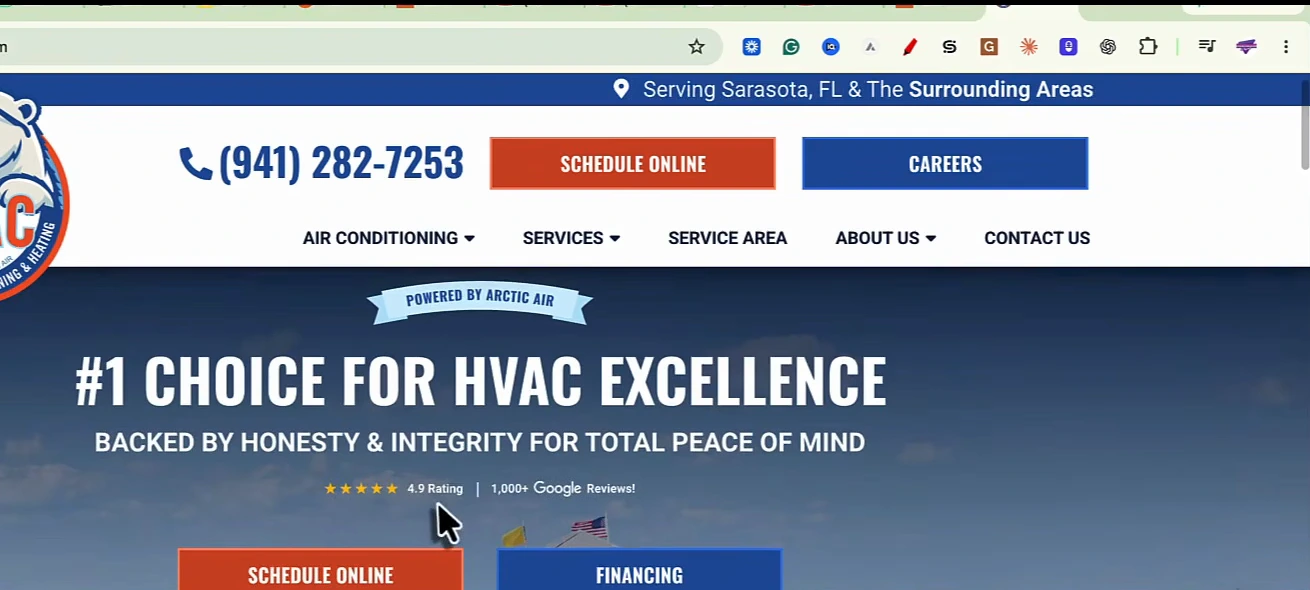
The rest of the page is, in his words, doing pretty well: reviews, a schedule-online call to action, a company story, a services grid. His one layout change is to move the social proof up. The Google reviews and the "why choose us" evidence sit well below the fold, and those are the things that make a visitor decide; he would put them above the fold so the decision happens faster. The verdict on number four is that the title tag and the H1 are what is keeping it out of the top three — a two-line fix for a business that has already done the hard part on its profile. For the on-page side of AC and heating specifically, our guide to SEO for HVAC companies goes through the service and city pages that follow from that title tag.
The competitor audit checklist
Everything above reduces to a checklist you can run on the three businesses above you in about twenty minutes. For each one, open the profile, then the reviews, then the website, and note what they do that you do not.
| Signal | What the pack businesses did | What to check on yours |
|---|---|---|
| Review count, frequency, rating | 651 / 890 / 2,400 reviews at 4.9 / 5.0 / 4.7; steady flow; the 2,400-review business is third after a recent run of bad ones | Are you getting reviews every week, not just in total? Any cluster of negatives you have not addressed? |
| Review replies | Two of three reply to everything; replies repeat the service and name the technician | Reply to all of them; keyword and technician in, customer details out; apologise and offer a contact on bad ones |
| Profile completeness | Categories, services list, address, hours, service area, appointments — nothing blank | Open every section of your profile and fill what is empty; make the address match everywhere |
| Hours | All three show 24 hours for an emergency query | Set the hours you can actually answer; never claim 24 hours you cannot honour |
| Posts and media | Regular posts with pictures; social profiles connected | Post routinely; connect YouTube, Instagram, Facebook |
| Title tag | Number four's is the business name repeated | Service plus city: "AC and heating repair Sarasota, Florida" |
| H1 and above-the-fold proof | Number four's H1 is a slogan; reviews sit far down the page | Service and city in the H1, customer language not industry jargon, reviews above the fold |
If your profile is missing several of these at once, the problem is bigger than any one fix and worth working through in order — our walkthrough of Google Business Profile SEO is the field-by-field version, and how to fix your local SEO covers the case where the profile exists but the phone does not ring.
Automating the part that never ends
Reviews and posts are the two items on the list that do not stay done. Every new review needs a reply within a day, and the posting cadence that number one keeps up is exactly what most owners drop by month two. The presenter's answer is to connect the profile to a tool: Arvow's Google Business Profile connector syncs the profile's reviews so a reply goes out automatically, in the SEO-friendly form above, as each review arrives, and publishes a daily Google post written from the business's own website and information. Which parts of the profile are safe to hand to automation and which are not is a real question — we drew that line in our post on Google Business Profile automation — but replies and posts are the two the pack businesses win on and the two most owners cannot sustain by hand.
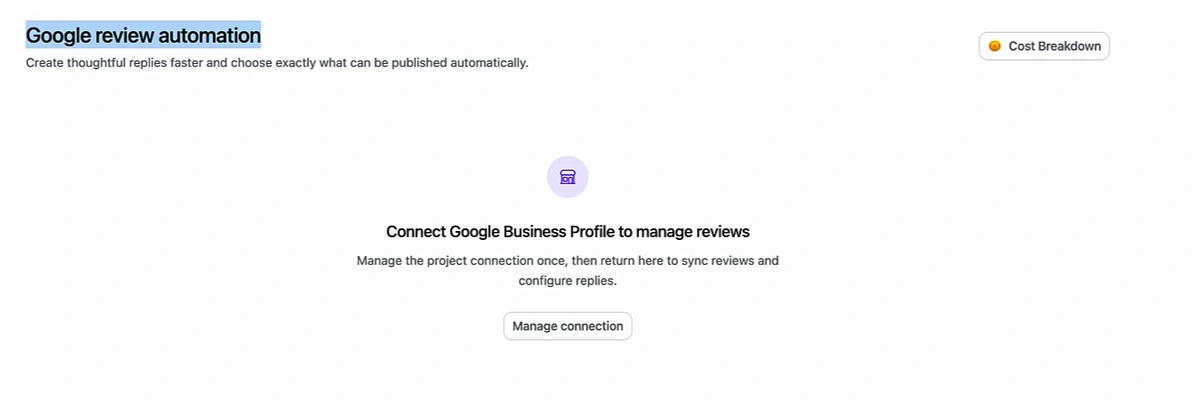
The rest of the tour in the video — bottom-of-funnel articles, automatic backlinks, the site optimizer, LLM brand monitoring, the keyword planner — is the layer you add once the profile is in the pack. The audit's lesson comes first: find the three or four basic things the businesses above you are half-doing, and do all of them.
Arvow connects to your Google Business Profile and handles the two jobs that decide the map pack and never stay done: an SEO-friendly reply to every review as it arrives, and a daily post written from your own site — alongside the articles, backlinks and rank tracking for the rest of your local SEO.
Generate, publish, syndicate and update articles automatically
The AI SEO Writer that Auto-Publishes to your Blog
- Cancel anytime
- Articles in 30 secs
- Plagiarism Free