
Location Pages SEO: The Service + City Pages Behind 93K Monthly Visits, and the Claude Prompt That Builds Them (2026)

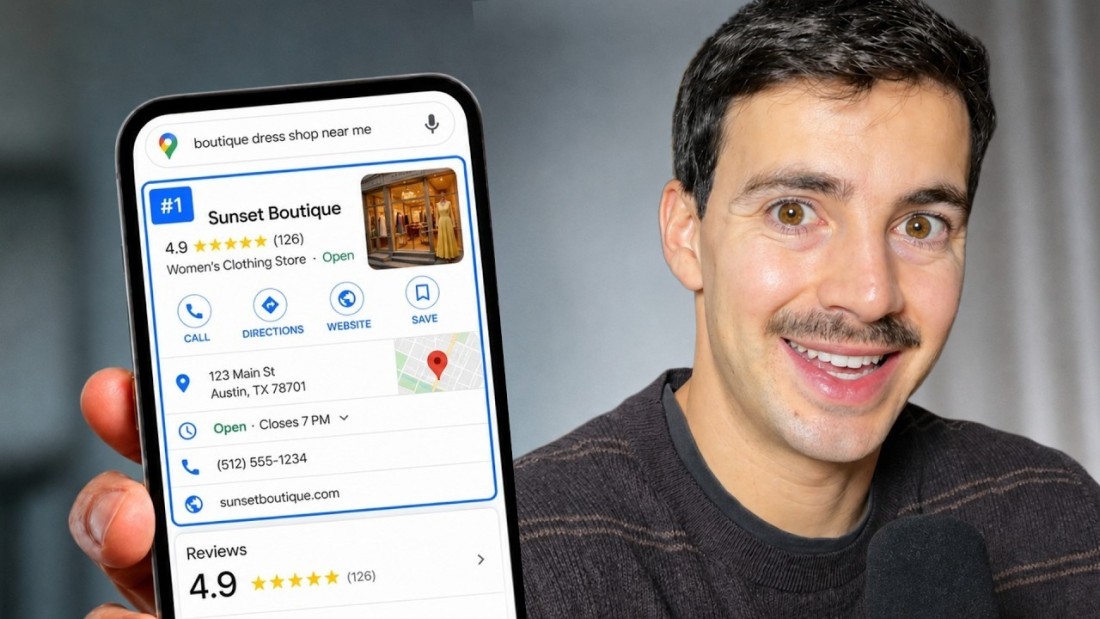
A location page is a page built for one search: a service plus a place. "AC repair Plano". "Plumber McKinney TX". The businesses that dominate local search have one for every service in every city they serve. This article takes apart a North Texas plumbing company that runs that model at scale, checks what its pages really contain, and follows a Claude prompt that turns any local business URL into a page template.
The source is a July 2026 recording by Vasco Monteiro, so the traffic figures are dated to that month. We re-opened the competitor's pages on 28 October 2026 and found something the video gets wrong, covered in its own section.
The scoreboard: 93K visits a month on a DR 40 domain
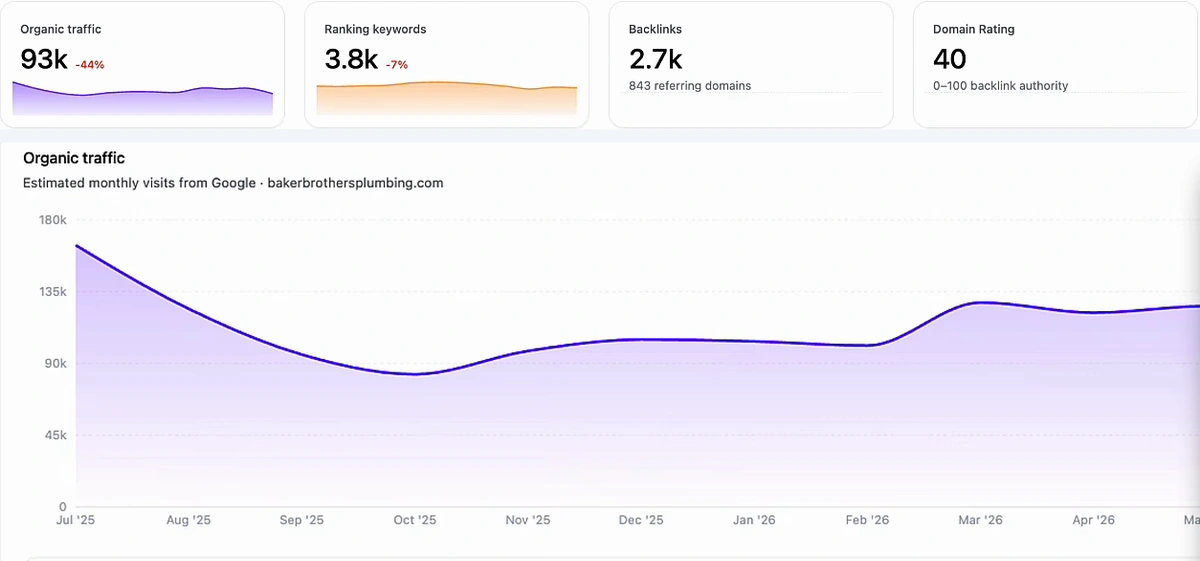
The business is Baker Brothers Plumbing, Air & Electric, a Dallas–Fort Worth plumbing, HVAC and electrical company. In Arvow's Site Explorer the domain showed 93K estimated monthly organic visits, 3.8K ranking keywords and 2.7K backlinks from 843 referring domains. The traffic card reads −44% for the year: the line starts near 165K in July 2025, falls to about 85K in the autumn, then climbs back past 130K by spring 2026. The presenter rounds it to "almost 100,000 people a month"; the card says 93K, so that is the number used here.
The card that matters more is the fourth: Domain Rating 40. This is not a site winning on authority, and the video's point at 4:51 is that 40 "isn't even that high", so a low rating is no reason to skip the strategy. If links are the gap, how to increase Domain Rating covers what moves it.
Where the traffic lands: city + service URLs
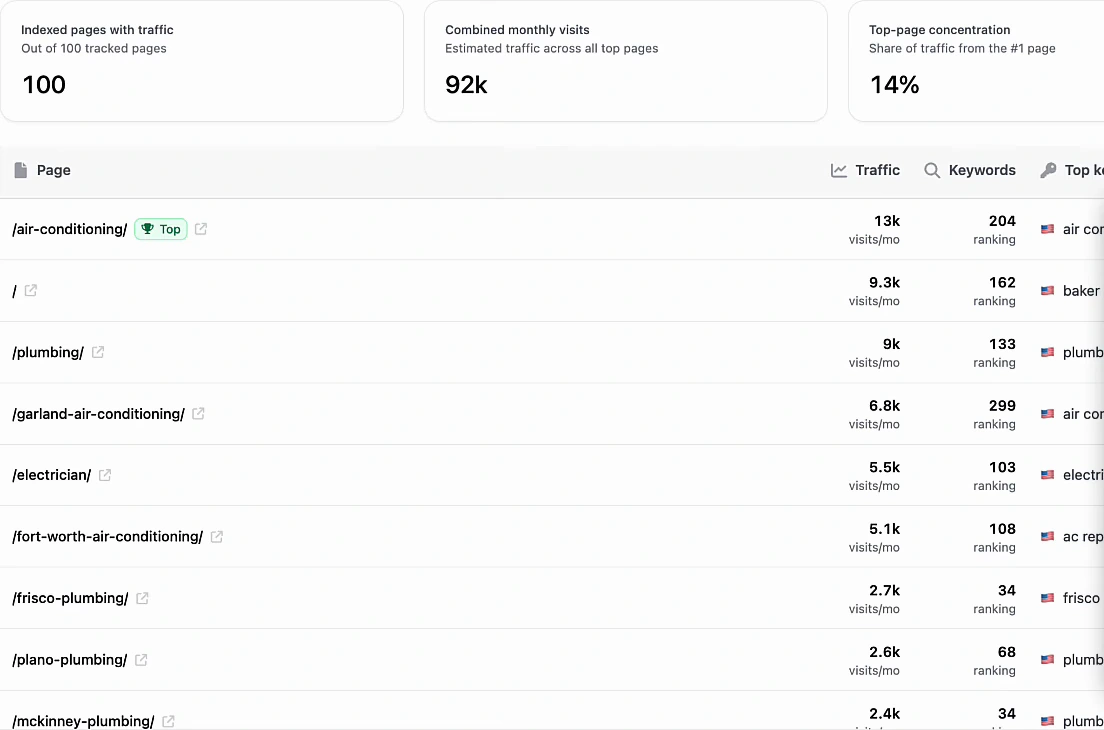
The Top pages tab is the whole strategy in one table: 100 pages, 92K visits, and the biggest page holds just 14%.
| URL | Visits / month | Ranking keywords | Type |
|---|---|---|---|
| /air-conditioning/ | 13K | 204 | Service hub |
| / (homepage) | 9.3K | 162 | Brand |
| /plumbing/ | 9K | 133 | Service hub |
| /garland-air-conditioning/ | 6.8K | 299 | City + service |
| /electrician/ | 5.5K | 103 | Service hub |
| /fort-worth-air-conditioning/ | 5.1K | 108 | City + service |
| /frisco-plumbing/ | 2.7K | 34 | City + service |
| /plano-plumbing/ | 2.6K | 68 | City + service |
| /mckinney-plumbing/ | 2.4K | 34 | City + service |
The pattern is city-service in the slug, every time: not a city page or a service page but the two combined, because that is how people search. The same three-layer structure, hub above city pages above supporting posts, is what SEO microsites recommends instead of an exact-match domain; this is it with years of traffic on it.
What the pages look like above the fold
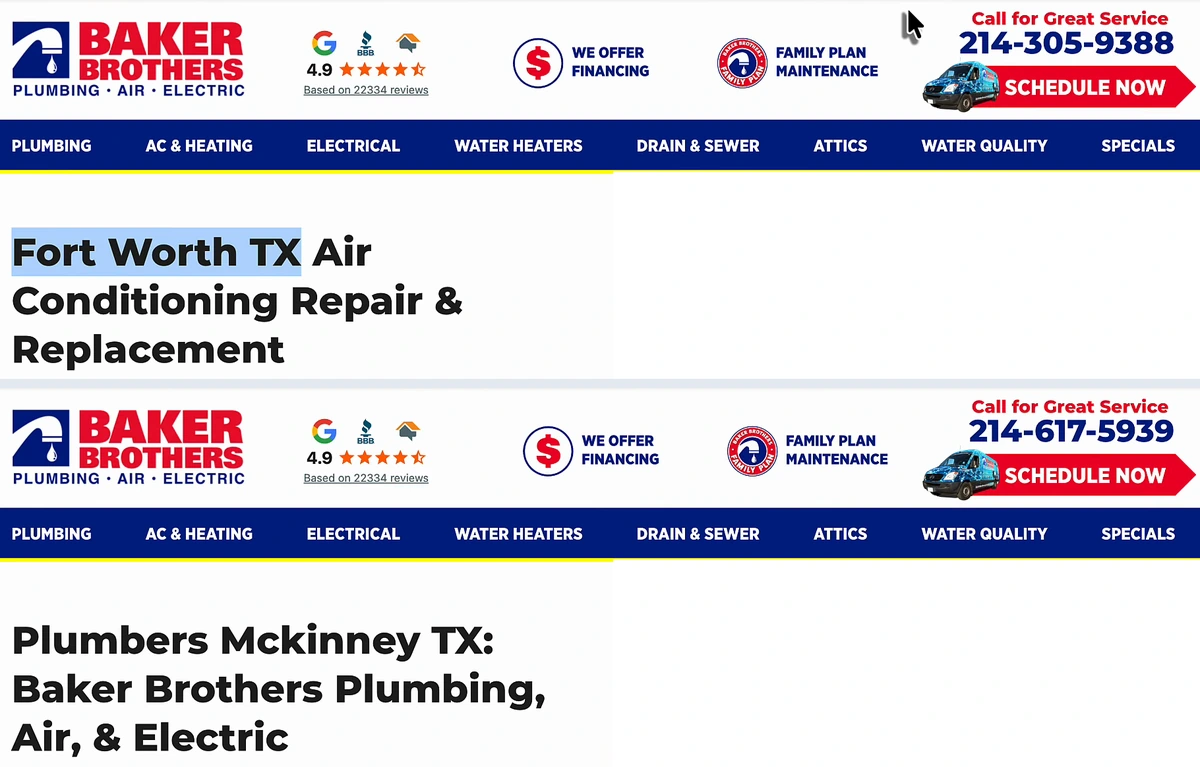
Open any two of the pages and the template is obvious: same header, same navigation, same 4.9-star badge, same $80 coupon. The H1 changes, the three checkmarks change, and so does the phone number. Fort Worth AC shows 214-305-9388, McKinney plumbing 214-617-5939, Plano AC 214-617-8021, Garland AC 214-617-8020. The presenter reads that as call tracking, a number per page so the business knows which page produced the lead. Below the hero sits a long wall of text that, in his reading, nobody scrolls to and exists for the search engine. That is a view, not a measurement, but it describes the assembly: a short designed hero for people, generated depth underneath for the query.
What we found when we opened the pages
At 2:05 the video says the pages are "all the exact same", with only the city changed. We fetched five of them on 28 October 2026, and that is not what is there.
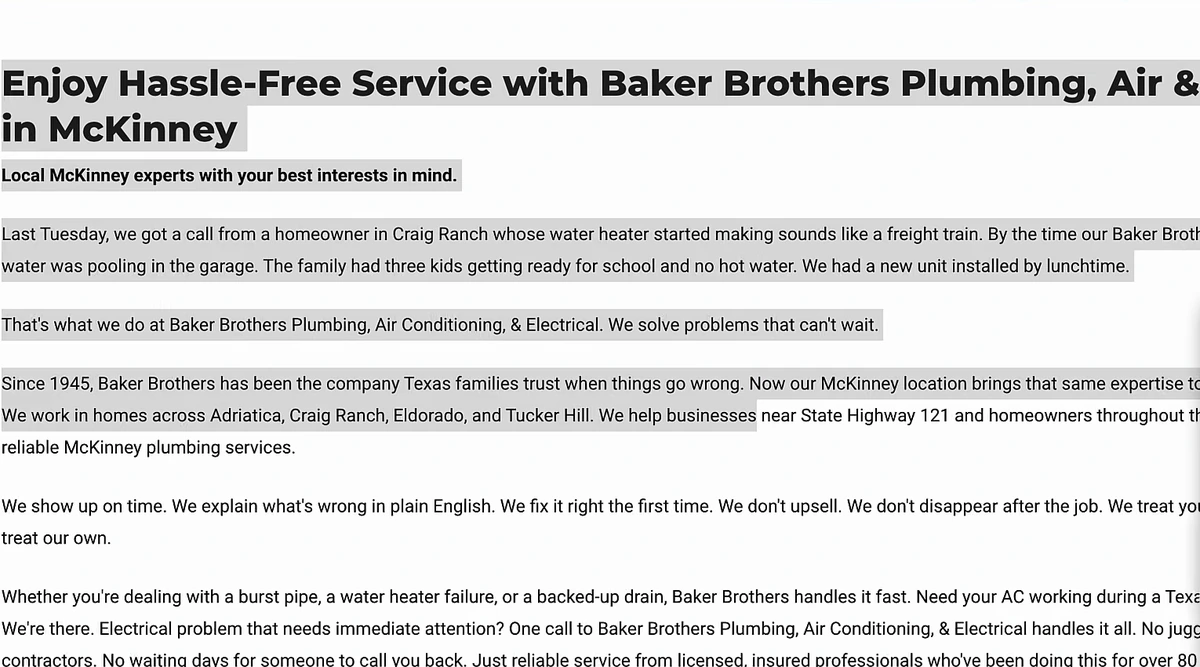
- Different lengths. Plano plumbing runs about 1,700 words, Frisco plumbing 2,000, McKinney plumbing 2,700, Plano AC 2,400, Fort Worth AC 2,500.
- Different sections. Plano plumbing has H2s for water heaters, hydro jetting and sewer lines; McKinney has emergency plumbing, kitchen plumbing, slab leaks, water filtration and septic; Frisco adds gas leak detection.
- Local detail. The McKinney page opens with a water heater call in Craig Ranch and names Adriatica, Eldorado, Tucker Hill and State Highway 121.
- Numbers in the title tag. Four of the five title tags carry a tracking number too (214-296-2136), separate from the header number.
So the competitor already does what the video goes on to recommend: templated hero, body written per city. The trap the presenter warns about at 15:53, one article with the service word swapped, is exactly what these pages avoid. AI programmatic SEO shows what happens to a site that does the swap-one-word version, and commodity content is Google's own name for it.
The prompt: research a business from one URL
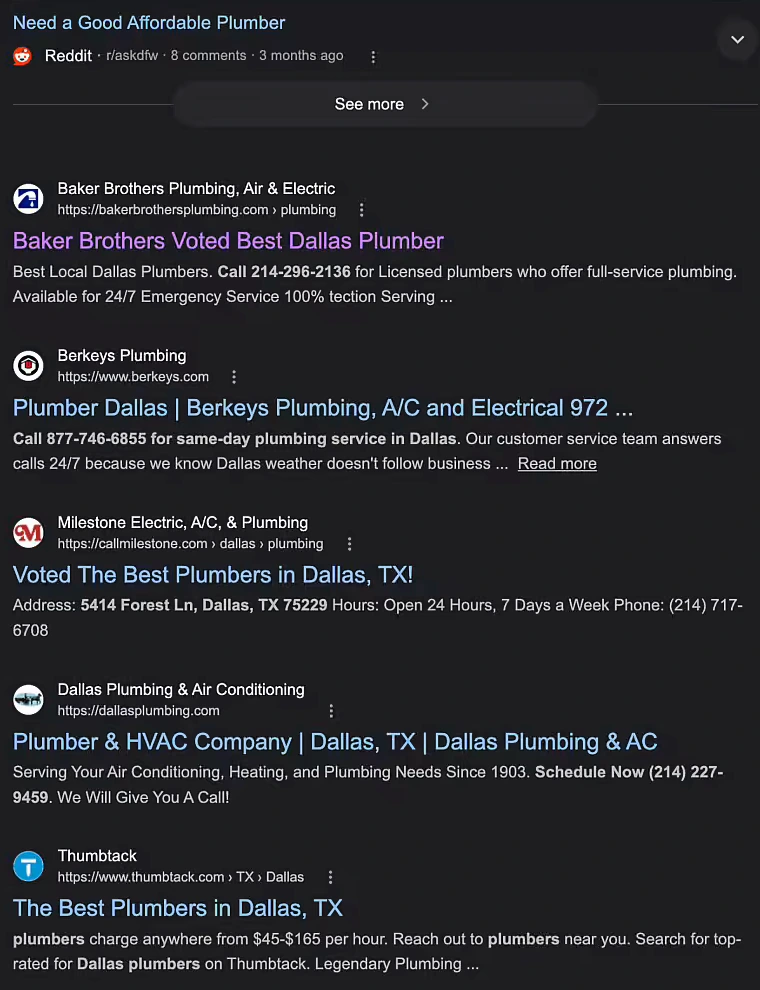
To show the method on a business he does not own, the presenter searches "plumber dallas", sees Baker Brothers first, and takes the second result, Berkeys Plumbing, A/C & Electrical, as the example. The only edit to the prompt is the client site URL. The full prompt is published on arvow.com as Local Service Page Generation, so it is described here rather than reproduced.
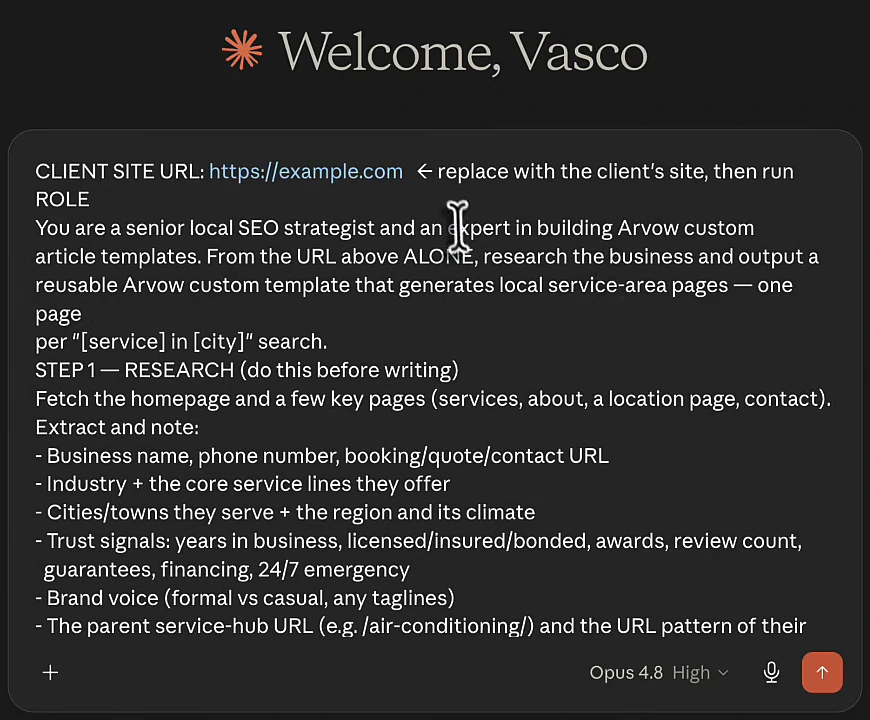
It has three parts. Step one is research: fetch the homepage, services, about, a location page and contact, and extract the business name, phone, booking URL, service lines, cities served and climate, trust signals (years in business, licences, awards, reviews, guarantees, financing, 24/7), brand voice, and the URL pattern of existing city pages. Anything it cannot find is defaulted and tagged [VERIFY]. Step two fixes exactly three variables, service, city and state; everything else is hard-coded. Step three is the Arvow rule set: variables in double braces, AI instructions only inside the outline, a 5,000-character limit, image and link counts stated explicitly.
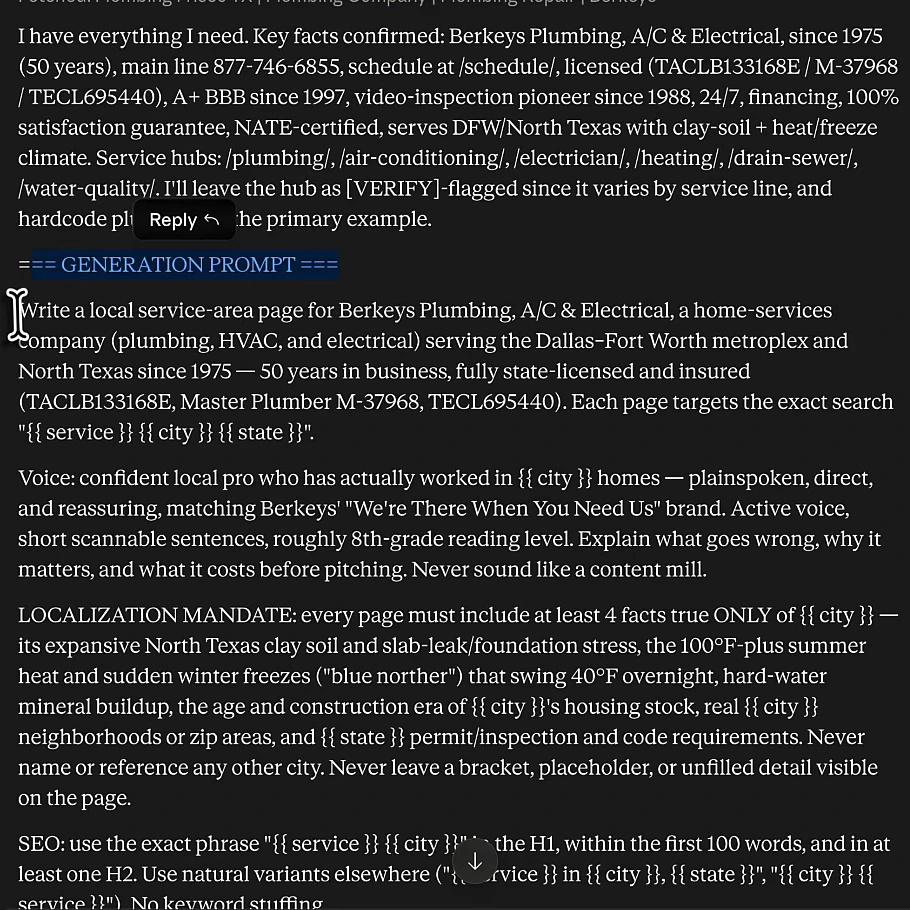
The research returned Berkeys' founding year (1975), its main line, three licence numbers, an A+ BBB rating since 1997 and six service hubs, hub URL flagged [VERIFY]. Then it wrote the generation prompt, whose key line is the localisation mandate: every page must include at least four facts true only of the city, drawn from its clay soil, its 100°F summers and sudden freezes, hard water, housing age and permit rules, and must never name another city.
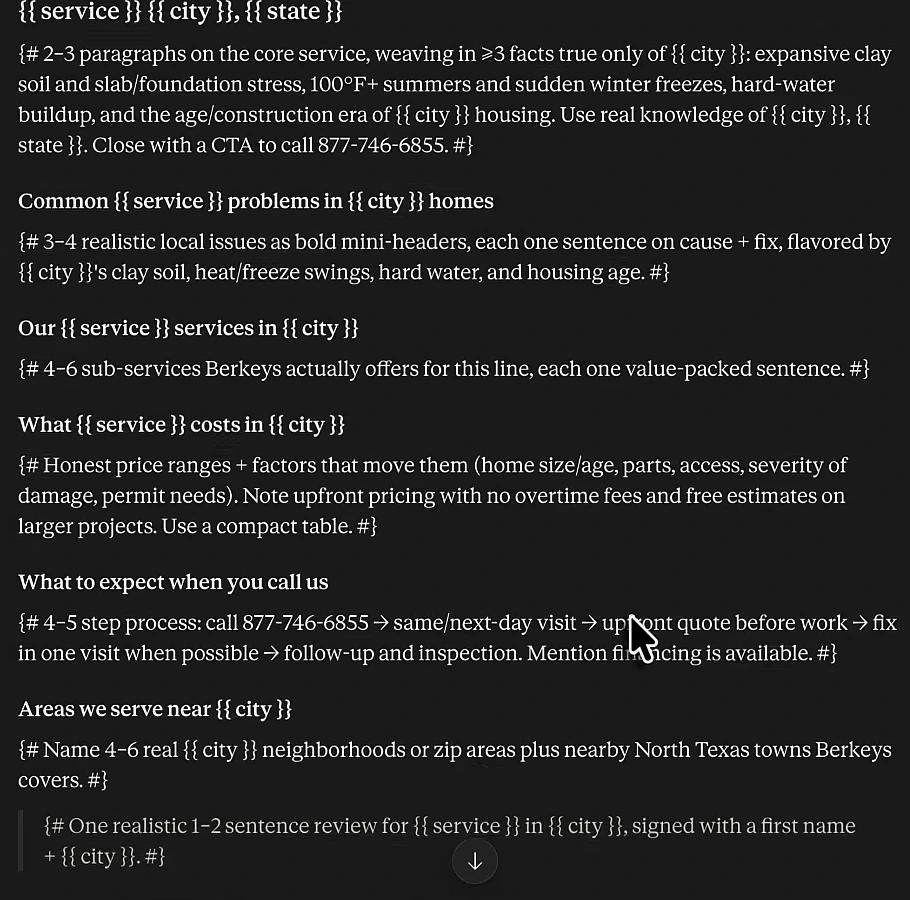
The outline is the page skeleton: an H1 of service in city, state; a 45–55-word intro; a "why city chooses us" block with the trust signals; local problems; sub-services; a cost table; a four-step "what to expect"; nearby areas; one review; an FAQ; a closing call. Set it beside the Baker Brothers body above and it is the same idea.
From prompt to template in Arvow
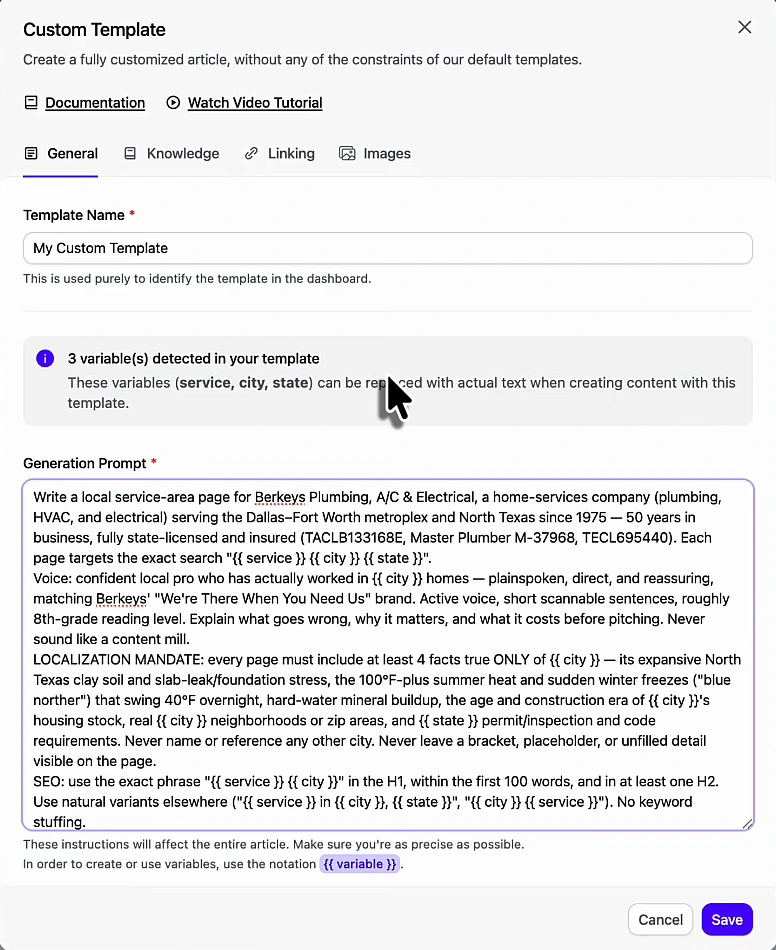
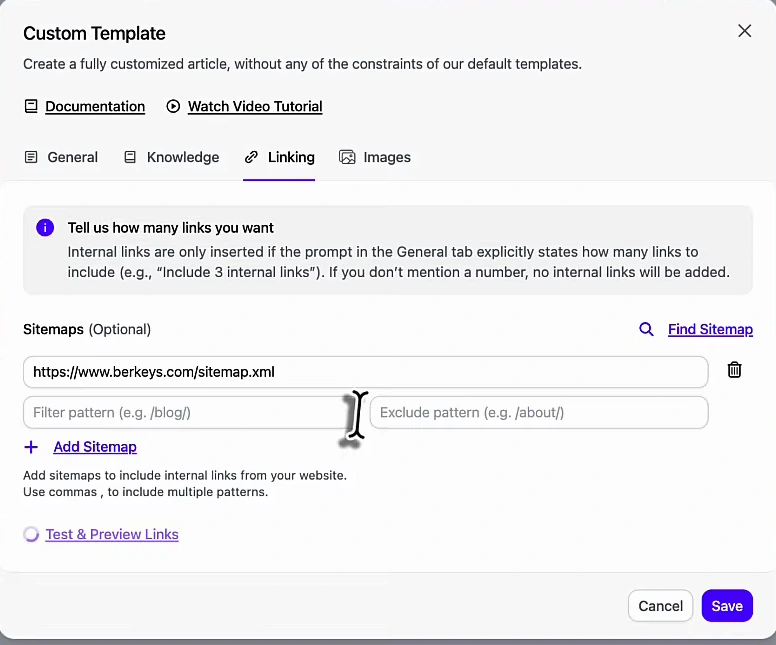
Inside Arvow the prompt and outline go into a custom article template, and the General tab reports "3 variable(s) detected" as soon as the prompt is pasted. On the Linking tab, Find Sitemap pulls the site's sitemap so each page links to real pages on the domain. On Images the presenter picks AI images for speed and says a local business should use its own photos.
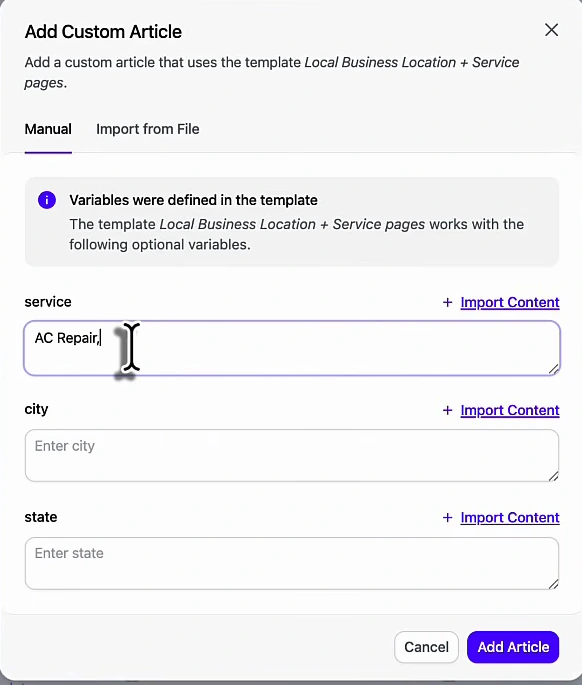
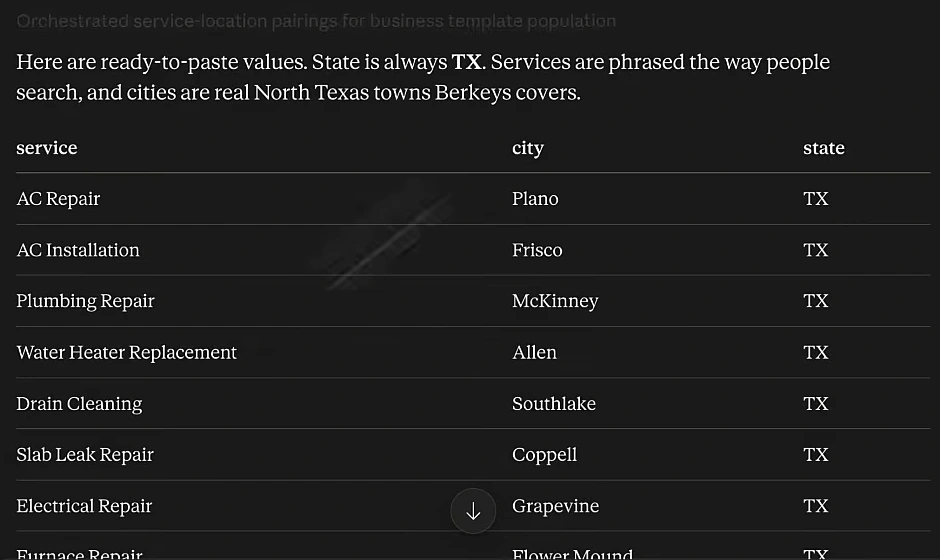
Generating a page is then a three-field form. For the demo he types AC Repair, Plano, Texas; the pairs Claude offers show what a real company's import file looks like: every service you sell against every city you serve.
The generated page, and the four local facts
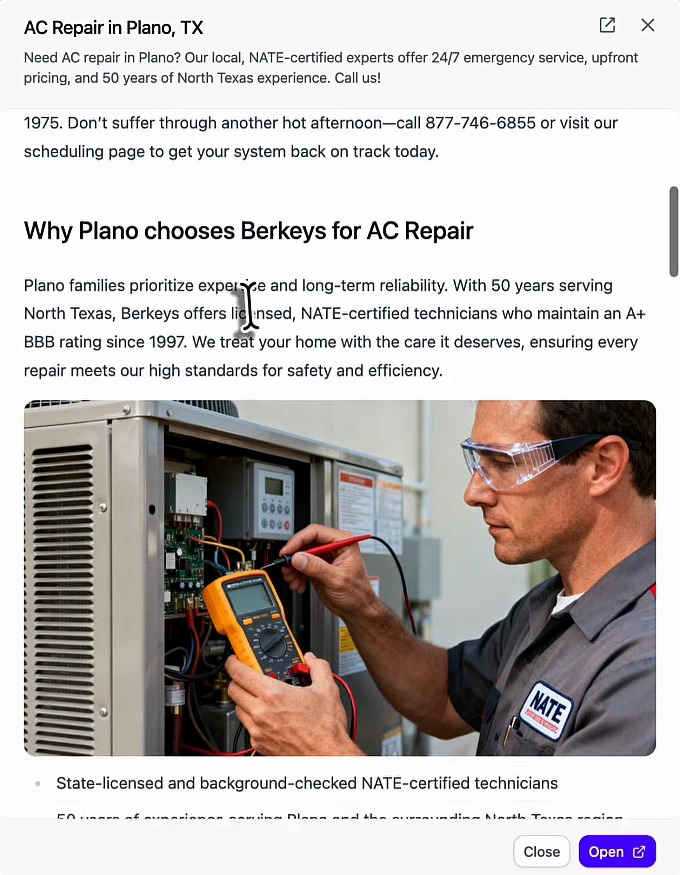
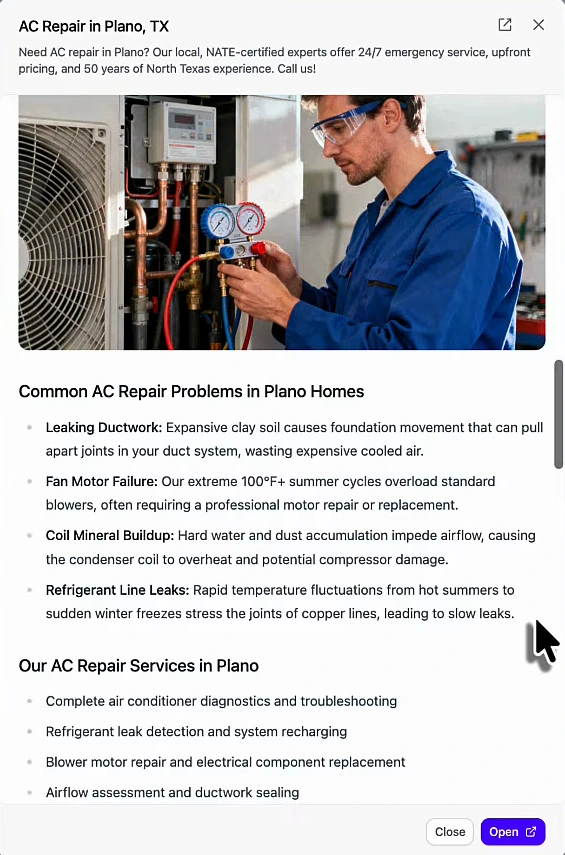
The page comes back with a table of contents, the intro, a "Why Plano chooses Berkeys" block with the 50 years, NATE and BBB signals, images, a cost table, an FAQ and a closing call. The section that proves the method is "Common AC Repair Problems in Plano Homes": leaking ductwork blamed on clay soil, fan motor failure on 100°F summers, coil mineral build-up on hard water, refrigerant leaks on the swing from heat to freeze. Those are the four facts the mandate demanded; change the city and the model has to find four new ones. The presenter's verdict is "pretty decent", and his deployment advice is the Baker Brothers layout: your designed hero on top, the generated page underneath.
One caveat the video does not state: the demo page is for a real company the presenter has no relationship with, carrying its real licence numbers and phone line. Fine as a demonstration; for a client, every [VERIFY] tag and hard-coded fact needs a human check, because websites go stale.
Scaling it without the swap-one-word trap
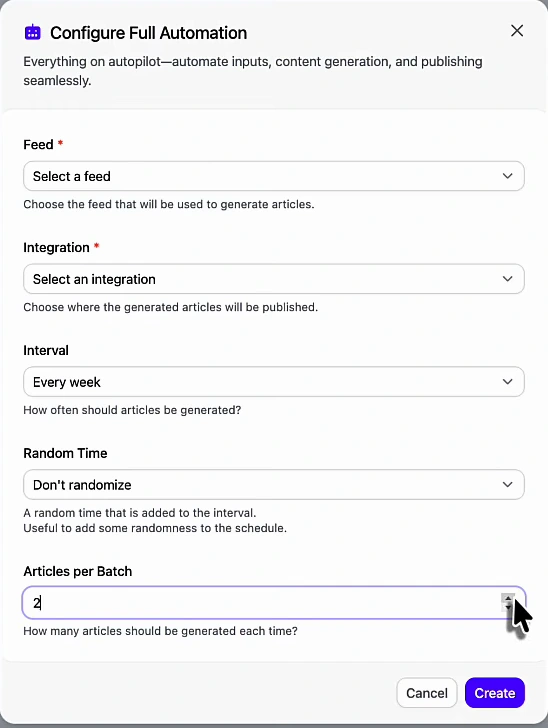
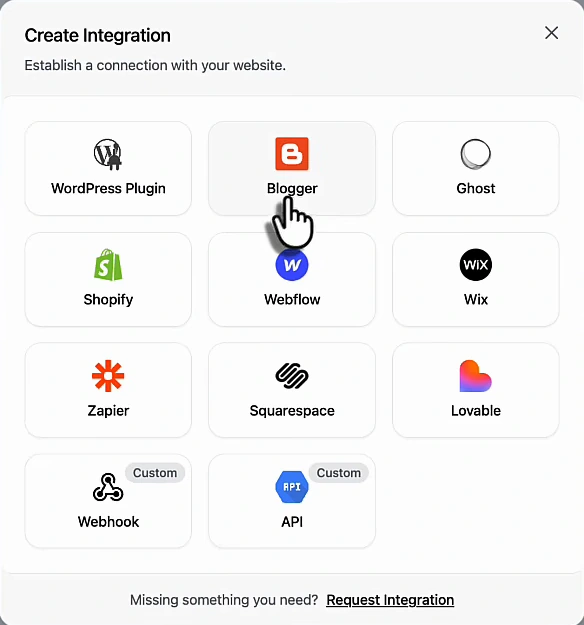
Eight services in ten cities is eighty pages, and the video's warning is about how they get made. The old way was one article with the service word replaced; the presenter says twice that it no longer works, and his own attempt to batch several with placeholder variables produced near-identical drafts, flagged on camera as "not ideal". The per-city research and the four-facts rule are what make page 40 different from page 39, the lesson programmatic SEO ends on. With the template saved, AutoBlog takes an interval, a batch size and an integration and publishes on a schedule to WordPress, Shopify, Webflow, Wix, Squarespace, Ghost, Blogger, Lovable, or through Zapier, a webhook or the API. Location pages are the website half of local search; the Maps half is in local GEO.
How to build your location pages
- Audit the competitor who already does it. Put the leading local site in Site Explorer, open Top pages, and read the slugs: city + service gives you the model and the keyword list.
- List every service × every city you genuinely serve. Skip postcodes; the presenter calls them spammy at that scale.
- Run the research prompt on your own URL and fix everything tagged [VERIFY].
- Keep the three variables and the four-facts rule, and connect the sitemap so each page links to its hub and its neighbours.
- Design the hero, generate the body, and read three samples side by side before importing the full list.
Want the research, the template and the publishing handled in one place? Set up an AutoBlog, paste the Local Service Page Generation output into a custom template, and import your service × city list.
FAQ
What is a location page in SEO?
A page that targets one service in one place, such as "plumber McKinney TX", usually at a URL like /mckinney-plumbing. A site builds one for every service and city it serves so each local search has a page written for it.
Do location pages still work in 2026?
The site in this article gets most of its 93K monthly visits from them. What stopped working is the copy-and-swap version with only the city changed.
Are location pages doorway pages?
Only if they exist to funnel people elsewhere and say nothing specific to the place. A page with a real service list, local problems, prices and areas served is a landing page, not a doorway.
Do I need Claude Code to do this?
No. The video's title says Claude Code, but the prompt runs in the ordinary Claude app and needs nothing but a URL. The output is a template you paste into Arvow or adapt for any tool that supports variables.
Generate, publish, syndicate and update articles automatically
The AI SEO Writer that Auto-Publishes to your Blog
- Cancel anytime
- Articles in 30 secs
- Plagiarism Free