
Search Central Live Barcelona 2026 Takeaways: Google's 12-Card Playbook for Google and AI Search, Checked Against the Stage

Google ran its Search Central Live Deep Dive Europe in Barcelona from 30 September to 2 October 2026, three days on crawling, indexing and serving, with a long stretch on how AI Overviews and AI Mode pick pages. Nex Gen AI's video turns that into a twelve-card playbook written at a fifth-grade reading level. This is the playbook, card by card, checked against what Google's speakers actually said on stage according to the attendees who wrote it up, and against the two Google guides the board itself cites.
What happened in Barcelona
The event was free, application-based and in English. Day one covered crawling, day two indexing and rendering, day three serving, ranking and the AI features. Google speakers included Gary Illyes, John Mueller, Martin Splitt, Cherry Prommawin, Duy Nguyen, Ryan Levering, Alex Jansen and Eric Murillo, with a keynote from Lino Cattaruzzi. Nothing "leaked": the sessions were public and several agencies published day-by-day notes. The line attendees repeated most was Google's own summary of the AI question: good SEO is good GEO, and AI Overviews and AI Mode run on the same crawl, index and serving stack as classic Search.
Three numbers from the stage frame everything below. AI Mode query volume has doubled every quarter since launch; the average AI Mode query is about three times longer than a classic one; and Google's systems find about 40 billion spam pages a day.
Where the twelve cards really come from
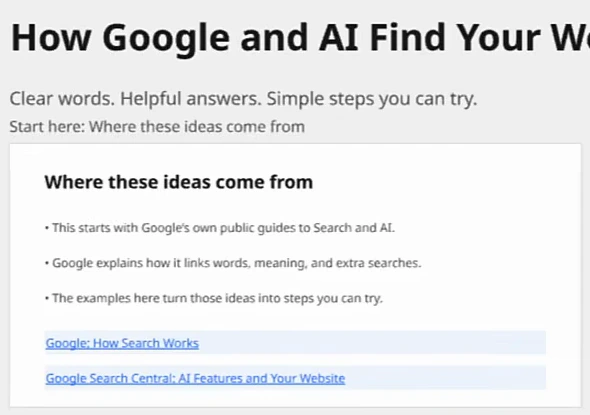
The first card on the board says where the ideas come from: Google's "How Search Works" and the Search Central page "AI features and your website". The presenter frames the cards as what Google "talked about" in Barcelona, and the overlap is real, because the Barcelona talks explained the same systems those pages describe. But the examples (rain boots, washable dog beds, a kids' baseball bat, a made-up shop called CozyPup) are the board's, and the stage versions used fried chicken, cameras and kettles. Where the two differ, the stage version is below.
Cards 1 to 3: how one page matches many searches
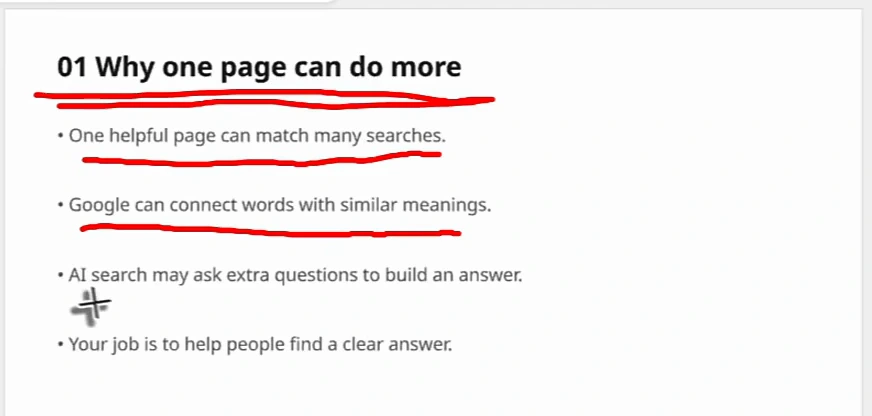
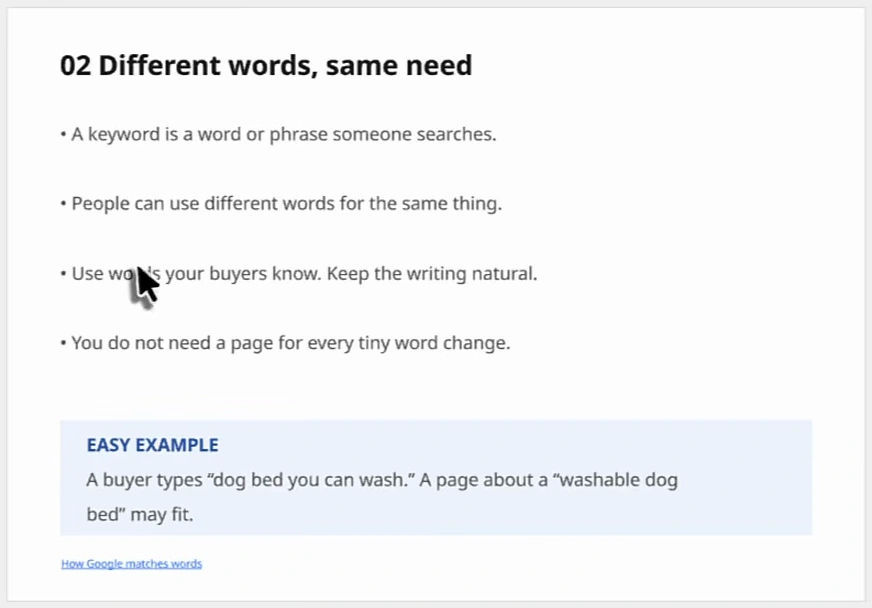
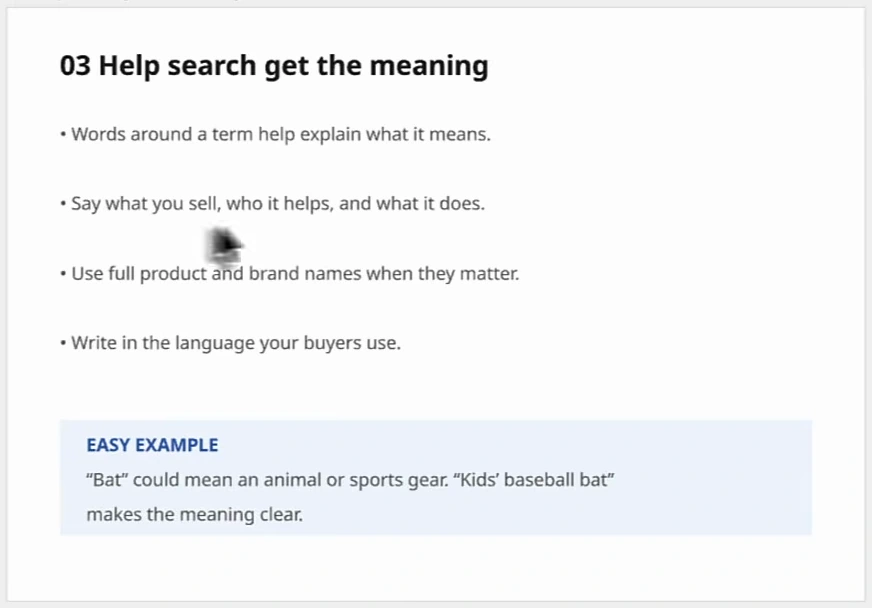
This is the part of the board that tracks the stage most closely. John Mueller's day-three talk on query understanding called synonym expansion "a very important part of Google's ranking system": Google rewrites almost every query before ranking, and a search for a fried chicken place in Barcelona is expanded so that "place" also matches "restaurant", "location" and "area". That is the mechanism behind card 02's washable dog bed. Two details from the stage sharpen the cards. Synonyms depend on context ("GM" next to "car" means General Motors; next to "barley" it means genetically modified), which is card 03's bat. And siblings are not synonyms: Canon and Nikon are related but never swapped in, and Google treats "X vs Y" searches as the signal that two terms are siblings. The practical reading is the card's: write in the buyer's words, and let synonym expansion do the rest.
Cards 4 to 6: one useful page, and the side questions AI asks
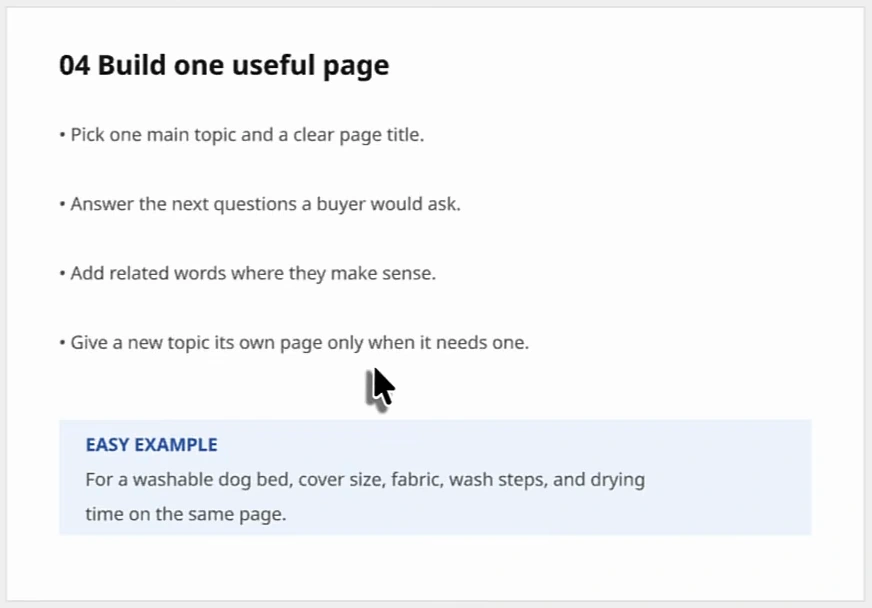
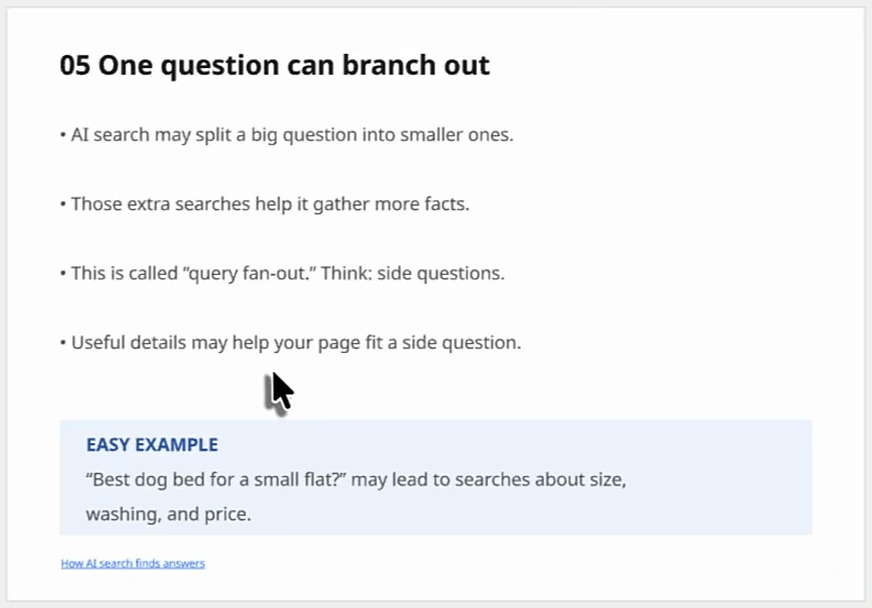
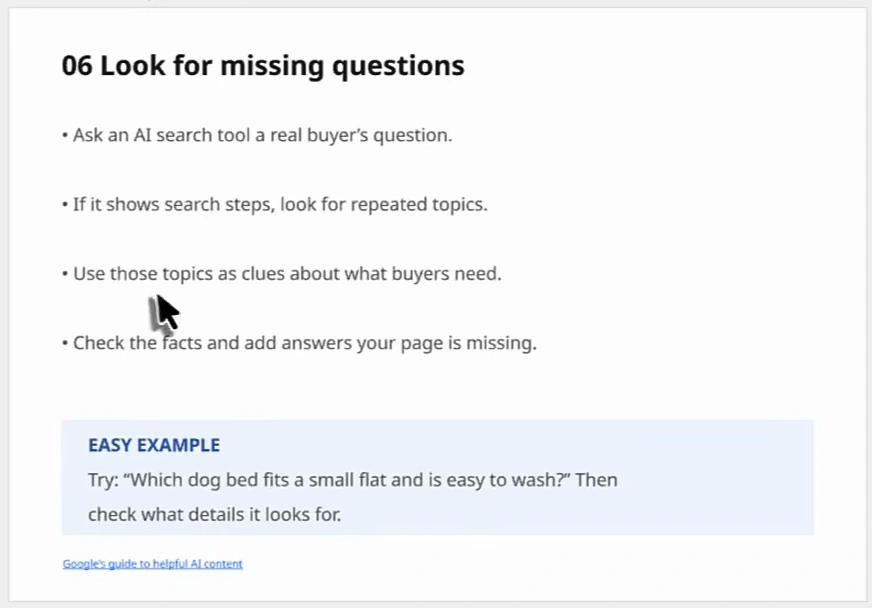
Google's own definition, from the AI features page the board cites, is that fan-out means "issuing multiple related searches across subtopics and data sources" while an answer is generated, which is why AI features can show a wider set of links than a classic result. In Barcelona, Mueller added the parts the card leaves out. The language model generates the fan-out queries and sends them to the normal search engine, each one goes through the same query understanding as a typed query, and none of them appear in Search Console because no user typed them. He also warned against chasing individual fan-out queries: a page built to catch one falls under the spam policies. So card 06 is sound as research (ask an assistant a buyer's question, note which sub-topics it keeps fetching, make sure your page covers them) and unsound as a page-spawning rule. We showed how to read those sub-queries in DevTools in optimising a site for AI agents, and the longer version of this advice is in how to rank in AI Overviews.
Cards 7 and 8: prices, details and comparisons
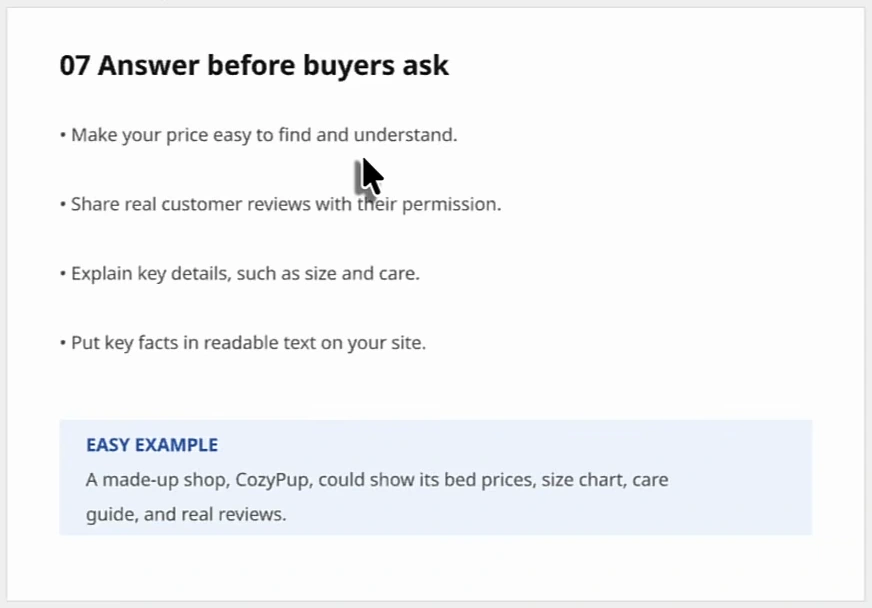
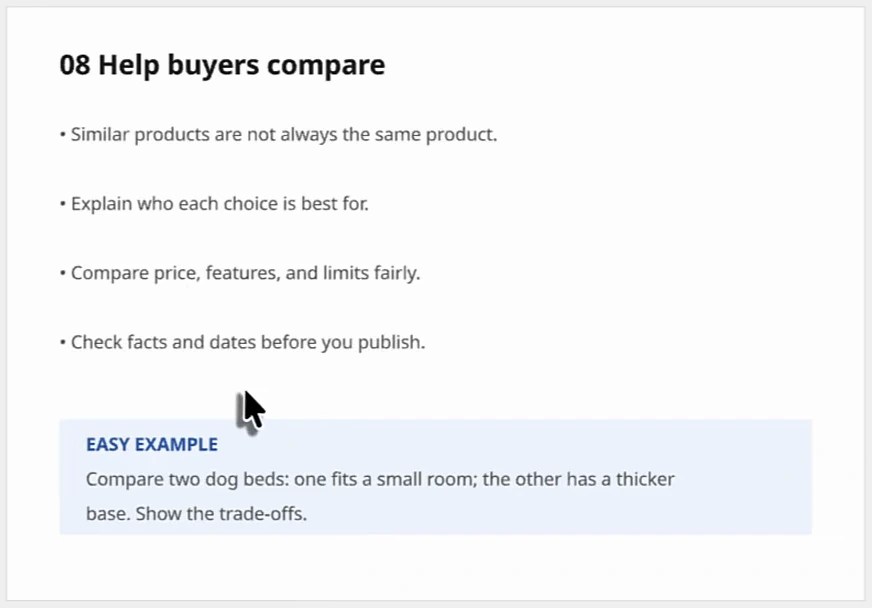
Nothing on the Barcelona stage said "publish your prices", so treat that line as the presenter's position, not Google's. What Alex Jansen's shopping session did say is close in spirit: conversational product attributes (the example was a kettle's water capacity and boil safety) now feed AI Mode directly, product highlights help in AI search, and "the bar for quality product data has been raised". Readable facts on the page and matching structured data are how that bar is met. On comparisons, the stage evidence is Mueller's sibling point: "X vs Y" searches are how Google learns that two products are alternatives, which is also why a fair comparison page is the natural home for that query. Pick the comparisons from buying intent keywords rather than from what is easiest to write.
Cards 9 to 12: links, refreshes and what to measure
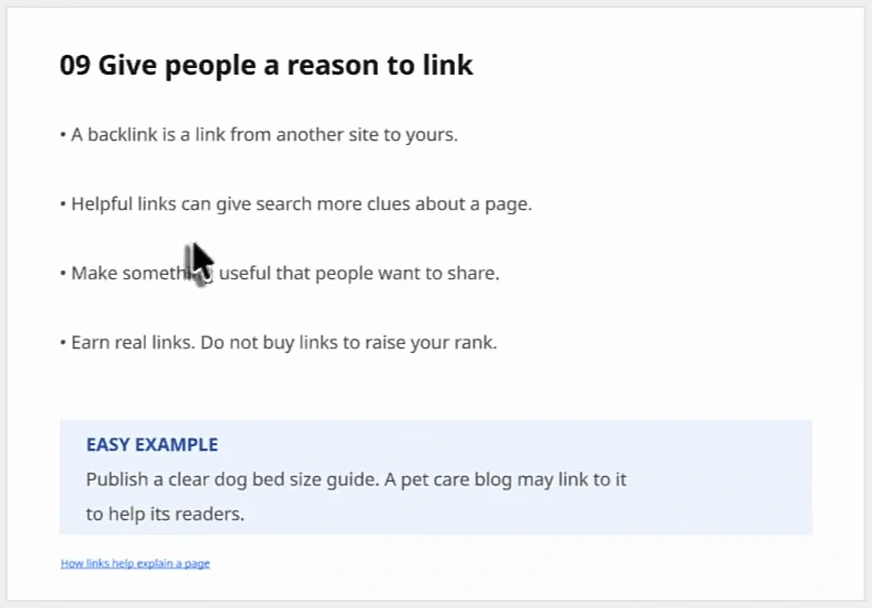
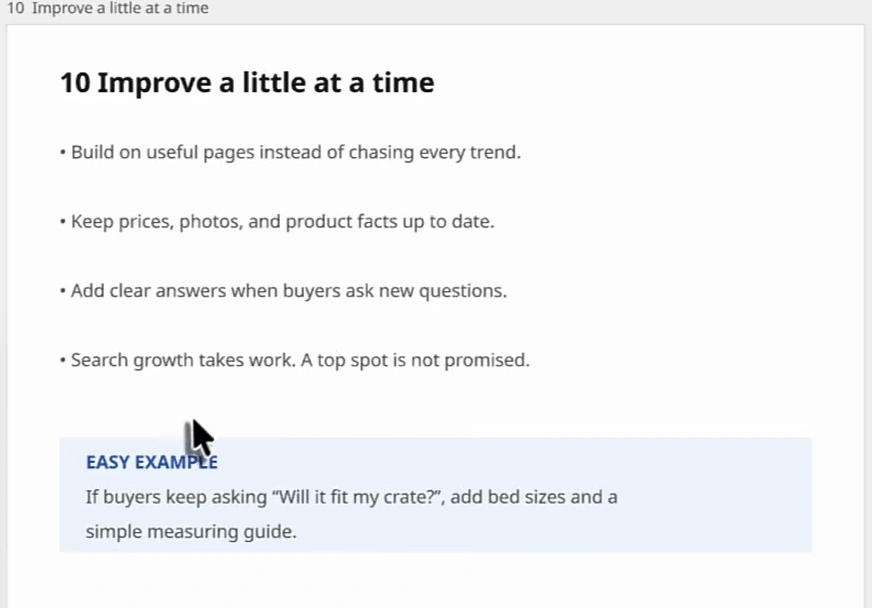
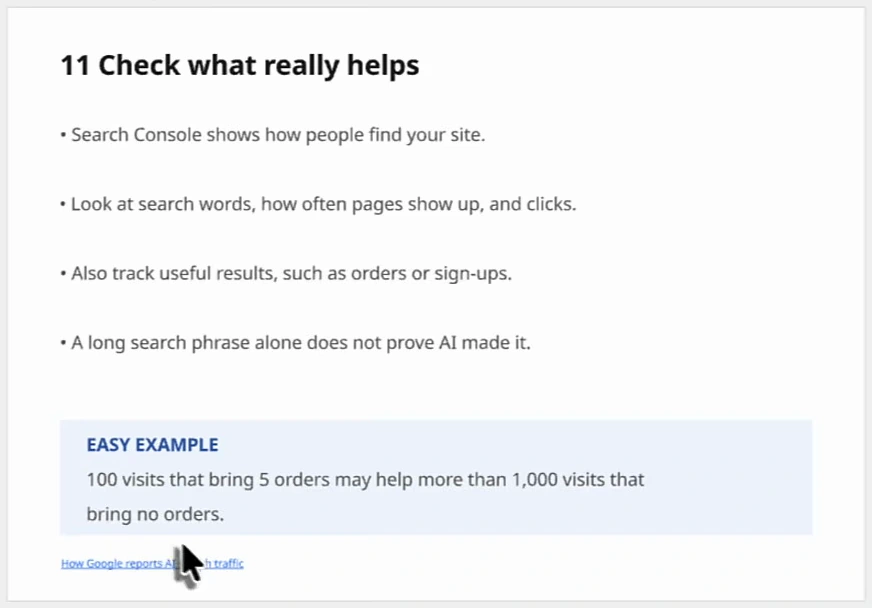
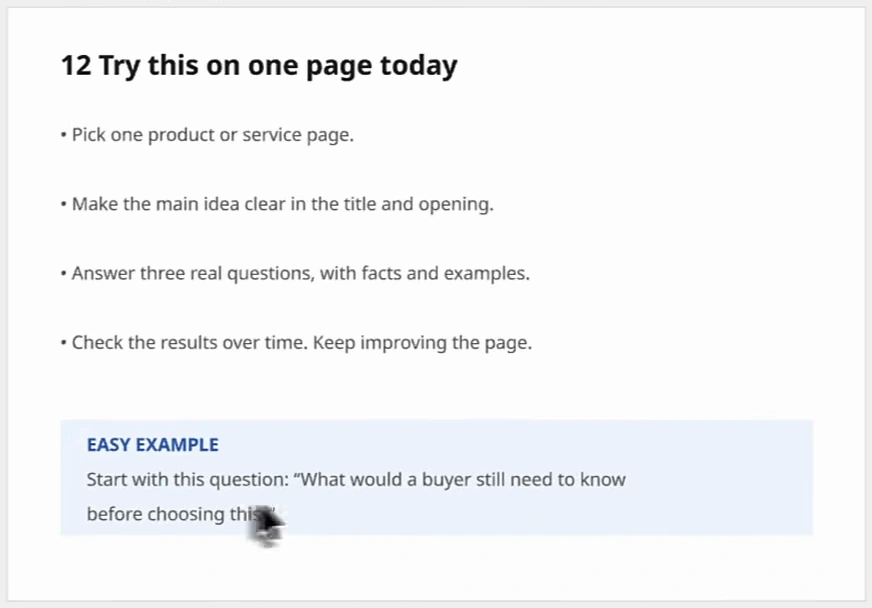
The stage was blunter than card 09. Gary Illyes said scaled content is now a bigger problem than link spam, and a lightning talk showed bought links still ranking in several languages, which Google acknowledged as a challenge; "do not buy links" is policy, not a claim that bought links never work. On card 10, Illyes gave the timelines the board omits: refreshing a known URL typically takes about 30 days to be recrawled, and recovery from a core update typically takes three to six months, with core updates described as "not punitive" and targeting pages rather than whole domains. Duy Nguyen's quality session is the fuller version of "build on useful pages": quality is judged on effort, originality, talent or skill, and accuracy, and the test is the effort a human put in, not whether a human or an AI typed it.
Card 11's last line, that a long search phrase alone does not prove AI made it, is the right caveat to attach to Illyes's "three times longer" statistic. Search Console gained an AI performance report and a new control for AI feature surfacing, but the fan-out queries still do not show up in the queries report. The conversion point came from an attendee, not Google: one brand's organic sessions fell 47% while enquiries per hundred search clicks rose 2.7 times. If you want the AI visits themselves, GA4 now groups them in its own channel, which our GA4 guide walks through.
What the video does not show
- No slide, photo or quote from Barcelona. Every screen is the Miro board or the Arvow app. The board credits two public Google guides, and the event facts above come from three published attendee recaps (ROAST, Locomotive and AIO SEO), not from the video.
- "Put your prices up" is the presenter's advice. Google's stage material covered product attributes and data quality, not a rule about displaying prices.
- Card 06 needs Mueller's caveat. Mine fan-out for coverage gaps; do not build a page per fan-out query.
- Half the video is a product tour. From 8:48 the presenter walks through Arvow's article types, knowledge base, chat, keyword planner, site explorer, review automation, automatic backlinks, site optimizer and LLM brand monitor. Those are covered feature by feature in AI agents for SEO, so this article stays on the playbook.
Running card 12 this week
- Pick one product or service page that already gets impressions in Search Console.
- Ask an AI assistant the buyer's question for that page and note the sub-topics it fetches (size, care, price, compatibility). That is your fan-out map.
- Rewrite the opening so the main question and its answer come first, in the buyer's words, with the full product name.
- Add the three facts a buyer still needs before choosing, including the price or a clear way to get it, and match your structured data to the visible text.
- Record impressions, clicks and conversions for the page today; re-check in 30 days, which is roughly the recrawl window Illyes quoted.
If you are doing this across dozens of pages, the same brief, buyer questions first and no commodity filler, is what an article template should enforce.
FAQ
Was there really a leaked Google playbook?
No. Search Central Live Deep Dive Europe was a public, three-day event, and the board in the video is built from Google's published guides. The value is in the plain-language retelling and the stage details that extend it.
Does AI Mode use a different index from Google Search?
According to the Barcelona sessions, no: AI Overviews and AI Mode use Googlebot and the Search index and serving stack. Gemini grounds live and uses a separate crawler. To be eligible for AI features a page needs to be indexed and eligible for a snippet; Google says there are no extra technical requirements.
Can I see fan-out queries in Search Console?
Not today. Mueller said in Barcelona that they are generated by the model, not typed by users, so they are not in the queries report; Search Console does have a newer AI performance report for the features themselves.
Event notes: ROAST's day-three recap, plus the day-one and day-two recaps on the same site, Locomotive Agency's nine takeaways and AIO SEO's three-day roundup, all read on 30 October 2026.
Want every product and service page to answer the buyer's next three questions? Arvow's AutoBlog writes from your brand brief and knowledge base, with buyer questions and internal links built into the template.
Generate, publish, syndicate and update articles automatically
The AI SEO Writer that Auto-Publishes to your Blog
- Cancel anytime
- Articles in 30 secs
- Plagiarism Free