
The Ripple Effect SEO Strategy: Supporting Content That Ranks Your Money Pages (2026)


Vasco Monteiro calls it the ripple effect: publish pages whose job is to be cited by AI and to rank, link them into the pages that sell, and watch the product and collection pages rise without being touched. The example is a tactical first-aid store, ViTAC Solutions, whose estimated US organic traffic went from 7.1K visits a month in December 2025 to 22K by October 2026 while the brand turned up in Claude, Gemini and Perplexity answers to buyer questions. This article walks the four steps with the numbers on screen, says where the two measurement tools disagree, and reads the backlink list honestly.
What the ripple effect is
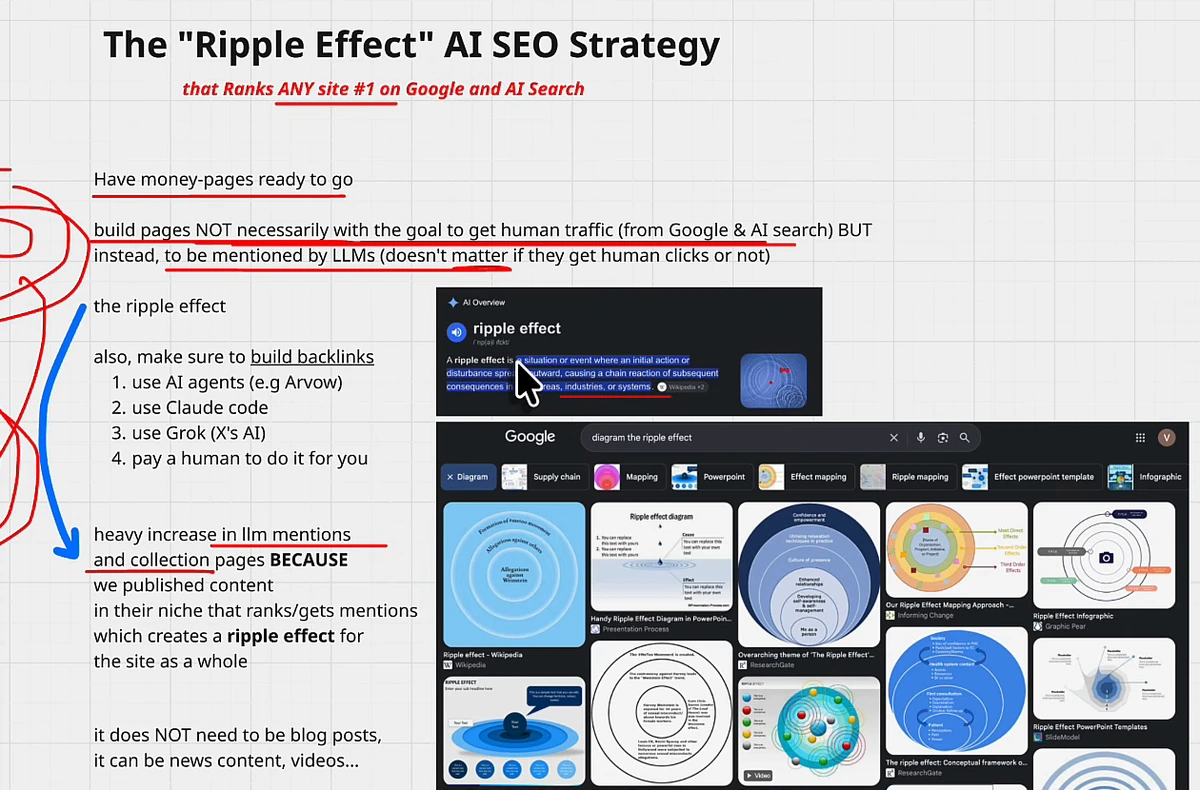
The board has four lines. Have money pages ready. Build pages not to get human traffic but to be mentioned by LLMs, whether or not anyone clicks. Build backlinks. Result: a heavy increase in LLM mentions and collection-page rankings, because the site published content in its niche that ranks and gets mentioned, which lifts the site as a whole.
Vasco is open that none of this is new. He says the strategy has existed forever and he is rebranding it because businesses pour everything into the one page they want to rank and nothing into the pages around it. The mechanism is the one behind topical authority and internal linking, with AI citations as the second payoff.
The case: a first-aid store, 7.1K to 22K
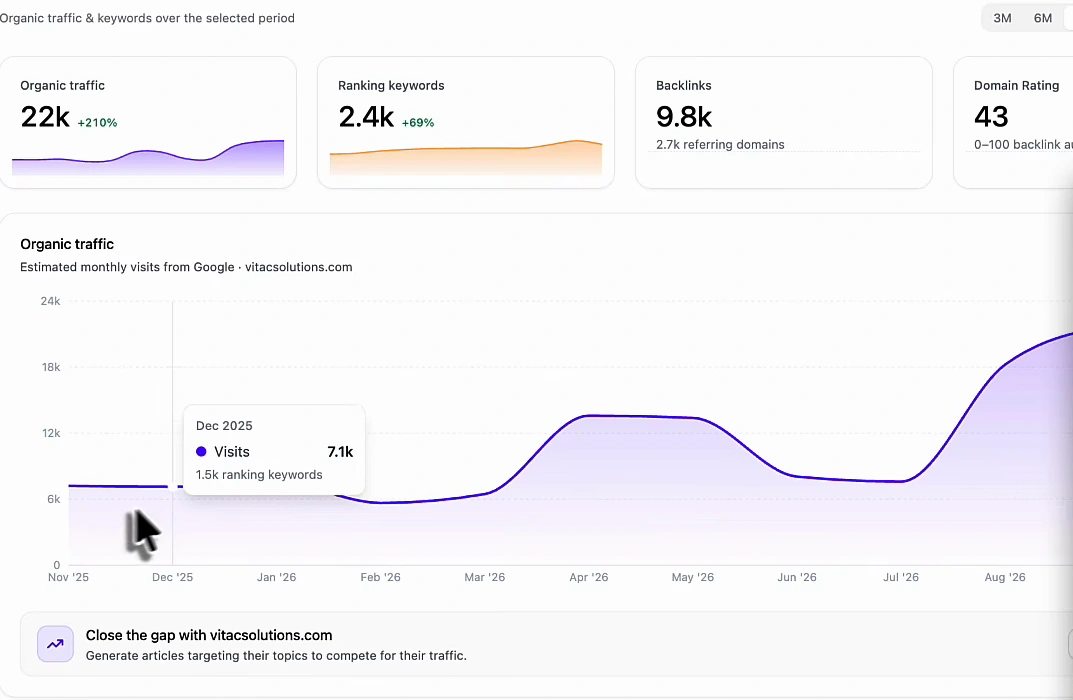
The store is analysed as a competitor in Arvow's Site Explorer, filtered to the United States. The one-year cards read 22K organic visits (+210%), 2.4K ranking keywords (+69%), 9.8K backlinks from 2.7K referring domains and a Domain Rating of 43. The December 2025 tooltip shows 7.1K visits on 1.5K keywords.
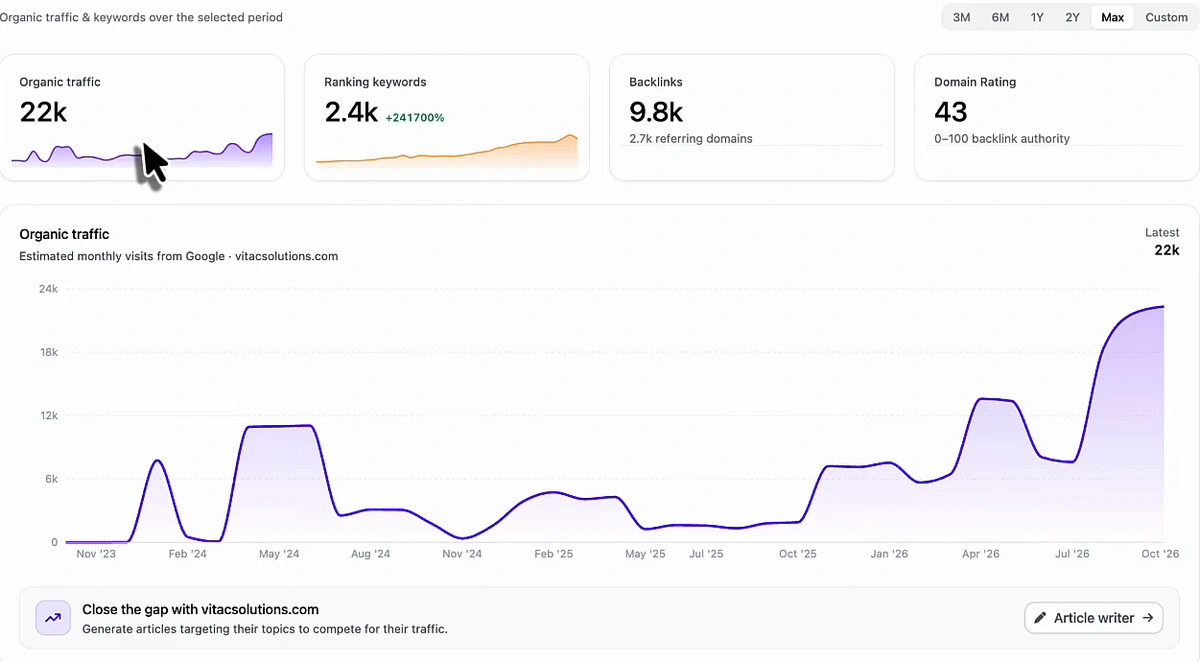
The Max range deserves a look before repeating the headline. The site sat near 11K estimated visits for part of 2024, lost most of it through 2025, and only passed its old peak this summer. The honest framing is a recovery that then doubled the previous best. The timing is the interesting part: the store's article sitemap shows 117 posts last modified in July 2026 and 85 in August, and the traffic line turns sharply upward in those two months.
What two tools say about the same site
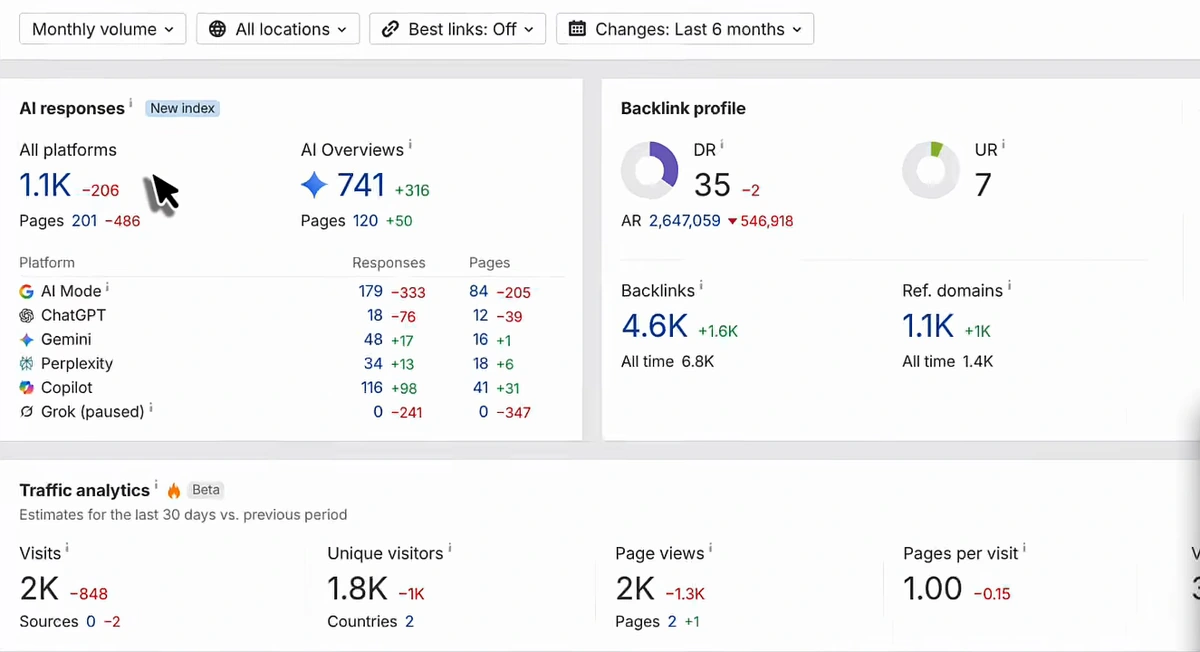
Vasco cross-checks in Ahrefs and says the two tools paint the same picture. They agree on direction and disagree on size. Six-month changes in Ahrefs: organic keywords 818 (+435), top-three rankings 330 (+264), backlinks 4.6K (+1.6K), referring domains 1.1K (+1K). The AI index counts 1.1K responses mentioning the brand across AI Mode, ChatGPT, Gemini, Perplexity and Copilot, plus 741 AI Overview appearances (+316).
| Metric | Arvow Site Explorer (US, keyword model) | Ahrefs (same screen) |
|---|---|---|
| Monthly organic traffic | 22K estimated | 3.9K organic; 2K visits in Traffic Analytics (beta, 30 days) |
| Domain Rating | 43 | 35 |
| Backlinks / referring domains | 9.8K / 2.7K | 4.6K / 1.1K |
| Ranking keywords | 2.4K | 818, of which 330 in the top three |
| AI mentions | 9 tracked prompts, 45% visibility | 1.1K responses + 741 AI Overviews |
Keyword models and clickstream panels measure different things, so a five-to-one gap is not a scandal. It is a reason to write "estimated" every time and to judge the strategy by the trend and by the money pages.
Step 1: have the money pages ready
Vasco's first rule is blunt: traffic, backlinks and mention counts are vanity metrics, and the only metric is money in the bank. Before building anything, the pages that take money have to exist: product and collection pages for a store, service and location pages for a service business. Arvow keeps a money page architecture prompt for laying those out.
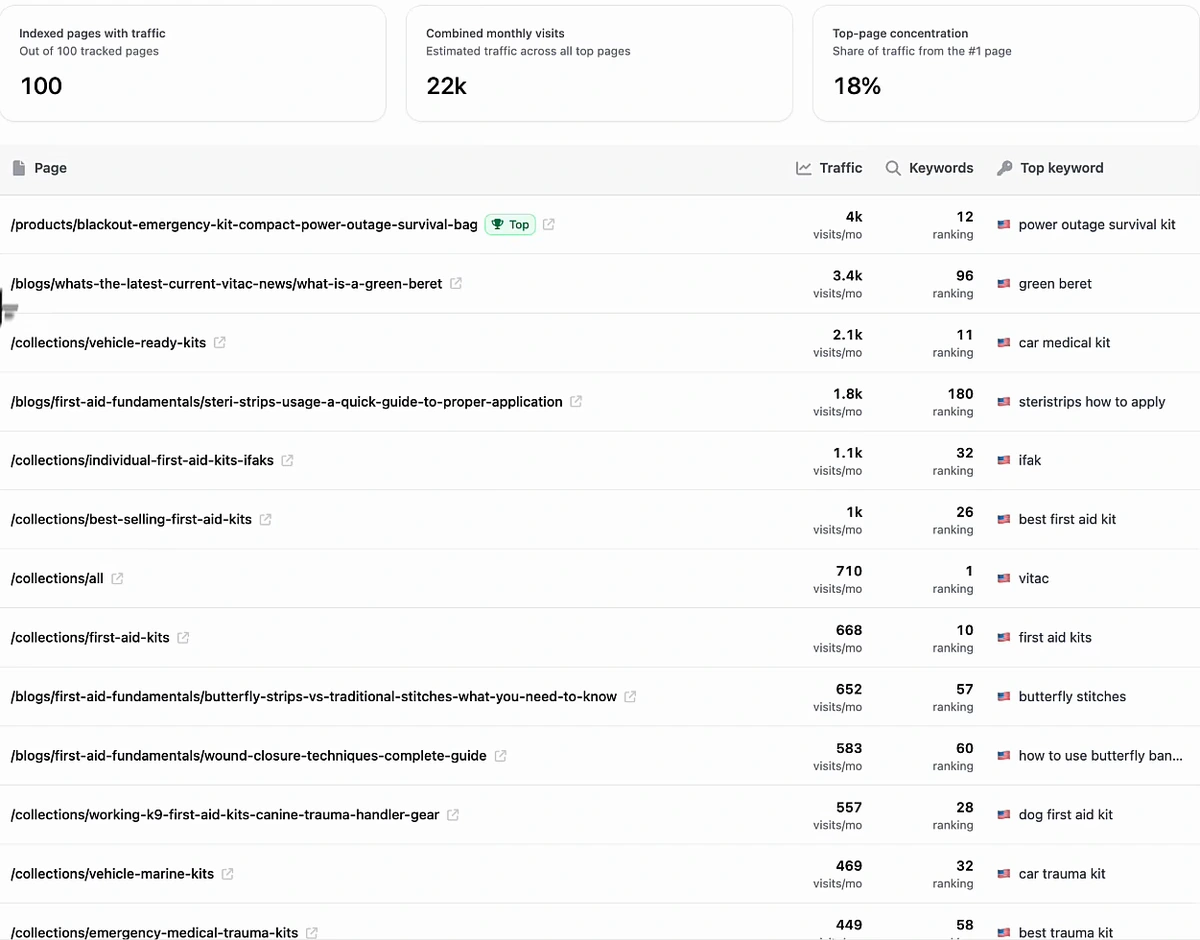
The top-pages report is where the ripple shows. All 100 tracked pages carry traffic and the top page holds 18% of it. The leader is a product page, a blackout emergency kit, at 4K visits on 12 keywords. Then a post titled "What is a Green Beret" at 3.4K on 96 keywords, the vehicle kits collection at 2.1K, a steri-strips guide at 1.8K on 180 keywords, the IFAK collection at 1.1K, best-selling kits at 1K. Money pages and guides interleave all the way down.
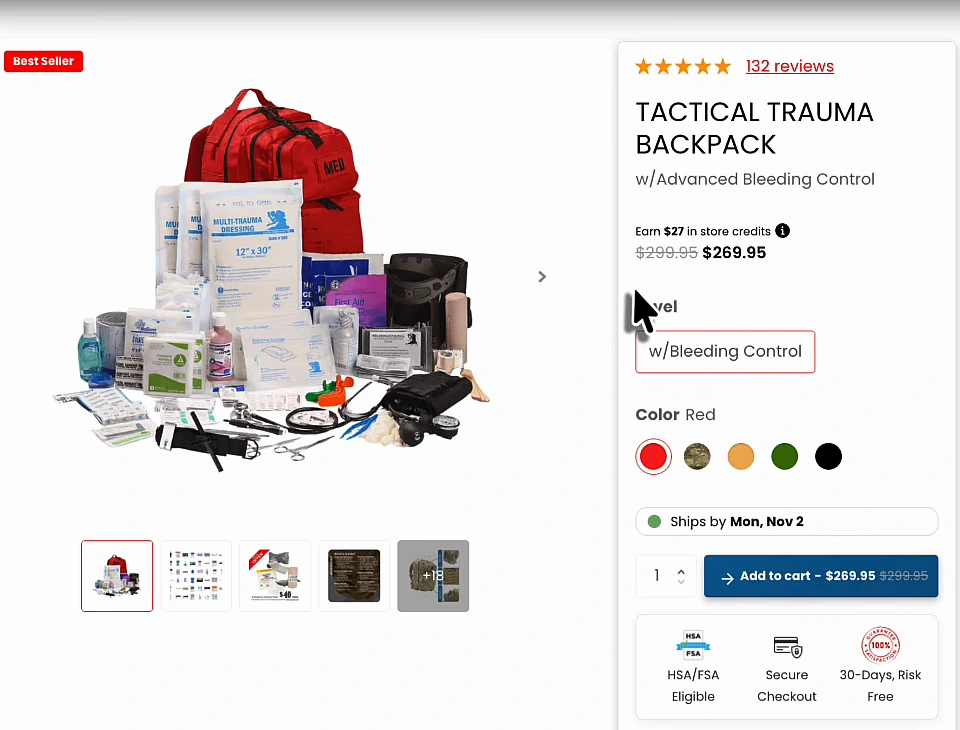
Two things we found when we opened the pages on 29 October 2026. The product URL at the top of the report now redirects to the trauma-kits collection, and the vehicle-ready-kits collection redirects to vehicle and marine kits, so the store has reorganised since the data was pulled. Vasco also catches a blog call-to-action landing on a 404. A money page that moves or breaks wastes the ripple; check the links before counting the lift.
Step 2: build pages to be cited, not clicked
Vasco says he does not care whether the supporting pages get human traffic, only that they are indexed, good enough to be cited, and linked to the money pages. A model reads the guide and reports back to the person who asked where to buy.
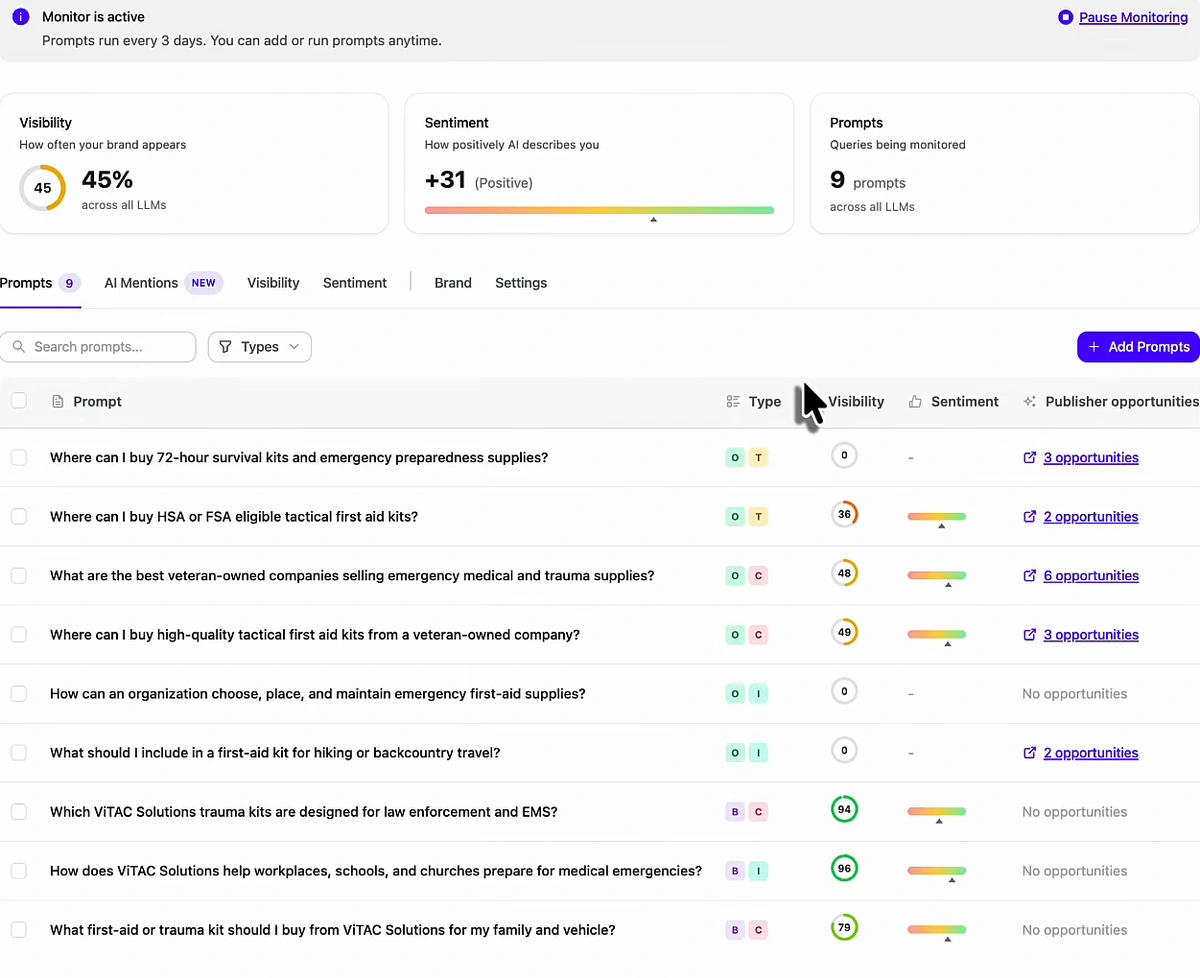
He set up an Arvow monitor for the brand just before recording: nine prompts, six unbranded, run every three days. Visibility is 45% and sentiment +31. The split is the useful bit. The three branded prompts score 94, 96 and 79. The unbranded ones score 36 (HSA or FSA eligible tactical kits), 48 (veteran-owned trauma suppliers) and 49 (tactical kits from a veteran-owned company), and three sit at zero: 72-hour survival kits, organisational first-aid supplies, hiking kits. Those zeros are the next pages to write.
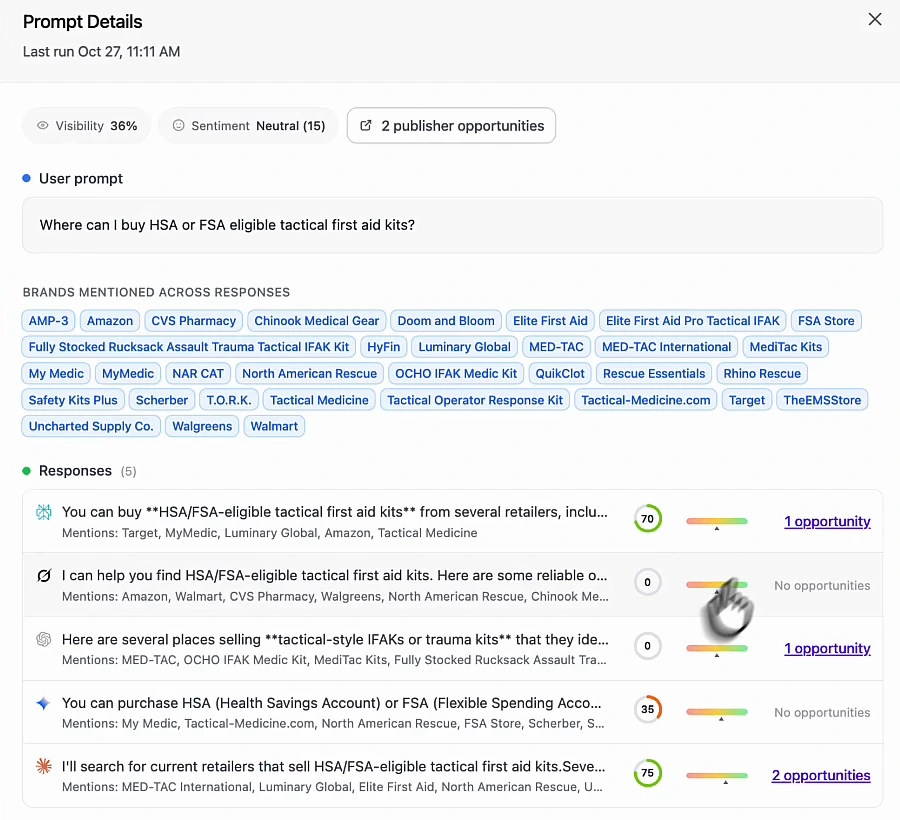
Open the HSA/FSA prompt and the five responses sit side by side. Three name ViTAC; two, including ChatGPT's, do not. Thirty-three other brands appear across the set, from Amazon to small tactical retailers. Two publisher opportunities are flagged: sources the models cite that the brand could pitch, the loop in brand mentions are the new backlinks.
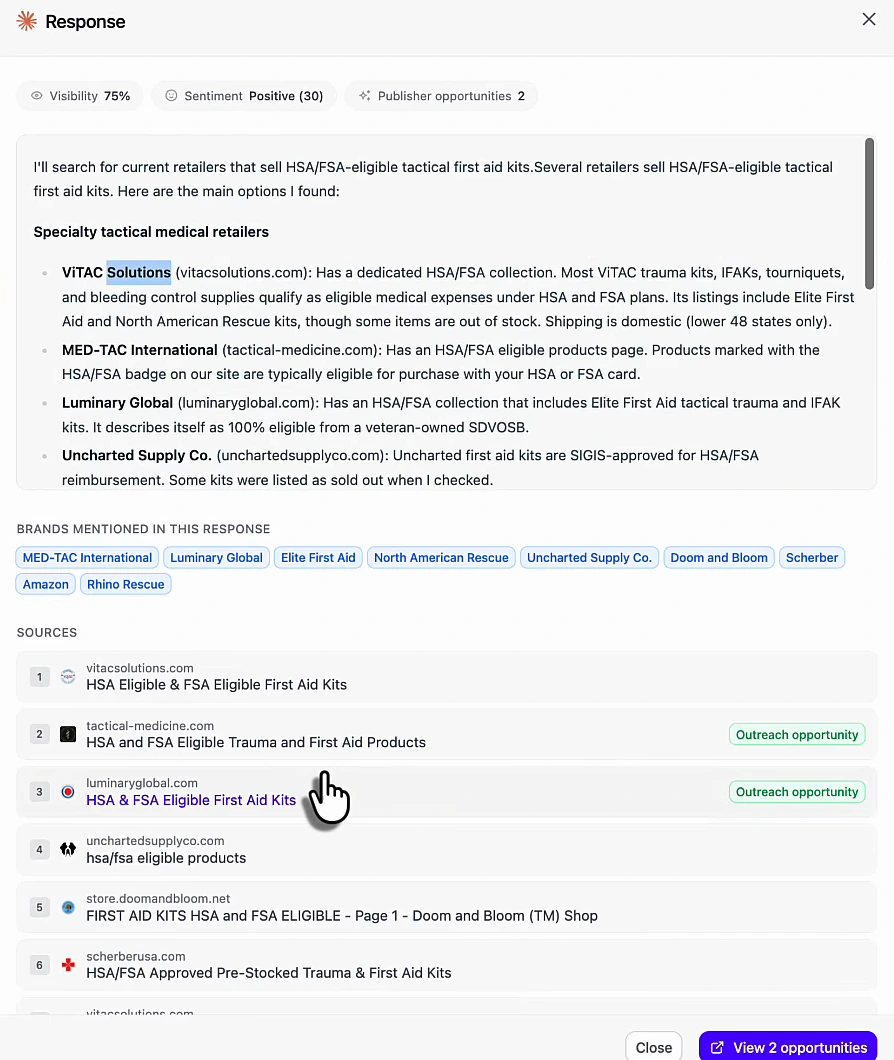
Claude's answer is the proof of mechanism. It lists ViTAC first under specialty tactical medical retailers, repeats that trauma kits and tourniquets qualify under HSA and FSA plans, and notes that shipping is domestic. Source one is the store's own page. Nobody searched for it; a model read it and passed its contents to the buyer, the behaviour described in how to get cited by ChatGPT, caught on a live prompt.
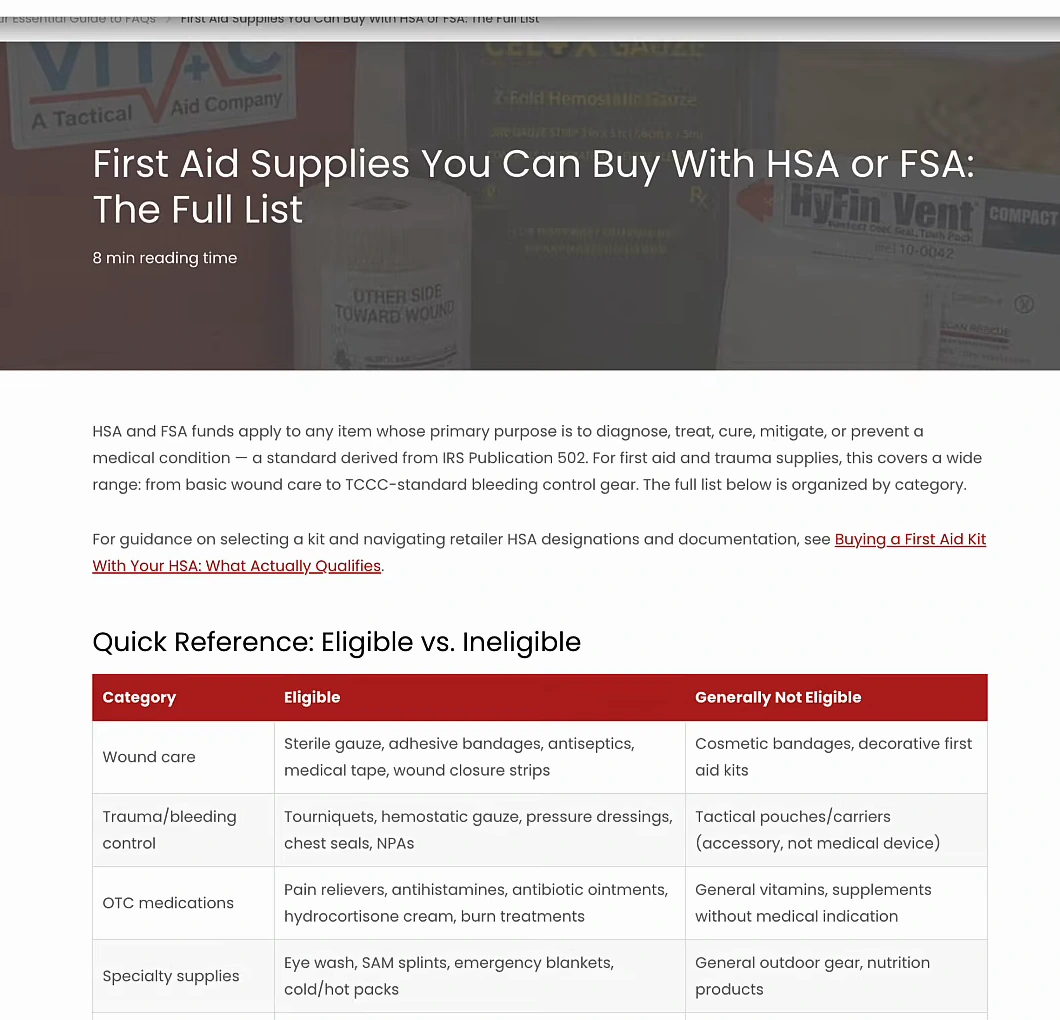
The cited page is an eight-minute guide with a quick-reference table, an IRS reference and a link to a sister post on buying a kit with an HSA. It lives in a blog called "common questions and answers", which holds 60 of the site's 204 articles, and it is one of about a dozen HSA/FSA posts in that cluster. One page did not win the prompt; a cluster that answers every version of the question did. Vasco's plug is that these pages are written with Arvow from the brand's uploaded assets, tone and competitor data; judge that from the page, and see does AI SEO work for the wider customer table.
Why the money pages move
The mechanism is the old one. The guides rank and earn mentions, they link to the collections and products, and the money pages inherit relevance and authority they could not earn alone. Vasco says product and collection pages climb when new articles go out, provided the two are interlinked. On this site the July and August publishing push sits under the steepest part of the curve.
Step 3: it does not have to be blog posts
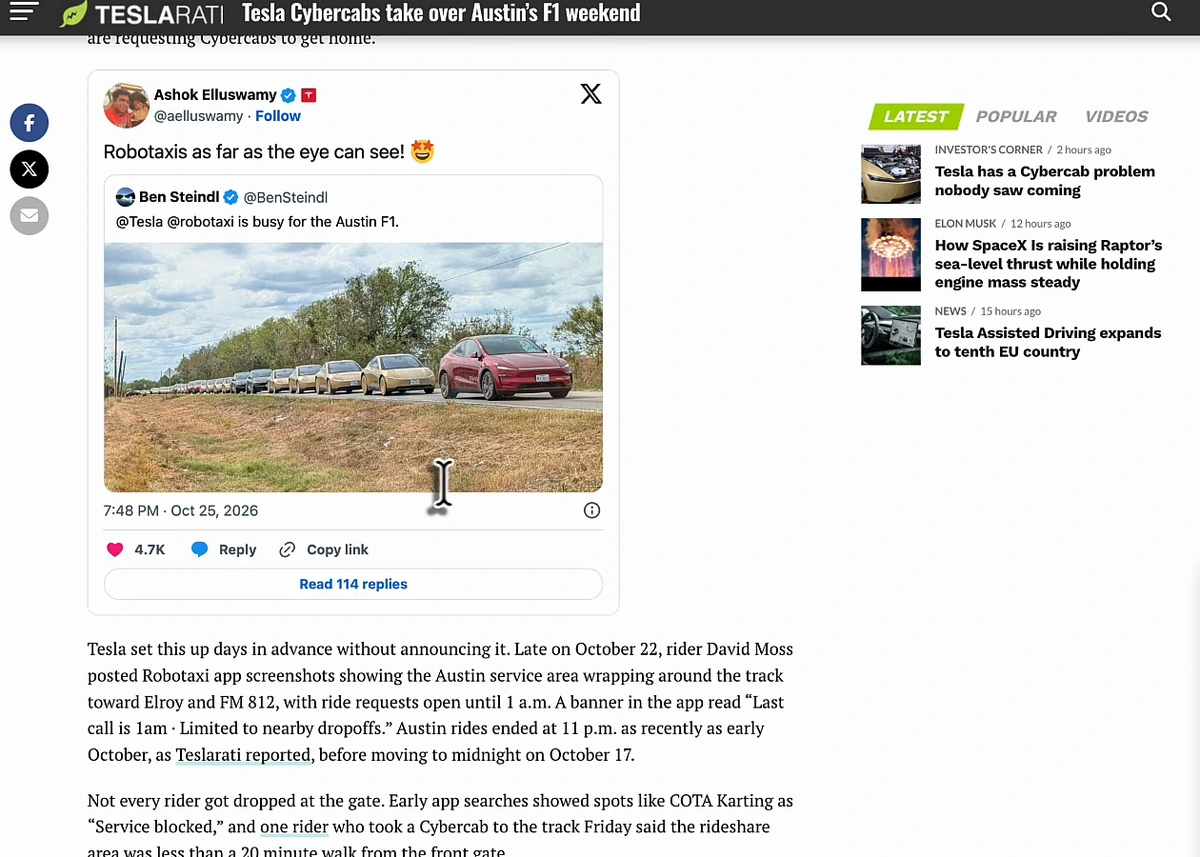
The supporting pages can be news. The example is a store selling Tesla accessories with a news section of short, image-led stories posted hours apart. News gets cited by LLMs, lands in Google News and travels on social, and people who read Tesla news buy Tesla floor mats. Search Engine Land does the same with algorithm news and sells event tickets. His worked version of the store is in how to add an automated news section; the e-commerce case is in why your store needs a blog section.
Step 4: backlinks, four ways, read honestly
Content alone can carry an easy niche; competitive ones still need links. Vasco lists four routes: AI agents, Claude Code, Grok, or paying a human. The first is Arvow's backlink exchange; the second is in how to build backlinks with Claude; the third is his "backlink factory" video; the fourth is the manual service, which places links only on sites rated DR 40 to 70+ with at least 1,000 organic visits a month.
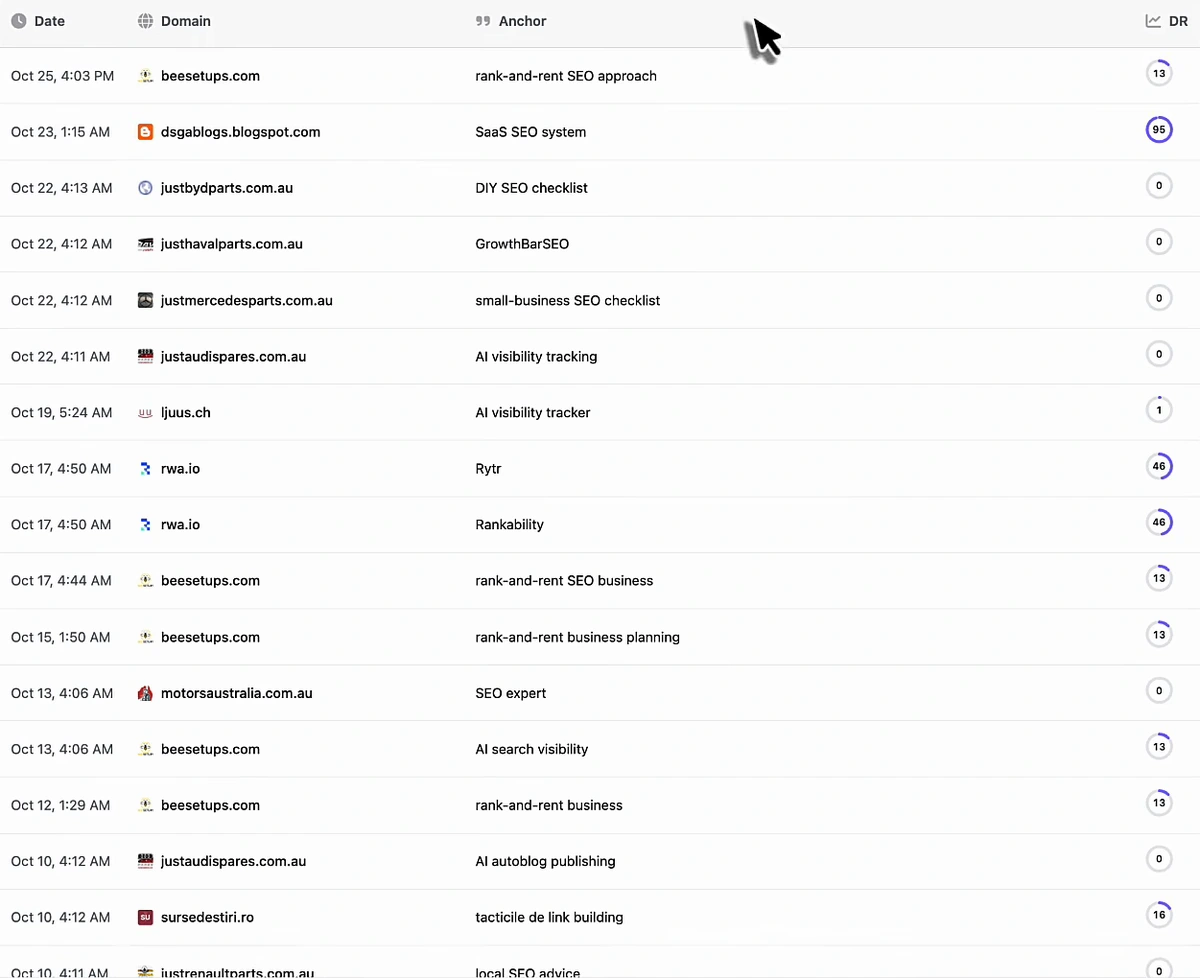
He opens Arvow's own list and reads out DR 95, 46, 13 and 16. Read the whole screen and the picture is mixed, which he admits: the agents apply criteria but you will get weak links beside strong ones. Of the 17 rows visible, seven are DR 0, five are DR 13 from one site, two are DR 46, one 16, one 1, and the DR 95 is a Blogger subdomain, which inherits blogspot.com's rating rather than earning its own. Four of the DR 0 rows are sister car-parts sites on the same template. The anchors are relevant and the links are real, but this is volume with a relevance filter, not curation. The economics are in the AI backlink agent review.
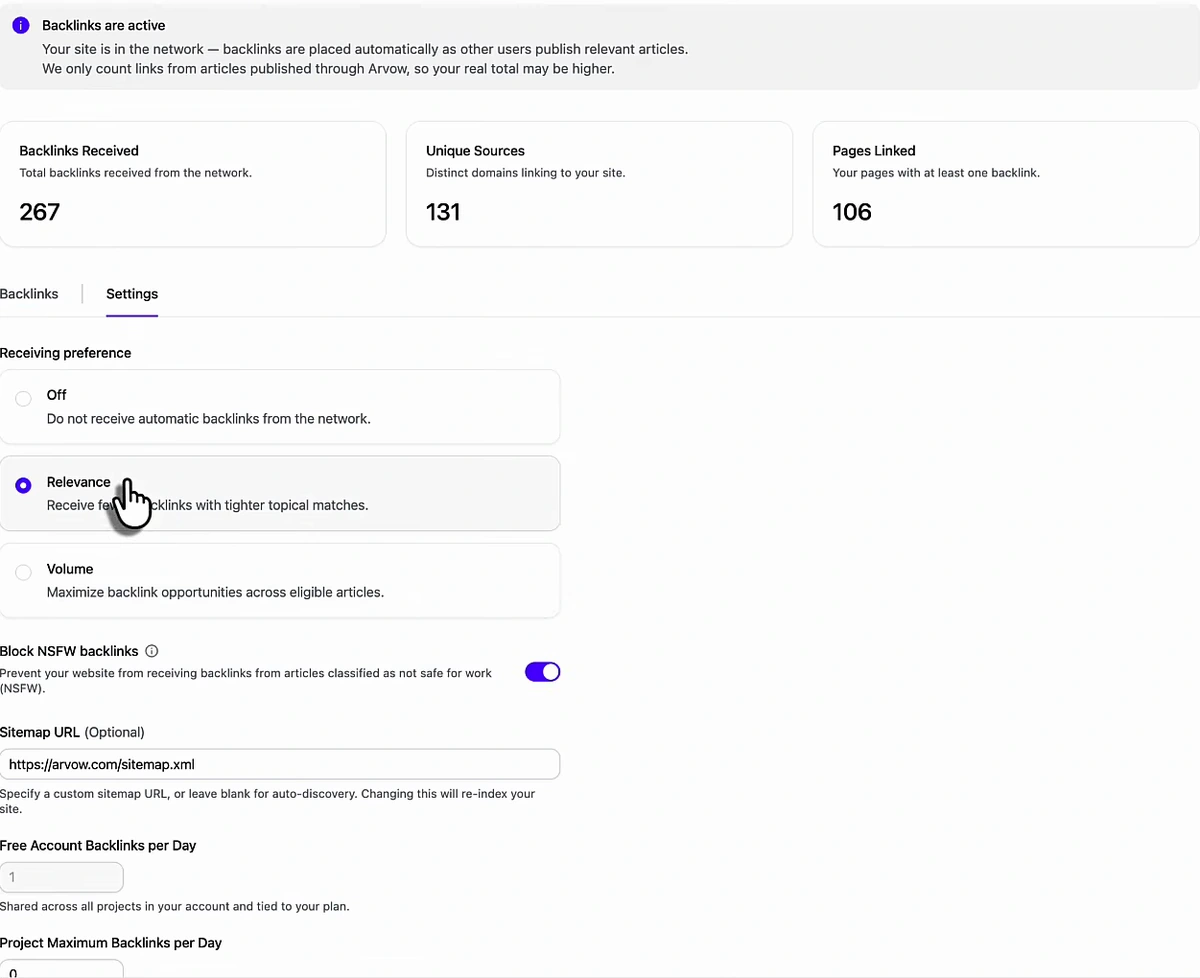
The settings page shows 267 backlinks received from 131 sources onto 106 pages, with the preference on Relevance and NSFW sources blocked; the banner notes only links from articles published through Arvow are counted. The trade is price against curation: pay a human for DR 40 to 70 with real traffic, or let agents or Grok work the 0-to-95 range.
The mistake the strategy exists to fix
Vasco closes on what he sees most. Store owners spend every hour on the one collection page, the one product page, the homepage, and nothing on the pages around them. Work on the pages you do not want to rank, he says, because ranking those is what makes the page you do want to rank move faster than it would alone. Keep his first rule as the scoreboard: count orders and leads from the money pages, and use SEO revenue attribution to tie the two together.
FAQ
Is the ripple effect a new SEO technique?
No, and the video says so. It is supporting content plus internal linking plus backlinks, renamed because the AI-citation payoff makes the old pattern visible: a guide can be cited by a model and lift a product page without ever being clicked.
Did the store really go from 7K to 22K?
In Arvow's US keyword model, yes: 7.1K estimated visits in December 2025 to 22K now. Ahrefs puts organic traffic at 3.9K and clickstream visits near 2K on the same day, and the Max chart shows the site near 11K in 2024. Treat the trend as solid and the absolute number as an estimate.
How many supporting pages does it take?
This store has 204 articles across eight blogs, 60 of them in a buyer-questions blog and about a dozen on the single HSA/FSA question the models now answer with the brand. One good page gets you into the running; a cluster gets you cited.
Do I still need backlinks?
For easy niches, maybe not; for competitive ones, yes. Automated links range from DR 0 to a Blogger subdomain at 95; the manual service holds to DR 40 to 70 with real traffic. Pick the route by how curated the profile needs to be.
Want the supporting pages, the news section and the monitor on one calendar? Arvow's AutoBlog writes and publishes from your brand's assets, and the LLM visibility tracker shows which prompts cite you and which are still at zero.
Generate, publish, syndicate and update articles automatically
The AI SEO Writer that Auto-Publishes to your Blog
- Cancel anytime
- Articles in 30 secs
- Plagiarism Free