
Does AI SEO Work? What 33 Customer Sites Show in Ahrefs (2026)

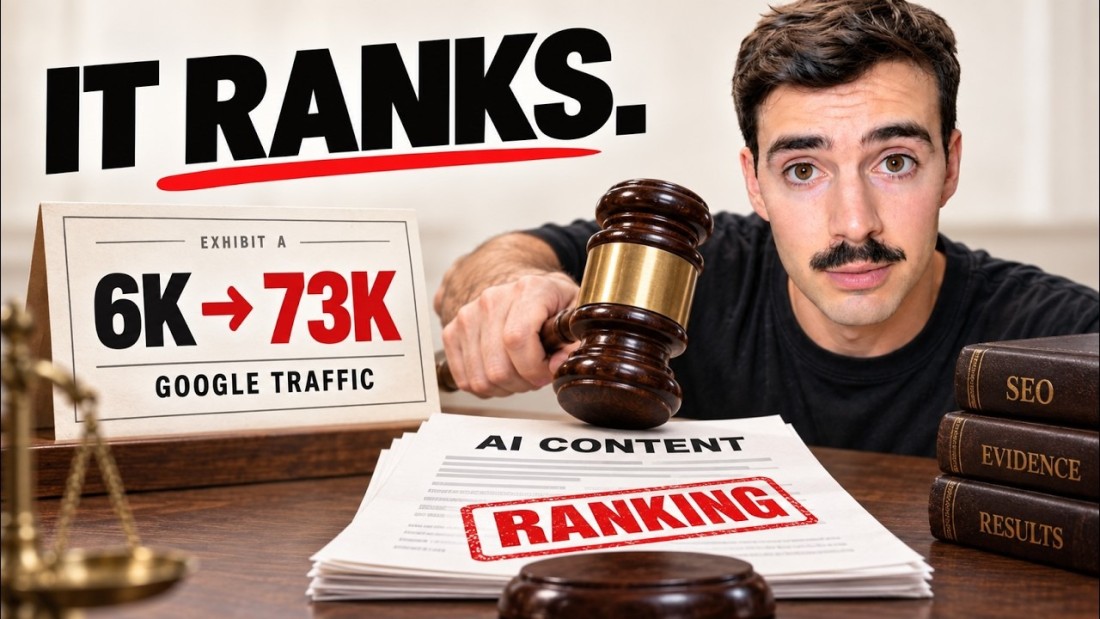
"AI content doesn't rank" is one of the most repeated lines in SEO. The honest reply is not another opinion. It's data: take real sites that used an AI SEO tool, measure their organic traffic before and after, and see what happened. That's what the video below does with Arvow's own customer base, and it's the best way to answer the broader question: does AI SEO work?
We went through the whole recording frame by frame and transcribed the full results table: 33 customer sites. The short answer is yes, for these sites, and in some cases dramatically. The longer answer is more useful, because the table also shows what AI SEO does not guarantee, and how to check the claim on your own site instead of taking anyone's word for it.
The short answer
AI SEO works when the output gets published, indexed and supported, and the evidence here is 33 paying Arvow customers whose estimated organic traffic grew after they started publishing with it. Eight of them went from zero to between 517 and 1,441 visits a month. The biggest went from 6,112 to 73,498. But three things matter as much as the headline:
- The list is filtered to sites that grew. It shows that AI SEO can work, not how often it does.
- Volume didn't predict results. A site with 35 articles out-grew sites with 1,500 or 2,800.
- The traffic numbers are Ahrefs estimates for the whole domain, so other SEO work those sites did is mixed in.
None of that makes the results fake. It tells you how to read them, and it's exactly what you should ask of any "AI SEO results" claim, including ours.
How the data was pulled
The presenter used an AI coding agent (Cursor) to join two data sources on each customer's domain. The first is Arvow's product database: who is paying, which features they use (articles, autoblogs, AI SEO Editor runs, the AI visibility tracker, backlinks through the exchange, a connected Google Business Profile, white-label reports), and when their first article went live. The second is Ahrefs: estimated organic visits now, and estimated visits for the month before that first article.
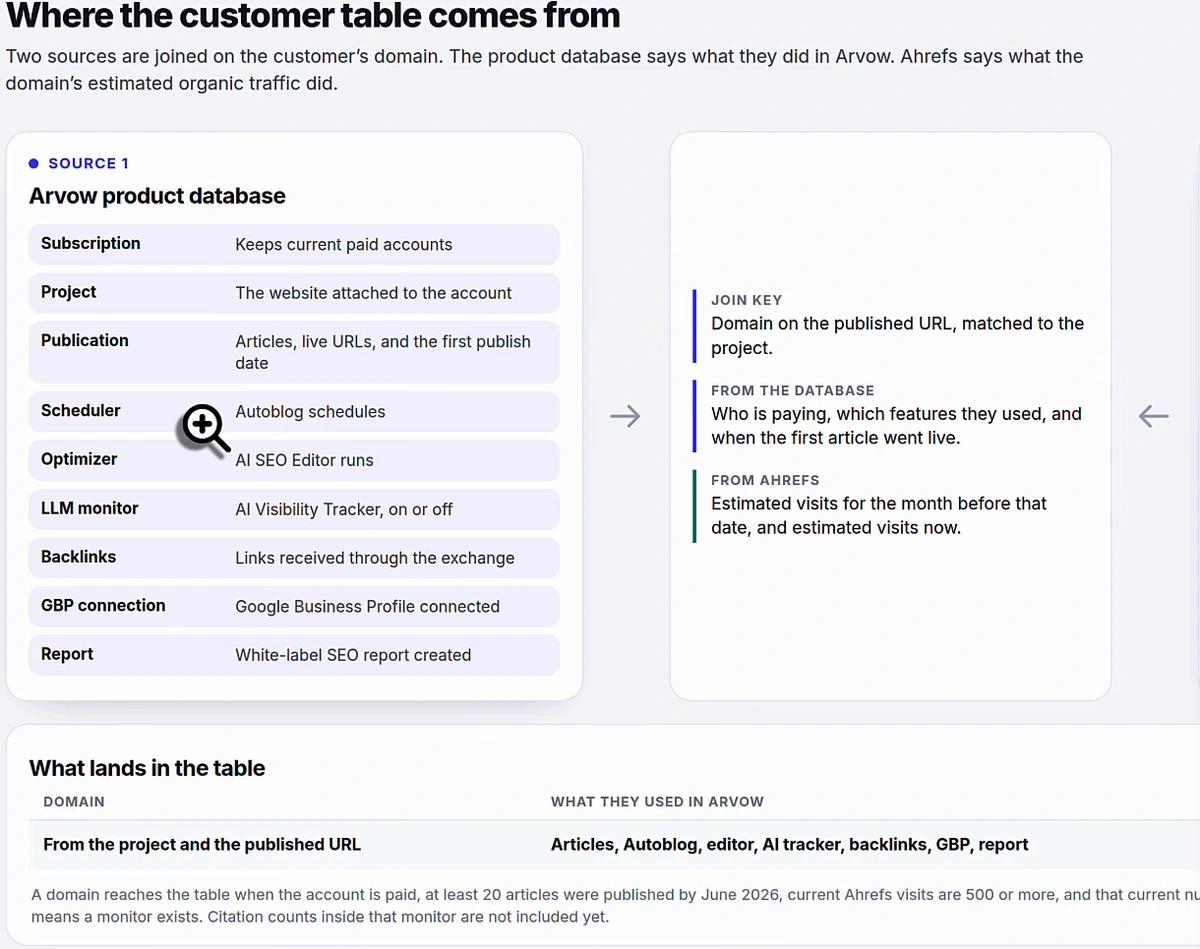
The footnote at the bottom is the most important line on the screen. A domain only reaches the table if the account is paid, at least 20 articles were published by June 2026, and current Ahrefs visits are 500 or more. The agent's own summary adds the last condition: every row is a customer whose estimated organic traffic at least doubled after publishing.
The results: 33 sites, before and after
Here is the table as it appears in the video. Domain names were blurred by the presenter; the usage and traffic columns are shown in full.
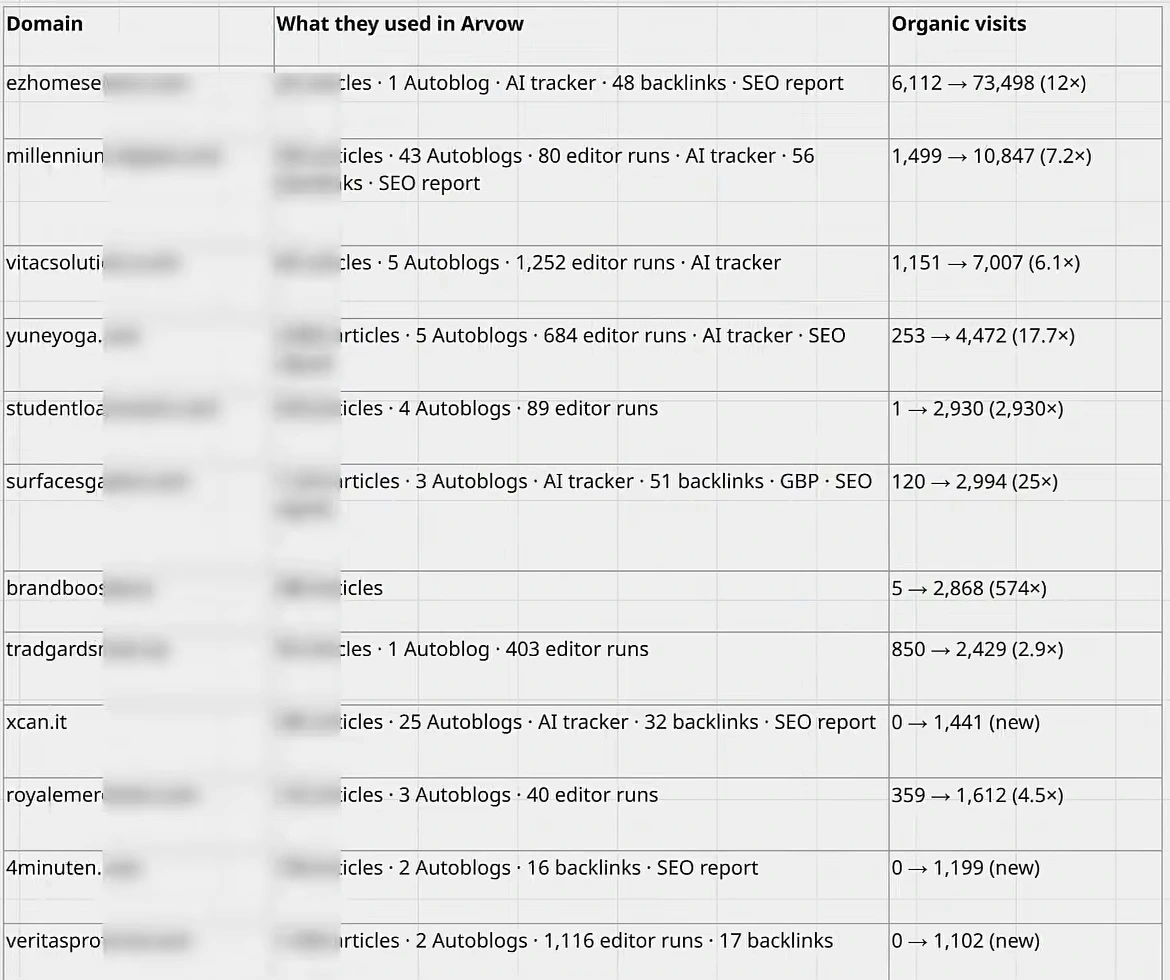
We transcribed all 33 rows from the video. A selection that covers the range:
| What they used in Arvow | Organic visits (before → now) |
|---|---|
| 35 articles · 1 autoblog · AI tracker · 48 backlinks · SEO report | 6,112 → 73,498 (12×) |
| 429 articles · 43 autoblogs · 80 editor runs · AI tracker · 56 backlinks · SEO report | 1,499 → 10,847 (7.2×) |
| 2,803 articles · 5 autoblogs · 684 editor runs · AI tracker · SEO report | 253 → 4,472 (17.7×) |
| 1,324 articles · 3 autoblogs · AI tracker · 51 backlinks · GBP · SEO report | 120 → 2,994 (25×) |
| 542 articles · 25 autoblogs · AI tracker · 32 backlinks · SEO report | 0 → 1,441 (new) |
| 1,596 articles · 2 autoblogs · 1,116 editor runs · 17 backlinks | 0 → 1,102 (new) |
| 178 articles | 9 → 549 (61×) |
| 480 articles · 5 autoblogs · 1,240 editor runs · AI tracker · 233 backlinks · GBP · SEO report | 4 → 554 (139×) |
| 27 articles · 3 autoblogs · 319 editor runs | 355 → 801 (2.3×) |
| 47 articles · 1 autoblog · 15 backlinks | 208 → 614 (3×) |
Across all 33 sites, the combined estimate went from 11,850 to 126,858 visits a month. Fourteen sites started at 10 visits or fewer, which is where the eye-catching multiples come from (1 → 2,930 reads as "2,930×"). Thirteen are now above 1,000 visits a month; the median site is at 801.
What the data shows
1. AI-written content can take a site from zero
Eight sites had no measurable organic traffic before their first Arvow article and now sit between 517 and 1,441 visits a month. For a new site, that's the hardest step: getting indexed, then getting the first rankings. It's the most direct answer to "does AI content rank?", which we cover from the Google-policy side in does AI content rank on Google.
2. More articles did not mean more traffic
This is the most useful finding in the table, and the video doesn't dwell on it. The site with the biggest result published 35 articles. The two sites with the most articles (2,803 and 1,596) reached 4,472 and 1,102 visits. When we ranked all 33 sites by article count and by current traffic, the two orders were essentially unrelated. Publishing volume isn't the lever. Which queries you target, how good each page is, and what authority the site already has matter more. The presenter says the same thing in his own words: going from zero to 500 is a different strategy from going from 1,000 to 10,000, and an e-commerce store, an agency and a local business each need a different plan.
3. One site carries more than half the total
The 12× site accounts for 73,498 of the 126,858 combined visits, about 58%. Take it out and the other 32 sites went from 5,738 to 53,360 combined. That's still roughly nine times more, but it's a better picture of a typical result than the headline number.
Verifying the biggest result in Ahrefs
The presenter opens the 12× customer in Ahrefs to show the traffic is real.
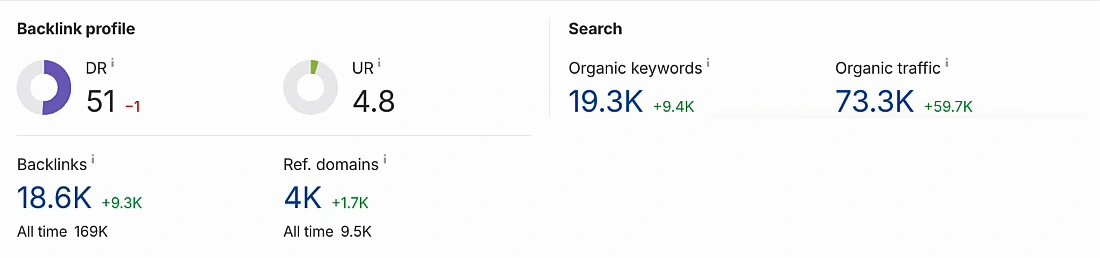
The 73.3K matches the table's 73,498. Look at the backlink profile, though: 18.6K backlinks (+9.3K) from 4K referring domains (+1.7K) in the last six months. The table credits this customer with 48 backlinks through Arvow's exchange. So most of that link growth came from somewhere else. The presenter raises this himself on camera: he isn't sure whether the site got links elsewhere that helped the content rank higher. That's the right instinct, and it's why the growth is best read as "Arvow content plus everything else this site did". For how links and content interact, see how long backlinks take to work.
What this data can't prove
Every one of these limits is visible on the screen in the video. They're worth stating plainly, because they apply to every "AI SEO results" claim you'll see.
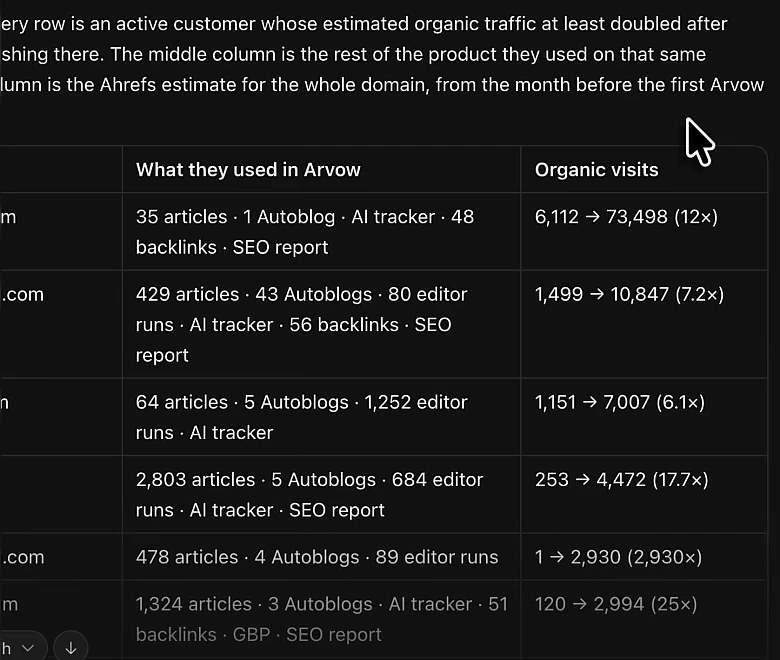
- It's a list of winners, not a success rate. The chapter title says "every Arvow customer", but the table's entry rule requires traffic to have at least doubled and to be at 500+ visits now. We don't see how many paying customers with 20+ articles didn't make it in. So the table proves AI SEO can work at scale. It doesn't tell you the odds for your site.
- It's the whole domain, not just the AI articles. On camera the growth is described as coming from "just these articles". The agent's note says the traffic column is the estimate for the whole domain. Ahrefs' Top Pages view (shown in the video, with URLs blurred) is where you'd separate the two, and the presenter shows Arvow articles among the top traffic drivers there. But the table itself doesn't make that split.
- The traffic is modelled. The diagram says it directly:
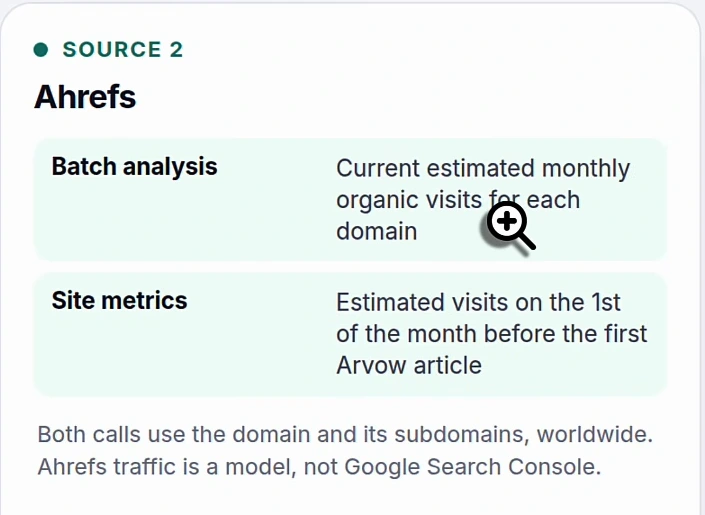
- Timing differs by site. "Before" is the month before each site's first Arvow article, so some sites have had a year to grow and others a few months.
The presenter says he plans to break individual sites down one by one. That's the right next step: a single site with Search Console data, its publishing dates and its link history answers "did the tool cause it?" far better than a table can. Our AI SEO case study is one of those, a 3.5K to 13.9K run with the dashboards shown.
How to check whether AI SEO is working on your site
You don't need a customer database to do this. You need your own site's data, and the same discipline the video's diagram uses.
- Record the start date. Note the date your first AI-assisted article went live. Everything is measured from there.
- Take the baseline from Search Console, not a third-party estimate: clicks for the month before that date.
- Split the traffic. In Search Console's Pages report, filter to the URLs you published with the tool and compare them against the rest of the site. If the whole domain grew but those URLs didn't, the tool isn't the reason.
- Log everything else you did. Links you bought or earned, a redesign, a migration, PR, a seasonal peak. The 12× site above shows why: its referring domains grew by 1.7K in the same window.
- Compare months, not days. New pages usually take weeks to months to settle into rankings. Our guide on how long it takes to rank on Google covers the typical timelines.
- Tie it to revenue if you can. Traffic is the leading indicator. Leads and sales are the answer. See SEO revenue attribution for tracing a sale back to one post.
FAQ
Does AI SEO really work?
It can. In this data, 33 paying Arvow customers with at least 20 published articles grew their estimated organic traffic at least 2×, and eight started from zero. The data is filtered to sites that grew, so it shows what's possible, not a guaranteed outcome. Results depend on topic choice, content quality and the site's existing authority.
Does Google penalize AI-generated content?
Google's stated position is that it rewards helpful content however it's produced, and targets content made mainly to manipulate rankings. The sites in this table rank with AI-written articles, which is consistent with that. We go through the policy and the evidence in is AI content good for SEO.
How many AI articles do I need to see results?
There's no fixed number. In this table, one site reached 73,498 visits a month with 35 articles, while another published 1,596 and reached 1,102. Every site in the table had at least 20 articles, because that was the entry rule. Start with fewer, better-targeted pages and grow from what ranks.
How long does AI SEO take to work?
Expect months, not days. The table measures each site from the month before its first article to now, and the Ahrefs chart for the largest site shows a climb over several months rather than an overnight jump.
Want to see how other sites grew with AI content? Browse Arvow customer results, or start publishing with Arvow's autoblog.
Generate, publish, syndicate and update articles automatically
The AI SEO Writer that Auto-Publishes to your Blog
- Cancel anytime
- Articles in 30 secs
- Plagiarism Free