
AI Backlink Agent: What My Bot Built vs a $295 Fiverr Gig (2026)

An AI backlink agent is an AI assistant that runs on its own machine, finds link opportunities for your site, submits your business to them, confirms the sign-up emails, checks which listings went live, and reports back without you touching a browser. In the video below I set one up to build links to arvow.com, then compare what it produced with a $295 Fiverr gig that sells the same kind of link.
The short version: the agent does the job that directory-submission gigs charge for, around the clock, and it produced verified live listings within days. It also shows exactly why that type of link is the bottom of the market. This article covers both: how to set the agent up, and how to read what it reports.
What an AI backlink agent actually does
The agent in the video isn't a link network or a plugin. It's a general-purpose AI assistant with its own computer, told that its "sole goal of existence" is to build relevant backlinks to one site. Everything else follows from that instruction. On this run it works through a loop:
- Find directories and launch sites that fit the business. Arvow is software, so it goes after AI-tool and SaaS directories; a local business would get local directories, an e-commerce store would get shopping ones.
- Submit the business, creating an account where the site requires one.
- Confirm the account through its own email inbox.
- Check whether the listing is live and actually shows the brand.
- Report the results to a Slack channel on a schedule.
What makes it an agent rather than a chatbot: a Claude Code or ChatGPT session stops when your laptop sleeps, while this one, as I explain around the three-minute mark, runs on its own computer and keeps working through the night.
Setting up the backlink agent, step by step
1. Install the agent app
The tool in the video is Grok Bot, the desktop agent app whose download page bills it as "AI teammates you can give real work to". I downloaded it from cursor.com/download/bot. It's available for macOS, Windows and Linux. Once installed, it's a simple chat window with a list of bots on the left.
2. Create a bot with one job
I created a new bot called "Backlink Builder" and gave it a one-line brief: your sole goal of existence is to build relevant backlinks to my site (arvow.com). What do you need from me? That second sentence matters more than it looks. Rather than guessing, the bot came back with the four things it couldn't work out from the site on its own:
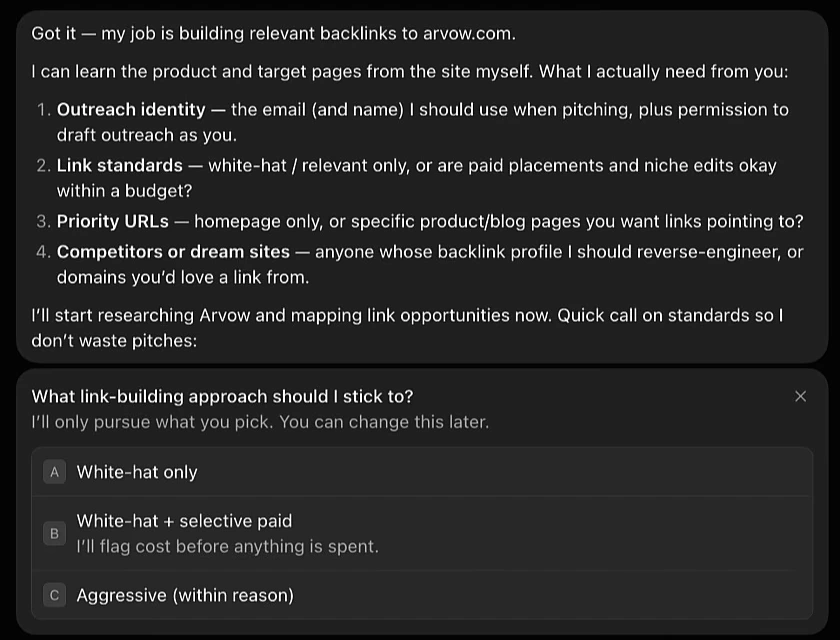
- Outreach identity: which email and name to use, and permission to draft outreach as you.
- Link standards: white-hat and relevant only, or are paid placements and niche edits fine within a budget?
- Priority URLs: the homepage only, or specific product and blog pages?
- Competitors or dream sites: whose backlink profile should it reverse-engineer?
Then it asks you to pick an approach: white-hat only, white-hat plus selective paid ("I'll flag cost before anything is spent"), or aggressive (within reason). Answer that one deliberately. It decides what the bot will do while you're asleep.
3. Give it its own email address
Almost every directory makes you create an account and verify it by email, so the agent needs an inbox of its own. I used Fastmail. In the video I call it free; the Fastmail page on screen actually offers "Try free for 30 days" with no credit card required, so budget for a paid plan if the bot is going to keep running after the trial.
You then send the bot the address and its password in the chat. Treat that inbox as the bot's, not yours: create a fresh one, don't reuse a password from anything else, and don't connect it to accounts that matter.
4. Instruct it like a new hire
In the video I compare it to instructing a child: without pointers on what you sell, what you want and why, it flails. Expect a back-and-forth; the brief gets sharper with each answer. For the exact prompt we run, the video asks you to comment "prompt" under it.
5. Send the reports somewhere you'll read them
We told it to connect to Slack and post reports into a team channel. Those reports are the evidence for the rest of this article.
What it built in the first days
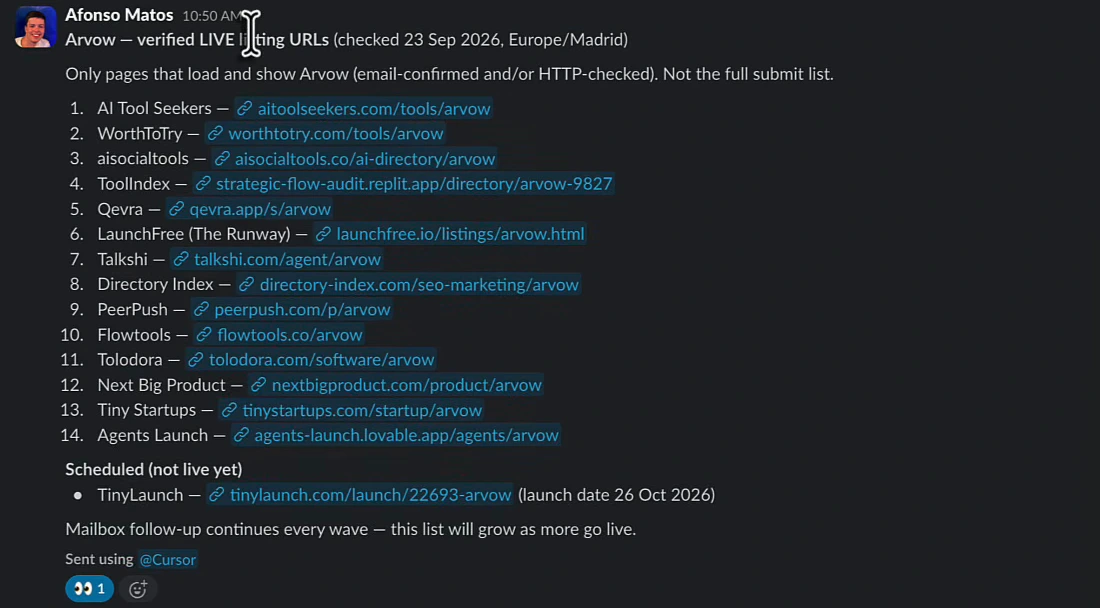
This is the report from 23 September 2026, listing only pages that load and show Arvow, confirmed by email and/or an HTTP check. Fourteen listings were verified live, with one more scheduled for a launch date in October:
The digests show the rate behind that list, and it's the most useful number in the video. The early-morning digest counts 50 new hard submissions, five newly live, and 81 still waiting on a confirmation, OTP or form gate. Six hours later: 41 more submissions, five more live, and a running total of roughly 442 submitted against about 36 live.
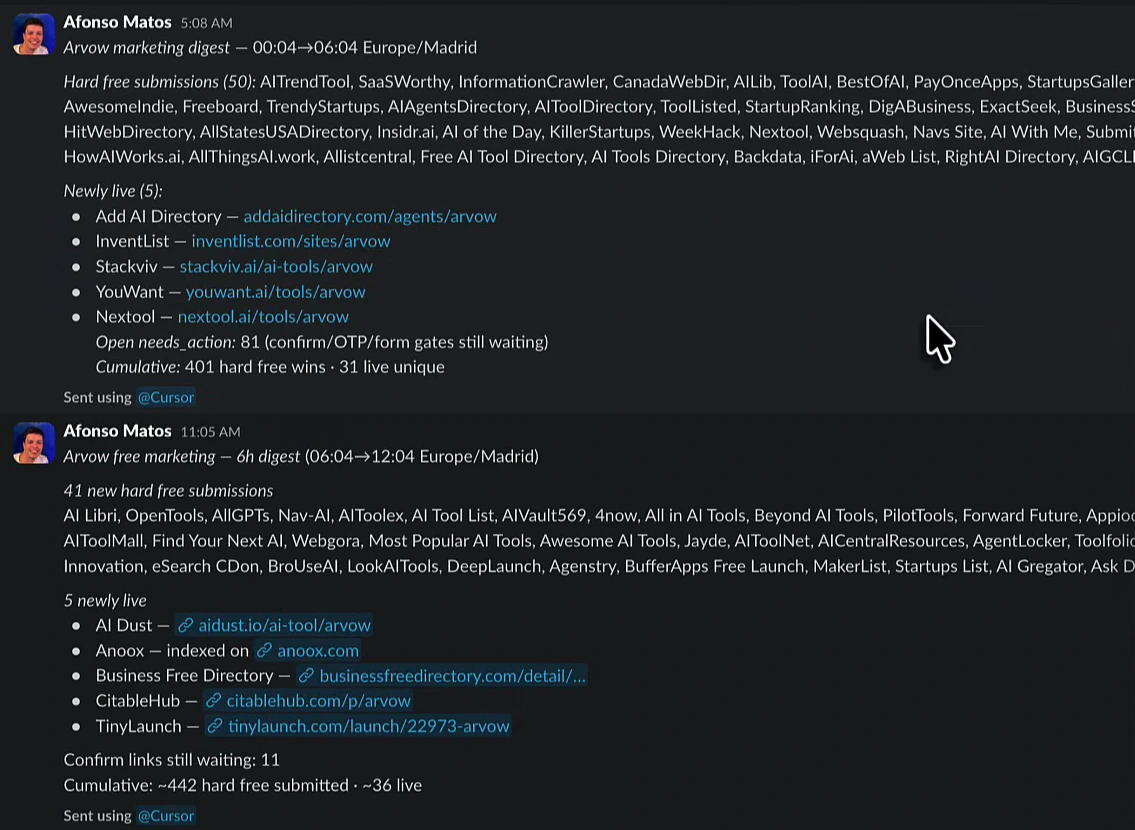
That's the real shape of directory link building. Most submissions never become a live, indexed page: they sit in moderation, need a confirmation step, or quietly die. A human would face the same ratio; the agent just doesn't mind doing 442 submissions to get 36 listings, and it logs every one.
The $295 Fiverr gig it replaces
Before building the bot, I paid for exactly this service on Fiverr. The gig: "I will manually submit your AI tool or SaaS product to 300 AI directories". Premium tier, 300+ listings, $295, 7-day delivery, from a seller with a 4.9 rating and 178 completed orders. It was delivered on 1 May 2026.
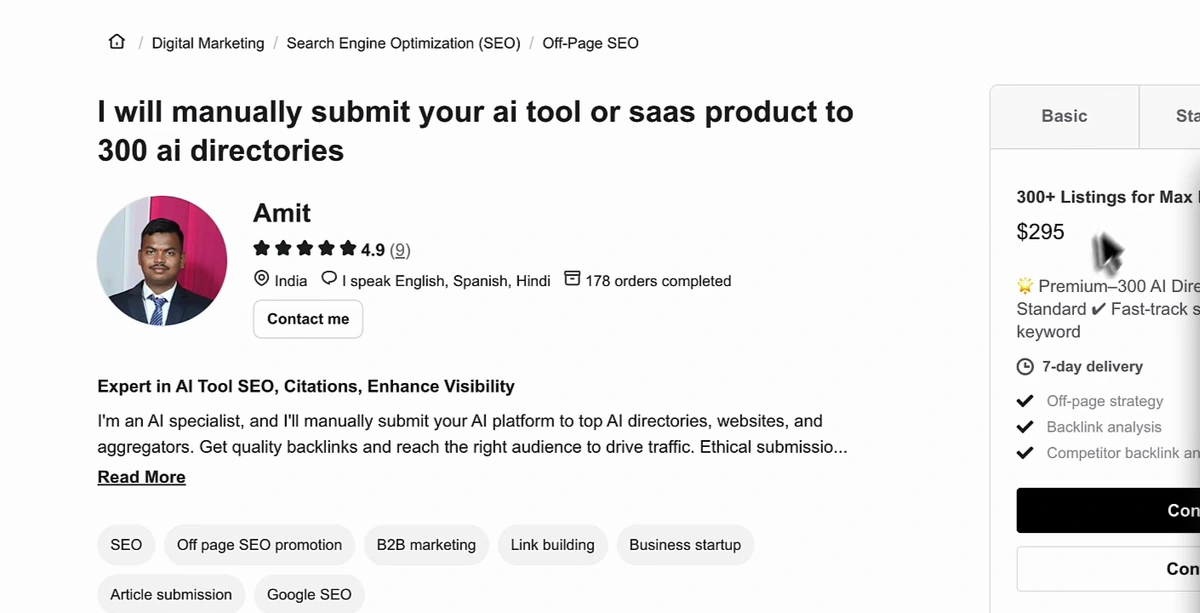
The listings the agent builds are the same type of link that gig delivers. That's the whole argument of the video title. In the video I'm also candid about the other half: a lot of what that gig delivered, "like 90%", was low value. $295 felt acceptable at the time. Now that the agent does the same work continuously, there's no reason to pay for it again. If you're weighing Fiverr link sellers generally, we tested three approaches in Fiverr backlinks: are they worth it?
Check every link it reports: DR is not the whole story
When the agent posts a new link, open it in Ahrefs before celebrating. The video does this for several of them, and the numbers tell a more careful story than "DR 76 backlink".
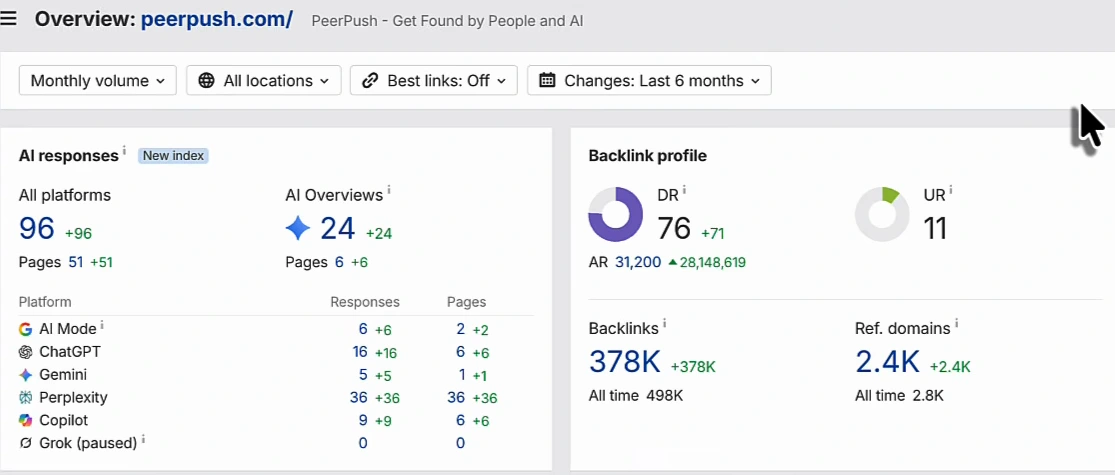
- PeerPush shows DR 76, but the change column says +71 in the last six months, with 378K backlinks from 2.4K referring domains. That's a young site that built its authority fast, averaging well over 100 links per referring domain. It does have real signals: 96 AI-platform responses and 115 organic keywords, with organic traffic of 1.9K shown at the edge of the frame. Useful listing, not a DR 76 editorial link.
- LaunchFree shows DR 40, 8K backlinks from 42 referring domains, all added in six months, and 30 organic visits.
- AI Dust shows DR 0.2. I call that one "kind of trash" on camera, and that's fair.
The best example of why you check is the listing I describe as "DR 90 or something":
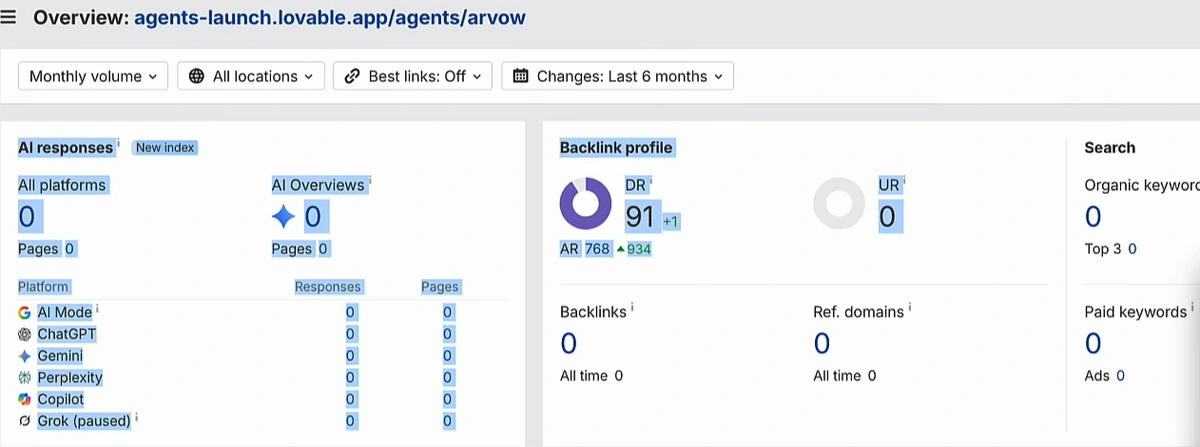
The listing lives on a directory someone built as an app on lovable.app. The DR 91 is lovable.app's, the platform's domain rating, inherited by every app hosted on it. The page linking to Arvow has UR 0, zero backlinks and zero referring domains. It's a real listing, but it isn't a DR 91 link in any sense that moves rankings. As I say about it in the video: "I don't think this one is very valuable."
The rule for reading an agent's reports: look at the linking page's UR and the site's organic traffic, not the domain's DR. DR on a new directory, or on a platform subdomain, tells you very little. We cover the trade-off properly in backlink quality vs quantity.
Where directory links fit, and where the agent stops
Directory and launch-site listings are a foundation layer: they make the brand discoverable and add referring domains, and some are places buyers and AI assistants actually look. They don't win competitive rankings.
What does is niche edits and guest posts on real sites with real traffic, and that's the part I say plainly in the video we still can't automate. The done-for-you service on Arvow's build-backlinks page sources DR 40 to 70 domains with at least 1,000 organic visits a month, and it's done by hand because it depends on relationships with site owners. That's why delivery takes around 14 days. On screen the packages start at 3 niche-edit backlinks for $490.
The next step I want from the agent is exactly that tier: hand it the step-by-step SOPs for niche edits and guest posts and let it run them for 24 hours a day. That isn't working yet. For a look at where AI prospecting helps on the high-quality side today, see AI backlinks: automated agents vs Claude Code, which covers using an AI to find placements rather than to place them.
Three ways to automate backlinks
The video closes with three options, in order of how much control you hand over:
| Option | What it builds | Control | What you manage |
|---|---|---|---|
| Your own AI agent (Grok Bot, as above) | Whatever you instruct: here, directory and launch-site listings | A bit of a wild west. It can do anything you let it. | The brief, its email, its link standards, checking what it reports |
| Arvow automatic backlinks | Contextual links placed inside articles published by other users on the network | More contained: preference, volume and filters are settings | A few toggles |
| Done-for-you manual links | Niche edits and guest posts on DR 40-70 sites with 1,000+ monthly traffic | Handled by a team | Choosing URLs and anchor text |
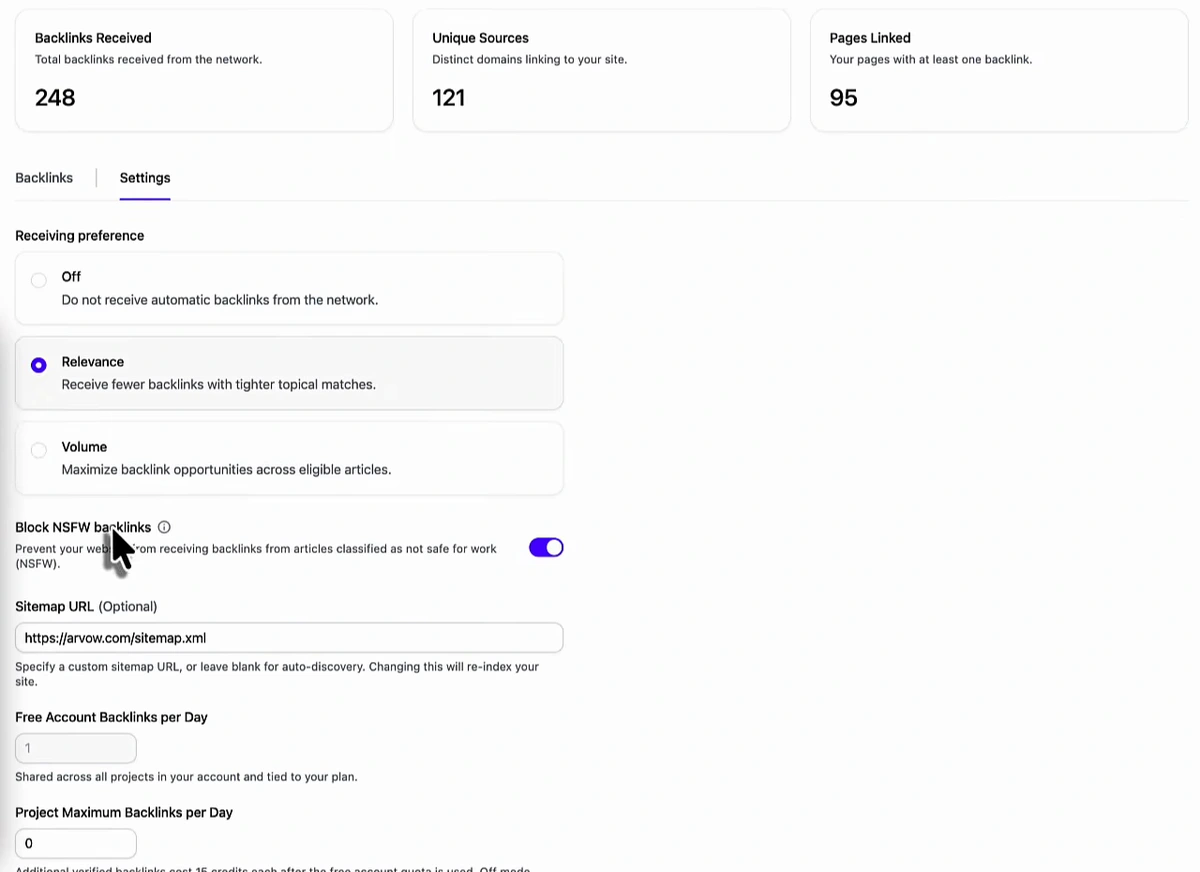
The contained option is the Automatic Backlinks feature inside the Arvow dashboard. On the account shown in the video it has received 248 backlinks from 121 unique sources, pointing at 95 different pages on the site:
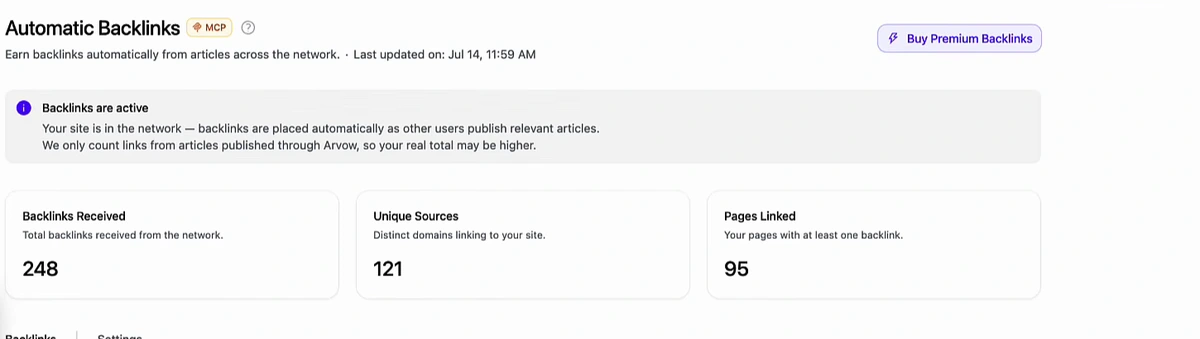
The linking domains are blurred in the video. In the DR column, I read out a spread from DR 1 and DR 10 up to DR 43, 47 and 63. The settings tab is where the "contained" part comes from:
How that network works, and how it differs from a classic link exchange, is covered on the automatic backlink exchange page.
Guardrails if you run your own agent
- Pick "white-hat only" first. Upgrade to "selective paid" only once you trust its judgement, and keep the rule that it flags costs before spending.
- Give it a disposable identity. A dedicated inbox and a unique password, nothing shared with your real accounts.
- Set priority URLs. Otherwise everything points at the homepage.
- Make it verify, not just submit. The useful report is the "verified live" one: pages that load and show your brand. The raw submission count is vanity.
- Spot-check in Ahrefs. UR of the linking page and organic traffic of the site, every time a "big DR" link shows up.
- Keep expectations on timing. Even real links take weeks to show up in rankings; how long backlinks take to work has the timelines from real orders.
The bigger point isn't directories: agents that do tasks on their own machine, on a schedule, can now take over repetitive SEO work. Link submission is just the first job we gave one, the same shift described in agentic SEO.
FAQ
What is an AI backlink agent?
An AI assistant that can act on the web, not just chat: it finds link opportunities, submits your site, confirms sign-ups by email, checks which links are live and reports back. The one in this article runs on its own computer, so it keeps working when your laptop is closed.
Can an AI agent build high-quality backlinks?
Not yet, in our experience. It reliably builds directory and launch-site listings. Niche edits and guest posts on real, high-traffic sites depend on relationships and judgement, and we still do those manually.
How many submissions turn into live links?
In the digests shown, about 36 of roughly 442 submissions were live, around one in twelve, with dozens more waiting on confirmation steps. Expect most submissions not to become live pages.
Want backlinks without running your own agent? Turn on automatic backlinks, or have the team place niche edits and guest posts for you. See Arvow's backlink options.
Generate, publish, syndicate and update articles automatically
The AI SEO Writer that Auto-Publishes to your Blog
- Cancel anytime
- Articles in 30 secs
- Plagiarism Free