
Local SEO for AI Overviews: How to Get a Local Business Recommended by Google's AI (2026)

Search "plumber miami" in Google's AI Mode and you do not get ten blue links. You get a paragraph that says it has "curated a list of the top-rated local professionals based on response times, customer trust, and specific plumbing needs", one named plumber with a reason, and a side panel with three more. Every local business that is not in that answer is invisible to the people who read it. Tim The SEO Guru's video opens on that result, picks a Miami plumber with good reviews that did not make the cut, and audits its website line by line to show what AI Overviews and AI Mode need from a local site. This article is that audit, re-checked against the live pages on 1 November 2026.
What AI Mode actually shows for "plumber miami"
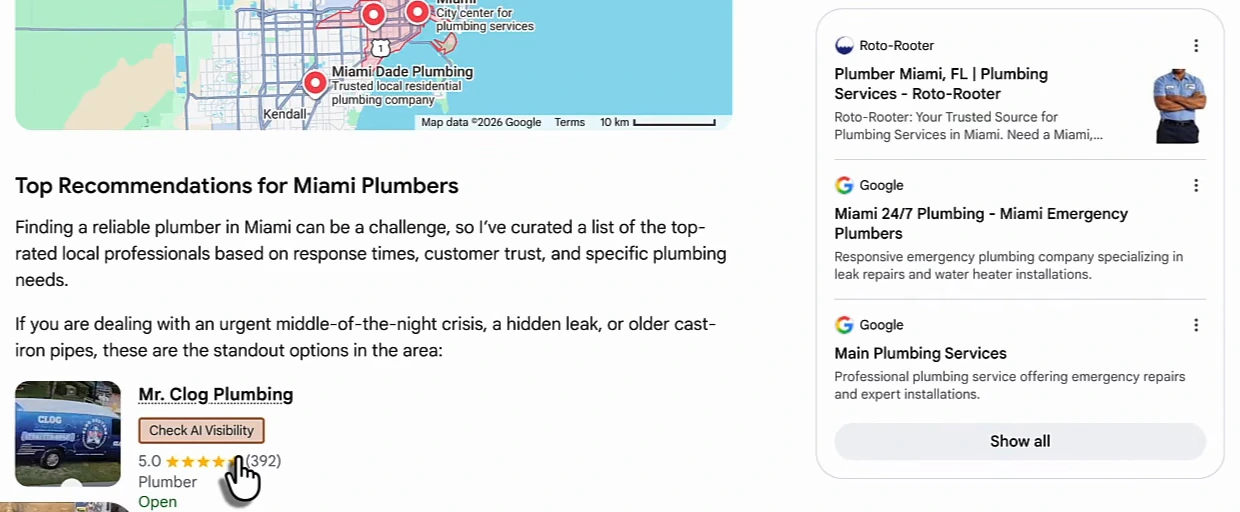
The answer frames the whole video. AI Mode does not list the ten nearest plumbers; it picks a handful and explains each pick. Its first pick, Mr. Clog Plumbing (5.0 stars, 392 reviews), is recommended "for immediate local emergency" because reviewers describe a technician arriving at three in the morning, stabilising the problem and returning the next day for the full repair, and because the business offers camera inspections for root intrusions. That reasoning comes from review text and from service detail, not from a star count.
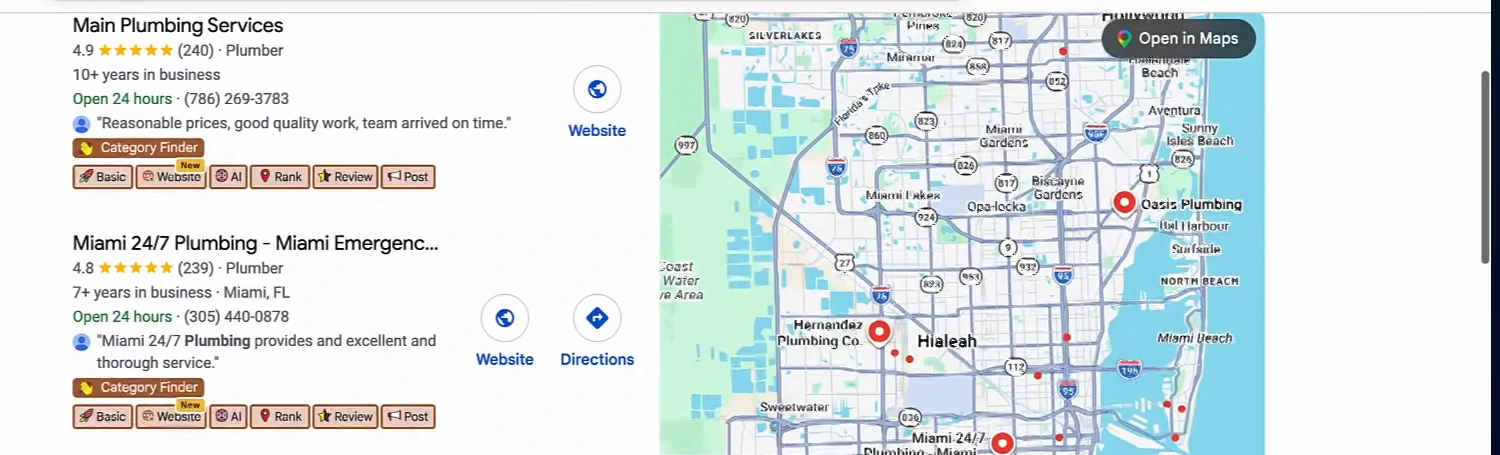
Tim then opens the Maps list, scrolls past the businesses with 240 and 239 reviews, and picks one further down: Coastal Plumbing of Brickell, a licensed Miami plumber whose own homepage shows a 5.0 rating from 70 reviews, 24/7 emergency service and a Florida licence number. Good reviews, a real licence, and still not in the AI answer; the profile and the website together decide who gets featured, and the website is usually the weaker half.
The structure that has to exist first
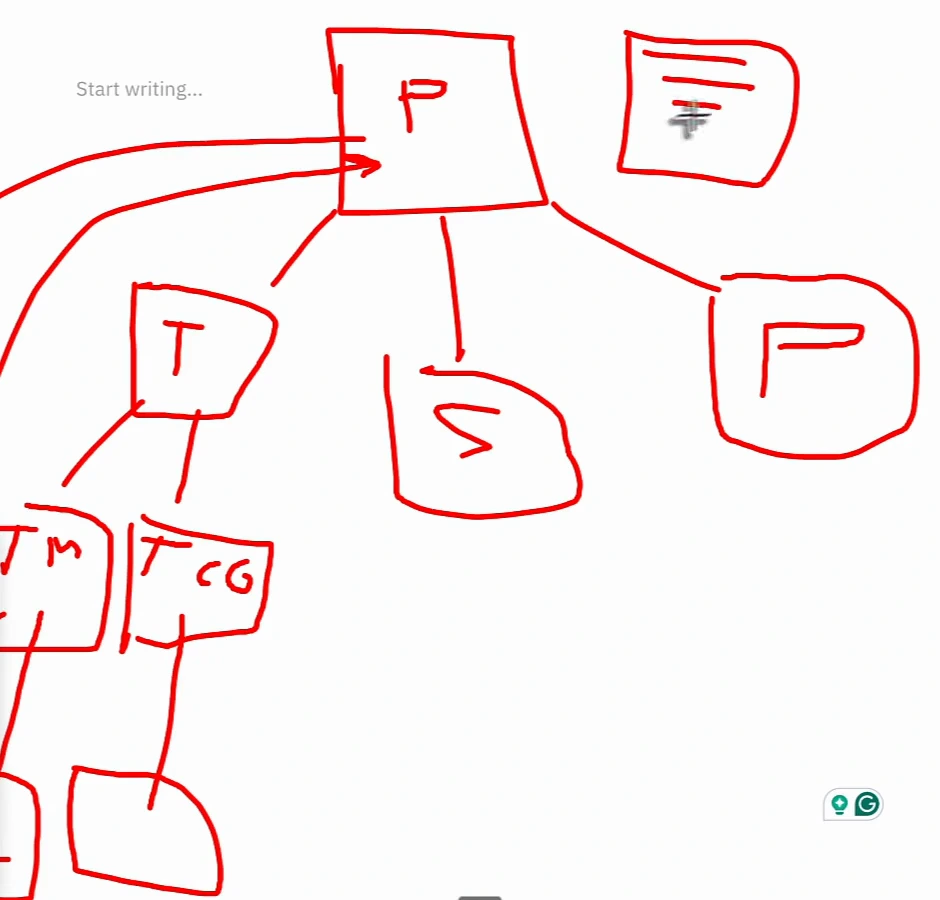
Before the audit, Tim draws the minimum structure on a whiteboard. The homepage links to a page for every service. Each service page links to a page for every service-and-location pair, and the location version has to be rewritten, not the Miami page with "Coral Gables" swapped in. Blog posts then feature those services in those places and link to the service pages, which link back to the posts and to the homepage. His complaint is that many local sites still have a homepage and one page listing every service, which gives AI nothing specific to cite. We covered how to build the city layer at scale in location pages SEO, and the no-storefront version in service area business SEO.
The competitor swap test

The rule Tim applies to every sentence is simple: if a competitor could paste it onto their own site unchanged, it is not good enough to get you featured. The page has to explain why this business is the right fit for this area, in terms no rival can claim.
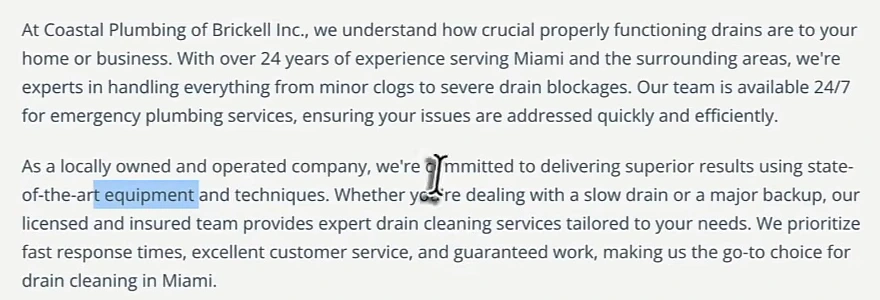
"With over 24 years of experience serving Miami" passes: not everyone can say it. "Available 24/7" passes, though many competitors can say it too. Then the second paragraph arrives: "superior results using state-of-the-art equipment and techniques", "licensed and insured", "fast response times, excellent customer service, and guaranteed work". Tim's reaction to the equipment line is the heart of the video: what equipment? Everyone says state-of-the-art; name the machine. Everyone is licensed and insured; that is the floor, not a differentiator. Guaranteed work: what is the guarantee, and for how long? He also wants the H1 to carry the city. The page is titled "Drain Cleaning Services"; a Miami service page should say "Drain Cleaning Services Miami".
We opened the same page on 1 November 2026, the day after the video went up. Every sentence he reads is still there, word for word, so the audit still applies.
Replace the claim with the proof
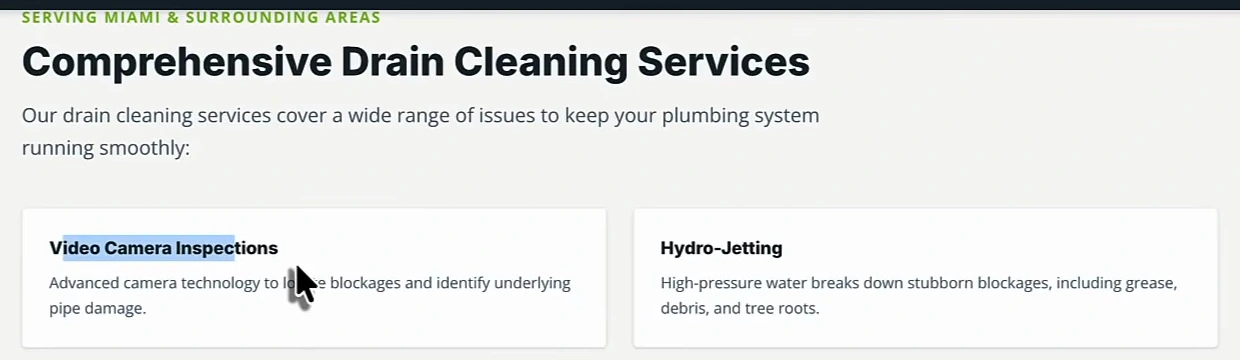
The services section is better than the intro, because it names methods: video camera inspections, hydro-jetting, clog removal, kitchen and bathroom drains, sewer line cleaning. Tim's push is to go one level deeper on each. Say what the camera is and what resolution it records at. Say what the hydro-jetting rig is. That detail is what an AI answer can quote when someone asks about a specific problem.
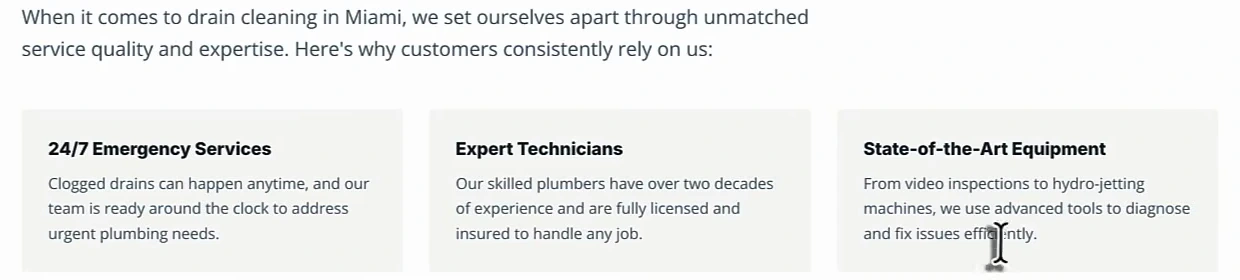
The six "why choose us" cards repeat the intro's claims in a grid: 24/7, expert technicians with "over two decades of experience", state-of-the-art equipment, guaranteed work with "warranties on all completed drain cleaning jobs", local knowledge of "Miami's unique plumbing challenges", and transparent pricing. Tim's test fails most of them for the same reason, and his aside about experience applies: he hired a carpenter with five years of experience who turned out to be no good. Years in business do not prove quality. Certifications, training, union membership and named technicians do. The table below is the rewrite he is asking for.
| What the page says | Why it fails the swap test | What to write instead |
|---|---|---|
| State-of-the-art equipment | Any competitor can claim it | The camera system and jetter you actually run, with the specs |
| Fully licensed and insured | Every legal plumber is | Keep the licence number, add the certifications and training behind it |
| Over two decades of experience | Experience is not evidence of quality | Named technicians, what they are certified in, how many drain jobs a year |
| Guaranteed work | Undefined | What is guaranteed, for how long, what the customer gets if it fails |
| Local knowledge of Miami's challenges | Says nothing about Miami | The housing stock, pipe materials and neighbourhoods you deal with |
| Affordable and transparent pricing | Unverifiable | Prices, or a price range per job type |
Credentials, reviews, landmarks and the question format
After the swap test, Tim lists what should be on the page in its place. Credentials and expertise, in detail. Reviews near the top of the page, with quotes from them in the body copy. Area-specific landmarks where they fit: knowing the Miami highways, having routes that get a van across the city fast, anything that proves a local presence rather than asserting one. And the basics that most local pages skip: what the service is, who it is for, why it is right for them, the use cases, the problems it solves.
The format he spends the most time on is question and answer. Part of every page should be structured as the questions customers actually ask, each followed by a plain answer, because that is the easiest thing for an AI to lift. His example: "How long does drain cleaning take?" answered with "On average our customers receive service in less than an hour." Ask an assistant for a plumber who can clear a drain today in under an hour, and the business with that sentence on its page is the one that gets named. The rest of the on-page guidance for AI features is in how to rank in Google AI Overviews; the local Q&A version is the piece most plumbing sites are missing.
What we found when we opened the city pages
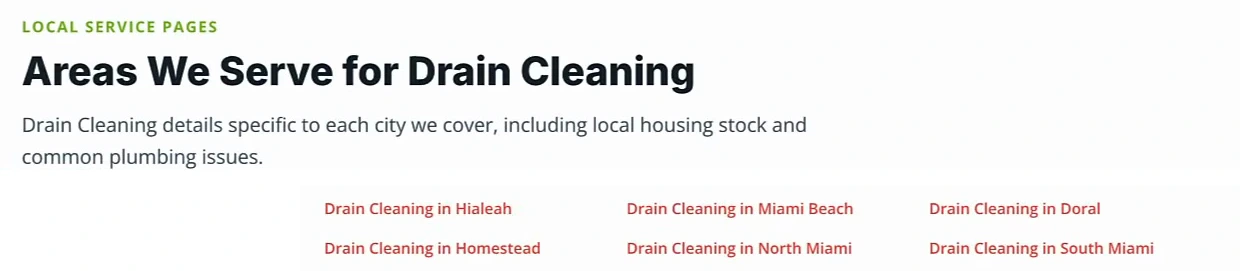
The drain cleaning page ends with links to eight city pages (Miami, Hialeah, Miami Beach, Doral, Kendall, Homestead, North Miami, South Miami), and Tim gives the site credit for that. He opens the Doral page for a few seconds, says the pages need more detail, and moves on. Read in full, it is more specific than the service page it hangs off.
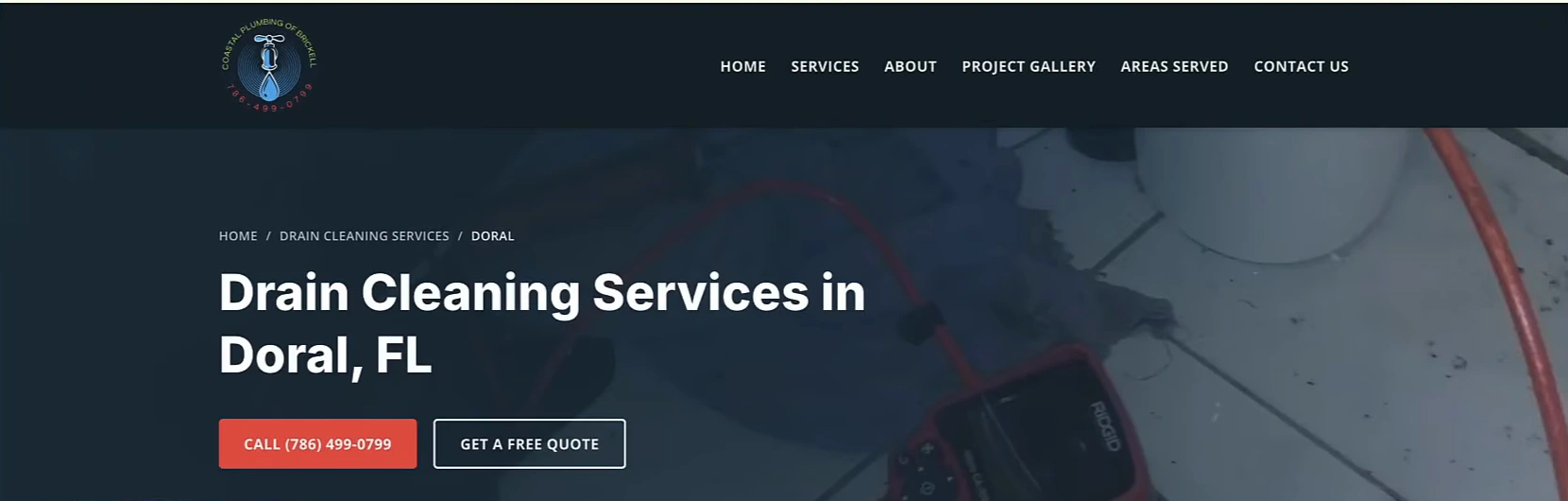
Below the hero, the Doral page says the city was built out largely since the 1990s and 2000s, that most homes use PVC and CPVC rather than the older metal pipe in Miami's historic neighbourhoods, and that the most common Doral problem is sourcing parts for imported and designer fixtures. It carries a "last updated: September 2026" line, a licence number and an FAQ. That paragraph passes the swap test. The weakness is what comes after it. The same five service cards and the same six "why choose us" cards from the Miami page are pasted in unchanged, so a 670-word city page is about a quarter city-specific and three quarters template. Each city page needs its own proof and its own questions, not the parent page's grid. The swap test applies between your own pages as much as between you and a rival.
What the video does not show
- No before-and-after. The video audits a site and explains the principle; it does not rewrite the page and show it entering the AI Mode answer.
- The AI answer leans on reviews as much as on site copy. AI Mode's reason for its first pick is a reviewer's story about a 3 a.m. call-out. The website work here is half of the job; the review and profile half is in local GEO and Google Business Profile for AI search.
- The search is a broad one. "Plumber miami" is the head term. The service-and-location pages in Tim's sketch exist to win the narrower searches ("drain cleaning doral", "toilet repair coral gables") where a small business can realistically be the named answer.
- The last four minutes are a product tour. From 9:54 Tim walks through Arvow's knowledge base, article generation, keyword planner, Google Business Profile posting and review replies, automatic backlinks, site optimizer, LLM brand monitor and site explorer. Those features are covered one by one in AI agents for SEO.
Running the audit on your own site
- Search your main service plus your city in AI Mode and in Maps. Note who is named in the AI answer and what reason it gives for each pick.
- Check the structure: a page per service, a page per service and city, and blog posts that link to both. If every service lives on one page, fix that before touching copy.
- Read each service page aloud and strike every sentence a competitor could reuse: state-of-the-art, licensed and insured, expert technicians, guaranteed work, transparent pricing.
- Replace each struck sentence with proof: the equipment by name, the certifications, the guarantee terms, the price range, the neighbourhoods and housing stock you work in.
- Move reviews up the page and quote them in the body. Add an owner or team section with real names.
- Add a question-and-answer block built from the questions customers phone in with, each answered in one specific sentence.
- Do the same on every city page, and make sure the city pages do not share their proof section with the parent.
- Put the city in the H1 of the service page, and re-run the AI Mode search in 30 days.
If you are writing these pages for more than a few services and cities, the brief for each one is the table above: proof, not claims, and nothing a competitor could have written.
FAQ
Is local SEO for AI Overviews different from ordinary local SEO?
The inputs are the same (profile, reviews, pages), but AI answers name a few businesses and explain why, so pages that only assert quality lose to pages that show specifics an answer can quote.
Does a service page need the city in its H1?
Tim's recommendation is yes for the main service page ("Drain Cleaning Services Miami") and a separate page per additional city. The audited site has the city pages but keeps the parent H1 generic.
Will question-and-answer sections really get quoted by AI?
They are the format most easily lifted into a generated answer, because the question matches the way people ask assistants and the answer is a single quotable sentence. Write the questions customers actually ask, not the ones you wish they asked.
Need service and city pages that carry real proof instead of template claims? Arvow's AutoBlog writes from your knowledge base, so the equipment, guarantees and service areas on every page are yours.
Generate, publish, syndicate and update articles automatically
The AI SEO Writer that Auto-Publishes to your Blog
- Cancel anytime
- Articles in 30 secs
- Plagiarism Free