
Local GEO: How to Get AI to Recommend Your Local Business (2026)


Local GEO (generative engine optimization for local businesses) is the work of getting AI search to name your business when someone asks it for a mover, a plumber or a lawyer near them. More of those searches now end in an AI answer rather than a list of blue links: Google opens AI Mode on its own, or people type the whole problem into ChatGPT. Whoever the answer names first gets the call.
The good news is that AI has to build that answer out of something, and for a local business most of the raw material is public and under your control. In the video below I go through the five things I'd do to give AI more of it. This article is the written version, with the screens from the video and links to our deeper guides on each lever.
The five levers on one board
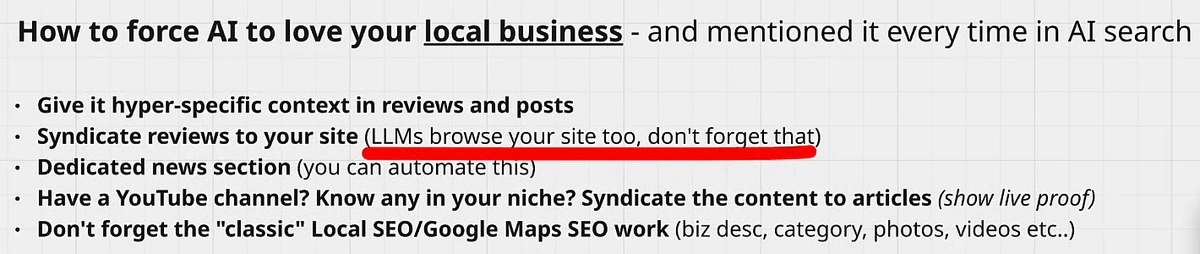
One idea runs through all five: AI recommends the business it has the most relevant context about. When it researches "movers in NYC" it reads your listing, your competitors' listings, the reviews and owner replies on all of them, and your website. Every lever below adds context to one of those places.
What local GEO is up against: the hyper-specific prompt
People don't type "NYC movers" into an AI. They type the whole situation. In the video I ask Google's AI Mode for "nyc movers for college student moving in", and the answer is built around details a short keyword would never surface:
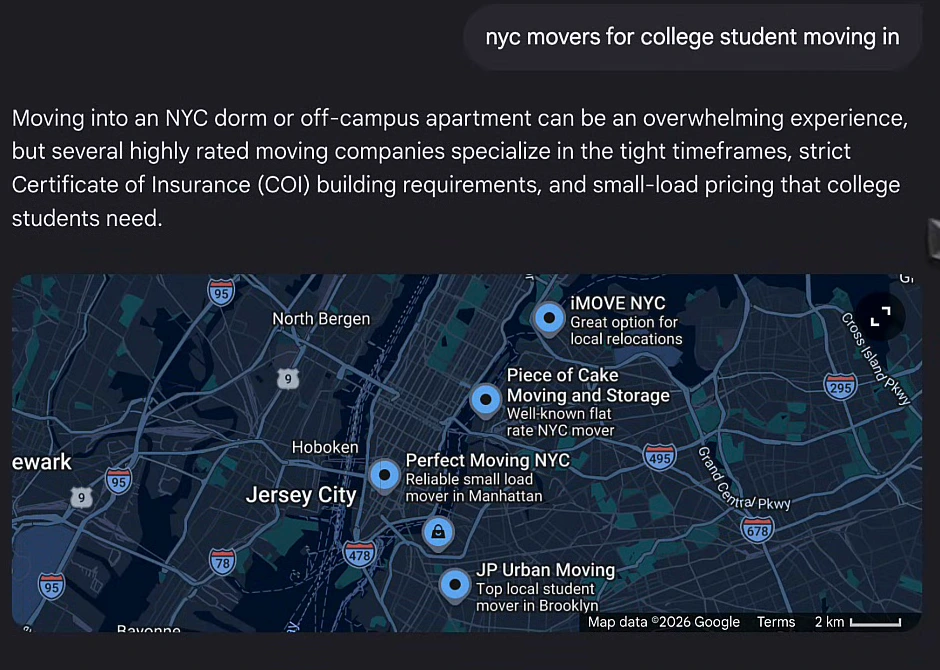
Tight timeframes, Certificate of Insurance (COI) requirements, small-load pricing: the answer matches the prompt's specifics, and each mover on the map comes with a one-line reason. Those reasons have to come from somewhere. Your job in local GEO is to make sure the specifics about your business exist in places AI reads.
1. Give AI hyper-specific context in your review replies
This is the lever I'd start with. Most owners reply to reviews with "Thanks!" or with a long, polite paragraph that says nothing. Here's a real example from a top-rated NYC mover, with my rewrite on top in red:
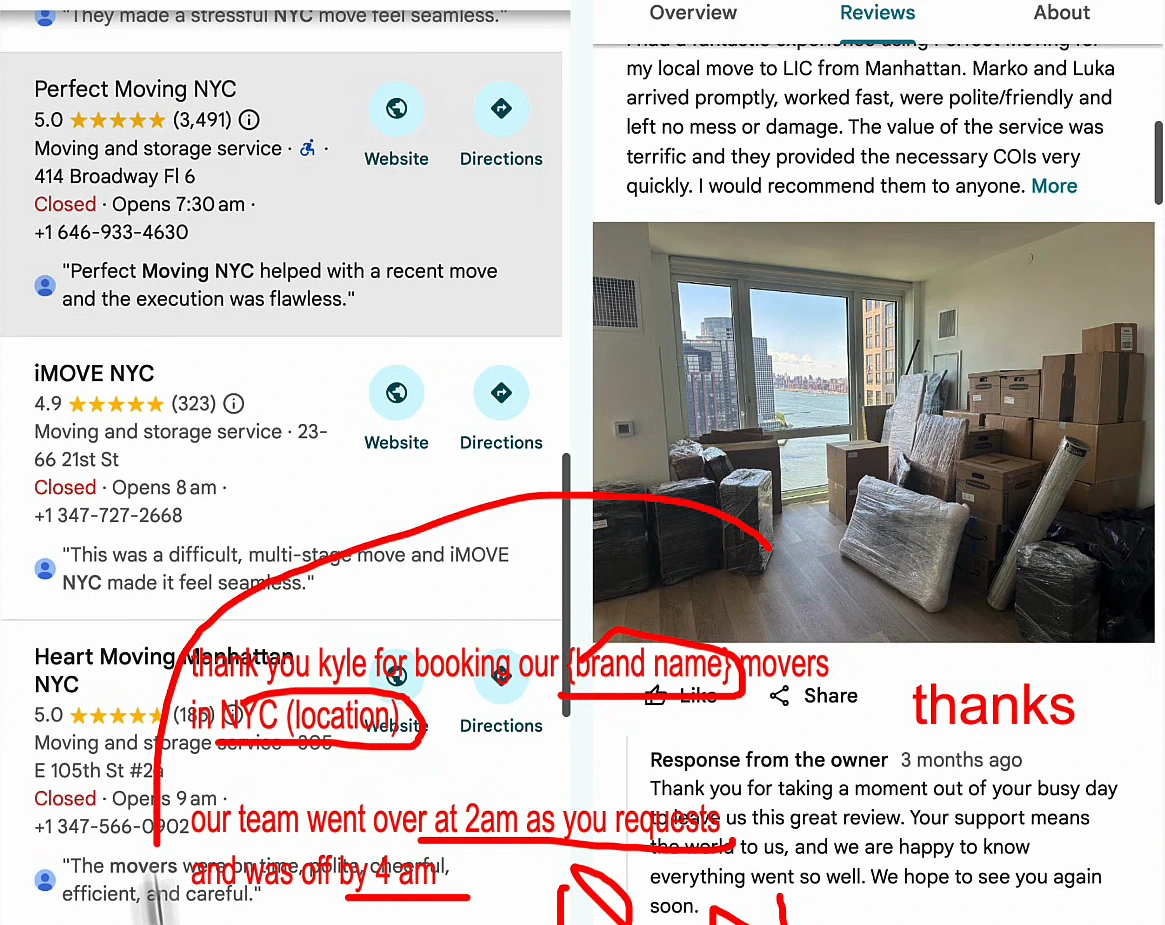
The customer's review mentions a move from Manhattan to Long Island City, the movers' names and the COI paperwork. The owner's reply thanks them for "taking a moment out of your busy day" and adds nothing. In terms of what an AI can learn from it, that reply is as empty as "thanks".
Now picture the rewrite: Thank you Kyle for booking [brand] movers in NYC. Our team went over at 2am as you requested and was done by 4am. Someone asks an AI at 2am which movers can do a same-night job in New York. The business whose replies say "2am", "NYC" and "done in two hours" has given the AI a reason to name it.
Proof that Google reads review text for intent
You can already see this on Google Maps without any AI. Search "plumber dallas for toilet" and look at the snippet under each listing:
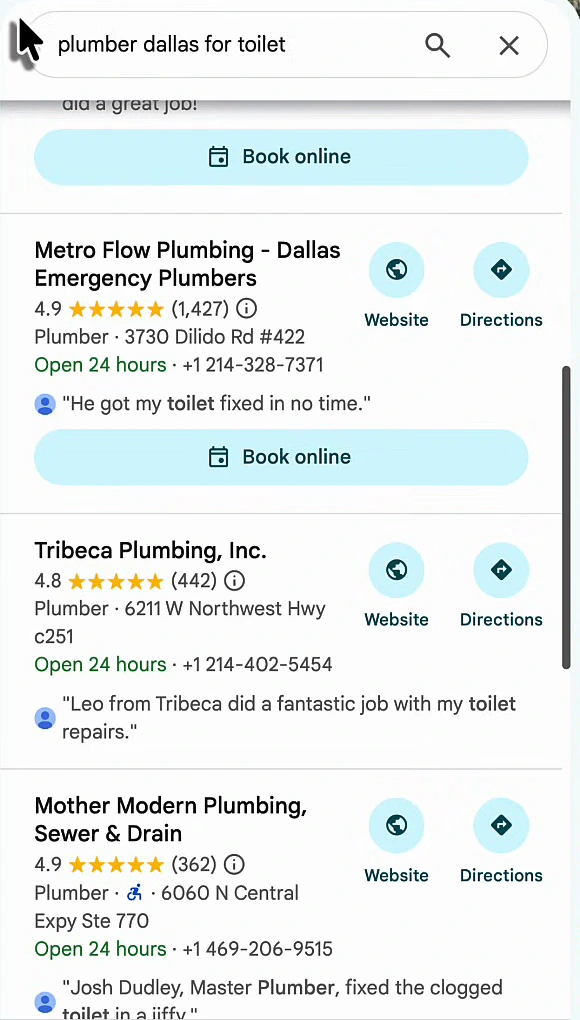
Every listing on that screen shows a review line that mentions a toilet, with the word in bold. Google is matching the query's intent to the text of the reviews. AI answers work from the same material, plus your replies, which are the part you fully control.
Here's what a reply with context looks like, from the top result in that same search:
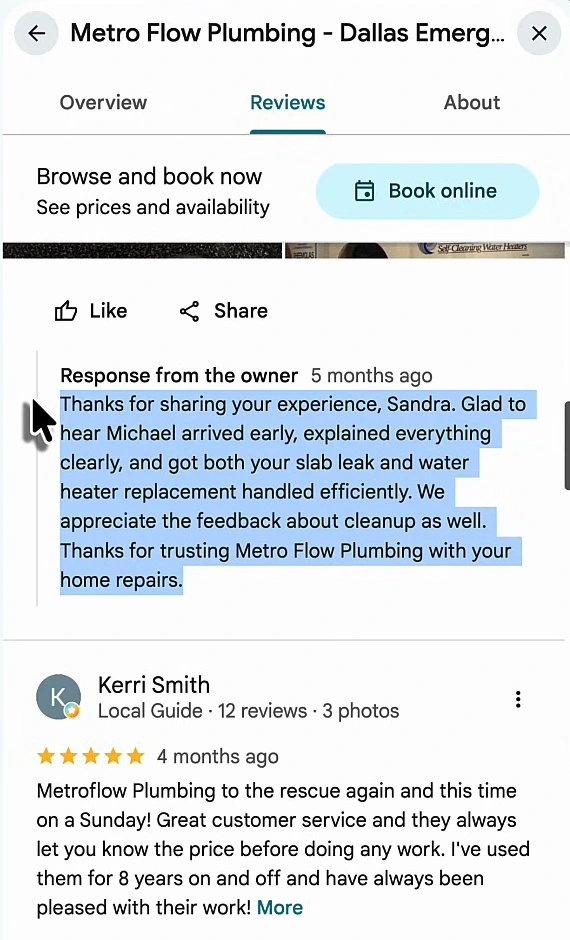
Technician's name, punctuality, two named services, the brand. That's the pattern: location, service done, time, price if relevant, how it went. Anything a future customer might type into a prompt. For the ranking side of reviews (count, velocity, keywords), see Google reviews SEO.
Automating the replies without making them generic
Writing replies like that by hand, every day, is where most owners give up. In the video I show Arvow's Google review automation as one way to do it. The parts worth copying, whatever tool you use, are the rules:
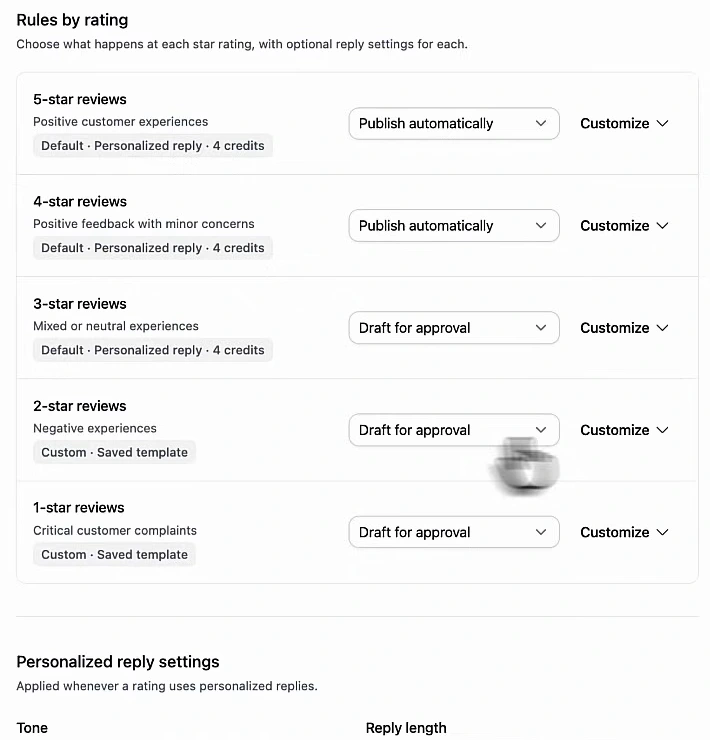
- Different handling per star rating. In the demo, 5- and 4-star reviews publish automatically; 3, 2 and 1 stars are drafted for approval.
- Tone, length and delay. The demo uses a friendly tone, two to three sentences, matched to the review's language, posted six hours after the review arrives.
- Safeguards. Reviews mentioning words like refund, legal, fraud, injury or discrimination are always held for approval.
You can also set everything to draft and just approve or edit. Whether you automate it, do it yourself or hire someone, the point is the same: every reply should add context. We go through the full setup in Google Business Profile automation.
2. Put the same context in your Google Business Profile posts
A Google Business Profile is a living entity. Reviews, replies, photos, videos and posts are how it shows Google it's active, and active listings tend to do better on Maps. Posts are also more text AI can read. Metro Flow, the plumber above, posts with images and a paragraph of context:
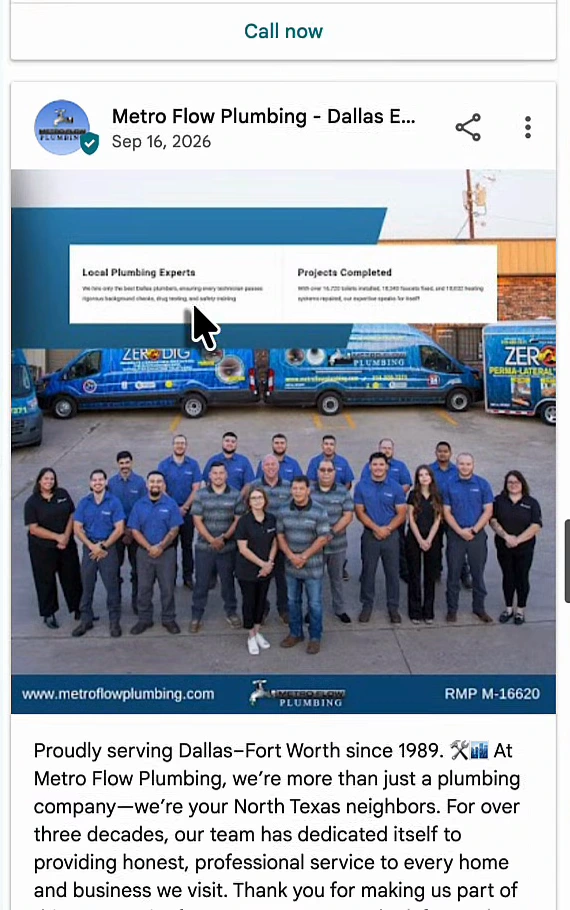
Posts can carry far more than "we're open": before-and-after jobs, seasonal offers, the neighbourhoods you covered this week, or, for a lawyer, anonymised case outcomes in the practice areas you want to be known for.
The same automation logic applies. Arvow's GBP posts automation drafts update, event and offer posts from your business information and can publish them on a schedule (weekly in the demo), with an optional AI image. Keep the content specific, and review it before it goes live if you're unsure.
3. Syndicate your reviews onto your own website
AI doesn't only read your listing. It browses your website too. If your best reviews live only on Google, a model reading your site sees a business with nothing to show for itself.
The example I use is Tempo Air, a Dallas–Fort Worth HVAC and plumbing company with over 2,000 Google reviews. It has a /reviews page, which is a good start, but here's what's on it:
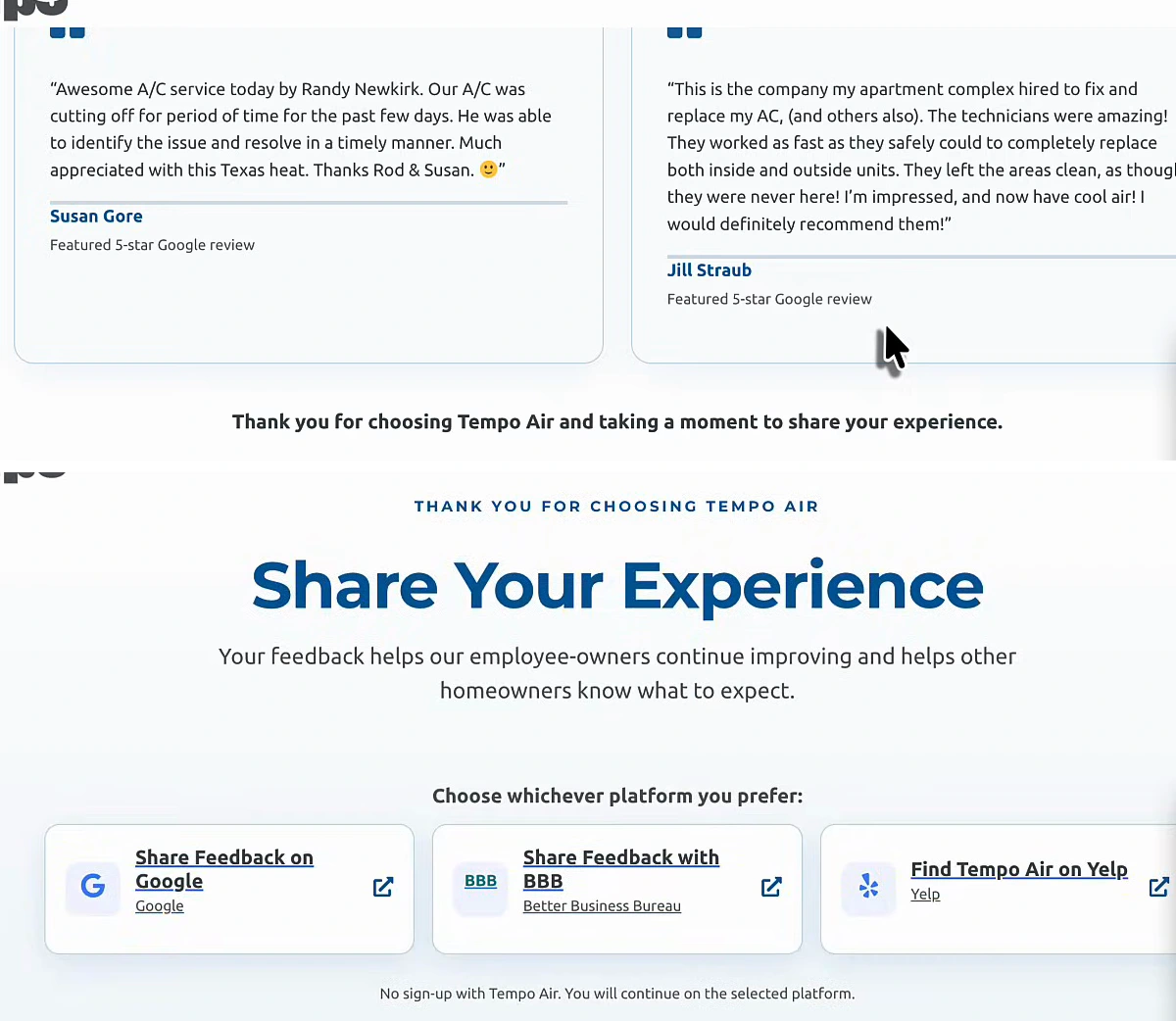
Two featured reviews and links out to the platforms. For a customer that's fine. For an AI building a picture of the business, it's thin: thousands of reviews exist, but almost none of their text is on the site. Put a real wall of reviews there, with the full text, ideally pulled in automatically by a plugin or a scheduled sync. The more of your customers' specifics live on your own domain, the more context an AI has when it reads you.
4. Run a news section for your niche
This one works for local businesses, e-commerce and agencies alike. In the video I show Teslarati, which runs Tesla news alongside a shop selling Tesla accessories, with shop links right next to the stories. Who reads Tesla news? People who own one or want one, which are exactly the people who buy accessories.
The local version: a plumber or dentist with a "News" link in the menu or footer, a lawyer covering new laws in their practice area, an accountant covering IRS and tax changes. The readers are people with that problem, and the section keeps adding fresh, topical pages to your site for AI and Google to read.
You don't have to write it by hand. Arvow's AutoBlog can run a recurring news feed for any topic:
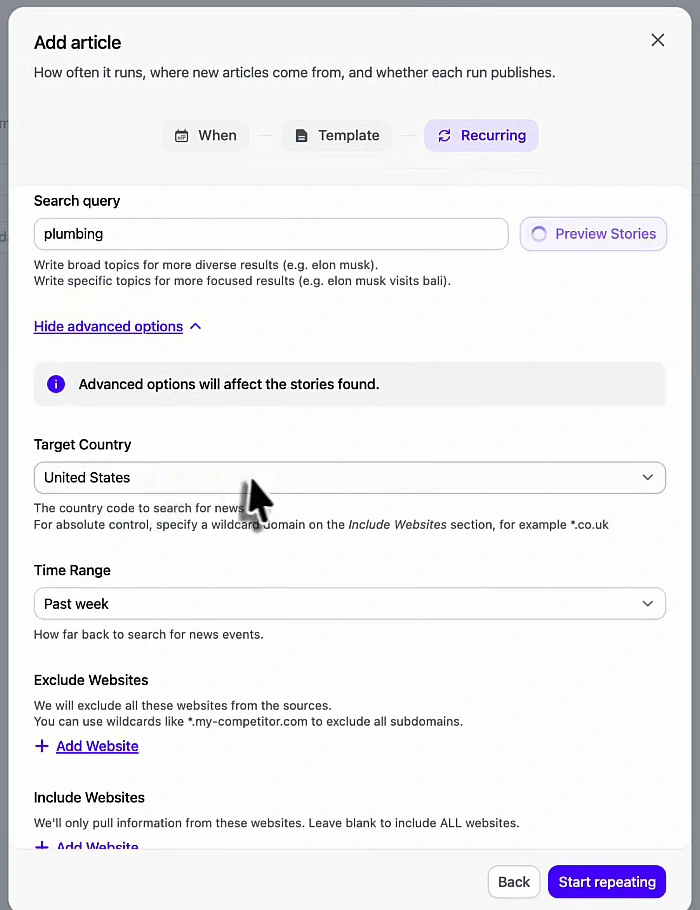
You set a topic (plumbing, in the demo), a target country and a time range, and you can exclude or include specific sources. It finds the latest stories in your niche, writes an original piece from them and publishes it to a dedicated section on a schedule. We cover this strategy in more depth in how to add an automated news section to your website, and it's lever 1 in how to rank #1 on Google and AI search.
5. Turn videos into articles
If you have a YouTube channel, every video is content your website is missing. Tempo Air is a good example of a local business already making videos:
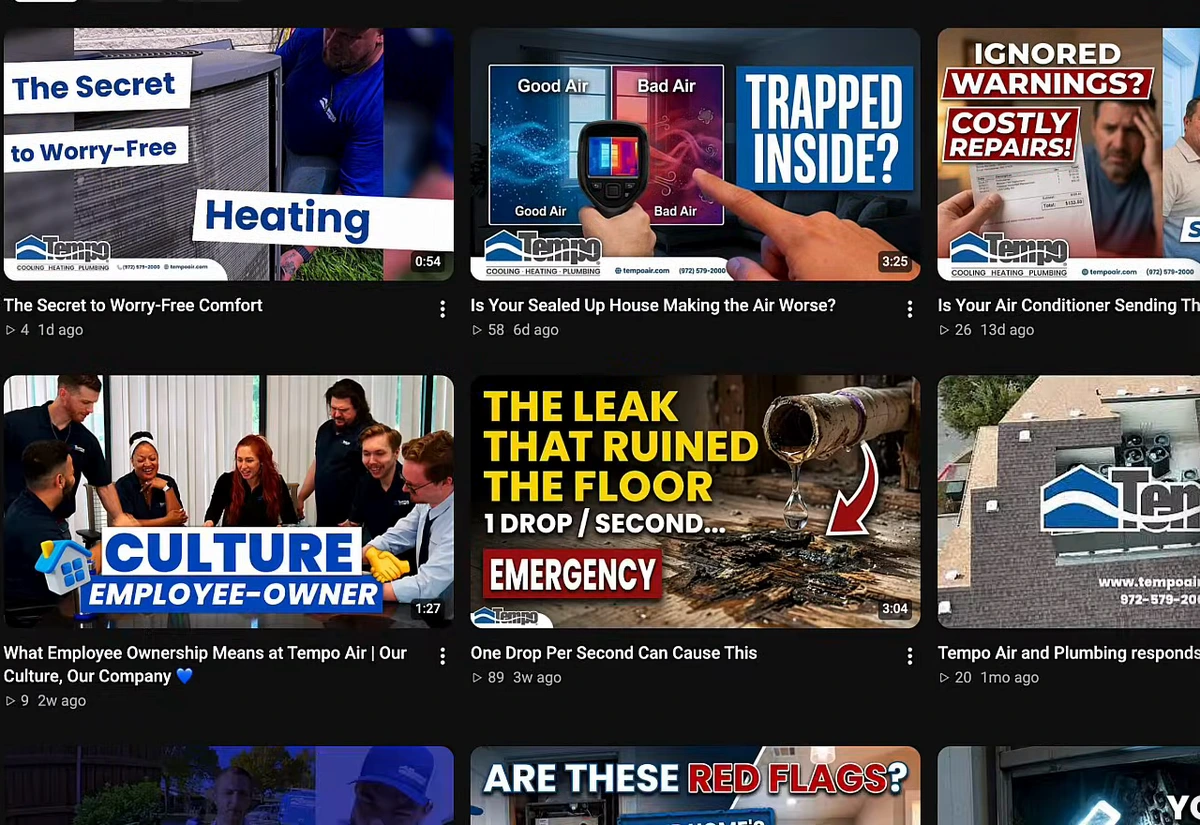
It's rare for plumbers and HVAC companies to have a channel at all, and these are good topics: indoor air quality, warning signs, a leak that "ruined the floor". But look at the view counts: single and double digits. As videos, most of that knowledge reaches almost nobody. As articles on tempoair.com, the same knowledge becomes pages that can rank on Google and be read by AI when someone asks about a sealed-up house making the air worse.
We do this ourselves: videos from this channel are turned into articles on arvow.com, with the video embedded, and this page is one of them. In AutoBlog the source is just a channel URL:
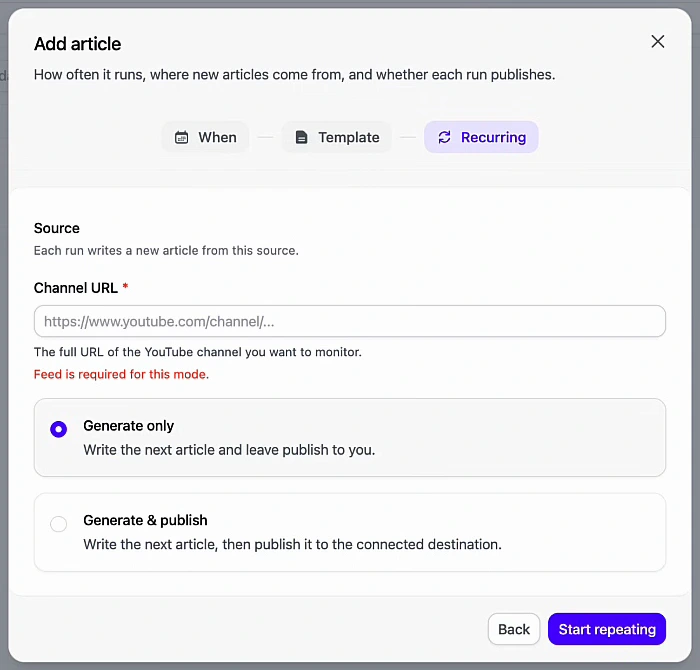
No channel of your own? You can use other creators' videos in your niche, as long as you credit them, which embedding the original video does. The YouTube product page is YouTube video to blog post.
Don't skip the classic Google Maps work
None of this replaces the basics: the right primary category, a complete business description, photos and videos, and the rest of a fully filled-out profile. AI search is built on top of the same signals that rank you on Maps, so neglecting them undoes everything above. We cover the profile itself in Google Business Profile for AI search and the ranking process in how to rank #1 on Google Maps.
Local GEO checklist
| Lever | Where AI reads it | What to do | Can it be automated? |
|---|---|---|---|
| Review replies | Your Google listing | Name the location, service, time, team and outcome in every reply | Yes, with rules by star rating and human approval for low ratings |
| GBP posts | Your Google listing | Post jobs, areas, offers and outcomes with specifics | Yes, scheduled drafts or auto-publish |
| Reviews on your site | Your website | Show the full review text, not just links to platforms | Yes, with a plugin or sync |
| News section | Your website | Publish news for your niche in a dedicated section | Yes, recurring news articles |
| Videos to articles | Your website | Turn each video (yours or credited) into an article with the video embedded | Yes, from a channel URL |
| Classic Maps SEO | Your listing and site | Category, description, photos, videos, complete profile | Partly |
In the video I promise that if you do three of these five, you'll see your business mentioned more in AI search. I'd add one honest caveat: nobody can guarantee what a model says, and AI answers vary from one run to the next. What you can control is how much specific, relevant context about your business exists in the places AI reads. That's what these five levers increase.
If you want to measure the result, our guide on how to get recommended by AI covers finding the prompts worth tracking and diagnosing the ones you don't win.
FAQ
What is local GEO?
Generative engine optimization for local businesses: making it more likely that AI search tools such as Google AI Mode and ChatGPT name your business when someone asks for a local service. It builds on local SEO, but focuses on the context AI reads: reviews and replies, posts, and your website.
Do review replies help with AI search?
Replies are text attached to your listing, and AI tools read listings when they research local businesses. A reply that names the service, location and outcome gives them something to match against a specific prompt; "thanks" gives them nothing. Google Maps already surfaces review text that matches a query's intent.
Is local GEO different from local SEO?
It's an extension. Classic local SEO (categories, profile completeness, reviews, links) still decides whether you rank on Maps. Local GEO adds the content layer AI needs to recommend you for specific situations, not just for a category and a city.
Want review replies, GBP posts, a news section and video-to-article syndication running on autopilot? See Arvow's local SEO automation.
Generate, publish, syndicate and update articles automatically
The AI SEO Writer that Auto-Publishes to your Blog
- Cancel anytime
- Articles in 30 secs
- Plagiarism Free