
How to Build an SEO Content Plan With Claude (2026)


An SEO content plan is the list of pages your site should publish, which search query each one targets, what kind of page it is, and in what order to build them. Agencies charge a lot to produce one. The video below shows how to get a solid first version out of Claude with one structured prompt: audit the site, map what competitors publish, find the gaps, expand the keywords, then cluster and prioritize everything into a plan.
We followed the full run, which builds a plan for a commercial cleaning company in the Dallas–Fort Worth area, screen by screen. The output is genuinely useful. The most valuable part, though, is two warnings Claude writes into its own answer, and they're easy to scroll past. We'll cover both.
What goes into an SEO content plan
A usable plan answers four questions for every row: which query, which page type (service page, city page, guide, cost explainer, comparison), how important, and where it sits in the site's structure. The pipeline in the video produces exactly that, in this order:
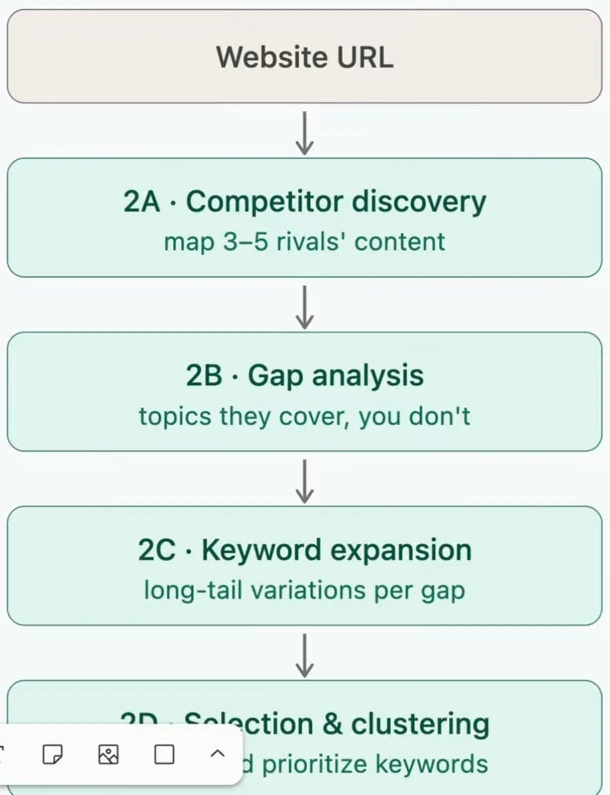
- Site audit: what the site already has.
- Competitor discovery: find three to five rivals for the core service plus location, and map their content.
- Gap analysis: topics they cover and you don't, ranked by how many competitors cover them.
- Keyword expansion: long-tail variations for each gap, from Google's own suggestions and "People Also Ask".
- Selection and clustering: group everything into clusters with a pillar page and support pages, each with a page type and priority.
The presenter shares the prompt with viewers who comment on the video; the steps above are legible on screen, so you can write your own version. If you'd rather run it in Claude Code with files and tools, our Claude Code SEO guide covers that setup.
Step 1: Audit what the site already has
You give Claude the site URL and it reads the site first. The example is a four-page WordPress site for a commercial cleaning company. The audit is blunt:
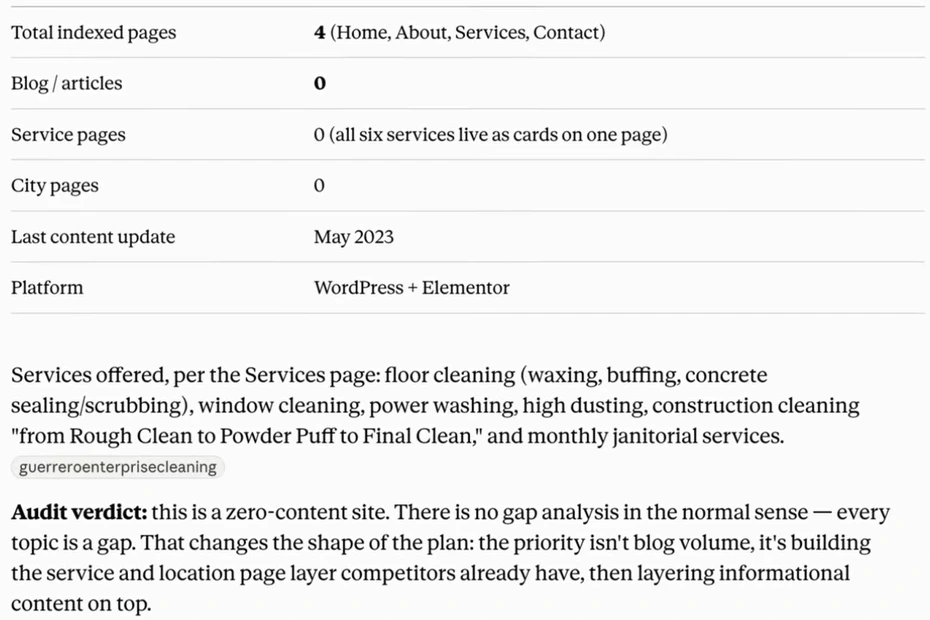
Read the verdict carefully, because it sets up everything later: on a zero-content site there's no gap analysis in the usual sense, since every topic is a gap. So the first job is building the service and location pages competitors already have. Informational articles come after.
Step 2: Map what competitors publish
Next, Claude searches for the service plus location, picks the competitors, and pulls their sitemaps or blog indexes to see what they publish.
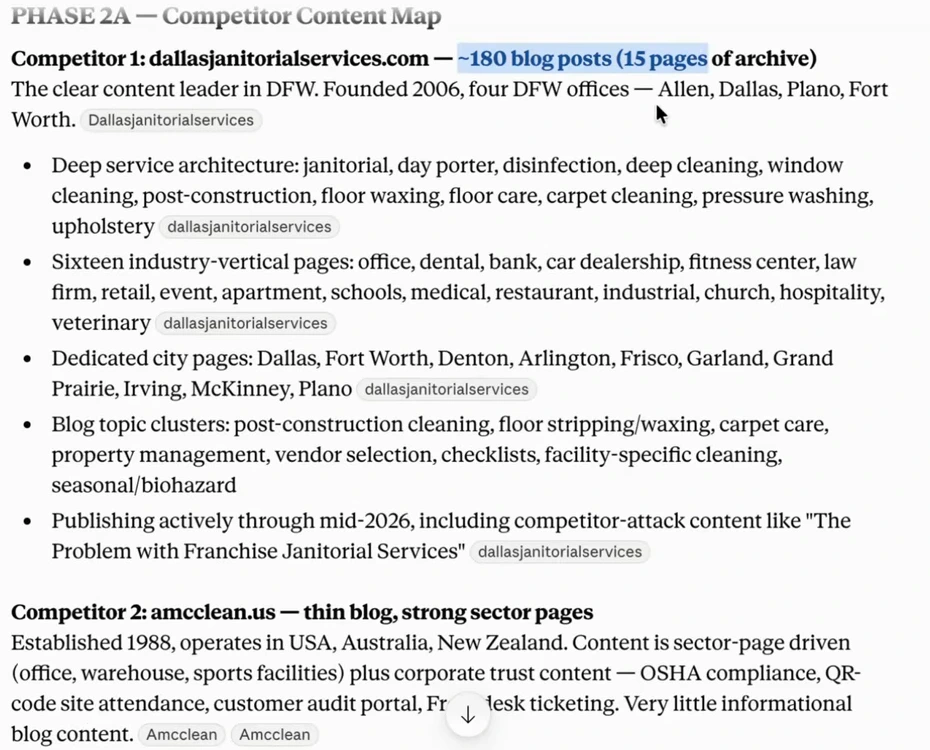
This is the most useful step for any business, including ones that already have content. The map shows how each competitor wins. The leader has around 180 posts plus service, industry and city pages. The second competitor has a thin blog and strong sector pages. They're two different models, and the plan can borrow from both.
Step 3: Find the gaps, ranked by competitor coverage
The gap analysis compares the competitor maps with the site and ranks each topic by how many competitors cover it.
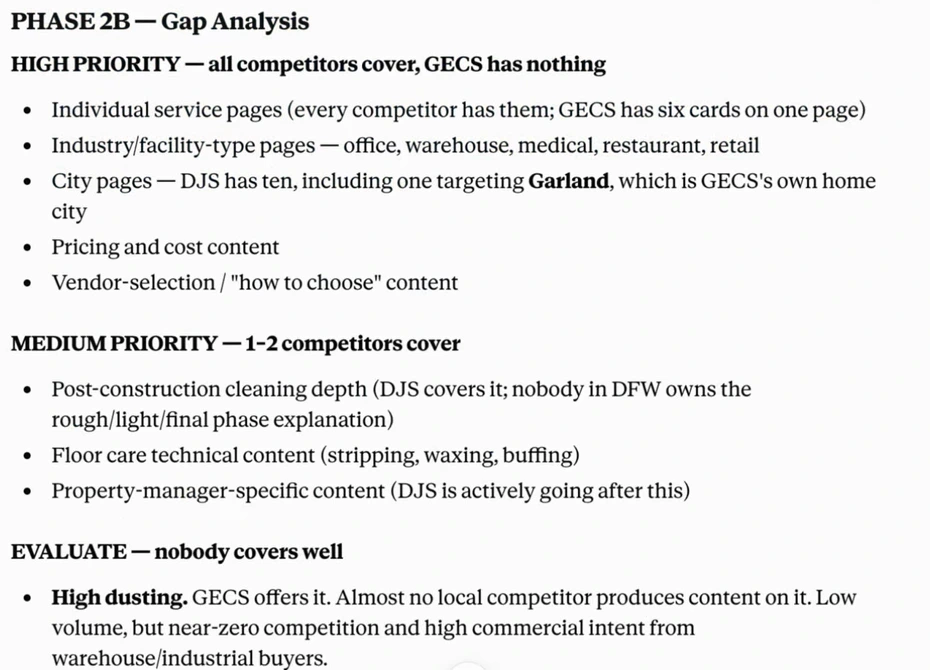
This is a good default rule. If every competitor covers a topic, it's table stakes: you need the page just to compete. If one or two do, it's an emerging opportunity. If nobody does, it's either an opening or a topic with no demand, and you have to check which. One detail stands out: the leading competitor has a city page for the company's own home city. That's the kind of finding that justifies the whole exercise.
Step 4: Expand the keywords, then read the caveat
For each gap, Claude searches the topic, notes the exact phrasing Google suggests and the "People Also Ask" questions, and adds long-tail and local variations. Then it builds the plan cluster by cluster:
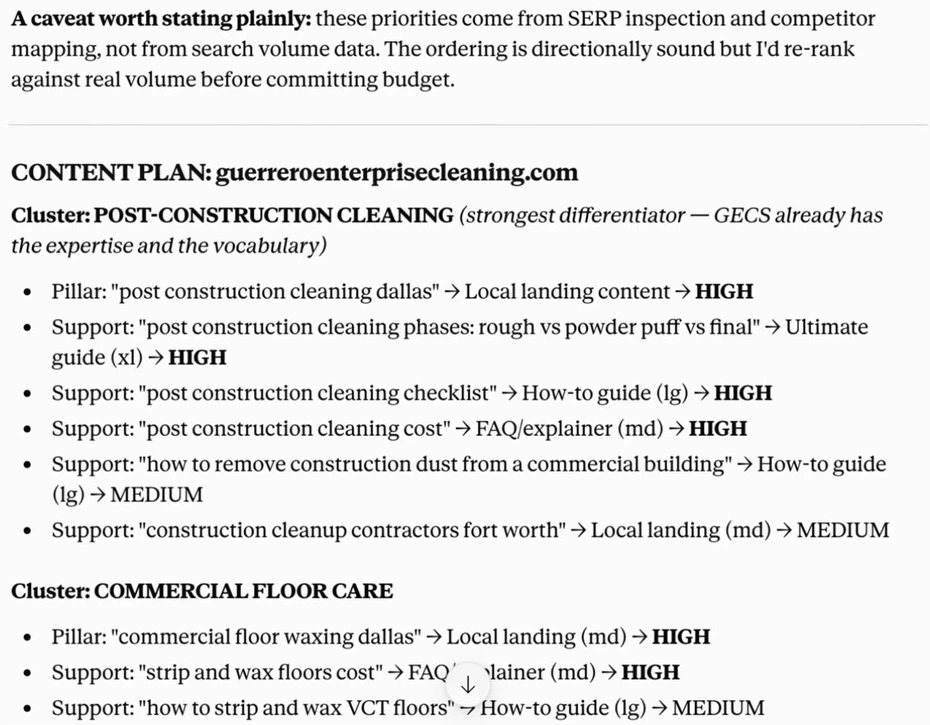
Each row gets a query, a page type and a priority, grouped under a pillar. The finished plan has 30 keywords in 8 clusters: post-construction cleaning, commercial floor care, buying and vendor selection, pressure washing, window cleaning, high dusting, facility types and city pages, with 14 high, 14 medium and 2 low priority.
Now the first warning. Right above the plan, Claude says that the priorities come from SERP inspection and competitor mapping, not search volume, and that it would re-rank against real volume before committing budget. The video moves straight past this. Don't. A chat model reading search results can tell you what competitors publish and what Google suggests, but not how many people search each phrase. Before you commit, run the 30 keywords through a tool with real volume data (Google Keyword Planner, Search Console for queries you already appear for, or any SEO suite) and re-order. Our guide to finding low competition keywords shows how to weigh demand against difficulty.
Step 5: Build the pages in the right order
The second warning comes at the end of the plan, and it's the most important thing Claude says in the whole session.
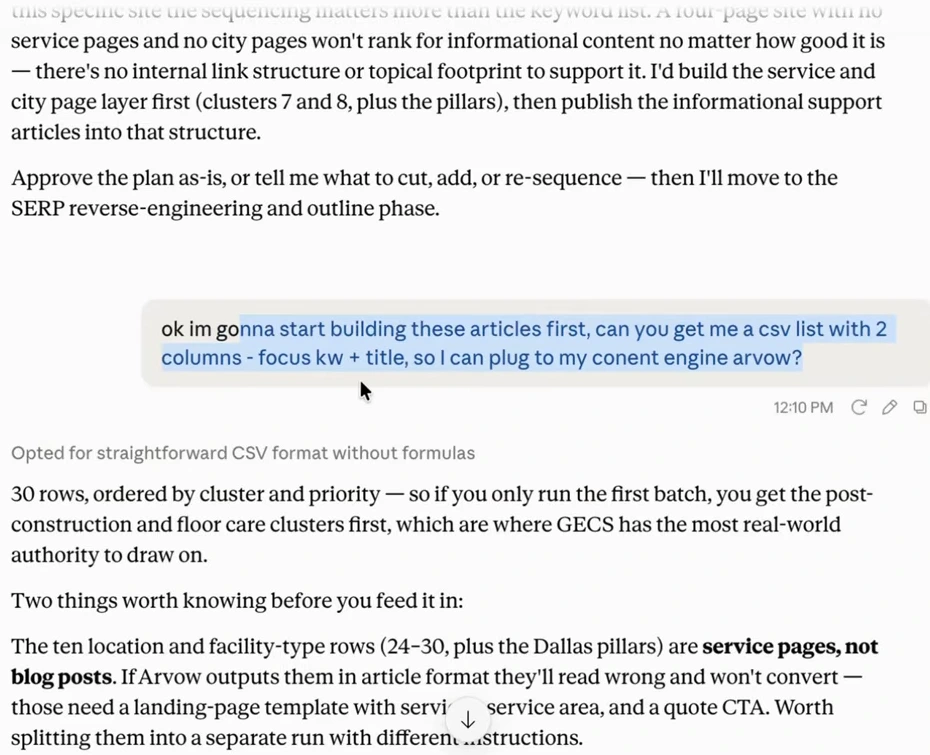
Claude's advice is to build the service and city pages first (the facility-type and city clusters plus each cluster's pillar), then publish the informational articles into that structure. A four-page site with no service pages won't rank for informational content "no matter how good it is", because nothing links the articles to what the business sells. When the presenter asks for the plan as a CSV to load into a content tool, Claude repeats the point: the ten location and facility-type rows are service pages, not blog posts, and need a landing-page template with services, service area and a quote call to action.
That's sound SEO advice, and it's the difference between a content plan and a list of blog titles. In practice:
- First: one page per service and one page per city you really serve, each with a clear quote CTA. For the structure of those pages, see how to outrank local competitors.
- Then: the cluster pillars, linking down to the supporting articles and up to the service page.
- Then: the supporting articles (checklists, cost explainers, how-tos, comparisons), each linking to its pillar and its service page.
This is the same pillar-and-support architecture described in how to build topical authority fast.
Step 6: Turn the plan into a publishing queue
The last step exports the plan as a two-column CSV (focus keyword and title), ordered by cluster and priority, ready for a content tool.
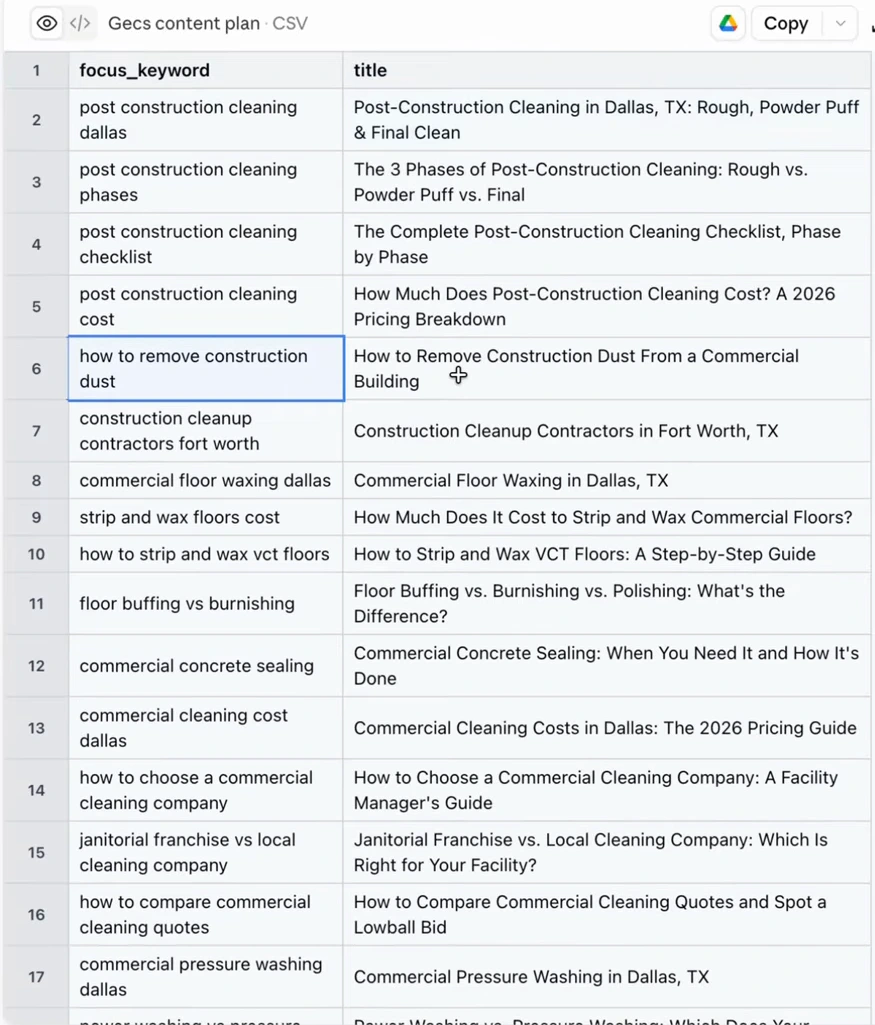
In the video the CSV goes into Arvow: connect the WordPress site, fill the knowledge base with the business's services, contact details and reviews, then create a planned autoblog that publishes a set number of articles a day (the presenter picks two, "to keep it simple and not too spammy"). He generates one article on screen, "How often should commercial windows be cleaned?", with a meta description, images, a table of contents, internal links, an embedded YouTube video, tables and FAQs.
Two things to do differently from the demo. Split the CSV: send the informational rows to the article queue, and build the service and city rows as landing pages, exactly as Claude advised. And publish in plan order, not whichever row is easiest to demo. The article generated in the video is a window-cleaning support piece; by Claude's own sequencing it should come after the service pages exist. The autoblog setup itself is covered on our autoblog page.
One more check worth reporting: the Arvow project in the demo is connected to a staging site (a zipwp.dev address), not the company's real domain. When we looked at the live site on September 29, 2026, two months after the recording, it still had only its original pages and no blog. So the video shows the method, not results; the presenter says on camera he'll come back with those later.
Does this kind of plan get results?
As proof, the video opens with a dental site in Ahrefs that, in the July 2026 recording, sat at about 40,000 organic visits a month after roughly a year of growth.
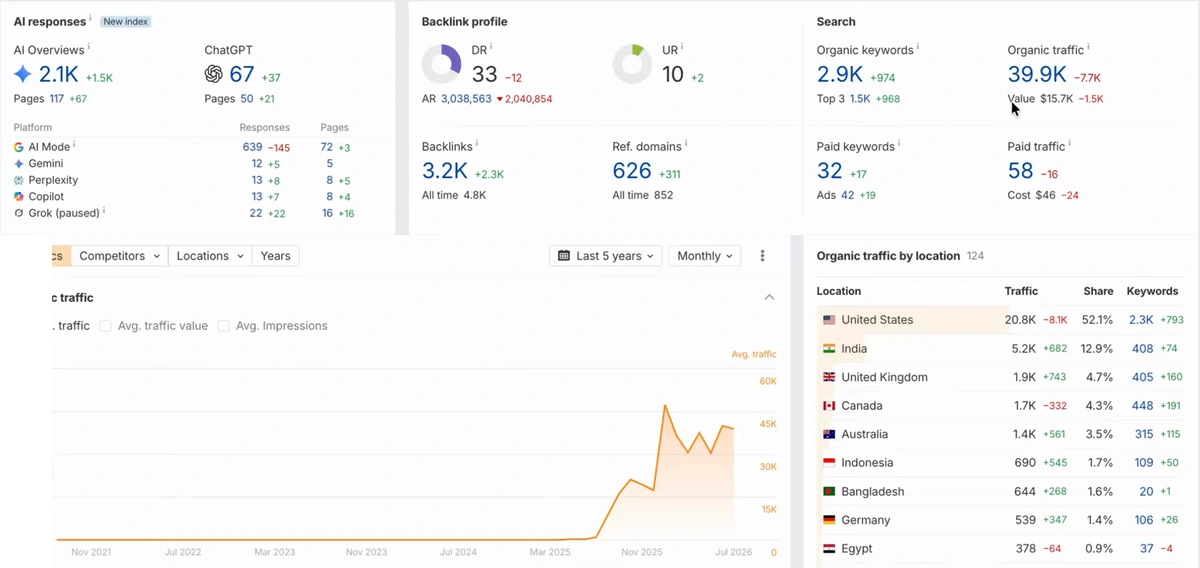
The numbers on screen match the voiceover: 39.9K estimated organic traffic worth about $15.7K a month in ad-equivalent value, $46 of paid traffic cost, and 2.1K AI Overview citations. Two details on the same screen are worth knowing if you're a local business:
- Only 52% of the traffic is from the United States. India, the UK, Canada and Australia make up much of the rest. For a clinic that serves one area, most of that traffic can never become a patient. Informational content attracts a national and global audience; that's normal, but it's why "traffic value" overstates what traffic is worth to a local business.
- The traffic is down 7.7K on Ahrefs' comparison period, after peaking in late 2025. Content plans need maintenance, not just a launch.
That's why the sequencing warning matters. The service and city pages are what turn local searches into calls; the articles build reach and topical authority around them. For a cleaning business specifically, our guide to SEO for cleaning companies covers the local side.
The SEO content plan checklist
| Step | What Claude does | What you check |
|---|---|---|
| Audit | Counts pages, posts, service and city pages | That it read the live site, not a cached or staging version |
| Competitors | Maps 3–5 rivals' services, industries, cities and blog | That they're real local competitors, not directories |
| Gaps | Ranks topics by how many competitors cover them | "Nobody covers it" can mean no demand |
| Keywords | Expands gaps from Google suggestions and PAA | Re-rank with real search volume before committing |
| Clusters | Groups into pillars and supports, with page types | Service and city rows are landing pages, not articles |
| Publish | Exports focus keyword + title as CSV | Build service pages first, then publish articles in plan order |
If you want a week-by-week version for a brand-new site, see our 30-day SEO plan; for mapping topics without a competitor crawl, see how to create a topical content map.
FAQ
What is an SEO content plan?
It's a prioritized list of the pages a site should publish: the target query for each, the page type (service page, city page, guide, cost explainer, comparison), the cluster it belongs to, and the order to build them in. It turns keyword research into a publishing schedule.
Can Claude create an SEO content plan?
Yes. With a structured prompt it can audit your site, map competitors' content, find gaps, expand keywords and cluster them into a plan, as the video shows. It can't see search volume, so re-rank its priorities with a keyword tool before committing, as Claude itself recommends in the run.
How many keywords should a content plan have?
Enough to cover your services, locations and the main questions buyers ask. The plan in the video has 30 keywords in 8 clusters for a local cleaning company, which is a sensible first batch. Add to it once you see which clusters start ranking.
Should I publish blog posts or service pages first?
Service and location pages first, if your site doesn't have them. Informational articles need somewhere to link to, and a site with no service pages has nothing for them to support. That's the advice Claude gives in the video, and it's right.
Have your content plan ready? Turn it into a publishing queue with Arvow's autoblog.
Generate, publish, syndicate and update articles automatically
The AI SEO Writer that Auto-Publishes to your Blog
- Cancel anytime
- Articles in 30 secs
- Plagiarism Free