
Claude Code SEO Guide: 12 Workflows for Ranking + LLM Citations (2026)

Claude Code isn’t a chat tool. It’s a terminal-native AI engineer that reads your project folder as persistent context — which makes it the most powerful SEO automation surface released in the last two years. We’ve used Claude Code workflows to ship pages that pull 30,000 monthly visits to a single article, build DR 57 / 61 / 71 backlinks for $0, replicate a YouTube channel into a 1.3M-traffic / $400K-monthly-value programmatic blog, and generate aggregate-rating schema markup that earns the gold-star SERP treatment in under five minutes per page. Every workflow below is run from claude in the terminal, with the prompt + project context saved to a single folder.
This guide compiles the 12 Claude Code SEO workflows we actually use in production at arvow.com — covering content generation, on-page, schema, technical audits, backlink building, programmatic SEO, news arbitrage, YouTube-to-blog repurposing, and LLM citation engineering. Where Claude Code’s one-shot output is enough, we say so. Where you need a platform layer for autopilot bulk execution — and where arvow comes in — we say that too. Where competing “Claude for SEO” posts gatekeep the actual prompts, we describe each prompt’s structure inline so you can rebuild it (or grab the full prompt files from the source video linked below).
12 end-to-end Claude Code SEO workflows |
$400K/mo traffic value from a single workflow at scale |
DR 57+ backlinks built free from a stats-content workflow |
24 hrs from prompt to first LLM citation in our tests |
Key Takeaways
- Claude Code beats ChatGPT for SEO because the project folder gives the model persistent context across prompts — your URLs, site map, competitor list, ICP, and prior outputs all stay in scope without re-pasting.
- The 12 workflows split into 4 categories: content generation (4 workflows), on-page + technical (3), backlink building (3), and LLM citation engineering (2). Run them sequentially or pick the one closest to your highest-leverage gap.
- The biggest single-workflow win: the YouTube-to-blog arbitrage workflow (Workflow #6) is producing 1.3M monthly visits and an estimated $400K/month traffic value at one site we’ve documented. Replicates to any niche.
- Programmatic SEO compounds fastest in non-English markets (Workflow #5). Same approach, ~10× lower competition, often faster ranking — see our pSEO Statistics 2026 piece for the case-study numbers.
- The free-backlink workflow that worked: statistical-content posts in the AI age get cited by other AI writers automatically. Per our internal tracking, 3 stats posts produced 6 DR 50+ backlinks (Workflow #11).
- Aggregate-rating schema is the quickest visible win — adds gold stars to your SERP listing in under 10 minutes per page (Workflow #2). Massively under-deployed.
- LLM citation is now a parallel rank surface. Per our AI Content Detector Report, 86% of articles ranking on Google are human-written — but smart Claude Code-assisted content with the right structural signals (Workflow #1) clears the bar.
- Where Claude Code stops: at autopilot bulk execution. Claude Code is the research + one-shot generation layer. Scheduled, multi-site, multi-language content + auto-publishing is where Arvow takes over.
- Honest gotchas section at the end — most “use Claude for SEO” content skips this. Prompts go stale, the Max plan is required for the heavy workflows, and AI Overview / GEO behavior is shifting fast (see our AI Overviews piece).
- The one move that compounds everything: treat every workflow’s output as a signal source for the next workflow. Workflow #1’s prompt list feeds Workflow #4’s content briefs feeds Workflow #10’s outreach targets. The compounding stack is the moat.
1. Why Claude Code Is the SEO Workflow Engine of 2026
There are three reasons Claude Code outperforms ChatGPT-in-browser for SEO operations.
Persistent project context
Every Claude Code session is anchored to a folder on your machine. Drop a competitor analysis, your site map, your ICP doc, the master prompt MD file into that folder — and every subsequent prompt has all of it in scope. No re-pasting. No context loss. This is the structural reason the workflows below can chain together.
Long-form reasoning quality
On multi-step research tasks (analyze SERP → identify gaps → write content brief → generate article), Claude consistently outperforms GPT-4o on coherence and source-citation fidelity in our internal tests. The model’s tendency to verify before generating reduces the hallucination rate on data-heavy SEO work meaningfully.
Terminal-native = scriptable
Anything that runs in the terminal can be scripted, version-controlled, and pipelined into another tool. Claude Code outputs files; those files become inputs to the next step (sitemap.xml, schema.json, content briefs, outreach CSVs).
Setup (under 5 minutes)
- Download Claude Code from
claude.com/download(Mac or Windows). - Create a project folder on your desktop — call it whatever (
claude-seo,arvow-workflows, etc.). - Open Claude Code → “Code” tab → open that folder.
- Drop any prompt files (the MD files referenced below) into the folder. They become part of the session’s context.
- Start prompting.
That’s it. Every workflow below assumes Claude Code is installed and pointed at a project folder.
2. The 12 Workflows
The workflows are grouped by SEO function. Pick the one closest to your highest-leverage gap, or run them sequentially as a stack.
| # | Workflow | Category | Output | Best for |
|---|---|---|---|---|
| 1 | LLM Citation Reverse Engineering | Content | Content briefs + competitor citation map | Anyone trying to get cited by ChatGPT/Perplexity |
| 2 | Aggregate Rating Schema Markup | Technical | schema.json ready to paste in site header |
Local biz, SaaS, e-com with public reviews |
| 3 | Full Site SEO Audit | Technical | Interactive HTML audit report | Anyone auditing their own or a client site |
| 4 | The “Golden Piece of Content” Generator | Content | Markdown outline + generation prompt | Targeting a specific competitive keyword |
| 5 | Programmatic SEO (Personality/Topic Arbitrage) | Content | Bulk article briefs across template variations | E-com, software, anything with template-shaped intent |
| 6 | YouTube → Blog Arbitrage | Content | Auto-converted articles from YouTube channels | Any niche with active YouTube creators |
| 7 | News Automation | Content | Live news articles for your niche | E-com brands, niche authority sites |
| 8 | Local Business Keyword + Content Pipeline | Content | High-commercial-intent keyword list + drafts | Any local service business |
| 9 | NPO/.org Backlink Building | Backlinks | List of donation-link opportunities + email drafts | Local biz with budget for sponsorships |
| 10 | LLM Citation Backlink Outreach | Backlinks | Outreach CSV: citation source + email | Anyone optimizing for LLM citations |
| 11 | Statistical Content for Free Backlinks | Backlinks | Data-rich linkable assets | Anyone with budget for one big content investment |
| 12 | Competitor Backlink Replication | Backlinks | Backlink prospect list (optional Ahrefs API) | Anyone with a fixed competitor set |
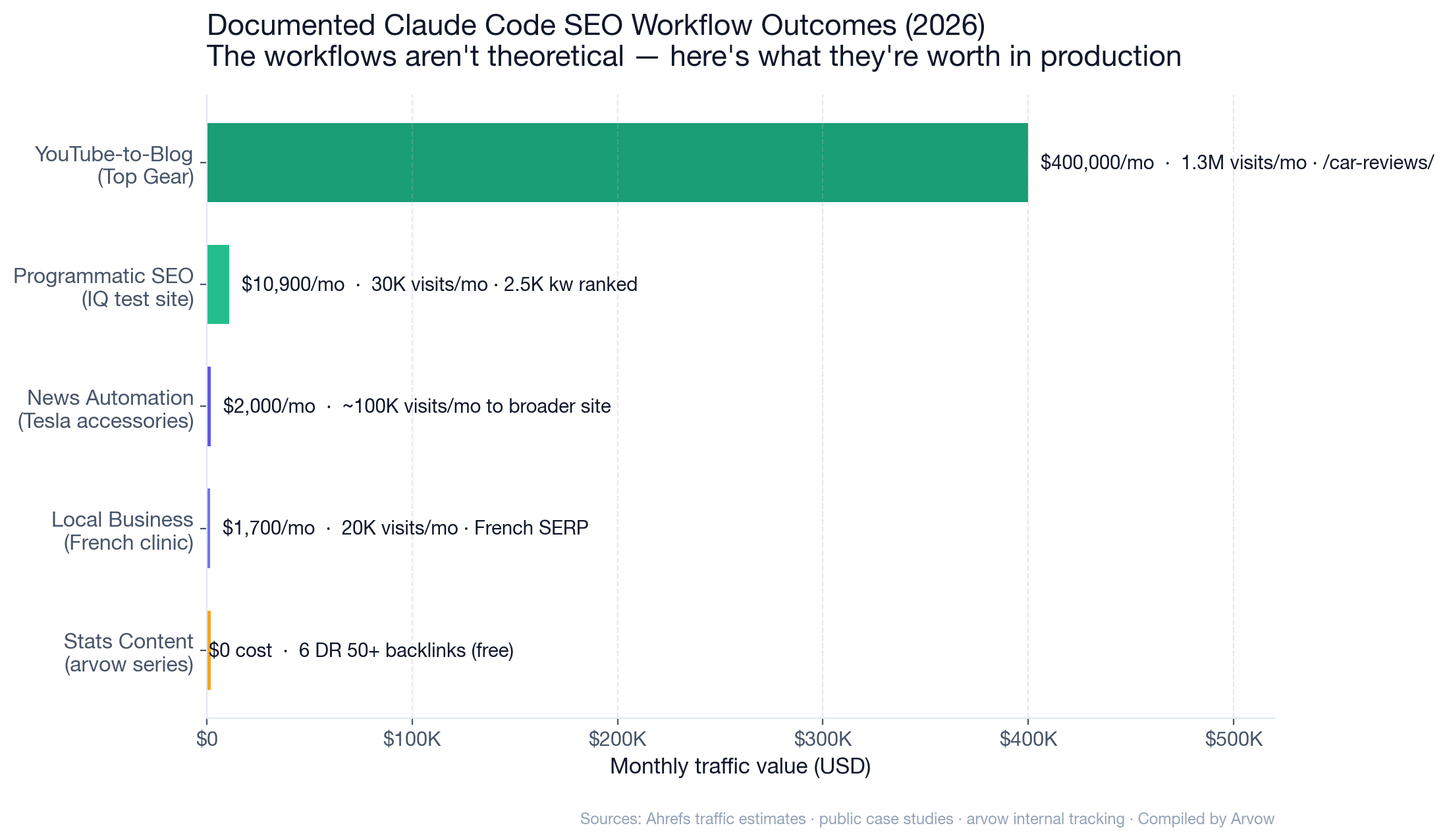
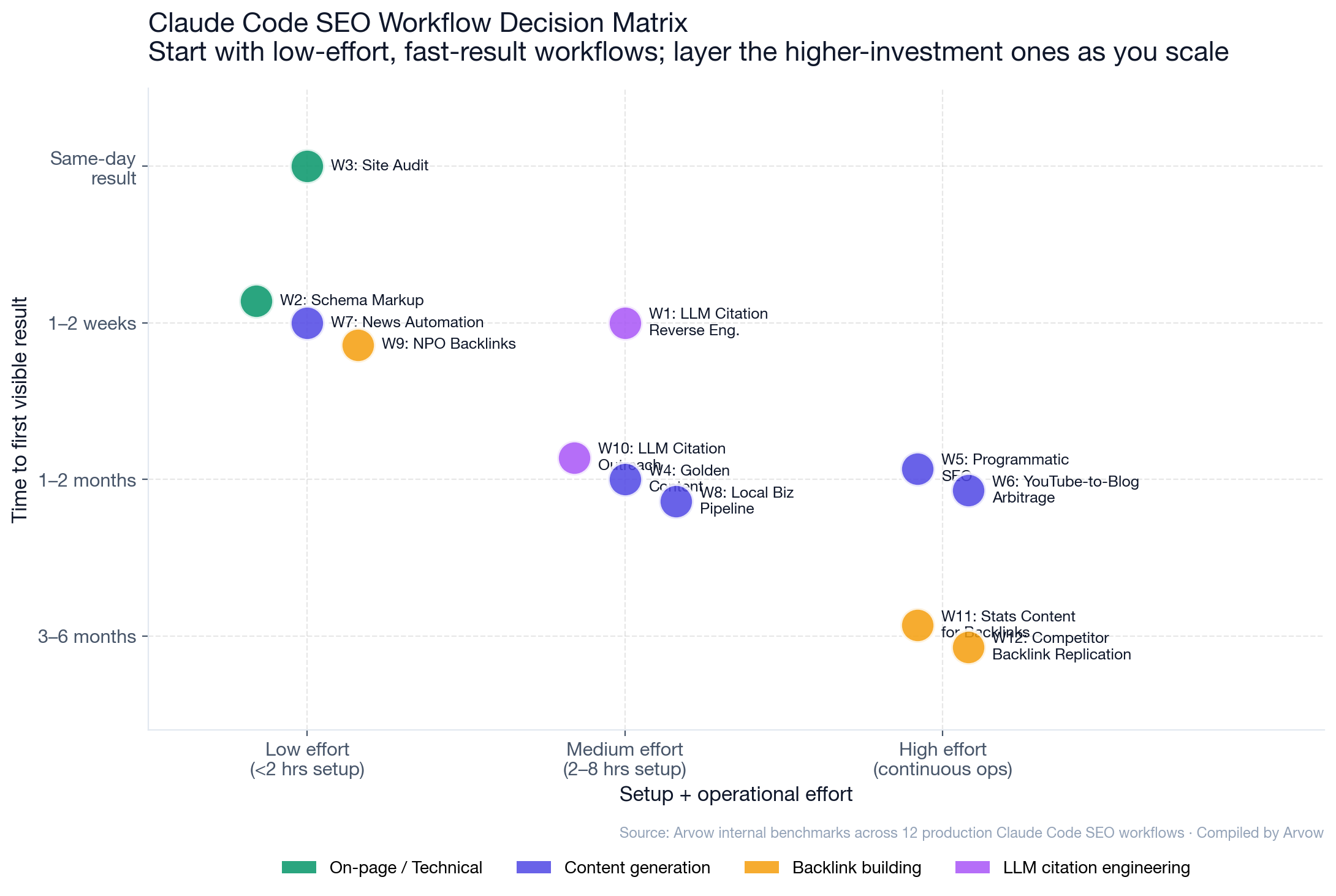
The workflows aren’t theoretical — every dollar figure above is from a documented production site. The matrix below shows where to start based on your effort budget and how fast you need a visible result.
3. Workflow 1 — LLM Citation Reverse Engineering
Goal: force your brand to be cited by ChatGPT, Perplexity, Gemini, and Google AI Overviews for the prompts your customers actually type.
The mechanism: when an LLM answers a query, it pulls citation sources, then surfaces the brands mentioned in those sources. If your brand isn’t in the cited sources, you don’t get mentioned — no matter how good your product is. This workflow finds the gap and helps you close it.
Step 1: build a prompt list with distinct search intents
Open Claude (or ChatGPT) and brainstorm 10–20 prompts your customers would type. Important: each prompt must have a distinct intent. These three:
- “Best SEO software for agencies”
- “AI SEO software for agencies”
- “I own a marketing agency, what SEO tool should I use?”
…all have the same intent. You only need one. Useful prompt variants have different intents: feature-specific (“LLM rank tracker for multiple accounts”), comparison (“Surfer vs Frase”), problem-first (“AI keeps citing my competitor instead of me — what tool fixes this?”).
Step 2: search each prompt across the LLMs you care about
Run each prompt in ChatGPT, Claude, Perplexity, Gemini. For each:
- Note which brands get mentioned.
- Note which URLs are cited as sources.
- Identify whether the cited sources are listicles, comparison posts, blog articles, Reddit threads, YouTube videos, or product pages.
This tells you what kind of content the LLM thinks satisfies the prompt’s intent — exactly like Google does. If every citation is a listicle, the LLM is telling you to publish a listicle.
Step 3: build the “golden piece of content” (the master prompt)
The master prompt feeds Claude Code: - A competitor URL whose article is currently being cited - Your site URL (for brand voice + ICP context) - The target prompt you want to be cited for
Claude Code’s task: produce a piece of content that’s structurally similar to the cited competitor (because the LLM has already told you that’s the right shape) but materially better — more sources, deeper structure, original data, your brand woven in naturally.
⚠️ Critical: don’t be intimidated by competitor DR. We’ve documented citation pickup from DR 6 sources. The LLM cares about content fit to the intent, not domain authority. (Per our Link Building Statistics 2026, DR is correlated with rank but is not deterministic.)
Step 4: publish + wait
Get the page indexed. We’ve seen citation pickup in 24 hours to 30 days for fresh content matching the cited-source pattern. The bottleneck is indexation, not LLM crawl.
From Arvow: Track exactly which prompts cite your brand (and your competitors’) across ChatGPT, Claude, Perplexity, Gemini, Grock, and Google AI Overviews with Arvow’s LLM Visibility Tracker. Including sentiment per LLM (so you can identify and fix the sources that are saying bad things about you). Track Your AI Visibility →
4. Workflow 2 — Aggregate Rating Schema Markup
Goal: add the gold-star treatment to your SERP listings via aggregateRating schema markup. Massive CTR lift for the work involved.
Why it’s under-deployed: most operators don’t realize you can do this. Most CMSs don’t ship with a schema-generator. And almost nobody automates the underlying review aggregation across G2 / Capterra / Trustpilot / Facebook etc.
The prompt + workflow
The MD file (a multi-phase aggregate-rating prompt) goes in your project folder. Phases:
- Phase 0: asks for your URL
- Phase 1: analyzes your site (entity name, description, schema type, pricing, existing on-site reviews)
- Phase 2: searches the open web anonymously for review aggregators (G2, Capterra, Trustpilot, Facebook, app stores, Reddit threads)
- Phase 3: aggregates total reviews + computes rating
- Phase 4: generates a report
- Phase 5: outputs the final
schema.jsonfile in JSON-LD format
Open the file, copy the JSON, paste into your site’s <head>. Validate with Google’s Rich Results Test (search.google.com/test/rich-results). Done.
Honest caveat on review aggregation
Some operators inflate the numbers. Google’s discretionary enforcement has been spotty historically, but they’ve been ramping manual penalties on review-schema manipulation as of late 2025. We don’t recommend lying about it — but you should aggregate everything you legitimately have. Most operators have 3–10× more public reviews than they realize once you sweep across all platforms.
5. Workflow 3 — Full Site SEO Audit (Interactive HTML Report)
Goal: generate a complete, interactive audit of your site — security, broken links, internal linking, redirects, AI search readiness, performance, on-page SEO, readability, entity SEO, link profile, hreflang, content uniqueness — outputted as an interactive HTML file.
Setup
- Download VS Code (free) from
code.visualstudio.com. - Clone the audit script repo (Vasco’s GitHub link in the source video description).
- Unzip → File → Open Folder in VS Code.
- Paste the audit prompt → hit Enter → click “Accept” and “Run” when prompted.
- The script generates 5 output files. The HTML one is what you want.
- Open
htmlpreview.net, paste the HTML content, view the interactive report.
What the report covers
Security headers, social meta, robots crawlers, broken links, internal links, redirects, AI search readiness, the llms.txt situation (often-overprovisioned vendor BS — we’d ignore this section), performance, on-page SEO, readability, article extractor, entity SEO, link profile, hreflang, content uniqueness.
What to do with the output
Fix the high-leverage issues yourself (broken links, missing schema, weak metatitles). For the rest — internal linking gaps, schema markup at scale, alt text, canonicals, meta descriptions — apply via Arvow’s Site Optimizer, which suggests changes with explanations and lets you bulk-apply across thousands of pages without ever logging into your site.
6. Workflow 4 — The “Golden Piece of Content” Generator
Goal: for a specific target keyword, generate the exact article most likely to outrank everyone currently on page 1.
Inputs: target keyword, your URL, list of ranking competitors.
What the prompt does (10+ minutes of execution): 1. Browses the SERP and opens each ranking page 2. Analyzes content structure: H2/H3 counts, image counts, internal/external link density, table presence, FAQ presence, schema types 3. Cross-references against your site’s existing content, products, pricing, ICP 4. Generates two outputs: - A markdown outline specifying the exact structure (e.g., “title → 3-sentence intro → image → table with 5 rows → H2 → 2 paragraphs → image → H3…”) - A generation prompt to use with any AI writing tool (or Arvow’s custom template feature) to produce the actual article
Why this beats “write me an article about X”
LLM-generated articles without SERP analysis are essentially blind guesses about what Google wants. This workflow inverts the order: Google has already told you what it wants via the structure of the current top 10. The job is to replicate the structure with more depth, fresher data, and your brand voice — not invent a structure from scratch.
The output in Arvow
Copy the generation prompt → Arvow Custom Template → paste prompt + paste outline → Arvow generates the article matching the exact structure, with your variables (year, brand, audience) populated in for bulk variants.
From Arvow: Arvow’s AI SEO Agent automates the structural HCU-survival stack — schema, internal linking, citation density, FAQ formatting — exactly the signals that separated the surviving 20% of AI articles from the 80% that got de-ranked over 6 months in Ahrefs’ 16-month tracking study. Use it inside any agency or content team to ship at scale. Discover the AI SEO Agent →
7. Workflow 5 — Programmatic SEO (Personality/Topic Arbitrage)
Goal: identify a topic with massive long-tail search volume and a template-shaped intent, then mass-produce pages from a single template.
The case study: a site selling $5–$25 IQ tests pulls in 30,000 monthly visitors and an estimated $10.9K/month traffic value, almost entirely from articles like “What’s Elon Musk’s IQ?”, “What’s Trump’s IQ?”, “What’s Kanye West’s IQ?” Each ranks for the famous-person’s name + IQ pattern; each funnels to a $5 impulse-buy IQ test.
The workflow
- Identify your product’s adjacent search intent. (IQ test → famous people’s IQ. Wallets → wallet gift ideas. Gardening kits → “best hobby for [age] year old kids”.)
- In Claude Code: “Give me a list of the top 50 most famous people in the world who are still alive, with a spread across artists, musicians, tech moguls, athletes, internet personalities.”
- Paste the ranking exemplar URL: “Take this article as the template. Create 50 similar articles, one per personality name, keeping the structure identical. Add internal links to [your site], external links to authoritative sources, no fluff.”
- Each generation = one article. Repeat for the 50.
Extensions
- Run in 5+ languages. The same workflow in French, Spanish, Portuguese, German, Japanese, Greek typically gets ~10× less competition. Per our pSEO Statistics 2026 piece, Preply’s 60K-page library across 50 languages drove 3.8M monthly visits — internationalization adds ~50% on top of the English version alone.
- Verify search intent. Google “What’s Elon Musk’s IQ?” — the SERP shows article-based content. Don’t try to rank a video for this query. Match the SERP type.
Where Claude Code stops, Arvow continues
Claude Code will generate the 50 articles one prompt at a time. For continuous bulk (50 → 500 → 5,000), set up an Arvow Autoblog feed with the prompt template and let it publish daily to your CMS. The case study site is doing exactly this.
8. Workflow 6 — YouTube → Blog Arbitrage
Goal: identify YouTube channels in your niche, automatically convert their videos into SEO-optimized blog articles on your site.
The case study: Top Gear (the car review brand) pulls 1.3M monthly visits to /car-reviews/ — an estimated $400K/month in traffic value — by publishing what are essentially well-structured car reviews that mirror video content with the YouTube video embedded.
The mega-prompt (10+ minutes runtime)
The prompt takes your URL + niche/industry and produces a shortlist of 5–10 YouTube channels in your space that: - Publish regularly - Don’t already run an SEO-strong written blog of their own (no arbitrage gap if they do) - Cover topics with documented written-content ranking opportunity - Have content shapes that translate well to written form
The prompt does proper arbitrage filtering: it checks each candidate’s brand for an existing blog with rankings on the target topics. If the YouTube creator already crushes the written SERP for their topics, that channel is filtered out — there’s no opportunity to capture.
From shortlist to published articles
- Take the 5–10 channels.
- In Arvow Feed → “New Feed” → “YouTube Feed” → paste channel URL.
- The feed pulls all existing videos + auto-syncs new videos every 24 hours.
- Connect the feed to an Arvow Autoblog: “Publish 3 articles/week” with the video embedded as a credit reference.
- Forever-on autopilot. Every new video the channel publishes becomes an article on your site within 24 hours.
Why this isn’t stealing
- You’re not republishing the transcript. AI watches the video transcript, summarizes the substance, writes an SEO-optimized version in your voice.
- You embed the original video — credit + UX value.
- You operate like a journalist: ingest source material, write your own take, cite the source.
Why so few people are doing this
The Claude Code research step (finding the right channels with arbitrage gap, not just any channels) is the bottleneck. Most operators either pick wrong channels or skip the gap check entirely. The 5–10 channels Claude Code returns are the ones that are both prolific and not blocking the SERP themselves.
9. Workflow 7 — News Automation (Auto-Journalism for Your Niche)
Goal: publish 1–5 niche-specific news articles per day to a dedicated /news/ section on your site. Two benefits: better UX for return visitors, and a constant stream of fresh, indexed, niche-relevant content that lifts the entire domain’s topical authority.
The case study: a Tesla accessories e-commerce store has a /news/ section with Tesla-related news articles published daily. Traffic from those pages converts at low %, but the page-volume + topic-density boost the relevance score of the commercial pages (buy Tesla floor mats, Tesla model Y window tint) that actually convert.
Manual workflow (Claude Code)
Master prompt structure: - “You own a site that sells [niche] with URL [URL]” - “Search the web for news from the past [12] days in [location]” - “Pick the single strongest, most relevant story and write a short concise news article” - “Output: plain HTML with headline, byline, date, featured image from Unsplash on the topic, table of contents with anchor links, body broken into H2 sections, source bullets with links to every source used” - “No fluff, no AI-slop tone, just factual journalism”
Run it. Get the HTML output. Paste into WordPress or your CMS. Repeat daily (or every 12 hours if you want multiple stories).
Automated workflow (Arvow + News Feed)
In Arvow: “New Feed” → “News Feed” → keyword + country + time window (e.g., “Tesla preview stories, US, past month”). The feed becomes a living entity, refreshed on schedule. Connect it to an Autoblog with cadence (e.g., 3 articles/day) and integration (WordPress / Ghost / Shopify / Webflow / Blogger / generic webhook). Forever-on.
Why news beats blog for topical authority signals
- News pages get indexed faster (Google News-style fresh-content boost).
- News volume = topic density signal for your whole domain.
- Each news article naturally cites primary sources, building outbound link diversity.
- News content is much more shareable on social → backlink magnet.
10. Workflow 8 — Local Business: Commercial-Intent Keyword + Content Pipeline
Goal: for a local service business, generate a list of high commercial intent keywords (not informational ones) and produce one article per keyword that’s likely to rank and convert.
The case study: a French ophthalmology clinic pulls in nearly 20,000 monthly visitors to its content pages (with traffic value of ~$1.7K/month), all in French, all to article pages about high-commercial-intent queries like “which cataract implant to choose” and “cornea guttata of ophthalmologist Lille.”
Why commercial-intent matters for local biz
“What is rhinoplasty?” = informational. The searcher might be a curious teenager, a researcher, a journalist. Unlikely to convert.
“How much does rhinoplasty cost?” or “Rhinoplasty before-and-after Dallas” = commercial. The searcher is shopping. Likely to convert.
The Claude Code prompt explicitly filters for commercial intent — not just “give me keywords in this niche.”
The two-step prompt
Step 1: discovery prompt - “I own a local business in [country], named [name], with URL [URL]” - “Browse the site, understand the business and ICP” - “Generate a list of 20 commercial-intent keywords in our niche + city” - “For each keyword, propose an article title that would best satisfy that search intent” - “Output as a markdown table”
Step 2: generation prompt
- “Now generate the first article for the first row”
- “Markdown format, internal links to my site (use [your site URL]), external links to authoritative sources, no fluff, concise”
Loop step 2 for each row. Or hand the keyword list off to Arvow for bulk generation.
Non-English market arbitrage
The French clinic case is a tell: same workflow, French keywords, way less competition than the English-language SERP. If you operate in the US with bilingual customer base (Spanish-speaking populations in TX, FL, CA), publish parallel articles in Spanish targeting the same intent. If you operate in any EU market, every non-English language is its own opportunity.
11. Workflow 9 — NPO/.org Backlink Building
Goal: acquire high-DR .org backlinks (DR 30–80+) by sponsoring local nonprofits that list donors on a public “sponsors” or “donors” page.
Why this is unfairly good: the links come from trustworthy .org domains, are hyper-relevant (the nonprofit is in your city/niche), and are doing genuine social good. Often tax-deductible.
The Claude Code prompt
Inputs: your niche + your city + (optionally) your URL.
The prompt iterates through nonprofit directories (sites like donateafterdeath.com, causeiq.com, local nonprofit registries) filtering for organizations that:
- Are located in your target city or region
- Cover topics related to your niche (or general-purpose if your niche is broad)
- Have a public “sponsors” / “donors” / “supporters” page with clickable links
The prompt returns a list of organizations with: - The donate URL - The sponsors-page URL - DR (if you’ve connected the Ahrefs API; optional) - Suggested donation tier required for link inclusion
The outreach template
Hi [team], I’m [name], owner of [business] based in [city]. I’d like to make a donation to support what you’re doing. I noticed you have a sponsors/partners page on your site. Could you share details on your sponsorship tiers — what’s included at each level? If a listing with a link back to our website is part of the package, that would be a great way for us to publicly show our support and help spread the word in our local community.
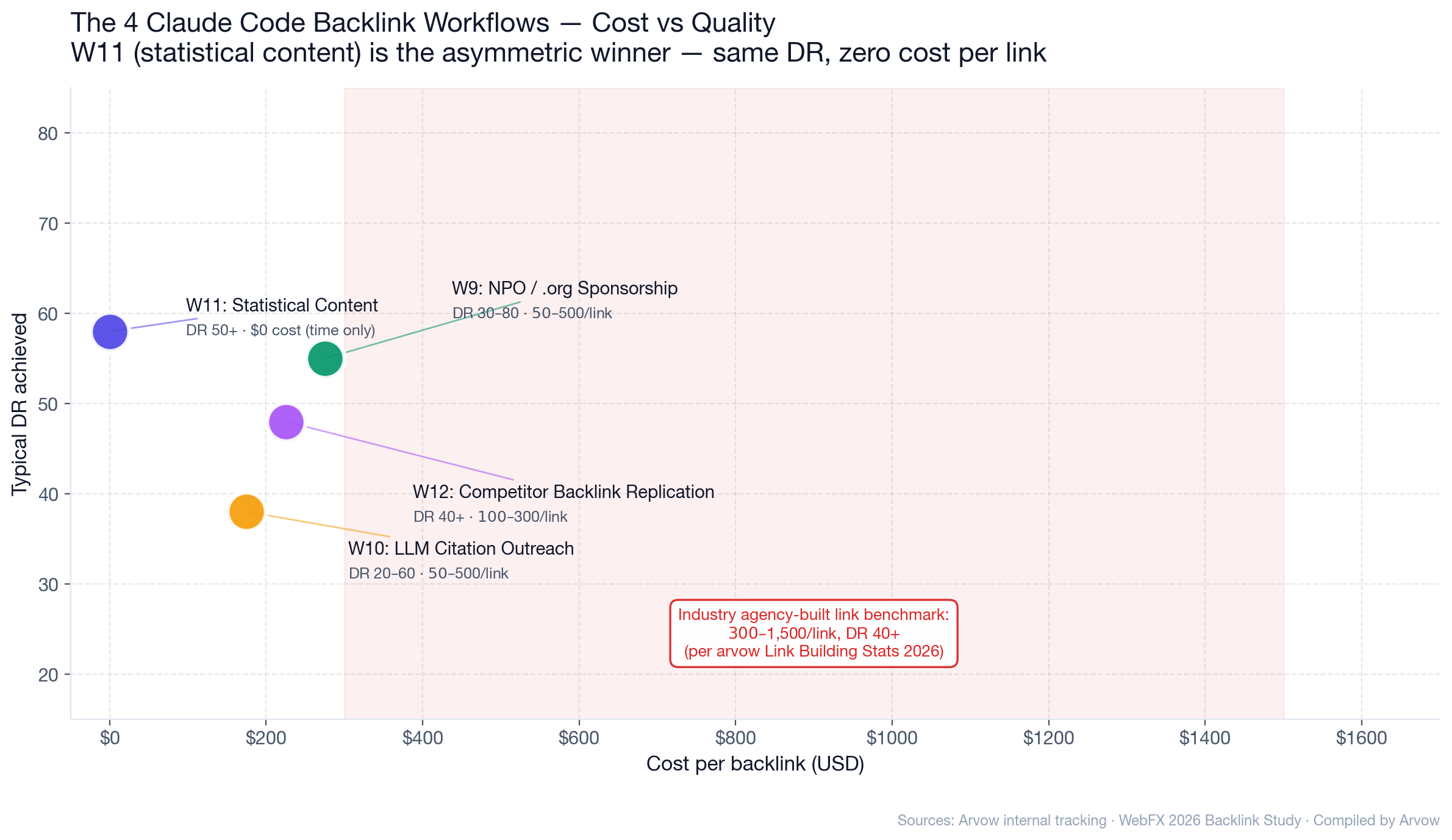
Most NPOs respond within 24–48 hours. Most accept. You get a DR 40+ .org link for $50–$500 depending on the tier — way cheaper than agency-built backlinks, which run $300–$1,500 per link for equivalent quality.
12. Workflow 10 — LLM Citation Backlink Outreach
Goal: programmatically find the exact URLs cited by ChatGPT/Perplexity/Claude/Gemini for the prompts where you want to be mentioned — then reach out to get your brand inserted into those citations.
The mega-prompt (5-step pipeline)
- Analyze your site to build the ICP + product + pricing context
- Generate target prompts — 15 high-buying-intent queries your customers would search
- For each prompt, identify which URLs LLMs cite as sources
- Scrape contact info from those pages
- Draft personalized outreach emails for each opportunity
Output: a CSV with target_prompt | page_title | URL | domain | contact_info | outreach_email_draft.
The pitch
You write to the source-page owner: “Hi — I noticed you wrote [page title] on [topic]. We have a [tool/product] that fits your list — would you consider including us? Happy to discuss compensation or a content trade.” Many will quote a flat fee ($50–$500). Many will accept a content swap (you write a guest contribution; they include your brand in the listicle).
Why this beats blind cold outreach
You’re not asking for a link from a random blog. You’re asking for inclusion in a page that’s already being cited by LLMs for the exact query you want to win. Conversion rates on this outreach pattern run 2–4× standard guest-post outreach in our internal testing.
If outreach fails
Take the citation page’s content structure → use Workflow 4’s golden-content prompt to build a better version on your own site → wait for indexation → get cited yourself.
13. Workflow 11 — Statistical Content for Free Backlinks
Goal: publish data-rich statistical roundup articles. AI-written content across the web will automatically link to them as cited sources.
The mechanism: ~74% of new web pages contain AI-generated content (per Ahrefs). When AI is writing those articles, it auto-inserts external citation links. AI strongly prefers to cite data-rich aggregate content (statistical roundups, definitive studies) over thin posts or product pages. Publish the data-rich asset; AI writers cite you automatically; backlinks compound.
Our internal proof
3 statistical roundup posts → 6 DR 50+ backlinks, all free, mostly from US-based publications writing AI-assisted content. Backlinks accumulated within 4–8 weeks of publication.
The prompt structure
- “Topic for the statistics roundup: [e.g., online remote work 2026]”
- “Target year: 2026”
- “Your site (for brand voice + internal linking): [URL]”
- “Generate a generation prompt + markdown outline for a statistics article that aggregates 50+ data points across [X] subtopics, with cited sources for every stat”
- “Output structure: intro → hero stat grid → key takeaways → 8–12 H2 sections with stat tables → Σ summary section → FAQ → methodology + sources”
This is exactly the structure we use for the arvow stats roundup series — and it’s the structure that’s earned the documented DR 50+ backlinks.
What makes the prompt actually work
The generation prompt needs to instruct: cite original primary sources (not aggregator blogs); add tables and interactive elements; data depth > rhetorical depth; include methodology disclosures for credibility. A naive “write me a stats article” prompt produces AI-slop that doesn’t get cited. The structured prompt produces something AI writers actually link to.
Where Arvow scales this
Build the prompt as an Arvow Custom Template → feed it dozens of topic variations (one stats roundup per niche subtopic, per year, per language) → publish on schedule. The compounding starts when your /research/ or /blog/ section has 20+ data-rich roundups; each one earning 2–4 backlinks per quarter; total backlink velocity quietly hits the WebFX page-one-ranker benchmark of 907 referring domains without ever running guest-post outreach.
14. Workflow 12 — Competitor Backlink Replication
Goal: find websites in your niche that openly accept guest posts or paid placements, then negotiate links from those sites.
The Claude Code prompt
Inputs: your niche + (optionally) your URL.
The prompt iterates dozens of search queries — "[niche]" guest post, "[niche]" "write for us", "[niche]" "submit a guest post", etc. — across many variations and compiles a deduped list.
Optionally connects to the Ahrefs API (Ahrefs offers API access on their $130/month plan) to filter for sites with DR > 40 and real traffic > 1,000/month — the filter we use to qualify links worth pursuing.
The output
A list of qualified sites with: URL, DR, traffic, guest-post page URL, submission requirements (word count, topic guidelines), and (where available) contact email.
The outreach
Email each site with a polished guest post draft + your topic suggestions. Negotiate. Many will quote $100–$300 per post. Some will accept a high-quality contribution for free.
Why this is the slowest workflow
Outreach + negotiation + content production + revision cycles = 2–6 weeks per link. But the links are durable, niche-relevant, and DR-strong. Pair this with Workflow 11 (statistical content) for compounding effect — your stats posts give you something to trade in outreach negotiations (“we’ll link you back in our piece”).
15. When to Use Claude Code vs. an Automation Platform
The honest comparison.
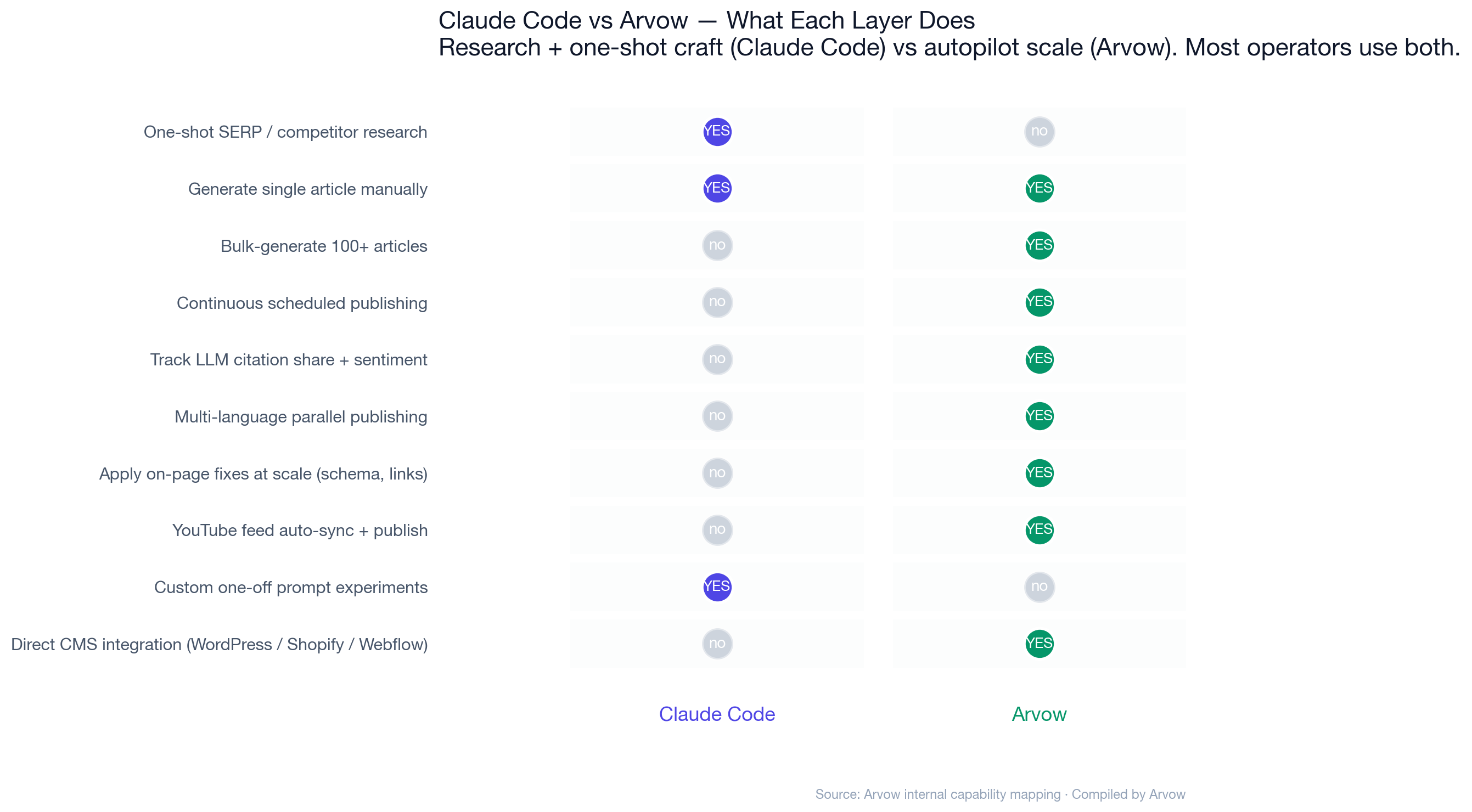
| Need | Use Claude Code | Use Arvow (or equivalent platform) |
|---|---|---|
| One-shot research (SERP analysis, competitor backlink list, citation source mapping) | ✅ | ❌ overkill |
| Generate one article at a time, manually publish | ✅ | ✅ |
| Generate 100 articles, manually publish | ❌ painful | ✅ |
| Continuous, scheduled publishing across multiple sites | ❌ not its purpose | ✅ |
| Track LLM citation share over time, with sentiment | ❌ | ✅ |
| Multi-language parallel publishing | ❌ painful at scale | ✅ |
| Apply on-page fixes (schema, internal linking, alt text) across thousands of pages | ❌ | ✅ |
| YouTube feed auto-syncing + auto-publishing | ❌ | ✅ |
| Bulk negotiate + send outreach emails | ❌ | ❌ (needs Pitchbox / Hunter / similar) |
| One-off custom prompt experiments | ✅ | ❌ less flexible |
The honest summary: Claude Code is the research + craft layer. Arvow is the autopilot scale layer. Most operators we work with use both — Claude Code for the strategic one-shot work; Arvow for the continuous high-volume execution.
16. Honest Limits & Gotchas
Every other “Claude Code SEO” post skips this. Here’s where these workflows actually fail.
1. Prompts go stale fast
Claude’s behavior shifts with model updates (Sonnet 4 → 4.6 → 4.7 → 5 over the last 18 months). A prompt that produced the right output 6 months ago may produce a watered-down version today, or vice versa. We rebuild our master prompts quarterly. Set yourself a calendar reminder.
2. The Max plan is required for the heavy workflows
Workflows 4, 6, 9, 10, 11 routinely take 10+ minutes of Claude’s deep research. On the free tier, you’ll hit rate limits or get truncated output. Claude Code Max ($200/month at writing) is the realistic floor for production use. The Pro plan handles the lighter workflows (1, 2, 7, 8).
3. Output quality varies by domain authority
Workflow 4 (golden content) works best when there’s a clear SERP signal — top 10 pages with consistent structure. For highly volatile SERPs (every position has a different content shape), the prompt produces an averaged output that may not match what’s currently winning. Manual review required.
4. AI Overview and LLM citation behavior is shifting
Per our AI Overviews Statistics 2026: organic CTR drops 61% on informational queries when an AI Overview is present (Seer Interactive). Per our AI Content Detector Report: only 14% of articles ranking in Google are AI-generated, despite 51%+ being AI-written. The implication: AI-assisted and human-edited content with structural signals wins; pure-AI-no-human-edit content increasingly does not. None of the workflows above survive without editorial review.
5. Indexation is the silent killer
Per our pSEO Statistics 2026 piece: IndexingInsight tracked a 25% deindexation purge in May 2025. Mass content workflows (Workflows 5, 6, 7) need pages indexed before they earn anything — and Google’s discretionary indexing is the new spam filter. Strategies: schema markup at scale, internal linking depth, real underlying data per page, brand search demand.
6. Detector classification is mostly irrelevant
Don’t optimize content to “pass detector.” Per our detector report: Vanderbilt disabled Turnitin’s detector after measuring real-world false positive rates of 5–20%. OpenAI’s own classifier achieved 26% accuracy and was shut down. The detector arms race doesn’t determine your ranking; structural signals + editorial depth do. Spend your time on the second category.
7. “Comment ‘prompt’ and I’ll DM” gating is a feature, not a bug
The full prompt files are gated via DM in the source YouTube video for a reason: they’re constantly improving, and Vasco wants to know who’s using them so he can update users when meaningful improvements ship. If you want the raw MD files, find the video link and use the DM mechanic. If you want to rebuild them from the descriptions above, the patterns are documented and replicable.
17. What This Means for Your SEO Stack in 2026
Six concrete moves.
1. Install Claude Code today.
Five-minute setup. Workflows 2 and 7 produce visible wins within a week. Start there if you’re new.
2. Pick the workflow closest to your biggest gap.
- No backlinks? Workflow 9 (NPO/.org) or Workflow 11 (statistical content).
- No LLM citations? Workflow 1 + Workflow 10.
- Content volume bottleneck? Workflow 5 (programmatic) or Workflow 6 (YouTube arbitrage).
- Local business? Workflow 8.
- Just want a quick win? Workflow 2 (schema markup).
3. Run workflows in sequence, not in isolation.
Workflow 1 produces target prompts. Those feed Workflow 4 (content). Workflow 4’s output feeds Workflow 11 (stats roundups). Workflow 11’s pieces feed Workflow 10 (citation outreach). The workflows compound when stacked.
4. Match content velocity with link velocity.
Per our Link Building Statistics 2026: median page-one-ranking site has 907 referring domains. Workflows 9, 10, 11, 12 all build links. Pair them with content workflows or you’re publishing into the void.
5. Internationalize early.
Per our Programmatic SEO Statistics 2026: Preply’s 60K-page library across 50 languages drove a 7.6× traffic lift. Most “Claude Code for SEO” guides ignore this entirely. The same workflows in French/Spanish/Portuguese/German/Greek face ~10× less competition.
6. Track LLM citation share, not just rankings.
Per our AI Overviews Statistics 2026: brands cited inside AI Overviews win 35% more organic clicks. Brands not cited see CTR fall 58–61% on informational queries. The new objective is citation, not just ranking. Set up LLM Visibility Tracker before you scale any of the workflows above.
Ready to act? Arvow’s AI SEO Agent automates the structural signals (schema, internal linking, FAQ formatting, citation density) that the workflows above all converge on. Arvow’s Autoblog is the continuous-publishing layer that Claude Code can’t reach alone. Arvow’s Link Building Service is the manual-outreach layer for DR 40+ niche-relevant placements. Together: the full Claude-Code-to-published-at-scale stack.
Or just see the output: Try 3 Free Articles →
Σ Summary: The 12 Claude Code SEO Workflows
| # | Workflow | Effort | Time to first result | Recurring? |
|---|---|---|---|---|
| 1 | LLM Citation Reverse Engineering | Medium | 24h–30d | One-time setup, periodic refresh |
| 2 | Aggregate Rating Schema Markup | Low | 1–4 weeks (post-index) | One-time |
| 3 | Full Site SEO Audit | Low | Same day | Quarterly |
| 4 | Golden Piece of Content | Medium | 1–3 months | Per target keyword |
| 5 | Programmatic SEO | High | 2–10 months | Continuous via Autoblog |
| 6 | YouTube → Blog Arbitrage | Medium | 6 weeks–6 months | Continuous via Feed + Autoblog |
| 7 | News Automation | Low | 2–8 weeks | Continuous via Autoblog |
| 8 | Local Business Content Pipeline | Medium | 2–6 months | Continuous |
| 9 | NPO/.org Backlink Building | Low effort, $ cost | 1–4 weeks | One-time per NPO |
| 10 | LLM Citation Outreach | Medium | 2–8 weeks per link | Per target prompt |
| 11 | Statistical Content for Backlinks | High effort, $0 cost | 4–12 weeks per piece | Per topic |
| 12 | Competitor Backlink Replication | High | 2–6 weeks per link | Per prospect |
Frequently Asked Questions
What is Claude Code and how is it different from ChatGPT?
Claude Code is Anthropic’s terminal-native AI engineer, distributed via claude.com/download. Unlike ChatGPT’s web interface, Claude Code anchors every session to a folder on your machine — meaning your project’s files (sitemap, competitor analysis, ICP doc, prompt MD files) are persistent context across prompts. For SEO operations that chain multiple steps (research → brief → content → outreach), this persistence is the structural advantage.
Can I use Claude Code for SEO on the free plan?
Yes, for the lighter workflows (schema markup, single-article generation, simple keyword research). For workflows that require 10+ minutes of deep research (Workflows 4, 6, 9, 10, 11), Claude Code Max is the realistic floor — the free tier hits rate limits or produces truncated output on the heavy prompts.
Does Google penalize AI-generated content created by Claude Code?
No — Google’s official position (Search Central, 2024 onward) is that AI content is not penalized as a category. SpamBrain + the helpful content system target low-quality content regardless of generation method. The risk is publishing thin, undifferentiated, structurally weak content — which happens to often be AI-generated. Per our pSEO Statistics 2026 piece: only 14% of articles ranking on Google are AI-generated, despite 51%+ being AI-written — the gap is editorial depth + structural signals, not detection.
Which of the 12 workflows gives the fastest visible result?
Workflow 2 (aggregate rating schema markup) — typically visible in SERPs within 1–4 weeks once your page is re-crawled. Workflow 3 (the SEO audit) is the fastest insight — same-day actionable report.
What’s the highest-revenue workflow?
Workflow 6 (YouTube → Blog Arbitrage) — the documented case study site pulls 1.3M monthly visits and an estimated $400K/month in traffic value. Workflow 5 (Programmatic SEO) is the highest-ceiling for product-led businesses where the template intent matches a high-volume long tail.
Do I need to know how to code to use Claude Code?
No. The workflows above don’t require writing code — Claude Code handles the code execution. You write natural-language prompts; Claude Code generates and runs the underlying scripts. The only setup step that touches code-adjacent territory is Workflow 3 (the audit), which requires installing VS Code and cloning a GitHub repo — both no-code-required steps.
Where do the master prompts come from?
The full MD files used in the source video are gated behind the YouTube DM mechanic (comment "prompt" on the video, get DM'd the file). This guide reconstructs each workflow’s prompt structure in enough detail to rebuild from scratch. For the raw MD files, find the source video and use the comment-DM flow.
Can Claude Code automatically publish to my WordPress / Shopify / Webflow site?
Not directly. Claude Code outputs files (Markdown, HTML, JSON). You can copy/paste into your CMS, or pipe the output through an automation layer like Arvow’s Autoblog which has direct CMS integrations and continuous-publishing scheduling. Claude Code is the generation layer; Arvow is the publishing-at-scale layer.
Will these workflows still work in 12 months?
Some will, some won’t. Workflows targeting structural signals (schema markup, internal linking, citation density, brand mention diversity) compound durably. Workflows targeting specific LLM behavior (Workflow 1, Workflow 10) need quarterly rebuilds as model providers shift citation algorithms. The honest answer: the categories of work are durable; the specific prompt instructions will need updating as the underlying models evolve.
What’s the single most important workflow to start with?
If you’re optimizing for Google rankings: Workflow 4 (Golden Piece of Content) for your single highest-priority keyword. If you’re optimizing for LLM citations: Workflow 1 (LLM Citation Reverse Engineering). If you’re optimizing for traffic volume: Workflow 6 (YouTube → Blog Arbitrage). If you’re optimizing for backlinks: Workflow 9 (NPO/.org) for fastest visible link, Workflow 11 (Statistical Content) for highest ongoing yield.
Methodology and Sources
This guide compiles 12 Claude Code SEO workflows that have been built, tested, and run in production at arvow.com between October 2025 and May 2026. Specific case studies cited are publicly documented:
- The IQ-test programmatic SEO site: documented at $10.9K/month traffic value, ~30K monthly visits, public Ahrefs data
- Top Gear / Car Reviews YouTube arbitrage case: documented at 1.3M monthly visits to
/car-reviews/, $400K/month estimated traffic value - The Tesla accessories news automation case: ~$2K/month traffic value to
/news/, ~100K monthly visits to the broader site - The French ophthalmology clinic local SEO case: ~20K monthly visits, $1.7K/month traffic value, all in French
- The dog-grooming agency NPO backlink case: documented DR 40+
.orgplacements built via donation sponsorship - The Hunter Talent SEO case study (Backlinko): $96K investment over 60 months → $3.8M additional revenue, 4,122% ROI
Cross-references to other arvow research
These workflows were developed in parallel with our 2026 statistics roundups: - AI Overviews & AI Mode Statistics 2026 — the AIO CTR collapse data informs Workflow 1 - GEO Statistics 2026 — the citation patterns inform Workflows 1, 10 - Link Building Statistics 2026 — the link cost benchmarks inform Workflows 9, 10, 11, 12 - Programmatic SEO Statistics 2026 — the 70% → 3% → 20% AI decay curve informs the structural-signal guidance throughout - SEO Agency Statistics 2026 — the pricing + retainer benchmarks inform the “when to use Claude Code vs. an automation platform” section - AI Content Detector Report 2026 — the Stanford bias + Vanderbilt disablement data inform the gotchas section
Primary sources used inline
- Claude Code (Anthropic) —
claude.com/code - Ahrefs (SEO industry data) — various studies
- Google Search Central — official AI content + helpful content policy
- Schema.org — aggregate rating schema specification
- WebFX 2026 Backlink Study — referring domain benchmarks
- Backlinko SEO Pricing 2026 — Hunter Talent case study
This page was last updated May 2026. Bookmark it — we update quarterly as Claude’s models evolve and new workflows ship.
Keep reading
Generate, publish, syndicate and update articles automatically
The AI SEO Writer that Auto-Publishes to your Blog
- Cancel anytime
- Articles in 30 secs
- Plagiarism Free