
How to Find Low Competition Keywords in 2026 (the Blood in the Water Method)

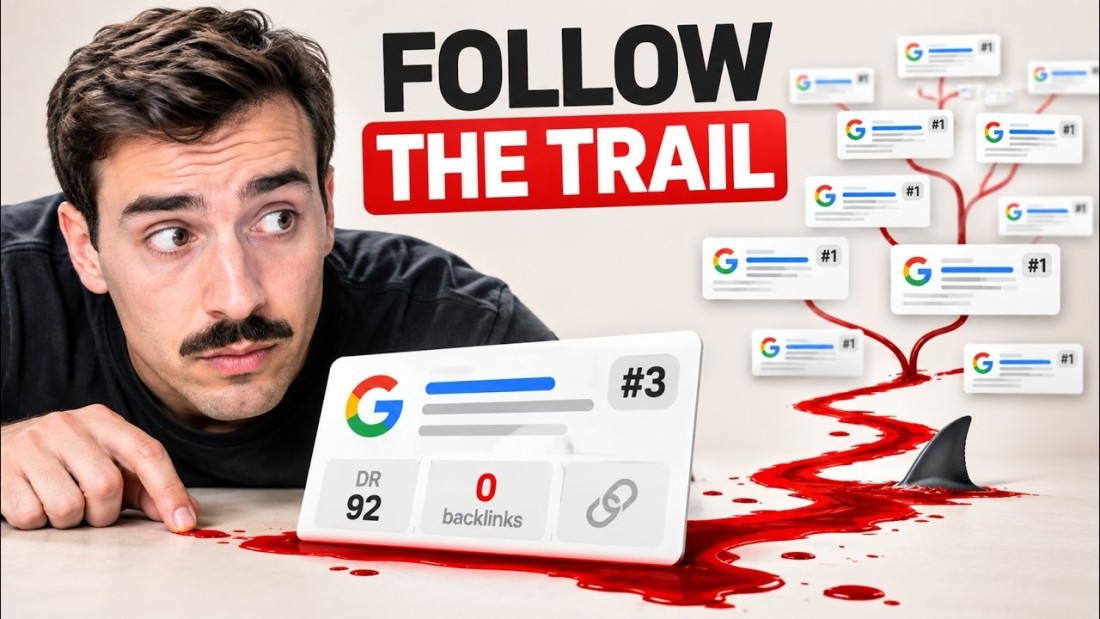
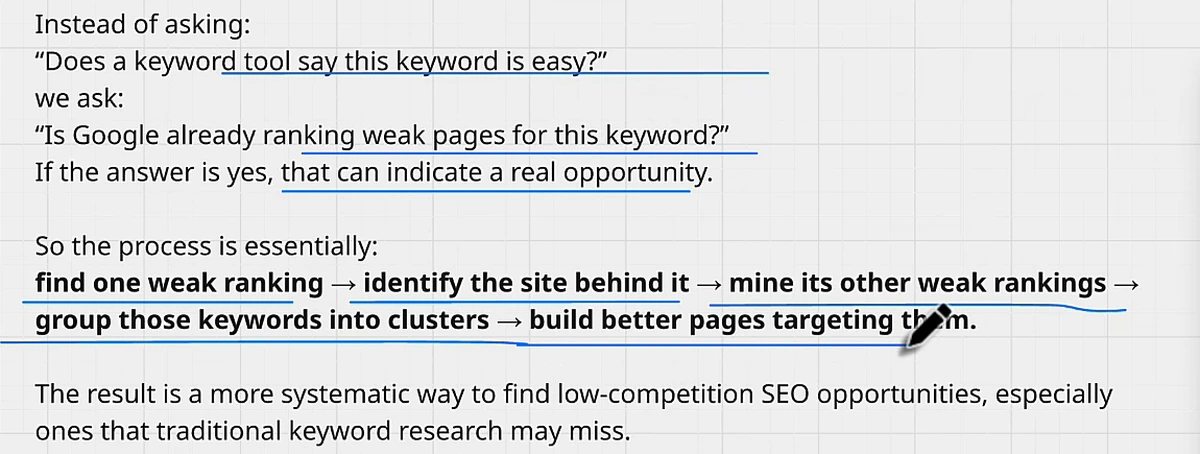
Most advice on how to find low competition keywords starts in the same place: open a keyword tool, filter keyword difficulty below 20, sort by volume. The method in the video below starts somewhere else entirely — with the search results themselves. It is called blood in the water, and the question it asks is not "does a tool say this keyword is easy?" but "is Google already ranking a weak page for it?" The video walks through the full prompt, then runs it live against arvow.com's own niche and gets back a scored list of keywords where a DR 48 site ranks top six with generic tool pages. This article breaks down the method, the scoring, and what the live run did and did not prove.
Why keyword difficulty is the wrong place to start
Keyword difficulty is an estimate built mostly from the backlink profiles of the pages that already rank. It tells you how strong the incumbents look on paper. It does not tell you whether Google is actually satisfied with them.
Those are different things. A very authoritative website can sit in the top five for a keyword even though the specific page has almost no backlinks, barely targets the query, or is a generic category page. The domain is carrying the page. When you see that, it tells you something a difficulty score cannot: Google is willing to rank a relatively weak page for this search, because nothing better exists yet.
That is the whole idea. A low KD number might be low competition, or it might be a keyword nobody bothered with because it converts badly. A weak page ranking on a strong domain is direct evidence that the SERP is under-served.
What an "accidental ranking" looks like
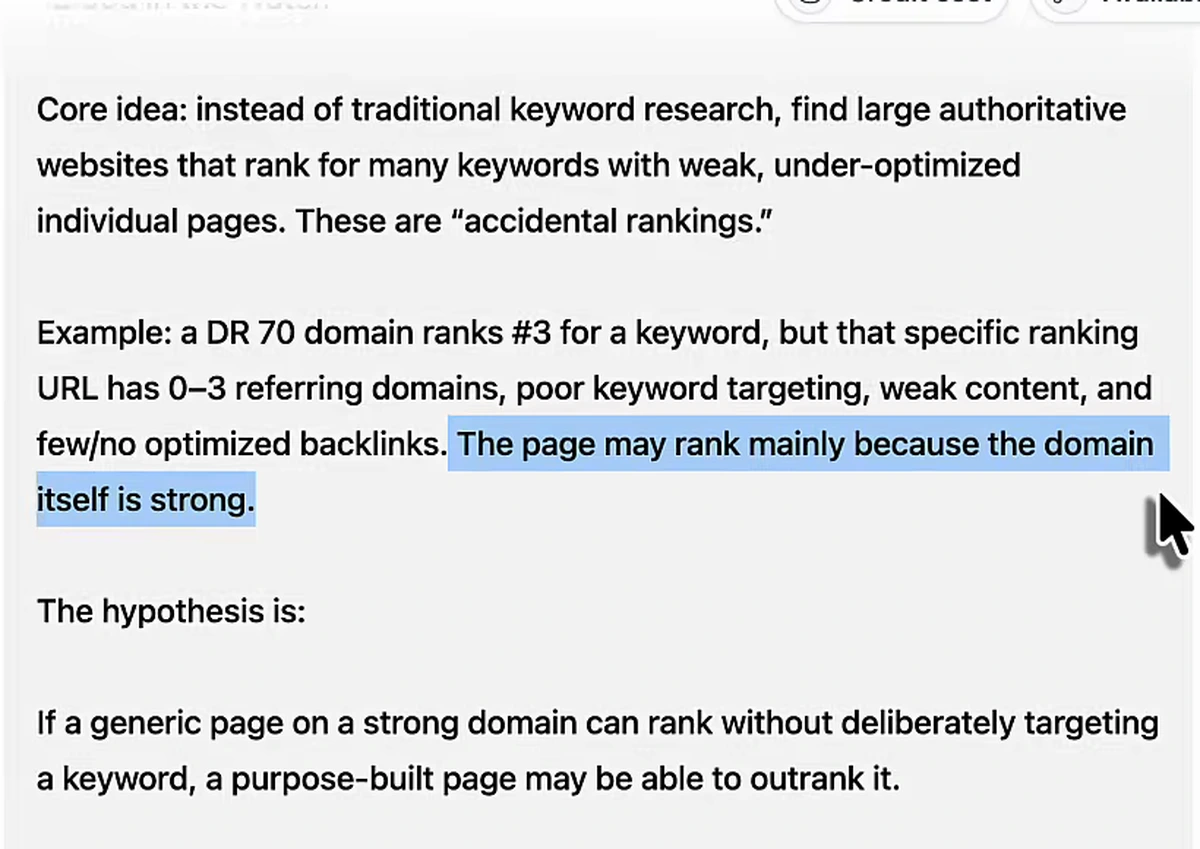
The method's core unit is the accidental ranking: a page that ranks for a keyword it was never really built for. The prompt shown in the video defines it with a concrete example — a DR 70 domain that ranks #3 for a keyword, while the ranking URL itself has zero to three referring domains, poor keyword targeting, thin content and few or no optimized backlinks. The page ranks because the domain is strong.
The prompt lists six signals that a ranking page is weak. Any one is a hint; several together are the opportunity:
- Forums, Reddit or other UGC ranking — Google is filling the slot with discussion because no dedicated page exists.
- Broad category pages ranking for a specific query.
- Very few referring domains pointing at the ranking URL itself, whatever the domain's total.
- Keyword missing from the title or H1.
- Outdated or thin content.
- Weak intent match — a blog post ranking where searchers want a tool, or a listicle where they want an answer.
How to find low competition keywords with this method, step by step
The prompt turns the idea into a six-stage workflow. You can run it by hand; it is slow but nothing in it requires AI.
1. Find one weak SERP
Start with a seed keyword or a niche — if you need a starting list, seed keywords are the right input. Search them and look for the six signals above. You only need one.
2. Identify the "weak broad competitor"
Look at who owns that weak ranking. You want a domain with strong overall authority that appears for many keywords in the niche, but whose individual pages often have weak page-level SEO. The opportunity appears exactly where a strong domain ranks with weak pages.
3. Mine its organic rankings
Pull as many of that domain's ranking keywords as you can. For each one, collect the keyword, ranking URL, position, search volume, estimated traffic, KD, CPC, referring domains to that URL, domain rating, title/H1, search intent and the other SERP competitors. In the prompt's own phrase: the competitor becomes your keyword database.
4. Detect the accidental rankings
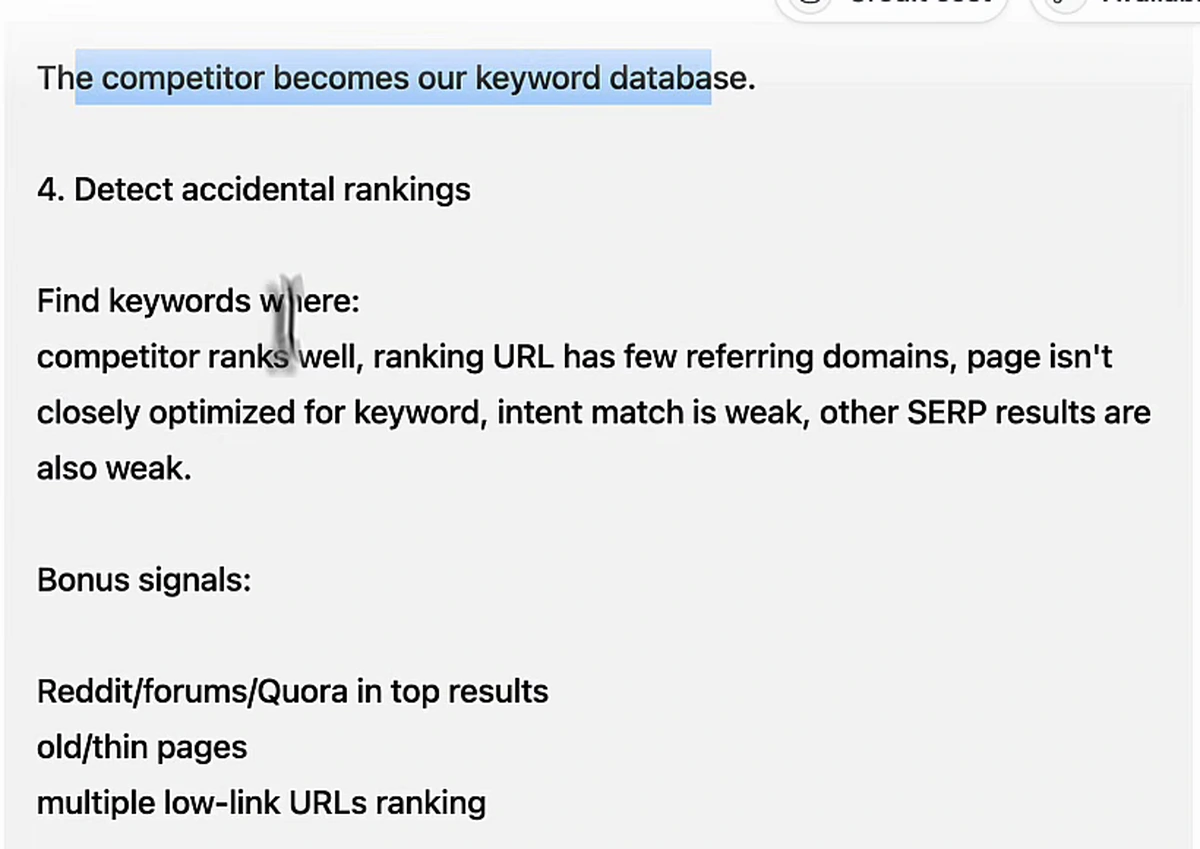
Filter the mined list down to rows where the competitor ranks well but the URL has few referring domains, the page is not closely optimized, intent match is weak, and the other results on the page are weak as well. That last condition matters: one weak page next to nine strong ones is not an opening.
5. Expand into clusters
Every opportunity implies neighbours: product + review, alternatives, X vs Y, best [category], [category] for [use case], long-tail variants, and other rankings from the same competitor. The goal, as the prompt puts it, is clusters, not isolated keywords.
6. Score every opportunity from 0 to 100
Positive factors add points: meaningful volume, commercial intent, the competitor in the top ten, few referring domains on the URL, poor title/H1 alignment, weak SERP results, a large related cluster. Negative factors subtract: strong referring domains, a SERP dominated by dedicated optimized pages, specialist sites, difficult intent, poor organic click opportunity. And one explicit instruction: do not rely only on KD.
A live run: what it found on arvow.com's own niche
The video runs the prompt inside Arvow's AI SEO chat, connected to the site's Search Console plus SERP and SEO data. Five tools fired — SERP analysis, competition analysis, keyword overview, domain overview and keyword rankings — and the reply opened with the weak-broad-competitor profile for the niche.
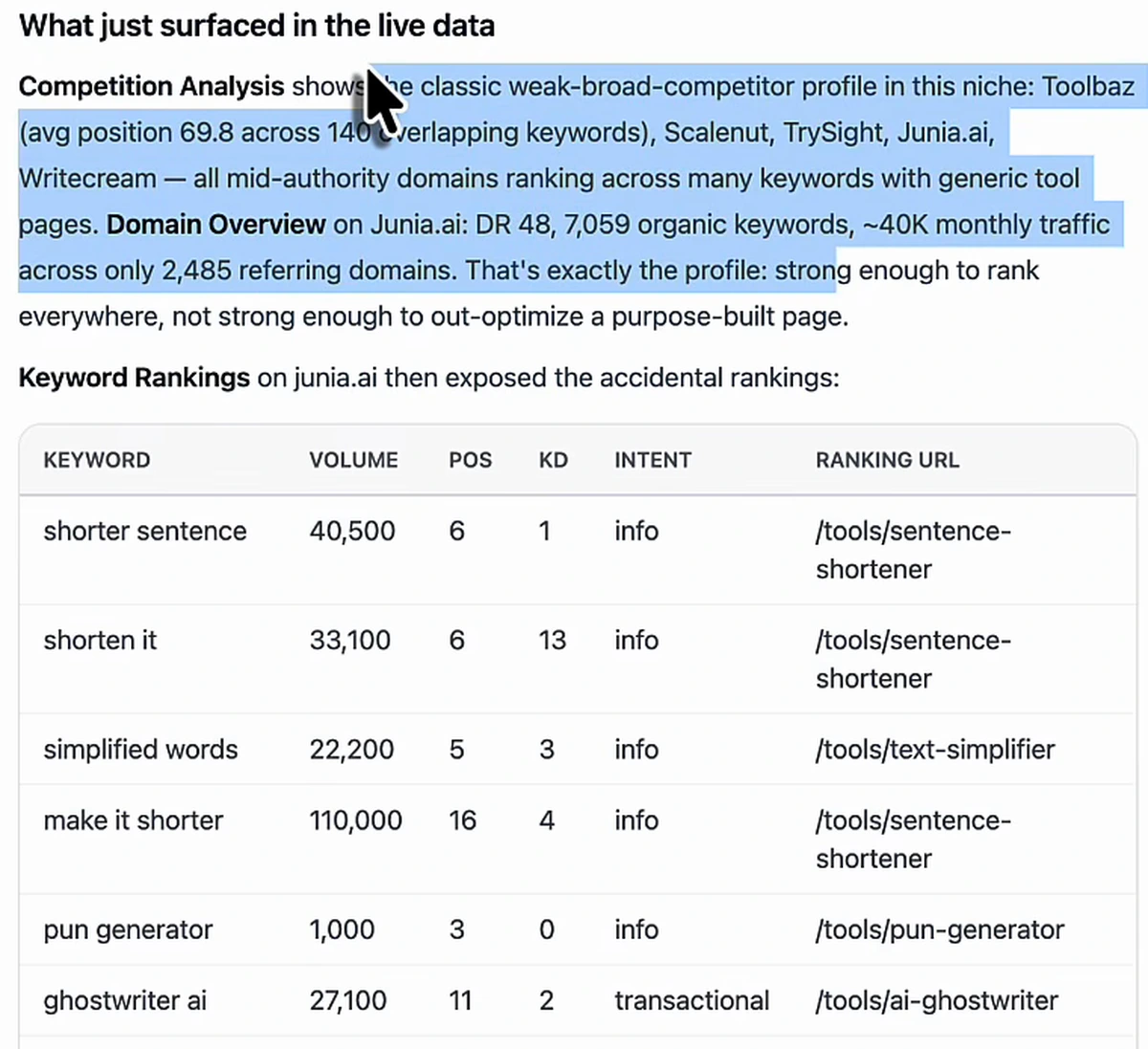
Two details are worth pulling out.
The competitor was mid-tier, not Forbes. The video's explanation uses the giant-publisher example — Forbes, LinkedIn posts, forum threads ranking on borrowed authority. But the chat deliberately went after a "mid-tier AI SEO competitor", reasoning that this is where accidental rankings hide: big niche authority, weaker per-page optimization than Semrush or Ahrefs. The domain it picked, at DR 48 with 7,059 keywords and ~40K monthly traffic on 2,485 referring domains, is, in its words, "strong enough to rank everywhere, not strong enough to out-optimize a purpose-built page". For most sites that is the more useful target — you can realistically out-build a DR 48 tool page; you probably cannot out-link Forbes.
Not every row is a top-ten ranking. "make it shorter" — the biggest number in the table at 110,000 — sits at position 16, and "ghostwriter ai" at 11. The scoring rubric handles this (position beyond 30 is a penalty; top ten is a bonus), but read the table as a candidate list, not a list of pages already on page one.
We re-checked one signal, and it only half held
An accidental ranking is supposed to be a page that does not target its keyword. When we loaded the competitor's sentence-shortener tool page on 24 September 2026, its title read "Free AI Sentence Shortener" and its H1 "Free Sentence Shortener". So for the head term sentence shortener, the keyword is in the title — that page is not accidental. The accidental part is the variants: "shorter sentence", "shorten it" and "make it shorter" are ranking on a URL that targets a different phrase. That is still a real opening, and it is precisely why stage 5 (clusters) exists. But it is a good reminder to open the ranking URL yourself before trusting a signal a tool reported.
The score, and why KD is only a penalty
The chat turned the prompt's factors into an explicit points table. Every score prints its breakdown, so you can argue with it.
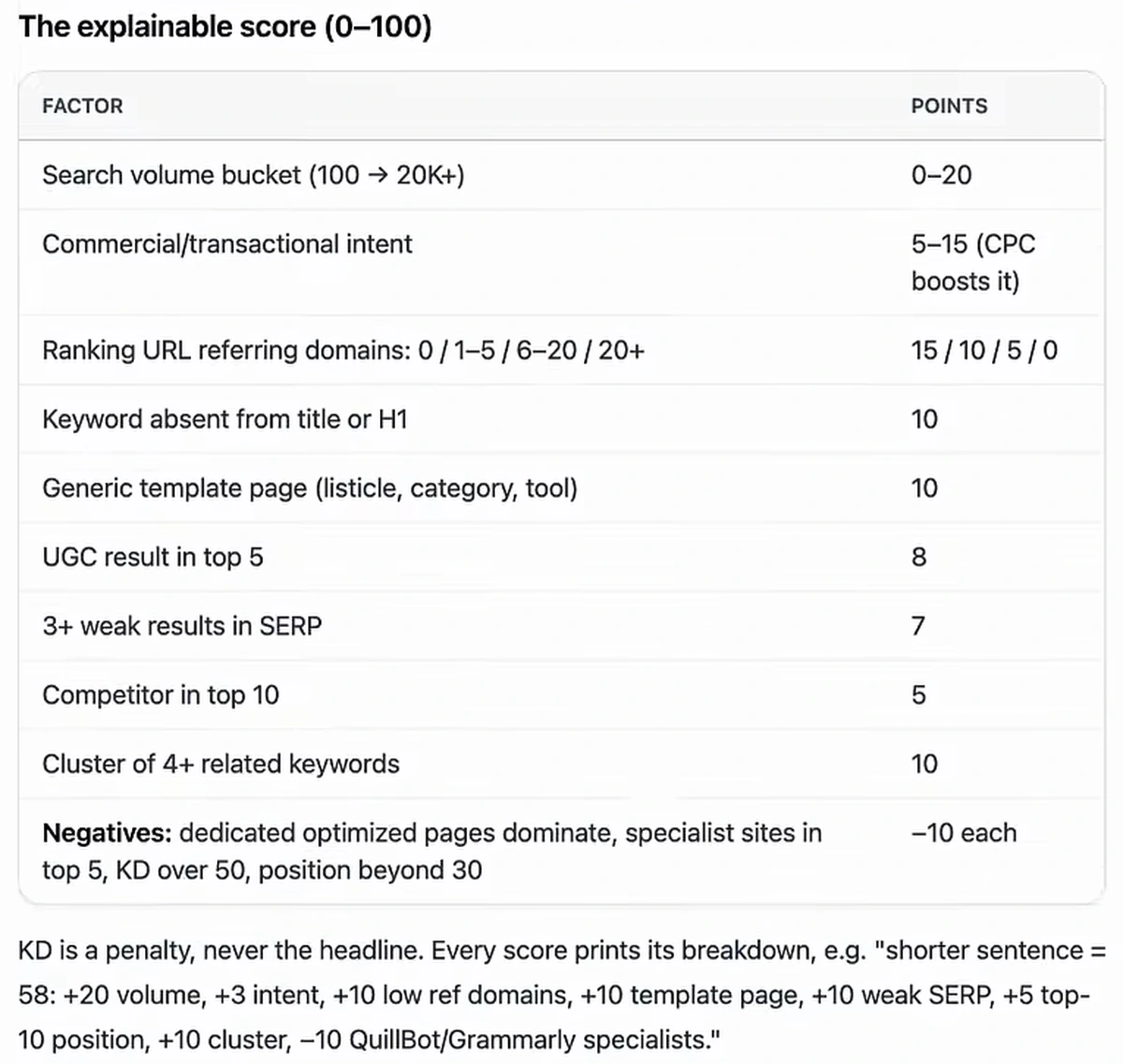
The worked example checks out: "shorter sentence" scores 58 = +20 volume, +3 intent, +10 low referring domains, +10 template page, +10 weak SERP, +5 top-10 position, +10 cluster, −10 because QuillBot and Grammarly are specialists in the SERP. That −10 is the honest part of the rubric — a strong specialist in the top five is exactly the kind of competitor a low KD number hides.
If you are building this yourself, copy the structure rather than the exact weights. The weights are a judgment call; the principle that referring domains to the URL outweigh the domain's overall strength is the part that makes the method work.
From opportunity to page plan
The last output is a plan per page: primary and supporting keywords, title, slug, intent, the competitor URL to beat, why the SERP is weak, and internal links.
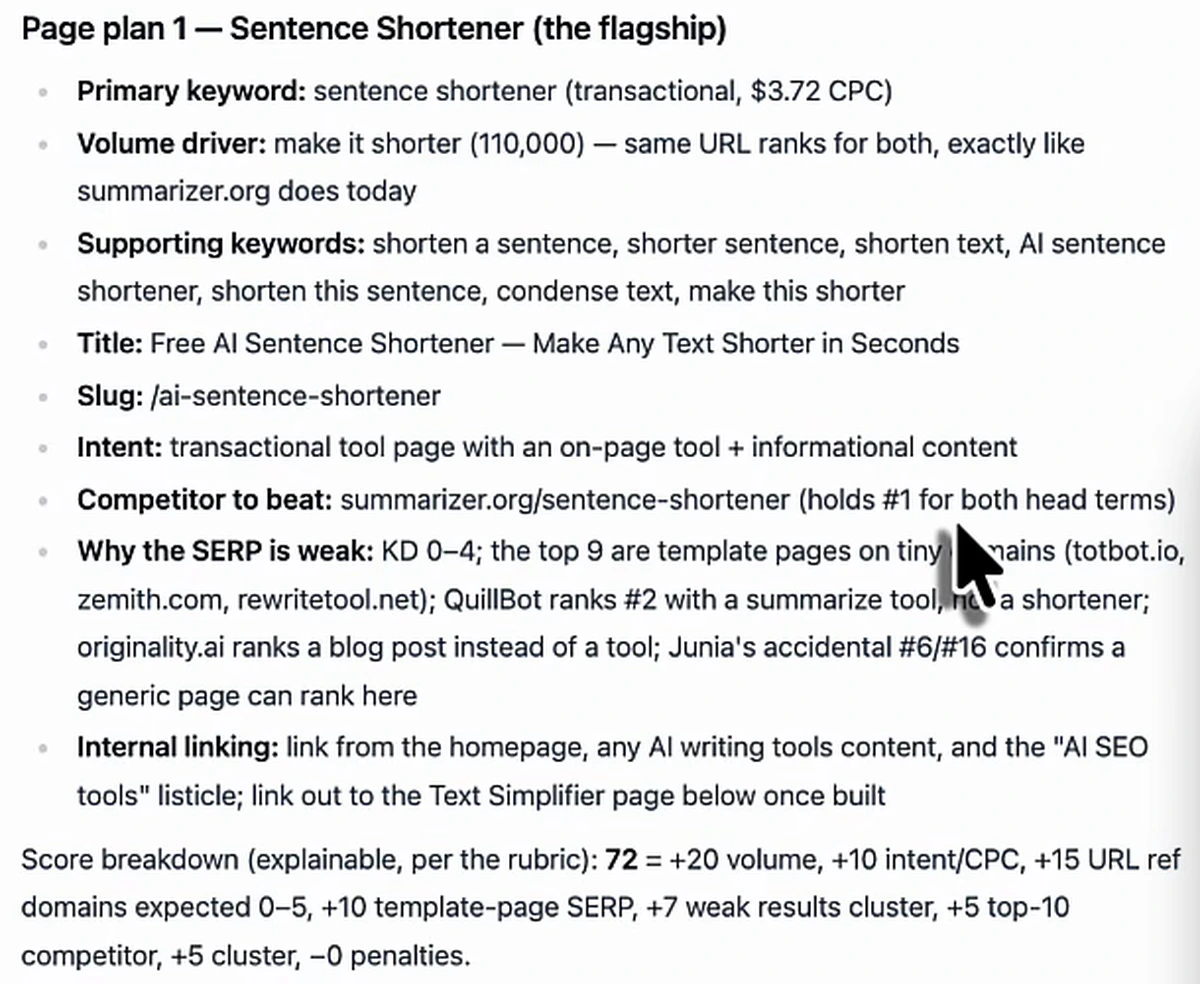
Notice the intent diagnosis in the plan: one result is a summarizer ranking for a shortener query, another is a blog post where searchers want a tool. That is weak intent match — signal six — and it is usually the easiest gap to close, because the fix is simply building the thing the searcher asked for.
The chat also grouped the adjacent keywords: the sentence-shortener and text-simplifier pair covers a family of roughly 300K monthly searches, with a text simplifier page planned as the second, cross-linked page. It then offered to draft the first page directly, which is where this kind of research normally stalls.
What you need to run it yourself
The presenter is blunt about one requirement: this does not work on dummy data. Pasting the prompt into ChatGPT or Claude with no data connected gets you plausible-looking keywords and nothing else. At minimum you need:
- Google Search Console — free, and it tells the model what your own site already ranks for.
- Live SERP access — the model has to actually see whether Reddit, Quora or a LinkedIn post is sitting in the top five.
- A backlink and keyword data source — an Ahrefs or Semrush API or equivalent, for referring domains per URL, KD, volume and CPC.
He also says it is expensive to run, because every pass makes live SERP checks and ranking pulls. That is the real cost of the method, AI or not. For the manual route, the same six stages work in a spreadsheet — it just takes far longer per competitor. If you would rather keep keyword research mostly automated, automated keyword research covers the broader workflow, and AI keyword analysis covers what language models are and are not good at here.
The presenter uses Arvow's AI SEO chat because the data sources are already connected — and he says plainly that it is his own tool and he is biased. The broader argument for letting an agent run this kind of multi-tool research is in agentic SEO.
What the video does not prove
The title promises ranking #1 on Google in 24 hours. The video does not show that happen. It shows the research: a scored opportunity list and a page plan, with the page itself queued for drafting. Whether that sentence-shortener page ranks, and how fast, is not on screen, so it is not claimed here.
What the method does credibly give you is better odds. A purpose-built page competing against template pages on tiny domains and a generic tool page on a DR 48 site is a fight you can win; a low-KD keyword chosen blind might not be. That is the honest version of "low competition".
FAQ
What is the blood in the water SEO technique?
A way to find low competition keywords by starting from the SERP instead of a keyword tool. You look for strong domains ranking with weak individual pages — few referring domains, keyword missing from the title, weak intent match — then mine that domain's other rankings for the same pattern and build better, purpose-built pages.
Is low keyword difficulty the same as low competition?
No. KD estimates how strong the ranking pages' backlink profiles look. Low competition means the ranking pages are weak for this query: generic, off-intent, thin, or ranking on domain authority alone. In this method KD is only a penalty, applied above 50.
Do I need AI to do this?
No. Every stage can be done by hand with Search Console, a SERP check and any backlink tool. AI makes the mining and scoring fast; it does not replace the data. Without live data connected, the output is guesswork.
What kind of competitor should I mine?
A mid-authority domain that ranks for many keywords in your niche with generic pages. In the live run that was a DR 48 site with ~7,000 ranking keywords. Very large publishers show the same pattern but are harder to displace.
Want to run the blood in the water pass on your own niche with Search Console, SERP and backlink data already connected? Try Arvow's AI SEO chat.
Generate, publish, syndicate and update articles automatically
The AI SEO Writer that Auto-Publishes to your Blog
- Cancel anytime
- Articles in 30 secs
- Plagiarism Free