
GEO Statistics 2026: The Complete Data Report on Generative Engine Optimization

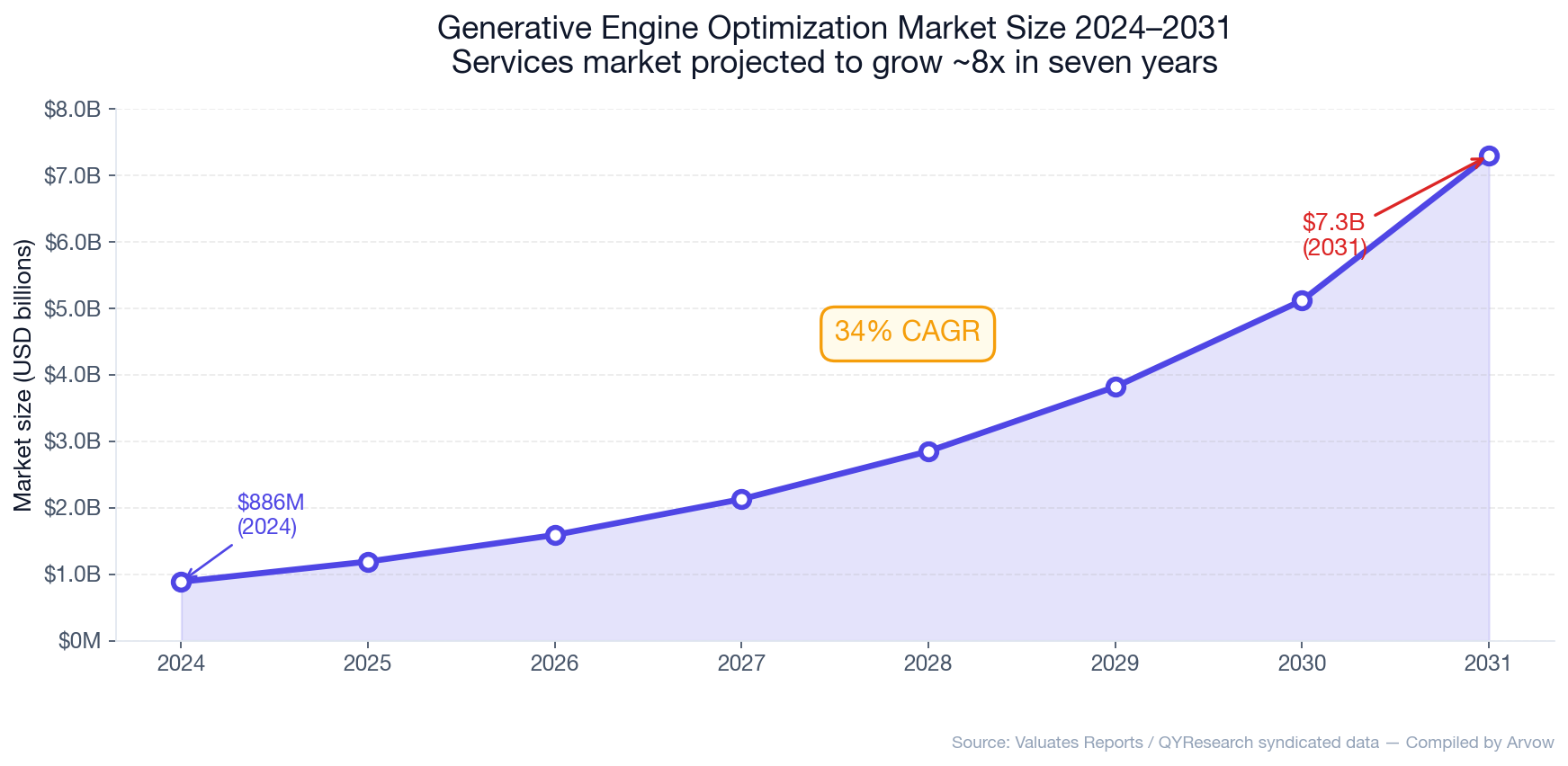
Generative Engine Optimization is now a $886M market projected to hit $7.3B by 2031 at a 34% CAGR — and 94% of enterprise CMOs plan to increase GEO investment in 2026, with GEO ranked their #1 strategic marketing priority. AI referrals already account for 1.08% of total website traffic across 10 enterprise industries (Conductor) — small in absolute terms, but converting at 11× the rate of traditional search for sign-ups (Microsoft Clarity, 1,200+ sites). The Princeton/Georgia Tech academic paper that defined the field showed specific tactics — adding citations, statistics, and quotations — boost a brand’s visibility in generative engines by 30–41%. This is what SEO was in 2003: small, growing fast, and structurally undervalued.
We aggregated data from Princeton, Profound, Yext, Conductor, Adobe Analytics, Microsoft Clarity and 25+ other primary sources to compile the most comprehensive and methodology-checked GEO statistics available in 2026. Where independent studies disagree (and they often do — AI Overview prevalence ranges from 13% to 48% across reports), we explain why. Every stat below is dated, sourced, and methodology-checked.
$7.3B GEO market projected by 2031 |
94% of CMOs increasing GEO investment in 2026 |
+41% visibility lift from adding quotations to content |
11x higher LLM sign-up conversion vs. search |
Key Takeaways (2026)
- Market size: GEO Services market hit $886M in 2024 and is projected to reach $7.3B by 2031 (Valuates Reports). The GEO tools category alone has absorbed $200M+ in venture funding since launch.
- Adoption is near-universal: 97% of enterprise digital leaders report GEO is already driving measurable business impact. 94% plan to increase investment in 2026 (Conductor, 250-CMO survey).
- Princeton’s tactics work: Adding quotations to your content boosts LLM visibility +41%, statistics +33%, citations +28%. For lower-ranked content, citing sources lifts visibility +115% (Aggarwal et al., KDD 2024).
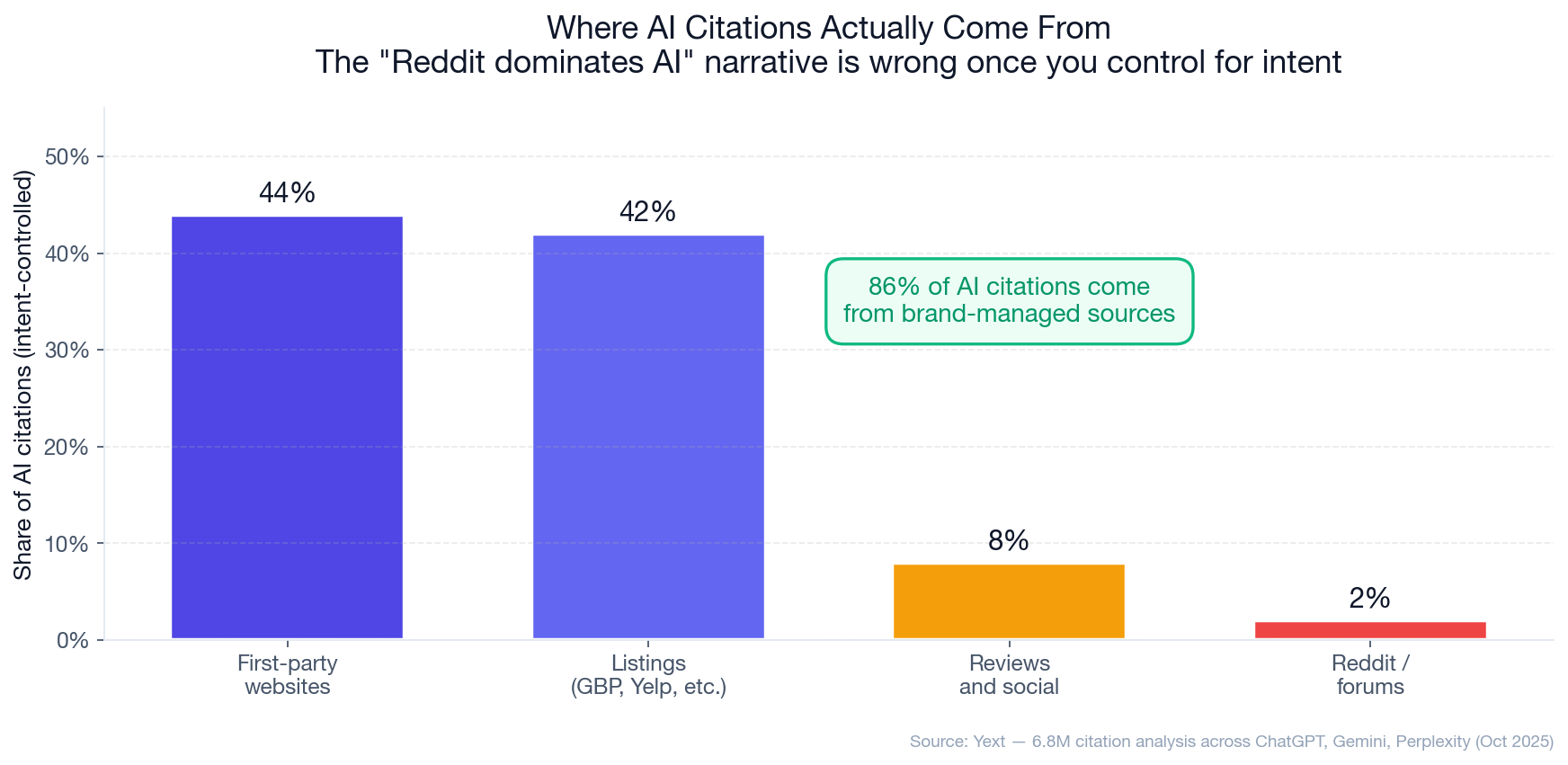
- Brand-managed wins: 86% of AI citations are brand-managed sources — not Reddit (Yext, 6.8M-citation analysis). The “Reddit dominates AI” narrative is wrong once you control for intent.
- AI traffic is small but converts hard: AI referrals are 1.08% of traffic but convert at 11× the rate of search for sign-ups (Microsoft Clarity, 1,277 domains). Adobe found AI conversion 42% better than other traffic as of March 2026.
- First-party Arvow data: Arvow’s own ChatGPT-driven signups grew from 6.7% to 38.1% in 3 months (5.6×). One yoga e-commerce brand earned 572 ChatGPT mentions and 54 Google AI Overview citations from 238 AI-published articles. Roughly 1 in 3 ChatGPT-cited pages have zero measurable Google traffic — the GEO/SEO decoupling is real.
- Platform shift: ChatGPT dominates referrals (87.4% per Conductor) but Gemini grew to 750M MAU in Q4 2025 and is closing fast. Citation patterns differ wildly by platform.
- Measurement gap: 62% of marketing leaders say they cannot measure GEO ROI. Investment is happening anyway.
- Stats don’t agree, and that’s the story: AI Overview prevalence ranges from 13% to 48% across studies. We explain why in §14 — the methodology choices that explain divergence are themselves the most useful insight in the field.
- The economic picture: Profound raised $155M and hit a $1B valuation in 18 months. Andreessen Horowitz frames GEO as the disruptor of an $80B+ SEO industry.
1. The GEO Market by the Numbers
GEO went from “buzzword” to fundable category in roughly 18 months.
Market size and trajectory: - The Generative Engine Optimization Services market was valued at US$886 million in 2024 and is projected to reach US$7.3 billion by 2031 at a 34% CAGR (Valuates Reports / QYResearch syndicated data, July 2025). - An alternate forecast — counting only software platforms, not services — pegs the market at $520M in 2025, growing to $698M in 2026 (Research Intelo). - Andreessen Horowitz frames GEO as disrupting the $80 billion+ SEO industry (a16z Enterprise Newsletter, Sarah Wang & Jennifer Li, May 2025).
Funding velocity tells the same story: - Profound raised $155M total in 18 months: $20M Series A (Kleiner Perkins, June 2025), $35M Series B (Sequoia, August 2025), and $96M Series C at a $1B valuation (Lightspeed, Q1 2026). - Total venture funding into the GEO/AEO tools category exceeded $200M by year-end 2025, including Bluefish ($20M Series A), Scrunch AI ($15M), Evertune ($15M), AthenaHQ ($2.7M Y Combinator), and Peec AI ($29M total) (PlateLunch Collective + individual press releases). - Profound’s 27M Enhanced Citation Categories study is now the largest published GEO dataset.
The honest interpretation: the $886M market figure is conservative. It counts services-only, on a narrow definition. If you include in-house spend, internal tooling, and consulting, the real money flowing into GEO in 2026 is several multiples larger.
2. AI Search Traffic & Referrals: How Big, How Fast, How Valuable
The single most-asked GEO question is: “How much traffic does AI actually send?” Three converging datasets give us the answer.
The headline numbers (Conductor enterprise dataset, 1,215 customer domains, 35.7M AI sessions of 3.3B total, May–September 2025): - AI referrals account for 1.08% of total website traffic across 10 enterprise industries. - 87.4% of AI referral traffic comes from ChatGPT. - Citation analysis covered 13,770 domains and 100M+ citations — the largest published GEO citation analytics study.
The growth curve (Microsoft Clarity, 1,200+ publisher sites, 8 months): - AI-driven referrals grew +155.6% over an 8-month period. - Comparison: Search +24.0%, Social +21.5%, Direct +14.9%.
The penetration data (Ahrefs): - 63% of websites receive trackable AI traffic — 1,900 of 3,000 sites studied (Ahrefs AI Traffic Study, February 2025). - AI traffic increased 9.7× in the past year, reaching 0.25% of average site total traffic. Google still sends 210× more traffic than ChatGPT, Perplexity, and Gemini combined (81,947-site sample, mid-2025). - ChatGPT accounts for >80% of all AI referral traffic to websites.
Adobe’s retail-specific data is the most aggressive growth signal: - Generative AI traffic to U.S. retail sites grew 1,200% year-over-year as of February 2025, then 693% YoY through 2025 holiday season, then 393% YoY in Q1 2026. - AI conversions were 54% higher than non-AI on Thanksgiving and 38% higher on Black Friday 2025. - AI traffic converted 42% better than other traffic in March 2026. - AI-driven revenue per visit was up 254% during the 2025 holiday season.
The picture is consistent across sources: AI traffic is still ~1% of total volume but growing 100–155% per year and converting at multiples of traditional channels. That math is why budget keeps flowing in despite the 1% absolute number.
3. GEO Adoption: How Brands and Marketers Are Investing
Adoption is near-universal among enterprises. The question is no longer “if” but “how much.”
Conductor’s State of AEO/GEO 2026 CMO Investment Report surveyed 250+ enterprise CMOs/VPs/Senior Directors: - 97% of enterprise digital leaders report GEO/AEO is already driving measurable, positive business impact. - 94% plan to increase GEO investment in 2026. - GEO ranked the #1 strategic marketing priority for 2026. - U.S. enterprises allocated 12% of digital marketing budgets to GEO in 2025. - 56% of digital marketing leaders reported “high or significant” GEO investments in 2025. - High-maturity organizations are 2× more likely than medium-maturity (and 3× more than low-maturity) to significantly increase GEO investment in 2026.
The publisher-side view (Reuters Institute survey of 326 senior digital news leaders across 51 countries, January 2026): - 74% of news executives are worried about a potential decline in search referral traffic this year. - 56% net are directing more effort at AI platforms (vs. less).
The honest tension: - 62% of marketing leaders say they cannot measure the ROI of their AI search optimization efforts (Conductor, 2025).
That last stat is the one to sit with. Companies are investing aggressively in GEO without a clean attribution model. They’re betting the channel matters before they can prove it numerically — which is the same gamble early SEO investors took in 2003.
4. The GEO Tactics That Actually Work — Princeton’s Findings
This is the section nobody else has properly translated. The Princeton/Georgia Tech/Allen Institute paper (“GEO: Generative Engine Optimization,” Aggarwal et al., KDD 2024) ran systematic experiments on 10,000 queries and identified the specific content modifications that boost a source’s visibility in generative engines.
The hierarchy of tactics, ranked by visibility lift:
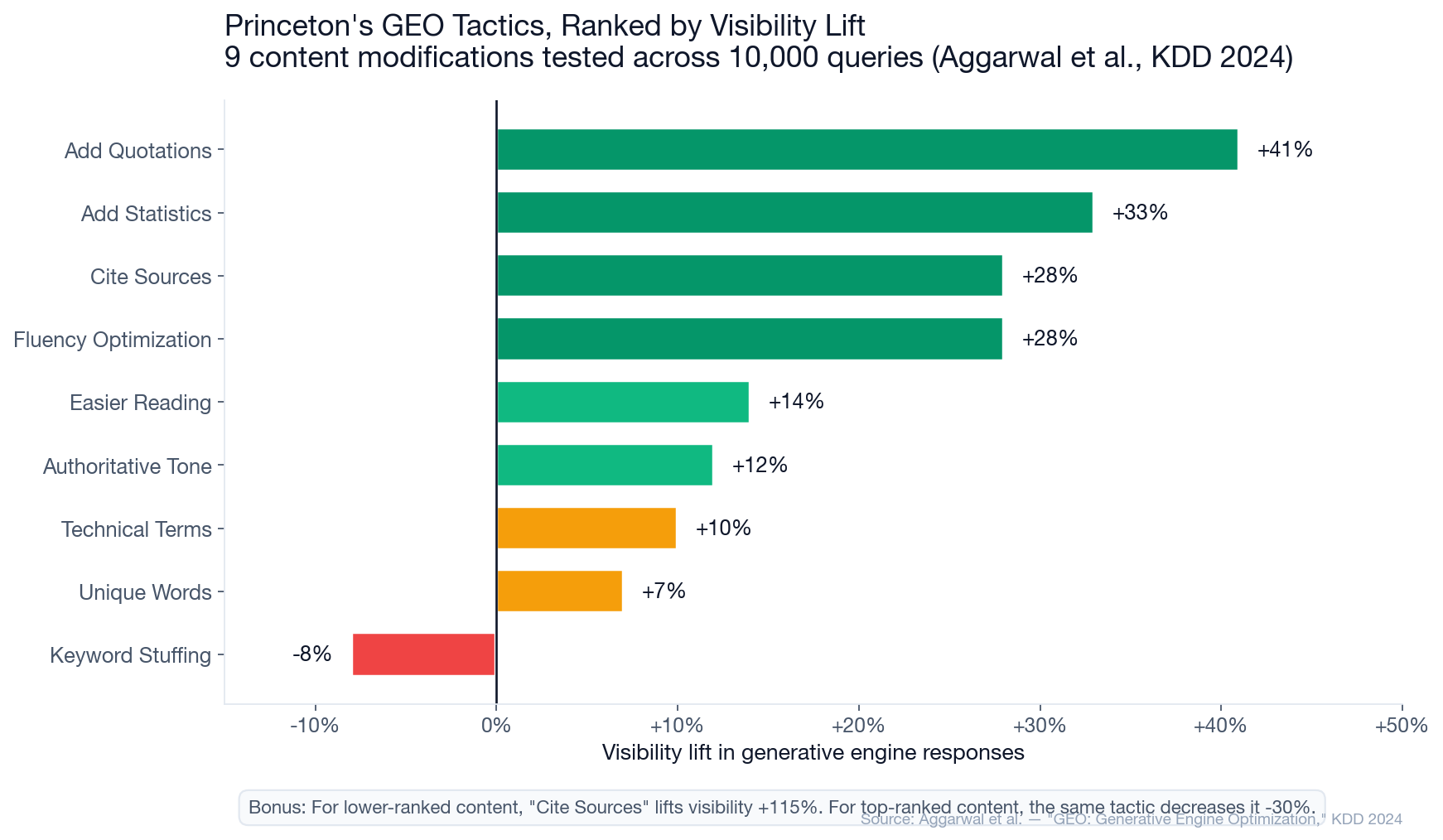
The leveling-effect finding (the most important one nobody talks about): - For lower-ranked content, citing authoritative sources can boost visibility by up to +115%. - For already-top-ranked content, the same tactic can decrease visibility by −30% (because dilution of the brand voice).
Translation: If you’re a small site, citation-density is your single biggest lever. If you’re already an authority, you should be referenced by others, not citing them.
Other validated findings from the academic and applied research: - AI Overviews-cited URLs are 27.7× more likely to appear in ChatGPT-cited URLs for the same query (BrightEdge, 16-month overlap study). Translation: optimizing for one helps the other — but the overlap is far from total. - Schema markup correlates with citation rate. Pages with FAQ schema, HowTo schema, and Article schema appear in Profound’s top-cited datasets at disproportionate rates (Profound 27M citation study). - Webflow case study (T-tested, p<0.01): structured Q&A formatting drove a statistically significant lift in LLM citation rate within 90 days.
From Arvow: Arvow’s AI SEO Editor automatically restructures existing content with the patterns Princeton and Profound found drive LLM citations — clean Q&A formatting, entity-rich definitions, citation-dense paragraphs, and FAQ schema. See how it works →
5. Where Generative Engines Actually Get Their Citations
The biggest myth in GEO is that “Reddit and YouTube dominate AI citations.” The biggest properly-controlled study says otherwise.
Yext analyzed 6.8 million AI citations across ChatGPT, Gemini, and Perplexity (1.6M queries per model, 20,820 unique domains, July–August 2025): - 86% of AI citations come from brand-managed sources. - 44% from first-party brand websites. - 42% from listings (Google Business Profile, Yelp, etc.). - 8% from reviews/social. - Only 2% from Reddit-type forums once you control for location and intent.
The Profound 680M citation study — the largest aggregate citation analysis published — gives the alternate view (without intent control): - Google AI Overviews top sources: Reddit 21.0%, YouTube 18.8%, Quora, LinkedIn, Gartner, NerdWallet, Forbes, Wikipedia 0.6%. - ChatGPT top sources: Wikipedia 7.8% (47.9% of ChatGPT’s top-10 sources), Reddit 1.8%, Forbes 1.1%, G2 1.1%.
These two datasets are not contradictory. They measure different things: - Profound counts every URL appearing across all queries. - Yext counts citations within intent-classified queries (commercial, branded, informational, etc.).
The reconciliation: Reddit and Wikipedia dominate aggregate counts because they appear for many low-intent queries. Brand-managed sources dominate when users are actually shopping or evaluating — which is where the money is.
First-party Arvow data on what gets cited: - A DR-17 site (Malta digital nomad visa consultancy) grew ChatGPT citations from 6 to 24 (+300%) in 2 months while Google AI Overview citations actually fell from 16 to 7 (−56%) — strong evidence that ChatGPT citation patterns are decoupling from AIO patterns. - A brand-new Celebrity IQ site with zero starting backlinks earned 1,000+ Google AI Overview citations per month within 9 months. - A yoga e-commerce brand earned 572 ChatGPT mentions and 54 Google AI Overview citations from 238 AI-published articles — a roughly 10:1 ChatGPT-to-AIO citation ratio for that vertical.
From Arvow: Arvow’s LLM Visibility Tracker shows you exactly how ChatGPT, Perplexity, Gemini, Claude, Copilot, Grok, and Google AI Overviews cite your brand today — and how citation share shifts week to week. Track Your AI Visibility →
See also: How LLM SEO increased Arvow’s ChatGPT leads by 38% and the NY dentist cited in every LLM for the tactical playbook.
6. How LLM Platforms Differ in Their Citation Behavior
Optimizing “for AI” as a single category is a category error. Each major LLM has its own sourcing logic.
Citation source preferences by platform (Profound 680M study, Aug 2024–June 2025):
| Platform | Top source | Share | Notes |
|---|---|---|---|
| Google AI Overviews | 21.0% | Heavy on UGC + question forums | |
| ChatGPT | Wikipedia | 7.8% (47.9% of top 10) | Heavy on encyclopedic + reference content |
| Perplexity | Mixed/news-heavy | — | Strongest direct citation behavior |
| Gemini | Mixed | — | Most volatile patterns; growing fastest |
| Claude | Curated/structured | — | Smallest dataset publicly tracked |
Platform-specific traffic & visit volume (Similarweb 2026 GenAI report): - Gemini: 1.1B monthly visits (grew 157% April–September 2025) — now the second-largest AI search surface globally. - Perplexity: 170M monthly visits as of September 2025. - Claude: 157M monthly visits.
Conversion behavior differs by platform (Microsoft Clarity, 1,277 domains): - Copilot subscription conversion: 17× direct, 15× search. - Perplexity: 7× both. - Gemini: 4× direct, 3× search.
Arvow’s first-party platform-by-platform data (Malta visa consultancy, 2-month period): - ChatGPT citations: 6 → 24 (+300%). - Gemini citations: 3 → 11 (+267%). - Perplexity citations: 1 → 3 (+200%). - Copilot citations: 0 → 3. - Google AI Overviews: 16 → 7 (−56%) — actively decreased during the same period.
The implication: ChatGPT, Gemini, and Perplexity citations all moved together. AIO moved opposite. Treating “AI search visibility” as one number is wrong. You need platform-specific tracking and platform-specific tactics.
From Arvow: Arvow’s AI SEO Agent automatically deploys the schema markup, structured Q&A patterns, and entity linking that LLMs across all 7 major platforms disproportionately reward. Discover the AI SEO Agent →
For the platform-by-platform deep dive, see our ChatGPT statistics 2026 and the 7 best AI visibility tracking and LLM brand-tracker tools.
7. GEO Content Patterns That Get Cited
What does cited content actually look like? Three converging datasets give specific structural answers.
Length and snippet patterns (Pew Research, 12,593 AI summaries from 68,879 unique searches): - The median Google AI Overview summary is 67 words long (range: 7–369 words). - 88% of AI summaries cite three or more sources; only 1% cite a single source. - Wikipedia, YouTube, and Reddit collectively account for 15% of AI summary sources.
Structural patterns (AirOps 2026 State of AI Search): - Pages with sequential heading structures are 2.8× more likely to be cited. - 68.7% of ChatGPT-cited pages follow logical heading hierarchies. - 87% of AI-cited pages use a single H1 tag. - 80% of AI-cited pages include lists. 78% of AI-generated answers themselves include list formats. - 61% of cited pages use 3+ schema types (Article, FAQPage, HowTo, Product, etc.).
Section-length pattern (SE Ranking, 129,000-domain study): - Pages organized into sections of 120–180 words between headings receive 70% more ChatGPT citations than pages with shorter, fragmented sections.
Freshness matters more than people think (AirOps 2026): - 70%+ of all AI-cited pages were updated within the past 12 months. - 50%+ of cited pages were refreshed within 6 months. - Pages not updated quarterly are 3× more likely to lose citations.
The off-site finding nobody talks about (AirOps): - 85% of brand mentions in AI responses originate from third-party pages. Brands are 6.5× more likely to be cited via third-party pages than via owned domains.
That last data point is structurally important. It means GEO isn’t primarily about your own site — it’s about ensuring your brand is referenced everywhere it makes sense (industry directories, comparison pages, listicles, partner blogs, podcasts, YouTube). Owned-domain optimization is necessary but not sufficient.
Arvow’s content-pattern findings from 38 case studies: - News/freshness content drives Google AI Overview citations disproportionately. A Melbourne digital marketing agency publishing 3 articles/week (industry news format) saw AIO citations grow +78% in 7 months while ChatGPT citations grew only +1 in the same period. - Featured images, table of contents, proper heading hierarchy, alt-text, internal links to service pages, embedded videos, and FAQ sections are consistent across high-cited Arvow case study sites. - Multiple appointment-scheduling/conversion CTAs correlated with citation rates in service-business case studies (Manhattan dental, French ophthalmology).
8. GEO ROI: Why AI Traffic Is Worth So Much More Per Visitor
This is the math that justifies GEO investment despite AI’s tiny absolute traffic share.
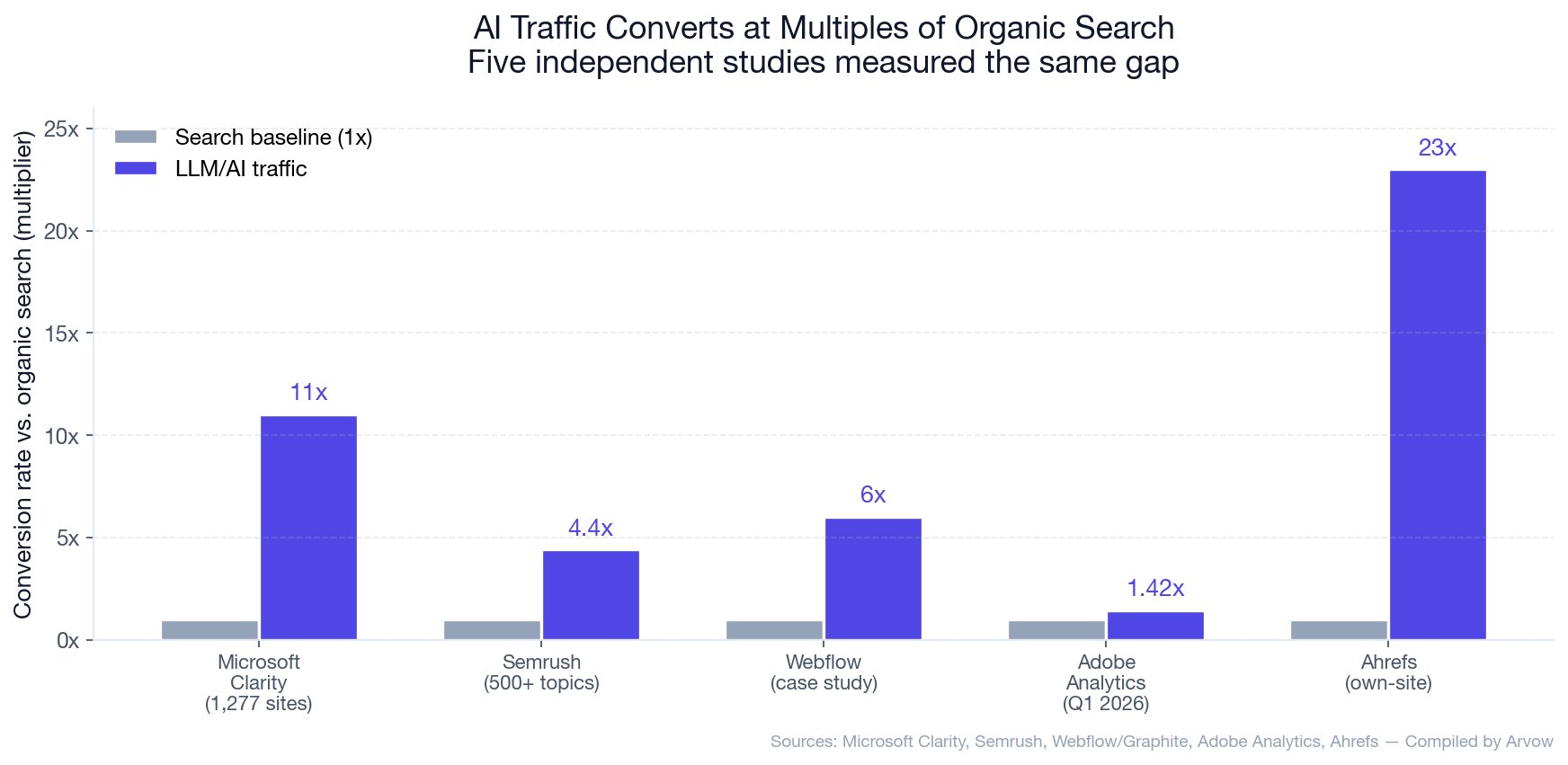
The conversion gap (Microsoft Clarity, 1,277 domains, 8 months): - LLM-based referrals achieved 1.66% sign-up conversion vs. just 0.15% from search — 11× higher. - AI-referred visitors are roughly 3× more likely to take action than visitors from organic search. - 52% of analyzed domains already converted AI traffic into sign-ups or subscriptions in the past month.
Platform-specific subscription conversion uplifts (Microsoft Clarity): - Copilot: 17× direct, 15× search. - Perplexity: 7× both. - Gemini: 4× direct, 3× search.
The Webflow case study — first transparent enterprise GEO data with statistical rigor (Graphite, 2025): - 8% of new Webflow signups came from AI as of June 2025, up from 2% in October 2024 — 4× growth in 8 months. - LLM signup conversion rate: 24% vs. 4% for non-brand SEO. - LLM share of voice grew 94% (from 33% to 64%). - Tactical lift, T-tested over 5 weeks (10 test vs. 10 control URLs): - Adding above-the-fold copy to template pages: +485% QoQ growth in LLM signups (168 → 983). - Adding a table of contents: +60% growth in AI visits (p=0.002). - Reformatting headers as questions: +58% uplift in AI visits (p=0.001).
Semrush’s traffic-quality data (500+ digital marketing topics): - LLM-referred visitors convert 4.4× better than organic search visitors. - Shoppers arriving from AI platforms have 38% longer visits and view more pages than shoppers from traditional search.
Ahrefs’ own first-party data: - AI-search visitors converted 23× better than traditional organic visitors at Ahrefs: AI search was ~0.5% of visits but ~12.1% of sign-ups.
Adobe Analytics retail-specific: - AI-driven revenue per visit (RPV) was up 254% during the 2025 holiday season YTD. - AI conversions 42% higher than non-AI in March 2026. - AI-referred visitors converted 31% more than other sources in 2025 holiday — up nearly 2× year-over-year.
Arvow’s first-party data: - Arvow’s own ChatGPT-driven signups grew from 6.7% to 38.1% of all new signups in 3 months (5.6×) — measured via PostHog + UTM tags. ChatGPT became the #1 acquisition channel by share. - A French ophthalmology clinic built a $32,000/year traffic machine (0 → 26,000 monthly visits) while earning citations across ChatGPT, Claude, Gemini, and Perplexity. - A Manhattan dental practice reached $3,600/month in equivalent ad spend value (3,200 monthly visits) while being cited across all 4 major AI surfaces.
The honest framing: AI traffic is small but disproportionately valuable. The 1% headline number is misleading because it ignores that those visitors monetize at 4–23× the rate of search visitors.
9. The GEO Tools & Technology Landscape
The GEO tools market went from non-existent to a unicorn in 18 months. Here’s the field.
Category leaders (by funding):
| Tool | Funding | Notable |
|---|---|---|
| Profound | $155M total | Series C @ $1B valuation (Lightspeed, Q1 2026); Kleiner Perkins, Sequoia |
| Peec AI | $29M | Serves 1,500+ marketing teams |
| Bluefish | $20M Series A | 2025 |
| Scrunch AI | $15M Series A | 2025 |
| Evertune | $15M Series A | 2025 |
| Otterly.ai | (Self-funded) | 15,000+ users, named Gartner Cool Vendor 2025 for AI in Marketing |
| AthenaHQ | $2.7M Y Combinator | 100+ paying customers |
| Goodie | (Self-funded) | Niche/specialist tracking |
Total venture funding into the GEO/AEO category: $200M+ by year-end 2025.
Gartner’s editorial recognition (Otterly.ai as a Cool Vendor 2025) is a meaningful signal — it’s the first time a GEO-pure-play tool has been formally recognized in Gartner’s marketing-tech analysis, suggesting category legitimacy with enterprise procurement teams.
Pricing landscape: - GEO services range from $1,500/month (basic hygiene) to $30,000+/month (enterprise). - Mid-market sweet spot: $3,000–$10,000/month. - Industry guidance: allocate 50–100% more budget for GEO than equivalent SEO ($5K/mo SEO ≈ $7.5K–$10K/mo GEO).
The category dynamic: Profound is the runaway leader, but the rest of the market is fragmented across 24+ tracked platforms. Expect consolidation in 2026–2027 as the bigger SEO/martech players (Semrush, Ahrefs, BrightEdge, Conductor) absorb or build competing GEO modules. Conductor and BrightEdge already have GEO measurement built in.
10. GEO vs. SEO: The Budget Shift
The headline isn’t “GEO is replacing SEO.” It’s “GEO is being added on top, and the new budget for it has to come from somewhere.”
The investment direction (Conductor, 250-CMO survey): - 94% of digital marketing leaders plan to increase GEO investments in 2026. - U.S. enterprises allocate 12% of digital marketing budgets to GEO in 2025. - 56% of leaders report “high or significant” GEO investments in 2025.
The budget premium (Demand Local agency pricing analysis): - Industry guidance suggests 50–100% more budget for GEO than equivalent SEO. - $5,000/month SEO investment maps to $7,500–$10,000/month for equivalent GEO scope.
Why GEO costs more per unit of effort: 1. Multi-platform tracking (vs. one Search Console for SEO). 2. Higher refresh requirement (Princeton paper + AirOps both confirm freshness matters more for GEO). 3. Off-site mention building (the 85% off-site finding from AirOps means more PR-style work). 4. Schema/structured data implementation across multiple types.
For agencies repricing existing clients: - GEO services don’t typically replace SEO retainers — they get added to them. - The smart move is bundling: an SEO+GEO retainer at 130–150% of the legacy SEO price, with the increment justified by the multi-platform tracking and off-site mention building.
For Arvow’s specific positioning here, see our case study on growing a site from 0 to 4,000/mo with AI SEO + GEO and the parallel 0 to 10,000/mo in 24 hours playbook. For the broader content economics, our AI content marketing statistics 2026 covers the supply-side data.
11. GEO Measurement: What Brands Actually Track
This is the area with the biggest gap between investment and capability.
The honest measurement state (Conductor, 2025): - 62% of marketing leaders cannot measure the ROI of their AI search optimization efforts. - 64% of marketing leaders are unsure how to measure AI search success (Yext). - Yet 94% are increasing investment anyway.
What brands are measuring (where they can): - Citation count (mentions per platform per period). - Citation share of voice (your % of citations vs. competitors on category prompts). - Citation drift — Profound found monthly citation drift ranges 40–60% across major platforms (Google AI Overviews 59.3%, ChatGPT 54.1%, Microsoft Copilot 53.4%). Translation: even if you’re winning today, you’ll lose 40–60% of your citations next month and need new ones. - AI referral traffic (UTM-tagged + auto-detection in analytics tools). - AI-attributed conversions (PostHog, Microsoft Clarity, custom).
The “mention vs. citation” framework (Profound): - ChatGPT mentions brands 3.2× more often than it cites them with links — based on 240M citations. - This is why “share of voice” tracking matters more than raw “did we get a backlink” tracking. Brand mentions in answer text matter even when no link is included.
The strongest sentiment-vs-volume insight: - Some Arvow case studies (French clinic, ophthalmology) explicitly track sentiment analysis alongside citation volume. The next frontier of GEO measurement isn’t just “how often” but “how favorably” your brand appears in AI answers.
The future of measurement: - 72% of marketers believe AI search will exceed traditional SEO impact within three years (Yext). - That belief is driving the tools market. Expect every major SEO platform to ship GEO measurement modules in 2026, with consolidation around 2–3 winners by 2027.
12. The Geographic and Demographic Picture
GEO data is heavily US-centric. Here’s what we know about the rest of the world.
Primary platform reach: - Google AI Mode rolled out to 200+ countries and territories in October 2025, supporting 40+ languages. - AI Overviews launched in 200+ countries by year-end 2025. - ChatGPT reached 800M weekly active users by December 2025 and 900M by February 2026 — global, but with US/India dominance.
Where AI search is heaviest (by traffic share): - U.S. users are 1.6× more likely to receive AI traffic than users in India or the U.K. (Ahrefs). - AI Mode hit 100M+ MAU across the U.S. and India (Alphabet earnings) — the two markets driving most growth.
Non-US case study evidence (from Arvow’s case studies): - German SaaS (3D rendering software): citations earned across all 5 major LLMs (ChatGPT, Perplexity, Gemini, Claude, Copilot) for native German content. - French ophthalmology clinic: 0 → 26,000 monthly visits, citations across ChatGPT, Claude, Gemini, Perplexity for native French content. - Vietnamese agency: 0 → 102,000 monthly visits in 45 days; LLM citations had a clear lag versus Google ranking, suggesting some non-English markets index slower into LLM training data. - Norwegian education site: 0 → ~3,900 monthly visits with 5,000+ keywords ranked. - Danish B2C SaaS: 12-month timeline to first measurable LLM citations.
The pattern: non-English markets are less competitive for LLM citations because most of the GEO playbook (and most published research) targets English-language search. Native-language content earns LLM citations at higher rates relative to local Google ranking — but with longer time-to-first-citation in low-traffic languages.
Publisher-side international data (Reuters Institute, 326 leaders across 51 countries): - 74% of news executives globally are worried about referral-traffic decline. - 56% net are directing more effort at AI platforms rather than less.
The international landscape is the biggest underserved opportunity in GEO right now. The Princeton paper findings, the Profound citation patterns, the Yext brand-citation framework — all of these likely apply outside English markets, but with better cost-per-citation economics because competition is thinner.
13. The Contradictions: Why GEO Statistics Don’t Agree
This is the section nobody else writes. Across the studies in this report, GEO numbers diverge wildly. Most “definitive GEO statistics” articles pick one number per topic. We laid them side by side and explain the methodological choices that drive the gap.
- Reuters Institute (Jan 2026): ~10% of US search results.
- Conductor (Apr 2026, 21.9M searches): 25.11%.
- Semrush (Nov 2025): 15.69% (after peaking at 24.61% in July 2025).
- BrightEdge (Feb 2026): ~48%.
- Advanced Web Ranking (Q4 2025): 49.92%.
Why they differ: sample composition. BrightEdge tracks the keyword types most likely to show AIOs (informational + question-format). Reuters samples broadly. Semrush includes the AIO pullback period in late 2025. None are “wrong” — they’re measuring different keyword universes.
- Profound (680M citations, aggregate): Reddit 21% of AIO citations.
- Semrush (150K citations): Reddit 40.1%.
- Yext (6.8M citations, intent-controlled): Reddit-type forums = only 2% after controlling for location and intent.
Why they differ: Yext intent-controls. Profound and Semrush count every URL. When users are actually shopping or evaluating, brand-managed sources dominate. Reddit dominates only when users are asking open-ended low-intent questions.
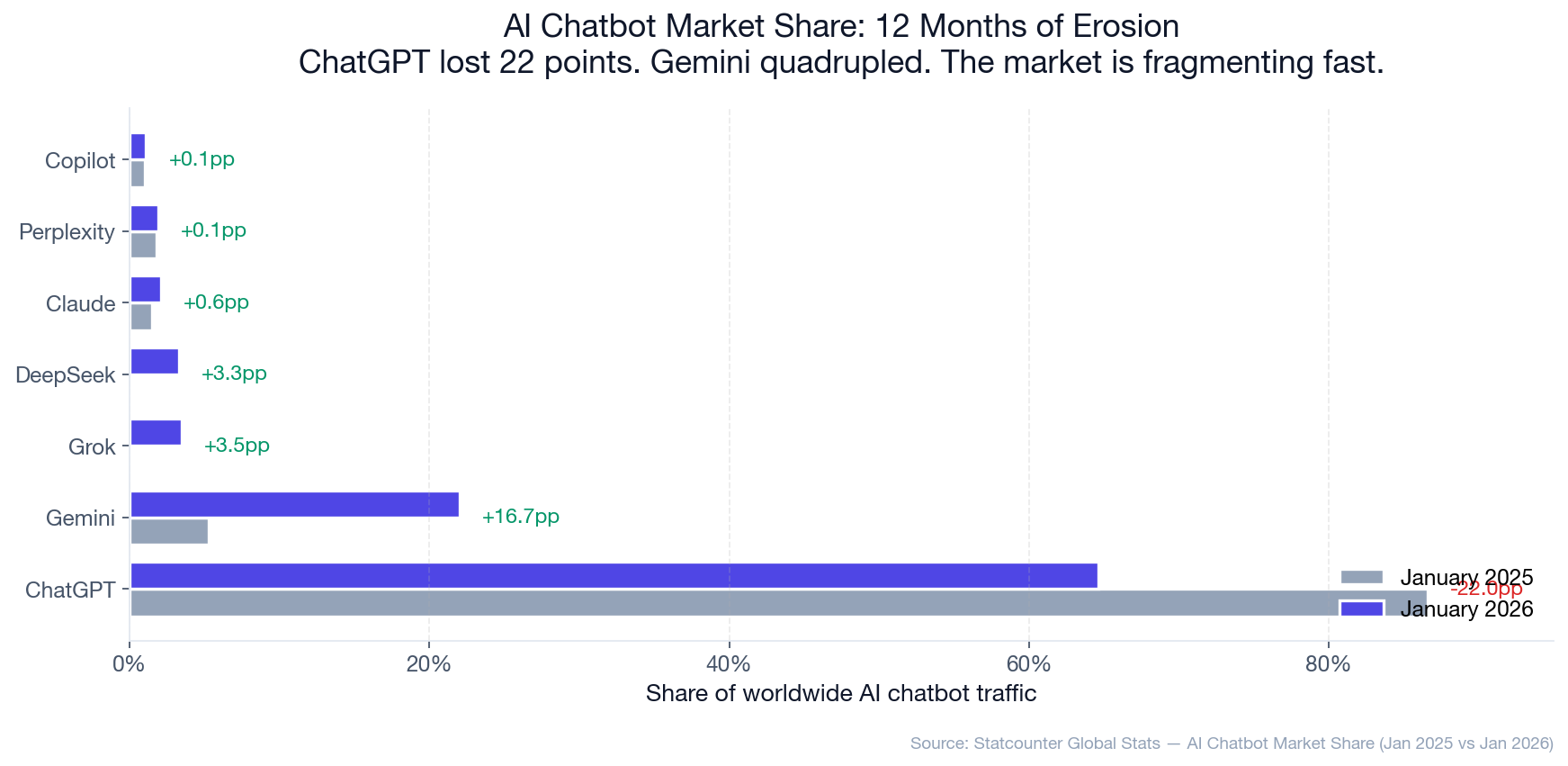
- Statcounter Global Stats (Jan 2026): ChatGPT 64.6% of worldwide chatbot traffic, down from 86.6% YoY.
- Conductor (Apr 2026, enterprise sample): ChatGPT 87.4% of AI referrals.
Why they differ: Statcounter measures end-user chatbot traffic (consumer-weighted). Conductor measures referral-source traffic to enterprise sites (B2B-weighted). Both can be right simultaneously — consumer attention is fragmenting, but enterprise referral flows are still ChatGPT-dominated.
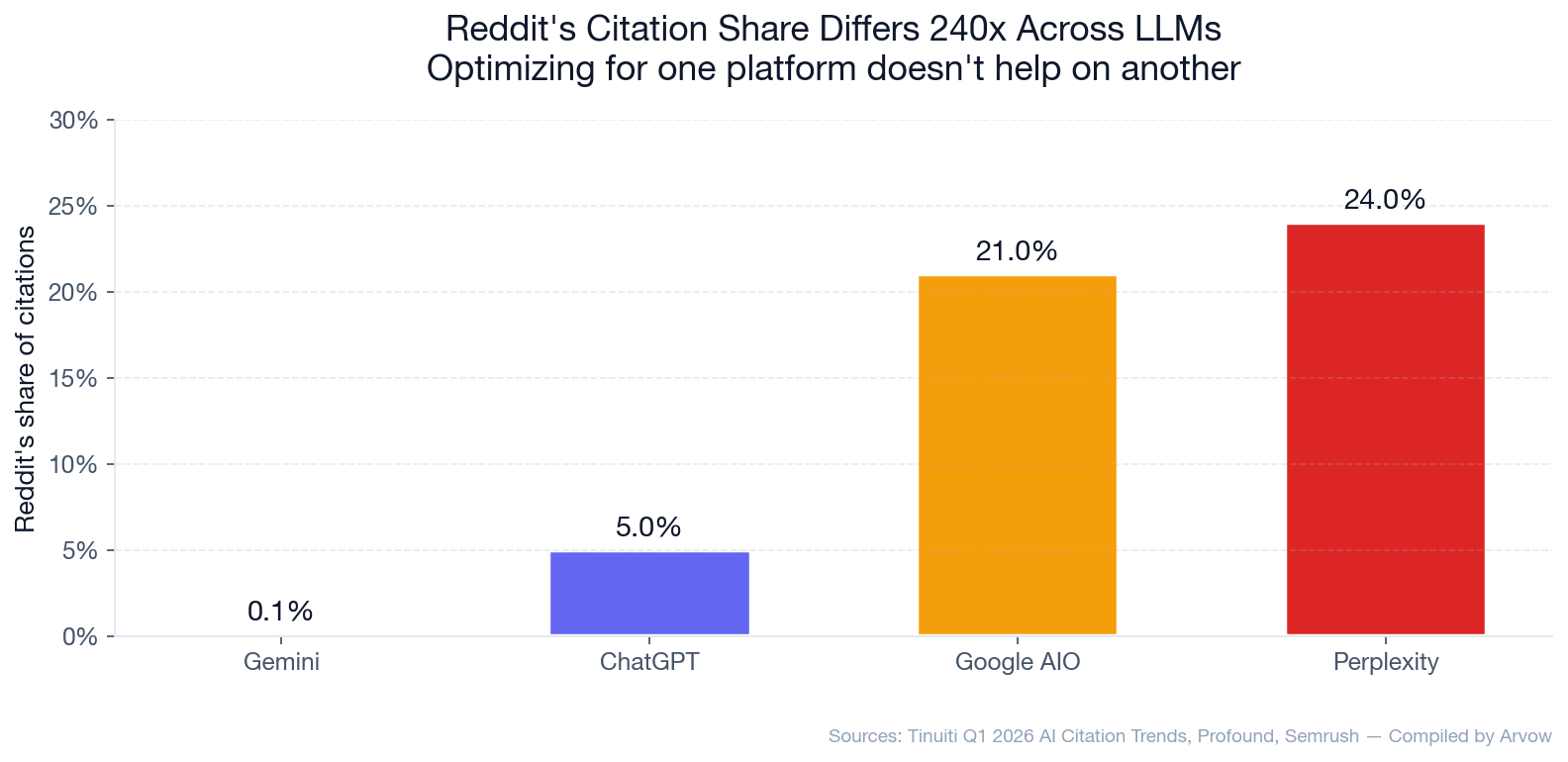
- Tinuiti (Q1 2026): Reddit accounts for just 0.1% of Gemini citations but 24% of Perplexity citations in the same product categories — a 240× spread.
Why this matters: “AI search” is not one channel. Optimizing for Reddit visibility is essential for Perplexity ranking but largely irrelevant for Gemini. This is the strongest empirical evidence for platform-specific GEO strategy.
- Semrush (3-month study, Aug–Oct 2025): ChatGPT cited Reddit in close to 60% of prompt responses in early August 2025; this collapsed to ~10% by mid-September. Wikipedia dropped from ~55% to <20% in the same window.
Why this matters: GEO platforms are not stable. Even within a single quarter, source mixes can shift dramatically. Lock-in to a specific GEO playbook is dangerous; the meta-skill is rapid measurement + tactical reallocation.
- Ahrefs (75K-domain study): Brand mentions correlate 0.66–0.71 with AI citation; backlinks correlate 0.27–0.33. Brand mentions matter ~2–3× more than backlinks for GEO.
- SE Ranking (129K-domain study): Sites with >32K referring domains are 3.5× more likely to be cited by AI than sites with fewer links.
Why both can be right: referring domains and brand mentions are correlated (high-authority sites accumulate both). The Ahrefs study isolates the partial effect of each variable; SE Ranking measures the joint effect. The honest read: backlinks help, but brand-mention quantity is the stronger leading indicator.
This is the most important internal contradiction in GEO right now. Arvow’s case study data shows roughly 33% of pages cited in ChatGPT have zero measurable traffic from Google — meaning LLMs are pulling from a long-tail content surface that Google’s rankings ignore.
The implication: ChatGPT visibility cannot be predicted from Google Search Console. You need separate measurement.
14. What This Means for Your Site in 2026
Six concrete moves the data above actually justifies.
1. Apply the Princeton tactics — in the order Princeton ranked them
Add quotations (+41%), statistics (+33%), and citations (+28%) to existing content. Lower-ranked pages benefit most: citing sources lifts visibility +115% for content not ranking in the top 3. This is the single highest-leverage GEO move and most teams haven’t done it.
2. Treat each LLM as its own channel
ChatGPT, Perplexity, Gemini, Claude, Copilot, Grok, and Google AI Overviews have different citation patterns. The 240× Reddit-share gap between Gemini and Perplexity (Tinuiti) makes this point unambiguously. Universal GEO strategy is malpractice; platform-specific strategy is the bar.
3. Build off-site mentions, not just on-site SEO
85% of AI brand mentions originate from third-party pages (AirOps). Most of GEO’s leverage is off your domain. Get listed in industry directories, comparison roundups, podcast notes, partner blogs, YouTube content, and authoritative third-party sources. Your domain alone is structurally insufficient.
4. Refresh quarterly
70%+ of AI-cited pages were updated within 12 months. Pages not refreshed quarterly are 3× more likely to lose citations (AirOps). GEO content has a half-life. Build a refresh cadence into your editorial calendar.
5. Measure citation share of voice, not just rankings
Set up tracking for citation count + citation share of voice + sentiment across the 7 major AI surfaces. Don’t wait for “GEO ROI” attribution to be solved — measure leading indicators (citation count, mention share, sentiment) while attribution catches up.
6. Publish at GEO velocity
The Webflow case study showed +485% QoQ LLM signup growth from a single template-page tactic. Arvow’s own data shows 5.6× ChatGPT-acquired-signup growth in 90 days from a focused GEO push. The pattern across both is: aggressive content velocity + structural optimization compounds fast in GEO, faster than it does in traditional SEO.
From Arvow: Arvow’s AI SEO Agent automates the full Princeton-tactics stack — citations, statistics, quotation patterns, schema markup, structured Q&A formatting — across every article you publish, then auto-publishes them on your blog at the velocity GEO actually rewards. Discover the AI SEO Agent →
Or if you want to see the output first: Try 3 Free Articles →
Σ Summary: GEO by the Numbers
The 20 highest-leverage stats from this report, in one table.
| # | Stat | Source |
|---|---|---|
| 1 | GEO services market: $886M (2024) → $7.3B (2031) at 34% CAGR | Valuates Reports |
| 2 | 94% of CMOs plan to increase GEO investment in 2026 (top priority) | Conductor (250-CMO survey) |
| 3 | 97% of enterprise leaders report GEO is already driving measurable impact | Conductor |
| 4 | AI referrals = 1.08% of total website traffic (87.4% from ChatGPT) | Conductor (1,215 domains) |
| 5 | LLM-referred sign-ups convert at 11× the rate of search (1.66% vs. 0.15%) | Microsoft Clarity (1,277 domains) |
| 6 | LLM-referred visitors convert 4.4× better than organic search visitors | Semrush |
| 7 | Adding quotations to content: +41% LLM visibility lift | Princeton/Aggarwal et al., KDD 2024 |
| 8 | Adding statistics: +33%; citations: +28% | Princeton paper |
| 9 | Citations boost lower-ranked content’s visibility +115% (the leveling effect) | Princeton paper |
| 10 | 86% of AI citations are brand-managed sources (only 2% Reddit) | Yext (6.8M citations) |
| 11 | Brand-mentions correlate 0.66–0.71 with AI citation; backlinks just 0.27 | Ahrefs (75K domains) |
| 12 | 85% of brand mentions in AI responses come from third-party pages | AirOps |
| 13 | AI traffic to U.S. retail grew 393% YoY in Q1 2026 (after 1,200% peak) | Adobe Analytics |
| 14 | GEO category absorbed $200M+ in VC funding in 12 months; Profound at $1B valuation | Multiple |
| 15 | Reddit citations: 0.1% on Gemini vs. 24% on Perplexity — 240× spread | Tinuiti (Q1 2026) |
| 16 | ChatGPT Reddit citation share collapsed from ~60% to ~10% in Aug→Sep 2025 | Semrush (230K prompts) |
| 17 | Pages refreshed within 6 months are 3× more likely to retain AI citations | AirOps |
| 18 | Arvow’s ChatGPT signup share grew 6.7% → 38.1% in 3 months (5.6×) | Arvow first-party |
| 19 | One yoga e-commerce brand earned 572 ChatGPT mentions from 238 AI articles | Arvow case study |
| 20 | ~1 in 3 ChatGPT-cited pages have zero measurable Google traffic | Arvow first-party |
Frequently Asked Questions
What is GEO (Generative Engine Optimization)?
GEO is the practice of optimizing content and brand presence to be cited or referenced by generative AI engines — ChatGPT, Perplexity, Gemini, Claude, Copilot, Grok, and Google AI Overviews. The discipline was formally defined in the Princeton/Georgia Tech “GEO: Generative Engine Optimization” paper (Aggarwal et al., KDD 2024), which identified specific content tactics — adding citations, statistics, and quotations — that boost a source’s visibility in generative responses by 30–41%.
How big is the GEO market in 2026?
The Generative Engine Optimization Services market was valued at $886M in 2024 and is projected to reach $7.3B by 2031 at a 34% CAGR (Valuates Reports). The GEO tools category alone has absorbed $200M+ in venture funding since launch, including Profound’s $1B Series C valuation in early 2026. Andreessen Horowitz frames GEO as the disruptor of an $80B+ SEO industry.
Does GEO actually drive traffic and conversions?
Yes — at small absolute volumes but high quality per visit. AI referrals account for about 1.08% of total website traffic (Conductor) but convert at 11× the rate of organic search for sign-ups (Microsoft Clarity, 1,277 domains). Adobe Analytics found AI conversions 42% higher than non-AI in March 2026 with 254% higher revenue per visit. Webflow’s case study showed 8% of all signups now come from AI, up from 2% eight months earlier.
What’s the single highest-leverage GEO tactic?
According to the Princeton paper, adding quotations to your content boosts visibility by 41%, statistics by 33%, and citations by 28%. The single most counterintuitive finding: for content currently ranking outside the top 3, adding citations can boost visibility by +115% (“the leveling effect”). For top-ranked content, the same tactic can hurt. Lower-ranked content benefits most from GEO tactics.
How is GEO different from traditional SEO?
Three structural differences: (1) Off-site matters more than on-site — 85% of AI brand mentions come from third-party pages (AirOps), so PR-style external mentions outweigh on-domain optimization. (2) Brand mentions outweigh backlinks — Ahrefs’ 75K-domain study found brand-mention correlation with AI citation is 0.66–0.71 vs. just 0.27 for backlinks. (3) Multi-platform tracking — citation patterns differ wildly across ChatGPT, Perplexity, Gemini, Claude, etc. Traditional SEO has one channel (Google); GEO has 7+ surfaces.
How do I get cited in ChatGPT?
The Princeton tactics apply: add quotations, statistics, citations to authoritative sources. Add structural patterns AirOps found correlate with citation: clean H1/H2/H3 hierarchy, lists, FAQ schema, sequential heading structures. Refresh content at least quarterly. And — most counterintuitively — focus on getting mentioned across third-party pages (industry roundups, comparison pages, podcast notes, YouTube). Roughly 1 in 3 pages cited in ChatGPT have zero measurable Google traffic (Arvow first-party data), so ChatGPT visibility is partially decoupled from Google ranking.
What are the best GEO tools in 2026?
Profound is the runaway leader ($1B valuation, $155M raised). Other significant players: Peec AI (1,500+ teams), Bluefish ($20M Series A), Scrunch AI, Evertune, Otterly.ai (Gartner Cool Vendor 2025, 15,000+ users), AthenaHQ. The major SEO platforms (Semrush, Ahrefs, BrightEdge, Conductor) have begun shipping GEO modules. For tracking your own brand’s citation share of voice across all 7 major LLMs, see Arvow’s LLM Visibility Tracker and the 7 best AI visibility tracking tools roundup.
How do I measure GEO ROI?
Honestly: 62% of marketing leaders say they cannot measure GEO ROI today (Conductor) and 64% are unsure how to measure AI search success (Yext). The leading-indicator metrics that can be measured: citation count by platform, citation share of voice (your % vs. competitors on category prompts), citation drift (40–60% monthly turnover per Profound), AI-attributed conversions (via UTM tags + Microsoft Clarity / PostHog), and sentiment of brand mentions. The most honest framing: measure what you can today and don’t wait for perfect attribution.
Methodology and Sources
This report aggregates data from 30+ primary sources published between November 2023 (Princeton GEO paper v1) and April 2026. We prioritized:
- Academic research — Princeton/Georgia Tech/Allen Institute (Aggarwal et al., KDD 2024) for the foundational GEO tactical findings
- Large-sample independent studies — Yext (6.8M citations), Profound (680M citations + 27M Enhanced Citations + 240M ChatGPT crawler), Conductor (100M+ citations across 13,770 domains, 250-CMO survey), Ahrefs (75K-domain brand correlation study + 81,947-site traffic study + 3,000-site AI traffic study), Semrush (230K prompts / 13-week study), AirOps (2026 State of AI Search), SE Ranking (129K-domain study)
- First-party platform data — Conductor enterprise customer panel (1,215 domains, 35.7M AI sessions), Microsoft Clarity (1,277 domains), Adobe Analytics (1+ trillion U.S. retail visits), Statcounter Global Stats
- Survey research — Pew Research Center (900-person browsing panel, 12,593 AI summaries), Reuters Institute (326 senior digital news leaders across 51 countries), Conductor (250-CMO survey), Yext (marketing-leader survey)
- Industry funding & analyst data — Profound, Bluefish, Scrunch AI, Evertune, AthenaHQ, Peec AI press releases; Andreessen Horowitz; Gartner; PlateLunch Collective tools comparison
- First-party Arvow case-study data — 38 published case studies at arvow.com/case-studies, including LLM citation counts across ChatGPT, Perplexity, Gemini, Google AI Overviews, Copilot, Grok, and Claude
Primary sources used
- Aggarwal et al. — “GEO: Generative Engine Optimization” (arXiv 2311.09735, KDD 2024)
- Adobe Analytics (retail AI traffic, holiday + Q1 2026 update)
- Ahrefs (AI brand visibility correlations, AI traffic study, AI traffic increase, ChatGPT traffic)
- AirOps (2026 State of AI Search)
- Andreessen Horowitz (Enterprise Newsletter, May 2025)
- BrightEdge (Generative Parser AIO/organic overlap)
- Conductor (2026 AEO/GEO Benchmarks, State of AEO/GEO 2026 CMO Investment Report)
- Gartner (traditional search forecast)
- Microsoft Clarity (AI traffic conversion study)
- PlateLunch Collective (AEO tools analysis)
- Pew Research Center (AI summaries browsing study)
- Profound (AI platform citation patterns, Enhanced Citation Categories, Series C announcement)
- Reuters Institute (Oxford) (Journalism, Media & Technology Trends 2026)
- SE Ranking (129K-domain GEO study, via Search Engine Land coverage)
- Semrush (most-cited domains study, AI search SEO traffic study)
- Similarweb (2026 GenAI report)
- Statcounter (AI Chatbot Market Share)
- Tinuiti (Q1 2026 AI Citation Trends Report)
- Valuates Reports (GEO Services market forecast)
- Webflow / Graphite (Webflow GEO case study)
- Yext (AI Citations Research, AI visibility cross-platform)
First-party Arvow data sources
- How LLM SEO increased Arvow’s ChatGPT leads by 38%
- NY dentist reached 3,200/mo visits and got cited in every LLM
- Yoga brand grew 900 → 5,000/mo with 572 ChatGPT mentions
- Malta Visa consultancy: ChatGPT citations 6 → 24 in 2 months
- Celebrity IQ site: 1,000+ Google AIO citations/month
- German SaaS cited in all 5 major LLMs
- French clinic: $32K/year traffic machine cited across 4 LLMs
- Melbourne agency: AIO citations +78% in 7 months
- The 1-in-3 ChatGPT-cited pages with zero Google traffic finding
- See the full case study library for the complete dataset.
This page was last updated April 2026. Bookmark it — we update quarterly as Princeton, Profound, Yext, Conductor, AirOps, and Microsoft Clarity publish new GEO data.
Keep reading
- AI Overviews & AI Mode Statistics 2026
- AI Content Marketing Statistics 2026
- ChatGPT Statistics 2026
- Blogging Statistics 2026
- 7 best AI visibility tracking and LLM brand-tracker tools
- Arvow vs Semrush AI Visibility Toolkit
- SearchGPT: the new AI search engine
- Prompt tracking in LLMs for AI SEO software
Generate, publish, syndicate and update articles automatically
The AI SEO Writer that Auto-Publishes to your Blog
- Cancel anytime
- Articles in 30 secs
- Plagiarism Free