
Linkable Assets in 2026: The Page That Earned 54 Free Backlinks


Most "free backlinks" advice is a list of places to put a link. This is the opposite: one page, published once, that other sites keep choosing to link to on their own. In the video below the page is opened in Ahrefs and the report reads 54 groups of links — referring domains at DR 90, 86, 82, 78 and 78, none of them requested, none of them paid for. The page is a statistics aggregation, and the method behind it is old enough to have a name: a linkable asset. What has changed is who is doing the linking.
What a linkable asset is
A linkable asset is a page whose job is to be referenced rather than to sell. Calculators, tools and original research all qualify — if you want the full spread of free tactics, they are catalogued in how to get free backlinks. This page is about the one type that has quietly become the most reliable: the aggregation.
An aggregation takes data that already exists, scattered across dozens of reports and blog posts, and puts it in one place with every number attributed. Nobody owns the underlying facts. What you own is the organisation of them. The presenter's framing of why that matters is blunt and correct: data scattered around the web is not very valuable, and the same data centralised — laid out in tables, easy to consume — becomes something people will reference instead of hunting down the originals.
The reason it works as a link magnet is the same reason it works as a resource. A writer who needs to say "94% of marketers plan to use AI in content creation" has two options: find HubSpot's original report, or cite the page that already collected it alongside twenty related figures. The second is faster, and it is the one that gets linked.
The page, and what it actually contains
The asset in question is AI content marketing statistics — a 2026 roundup of 50+ data points on adoption, ROI and trends. It is a plain blog page. No tool, no interactive widget, no gated download.
It opens by stating the headline finding and naming where the data came from, then front-loads a key-takeaways block in which every single line carries its source in brackets.
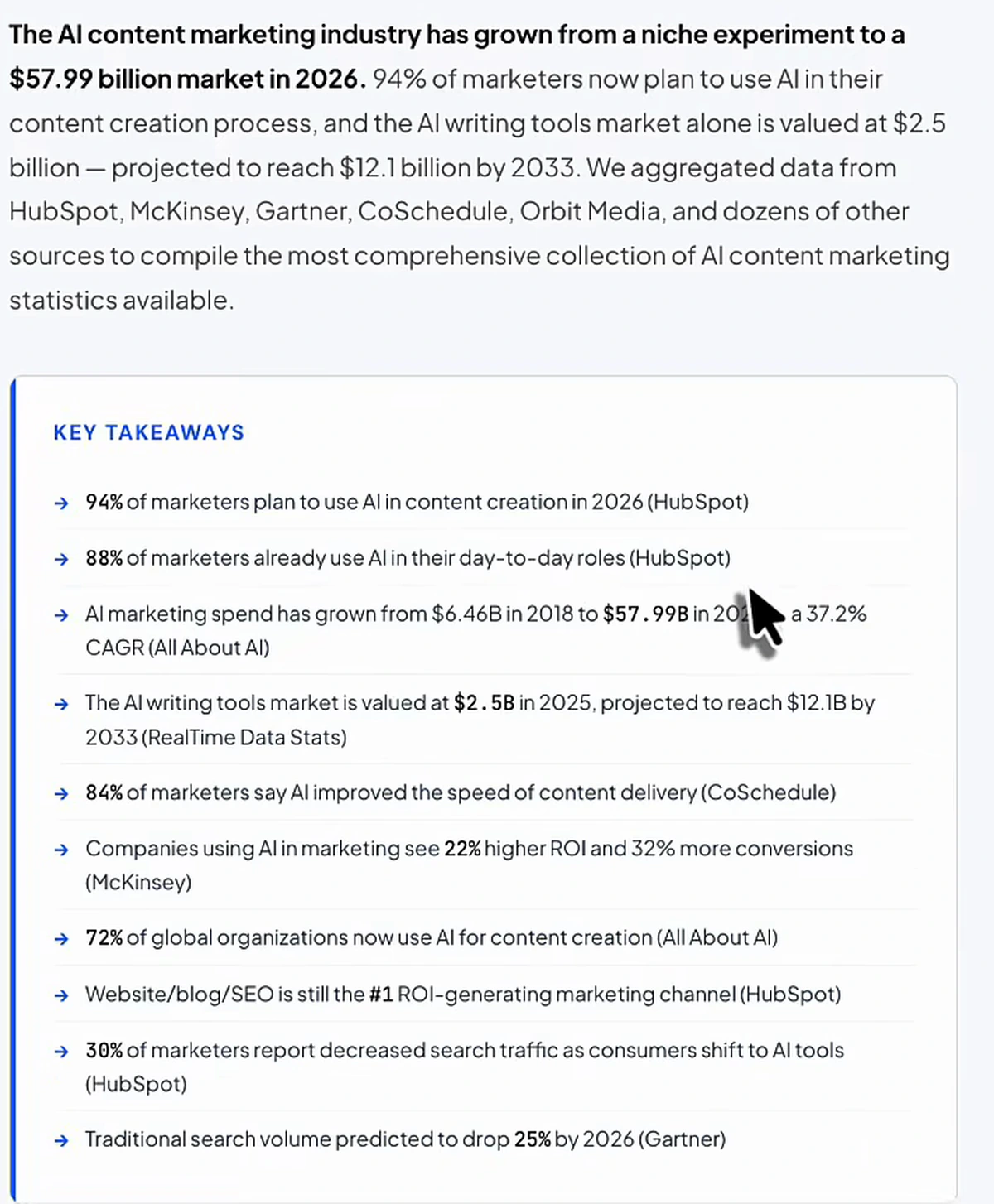
Below that the page is a sequence of themed sections, each ending in a three-column table: metric, value, source. Adoption statistics. Blogging statistics. Quality and trust. ROI and performance. The format is the whole product.
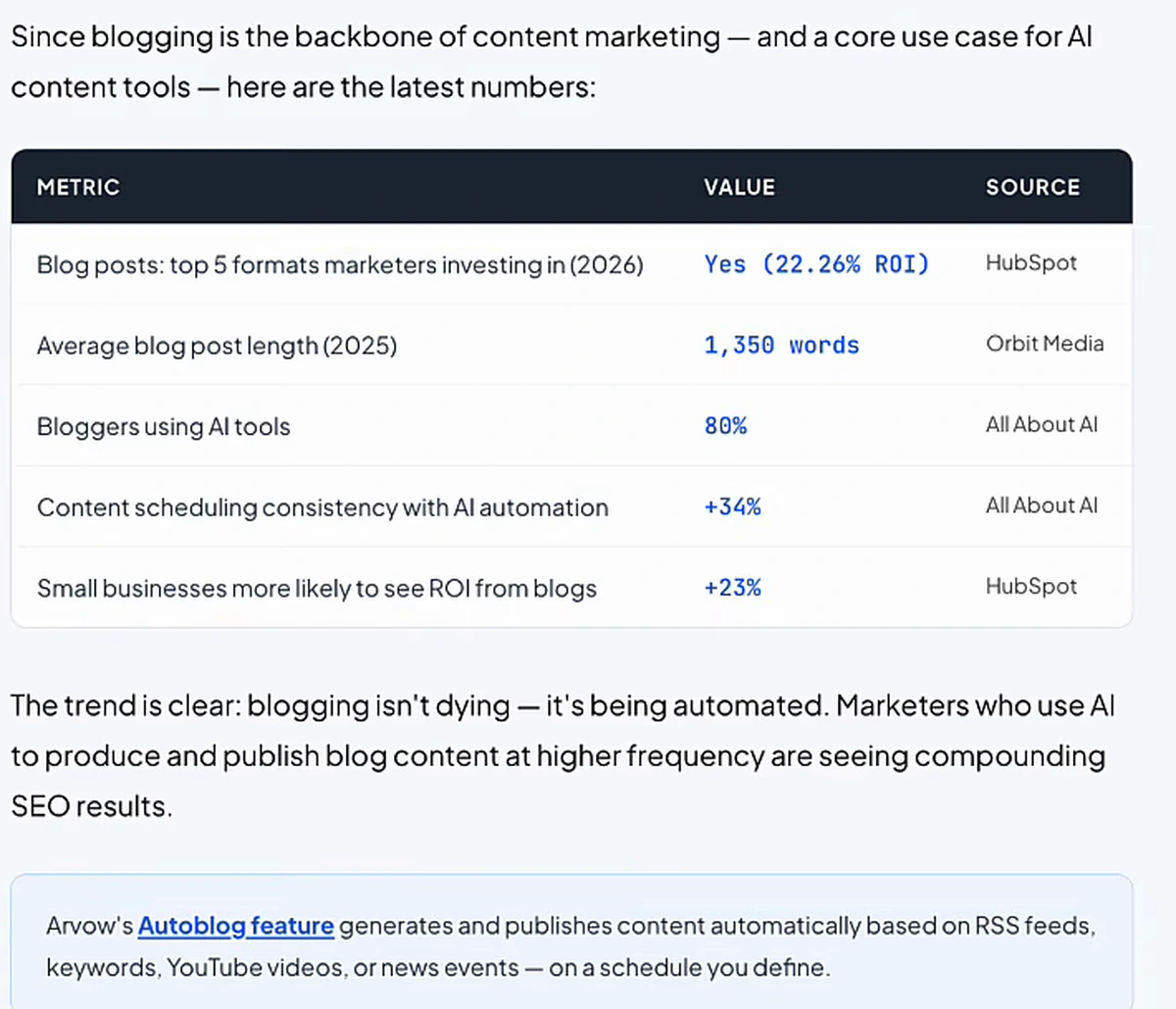
One honest note, because the video makes a point of it. The presenter says the page does not promote the product — and in the sense that matters, it does not: there is no pitch, no "and here's why our tool is best", no argument bent toward a sale. But it is not brand-free either. A small callout in the blogging section mentions the Autoblog feature and links to it. That is the line worth copying: a product can appear on a linkable asset as a footnote, never as the point. The moment the page starts arguing for you, other sites stop citing it.
What it earned
Here is the page's backlink report, filtered to one link per domain.
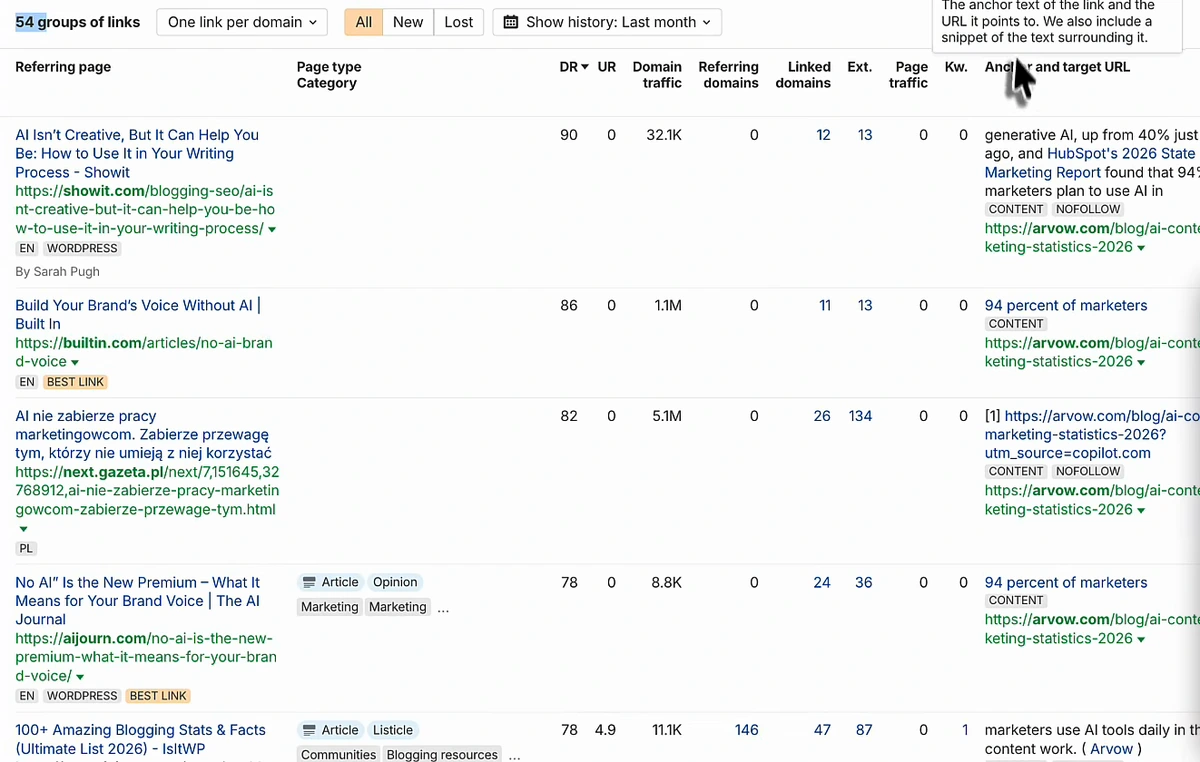
Read the columns carefully, because the report contains the caveat as well as the win:
- The authority is real. DR 90 with 32.1K monthly organic traffic; DR 86 on a site pulling 1.1M; DR 82 on 5.1M. These are publishers, not link farms.
- Two of the top five are nofollow. The DR 90 and the DR 82 rows are both tagged NOFOLLOW; the DR 86 and one DR 78 row are tagged BEST LINK. A nofollow mention from a DR 90 publisher still carries brand value and still feeds AI systems — see brand mentions are the new backlinks — but nobody should read this table as 54 dofollow links.
- The anchors are citations, not keywords. "94 percent of marketers". "marketers use AI tools daily in their content work (Arvow)". Nobody optimised these, which is exactly why they look natural.
- Every row points at the same URL. One asset, 54 domains. That is the leverage a single good page has over fifty outreach emails.
None of these were requested and none were paid for, which is the claim the report is there to support.
Why this works now: AI writers need sources
The mechanism has changed, and this is the part worth understanding before you build anything. A large share of the content being published this year is drafted with AI assistance, and a model writing a well-structured article reaches for external citations — it links out to whatever looks like the most credible, most complete source for the number it just used.
Look at the page carrying the DR 90 link. The paragraph the link sits in cites the U.S. Chamber of Commerce and HubSpot's 2026 State of Marketing Report in the same breath.
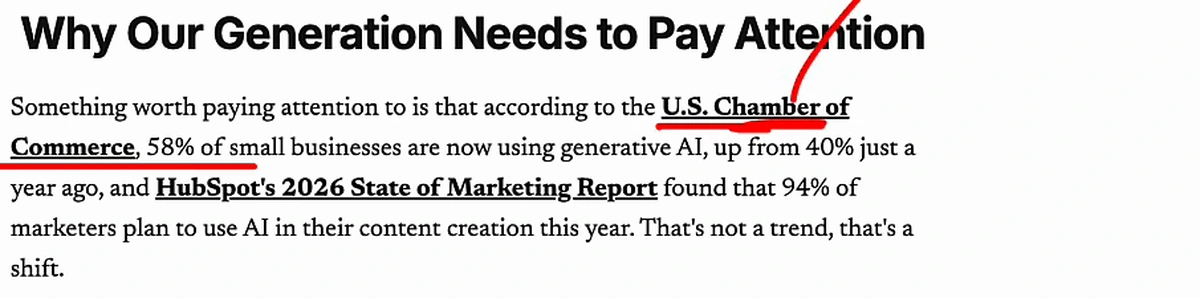
That is the whole opportunity in one sentence: an aggregation page is not competing with other blog posts for that link. It is competing with primary sources — and it wins whenever the writer wants several related numbers rather than one.
There is a harder piece of evidence sitting in the report, and it is the most interesting thing on the screen. The DR 82 Polish row's target URL is not the clean page URL. It ends in ?utm_source=copilot.com. Microsoft Copilot appends that parameter to links it surfaces, so the URL on that page is one the author was handed by an AI assistant and pasted straight into their article. The link was not earned through outreach or through someone browsing the site. It was earned by being the thing an AI assistant returned when someone asked for AI content marketing statistics.
Which reframes the exercise. You are not only writing for the writer. You are writing to be the citation an AI system hands them.
Choosing what to aggregate
The presenter's test is that regardless of your niche, there is some data you can centralise that will earn links. That is true, but it is not a plan. Three filters make it one:
- The data has to be scattered. If one authoritative report already contains everything, writers will cite that report and your page adds nothing. You want a topic where the useful numbers live in eight different places.
- Somebody has to need the number mid-sentence. Aggregate statistics that people quote in passing to support an argument — adoption rates, costs, timelines, growth. Not data people study as the subject itself.
- It has to be updatable. A statistics page dated to a year is a page you must refresh each year. That is the maintenance cost of the tactic, and it is the reason most people abandon it after one.
Arvow runs this as a family rather than a one-off — separate roundups for link building statistics, AI overviews, blogging, GEO and agency benchmarks. Each one covers a different question writers ask, and each one collects its own domains. That is the version of this tactic that compounds.
Building one
The mechanics are unglamorous, which is why the presenter concedes this is the method people least want to do:
- Collect and attribute. Gather every credible figure on the topic and record the source for each as you go. The attribution is not decoration; a page of unsourced numbers is not citable.
- Structure it for lifting. Metric, value, source. Short themed sections. A takeaways block near the top so a reader who only wants one number finds it in five seconds.
- Write no argument. Frame sections neutrally. The page's authority comes from being useful to people who disagree with you — the video notes that even competitors link to it.
- Keep the brand mention to a footnote. One contextual link to your product where it genuinely fits, and nowhere else.
- Put the year in the title and diarise the update. Then leave it alone. Links to this page arrived over months, not days.
The video's presenter uses Arvow's own research and writing to produce these pages, which is worth stating plainly since it is his product; the format above is what matters and it does not depend on any particular tool.
Where this sits among the other free methods
The video gives five free tactics, and it is candid that they are not equal. Social profiles and profile links are foundation work — anyone can build them, which is precisely why they carry little leverage. Charity links, where a donation earns a place on a nonprofit's donors page, buy genuinely niche-relevant authority but are not free. PR is free only if you have something a journalist actually wants.
Aggregation is the one the presenter singles out as producing links more powerful than the rest — and, he adds, probably more powerful than links you would pay for. The trade is that it is the only one that requires you to make something first. The nine-method version of this list, with the rest of the tactics worked through, is in how to get free backlinks; a ranked comparison of free and paid approaches is in 13 backlink building methods ranked.
Free is not a strategy on its own
The closing argument in the video deserves repeating because it cuts against the title. Everything free is, by definition, available to your competitors. A linkable asset is the exception that proves it — it is free in cash and expensive in effort, which is what keeps it scarce. But the presenter's own conclusion is that paying for links is what buys speed, because a paid link is one your competitor cannot simply copy.
The sensible read is that these are different instruments. The aggregation page compounds slowly and keeps earning after you stop working on it. Paid links move faster and stop when you stop. If you are weighing the two, backlink quality vs quantity is the framework, and the pricing for manually built links is on the buy backlinks page.
Start with the asset anyway. It is the only item on the list that is still working for you in a year.
The statistics page in this article was researched and written with Arvow, and it is one of eight roundups on the blog earning links the same way. See the asset itself — then build yours.
Generate, publish, syndicate and update articles automatically
The AI SEO Writer that Auto-Publishes to your Blog
- Cancel anytime
- Articles in 30 secs
- Plagiarism Free