
Link Building Statistics 2026: The Complete Data Report

Backlinks are not dead. They’ve just been repriced. The average SEO now pays $508.95 per quality backlink in 2025 (Editorial.link, 518-pro survey), and 47% pay $500 or more per high-quality link in Q1 2026 (Reporter Outreach). Despite Google publicly de-emphasizing link signals — “we need very few links to rank pages” (Gary Illyes, 2024) — Ahrefs’ analysis of 1 million SERPs shows referring domains remain the strongest correlator with rankings (Spearman 0.255). And in a counter-narrative nobody saw coming, brand mentions now outweigh backlinks 3:1 for AI Overview visibility (Ahrefs, 75K-brand study).
We aggregated data from Ahrefs, Backlinko, BuzzStream, Reporter Outreach, Editorial.link, Authority Hacker, WebFX and 25+ other primary sources to compile the most comprehensive and methodology-checked link building statistics available in 2026. Where studies disagree (and they often do — outreach response rates range from 1.7% to 8.5% across studies), we explain why. Every stat below is dated, sourced, and methodology-checked.
$361 average direct cost per quality backlink |
58% of SEOs are increasing link budgets in 2026 |
7.6% of guest-post sites meet baseline quality |
92.2% of page-one backlinks are editorial |
Key Takeaways (2026)
- Links still matter, but less: Backlinks now represent 13% of Google’s algorithm weight, down from ~50% historically (First Page Sage). Yet referring domains remain the #1 ranking correlator (Ahrefs, 1M SERPs).
- Pricing is up: Average SEO willingness-to-pay is $508.95 per quality link in 2025 (Editorial.link). Direct guest post cost averages $364.76; agency-mediated runs $1,459.06 — a 4× markup (BuzzStream).
- The quality crisis: Only 7.6% of guest post sites meet baseline quality criteria (DR 65+, traffic 10K+) per BuzzStream’s 26K-site analysis.
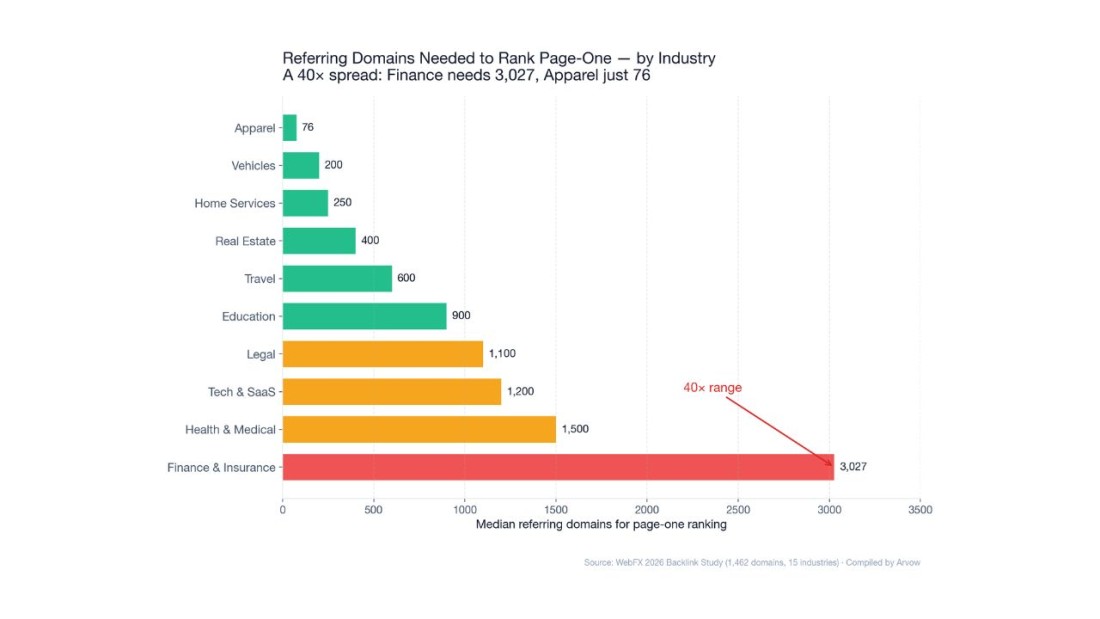
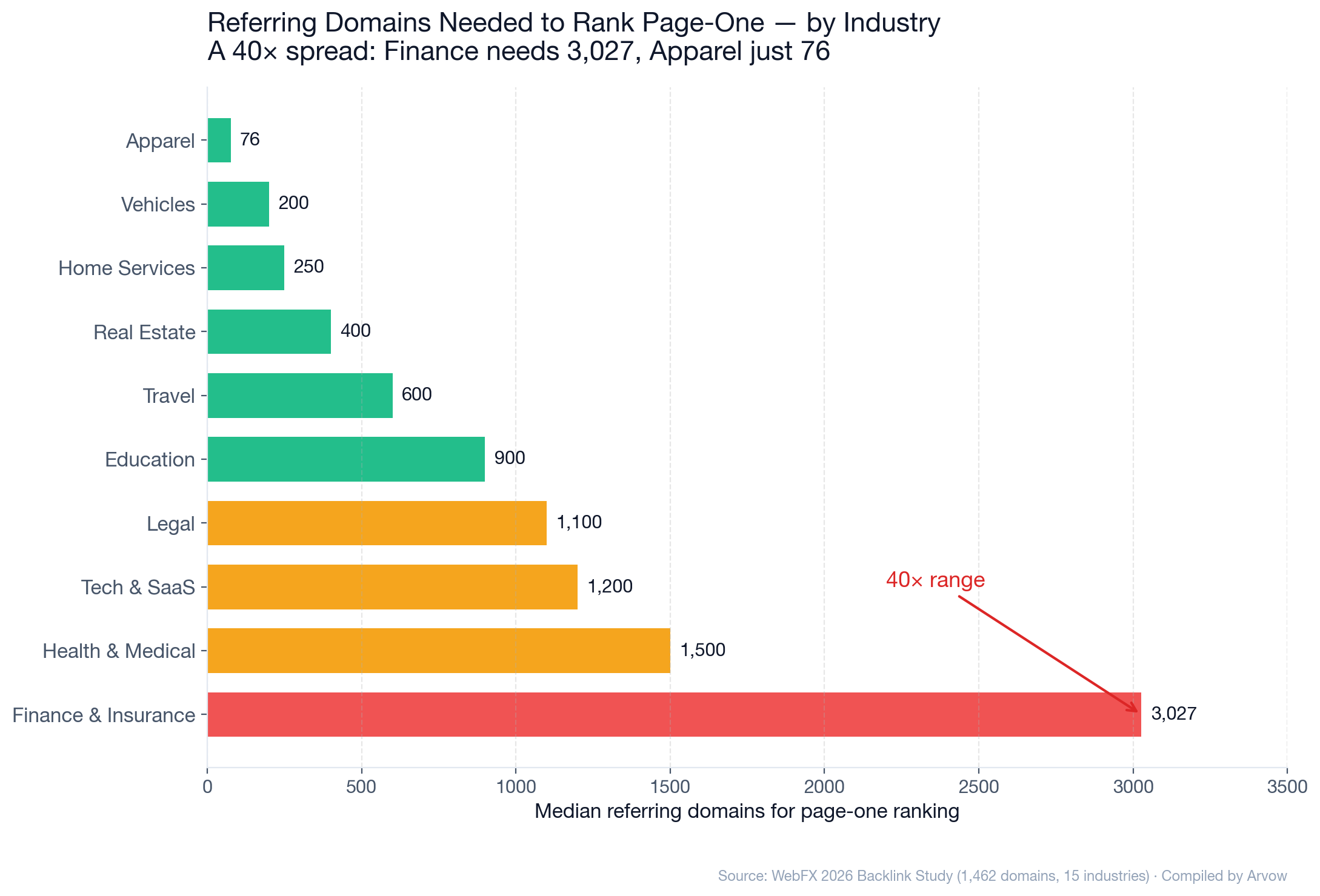
- Industry variation is enormous: Median page-one ranker has 907 referring domains, but the spread is 40× — Finance needs 3,027 while Apparel needs just 76 (WebFX, 1,462 domains across 15 industries).
- Outreach is harder than ever: Cold outreach gets only 8.5% reply rate (Backlinko, 12M emails), and editorial rejection rates rose 33% from 2023–2025 due to AI-saturated inboxes.
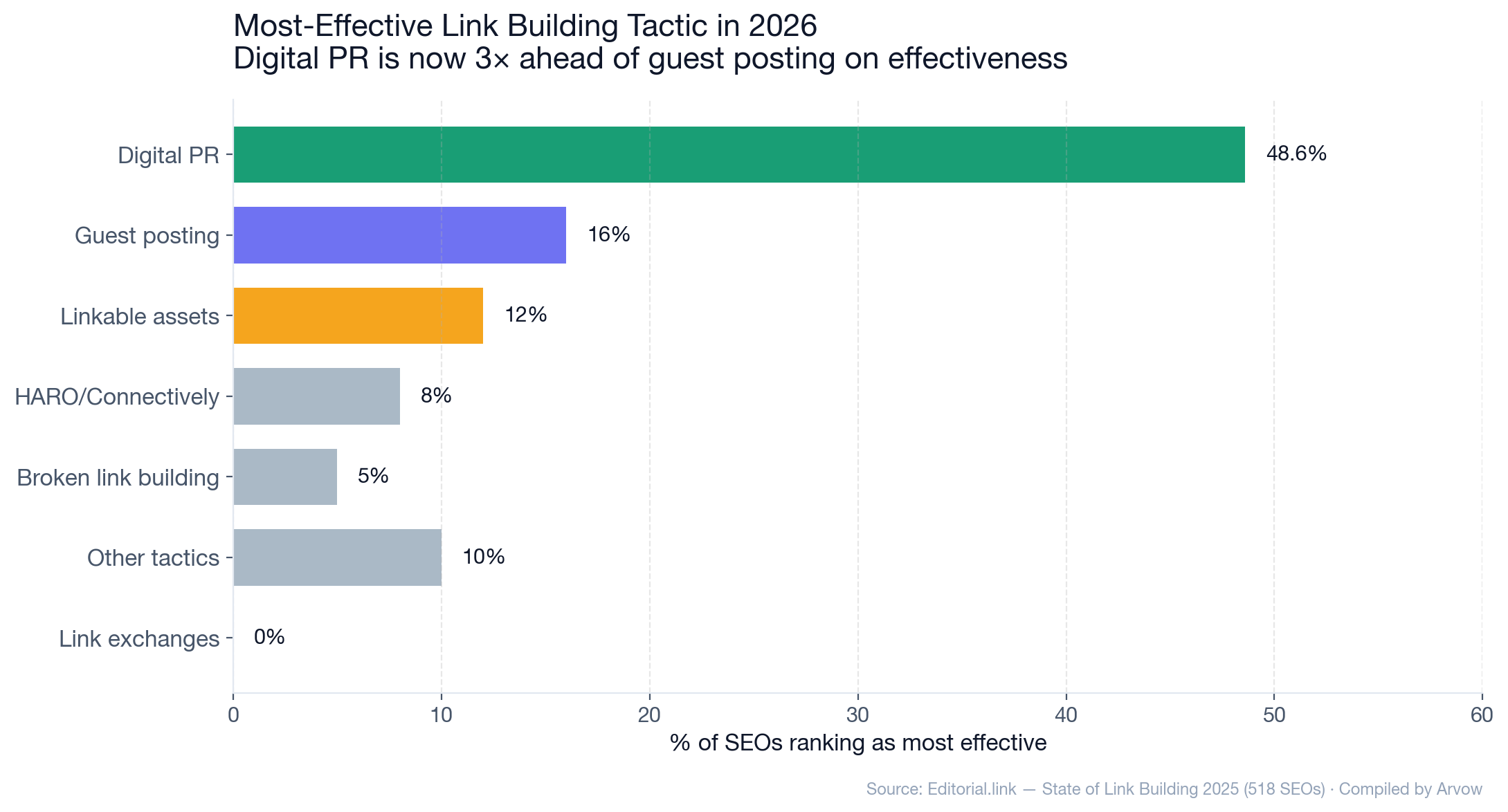
- Digital PR is now #1: 48.6% of SEOs say digital PR is the most effective link-building tactic in 2025 — far ahead of guest posting (16%) and linkable assets (12%) (Editorial.link).
- AI is changing the playbook: AI-generated outreach gets a 4.19% response rate vs 2.60% for non-AI (Belkins) — a 61% lift. But editorial rejection rates rose 33% as inboxes saturated.
- The GEO/link interaction: Brand mentions correlate 0.66–0.71 with AI Overview visibility; backlinks correlate just 0.22–0.33 (Ahrefs, 75K brands). For LLM citations, mentions matter ~3× more than links.
- Editorial dominates: 92.2% of page-one backlinks are editorial; directories just 6.8%; resource pages 1.1% (WebFX 2026).
- The honest contradiction: 91.89% of SEOs believe their competitors buy links; 55.98% don’t think Google detects them (Editorial.link). Rule-following and rule-breaking coexist in the same industry.
1. The Link Building Market in 2026
The link building economy is healthier than the discourse suggests.
The macro picture: - The global SEO services market grew from $81.46B in 2024 to a projected $108.28B in 2026 — a 32.9% increase in two years, with a 13.24% CAGR through 2030 (MarkNtel Advisors). - U.S. businesses spent an estimated $119.4B on SEO and internet marketing consulting in 2025 (IBISWorld via Resourcera). - 58% of SEOs increased their link-building budgets in 2026 despite Google’s public de-emphasis of links (Reporter Outreach, 500-pro survey).
Budget distribution among practitioners (BuzzStream State of Digital PR 2026, 150+ pros): - 60%+ of digital PR practitioners run on monthly budgets under $10,000. - Only 4% spend $20,000+/month. - Average reported cost-per-link: $750. - 51% of teams don’t track CPL at all — a striking transparency gap in the industry.
Inflation in publisher fees: - Publisher fees for sponsored placements rose 20–40% between 2024 and 2026 (RhinoRank industry data via Reporter Outreach). - Editorial.link’s 518-SEO survey found $8,406/month is the minimum monthly link-building budget needed to compete in high-difficulty niches.
The honest read: link building isn’t shrinking. It’s repricing toward higher-quality, more-vetted placements — and away from the cheap-link-marketplace model that dominated 2018–2022.
2. Are Backlinks Still a Ranking Factor in 2026?
This is the section every SEO wants the answer to. The honest answer: links matter less than they did in 2019, but they’re still the strongest single ranking correlator.
Google’s own framing (deflection)
Google has spent the past 18 months publicly de-emphasizing links:
- Gary Illyes (April 2024): “We need very few links to rank pages… Over the years, we’ve made links less important.”
- John Mueller (2024): “My recommendation would be not to focus so much on the absolute count of links… over-focusing on links will often result in you wasting your time.”
The data (counter-narrative)
Ahrefs ran the most rigorous independent test — 1,000,000 SERPs analyzed, top 20 results each, Spearman rank correlation:
| Factor | Correlation with rankings |
|---|---|
| Referring domains | 0.255 (strongest) |
| Total backlinks | 0.248 |
| Followed backlinks | 0.242 |
| Domain Rating | 0.131 |
Translation: links are still the #1 ranking correlator — but at lower strength than 2019’s baseline of 0.27–0.29. Counter-narrative confirmed: links are not dead.
The local-search wrinkle
Local search queries showed a 0.33 link-to-rank correlation — significantly stronger than informational or commercial query types (Ahrefs, same study). Counter-intuitive given local SEO’s reputation for being review-driven.
How Google itself weighs links (estimated)
First Page Sage’s quarterly algorithm-weight estimate (15-year continuous tracking):
- Backlinks now represent 13% of Google’s algorithm weight, down from 15% in 2024 and from over 50% historically.
- Link Distribution Diversity jumped from <1% to 3% of algorithm weight after the May 2024 Google API leak revealed link-source variety as a tracked signal.
The classic Backlinko/Ahrefs benchmark, refreshed
- The #1 result on Google has 3.8× more backlinks than positions 2–10 (Backlinko 11.8M SERP study, refreshed April 2025 with Ahrefs data).
- ~95% of all pages indexed by Ahrefs have zero backlinks — the foundation of every link-bait pitch.
The hard 2026 number
Median page-one ranking site has 907 referring domains across 15 industries (WebFX 2026 Backlink Study, 1,462 domains analyzed). And editorial links account for 92.2% of all page-one backlinks; directories 6.8%; resource pages 1.1%.
The “directories still work” narrative is dead. Editorial mentions are 13× more common than directory listings on page-one results.
3. The Cost of Links in 2026
Pricing is the area where 2024 stats are most misleading. Numbers have moved.
What SEOs actually pay (multiple primary sources)
- $508.95 — average willingness-to-pay for one quality backlink in 2025 (Editorial.link, 518 SEOs).
- 47% of SEOs paid $500+ per high-quality link in Q1 2026; 16% paid $1,000+; 76% paid at least $300 (Reporter Outreach, 500-pro survey).
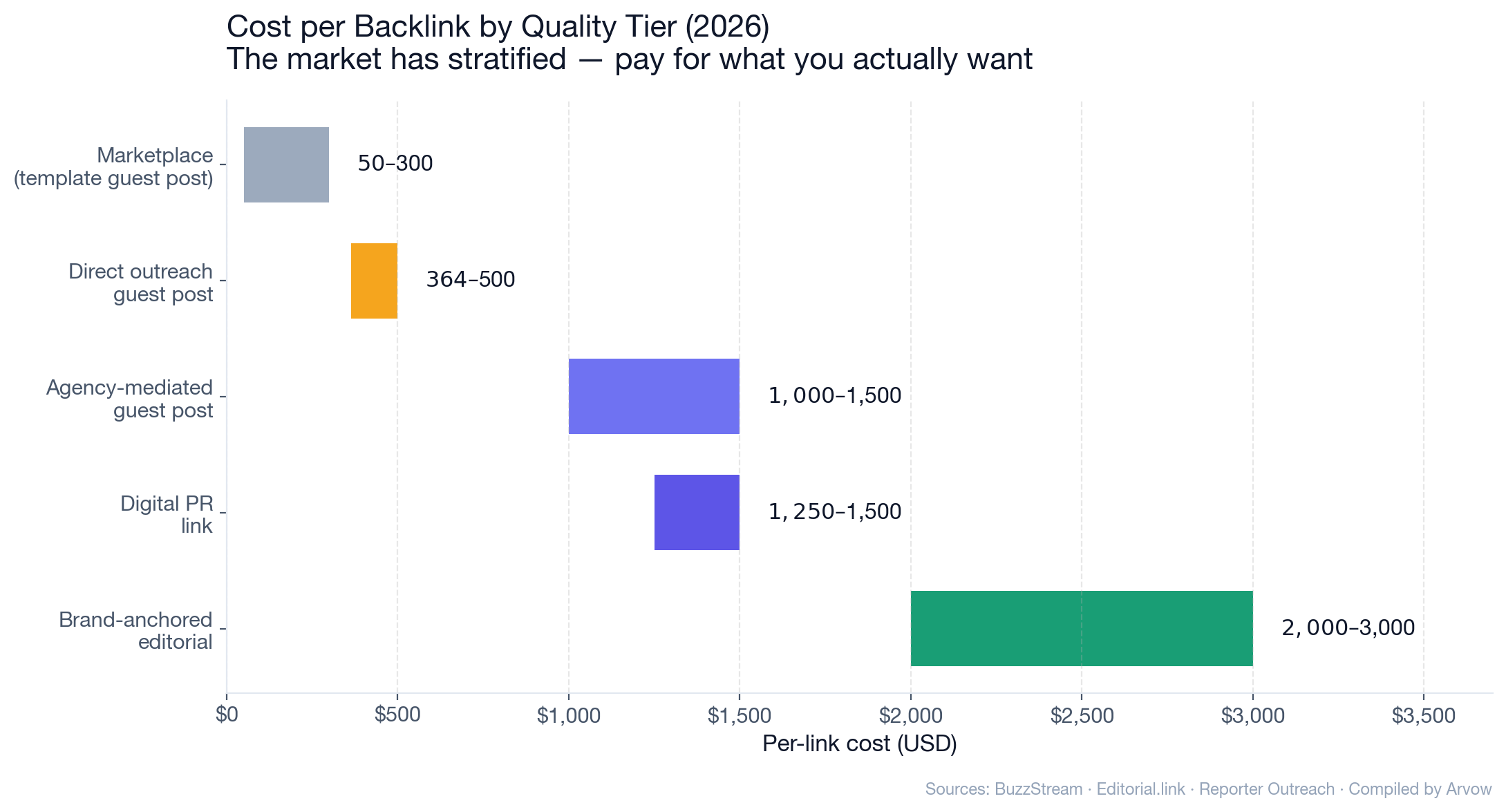
- Average direct guest post cost in 2025: $364.76. Average vendor-mediated cost: $1,459.06 — a 4× markup through agencies (BuzzStream, 26K-site analysis + 174 link insertion offers).
- Digital PR per-link cost: $1,250–$1,500, with full campaigns running $5,000–$10,000 (BuzzStream).
Why pricing has shifted
Three forces compressed the market in 2025–2026:
- AI content saturation flooded inboxes, increasing the value of vetted placements over volume.
- Publisher fees rose 20–40% (2024 → 2026) as outlets responded to demand pressure.
- The quality floor moved up — DR 65+ AND 10K+ traffic became the new baseline (vs. DR 30+ a few years ago).
The cost-tier reality
| Tier | Per-link cost | What you get |
|---|---|---|
| Marketplace / template guest post | $50–$300 | DR 30–60, low traffic, often “DR-padded” |
| Direct outreach guest post | $364–$500 | DR 50–70, real editorial standards |
| Agency-mediated guest post | $1,000–$1,500 | DR 65+, traffic-vetted, full process |
| Digital PR link | $1,250–$1,500 | Trophy-tier publishers, news placements |
| Brand-anchored editorial | $2,000+ | High-DA news sites, often unique to budget |
From Arvow: Arvow’s link building service places real, niche-relevant, manually-outreached backlinks on DR 40+ sites with 1,000+ verified monthly organic traffic — not just DR-padded marketplace listings. Live within 14 days, replaced free forever. See pricing →
4. Outreach Response Rates: What Actually Works
This is the area with the biggest gap between what works in theory and what happens in inboxes.
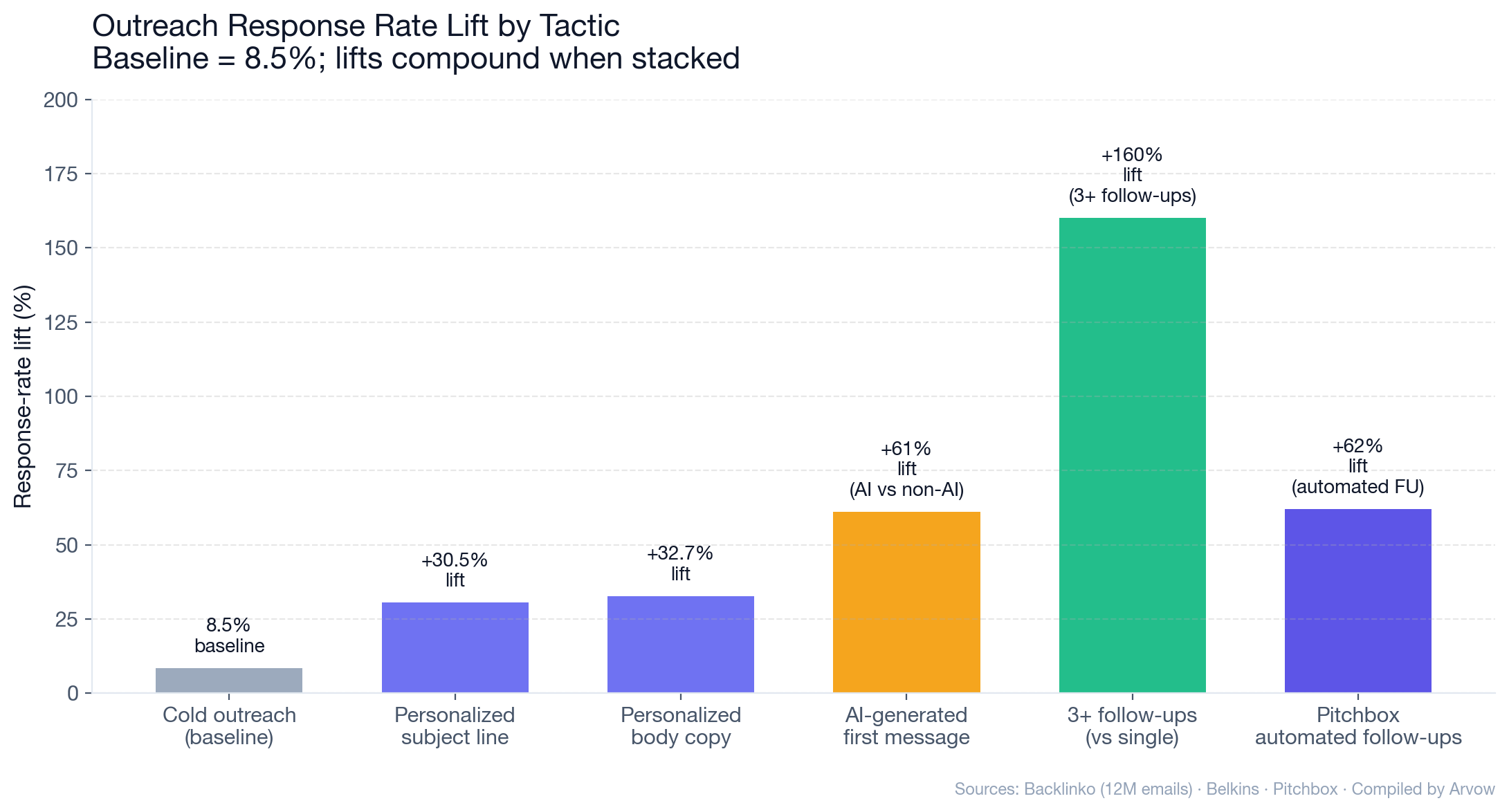
The baseline (Backlinko’s 12-million-email study)
The single most-cited outreach study in the industry. 12M emails analyzed via Pitchbox:
- Only 8.5% of cold outreach emails receive any response. 91.5% are ignored.
- Personalized subject lines lift response rate by 30.5%.
- Personalized body copy lifts response by 32.7%.
- Three or more follow-ups boost response 160% vs single-contact outreach.
The 2025–2026 reality: it’s gotten harder
- Editorial rejection rates rose 33% from 2023 to 2025 — partly driven by AI content saturation in editor inboxes (Reporter Outreach, 500-pro survey).
- 75% of journalists receive up to 100 pitches per week; 49% seldom or never respond (Cision State of the Media 2024 / Muck Rack).
- 73% of journalists reject pitches due to irrelevance to their beat; 77% cite “spamming/mass-pitching” as the top reason for blocking outreach (Cision).
- 55.4% of digital PR pros send only one follow-up email per pitch (BuzzStream State of Digital PR 2026) — meaning most teams aren’t even getting to the cadence Backlinko’s data says works best.
The AI outreach paradox (counter-intuitive)
You’d expect AI outreach to underperform — it doesn’t:
- AI-generated first outreach messages get a 4.19% response rate vs. 2.60% for non-AI — a 61% lift (Belkins, 2025 LinkedIn outreach study).
- Pitchbox’s automated follow-ups boost response rates by approximately 62% (Pitchbox internal data, 2025).
The honest reconciliation: AI helps you send more and respond faster, but acceptance rates are tightening because everyone is using AI. The arms race favors quality of pitch + speed of follow-up, not raw volume.
5. Tactic Effectiveness: What Actually Works in 2026
Two converging surveys agree on the headline.
The new ranking (Editorial.link 518-SEO survey, 2025)
| Tactic | % saying “most effective” |
|---|---|
| Digital PR | 48.6% |
| Guest posting | 16% |
| Linkable assets | 12% |
| HARO/Connectively | 8% |
| Broken link building | 5% |
| Other | ~10% |
The “most-used” gap
Despite digital PR being the most-effective tactic, guest posting remains the most-used:
- Guest posting: 64.9% of link builders currently using it (Authority Hacker, 755-link-builder survey); 81% in newer Omniscient Digital data (105 pros, 21 countries).
- 67.3% of marketers use digital PR as their primary link-building method (Authority Hacker / FATJOE 500 SEO pros).
- Link exchanges had 0% ranked #1 in Reporter Outreach’s 2026 effectiveness ranking — the dead-letter tactic.
Digital PR yield (real numbers)
The honest math (Reboot Online digital PR analysis — 371,631 articles, 6,200+ backlinks over 2 years to June 2024):
- Average digital PR campaign earns 42 unique referring domains at average DR 61.
- 48% of digital PR backlinks are dofollow; 33% syndicated; 19% nofollow.
- 20.62% of digital PR backlinks fall in DR 70–79 (the most common band).
- 7.83% of digital PR links earn DR 90+ — the trophy tier.
From Arvow: Stop paying digital-PR agency fees for theoretical campaigns. Arvow’s link building service delivers manually-outreached, niche-relevant backlinks on DR40+ AND 1K+-traffic sites, with screenshot proof and live Google Sheet reporting. See how it works →
Other tactics (2026 baselines)
- Broken link building: ~22% success rate when pitched with relevant replacement content (Ahrefs / Backlinko broken-link benchmarks).
- Press release pitches surged from 72.8% (2025) to 85.1% (2026) of digital PR teams using them (BuzzStream 2026).
- Data-led pitches now used by 95.9% of digital PR pros (up from 95% in 2025) — near saturation.
- HARO/Connectively response rates declined 30%+ year-over-year as journalists shifted off the platform after Cision’s 2024 HARO retirement and rebrand.
6. Link Velocity & Time-to-Acquire
How fast should links accumulate? How quickly should rankings respond? The data has hardened in 2025–2026.
What “normal” link velocity looks like
- Top-ranking pages gain new followed referring domains at +5% to +14.5% per month; over 3 months they accumulate +17% to +50% additional backlinks (Ahrefs Backlink Growth Study — still the canonical benchmark, 10K keywords / 200K pages).
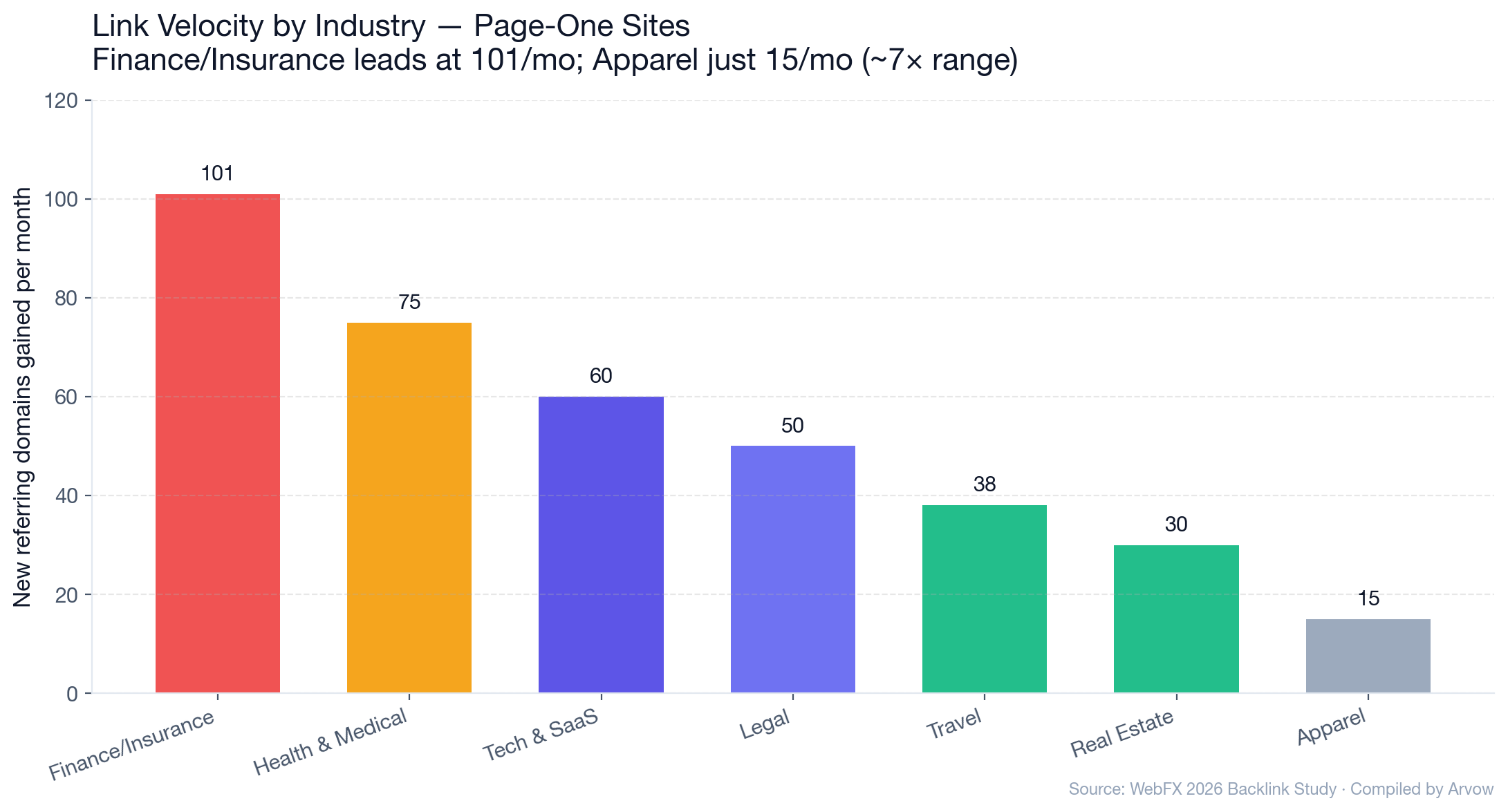
- Cross-industry, page-one ranking sites add 48 new referring domains per month on average (WebFX 2026, 1,462 domains).
- Finance/Insurance leads at 101 new referring domains/month; Apparel at 15/month — a 7× range.
How fast rankings actually move after link acquisition
Two surveys agree on the timeline: - 46.6% of link builders observe link impact on rankings within 1–3 months of acquisition (Authority Hacker, 755-link-builder survey). - 57.1% of SEOs expect to see link-building results within 1–3 months (Editorial.link, 518 pros).
For digital PR specifically (BuzzStream State of Digital PR 2026): - 81% of digital PR teams secure first coverage within one week of pitching. - 51.4% see first coverage in 3–6 months of starting a campaign. - 85.2% see measurable SEO results within 6 months.
Per-builder output benchmarks
The honest reality at the practitioner level: - 73.5% of link builders build fewer than 10 links per month (Authority Hacker). Most professionals work at low volume. - A single digital PR link builder generates an average of 15.58 links per month (BuzzStream State of Digital PR 2025). - 32.5% of digital PR teams report 31+ links per team member per month in 2026 — a small minority hitting enterprise scale (BuzzStream).
Link rot — why this is a forever job
- 8.03% of all links break within the first 3 months; 17.37% are gone within a year; 44% are gone after 7 years (Linkody Link Rot Study).
- 66.5% of links to websites built in the last 9 years are already dead or non-functional (Ahrefs link rot analysis, 2.06M domains).
Translation: even maintaining current link equity requires acquisition. Stopping is decay.
7. Quality Signals: DR, Anchor Text, & What Counts as a “Good” Link
The “quality > quantity” debate is over. The data only argues about thresholds.
The quality consensus
- 93.8% of link builders agree link quality matters more than quantity (Authority Hacker, 755-pro survey).
- 62% of SEOs prioritize link quality over quantity in 2026.
- 52% set a minimum DR 50+ requirement; 22% require DR 60+; only 9% set no DR floor (Reporter Outreach, 500-pro survey).
Anchor text distribution (2025 baseline)
The 2025 anchor-text mix SEOs aim for (Editorial.link, 518 pros):
| Anchor type | Share |
|---|---|
| Partial-match | 41.7% |
| Exact-match | 25.1% |
| Branded | 20.5% |
| Related/topical | 8.7% |
| Other | ~4% |
Nofollow + brand mentions matter more than people thought
- 78.8% of SEOs believe nofollow links impact rankings.
- 80.9% say unlinked brand mentions also affect rankings (Editorial.link, 518 pros).
The industry has decisively moved past “nofollow doesn’t count” — and the GEO/AI Overview data (covered in §11) backs this up.
Ahrefs has won the metric war
- 64.1% of SEOs use Ahrefs DR/UR as their primary domain authority metric.
- 15.4% use Semrush Authority Score.
- 11.6% use Moz DA/PA.
- 8.9% use Majestic CF/TF (Editorial.link, 518 pros).
Editorial dominates page-one
- Editorial links account for 92.2% of all page-one backlinks across 15 industries (WebFX 2026).
- Directories: just 6.8%.
- Resource pages: 1.1%.
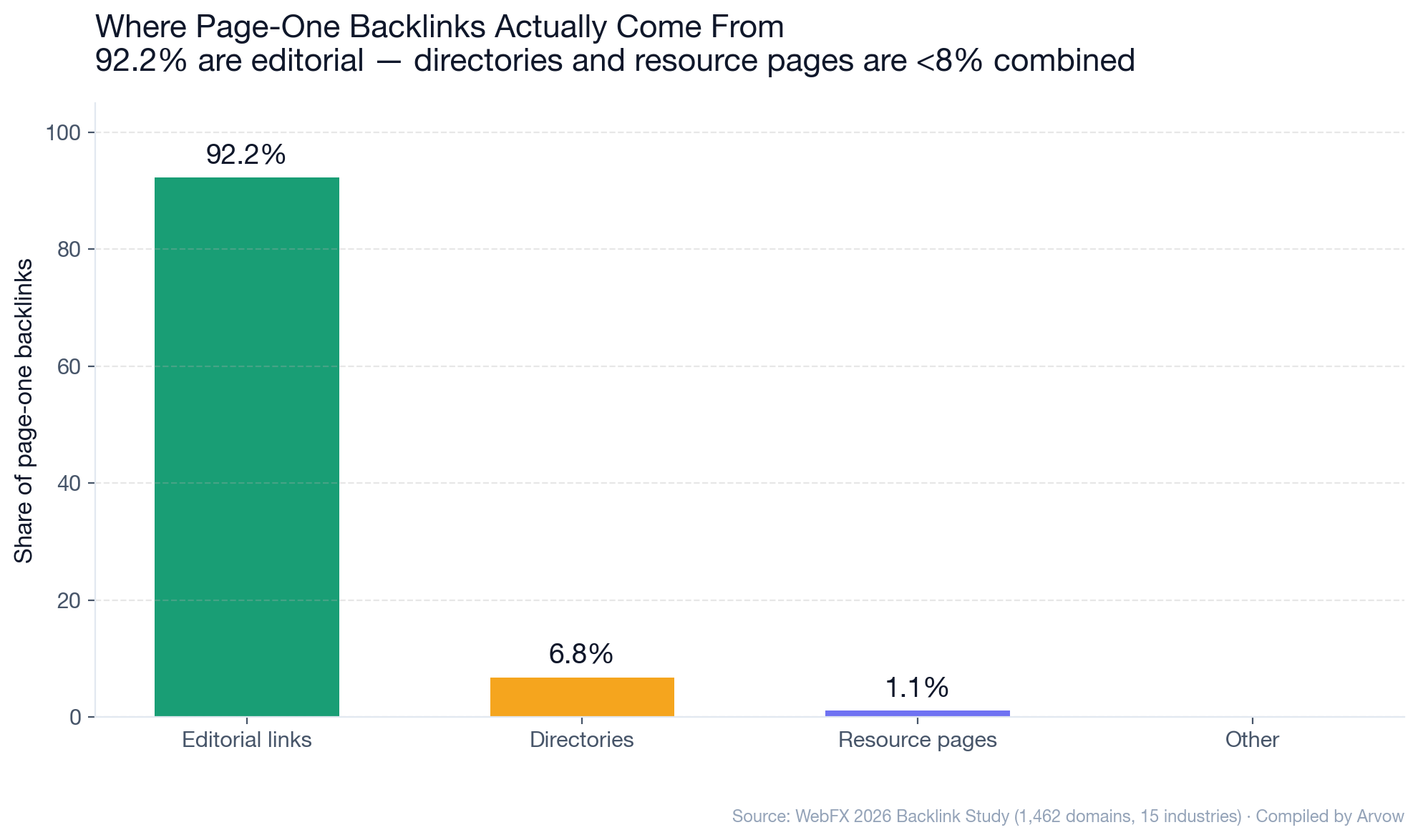
By industry, Real Estate (95.6%), Vehicles (95.4%), and Dining/Nightlife (94.8%) have the highest editorial-link share among page-one backlinks.
Where to point links (page-targeting strategy)
- 52.7% of SEOs say service/product pages get the most link-building attention.
- 38.4% blog posts.
- 7.1% homepage (Editorial.link).
Money-page focus dominates — counter to common “blog-only” link strategy.
8. The Quality Crisis: Toxic Links, “DR-Padded” Sites & Penalty Reality
This is the section nobody else writes properly. The honest state of link quality in 2026.
The 7.6% problem
Only 7.6% of guest post opportunities meet baseline quality criteria — DR/DA >65 AND traffic >10,000 monthly — across 26,000+ guest post sites analyzed (BuzzStream Link Building Pricing Study, January 2025).
Translation: 92.4% of available guest post inventory is junk. The link marketplace is structurally broken — most sellers pad DR with link networks while sitting on near-zero traffic.
What “DR-padded” actually means
A DR 60 site with 100 monthly organic visitors is not equivalent to a DR 60 site with 10,000 monthly organic visitors. Yet most link marketplaces only show DR. The traffic-verified link is the new floor.
Disavow practice has shifted
- 39% of SEOs use Google’s Disavow Tool; 61% don’t bother (Editorial.link).
- 38% of SEO specialists do nothing about spam backlinks they detect; another 38% disavow (industry survey aggregated 2024–2025).
The majority has stopped reactive disavowing — partly because Google itself signals reduced reliance on disavow, partly because algorithmic devaluation handles most spam links automatically.
Recovery timelines (when penalties hit)
- Average Google manual-action recovery: 67 days for fast corrective action + reconsideration request.
- Algorithmic recoveries average 4–6 months (industry data aggregated 2025–2026).
The 2024–2025 spam updates
- Google’s December 2024 spam update was the biggest spam update ever released; rolled out December 19, took 7 days (Google Search Central).
- Google’s August 2025 spam update penalized sub-500-word content most consistently; sites with DR 40+ and strong branded search held up best (Raptive analysis).
Branded equity now protects against spam updates more than link counts do.
The honest industry confession
- 91.89% of SEOs believe their competitors buy backlinks.
- 55.98% don’t think Google effectively detects paid links (Editorial.link, 518-pro survey).
Rule-following and rule-breaking coexist in the same industry. The data above just makes the math explicit.
From Arvow: Stop paying marketplace prices for DR-padded junk. Arvow’s link building service only places links on sites that pass both DR 40+ AND 1,000+ verified monthly organic traffic — manually outreached, niche-relevant, with screenshot proof and live Google Sheet reporting. Replaced free, forever. See pricing →
9. Industry-Specific Link Building Benchmarks
The single biggest gap in every other “link building statistics” article. Treating link building as monolithic is a category error.
The 40× variance (the headline finding)
WebFX 2026 Backlink Study analyzed 1,462 domains across 15 industries:
| Industry | Median referring domains for page-one ranking |
|---|---|
| Finance & Insurance | 3,027 |
| Health & Medical | ~1,500 |
| Tech & SaaS | ~1,200 |
| Legal | ~1,100 |
| Education | ~900 |
| Travel | ~600 |
| Real Estate | ~400 |
| Home Services | ~250 |
| Vehicles | ~200 |
| Apparel | 76 |
That’s a 40× range. “How many links do I need to rank?” depends entirely on the vertical.
Where the link spend concentrates
Industries with highest link-building budgets (Editorial.link, 518 pros): - iGaming/gambling: 61.0% of high-budget respondents. - Finance: 18.4%. - Law: 16.4%.
YMYL niches dominate spend — quantifying the cost barrier in regulated/high-CPC verticals.
Difficulty rankings (digital PR specifically)
Hardest industries for digital PR (BuzzStream State of Digital PR 2026, 150+ practitioners): - Finance: 23.6% rate it hardest. - Health/Wellness: 20.3%. - Education: 19.6%.
Easiest industry: Travel — 46.6% of practitioners rate it easiest.
B2B vs B2C content dynamics
- B2C content gets 9.7× more social shares than B2B content (Backlinko 912M blog posts study).
- 93% of B2B content gets zero links from other websites; only 3% get links from multiple websites.
- 94% of all blog posts (any category) receive zero external backlinks — only 2.2% earn links from multiple sites.
B2B content link economics are punishing. Most pieces never earn a single backlink.
Local SEO weight
- Citations contribute ~11% of local pack ranking signals in 2024 (BrightLocal Local Search Ranking Factors).
- Reviews grew from 16% (2023) to 20% (2024) of local pack ranking weight — eating into citation share.
Real campaign uplift (illustrative, vendor-disclosed)
For context only — these are vendor-disclosed campaign outcomes, not survey averages: - SaaS: +2,203% organic traffic in 6 months (links DR 78 average). - Telehealth: +124% in 12 months across 83 placements at DR 81 average (Reporter Outreach campaign disclosure).
10. Team Structure: In-House vs. Agency vs. Freelancer
The build-vs-buy decision in 2026.
How the work gets done
- 60% of businesses outsource link building entirely to agencies/freelancers; 29% in-house only; 11% hybrid (uSERP State of Backlinks 2025, 800+ pros).
- Editorial.link 2025 survey: 56% outsource at least some link-building tasks; 44% handle entirely in-house.
- BuzzStream finds 61% manage entirely in-house — slight definitional differences with Editorial.link, but the directional message holds: most teams keep significant in-house work.
Compensation benchmarks (US, 2025)
- Average US SEO Link Builder salary: $79,311/year ($38/hour, Glassdoor September–October 2025).
- Top 10% earners: $145,139/year.
The build-vs-buy economics
- Building an in-house SEO team costs ~$138,040 in year one (compensation + tooling + benefits, aggregated 2025 data).
- Outsourced agency services run $1,500–$5,000/month, $100–$300/hour, or $5,000–$30,000 per project.
The pivot point sits around the $138K in-house team threshold — above that volume, in-house wins on per-link cost; below it, outsourcing wins.
The experience paradox
The most counter-intuitive team-structure finding:
- In-house SEOs pay 75% more per link than niche site owners.
- Experienced SEO pros pay 221% more per link than beginners (Authority Hacker, 755 link builders).
Reading this charitably: experience drives focus on higher-quality (more expensive) placements. Reading it cynically: ego and budget cushion compound. Both interpretations have data behind them.
Output expectations per builder
- Single digital PR link builder: ~15.58 links/month average (BuzzStream).
- 73.5% of link builders build fewer than 10 links/month (Authority Hacker).
10 links/month is the realistic per-builder benchmark. Anyone promising 30+ at quality is either at enterprise scale or selling junk.
11. AI’s Impact on Link Building in 2026
This is the section that didn’t exist in any of the 2022–2024 stats roundups. New territory.
The 3:1 brand-mentions-vs-backlinks finding
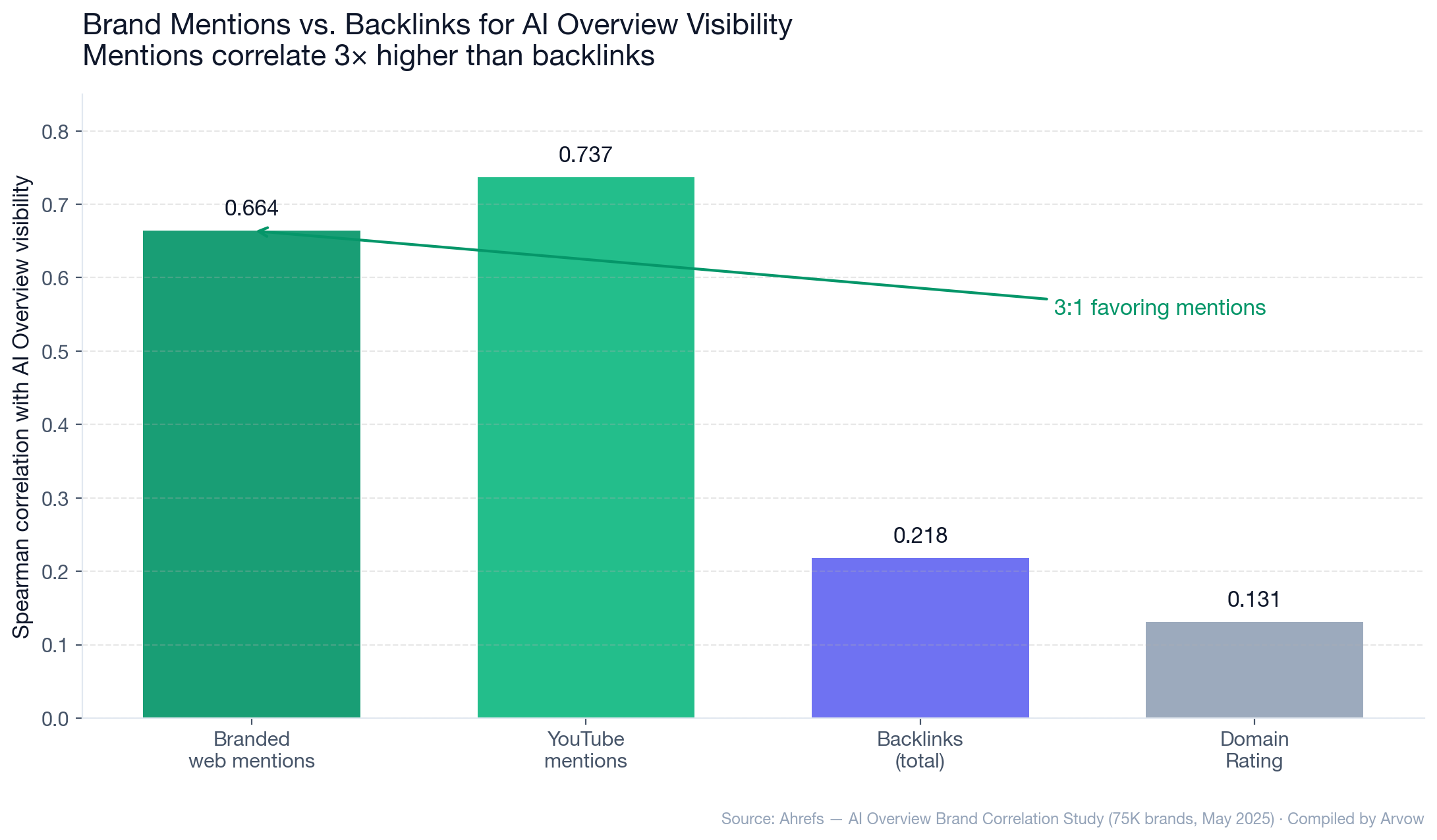
The single most-cited 2025 stat in this space. Ahrefs analyzed 75,000 brands (DR>40, ≥800 monthly searches per topic):
- Branded web mentions correlate with AI Overview brand visibility at 0.664.
- Backlinks correlate at just 0.218.
- Translation: brand mentions outweigh backlinks 3:1 for AI Overview visibility.
The visibility concentration
- Brands in the top 25% for web mentions earn 10× more AI Overview mentions (avg. 169) than the next quartile (avg. 14).
- 26% of brands have zero AI Overview mentions.
- Top 50 brands appearing in AI Overviews account for 28.9% of all citations.
The winner-takes-all dynamic is severe. Brand-mention leaders compound their AI visibility advantage.
But links still matter for AI search
The reconciling finding (Ahrefs, July 2025, 1.9 million citations from 1 million AI Overviews):
- 76.10% of AI Overview citations come from URLs ranking in Google’s top 10.
- Only 14.4% don’t rank at all (below position 100).
Translation: top organic ranking still drives most AI citations. Links → rankings → AI citations. The chain is intact, just stretched.
Platform-specific link correlations
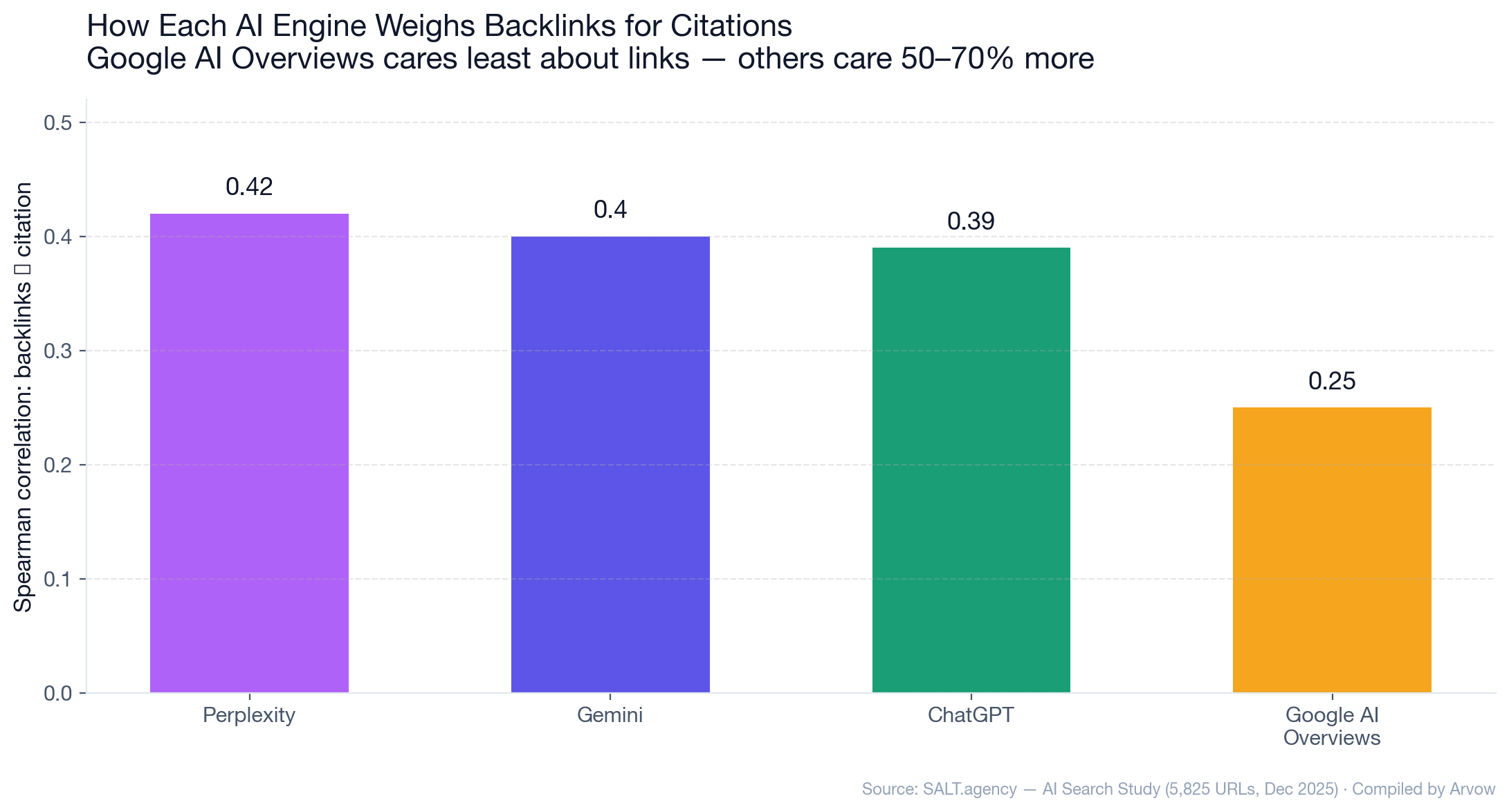
SALT.agency analyzed 5,825 URLs across 4 AI engines:
| Platform | Backlink correlation with citations |
|---|---|
| ChatGPT | 0.39 |
| Perplexity | 0.42 |
| Gemini | 0.40 |
| Google AI Overviews | 0.25 |
Google AI Overviews under-weights backlinks compared to other AI engines. Cross-platform GEO requires both: links for ChatGPT/Perplexity/Gemini, brand mentions for AI Overviews.
Industry consensus matches the data
- 73.2% of SEOs believe backlinks influence appearance in AI search results (Editorial.link 2025).
- 74% in newer Reporter Outreach 2026 data confirm backlinks impact AI visibility.
The AI tool stack of link builders (Omniscient Digital, 105 pros, June 2025)
| Tool | % of link builders using |
|---|---|
| ChatGPT | 88.6% |
| Ahrefs | 57.1% |
| Semrush | 51.4% |
| Gemini | 27.6% |
| Claude | 10.5% |
| Perplexity | 10.5% |
How link builders feel about AI’s impact
- 74% report AI made their workflow more effective (26% significantly more, 37% slightly better).
- 12% say AI made things worse (Omniscient Digital).
- 76.4% of digital PR pros say AI fundamentally changed their work (BuzzStream).
- Only 40% have a “repeatable, reliable process” for earning AI citations — the maturity gap.
The new KPI
- 66.2% of digital PR pros now track AI citations as a campaign outcome — up from negligible levels two years ago (BuzzStream 2026).
- 78.4% now track AI visibility as a category metric.
- AI Overview citations skew very recent: 85% were published in the last two years, 44% in 2025 alone.
- 82% of AI Overview citations come from earned media (third-party editorial), not owned content.
From Arvow: Arvow’s LLM Visibility Tracker shows you exactly how your brand citations track across ChatGPT, Perplexity, Gemini, Claude, Copilot, Grok, and Google AI Overviews — alongside your backlink profile. Track your AI visibility →
12. Linkable Assets: The Content That Earns the Most Links
If links are the goal, what content earns them?
Length & depth
- Long-form content (3,000+ words) earns 77.2% more referring domain links than articles under 1,000 words (Backlinko 912M blog posts study).
- Optimal sweet spot for ranking: 2,500–4,000 words. Content in this range averages position 3.1 vs. 10.2 for 500–1,000 word articles.
Format effectiveness
From the Backlinko 912M-post study: - List posts generate 218% more social shares than how-to posts and 203% more than infographics. - “Why Posts,” “What Posts,” and infographics get 25.8% more links than videos and how-tos. - Original research and statistics pages attract 200% more backlinks on average (PressWhizz analysis).
The viral-vs-linkable disconnect
Counter-intuitive but rigorous:
- Pearson correlation between social shares and backlinks: 0.078 — essentially no relationship.
- 1.3% of articles generate 75% of all social shares.
- 0.1% of articles receive 50% of total shares.
Going viral doesn’t reliably earn links. The two are nearly independent variables.
Stats roundups specifically
The format you’re reading right now. Examples of how well it scales: - Stanford’s 2025 AI Index Report has earned over 12,000 backlinks — the canonical benchmark study (Stanford HAI / Ahrefs). - Authority Hacker’s 755-link-builder survey says “creating link-worthy content” is the most-effective tactic — even from outreach-heavy professionals.
What this means
The data suggests the highest-leverage linkable assets in 2026 are:
- Original research / statistics roundups with proprietary data
- Long-form depth pieces (2,500–4,000 words) on well-defined topics
- Industry benchmark reports that practitioners can cite
- Free tools (calculators, generators) — under-represented in survey data but consistently link-magnetic in case studies
What doesn’t earn links reliably: short opinion pieces, recycled list posts, and viral social-friendly content.
From Arvow: Most teams can’t publish at the velocity the data demands. Arvow’s Autoblog automates publication of long-form, research-grade content — auto-formatted for AI Overview citations and link-earning structure. Set up your Autoblog →
13. The Contradictions: Where Link Building Studies Disagree
This is the section nobody else writes. The 2025–2026 link building data is full of conflicting numbers. Most “definitive” articles pick one and move on. We laid the conflicts side-by-side and explain why.
- Backlinko (12M emails, 2019–2024): 8.5% reply rate.
- Belkins (LinkedIn, 2025): 2.60% non-AI vs 4.19% AI-generated.
- Industry reports: Some agency benchmarks show 1.7% as the floor.
Why they differ: sample (cold outreach vs warm vs LinkedIn vs blogger outreach). All measurements are valid for their channel; the headline number depends on which channel.
- Marketplace listings: $50–$300.
- Editorial.link willingness-to-pay: $508.95.
- BuzzStream agency-mediated: $1,459.06.
- Digital PR per-link: $1,250–$1,500.
Why they differ: quality tier and vendor markup. Marketplace prices are pre-quality-filter; willingness-to-pay surveys ask about quality links; agency prices include the labor of vetting + outreach. All three numbers are real for their tier.
- Google’s public position (Illyes, Mueller 2024): Links matter less; don’t over-focus on them.
- Ahrefs 1M-SERP study: Referring domains remain the strongest single ranking correlator (0.255).
- First Page Sage estimate: Backlinks are 13% of algorithm weight in 2026 (down from 50%+ historically but still material).
Why this is the right framing: Both can be true. Links are less important than they were — but still the most important single factor measurable. The honest read: links are necessary but not sufficient.
- Ahrefs (75K brands): Brand mentions correlate 0.664 with AI Overview visibility; backlinks 0.218 (3:1 favoring mentions).
- Ahrefs (1.9M citations): 76.10% of AI Overview citations come from top-10 ranking pages (which require links to rank).
Reconciliation: The right answer is “both, sequentially.” Backlinks → top-10 rankings → AI Overview citation. Brand mentions → AI Overview visibility directly, bypassing rankings. Different mechanisms, both real.
- Industry consensus (Editorial.link): 91.89% of SEOs believe competitors buy links; 55.98% don’t think Google detects paid links.
- Google’s position: Disavow tool exists; spam updates penalize bought links.
Reconciliation: The industry collectively bets that detection is imperfect. Algorithmic devaluation (the silent kind) is more common than penalties (the loud kind). Most SEOs operate accordingly.
- Linkody (3 months): 8.03% of links break.
- Linkody (1 year): 17.37%.
- Linkody (7 years): 44%.
- Ahrefs (9 years, 2.06M domains): 66.5% of links to sites built in the last 9 years are dead.
Reconciliation: Time horizon. The Ahrefs 66.5% number is the long-tail decay; Linkody’s 8/17/44% is the short/medium/long-term curve. Both are accurate for their period.
14. What This Means for Your Site in 2026
Six concrete moves the data above actually implies.
1. Buy quality, not DR
Stop paying for DR-only links. Only 7.6% of guest post sites pass DR + traffic (BuzzStream). Insist on the dual filter: DR 40+ AND 1,000+ monthly organic traffic. Anything less is paying for the illusion of authority.
2. Increase budget anyway
58% of SEOs increased link budgets in 2026 despite Google’s “links matter less” messaging. The reason: link prices are rising 20–40%, and the per-link quality bar is rising faster. You’ll buy fewer links but they need to be better.
3. Diversify into digital PR
48.6% of SEOs say digital PR is the most-effective tactic in 2025 — far ahead of guest posting (16%) and linkable assets (12%). If you’re 100% on guest posts, your link profile looks like 2019. Add digital PR (linkable-assets + journalist outreach + earned media) for the 2026 mix.
4. Build brand mentions, not just backlinks
For AI Overview visibility, brand mentions correlate 3× higher than backlinks (Ahrefs 75K-brand study). Get listed in industry roundups, comparison pages, podcast notes, partner content — even when the links are nofollow or unlinked. The mention itself moves the needle for AI search.
5. Track your AI citations
66.2% of digital PR pros now track AI citations as a campaign outcome (BuzzStream 2026). Most teams can’t yet — only 40% have a repeatable process. Set up tracking now via Arvow’s LLM Visibility Tracker or equivalent. Leading indicator beats lagging indicator.
6. Publish at velocity that compounds
The link velocity benchmarks demand it. Page-one ranking sites add 48 new referring domains per month. Your site needs the content surface for those links to land on. Arvow’s Autoblog handles the publishing cadence so the content is there when the links arrive.
Ready to act on the data? Arvow’s full stack — link building, autoblog, and LLM Visibility Tracker — runs the entire link + content + AI-citation loop together. Get started →
Σ Summary: Link Building 2026 by the Numbers
The 20 highest-leverage stats from this report, in one table.
| # | Stat | Source |
|---|---|---|
| 1 | $508.95 — average willingness-to-pay for one quality backlink (2025) | Editorial.link, 518-pro survey |
| 2 | 47% of SEOs paid $500+ per link in Q1 2026; 16% paid $1,000+ | Reporter Outreach, 500 pros |
| 3 | $364.76 direct guest post cost vs $1,459.06 agency-mediated (4× markup) | BuzzStream, 26K-site analysis |
| 4 | Only 7.6% of guest post sites meet baseline quality (DR 65+ AND 10K+ traffic) | BuzzStream |
| 5 | Backlinks = 13% of Google’s algorithm weight (down from 50%+ historically) | First Page Sage |
| 6 | Referring domains remain the #1 ranking correlator (Spearman 0.255) | Ahrefs, 1M SERPs |
| 7 | 3.8× more backlinks for #1 ranking vs positions 2–10 | Backlinko, 11.8M SERPs |
| 8 | 907 referring domains = median page-one ranker (cross-industry) | WebFX 2026, 1,462 domains |
| 9 | 40× variance by industry — Finance 3,027 RDs vs Apparel 76 | WebFX 2026 |
| 10 | 92.2% of page-one backlinks are editorial; directories 6.8% | WebFX 2026 |
| 11 | 8.5% cold outreach reply rate | Backlinko, 12M emails |
| 12 | +30.5% / +32.7% / +160% lifts from personalized subject / body / 3+ follow-ups | Backlinko |
| 13 | 48.6% of SEOs say digital PR is the most effective tactic | Editorial.link |
| 14 | AI outreach gets 4.19% reply rate vs 2.60% non-AI (+61% lift) | Belkins LinkedIn study |
| 15 | 42 unique referring domains average per digital PR campaign at DR 61 | Reboot Online, 371K articles |
| 16 | 73.5% of link builders build fewer than 10 links/month | Authority Hacker, 755 pros |
| 17 | Brand mentions correlate 0.664 with AIO visibility vs 0.218 for backlinks | Ahrefs, 75K brands |
| 18 | 76.10% of AI Overview citations come from top-10 ranking pages | Ahrefs, 1.9M citations |
| 19 | 91.89% of SEOs believe competitors buy links; 55.98% doubt Google detects | Editorial.link |
| 20 | 66.2% of digital PR pros now track AI citations as campaign outcomes | BuzzStream 2026 |
Frequently Asked Questions
Are backlinks still a ranking factor in 2026?
Yes — but with caveats. Referring domains remain the strongest single ranking correlator (Spearman 0.255 across 1 million SERPs analyzed by Ahrefs). However, link correlations have weakened from 0.27 (2019) to 0.22–0.24 (2025), and First Page Sage estimates backlinks now represent 13% of Google’s algorithm weight (down from 50%+ historically). Google’s own framing — “we need very few links to rank pages” (Illyes, 2024) — is technically true and practically misleading: links are necessary but not sufficient.
How much does a backlink cost in 2026?
It depends on the tier. Average willingness-to-pay is $508.95 per quality link (Editorial.link, 518-pro survey). 47% of SEOs pay $500+ per high-quality link in Q1 2026 (Reporter Outreach). Specific tiers: marketplace listings $50–$300, direct guest posts $364, agency-mediated guest posts $1,459, digital PR per-link $1,250–$1,500. Anything below $300 typically falls below the quality floor (DR 40+ AND 1,000+ monthly traffic).
What’s the best link-building tactic in 2026?
Digital PR. 48.6% of SEOs rank it as the most-effective tactic, far ahead of guest posting (16%) and linkable assets (12%) per Editorial.link’s 518-pro survey. Reporter Outreach’s 2026 survey confirms: 34% of SEOs rank digital PR as their top-performing method. Despite this, guest posting remains the most-used tactic (64.9–81% of practitioners) — the gap between effectiveness and adoption is the opportunity.
Do backlinks help with AI Overview / ChatGPT citations?
Yes, indirectly. 76.10% of AI Overview citations come from URLs ranking in Google’s top 10 (Ahrefs, 1.9M citations) — and those rankings require links. But brand mentions matter even more: branded web mentions correlate 0.664 with AI Overview visibility vs. just 0.218 for backlinks (Ahrefs, 75K brands) — a 3:1 ratio. Cross-platform: ChatGPT (0.39), Perplexity (0.42), and Gemini (0.40) reward backlinks more directly than Google AI Overviews (0.25) (SALT.agency).
How long does it take for link building to impact rankings?
1–3 months for most campaigns. 46.6% of link builders observe impact within 1–3 months (Authority Hacker, 755-pro survey); 57.1% of SEOs expect results within that window (Editorial.link). For digital PR specifically: 81% secure first coverage within one week of pitching, 51.4% see first coverage in 3–6 months, and 85.2% see measurable SEO results within 6 months (BuzzStream).
How many backlinks do I need to rank?
It depends entirely on your industry. Cross-industry median: 907 referring domains for page-one ranking (WebFX 2026, 1,462 domains analyzed). But by vertical: Finance & Insurance needs 3,027 RDs; Apparel needs just 76. That’s a 40× spread. Use the WebFX industry breakdown to set realistic expectations — generic “you need X links” advice is useless without vertical context.
Should I use AI for link-building outreach?
Yes, with caveats. AI-generated first messages get 4.19% response rate vs. 2.60% non-AI (Belkins LinkedIn study) — a 61% lift. Pitchbox automated follow-ups boost response rates ~62% (Pitchbox). However, editorial rejection rates rose 33% from 2023–2025 partly due to AI saturation (Reporter Outreach). The honest framing: AI helps you send more and follow up faster, but the acceptance bar is rising. Use AI for cadence and volume, keep humans on personalization and pitch quality.
How do I tell good links from “DR-padded” junk?
Use the dual filter: DR 40+ AND 1,000+ monthly verified organic traffic. A DR 60 site with 100 organic visitors is not equivalent to a DR 60 site with 10,000 visitors — yet most marketplaces only show DR. Per BuzzStream’s 26K-site analysis, only 7.6% of guest post inventory meets quality criteria (DR 65+ AND 10K+ traffic). Anything that passes only one filter is junk, and that’s most of the market.
Methodology and Sources
This report aggregates data from 30+ primary sources published between 2024 and April 2026. We prioritized:
- Large-sample industry surveys — Reporter Outreach (500 SEO pros, Q1 2026), Editorial.link (518 SEO experts, 2025), Authority Hacker (755 link builders), uSERP (800+ SEOs), BuzzStream (150+ digital PR pros, 2025 + 2026), FATJOE (500+ pros), Omniscient Digital (105 pros across 21 countries)
- Large-sample link studies — Ahrefs 1M SERPs (Jan 2025), Ahrefs 75K brands (May 2025), Ahrefs 1.9M AI Overview citations (July 2025), Backlinko 11.8M SERPs (refreshed April 2025), Backlinko 12M outreach emails, Backlinko 912M blog posts, WebFX 1,462 domains across 15 industries (April 2026), BuzzStream 26K guest post sites (Jan 2025), Reboot Online 371,631 articles
- Algorithm-weight estimates — First Page Sage quarterly tracking
- Salary & cost data — Glassdoor (2025), aggregated industry compensation analysis
- Penalty & spam-update data — Google Search Central, Raptive publisher network analysis
Primary sources used
- Ahrefs: Links matter less but still matter, AI Overview brand correlation, Search rankings AI citations, AI Overviews reduce clicks update, Backlink growth study, 90+ AI SEO statistics
- Authority Hacker: Link Building Survey of 755 link builders
- Backlinko: 11.8M SERP study, 12M outreach emails study, 912M blog posts study
- Belkins: LinkedIn outreach study 2025
- BrightLocal: Local Search Ranking Factors
- BuzzStream: State of Digital PR 2026, Link Building Pricing Study 2025, Digital PR Statistics
- Editorial.link: State of Link Building 2025
- First Page Sage: Google Algorithm Ranking Factors 2025
- Glassdoor: SEO Link Builder salary data 2025
- Linkody: Link Rot Study
- MarkNtel Advisors: SEO Services Market analysis
- Omniscient Digital: How AI Is Reshaping Link Building Survey
- Pitchbox: Outreach data and platform research
- Raptive: August 2025 Spam Update Analysis
- Reboot Online: Digital PR Statistics analysis
- Reporter Outreach: State of Link Building 2026
- SALT.agency: AI Search Backlink Study
- Search Engine Land: Industry reporting on Google statements
- Search Engine Journal: Mueller link statements
- Stanford HAI: AI Index Report 2025 (linkable asset reference)
- uSERP: State of Backlinks for SEO 2025
- WebFX: 2026 Backlink Study
This page was last updated April 2026. Bookmark it — we update quarterly as Reporter Outreach, BuzzStream, Editorial.link, Ahrefs, and WebFX publish new data.
Keep reading
Generate, publish, syndicate and update articles automatically
The AI SEO Writer that Auto-Publishes to your Blog
- Cancel anytime
- Articles in 30 secs
- Plagiarism Free