
Not all backlinks are created equal. Some can move your rankings overnight. Others will burn through your budget and leave you wondering why nothing happened.
After years of building backlinks for Arvow and dozens of client sites — across local businesses, SaaS, agencies, and e-commerce — I've put 13 of the most common backlink strategies (plus a bonus one) on a tier list so you can stop guessing where to spend your time and money.
This isn't theoretical. Every ranking here is based on what's actually worked (or failed) in my own testing.
Prefer to watch? Here's the full breakdown:
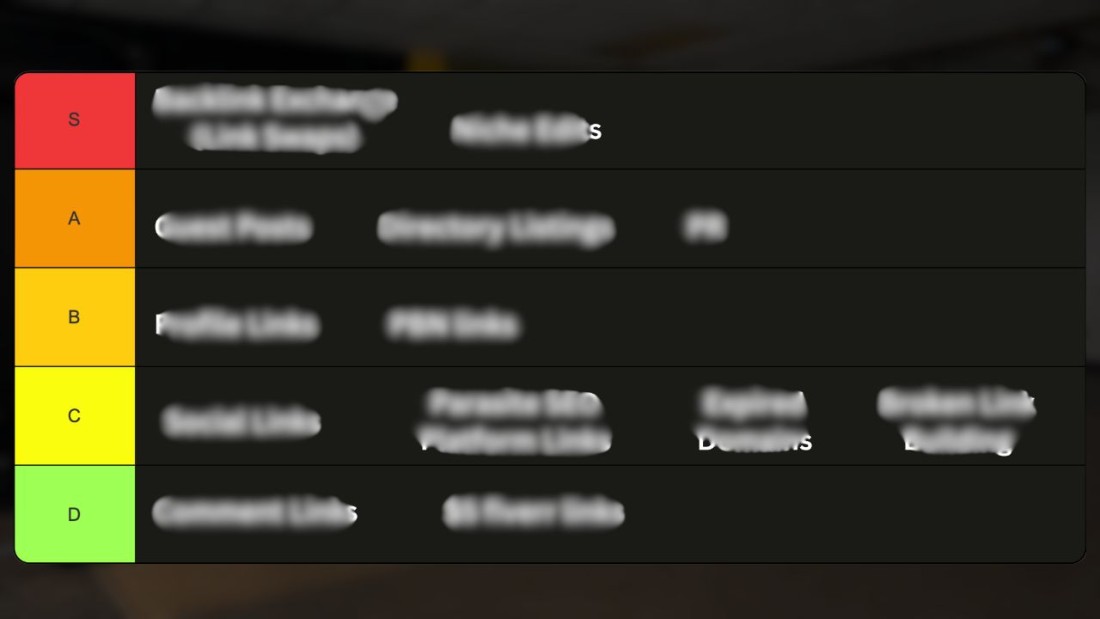
The Tier List at a Glance
How I Ranked Them: My Criteria
Three variables determine where each method lands on the tier list:
- Effectiveness — does it actually move rankings or just look good in a backlink report?
- Cost — both money and time, including outreach and follow-up
- Risk — how exposed are you to a Google penalty or link spam policy violation?
The S-tier strategies hit the trifecta: high effectiveness, reasonable cost, and minimal risk. The D-tier strategies fail on all three.
Here's how the 14 methods compare on cost vs. effectiveness:
The pattern is clear: methods that combine real authority with verifiable relevance and reasonable cost cluster in the upper-left. Spammy, cheap, and easily-replicable methods drag rankings sideways at best.
Let's break each one down.
S Tier — Build These First
1. NGO / Charity Links
One of the most underrated, untapped link types in SEO — and one of the easiest wins available if you have any budget at all.
What it is: You donate to a nonprofit. Most charities publicly thank their donors and supporters with a dedicated page that links back to the donor's website. You get a link from a high-authority, niche-relevant, location-specific domain. They get funding.
Why it's S tier:
- Charity domains are typically on
.organd carry strong authority (often DR 50–70+) plus real organic traffic - You get niche relevance and location relevance in a single link — the holy grail combo
- It's a tax write-off (consult your accountant)
- You're doing actual good
How to find them: Go to GreatNonprofits.org, search by city or niche, and look for ones with a public "Donors" or "Supporters" page that lists external links.
| Step | Action |
|---|---|
| 1 | Search GreatNonprofits.org by your city or niche |
| 2 | Open candidate sites and check DR + organic traffic |
| 3 | Verify they have a /donors, /partners, or /supporters page that links externally |
| 4 | Reach out to confirm they'll list and link your business |
| 5 | Donate, send your logo and URL, follow up |
Cost: Donations vary, but DR 50+ .org backlinks for $50–$500 are common. Cheap relative to almost any other paid link of equivalent quality.
This is the best link strategy most people aren't using. Build these for your own business or your clients before doing almost anything else.
2. Niche Edits
Niche edits are one of my favorite paid link strategies, and they consistently outperform guest posts in my testing.
What it is: Instead of writing a brand new article on someone else's blog (a guest post), you pay the site owner to insert a link to your site inside an existing article they've already published — one that's already indexed, already getting traffic, and already trusted by Google.
Niche Edits vs. Guest Posts
| Factor | Niche Edits | Guest Posts |
|---|---|---|
| Article status | Already live, indexed, ranking | Brand new, zero history |
| Time to impact | Faster (link inherits page authority) | Slower (page must accrue authority) |
| Content control | Limited — fit link into existing copy | Full — you write the whole article |
| Typical cost | $100–$300 | $200–$500+ (content + placement) |
| My ROI verdict | Higher per dollar | Still strong, just less efficient |
How to find opportunities: Use Google search operators to surface sites that openly accept editorial placements:
inurl:"write-for-us" [your niche]intitle:"guest post" [your niche]"contribute to" [your niche]"become a contributor" [your niche]"submit your article" [your niche]"accepting guest posts" [your niche]
Sites that openly accept guest posts will almost always also accept niche edits — and niche edits are cheaper.
Minimum viable threshold: I've found that the lowest level where niche edits actually move rankings is around DR 40–70 sites with at least 1,000+ monthly organic visitors from Ahrefs or Semrush. Below that, you're paying for noise.
If you want to skip the manual outreach, Arvow's link building service handles niche edits at $150 per link from DR 40–70 sites with verified organic traffic.
3. Backlink Exchanges (Link Swaps)
The only completely free strategy on this list — and surprisingly effective when done correctly.
What it is: You and another site owner agree to link to each other. They give you a contextual link, you give them one back. Both sites benefit.
The catch most people miss: Direct 1:1 swaps with competitors are fine if your product is genuinely better than theirs — they're sending traffic from a position of weakness. But the real magic is in non-direct swaps: businesses in your broader niche serving a different ICP. Less risk, fewer awkward conversations, same SEO benefit.
Manual approach: Same outreach process as niche edits. Send emails, propose a swap, agree on placements. Most will say no. Some will say yes. Repeat at scale.
Automated approach: Arvow has a built-in backlink exchange feature that automates this entirely. You join the network, activate the feature, and we match you with relevant sites in our pool of thousands of users. Notably, it's not strictly 1:1 — you often receive more links than you give based on how the network matches.
A Tier — Layer These In Next
4. Guest Posts
The niche edit's slightly less efficient sibling. Still very good — just not as bang-for-buck.
Why they're A tier instead of S:
- The article is brand new, not indexed, with zero traffic on day one
- Niche edits piggyback on already-ranking content, which is more efficient
- Cost is higher (you're paying for content production plus placement)
Why they're still worth doing:
- You control the content and anchor text completely
- You can write content that perfectly contextualizes your link
- Some sites only accept guest posts, not niche edits
- A great guest post can drive referral traffic on its own
The same Google search operators from the niche edit section apply here. If you publish high-volume guest content, an AI SEO writer can speed up the drafting step considerably.
5. PR / Press Releases
If you've ever seen a brand "as featured in Yahoo Finance / MarketWatch / Benzinga" — that's almost always a PR distribution play.
What it is: You write a press release announcing news (a launch, a milestone, a hire, a product update) and syndicate it through a distribution service that pushes it to hundreds of news outlets — AP News, MarketWatch, Benzinga, regional affiliates of major networks, and so on.
The output:
| Outcome | Typical Range |
|---|---|
| Backlinks per release | 100–300+ |
| Link permanence | 30 days on most outlets, permanent on some |
| Cost (direct from distributor) | ~$400 for a 20-outlet syndication package |
| Cost (Fiverr resellers) | $200+ for the same syndication, marked up |
Why it's A tier:
- You get hundreds of trusted-source backlinks at once
- Helps with brand authority signals — important for LLM citations in AI search
- Some placements stick around permanently
- A real news angle can drive actual traffic and PR
The big caveats:
- Most placements are syndicated copies, which Google deduplicates
- Some outlets keep the release for only ~30 days, which can be too short for indexing
- Don't pay $200+ on Fiverr — those sellers are reselling the exact same syndication service you can buy direct for a fraction of the price
PR works best when it's actual news. A real launch, a real milestone, a real story. The more newsworthy the angle, the better the pickup rate.
6. Directory Listings
Often confused with profile links — but directories are a meaningful step up.
What it is: A directory is a niche-specific aggregator that lists businesses or tools in a category. Examples: Yelp for local businesses, There's an AI for That for AI tools, Hotfrog for general listings, or any vertical-specific directory in your space.
Why directories outperform profile links:
- Each listing gets its own dedicated page about your business (description, images, sometimes multiple links)
- Niche-specific directories pass strong topical relevance signals
- Many have real organic traffic and decent DR
- They're often the first thing LLMs cite when answering "what's the best [tool/service] for X"
The hierarchy of "low-effort" link types:
How to find them: Search for "[your niche] directory," "[your niche] tools list," "[your niche] business directory." Look for ones with real traffic, real listings, and a clear submission process.
Cost: Many are free. Paid ones with strong metrics are usually worth the money. Building 100–200 directory listings manually is a slog, which is why we now offer this as a managed service alongside niche edit link building.
B Tier — Works If Done Right
7. PBN Links
PBNs get a lot of hate, mostly because most people execute them badly. Done correctly, they still work — but they take real effort to build.
What it is: A Private Blog Network is a collection of expired domains you've registered, rebuilt into real-looking sites, and use to link to your main site. You control the network, so you can build as many backlinks as you want.
Why it's B tier (not higher):
- Build your own properly = B tier
- Buy links from someone else's PBN = C/D tier (because if you can buy access, so can casinos and adult sites — torching the network's quality)
- Requires separate hosting for every site
- High upfront time investment
The expired domain workflow:
| Step | Action | Tools |
|---|---|---|
| 1 | Find expiring domains with real authority | ExpiredDomains.net |
| 2 | Filter for niche relevance, clean backlink profiles, trust metrics | Ahrefs, Majestic |
| 3 | Re-register the domain | GoDaddy, Namecheap, Dynadot |
| 4 | Host on a separate provider/IP from your other PBN sites | Cloudflare, various small hosts |
| 5 | Rebuild the site (real content, real branding, social profiles) | AI SEO Writer, Autoblog |
| 6 | Add a contextual link to your money site once trust is established | Manual placement |
PBNs work — much of my early SEO foundation came from one. But they're not for beginners, and the ongoing maintenance cost is real. If you're not willing to maintain separate hosting and footprint isolation, don't bother.
8. Profile Links
Profile links sit just above comment spam — better, but not by a huge margin.
What it is: A backlink from a profile page on a high-authority site. Examples:
- Udemy instructor profile (DR ~95)
- Tripadvisor profile (DR ~95)
- WordPress.org profile (DR ~95)
- Kickstarter creator profile
- Behance / Dribbble portfolios
Why they're B tier:
- The host domains are extremely powerful
- They're relatively easy to get
- They support brand presence signals
Why they're not higher:
- Anyone can build them — they're not exclusive
- Most are no-follow or naked URL anchors
- They rarely move rankings on their own
When to build them: After you've exhausted S- and A-tier options. They're decent for diversifying your backlink profile and useful for brand mentions, but they're not the lever that moves your rankings.
C Tier — Situational
9. Expired Domain Redirects (301s)
A faster, dirtier version of the PBN strategy.
What it is: Instead of rebuilding an expired domain into a full site, you buy it and 301-redirect every page to your main site. All historical authority and backlinks pass to you directly.
Why it's C tier:
- It works (or worked, last time I tested it heavily)
- Significantly less work than building out a PBN site
- But it's distinctly black-hat and visibly violates Google's link spam policies when overused
- Quality of source domains varies wildly
How to find domains: Same source as PBN candidates — ExpiredDomains.net, filtered for clean profiles in your niche.
I haven't relied on this strategy in a while. It still works in some cases, but the risk profile makes it hard to recommend over safer S- and A-tier options.
10. Parasite SEO Platform Links
Massive misconception about this one: parasite SEO is not primarily a link-building strategy. It's a ranking strategy.
What it is: Publishing content on high-authority platforms so your content ranks on Google by leveraging the host platform's domain authority:
- Medium (DR ~95)
- LinkedIn Articles (DR ~99)
- Reddit (DR ~93)
- Quora (DR ~91)
- Notion public pages
- GitHub README files
- Indie Hackers
- HubSpot community
- Canva published designs
Why it's C tier for link building specifically:
- Yes, you get a link from a DR 90+ domain
- But anyone can build that link — it's free for everyone
- Most are no-follow
- The real value is the host page itself ranking for your target keyword, not the link back
If you can't get your DR 10 site to rank for "best AI writing tools," a Medium article on the same keyword might rank for you. That's the actual play.
If you're doing parasite SEO purely for the link, you're missing the point.
11. Social Links
Facebook, Instagram, LinkedIn, X/Twitter, Pinterest, YouTube, TikTok.
Why they're C tier:
- Almost all are no-follow
- Anyone can build them
- They won't move Google rankings directly
Why you should still build them:
- Default expectation in 2026 — every legitimate brand has them
- LLMs pull citations from social platforms (especially LinkedIn, Reddit, YouTube, X)
- They reinforce brand entity signals — a topic we've researched extensively at Arvow
- One hour of work to set up across all platforms
Treat this as table stakes, not strategy. If you don't have social profiles, build them this week. Don't expect them to move your Google rankings.
12. Broken Link Building
In theory: brilliant. In practice: extremely high effort for limited returns.
What it is: You find a high-authority site linking to a dead URL (404 or unregistered domain), email the site owner, and suggest they replace the broken link with one to your equivalent resource.
Why it's C tier despite being white-hat and elegant:
- Most outreach gets ignored (typical reply rate: 5–15%)
- Hours of work might yield 1–2 links
- The same time invested in S/A-tier strategies produces more results
When to use it: After you've exhausted S, A, and B tiers. It does occasionally hit big — I've had cases where one good relationship led to fixing broken links across multiple partner sites for the same client. But that's a 1-in-100 outcome.
How to find opportunities: Tools like Ahrefs have built-in broken backlink filters. Plug in a competitor or relevant authority site, filter for broken outbound links, and start prospecting.
D Tier — Don't Bother
13. Blog Comment Links
A relic of 2010-era SEO. Some sellers still pitch them. Don't buy.
What it is: Links dropped in the comment sections of blogs and forums.
Why they're D tier:
- Forums now have aggressive anti-spam rules
- Most comment-enabled blogs that survived this strategy are themselves low-quality
- Your link will sit alongside casino, adult, and pharma spam
- They don't move rankings — at all, in my testing
If anyone is still selling you "1,000 comment backlinks for $50," walk away.
14. $5 Fiverr Backlinks
The most common money pit in SEO.
What it is: Bulk backlink packages sold for $5–$20 on Fiverr or similar marketplaces.
Why the math doesn't work:
| Spend | Option A: Fiverr | Option B: Quality Niche Edits |
|---|---|---|
| $500 | ~100 links from inflated/bot-traffic domains | 3–4 links from DR 40–70 sites with real organic traffic |
| Ranking impact | ~Zero, in my testing | Measurable lift on target keywords |
| Risk | Linked next to casino/adult/pharma spam | Clean, niche-relevant placements |
The metrics advertised on these gigs are almost always inflated — fake DR, bot traffic, irrelevant keyword rankings. One quality DR 60 niche edit will outperform 100 of these every single time.
The principle: If a backlink is cheap because anyone in the world can buy it, it's worthless to Google.
How to Actually Apply This
Don't try to do everything at once. The order I'd recommend:
| Phase | Focus | Why |
|---|---|---|
| 1 | S Tier — NGO links, niche edits, backlink exchanges | Best ROI per dollar and per hour invested |
| 2 | A Tier — Guest posts, PR releases, directory listings | Layer in once S-tier opportunities are exhausted |
| 3 | B Tier — Profile links, your own PBN | Build opportunistically; PBN only if you'll maintain it |
| 4 | C Tier — Parasite SEO, social, broken link building | Use strategically (parasite for ranking, social for brand) |
| 5 | D Tier — Comments, $5 Fiverr packages | Never. They're pure waste. |
The thread running through every effective strategy: links from real sites with real authority, real traffic, and real topical relevance. Anything that doesn't tick those three boxes isn't worth your time.
Want Help Building These?
If you'd rather skip the manual work, Arvow handles three of the highest-ROI strategies on this list:
- Niche edit links — $150/link from DR 40–70 sites with verified organic traffic
- Directory listings — bulk niche-specific directory placements (in our resources tab)
- Backlink exchanges — automated swaps within Arvow's network of 20,000+ users
While you're building backlinks, your on-page SEO matters too. Arvow's AI SEO Agent automatically fixes structured data, meta titles, image alt text, and internal linking issues across your site — so the link equity you're building actually has somewhere productive to flow.
You can also build everything here yourself for free using the steps above. Whichever path you choose, the principle is the same: focus on the tiers that actually move the needle, and stop wasting money on the ones that don't.