
How to INSTANTLY Get Mentioned in AI Search (NEW Method)

Most people who could buy from you have never heard of you. When they ask ChatGPT, Google AI Mode or Perplexity what to use, they describe the problem, not your name. Getting mentioned in AI search starts with knowing which of those prompts you should be in, and then why the AI picks someone else. In a video recorded on 2 November 2026 I showed how I find those prompts in about a minute, track them for my own brand, and act on the results. Here it is in writing, with the screens.
The one prompt that generates your list
Open ChatGPT and paste this, replacing the placeholders with your own brand, product and site:
"Give me a list of prompts I can type into an LLM AI chat that don't mention {your_brand}/{your_product} in the prompt, but where you're confident the reply might mention it. Research my website and competitors sites, as well as socials, to learn what I do and the niche I'm in: yoursite.com"
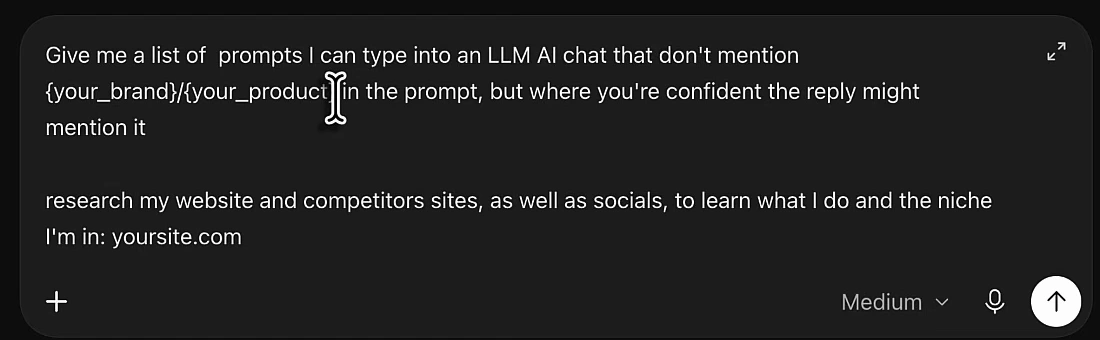
The first clause is the one that matters: prompts that never contain your brand, product or agency name, but where the model is likely to bring you up. It does not matter what you sell. ChatGPT researches the site you give it and returns the questions people in your niche would plausibly ask an AI.
For Arvow it came back with 40 prompts in four groups: AI SEO software ("What's the best AI SEO software?", "Cheapest AI SEO tools?"), AI content generation ("How can I automate blog writing?", "Which AI publishes blogs automatically?"), AI search visibility and LLM tracking ("How do I track ChatGPT mentions?", "Best alternatives to Profound?") and SEO automation ("Can AI manage SEO automatically?", "Best AI SEO tools for Shopify?"). It then volunteered a top ten to test first, "based on how closely they match its product positioning".
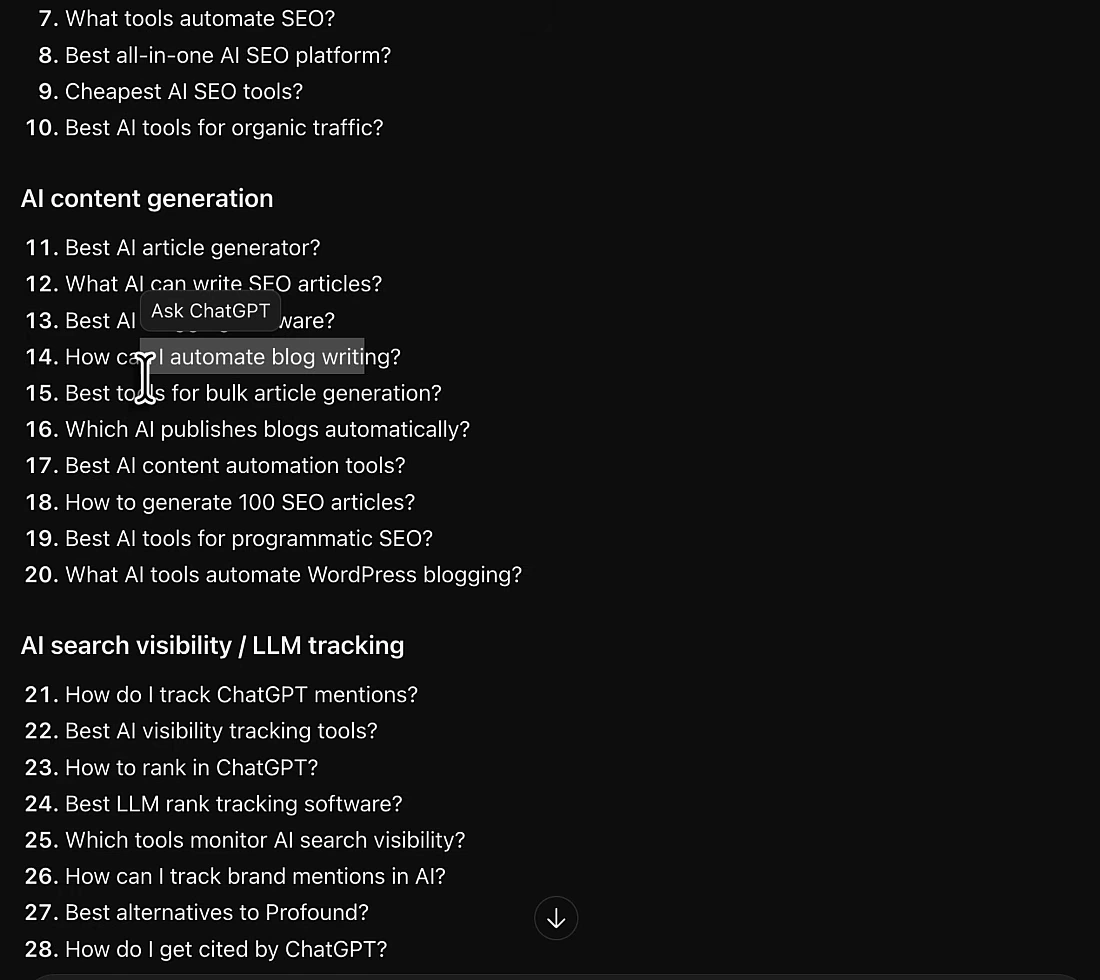
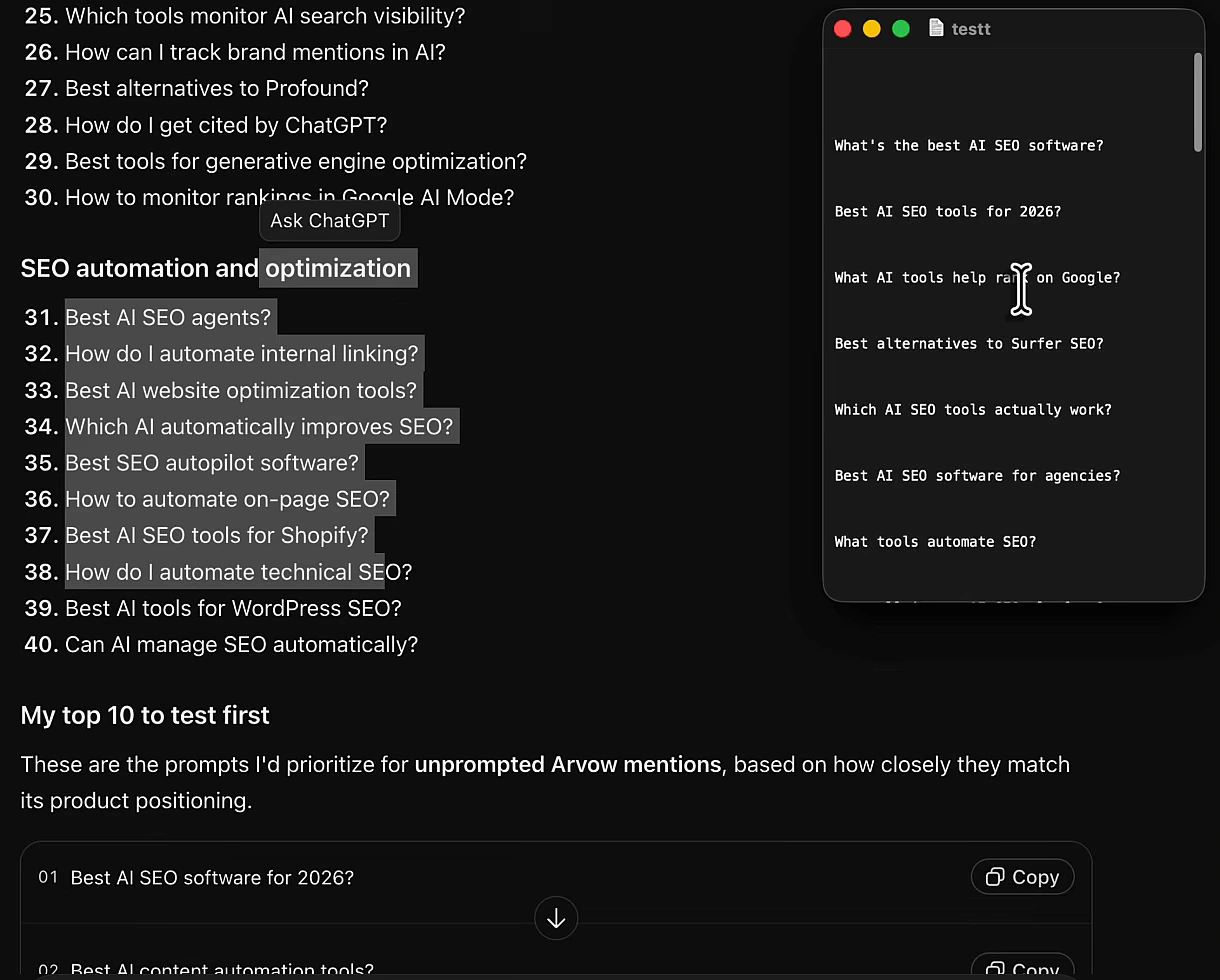
Copy everything into a text file for import into whatever LLM rank tracker you use; I use my own, but the method does not depend on the tool.
Branded versus non-branded prompts: why group B is the one that pays
Two groups of people type into any AI, and the list above targets only one. Group A already knows you: "is the Mac mini good for students?", "is the Nomad MagSafe wallet safe?". Group B has no idea you exist: "I need a new laptop for school under $500, which should I get?", "I need a wallet that sticks to the back of my phone, give me some links." The AI might recommend the Mac mini or the Nomad wallet, or Samsung, Dell, Apple's own wallet, or a hundred other brands.
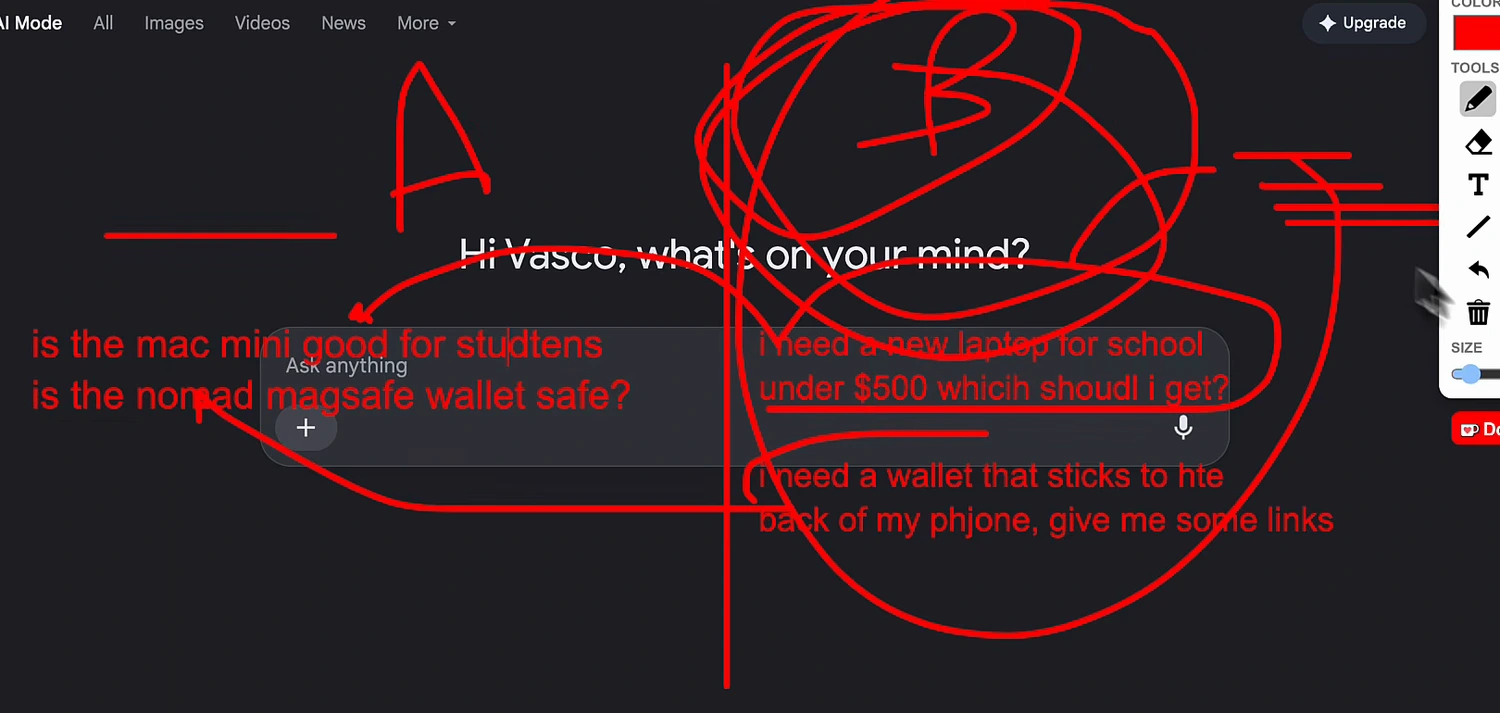
Group B is bigger and is where new customers come from. Someone who typed your name already saw you in an ad or on social media; someone asking "which AI tools automate WordPress blogging?" who is told "use Arvow" is a customer you did not have a minute ago. That is why the generated list excludes your name: it is a list of group B prompts. What to do once you are in the answer, including sentiment, is in how to get mentioned in AI search; this article is about finding the prompts.
Track all of them, live, for your own brand
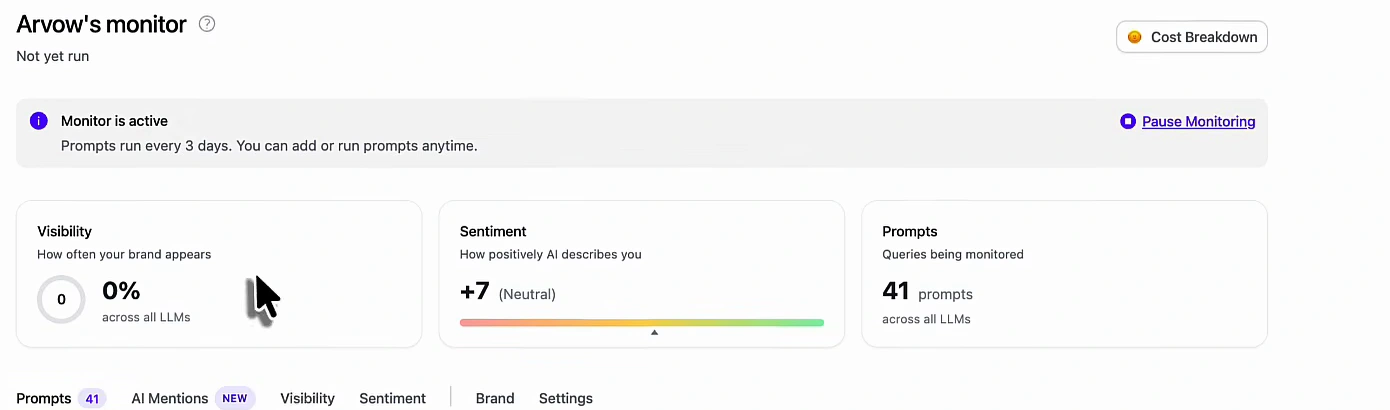
I created a new monitor for arvow.com, imported the prompts and ran them. The headline card read 0% visibility across all LLMs, a neutral sentiment of +7, and 41 prompts (the 40 from ChatGPT plus one branded prompt I added as a contrast). Prompts re-run every three days, so the number moves. What "visibility" measures is in our AI visibility tracker guide; the point here is the per-prompt view.
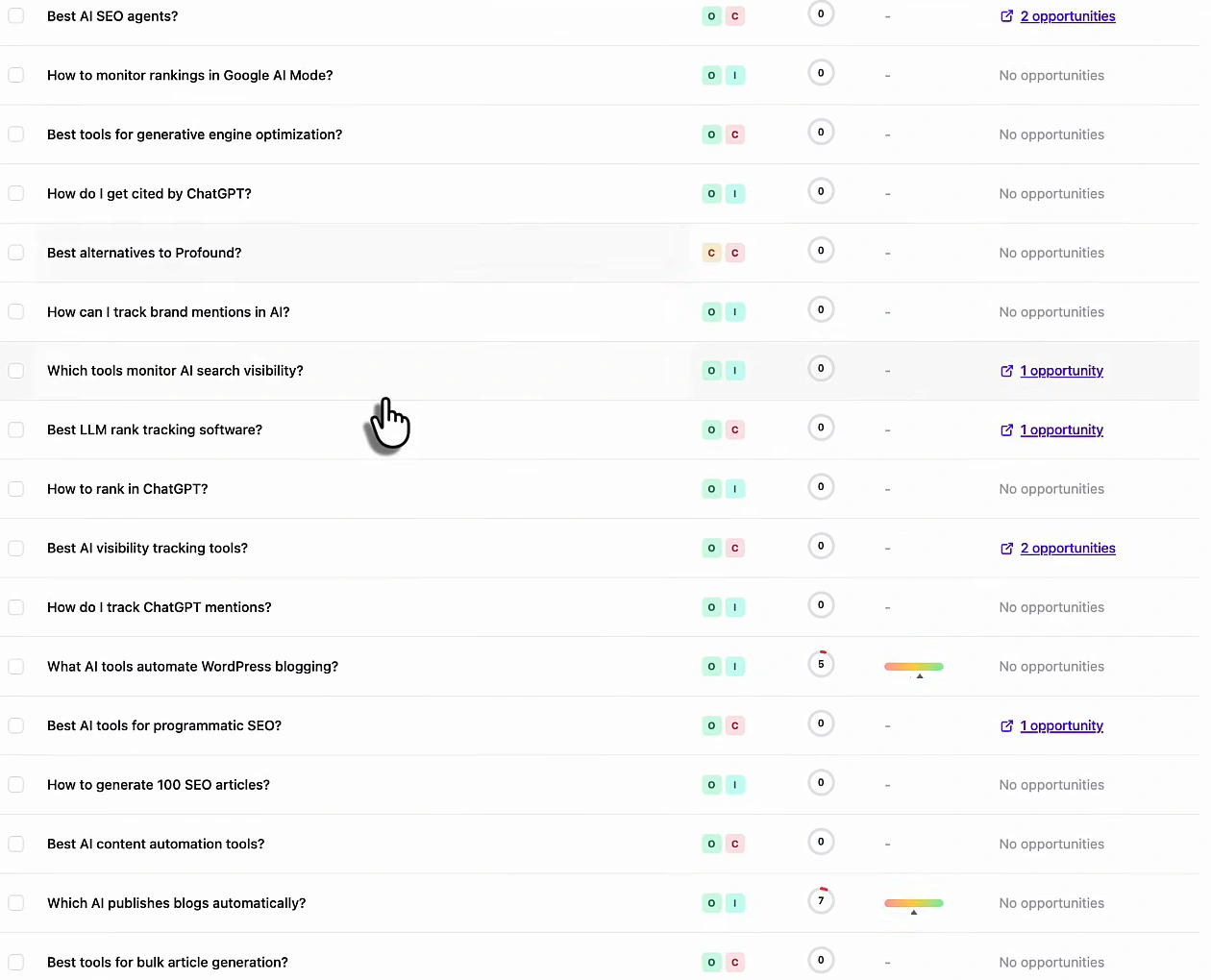
Most rows showed a zero: nowhere to be seen for most of the 41 prompts, which is mine to fix. A few had a number: "What AI tools automate WordPress blogging?" 5, "Which AI publishes blogs automatically?" 7, "How can I automate blog writing?" 4. The last column, "publisher opportunities", counts the pages the AI cited for that prompt that list competitors but not us.
Why an AI mentions you: it is always the sources
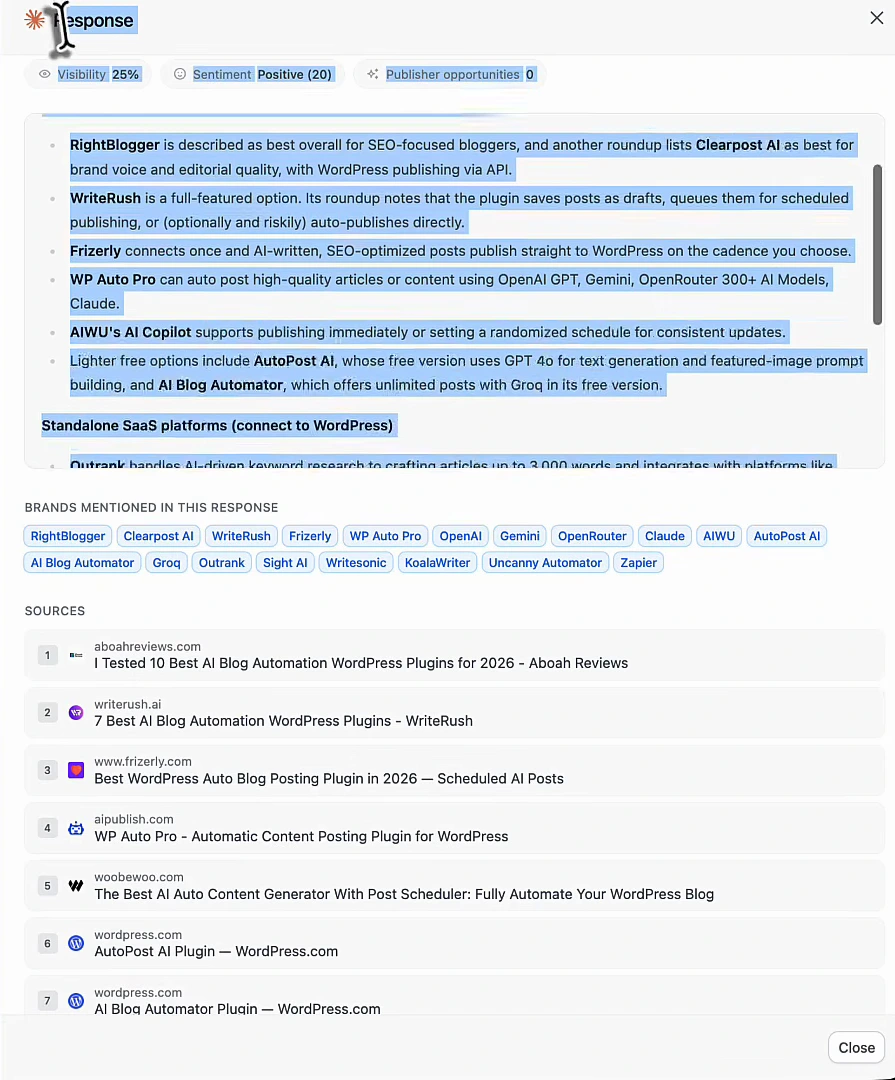
Click into "What AI tools automate WordPress blogging?": 5% visibility, positive sentiment of 20, five responses, one per model. We were mentioned in Claude's answer (a 25 on that row) and in none of the others: not ChatGPT, Gemini, Perplexity or Grok. Above the responses sits every brand named across the five answers, more than fifty, from 10Web to Zapier.
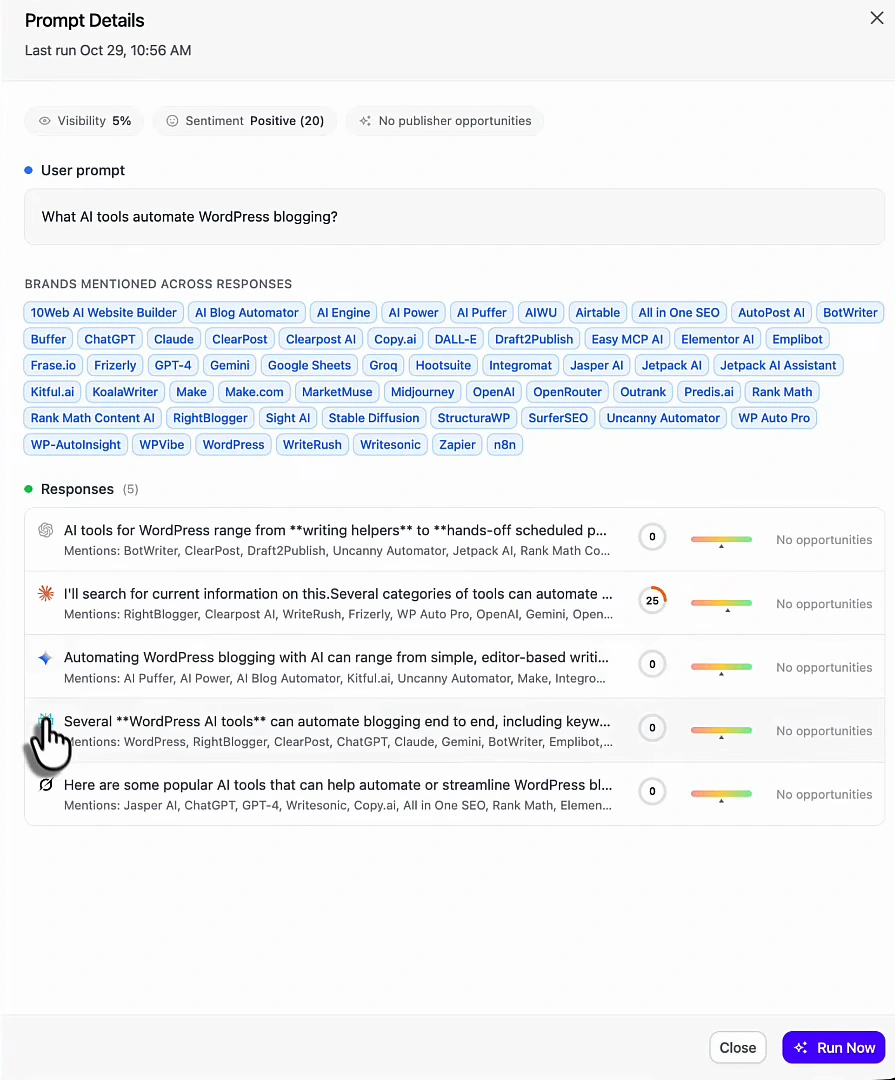
Why any AI mentions you is never mysterious: it is in the sources. The Claude answer is built from seven pages: a RightBlogger roundup, reviews on aboahreviews.com and writerush.ai, a Frizerly post, a WP Auto Pro page, two WordPress.com plugin pages. Somewhere in those, we are named.
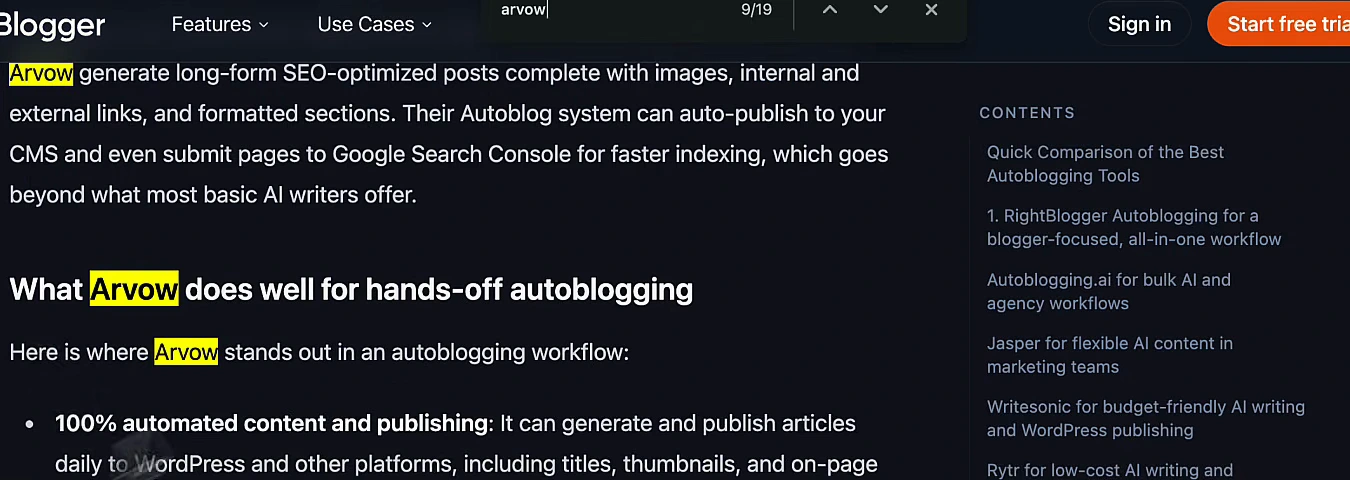
I opened the RightBlogger piece, "7 Best Autoblogging Tools for AI Blog Automation in 2026", and searched the page for "arvow": 19 matches, including a section headed "What Arvow does well for hands-off autoblogging". That page is the only reason Claude recommends us for that prompt. Re-checked on 3 November 2026, the article is still live, updated 30 October, and Arvow is its sixth of seven tools.
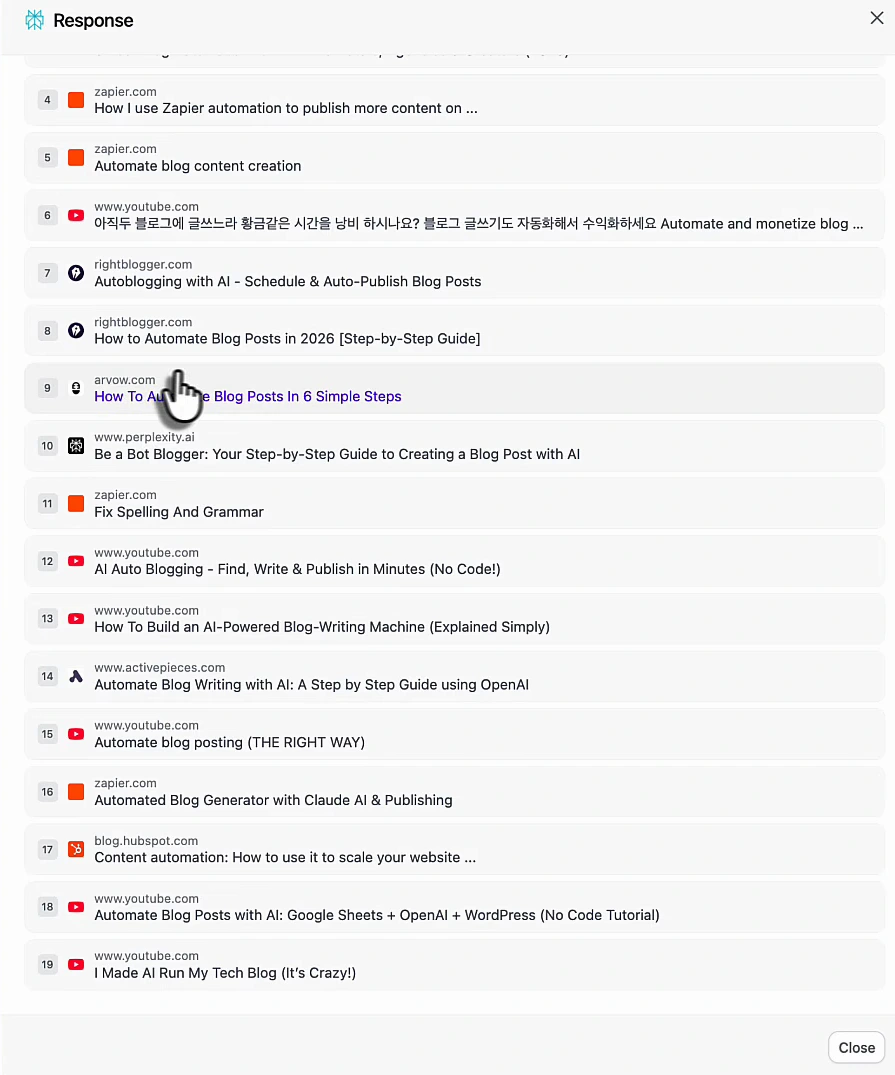
The second prompt with a score, "How can I automate blog writing?", was a Perplexity mention, and the mechanism is the same with a different source. Perplexity's sources list ran to 19 items, and the ninth was our own guide, how to automate blog posts in six steps. Nine of the other sources were YouTube videos. Perplexity leans on video far more than the other models, which matters later.
When a competitor is in the answer and you are not
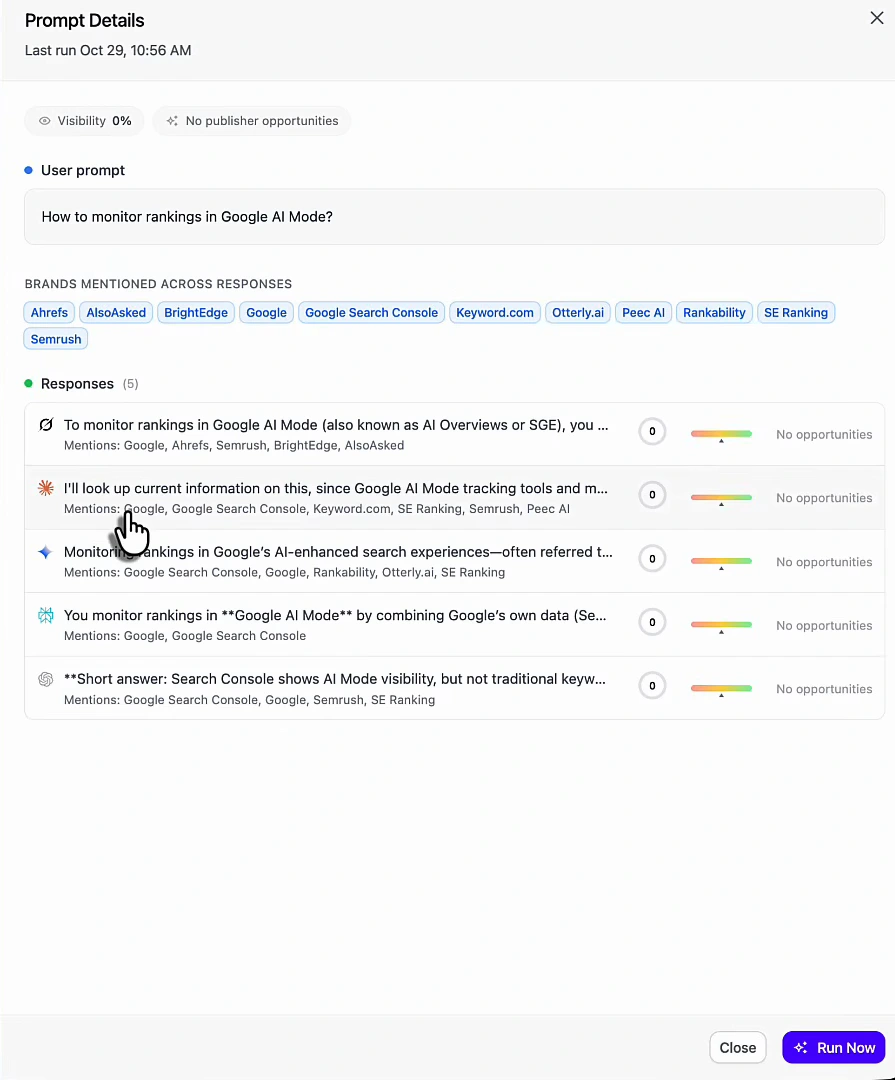
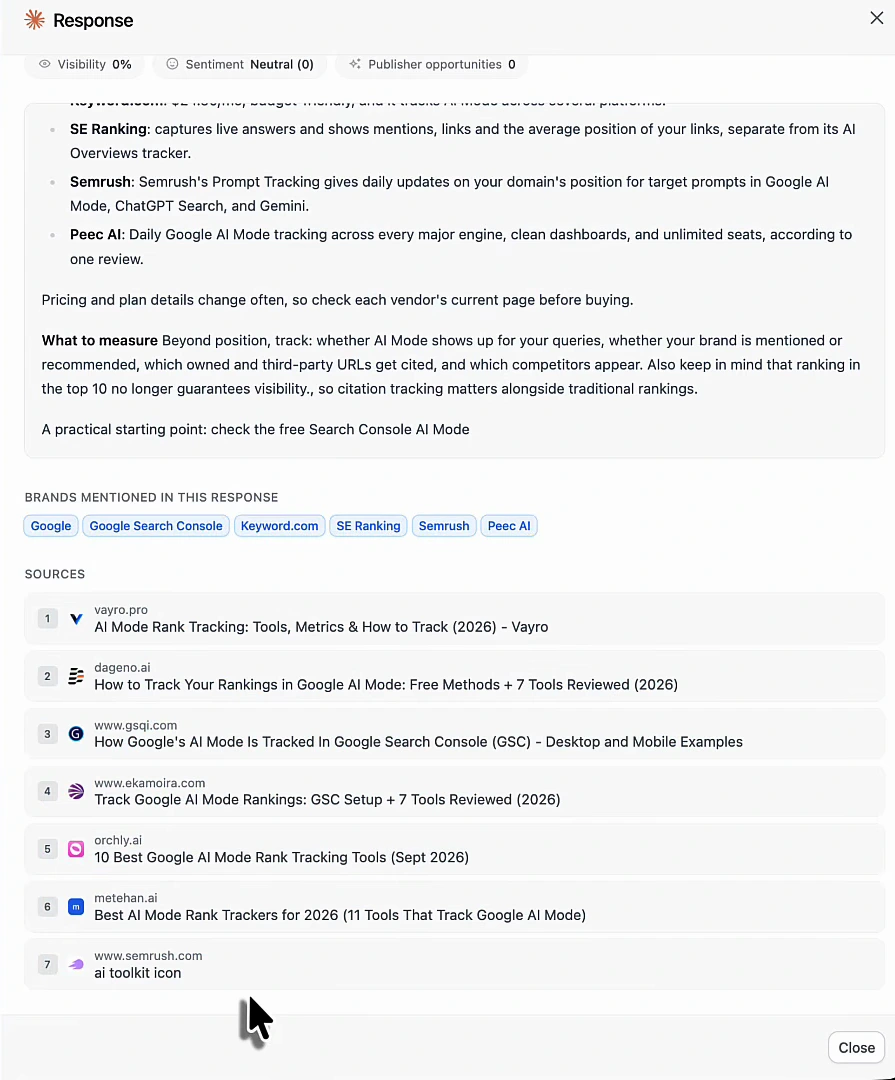
Now the zeros. "How to monitor rankings in Google AI Mode?" is a prompt I want, because Arvow does exactly that, and we are absent from all five answers. The brands that are present: Ahrefs, AlsoAsked, BrightEdge, Google Search Console, Keyword.com, Otterly.ai, Peec AI, Rankability, SE Ranking and Semrush.
Why is Semrush mentioned and not us? Open the answer and the sources are seven listicles: vayro.pro, dageno.ai, gsqi.com, ekamoira.com, orchly.ai, metehan.ai and Semrush's own site. Semrush's Prompt Tracking is described in the response text because those pages describe it. My job now is to look at each of those pages and ask two questions. Can I get into this source, by pitching the author or, honestly, by paying to be the eleventh tool on the list? And if not, can I create a new source: a "best AI monitoring trackers for 2026" page that ranks us first and that the models start pulling in?
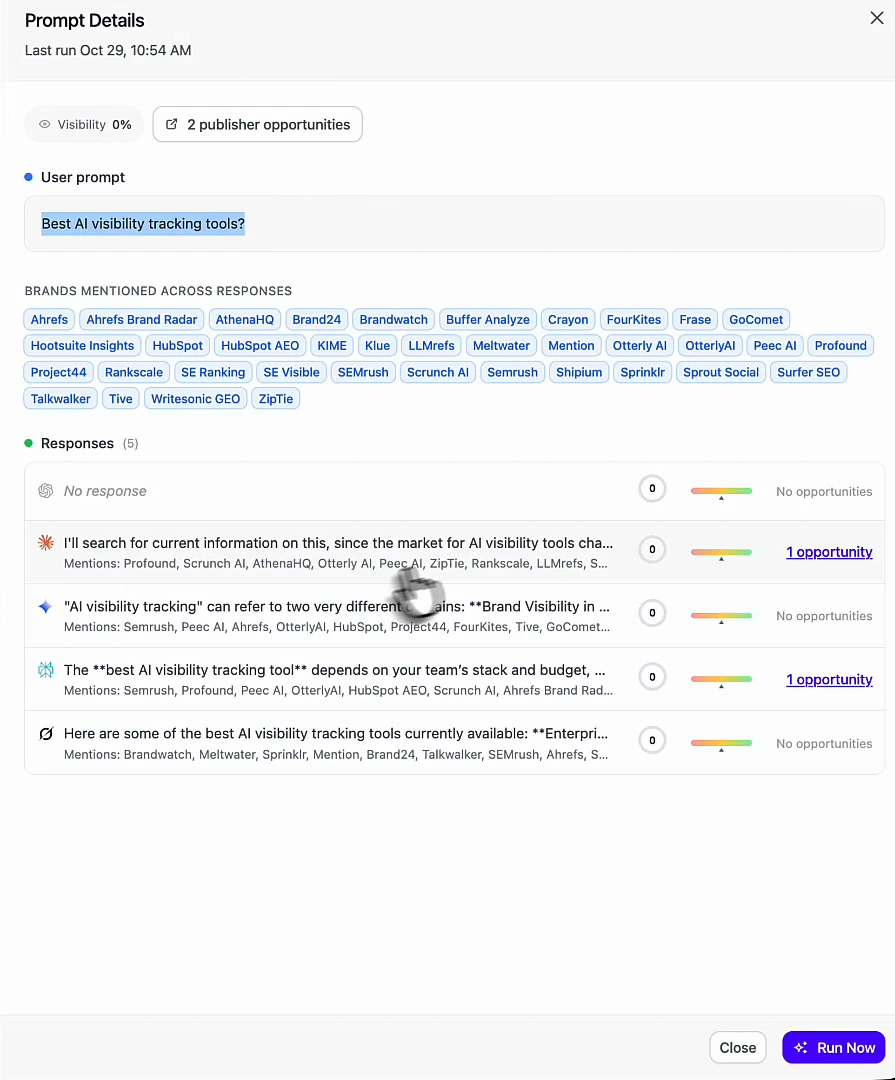
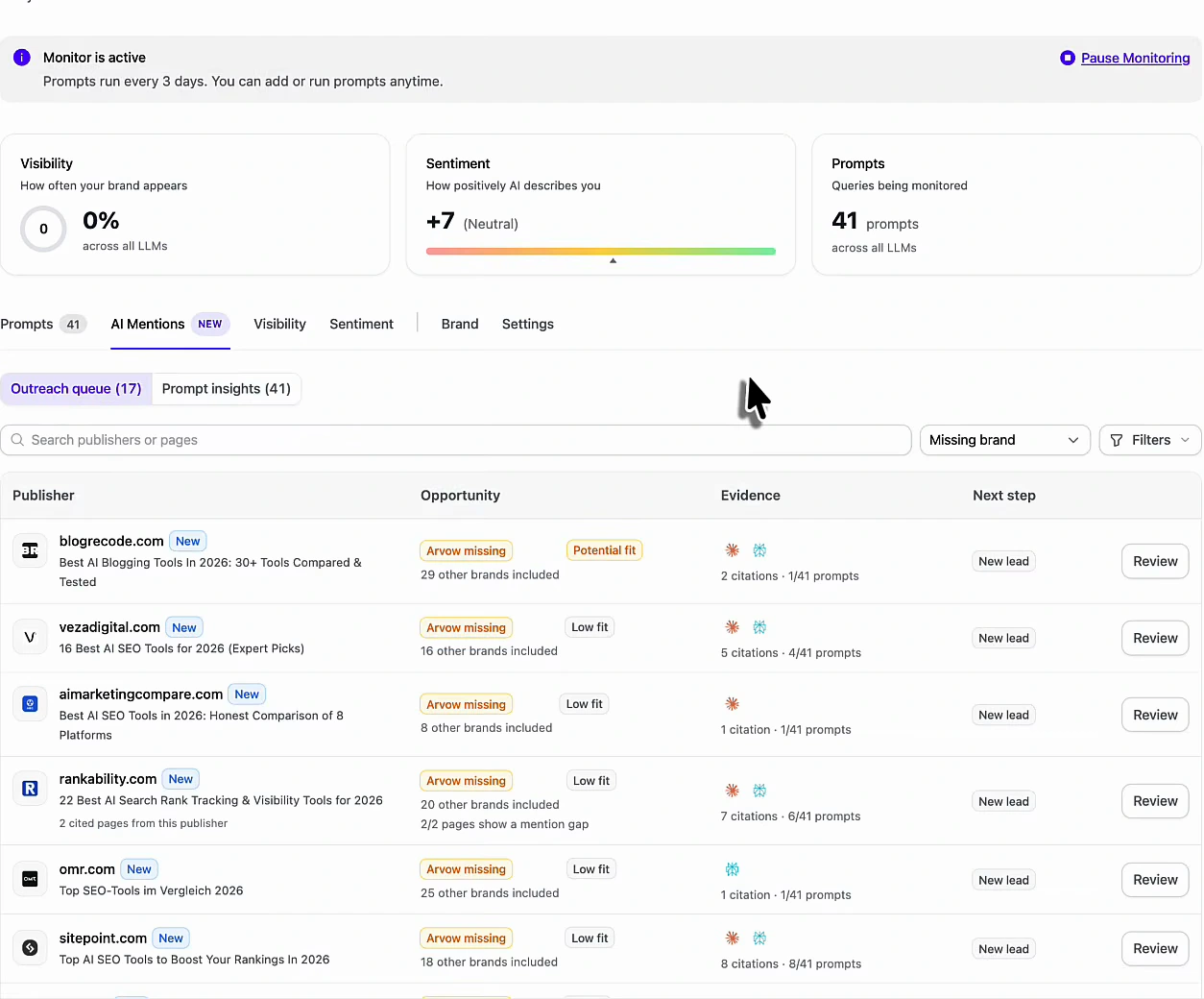
"Best AI visibility tracking tools?" is the same story at scale: 0% visibility, more than forty brands across the five answers, from Ahrefs Brand Radar to Profound, Semrush and ZipTie, and two flagged publisher opportunities. Those feed an outreach queue of 17 publishers for the whole monitor, each with the cited page, how many other brands it lists, citations across the 41 prompts, and a fit rating. On recording day the top was blogrecode.com's "Best AI Blogging Tools In 2026: 30+ Tools Compared" (29 other brands, potential fit), then vezadigital.com, aimarketingcompare.com, rankability.com (7 citations, 6 prompts), omr.com and sitepoint.com (8 citations, 8 prompts). The same logic is why brand mentions are the new backlinks.
Update the sources you already own
The sources you are already cited in need the same attention. Our blog-automation guide, the one Perplexity pulled in, carries a "2 years ago" byline. Models re-crawl your site every few days looking for the freshest information, so an old page is a mention that can quietly become an outdated answer. It is on the rewrite list. Check the byline on every page of yours that shows up in a source list.
Find the pattern in what gets cited
Across all the prompts you want, ask what type of page the models cite. For the blog-automation prompts it was listicles and comparison pages, with Perplexity adding YouTube. If every source for a prompt is a Reddit thread, write the Reddit post (see Reddit AI mentions). If they are LinkedIn posts, write LinkedIn posts. If Perplexity cites eight YouTube videos, make the video. This is what AI search optimisation will be for the next few years: matching the format each model trusts for each prompt. How prompt tracking differs from keyword tracking is in prompt tracking in LLMs.
The process, start to finish
- Generate the prompts. Paste the prompt above into ChatGPT with your brand, product and URL; 40 is a good first batch.
- Keep only non-branded prompts. Anything that names you is group A. Add one or two branded prompts by hand if you want the contrast, and label them.
- Track them across models. Import the list into an LLM tracker and run it against ChatGPT, Gemini, Claude, Perplexity and Grok. Expect mostly zeros.
- For every mention, open the sources. Find the page that caused it. Keep that page current and consider what a second page like it would do.
- For every zero, open the sources too. List the pages citing your competitors. Pitch them, pay where that is honest and allowed, or build the page that does not exist yet.
- Match the format. Listicle, Reddit thread, LinkedIn post, YouTube video: produce whatever each model is already citing for that prompt.
- Re-run every few days and treat the visibility score as a trend, not a verdict. Answers vary between runs.
Two caveats from my own numbers
- A single run is noisy. The scores above come from one run on 29 October; the same prompt can name you in one session and not the next. Tracking every three days smooths that.
- There is no search volume for prompts. You cannot rank the 40 by demand the way you would keywords, so prioritise by how close each prompt is to a purchase decision. ChatGPT's own "top 10 to test first" ordering is a reasonable start.
FAQ
How do I find the AI search prompts my brand should be mentioned in?
Ask ChatGPT for prompts that do not contain your brand or product name but where the reply is likely to mention you, and tell it to research your site, competitors and socials first. It returns a categorised list; for arvow.com that was 40 prompts in four groups.
What is the difference between branded and non-branded AI prompts?
Branded prompts contain your name ("is the Nomad MagSafe wallet safe?"); the person already knows you. Non-branded prompts describe the need ("I need a wallet that sticks to my phone"); the person does not know you, which is why a mention there wins a new customer.
Why does ChatGPT recommend my competitor and not me?
Because the pages it pulled in for that prompt name your competitor and not you. Open the sources behind the answer, then either get added to those pages or publish a page that answers the prompt better.
How often should I re-run AI prompt tracking?
Every few days. Answers change between runs and models re-crawl sites constantly, so a visibility score is only meaningful as a trend.
Want the 40 prompts tracked across ChatGPT, Gemini, Claude, Perplexity and Grok, with the cited pages and the outreach queue built for you? That is what Arvow's LLM visibility tracker does, re-running your prompts every three days.
Generate, publish, syndicate and update articles automatically
The AI SEO Writer that Auto-Publishes to your Blog
- Cancel anytime
- Articles in 30 secs
- Plagiarism Free