
AI Visibility Tracker: Full 2026 Guide to Increase AI Search Brand Mentions

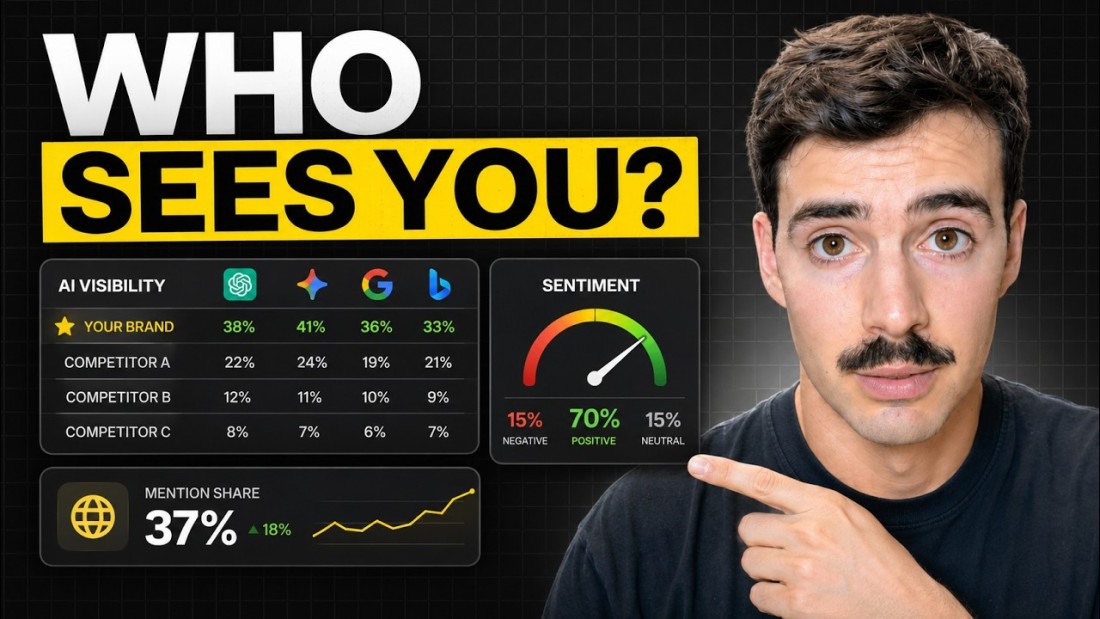
Most brands measuring AI search stop at one question: does ChatGPT mention us? That question is too easy to pass. Put your brand name inside the prompt and every model will mention you — it has no choice. The number that actually decides whether you get recommended is the one sitting next to it: sentiment.
This is a walkthrough of a real audit on our own brand, using our own LLM visibility tracker. Nothing here is cleaned up. One of the models called us "barely known in the space," and we'll go through exactly why it said that, which page taught it to say it, and what you can do about it.
Visibility and sentiment are two different numbers
A brand monitor tracks a set of prompts across ChatGPT, Claude, Gemini, Perplexity and Grok, then reports two things per prompt. Visibility is how often your brand shows up in the answer. Sentiment is how the answer describes you once it does.

These move independently, and that is the whole point. Rising visibility with falling sentiment means you are becoming more famous for the wrong reasons — the models are getting more confident about a story you did not write. You cannot see that with a mention counter.
Start with the branded prompt, even though nobody searches it
The first prompt to monitor is the one with your own name in it: "is [brand] the best [category] for [audience]?" Almost nobody types this. That is fine — it is not a traffic target, it is a diagnostic.

Visibility comes back at 92%, which tells you nothing — the brand name was in the question. The useful signal is the row of sentiment bars underneath. Three models describe us positively. Two do not. One sits at -75, and its answer opens by saying, flatly, that we are not the best option and are barely known in the space.
That is a claim about third-party validation, not about the product. Which means it came from somewhere.
Open the answer, then open the sources
Every monitored response stores the full text and the citations behind it. This is where the audit actually happens.

The reasoning is specific: a competitor is cheaper, some users describe the output as "flat and generic," and the conclusion recommends that competitor outright. Underneath, the sources: a Trustpilot page, a Reddit thread titled as a head-to-head between a competitor and us, and our own site.
Language models do not invent this material. They read pages and summarise them. A negative answer is not an opinion you have to argue with — it is a reading list you can go edit. Every citation in that panel is a job.
Why the branded prompt decides the unbranded one
Here is why the diagnostic matters. The prompt that actually generates revenue has no brand name in it at all.

Three percent. Four of the five responses score zero. And the two numbers are connected: if the models that do know you describe you as not-a-leader and barely-known, they will not put you on the shortlist when the brand name disappears from the question. The branded prompt is where the sentiment is set. The unbranded prompt is where it gets spent.

Four ways to change what the sources say
Once you have the citation list, every source falls into one of four buckets. Work through them in this order, because they get progressively more expensive.
1. Reply to what you cannot remove
Some sources are frozen. In our case a chunk of the negative sentiment traces back to reviews from an old lifetime-deal launch, where the complaint was about the credit limits on that specific offer, not the software. We cannot delete those, and we would not want to. We can reply to them — and a reply is text on the page, which means it is text the model reads.
2. Add to sources that accept additions
One of the cited pages was a Reddit thread comparing us to a competitor, posted by an account with an obvious stake in the outcome. You cannot rewrite someone else's post. You can comment on it. A cited thread with a comment box is the cheapest fix on this list: the page is already trusted, already indexed, already being read by the model.
Two rules make this work rather than backfire. Comment from a real account with real history, and make the comment genuinely useful — a specific comparison, a use case, a limitation you will admit to. Astroturfing gets removed, and a removed comment is worth nothing.
3. Get added to the listicles already being cited
Look at the source panels across your prompts and you will notice how many are "7 best," "10 best," "6 best" roundups. If a model leans on listicles for a prompt, then appearing in those listicles is the ranking factor for that prompt. Contact the publishers and ask what inclusion involves. Some will want a paid placement, some will want a better product than whatever currently sits in slot four.
4. Create new sources when nothing else works
If the existing pages are closed, unfriendly, or run by a competitor, the remaining move is to add pages to the web that say what is true. Models cannot cite evidence that does not exist.
The version of this that works is boring: named customers, real numbers, published where they can be crawled. Client interviews. Case studies with named outcomes. A YouTube video with a transcript. A LinkedIn post. If you have fifty agency customers and none of them appear anywhere on the open web, then "barely known in the space" is a fair reading of the evidence, and the fix is publishing — not arguing.
Reverse-engineer the competitors who are winning
The fastest way to shortcut all of this is to stop guessing at your own strategy and go read someone else's.

Set up a monitor on a competitor, track the same prompts you care about, and read the sources behind the answers where they win. You now have a list of the exact pages teaching the models to recommend them. Some of those pages you can join. Others you can only match — but at least you know what you are matching, and you have stopped guessing which channels move the needle. This is the same logic as prompt tracking, pointed at someone else's brand.
The hard part is finding the places, not fixing them
Leaving a comment takes two minutes. Emailing a publisher takes five. Neither of those is the bottleneck.
The bottleneck is knowing which thread, out of the entire internet, is the one a specific model reads before answering a specific prompt — and noticing when that changes. A two-year-old comment with two upvotes can be load-bearing for an answer worth real money to you, and there is no way to find it by hand. That is the entire job of a monitor: turning "the AI doesn't like us" into a list of URLs with owners and next actions.
The loop, in order
- Add the branded prompt. "Is [brand] the best [category] for [audience]?" — your diagnostic.
- Add the prompts that pay. The unbranded ones your buyers actually type.
- Read sentiment per model, not the average. An average of +30 can hide a -75.
- Open every negative answer and list its sources. This is your work queue.
- Sort each source: reply to it, add to it, get into it, or replace it.
- Mirror a competitor on the prompts where you score zero, and read their citations.
- Re-run and compare. Sentiment moves slowly — you are waiting on re-crawls, not on the model.
Want to see which sources are shaping your own AI answers? Start with the free LLM brand mention tracker, or run the full setup inside the AI visibility tracker.
FAQ
What is AI brand sentiment?
It is how positively or negatively an AI model describes your brand when it mentions you, scored separately from how often it mentions you. A brand can hold high visibility and negative sentiment at the same time — which is the worst combination, because the models are confidently repeating a bad summary.
Why track a branded prompt nobody searches?
Because it isolates sentiment from visibility. With your name in the prompt, every model answers, so any variation you see is purely in how they describe you. That reading predicts whether you get shortlisted on the unbranded prompts that actually convert.
Can you actually change what an LLM says about your brand?
You change the sources, and the model follows on its next crawl. Models summarise pages rather than holding opinions, so editing, adding to, or creating the cited pages is the mechanism. See AI brand monitoring for the tracking side and how to track ChatGPT brand mentions for the ChatGPT-specific setup.
How long does sentiment take to move?
Longer than a content change and shorter than a backlink campaign. You are waiting for the cited pages to be re-crawled and re-summarised, so the timeline depends on how often those specific sources get refreshed — a live Reddit thread updates far faster than a static review page.
Do Reddit comments really influence AI answers?
When the thread is already in the citation list, yes — the page is trusted, and your comment becomes part of what gets summarised. It does nothing on a thread no model is reading, which is why you work from the source panel rather than from guesswork.
Which models should I track?
The ones your buyers use. In practice that means ChatGPT, Claude, Gemini, Perplexity and Grok, and they disagree with each other constantly — in the audit above, the same prompt produced both a positive and a very negative answer on the same day. Tracking only one model gives you a badly biased read. Our comparison of AI visibility tracking tools covers the coverage differences.
The takeaway is small and slightly uncomfortable: if the models are describing you badly, they are usually describing the internet accurately. The gap is not in the model. It is in what you have published, and what you have let other people publish unanswered. Start with rank and mention tracking, then go fix the reading list.

Generate, publish, syndicate and update articles automatically
The AI SEO Writer that Auto-Publishes to your Blog
- Cancel anytime
- Articles in 30 secs
- Plagiarism Free