
How Long Do Backlinks Take to Work? 4 Client Timelines, Month by Month (2026)

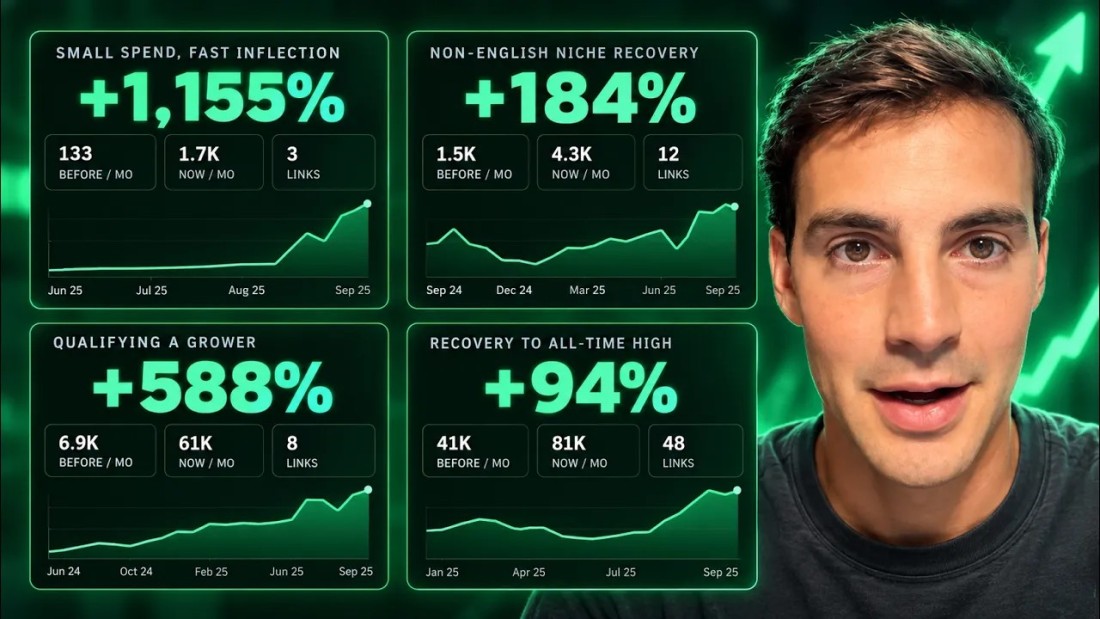
How long do backlinks take to work? The honest answer from four client campaigns is "somewhere between the same month and a year", and the spread is not random — it tracks the size of the site, the number of links and whether the site was growing, flat or falling when the links went live. The video below is Vasco's walkthrough of those four campaigns, with the traffic curves annotated at the exact month the links started, the month Ahrefs first saw them, and how many placements were still live. This article pulls the timelines out of it and turns them into something you can plan against.
A note on the cards: they are not Ahrefs screenshots. Vasco had Claude read his team's backlink order sheet (order date, links delivered, live date) alongside Ahrefs traffic data and build one card per success story, each with a "keep it honest" box. Client domains are redacted on the cards; the linking domains the video opens in Ahrefs are shown as-is.
The short answer: four timelines from four campaigns
| Campaign | Links | Links went live | Ahrefs first saw them | Traffic moved | Result |
|---|---|---|---|---|---|
| Adjustable-bed retailer | 3 (1 order) | June 2026 | June 2026 | Same month | ~130 → ~1.7k/mo within 3 months (+1,155%) |
| UK travel-money site | 48 (6 orders) | April–July 2026 | May 2026 | Within 1–3 months | 41k → 81k/mo; 88k in July 2026, past its old peak (+94%) |
| Fintech (global payroll) | 8 (3 orders) | Dec 2024–Jan 2025 | Feb 2025 | ~6 months later | 8.9k → 61k/mo; 72k by Sept 2026 (+588%) |
| Dutch linen e-commerce shop | 12 (4 orders) | June–Nov 2025 | Sept 2025 | Gradual, full recovery ~12 months on | 1.5k → 4.3k/mo, back to its 2024 peak (+184%) |
Two clocks are running in that table. The first is discovery: how long until Google (here, Ahrefs as the proxy) crawls the new links — same month to three months. The second is response: how long after discovery the traffic curve bends — immediately to about six months. Together they make the "same month to a year" spread. The reasons behind each timeline are more useful than the average, so here is each campaign.
Same month: 3 links on a tiny site
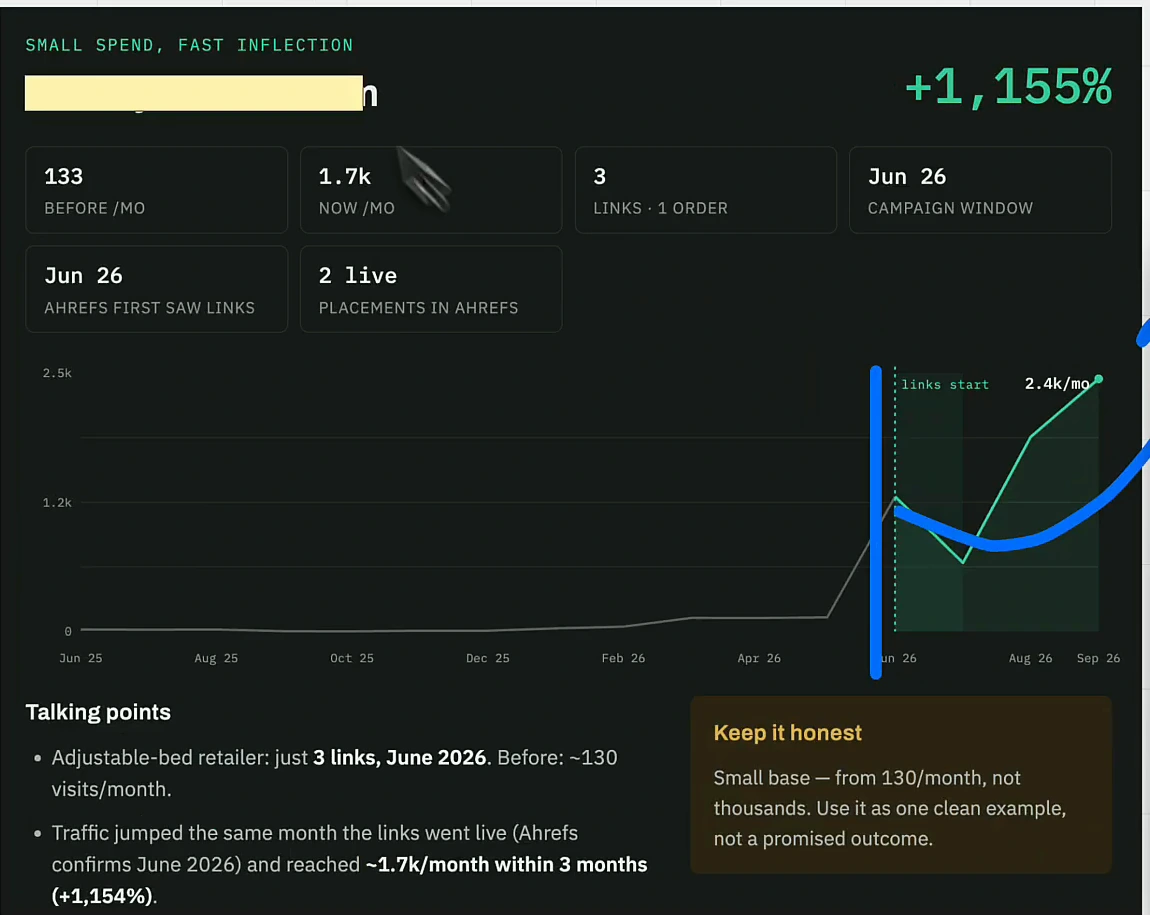
The fastest result in the video is also the smallest site. An adjustable-bed retailer bought a single order of three links in June 2026. Ahrefs saw the links the same month, and the traffic jumped the same month — from about 130 visits a month to roughly 1.7k within three months, with the chart peaking around 2.4k. On paper that is +1,155%, and it is the number the video leads with.
The card's own caveat is the important part: this is a small base. Going from 130 to 1,700 visits is a real change for that business, but it is not the shape you should expect on a site already doing tens of thousands. Small sites move fast because a few strong referring domains are a large share of everything pointing at them. Only two of the three placements had shown up in Ahrefs at the time of the card, which is normal — link indexes lag, and so does Google.
One to three months: 48 links reversing a year-long slide
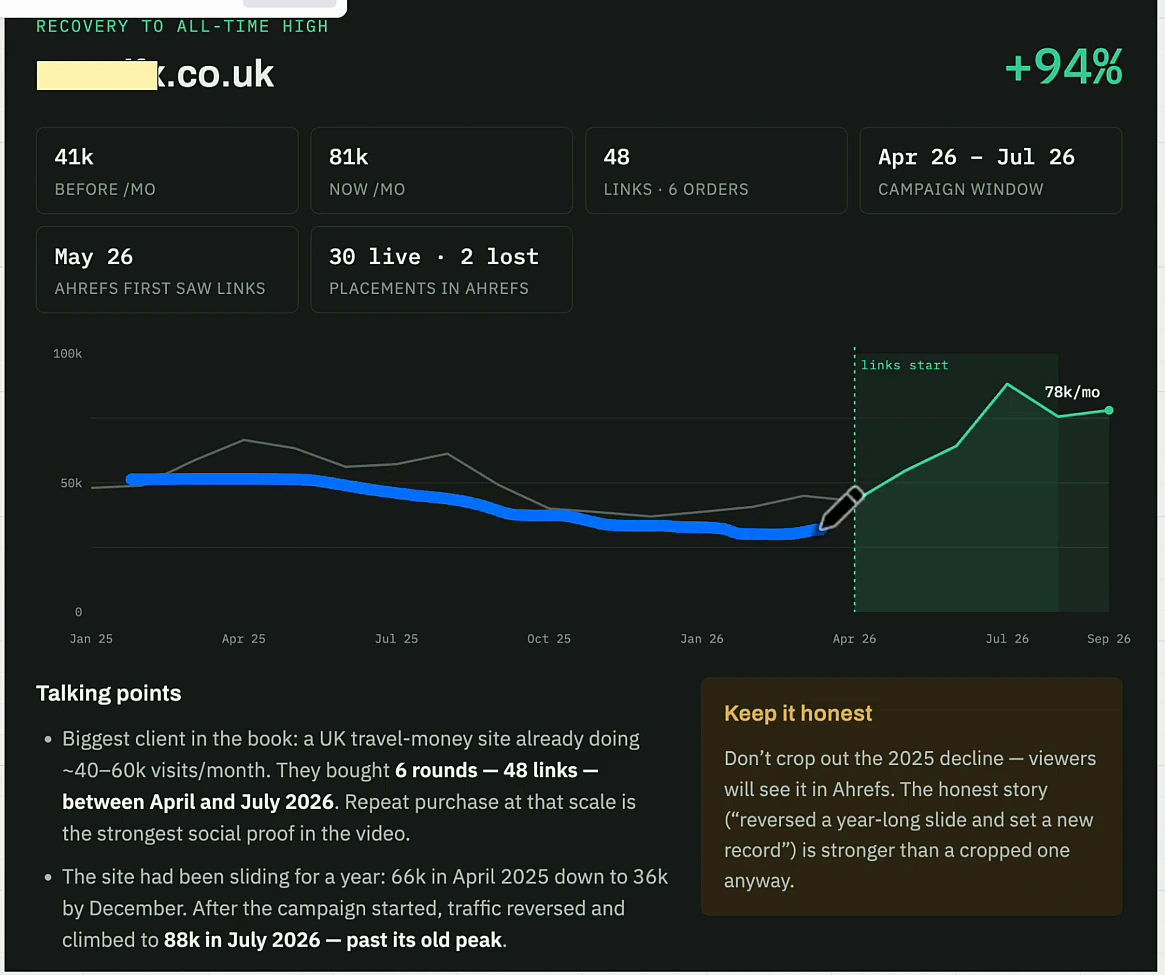
The biggest campaign is a UK travel-money site that was already doing 40–60k visits a month. It had been sliding for a year: 66k in April 2025 down to 36k by December. Between April and July 2026 it bought six rounds — 48 links in total — and Ahrefs first saw them in May. Traffic reversed almost immediately and climbed to 88k in July 2026, past its previous peak; the card shows 41k before and 81k now, with 30 placements live and 2 lost.
One to three months from first links to a new all-time high — faster than the fintech case below despite the site being far bigger, for two reasons. Volume: 48 links over four months is a steady drumbeat of new referring domains. And history: it was recovering ground it used to hold, which is quicker than earning positions a domain has never had. A business at 40k visits a month does not buy six rounds unless the first ones moved something.
Six months: 8 links on a site that was already growing
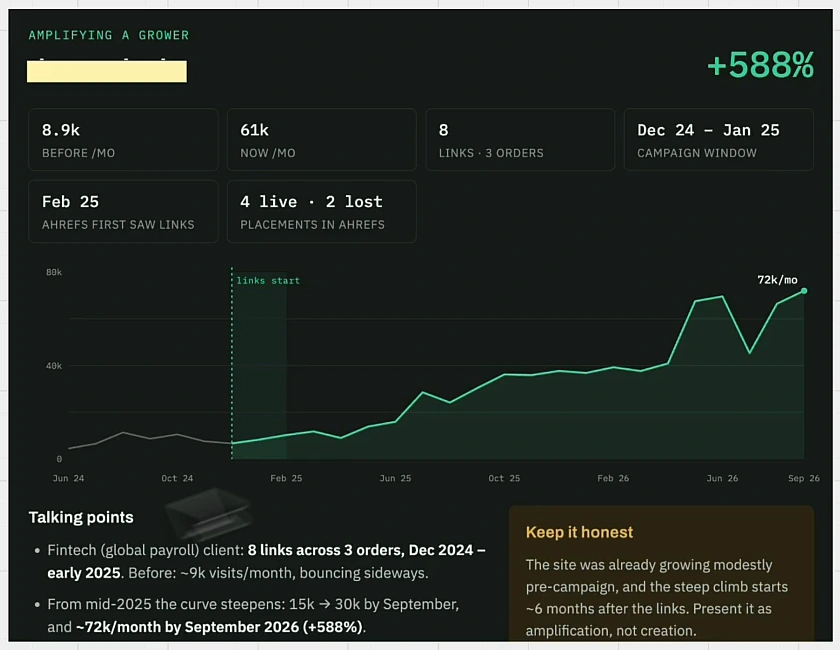
This is the campaign that should reset expectations for anyone with a mid-sized site. A fintech client in global payroll was bouncing sideways at around 9k visits a month. It bought eight links across three orders in December 2024 and January 2025; Ahrefs saw them in February. Nothing dramatic happened for months. From mid-2025 the curve steepens — 15k to 30k by September 2025 — and by September 2026 it sits around 72k a month, +588% on the pre-campaign baseline.
The "keep it honest" box is blunt: the site was already growing modestly before the campaign, and the steep climb starts roughly six months after the links. Present it as amplification, not creation. That is what backlinks usually do on a site with decent content — they raise the ceiling on pages that were already close, and it takes a few crawl-and-re-rank cycles for that to compound into a visible curve.
Nine to twelve months: 12 links to recover a non-English shop
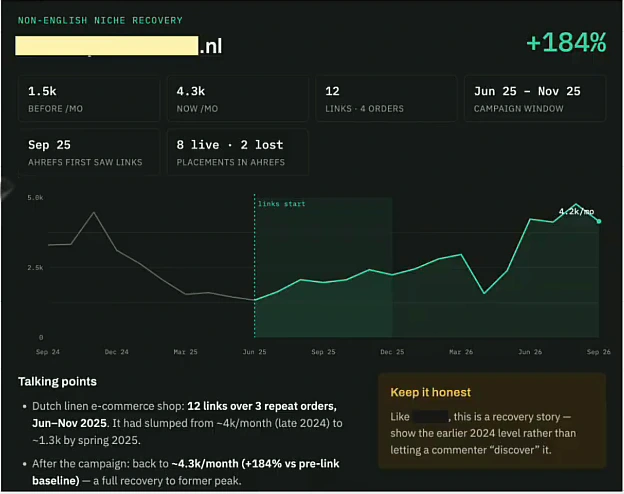
The slowest timeline is a Dutch linen e-commerce shop. It had slumped from about 4k visits a month in late 2024 to about 1.3k by spring 2025. Twelve links went out across four orders between June and November 2025; Ahrefs did not see the first ones until September — a three-month discovery lag, the longest in the set. Traffic climbed steadily rather than in a step, and by mid-2026 it was back at about 4.3k a month, a full recovery to its former peak and +184% against the pre-link baseline.
Why slower? A non-English niche means a smaller pool of relevant referring domains and, usually, slower crawling of both the shop and the sites linking to it. The card frames it as a recovery story and says to show the 2024 level up front: +184% sounds like growth, but the site got back what it had lost, and it took the better part of a year.
Why the timelines differ: what the four cases have in common
Line the four up and the pattern is consistent enough to plan with.
- Site size sets the speed. The 130-visit site moved in the same month; the 9k site took six months; the 40k site took one to three months only because it received 48 links. The smaller the site, the larger a share each new referring domain represents, and the faster the response.
- Volume shortens the wait. Three links moved a tiny site; it took 48 to move a 40k site quickly. Eight links on a 9k site worked, but slowly. Our guide to how many backlinks you need covers how to size a campaign to the competition rather than to a budget.
- Recovering is faster than creating. Both recovery cases (the UK site and the Dutch shop) got back to old peaks; the fintech site, which was earning new ground, took longest to show it.
- Discovery lag is real and variable. Same month, one month, two months, three months — that is how long Ahrefs took to see the links in each campaign. Google's crawl of the linking pages runs on its own schedule, and nothing happens until it does.
- Some links drop. Three of the four cards show 2 placements lost. Budget for it, or use a service that replaces lost links.
The video's own summary is a range, not a promise: buy links, keep doing everything else, and do not expect them to rank you first right away. Vasco is explicit that content and technical SEO were happening on these sites too — while also saying that, being honest with himself, backlinks had the most pull. That is consistent with what we found when we measured how much backlinks increase traffic on a single campaign, and with the larger question of whether backlinks still work at all in 2026.
The links behind the curves: DR 62 to DR 81, with real traffic
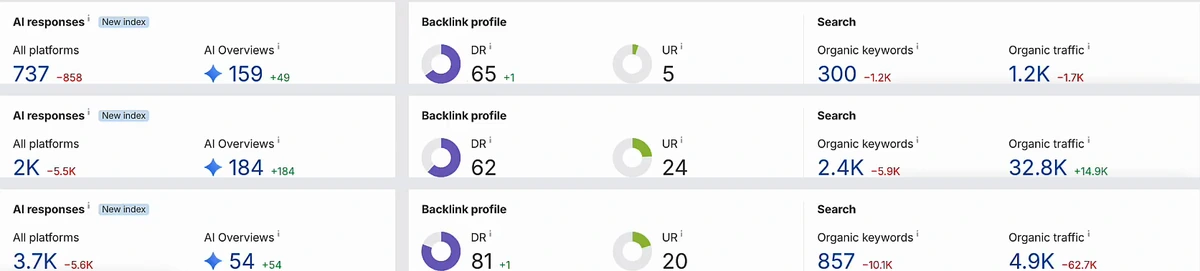
Timelines only mean something if you know what kind of link produced them, so the video opens several of the linking domains in Ahrefs. The three shown above are DR 65 with about 1.2k monthly organic visits, DR 62 with 32.8k organic visits and 2.4k ranking keywords, and DR 81 with about 4.9k organic visits — that last one picked at random from the delivery sheet. Each also carries an "AI responses" count in the thousands, Ahrefs' new index of how often the domain appears in answers from ChatGPT, Gemini, Perplexity and the rest. When a domain with that authority, real traffic and a presence in LLM answers links to you, the curves above are what tends to follow.
The contrast he draws is with the $5 links on Fiverr — the one kind he tells you not to buy, whatever else you do. We tested those separately in our Fiverr backlinks teardown, and the reason they do not produce these timelines at any duration is that the linking domains have no traffic, no rankings and no trust to pass. The metric that matters is not DR alone but DR with organic traffic behind it; the trade-off between a few strong links and many weak ones is worked through in backlink quality vs quantity.
The clock starts at delivery, not at order
One practical detail for anyone planning around these timelines: they start from the month the links went live, not the day the order was placed. The video is candid that the placements are manual work — no AI in the outreach, which Vasco says is part of why the links perform — and that an order placed today is delivered in about 14 days. The Arvow backlink service page lists the same terms: DR 40+ domains with at least 1,000 organic visits a month, first placements live within 14 days, lost links replaced free. Add discovery lag on top of delivery: look for movement from month two, judge the campaign at month six.
If you would rather build the links yourself, the same video points to the channel's two long tutorials on exactly the process the team runs, and we have written both up: how to get free backlinks and how to build backlinks with Claude. DIY costs time instead of money; once the links are live the timelines are the same.
What to do with this
- Set the expectation by site size before you order. Under 1k visits a month: expect movement within the first month or two. 5–20k: plan for six months. Above 20k: it will take volume, and it will still be a few months.
- Mark the live date on your own traffic chart. Every card in the video has a "links start" line; add one to yours. It is the only way to tell a link effect from a seasonal one.
- Check discovery before results. If Ahrefs or Search Console has not seen the links, the clock has not started; three months is normal for a niche site.
- Keep the rest running. Content, on-page and technical fixes are what the links amplify. A campaign on a site with nothing worth ranking amplifies nothing.
- Do not crop the decline. Show the slide before the recovery; it is a stronger story, and they will see it in Ahrefs anyway.
How long do backlinks take to work? On these four campaigns: same month for a tiny site with three strong links, one to three months for a large site under a heavy campaign, six months for a mid-sized site with a handful, and about a year for a non-English shop recovering lost ground. If your timeline is longer than that, check the links before you check the calendar. For the related question of how long it takes to reach the top position once the links are in, see how long it takes to rank first on Google.
Arvow builds the links behind these curves — DR 40+ domains with real organic traffic, delivered in about 14 days, with lost links replaced free. See the backlink service, or keep building with the guides above.
Generate, publish, syndicate and update articles automatically
The AI SEO Writer that Auto-Publishes to your Blog
- Cancel anytime
- Articles in 30 secs
- Plagiarism Free