
How to Get .Gov Backlinks in 2026 (Plus .Edu, City, Chamber and Partner Directory Links)

Short version: there is a US government website that will list your business, with a clickable link to your site, for free. It is the Small Business Administration's Small Business Search, and it is fed by the SAM.gov registration any company can complete. In a 13-minute video published on 9 October 2026, Tim The SEO Guru walks through that opportunity plus four more directory-style links most small businesses never claim: the city's own business list, the alumni business directory of the college you went to, the local chamber of commerce, and the partner directory of a software product you work with.
This article is that walkthrough with the homework done. We opened every page shown on screen and read the rules: who qualifies, what it costs, and whether the link is really there. Two of the five are free and open to almost any local business. One is free but needs a school connection. Two cost money, and one of those costs a lot more than the video lets on. The frames below are from the video; the quotes are from the live pages as read on 10 October 2026.
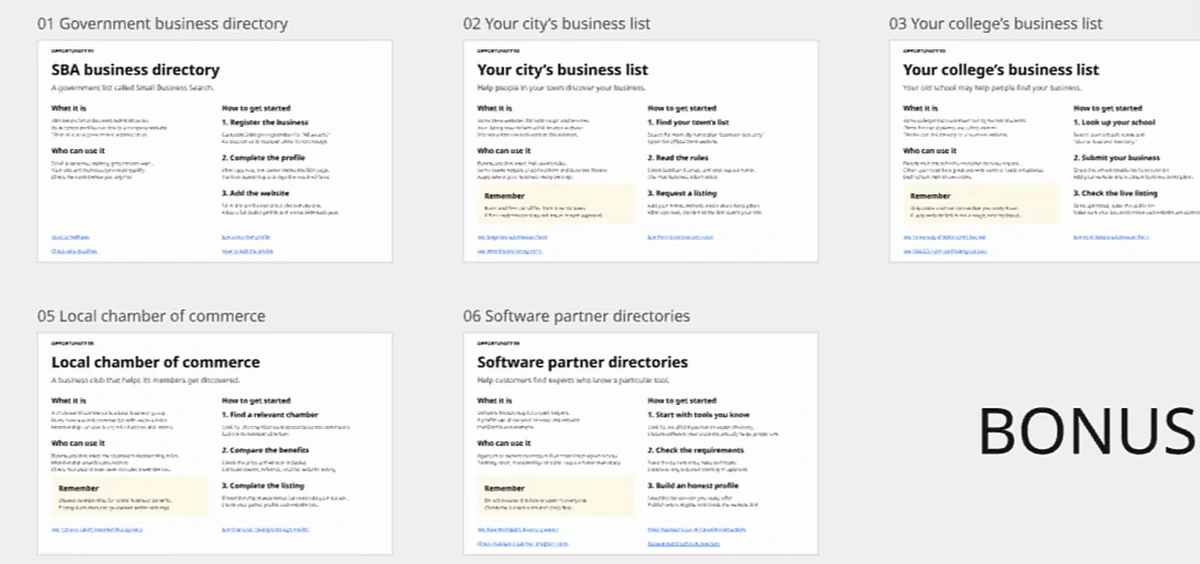
The five directories at a glance
| Directory | Domain | Who qualifies | Cost | Link to your site? |
|---|---|---|---|---|
| SBA Small Business Search | search.certifications.sba.gov (.gov) | US businesses registered in SAM.gov and within SBA size standards | Free (SAM.gov charges nothing) | Yes, a "Website" field on the profile, shown on screen |
| City business directory | City site (often .gov) | Businesses inside the city limits with a business licence (Peachtree Corners, GA, as shown) | No fee stated | "Web URL" is listed as permitted information |
| College alumni business directory | .edu | Alumni who own or lead the business (Kent State, as shown) | Not stated | Yes, "Visit Website" links on the live directory |
| Chamber of commerce | Chamber site (.org/.com) | Paying members | Membership dues, vary by chamber and tier | Member directory, plus a printed and digital Community Guide (Charlotte County, FL, as shown) |
| Software partner directory | Vendor's domain (HubSpot shown) | Members of the vendor's partner programme | HubSpot: $400/month membership or $400/month software spend | Yes, a listing with a partner badge |
Two things before the detail. None of these is a trick: every one is a real directory whose owner wants accurate business listings on it. And none of them scales. You get one SBA profile, one city listing, one alumni entry. These are the "local citations and business profiles" method from our free-backlinks guide done properly, not a link-building campaign. Treat them as the base layer and build the rest on top.
1. The SBA Small Business Search: a .gov profile with a website field
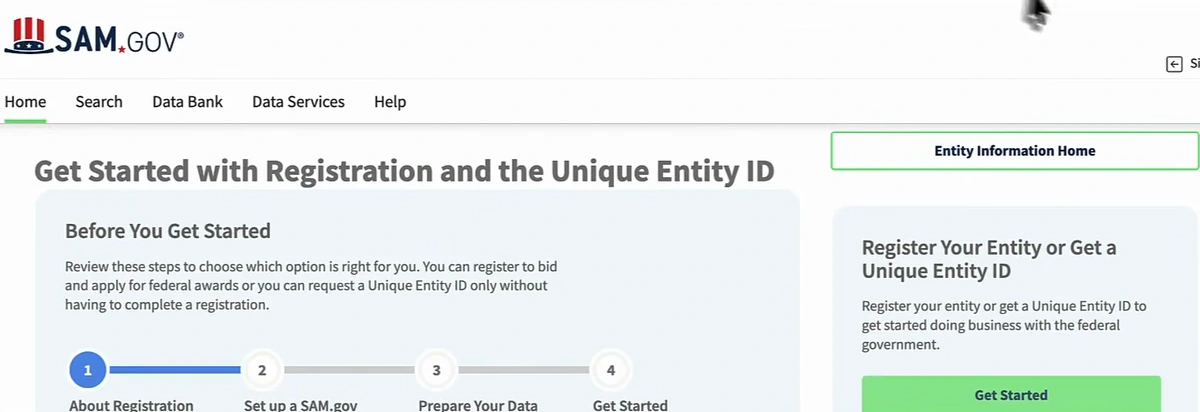
The headline opportunity is a profile on the Small Business Administration's search tool. The SBA's own contracting guide calls it "the Small Business Search (SBS, formerly known as the Dynamic Small Business Search)" and explains that when you register in SAM.gov, the System for Award Management, that information populates the SBS database. The SBA's advice is to "create a comprehensive business profile" so agencies can find you. The presenter's framing is the same, in plainer words: think of it as a government address book.
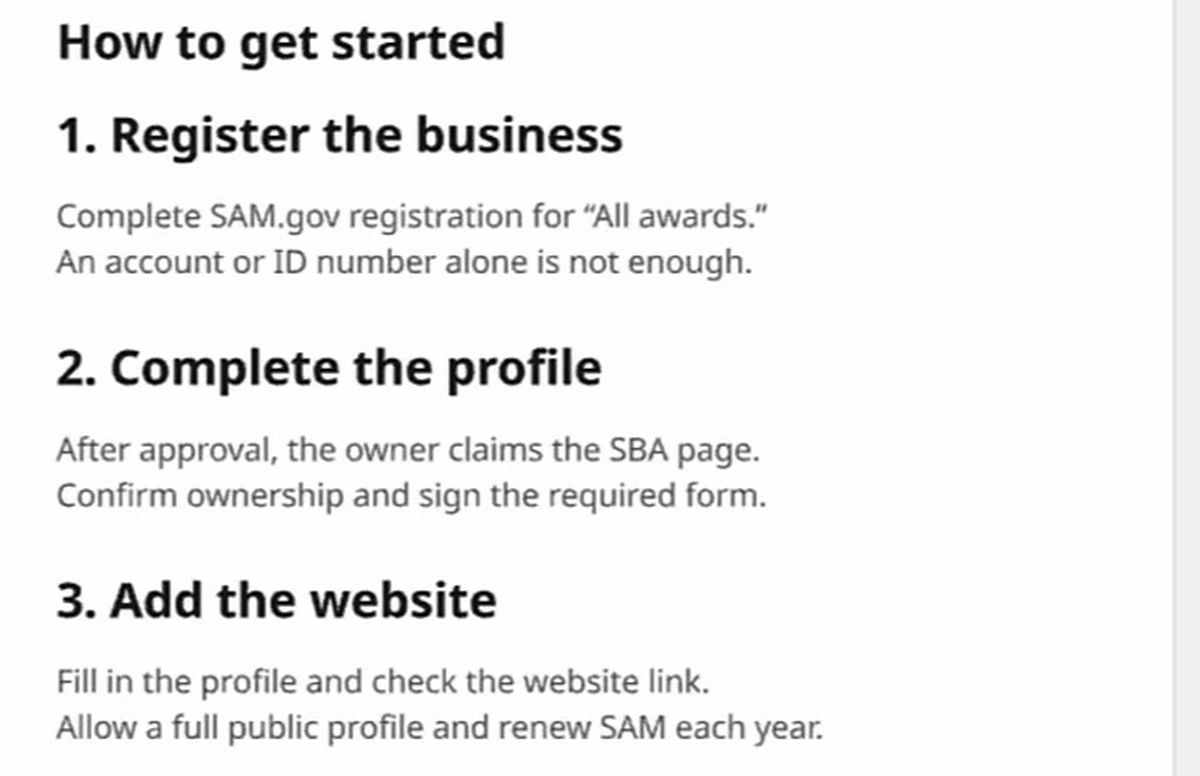
The sequence, as shown on screen and checked against SAM.gov:
- Register the entity in SAM.gov for "All awards". SAM.gov offers two paths: a Unique Entity ID only, or a full registration "to bid and apply for federal awards". Only the full registration feeds the SBS. SAM.gov is run by the General Services Administration and registration is free; the SBA and the government's own procurement help centres repeatedly warn that third parties charging to "register you" are not needed.
- Claim and complete the SBA profile. After SAM approval, the business owner claims the profile and fills it in. The video's card notes that ownership has to be confirmed and a form signed.
- Add the website and keep the registration alive. The profile has a "Website" field and an "Additional website" field. SAM.gov registration must be renewed every 365 days to stay active, which is written on the SAM.gov page shown in the video, so the profile is not a one-off job.
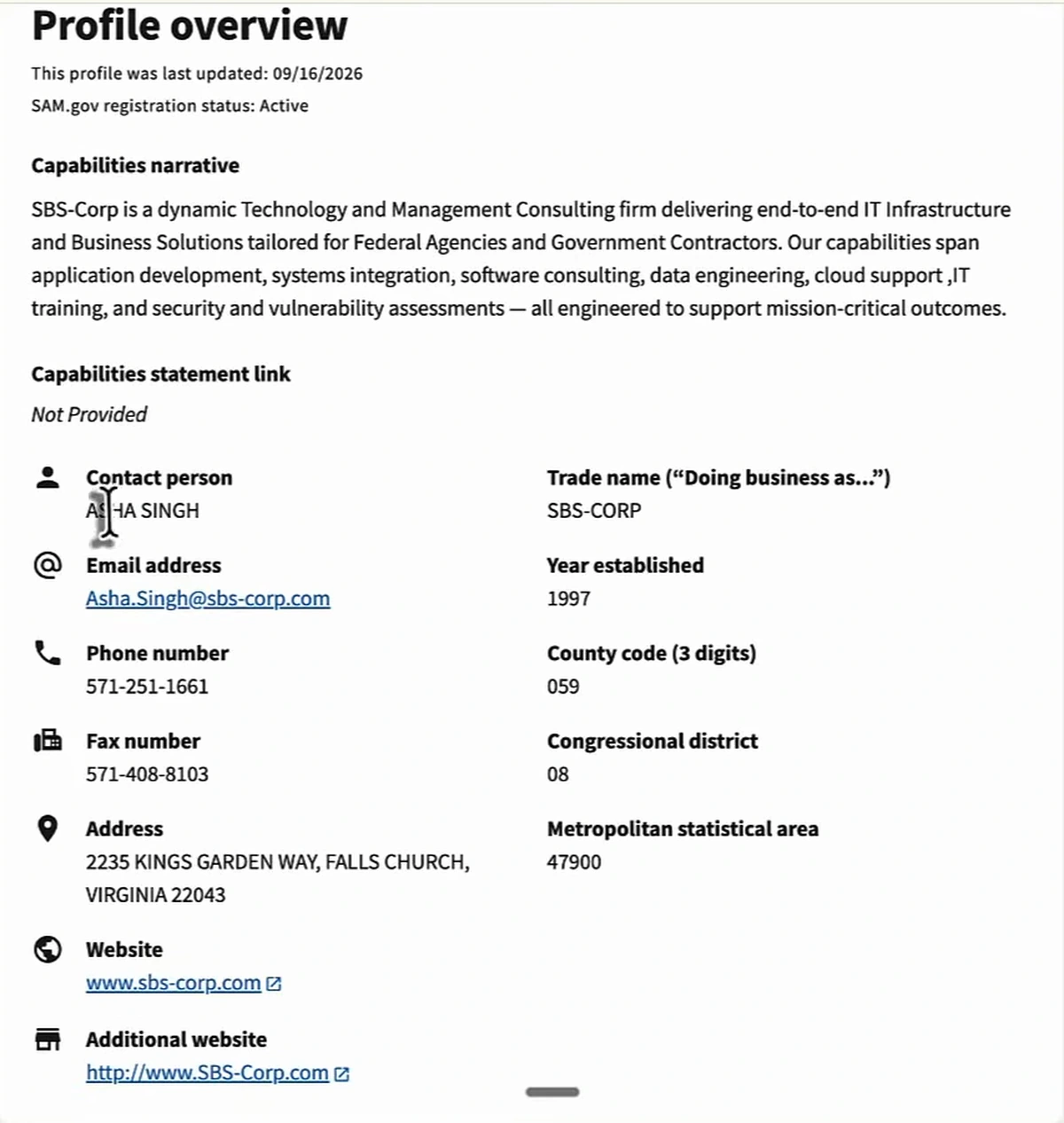
Three honest caveats the video does not dwell on:
- It is a procurement record, not a marketing listing. The profile publishes a capabilities narrative, NAICS codes, a named contact, email, phone, fax and street address. Whatever you put in SAM.gov becomes the public face of your company to federal buyers. If federal work is not even plausible for you, this is the wrong reason to register.
- You do not have to take contracts, but you do have to qualify. The presenter says it directly: "Do you have to take government contracts? No. Will your business always qualify? Not necessarily." The SBA's basic requirements are a UEI, a NAICS code, meeting SBA size standards for your industry, and an active SAM registration.
- We could not confirm the link is followed. The Small Business Search is a JavaScript application; fetching a profile URL from outside returns a 1.2 KB shell with the page title and nothing else. The link is there in a browser, with an external-link icon, and the video shows it. Whether it carries a nofollow attribute we could not see from here, and the presenter does not check either. Plan on the profile being worth having as a citation on a .gov domain, and treat any ranking credit as a bonus.
2. Your city's business directory
Many city websites keep a public list of local businesses, and some let you include a link. The example on screen is Peachtree Corners, Georgia, whose submission requirements page we re-read live. The rules are short and typical:
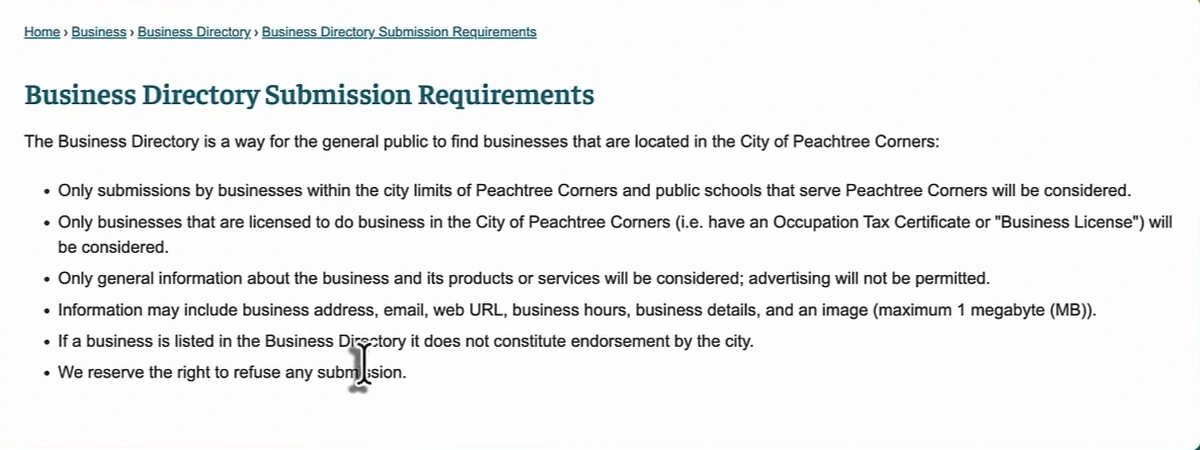
The two gates are location and licensing: "Only businesses that are licensed to do business in the City of Peachtree Corners (i.e. have an Occupation Tax Certificate or 'Business License') will be considered." No fee is mentioned anywhere on the page. The city also says a listing "does not constitute endorsement by the city" and that it reserves the right to refuse any submission, which is the usual language and nothing to worry about.
To find yours, do what the card says: search your city name plus "business directory" and open the official city website, not a third-party aggregator. The video's board links two other examples, Smyrna and Wrentham, both with submission forms. Some larger cities run more than one list (economic development office, tourism office, downtown association), so check each. Submit the exact business name, address and phone you use everywhere else; the card's reminder that "a form submission does not mean instant approval" is right, and some cities only update the list a few times a year.
3. Your college's alumni business directory (.edu)
The quietest of the five. Many universities publish a directory of businesses owned by their graduates, and the entries link out. The example is Kent State University, whose submission page reads: "Are you a Kent State graduate who owns or leads a business? Submit your information below to be featured in our Alumni Business Directory." The eligibility line is unambiguous: "Eligible participants must be Kent State alumni and primary owners or leaders of the business listed."
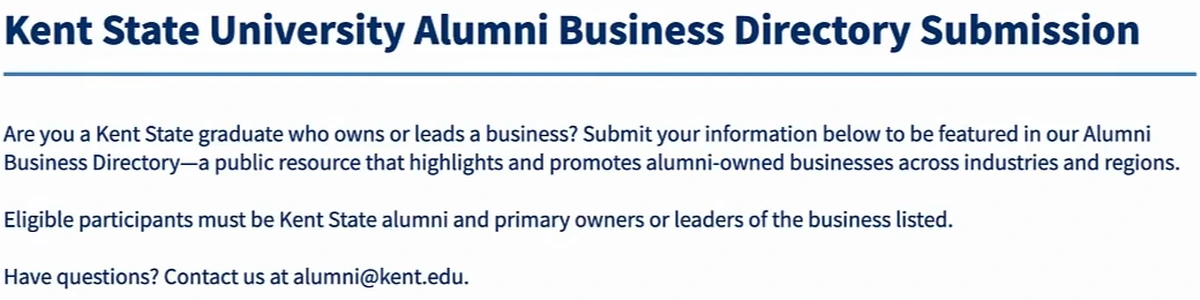
We opened the live Kent State directory on 10 October 2026: it is searchable by industry and keyword, and each business entry has a "Visit Website" link, so the link the video promises is real. The page does not say whether listing is free; nothing on it suggests a charge, and the form asks only for business details, your name and graduation year. The board also links the University of Baltimore's live list as a second example.
The card's "Remember" box is the right note to end on: "Only claim a school connection you really have. A .edu website link is not a magic ranking boost." Alumni offices verify graduation records, and a fake claim gets you removed from the one directory you cannot re-apply to.
4. The chamber of commerce
Chambers are the one on this list most people already know about, and the one with the clearest cost. The video's example is the Charlotte County Chamber of Commerce in Florida, whose member benefits page is shown on screen and reads, in part: "As a valued member of the Charlotte County Chamber of Commerce, you have access to a variety of promotional, networking, and marketing opportunities."
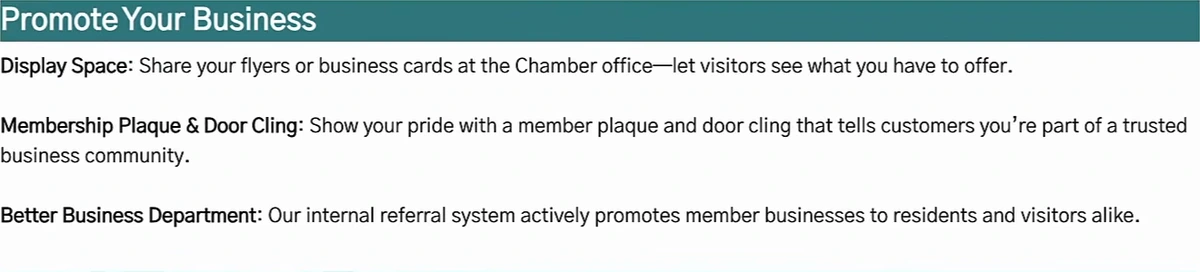
The link comes from the member directory on the chamber's website and, in Charlotte County's case, from a "Community Guide & Membership Directory" that the page says reaches "over 10,000 residents, visitors, and prospective movers". The presenter's point is that the fee buys more than a link: a referral system ("Better Business Department"), member-only events, a weekly email where members can post a 90-word blurb at no cost, and paid ad slots in a quarterly newsletter and a monthly digital mailing that goes to "over 3,000 engaged subscribers". He is candid that "some of them do require, if not most of them probably require, a fee".
Dues vary widely by chamber and by tier, and the card's instruction is the right one: "Check the price and what is included. Consider events, referrals, and the website listing." Confirm that your chosen tier actually includes a public profile with a website link before you pay, because some chambers reserve the linked listing for higher tiers. And as the card says, "Paying dues does not guarantee better rankings." Join a chamber for the business; take the link as part of the package.
5. Software partner directories (and what HubSpot's really costs)
The fifth opportunity is the one the video undersells on cost. Software companies run directories of agencies and consultants who implement their product. The example is the HubSpot Solutions Directory, which the video shows holding 3,553 solutions partners, each with a profile, a tier badge and a rating.
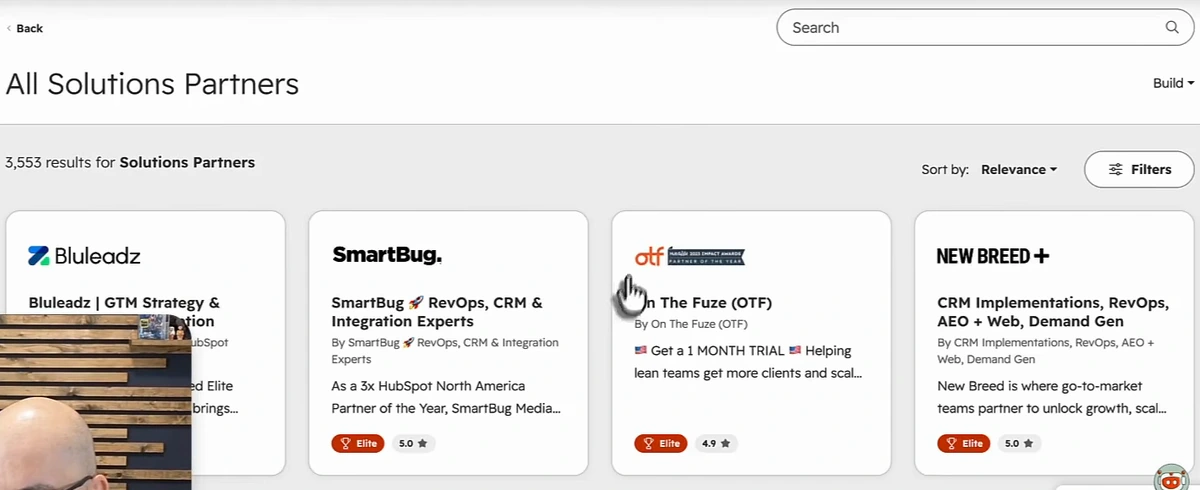
Here is the part the video skips. HubSpot's Solutions Directory is only open to members of its Solutions Partner Program, and the programme page we read on 10 October 2026 lists the entry cost as "starting from $400/month", with the note that you "must have $400 USD, after discounts, in software spend or purchase the Partner Program Membership that will be billed monthly at $400 USD." The directory listing with a partner badge is one of the listed benefits, alongside revenue share and a dedicated account manager. So this is a $4,800-a-year link at minimum, unless your business already spends that on HubSpot anyway.
That does not make it a bad idea; it makes it a different idea. If you are an agency that genuinely implements HubSpot, Shopify, Salesforce or Webflow, their partner directories send real client enquiries, and the link is a side effect. If you would be joining for the link, the card's own wording warns you off: "Training, tests, membership, or other requirements may apply." Read the current rules and costs first, and describe only the services you really offer, because partner profiles are reviewed and rated by clients.
The sixth card the video skipped
The Miro board is titled "6 Backlink Opportunities Explained Simply", and the card at position 04, "Travel and tourism websites", is visible on the overview but never discussed; the presenter goes from the college directory straight to the chamber. For a hotel, restaurant, tour operator or attraction, the local convention and visitors bureau, the state tourism site and the regional "things to do" portals work exactly like a city directory: an official body, a public listing, a web URL field, eligibility rules. Worth adding to your list if you are in that sector.
What these links are, and what they aren't
The video calls the SBA link "a super high DR backlink". The domain rating is real: sba.gov, a state university and a city government are among the most trusted domains on the web. But a link's value to Google is about the linking page's own authority and relevance and whether the link is followed, not its top-level domain. Google's John Mueller has said for years that .gov and .edu links get no special treatment, and a directory page deep inside a .gov site that links to five hundred businesses passes a sliver of whatever authority that page has.
What these five do reliably is something else: they put a consistent name, address, phone and website on pages that search engines and AI assistants already trust, which is the citation side of local search. That is why they sit at the top of our ranking of free backlink methods and why directory listings are rated an A-tier method in our tier list of link-building methods: cheap, permanent, and about trust rather than volume. For the trade-off between a handful of links like these and a hundred low-quality ones, see backlink quality vs quantity.
The presenter's closing line is that backlinks "are still king when it comes to SEO rank, authority, and getting featured in AI overviews." We'd soften "king", but the second half is where these particular links pay off: an entity that government, education and trade bodies all list consistently is exactly the kind of entity an AI assistant is comfortable naming.
Bonus: finding the links your competitors already have
The video's bonus section moves from directories to prospecting, with two tools. The first is a free skill file from our prompts library, a folder with two Python scripts that you open in Claude: one pulls the referring domains of your competitors and scores them, the other finds guest post opportunities in your niche. The presenter's summary is accurate: "chances are if your competitor got the backlink you can do the same thing." The method behind it, including the search footprints it runs, is written up in AI backlinks: automated vs manual, so we won't repeat it here.
The second is the AI chat inside Arvow, which already knows your website and brand brief. The presenter tested it on a demo chiropractic project with the prompt: "Based on my website URL, find me backlink opportunities from my competitors that they are getting, so I can also work to get and provide those links." The reply is worth reading in full, because the caveats are better than the leads.
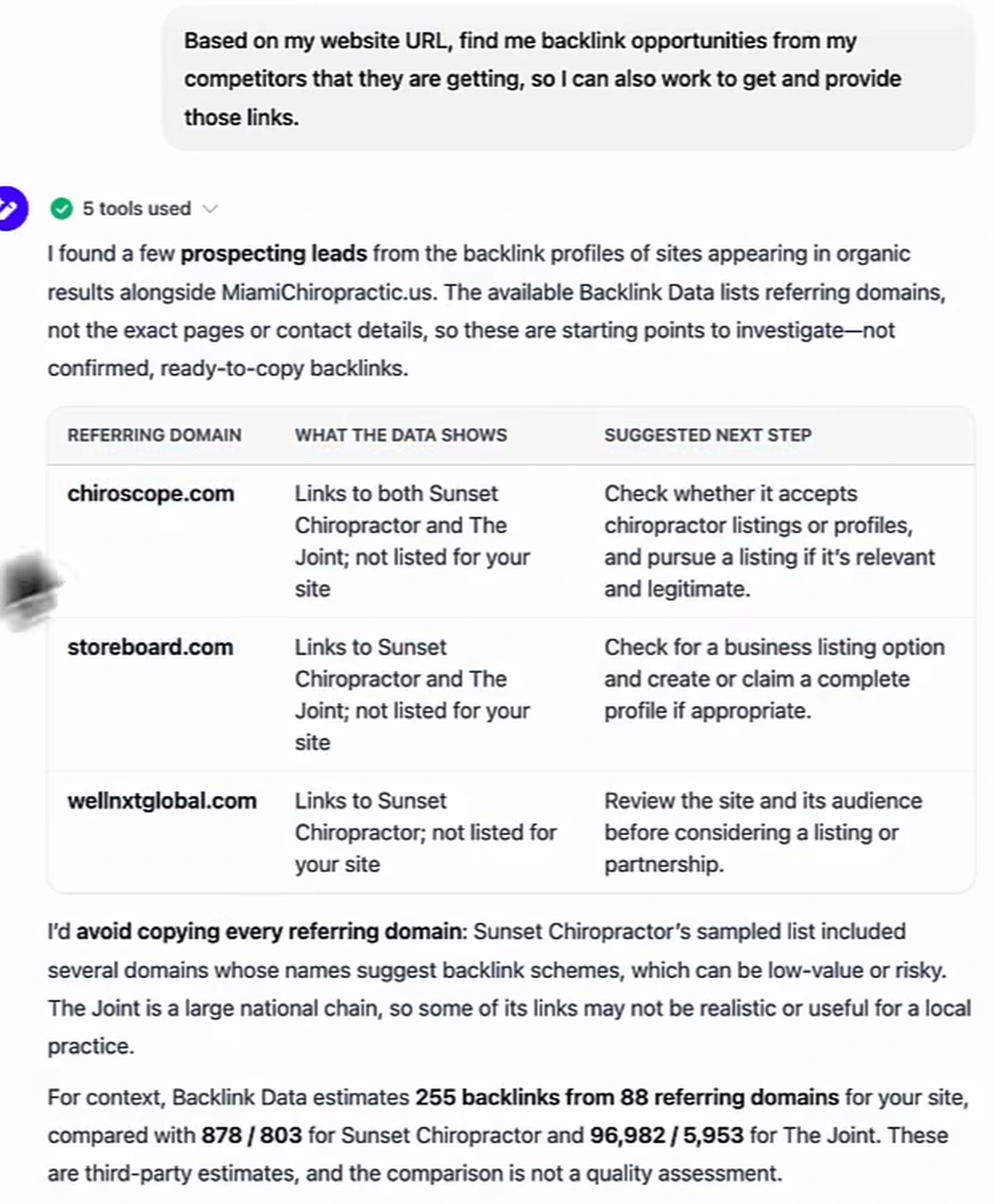
Three referring domains, each tagged as a starting point to investigate rather than a confirmed link, and a comparison of backlink counts that the chat itself labels "third-party estimates" and "not a quality assessment". The warning about domains "whose names suggest backlink schemes" is the one to internalise: the fact that a competitor has a link does not mean you want it. The same lesson, from a different video, is in what a $500 backlink gets you.
The automated route, with the DR column as shown
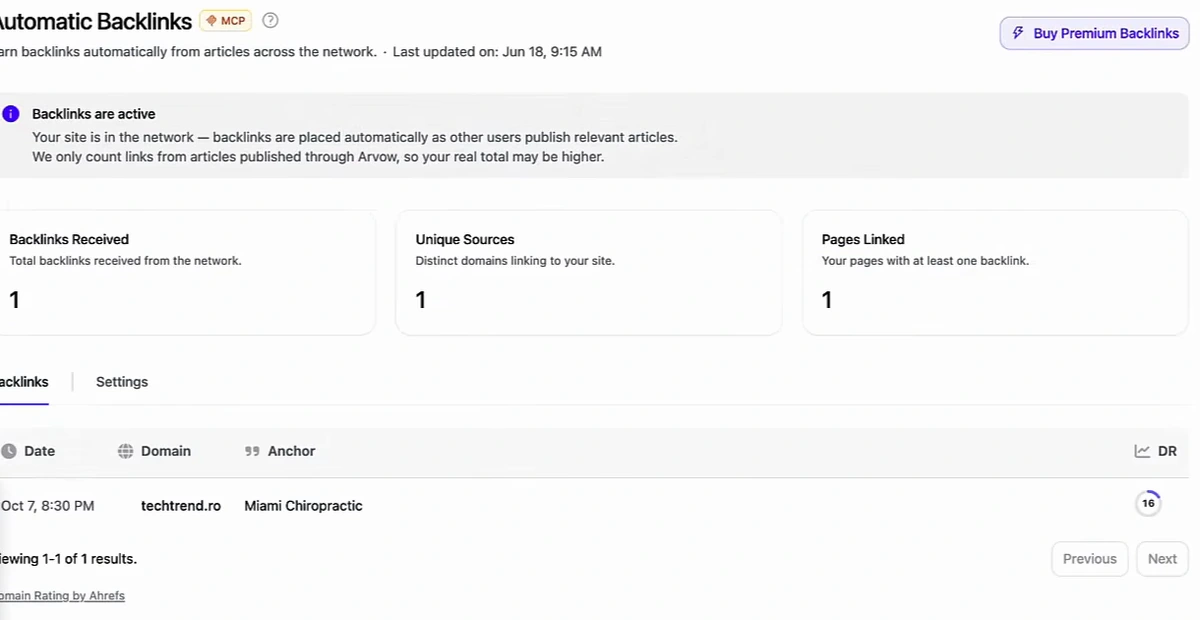
The video ends on Arvow's backlink pool, which the presenter describes correctly: when other users in the network publish relevant articles, your site gets linked from them, and your published articles link out to theirs. On the demo project the panel shows one backlink received so far, from a DR 16 domain, placed on 7 October.
He then opens a second account "utilizing this service" with 247 backlinks received, and reads the DR column aloud as "a 15, not that high, but then here's a 33 backlink, a 38 backlink, an 18, 13, 10, 15", adding that "some of these get in the 40s, 50s, 60s". The domains are blurred in the video, but the DR badges are not. Here is the column exactly as it appears in the frame:
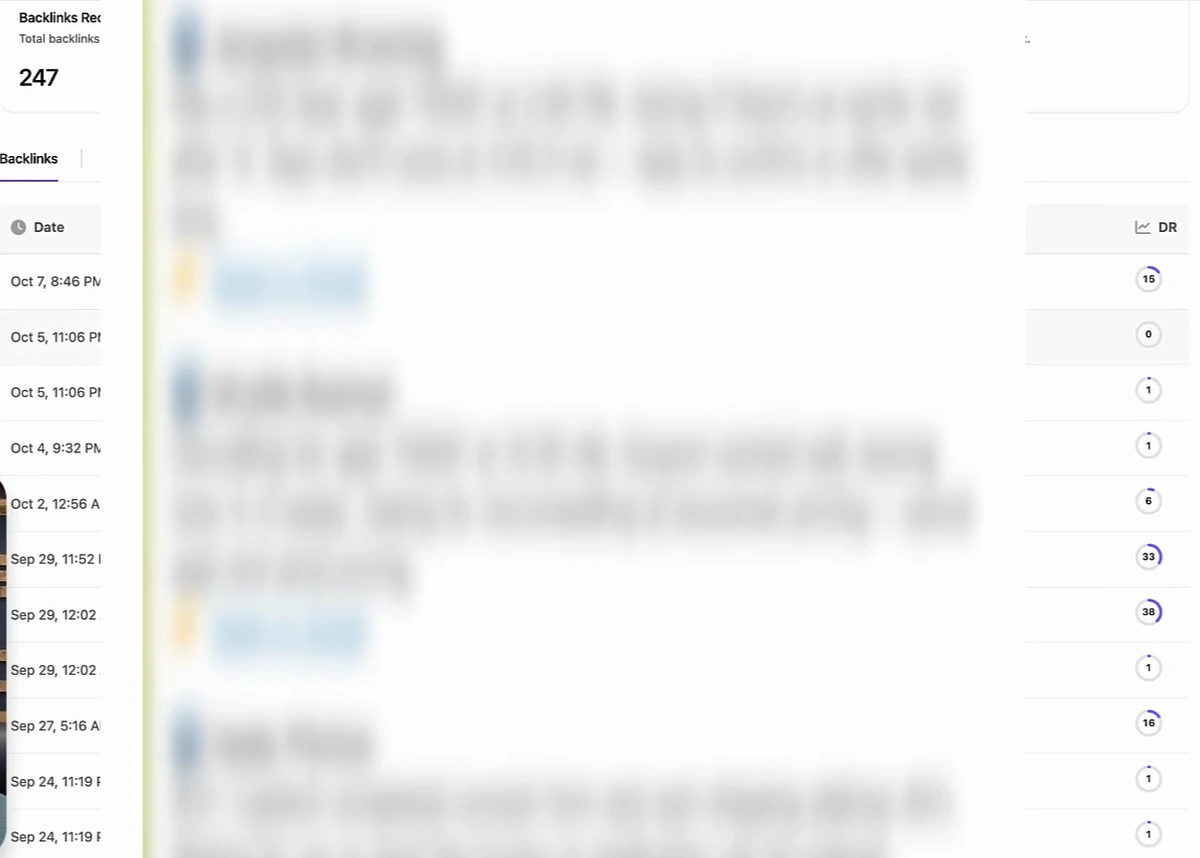
Of the eleven visible rows, two are DR 33 and 38, two are 15 and 16, one is 6, and six are DR 0 or 1. That is a normal profile for a network that places links in freshly published articles on member sites, many of which are new domains, and it is the same pattern we audited in our own automated-vs-manual comparison. The feature exists to add volume on autopilot, not to replace a chamber listing or a .gov profile, and the two work best together. Automatic Backlinks is part of the Business plan, which on 10 October 2026 is $169 a month billed monthly or $69 a month on the yearly rate; details are on the automatic backlink exchange page and pricing.
How to do it this week
- Decide on the SBA profile honestly. If federal or state-funded work is plausible for your business, register in SAM.gov for "All awards" (free, from the government site only), then claim and complete your Small Business Search profile and fill the website field. If it is not plausible, skip it; a procurement record is the wrong place to put a marketing listing.
- Find your city's list. Search "[your city] business directory", confirm you are inside the limits and licensed, and submit the same name, address and phone you use on Google Business Profile.
- Email your alumni office. Search "[school] alumni business directory". If one exists, submit; if it does not, ask. Alumni offices like these lists and sometimes start one on request.
- Price the chamber. Get the dues sheet, confirm which tier includes a linked web listing, and join only if the events and referrals are worth it on their own.
- Check partner directories only where you already pay. If your business already spends on a platform's software, the partner listing may be nearly free. If not, the HubSpot number above is the real cost.
- Then prospect. Run the competitor backlink skill or the chat prompt above, and investigate the leads instead of copying them.
Five listings, one afternoon, and a citation footprint on domains most of your competitors have never claimed. It will not triple your traffic. It will make every other link you build afterwards sit on firmer ground.
FAQ
Are .gov backlinks free? The SBA one is. SAM.gov registration is free and the Small Business Search profile that comes from it is free. City business directories are usually free too, with location and licensing rules. Anyone charging you to "get a .gov backlink" is either selling SAM.gov registration you can do yourself or selling something Google treats as link spam.
Do I have to bid on government contracts to be in the SBA search? No. You need an active "All awards" SAM.gov registration and to meet SBA size standards, and your business becomes a public procurement record. You never have to bid. Register only if federal work is at least plausible for you.
Is the SBA profile link dofollow? We could not verify it. The search is a JavaScript app, so the profile markup is not visible to a plain fetch, and the video does not check. Treat the profile as a trusted citation first and a ranking link second.
Do .edu and .gov links rank better than other links? Not because of the domain ending. Google has said it does not give special weight to a top-level domain. The pages are usually trustworthy and the listings are usually permanent, which is the real value.
How many links can I get this way? Typically one per directory, so three to five for a single-location business. These are foundation citations, not a campaign. Guest posts, digital PR and automated exchanges are where volume comes from.
Can an agency do this for clients? Yes, and it is one of the few link tasks that is both cheap and defensible. The alumni directory is the exception: the owner has to be the graduate, so you can only prepare the submission.
Generate, publish, syndicate and update articles automatically
The AI SEO Writer that Auto-Publishes to your Blog
- Cancel anytime
- Articles in 30 secs
- Plagiarism Free