
What a $500 Backlink Actually Gets You in 2026 (DR 81 Teardown)

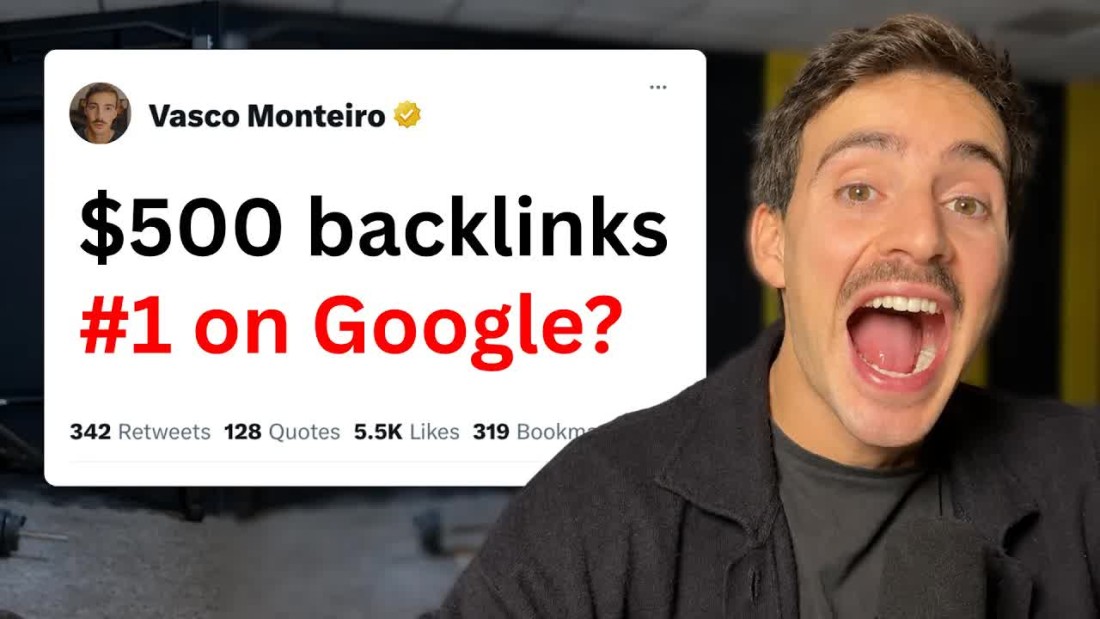
"If you invest $500 in your SEO, how high can you rank?" It is the right question asked the wrong way round, and the honest answer is that it depends entirely on what you buy with it.
So let's make it concrete. Below is a real DR 81 domain, its real traffic, its real citation footprint across AI search, and the page it publishes about working with outside writers. Then we compare it against a link that cost nothing. By the end you should be able to price a link yourself instead of guessing.
What a DR 81 domain actually looks like
The site in question is The Drive — automotive news, a real editorial operation with a large audience. Here is its profile in a third-party index at the time of recording.
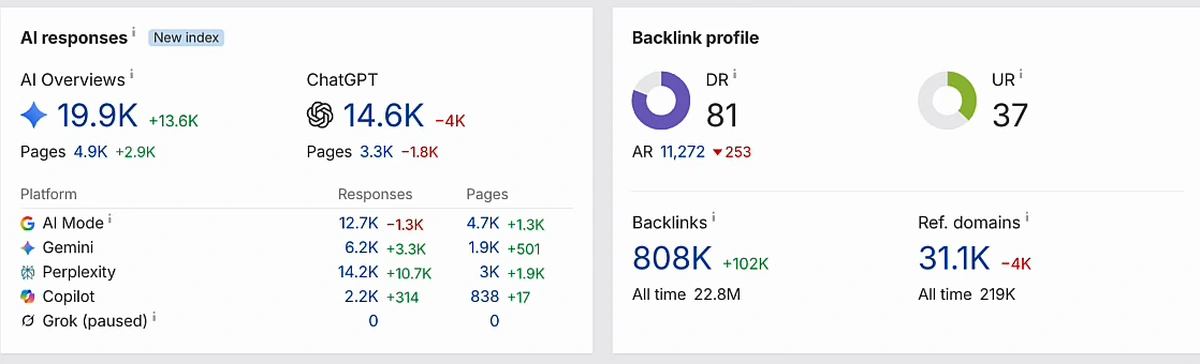
That is a genuinely strong domain. Domain Rating 81, URL Rating 37, 808K live backlinks (22.8M all time) from 31.1K referring domains. The AI numbers are the interesting half: pages on this domain were cited 19.9K times in AI Overviews (up 13.6K), 14.6K times by ChatGPT, 14.2K by Perplexity and 12.7K in AI Mode. When a model reaches for a source on a car question, it lands here often.
Search side, at the same moment:

351K organic visits a month, mostly US, 53.4K keywords with 24.5K of them in the top three. It is a big site. It is also a site whose organic traffic is down 95.9K and whose traffic value is down $70.1K over the window. Both things are true, and the second one is the kind of detail that never makes it into a link seller's pitch. Check the trend line, not just the badge.
Read the page before you budget for it
Here is the part that matters most, and it is the part people skim. When you go looking for how to get onto a site like this, you will usually land on a page like the one below. Read it carefully.
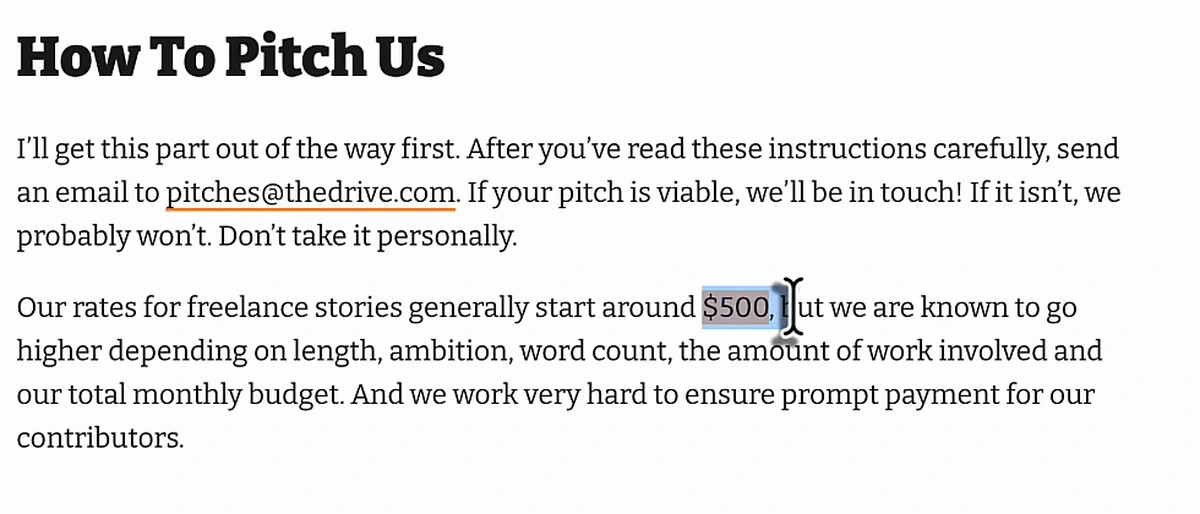
That $500 is real, and it is still on the page today. But look at which direction the money moves. The page is titled How to Pitch Stories to The Drive, its subheading is "We want your stories! In return, we will give you money," and the sentence in the screenshot is about prompt payment for our contributors. This is an editorial commissioning rate — the outlet paying a freelance journalist roughly $500 to write a story. It is not a rate card for buying a placement about yourself.
The distinction is worth internalising because the two things look almost identical in a search result and cost the same order of magnitude:
| Editorial pitch page | Paid placement rate card |
|---|---|
| They pay you | You pay them |
| Addressed to writers and journalists | Addressed to brands and agencies |
| Words like contributors, bylines, pitches, rates | Words like sponsored, partner content, advertise with us |
| Link is editorial and earned | Link usually needs a paid/sponsored disclosure |
For a domain like this one, that is good news rather than bad. The route in is editorial: pitch a story that genuinely serves their readers, and the strongest link on this list costs you a pitch email and some reporting instead of $500. That is slower and it is not guaranteed — most pitches get ignored — but it is the difference between an expense and a fee.
Paid placements in this price band absolutely do exist elsewhere; the point is simply to confirm which kind of page you are on before the money leaves. If you want the wider map of routes, we ranked them in 13 backlink building methods, worst to best.
Why Domain Rating moves the needle at all
Domain Rating is a third-party score, not a Google metric, and the relationship to rankings is a correlation, not a causation — a point Vasco is careful to make in the video. What sits underneath it is real, though: high-DR sites are sites that other trusted sites already vouch for.
The analogy from the video is the useful one. Two equally qualified applicants, one carrying a recommendation letter from someone the admissions office already trusts. The letter does not make that person smarter. It moves them up the pile. Links work the same way — when domains Google already trusts point at you, Google extends some of that trust, and ranking for your keywords gets easier.
For scale, here is the same index reading Arvow's own domain at the time of recording:
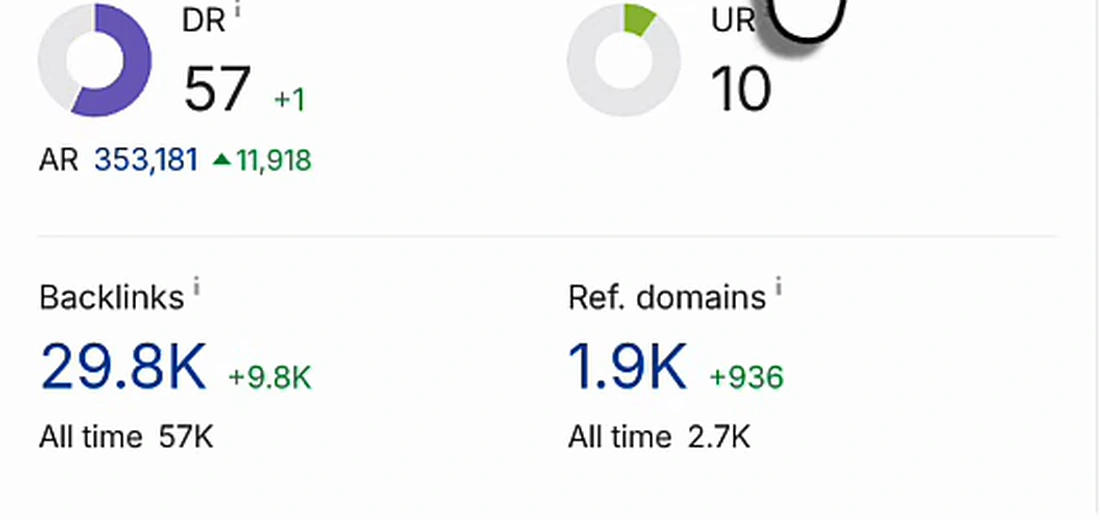
DR 57 versus DR 81. The gap is not 24 points of effort, it is roughly 16x the referring domains — 1.9K against 31.1K. That is what the scale actually costs, and it is why one link, however good, does not reorder a SERP on its own. If you want to work out your own number, we covered the method in how many backlinks you need to rank.
AI mentions do not weight DR the way Google does
This is where the $500 calculation gets more interesting, because the two payoffs are not the same payoff.
For classic organic rankings, the DR correlation is strong and well established. For brand mentions inside LLM answers, it is much weaker — models are assembling an answer from what the web says about you, and a mention on a small, precisely relevant page can carry as much weight as one on a giant domain. Vasco's read in the video is that this will tighten over time, because as AI search gets noisier the models will need some trust signal to sift with, and "which brands do other trusted brands link to" is the obvious one available. That is a forecast, not a measurement — treat it as such.
The practical consequence today: if your goal is AI visibility rather than blue links, relevance and volume of mentions beat raw authority. We went deeper on that in brand mentions are the new backlinks.
The link that cost nothing
The counterweight in the video is Arvow's automatic backlinks feature, which places links from articles other users publish across the network.
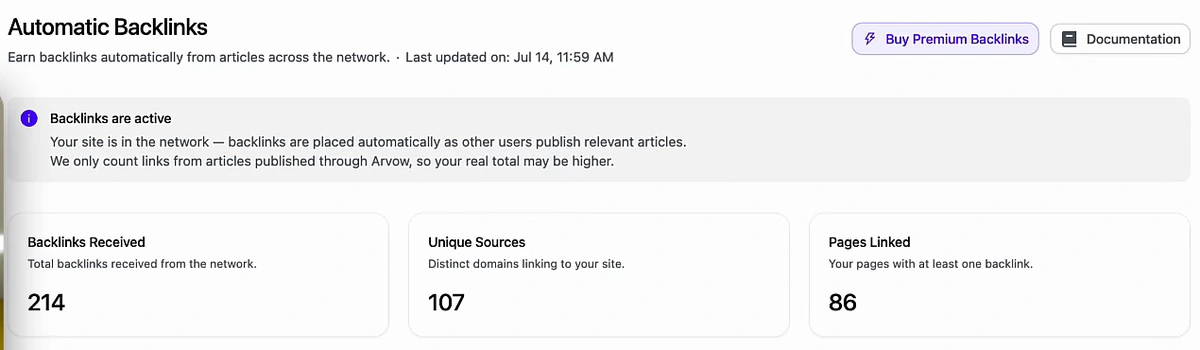
214 backlinks, 107 unique referring domains, 86 pages linked. You choose whether the network optimises for relevance or volume, and how many links per day. Most of them are ordinary. One of them was not:
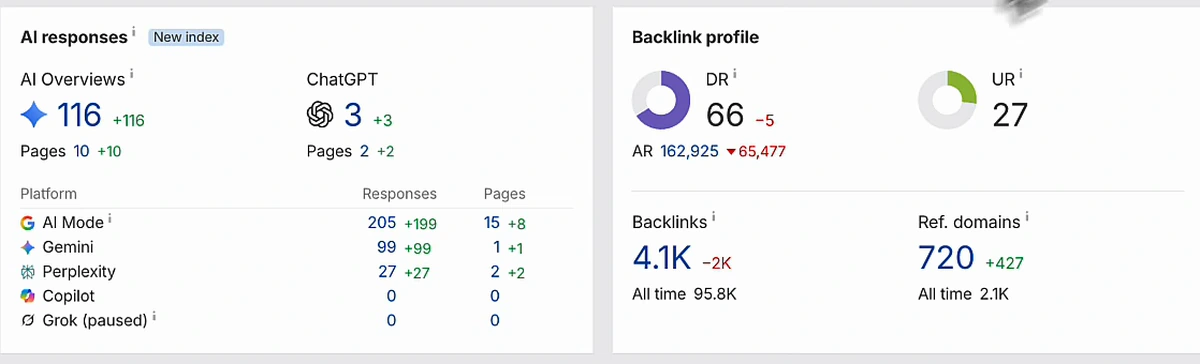
A DR 66 link, at $0 incremental cost because it is bundled into the plan. Worth reading that panel honestly, though: DR 66 with 67 organic keywords and 4.1K live backlinks is a high-authority domain with a very small organic footprint. It passes authority. It will not pass you referral traffic. That is a different product from a 351K-visits-a-month publisher, and pretending otherwise is how people end up disappointed with automated links.
The comparison in full is in automated agents vs. doing it manually.
So is $500 worth it?
A usable decision rule, drawn from the video and the numbers above:
- Pay when you are already close. If the page is on the bottom half of page one for a keyword that converts, a strong relevant link is a plausible catalyst for moving into the top three. That is the scenario where the spend has a mechanism behind it.
- Do not pay for the wrong niche. A DR 81 automotive site does nothing for a B2B SaaS. Relevance is the filter you apply before you ever look at the DR.
- Do not pay for a badge alone. Check the trend and the organic footprint, not just the number. The Drive's traffic is down 95.9K; the DR 66 site has 67 keywords. Both facts change what the link is worth.
- Check which way the money flows. If the page is a contributor rate card, pitch it — do not try to buy it.
- Run the cheap layer underneath. Automated and exchange links to lift a low DR off the floor, manual outreach reserved for the handful of placements worth real money.
And the honest caveat, stated plainly in the video: no single link makes you rank first. Link building is a large part of SEO, not all of it. The chain runs backlinks → authority → easier rankings → traffic → conversions, and it is a loose, indirect chain with a conversion problem waiting at the end of it. Plenty of sites have traffic and still make no money.
For the wider benchmark data on what links cost across the industry, we keep a running set in link building statistics 2026.
Want the cheap layer running on autopilot while you save outreach for the links worth paying for? Turn on automatic backlinks in Arvow and let the network build to your site while you pitch the big ones yourself.
Generate, publish, syndicate and update articles automatically
The AI SEO Writer that Auto-Publishes to your Blog
- Cancel anytime
- Articles in 30 secs
- Plagiarism Free