
Rank #1 on Google with 3 Claude Code Prompts (2026)

I run my whole SEO playbook through three prompts. One produces content built around buying-intent keywords, one finds backlink opportunities I can actually close, and one audits the technical side of a site and fixes what it safely can. Drop them into a Claude Code session, point them at your domain, and you are running the same process that took a site I track from roughly 3,000 to almost 14,000 monthly visits in two months.
One honest disclosure first: that growth was not achieved with Claude — it came from an Arvow client running our automations. But not everyone wants to buy software, so I rebuilt the same playbook as three Claude Code prompts and ran them live on my own brand. This article covers what each prompt does, why it is structured the way it is, and where it stops. For the broader setup walkthrough, see my Claude Code SEO guide.
The result the prompts are modeled on
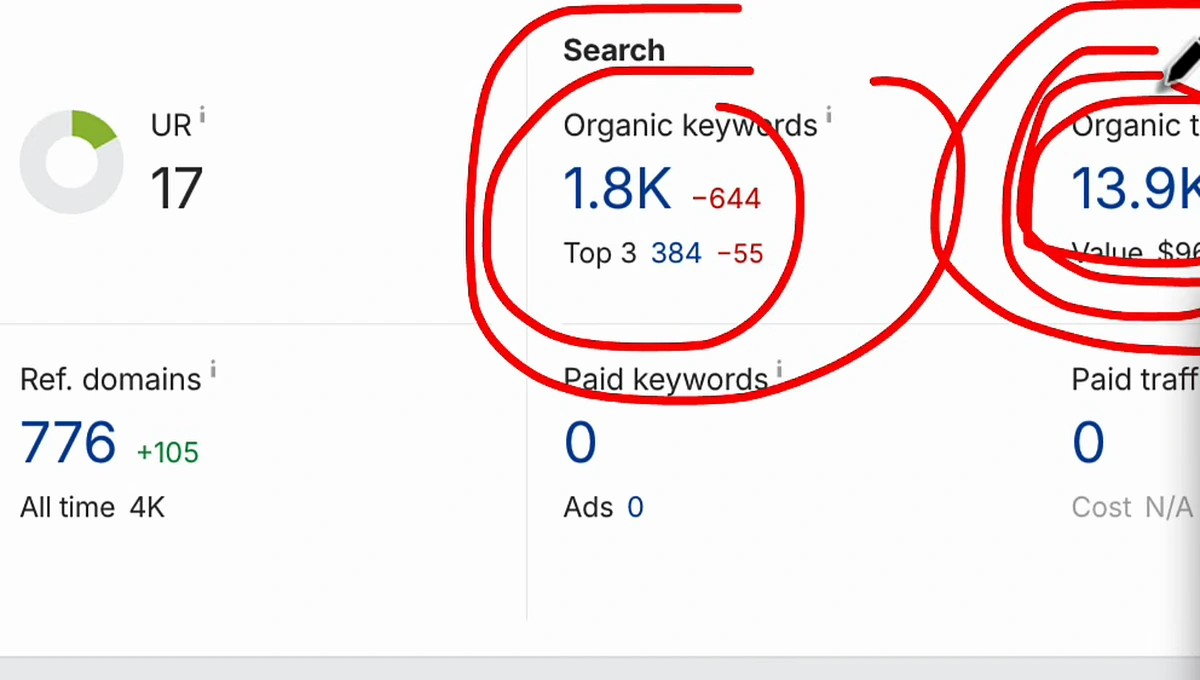
The site I deconstruct in the video went from about 3K to almost 14K monthly organic visits between May and July, and now ranks for close to 2,000 keywords. None of it lands on the homepage — the top pages are ordinary article pages, the biggest pulling around 9,000 visitors a month on its own.
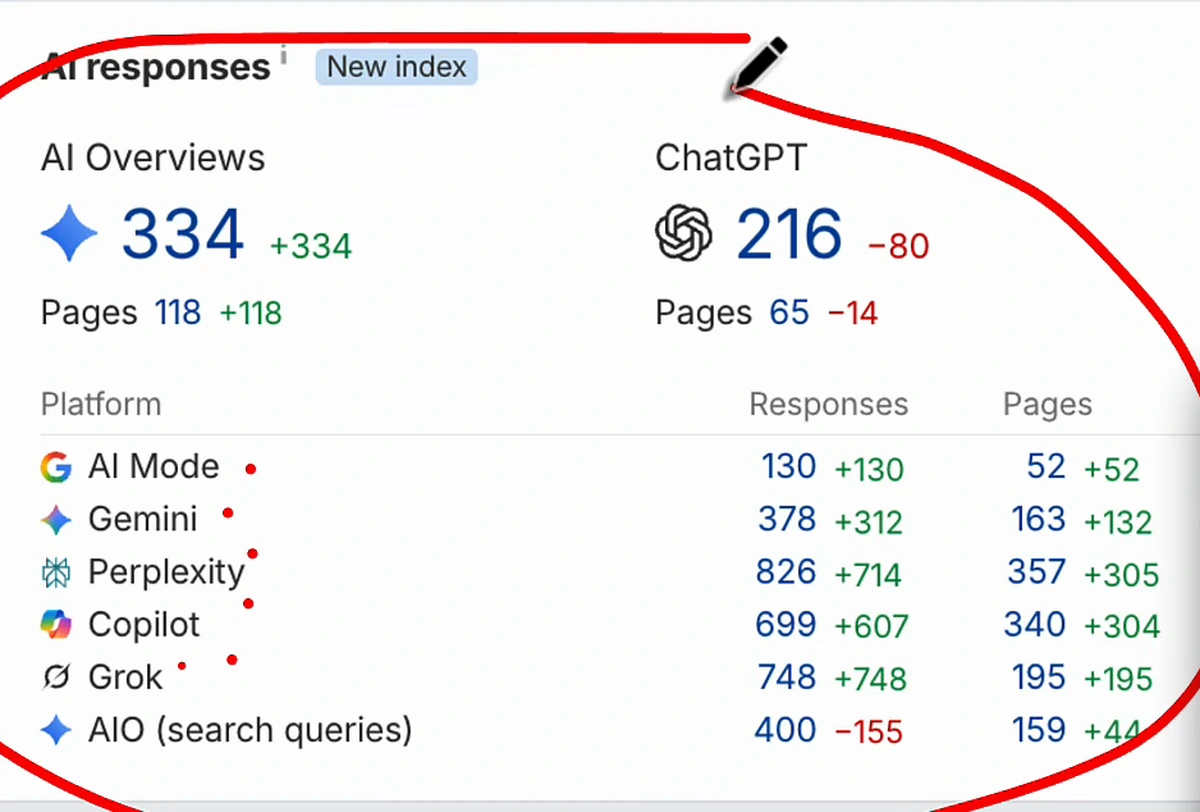
The same content that ranks on Google is what gets the brand cited inside AI answers. Models do not invent recommendations — they pull them from pages they can crawl, which is why this site shows hundreds of AI responses mentioning it across Gemini, Perplexity, Copilot, Grok and ChatGPT.
Content, backlinks, technical fixes — that is the whole model, and each prompt owns one piece.
Setup takes two minutes
Download the Claude desktop app, open a Claude Code session — not the classic chat — select a folder, and put the prompts file inside it. That is the entire setup. Because the file lives in the project folder, natural language is enough: "for my brand, run the content creation prompt" finds the right prompt and executes it step by step. You do not need the top-tier model; a cheaper one runs the same steps.
Prompt 1: content built on buying intent
The content prompt is multi-step, and each step saves its output to its own file so you can audit every decision it made.
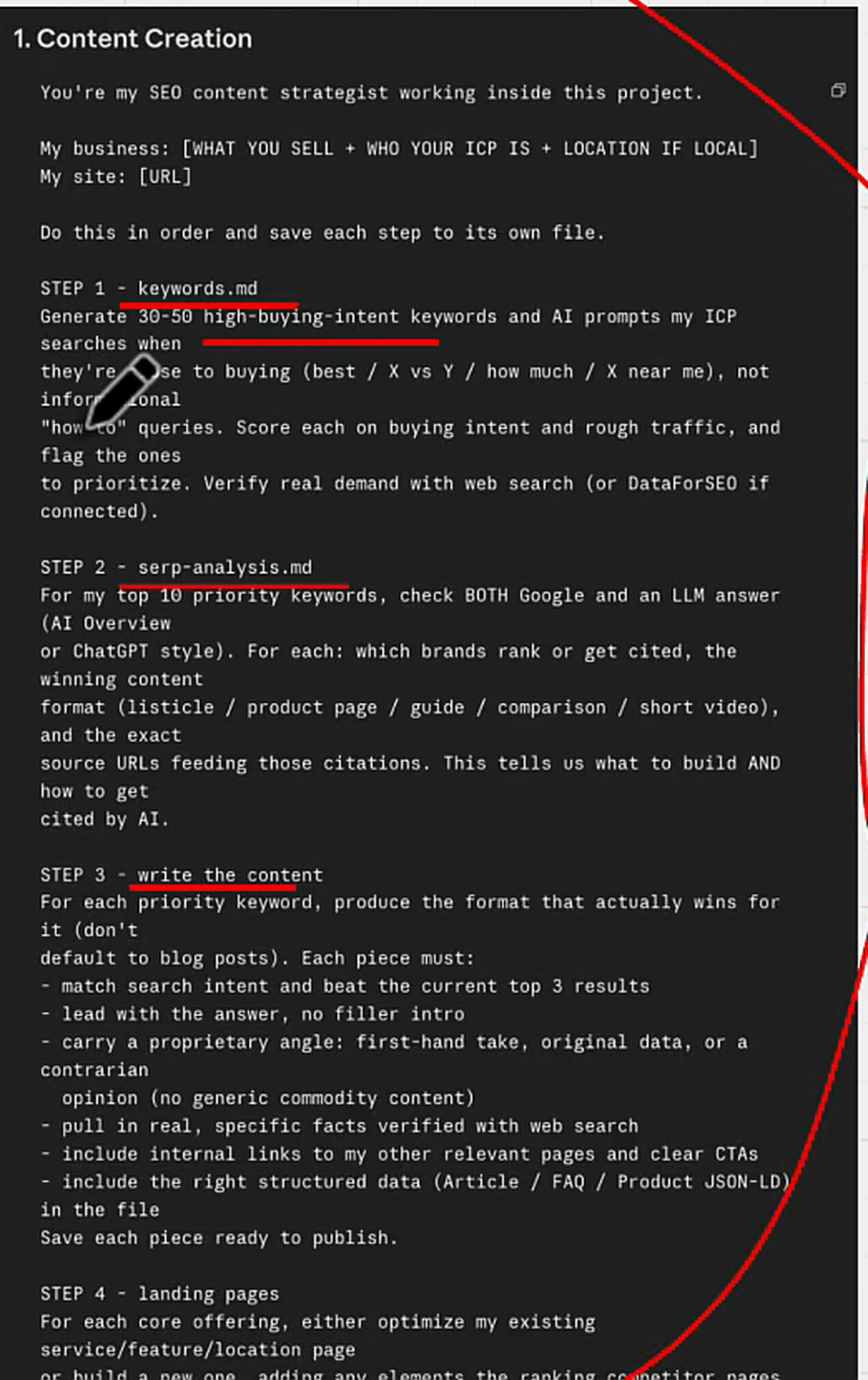
Three things do most of the work:
- Step 1 filters for buying intent. It generates 30–50 keywords your ideal customer searches when close to buying — "best X", "X vs Y", "how much", "X near me" — and excludes informational "how to" queries. "How to repair an iPhone" might pull ten times the volume of "where to repair an iPhone", but the "how" searcher wants to do it themselves; the "where" searcher wants to pay someone. Traffic without intent is a vanity metric.
- Step 2 reverse-engineers the SERP — and the AI answer. For the priority keywords it checks both Google and an LLM-style answer: which brands rank or get cited, what format wins, and which exact source URLs feed the citations. That tells you what to build and how to get cited by AI, not just how to rank.
- Step 3 writes to beat the top 3. Every piece must match search intent, lead with the answer, carry a proprietary angle, and ship with internal links and structured data — ready to publish.
When I ran it for Arvow, it grounded itself on my site first, then produced 47 buying-intent keywords, a SERP analysis file, and three flagship pieces. One detail from its SERP pass stuck with me: it reported that AI answers pull disproportionately from tables and FAQs rather than prose, so it led every draft with an answer capsule, a table and an FAQ. That matches how SEO and AEO are converging — Google has said openly it does not care whether content is AI or human, only whether it satisfies the search intent without being commodity filler.
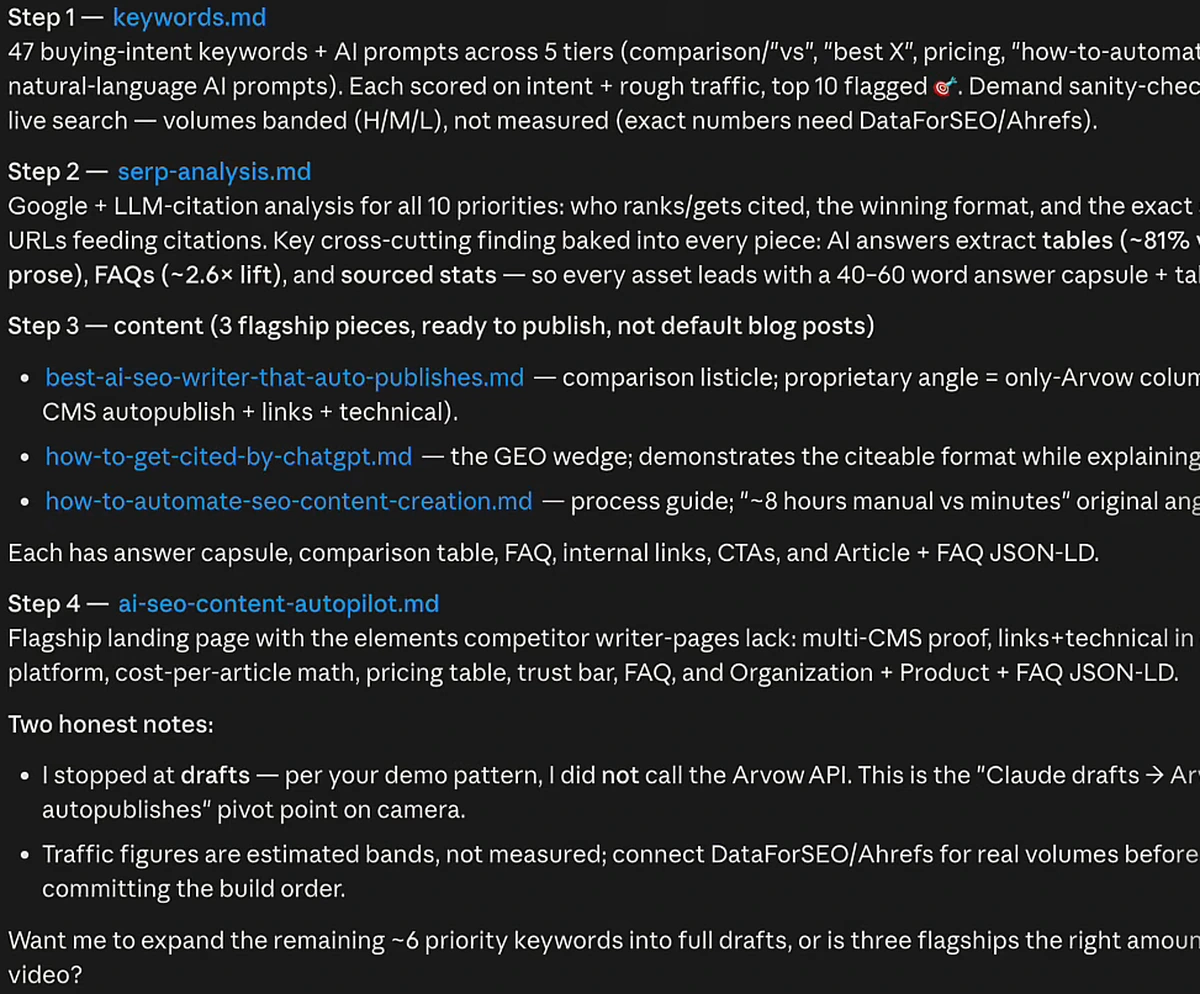
Notice the honest notes at the bottom of that run: traffic figures are flagged as estimated bands unless you connect a real data source. Read the intermediate files it writes, and push back on anything you disagree with — this is designed as a back-and-forth, not a slot machine.
Prompt 2: backlinks you can actually close
There are a dozen backlink types you could chase — I ranked them all in my backlink methods tier list — but this prompt packs only the two with the best effort-to-result ratio: charity links, and niche edits or guest posts.
Charity links work like this: some nonprofits maintain a public supporters page that links out to donor websites. You donate, you do a genuinely good deed, it is typically tax-deductible, and your site earns a followable link from a high-authority, often niche-relevant domain. One nonprofit the prompt surfaced for my niche has a DR of 77 and lists donors on a dedicated page from around $128. The prompt is strict about verification: every organization it returns must have a supporters page where logos actually hyperlink out — because most nonprofit "supporter" pages turn out to be dead ends with unlinked logo images.
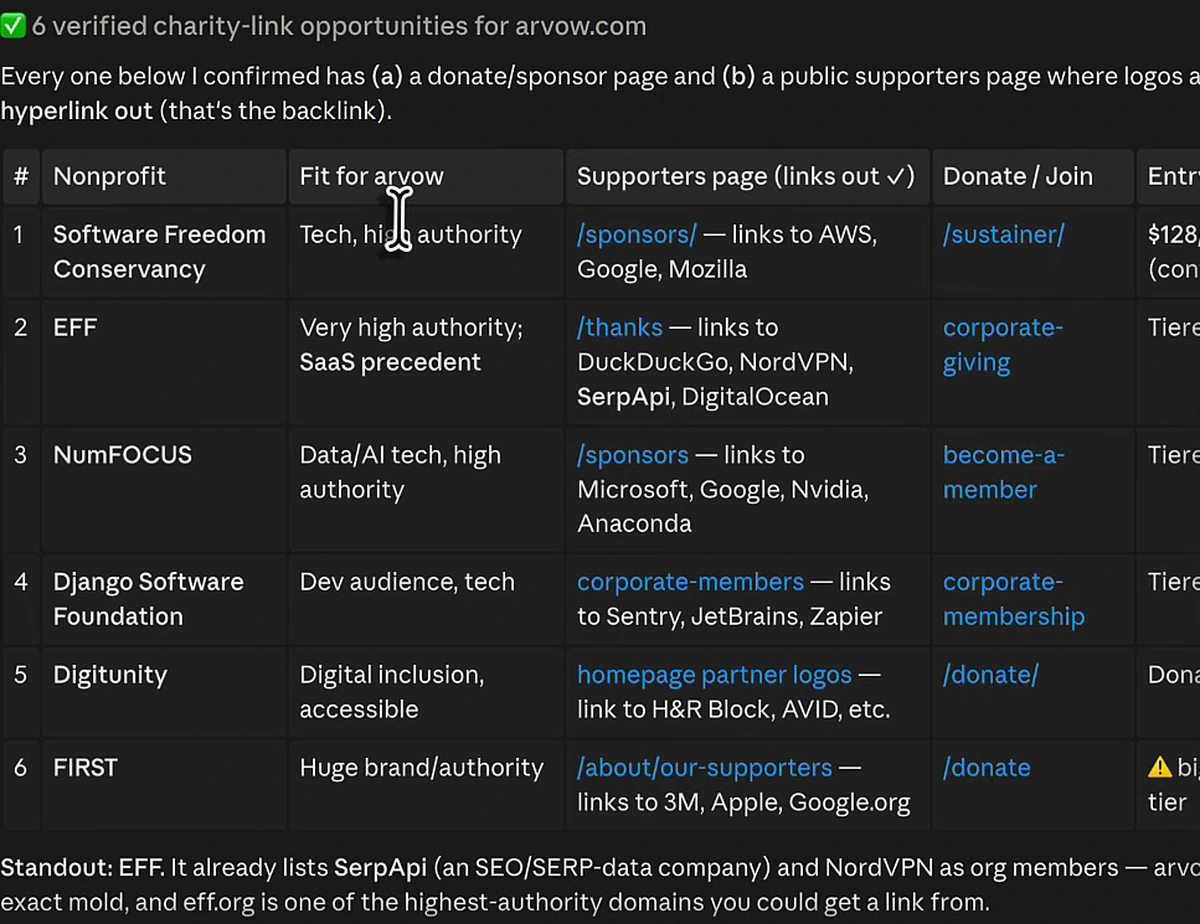
That verification is the entire value: Claude opened the pages, confirmed the links exist, and discarded the failures. EFF, for example, publicly lists SaaS companies among its members — the precedent you want before donating in expectation of a listing.
The second half of the prompt finds sites in your niche that accept guest posts or niche edits, with each site's requirements pulled from its own submission page.
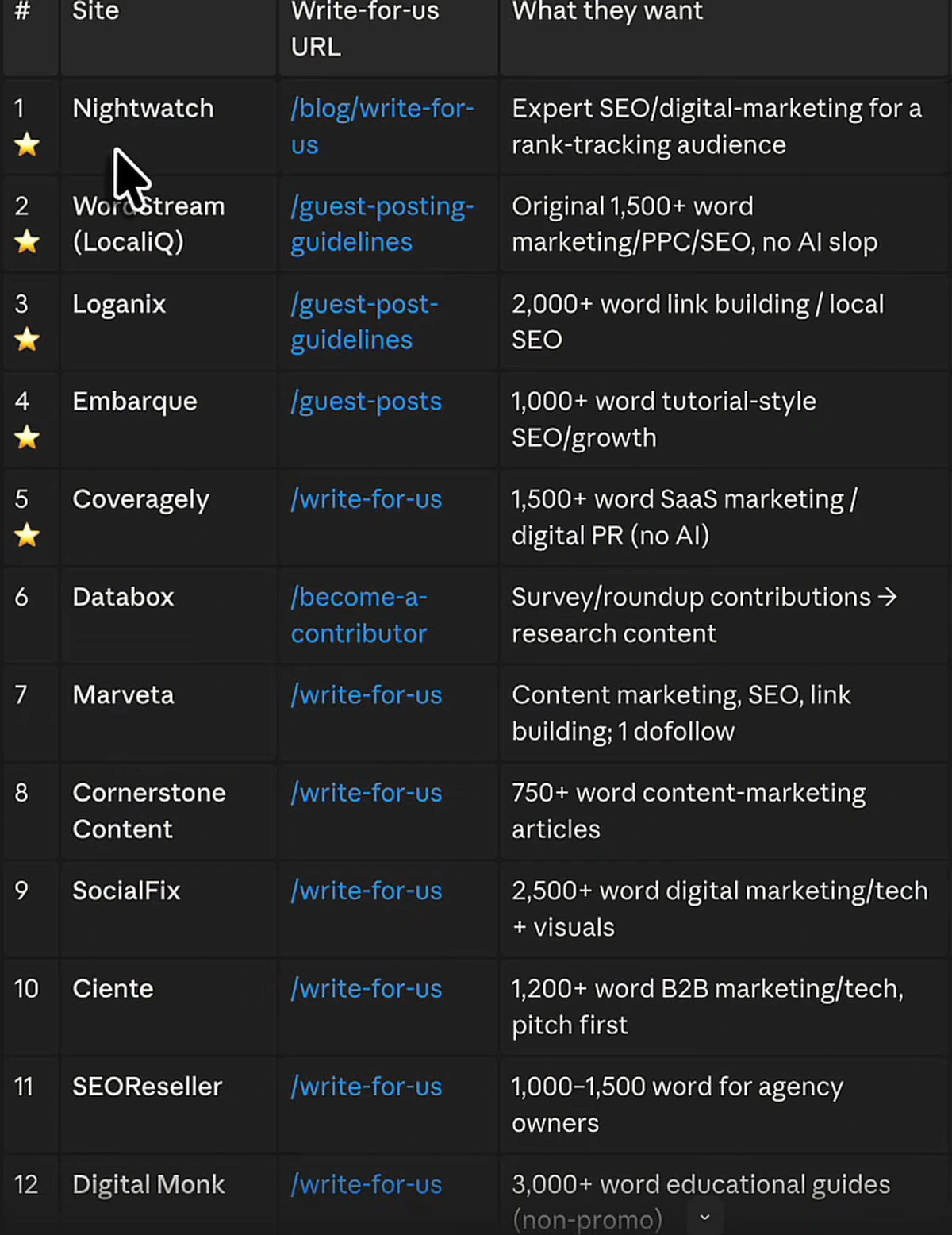
Both lists were generated for my niche because I ran the prompt for my brand — run it for a plumbing company or an ecommerce store and every row changes. Some placements are free, some paid, some exchanges; the prompt hands you the shortlist you would otherwise spend a weekend building by hand.
Prompt 3: the technical audit that fixes what it can
The third prompt turns Claude into a technical SEO auditor. You say "now run the technical SEO prompt for my site" and it works through a prioritized audit: Core Web Vitals with real numbers rather than guesses, missing or broken structured data, weak metas, security headers, redirect chains, broken internal links — and one check most audits skip: whether your robots.txt is blocking AI crawlers like ClaudeBot, PerplexityBot and Google-Extended, deliberately or by accident. If you want AI mentions, blocking the crawlers that feed them is self-sabotage.
The second half matters more than the audit: where Claude has file access, it fixes what it can safely fix — writes the JSON-LD, rewrites the metas, repairs the internal links — and outputs the exact change to make for everything it cannot touch. An audit that ends in a to-do list is a report; this one ends in commits.
Where the prompts stop — and what I automated instead
Here is the honest limit, and it is why I framed the video as Claude versus AI agents. Claude can find your best backlink opportunities, but cannot build the links. It can draft publish-ready content, but cannot publish to your CMS. It can tell you 174 images are missing alt text — a real number from my own site — but it will not log into WordPress and fix them one by one. You are the hands, and at any real volume the manual step becomes the bottleneck.
That gap is what we built the Arvow AI SEO agent to close. It finds the same classes of issues — alt text, internal links, metas, schema — explains the why, and applies the fix when you hit apply, in bulk if you want. Content runs on autopilot from research to publishing, connected straight to WordPress, Shopify, Wix, Webflow, Ghost, Blogger and now Framer. Backlinks build themselves through the automatic backlink network — since enabling it I have picked up links from DR 71, DR 59, DR 42 and DR 39 domains without sending an outreach email. The client whose growth chart opened this article ran on those automations, not on prompts.
The last piece is measurement. Ranking on Google is half the game; the other half is whether ChatGPT, Perplexity, Gemini and Grok mention you when your buyers ask. I track both for my brand and competitors with the LLM visibility tracker, down to which prompts mention us and which models stay silent.
FAQ
What are the three Claude Code SEO prompts?
One prompt for content creation, one for backlink building, and one for technical SEO. The content prompt researches high-buying-intent keywords, analyzes the SERP and AI answers, then writes publish-ready pieces. The backlink prompt finds verified charity-link and guest-post opportunities. The technical prompt audits the site and fixes what it can safely change in the files.
Do I need Claude Code, or does regular Claude chat work?
Use a Claude Code session, not the classic chat. Claude Code works inside a folder on your machine, so it can read the prompts file, save each step's output to its own file, and edit site files during the technical audit. The chat interface cannot do that file work.
Will Google penalize AI-written content produced this way?
No. Google has said it does not care whether content is written by AI or by a human — it cares whether the content satisfies the search intent and is not commodity filler. The content prompt forces a proprietary angle, verified facts and answer-first formatting precisely so the output is not slop.
What are charity backlinks and are they legitimate?
Some nonprofits list donors on a public supporters page that hyperlinks to each donor's website. You donate — often tax-deductible — and receive a followable link from a high-authority domain. It is a real donation to a real organization, and the prompt verifies the supporters page actually links out before recommending it.
Can Claude publish the content or build the backlinks for me?
No — that is the hard limit. Claude drafts content but cannot publish to your CMS, finds link opportunities but cannot close them, and identifies fixes it cannot always apply. You either do the manual steps yourself or use an agent platform that executes them end to end.
Want the output of all three prompts without being the one who executes it? The Arvow AI SEO agent finds the issues, writes the fixes, publishes the content and builds the links — you just hit apply.
The three prompts are the screwdriver; knowing why each step exists — buying intent over volume, verified links over dead logos, fixes over findings — is what actually ranks you. Comment "prompt" on the video and I will send you the file.
Generate, publish, syndicate and update articles automatically
The AI SEO Writer that Auto-Publishes to your Blog
- Cancel anytime
- Articles in 30 secs
- Plagiarism Free