AI Slop SEO: How One AI Site Went From 6,800 Visits to 146 (2026)

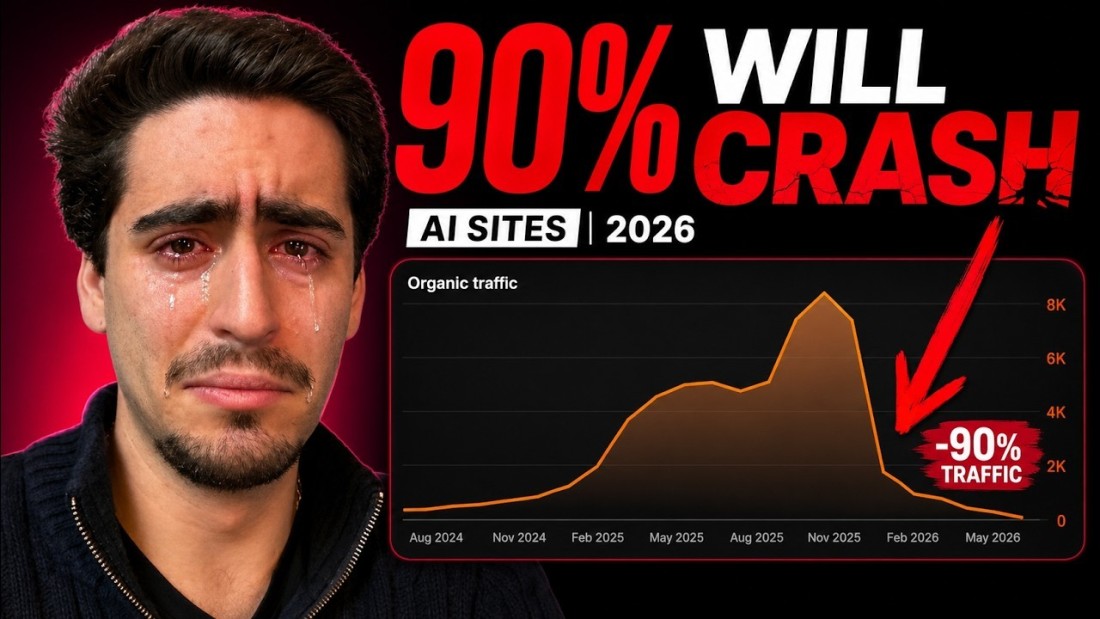
AI slop is content generated in bulk with no research, no checking and nothing new to say. In SEO it tends to follow one pattern: fast growth, then a collapse. In a May 2026 video, Afonso Carvalho of Arvow showed his own test site doing exactly that. It grew from almost nothing to about 6,800 monthly visits on unedited ChatGPT articles, then fell to 146. This article walks through his numbers, checks the timeline against Google's update history, and lists what separates AI content that lasts from AI slop.
What is AI slop in SEO?
AI slop is a page that exists only to fill a keyword. Nobody researched it, nobody read it before publishing, and it says nothing a reader could not get from the same prompt.
Google does not use the word. Its spam policies call the practice scaled content abuse: "many pages are generated for the primary purpose of manipulating search rankings and not helping users." The first example on Google's list is "using generative AI tools or other similar tools to generate many pages without adding value for users." The policy applies "no matter how it's created", so the problem is the missing value. The tool is not the issue.
The case study: one site, up and then down
Afonso started the site in early 2025 as an experiment. It was a finance site in German, a language he does not speak. The workflow was as simple as it gets:
- Collect a list of keywords.
- Have ChatGPT write an article for each one.
- Paste the output into WordPress and publish, without reading it.
- Later, automate the same steps so articles went out every day.
It worked for most of a year. Ahrefs estimated 1,092 monthly organic visits in March 2025 and 6,796 at the peak in November 2025.
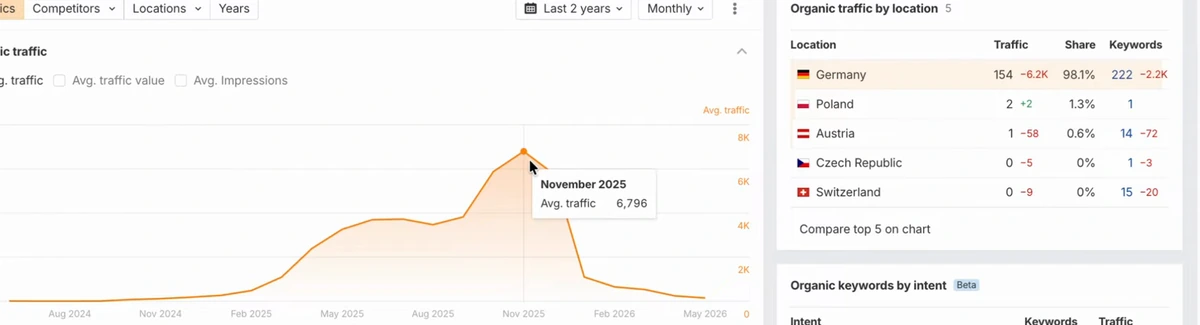
Then the line fell. By May 2026, when the video was recorded, the estimate was 146.
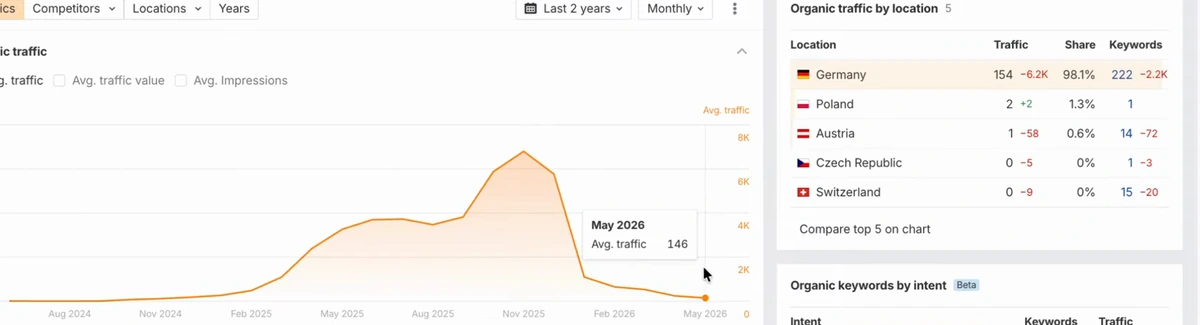
The summary row shows what went with the traffic.

| Metric (Ahrefs, May 2026) | Value | Six-month change |
|---|---|---|
| Organic traffic | 156 | -6.4K |
| Organic keywords | 252 | -2.4K |
| AI Overview citations | 0 | -169 |
| ChatGPT citations | 9 | -78 |
| Domain Rating | 27 | +1 |
| Referring domains | 401 | +115 |
Two things stand out. The AI citations disappeared along with the rankings, so being dropped from Google also removed the site from AI answers. And the backlink numbers went up while traffic went to zero. Links did not protect it.
Which Google update hit it?
In the video, Afonso says Google released an anti-spam update in November 2025. Google's Search Status Dashboard does not list one. These are the confirmed updates around that time:
| Update | Dates |
|---|---|
| August 2025 spam update | 26 August to about 22 September 2025 |
| December 2025 core update | 11 to 29 December 2025 |
| March 2026 spam update | 24 to 25 March 2026 |
Nothing is listed between late September and 11 December 2025. The monthly chart still shows more than 6,000 visits in December and a little over 1,000 in January. A fall between those two months lines up best with the December 2025 core update. Two other explanations are possible. Google says its spam systems run all the time, not only during named updates. A manual action would also do it, and that would show in Search Console's Manual actions report. The video does not show Search Console, so the exact cause is not confirmed.
The practical point does not change. You do not need a "spam update" to lose a site like this. A core update can do it too. If your own traffic fell, our guide to a Google traffic drop covers how to work out what hit you.
Why the site crashed
Afonso's whiteboard lists what the articles were missing.
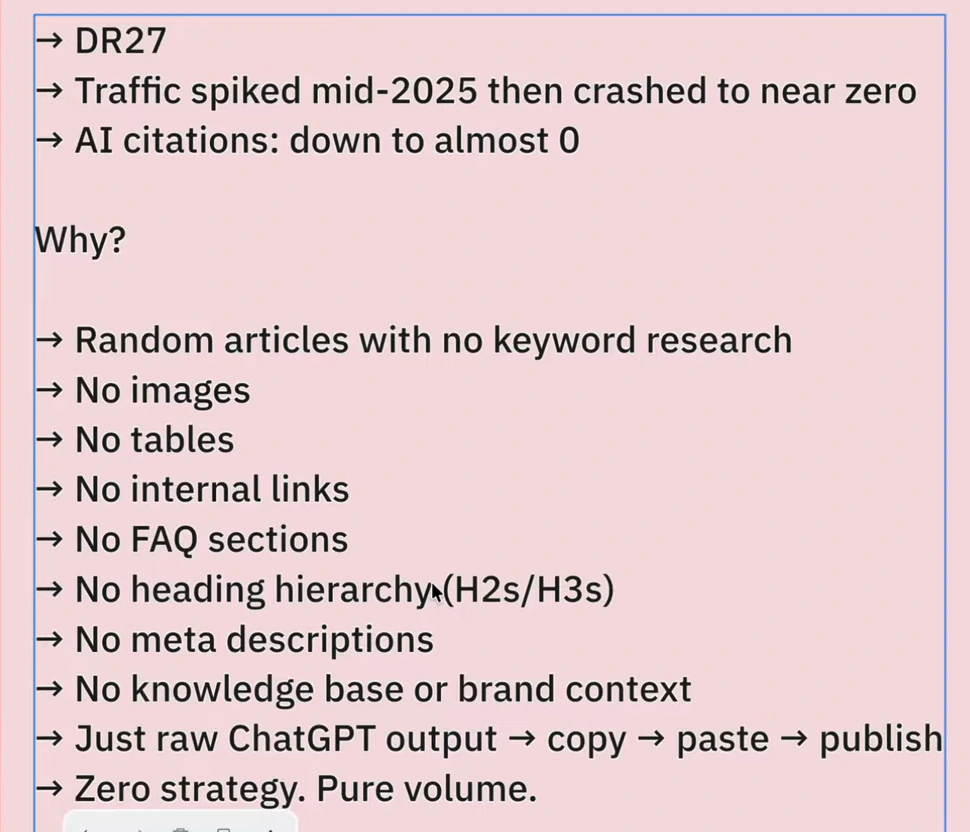
The formatting gaps are real. But three things he mentions in passing matter more than any of them:
- Nobody read the articles. He did not speak the language, so errors could not be caught.
- The topic was finance. Google holds money and health topics to a higher standard for accuracy and trust.
- There was no clear author and no original information. Every page repeated what the model already knew.
That combination is close to a textbook match for Google's scaled content abuse definition. Google's own guidance on generative AI says the tools are useful "when researching a topic, and to add structure to original content", and warns that generating many pages "without adding value for users" may violate the spam policy. You can read the full wording in Google's spam policies.
So Google is not penalizing AI content as such. It is removing pages that add nothing. We look at the evidence for that in does AI content rank on Google.
The comparison: an AI-assisted site that kept growing
The second site in the video is arvow.com, whose blog is also written with AI.
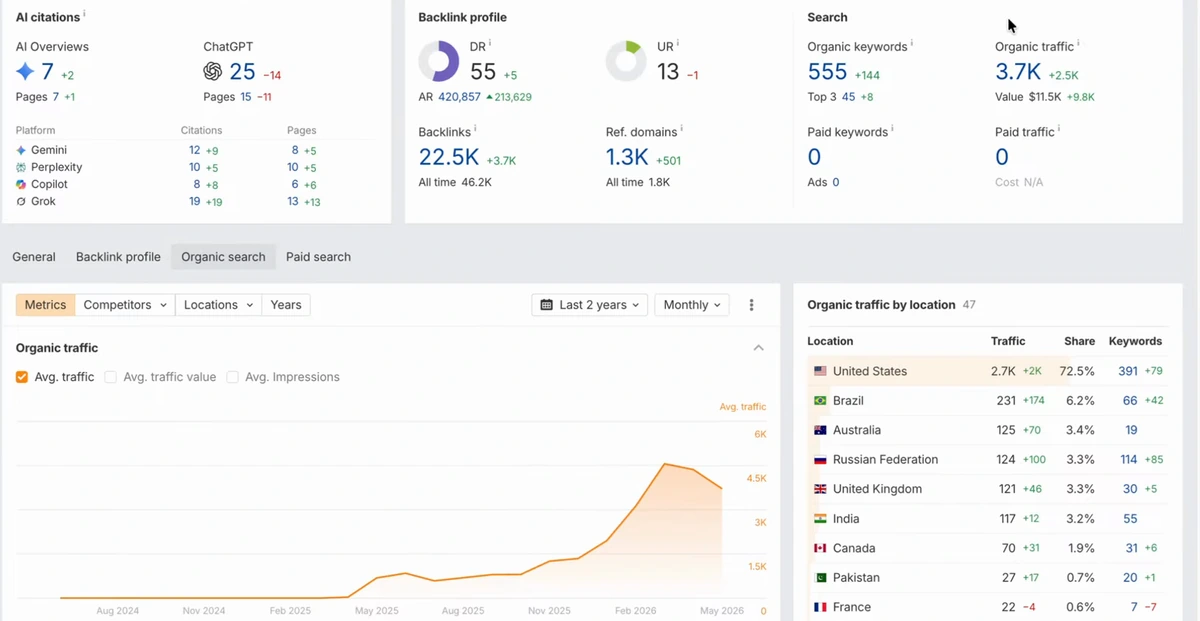
| Ahrefs, May 2026 | Crashed site | arvow.com |
|---|---|---|
| Organic traffic | 156 | 3.7K |
| Traffic value | $61 | $11.5K |
| Organic keywords | 252 | 555 |
| Domain Rating | 27 | 55 |
| Referring domains | 401 | 1.3K |
| AI Overview citations | 0 | 7 |
| Main market | Germany (98.1%) | United States (72.5%) |
Traffic value is Ahrefs' estimate of what the same clicks would cost in Google Ads. The comparison makes a useful point: 3.7K visits on commercial keywords are worth far more than 6.8K visits on random ones. The first site's traffic was valued at $61 a month even before it vanished from view.
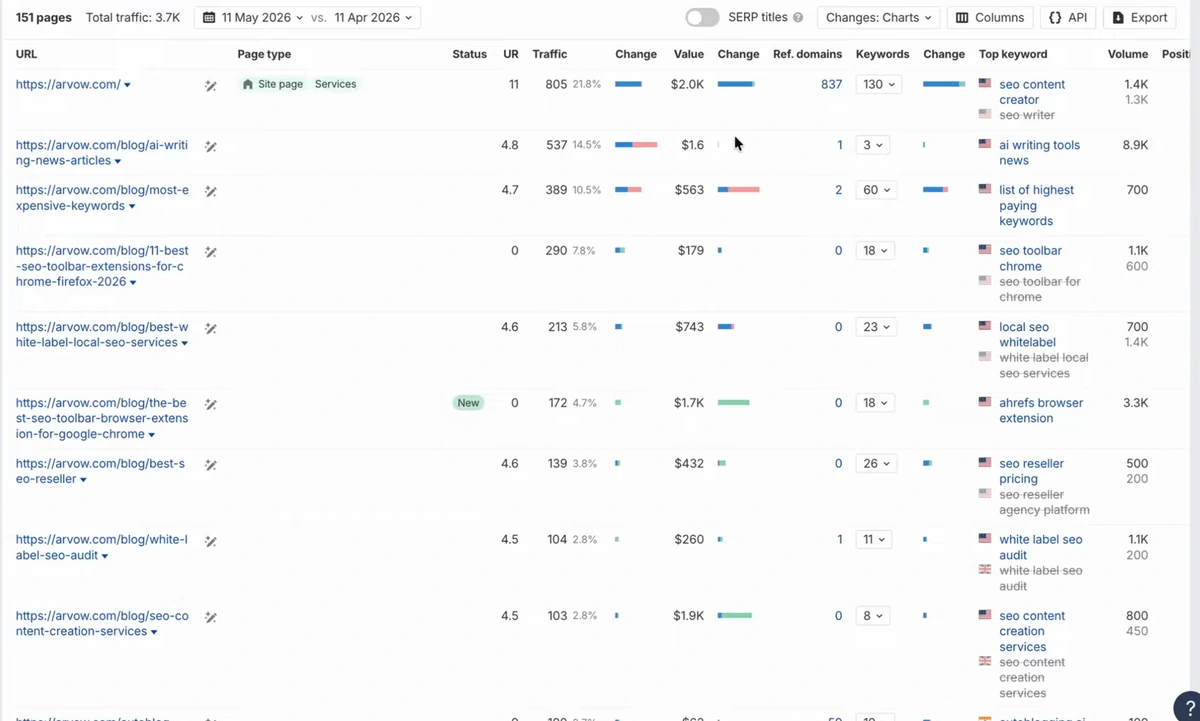
The top pages report shows where the traffic goes. After the homepage, the leading pages are blog posts.
Three caveats
This is two sites, not a controlled test. Keep these in mind:
- Authority differs. DR 55 with 1.3K referring domains against DR 27 with 401. A stronger domain gets more benefit of the doubt.
- The sites are different kinds of business. One is a real company writing about its own field. The other was an anonymous finance blog.
- Not every number rose. The same screen shows arvow.com's ChatGPT citations at 25, down 14, and the final month on the chart dips.
The contrast is still clear. It just should not be read as "formatting saved one site".
What separates AI content from AI slop
The whiteboard's second list shows how the surviving site's articles are built.
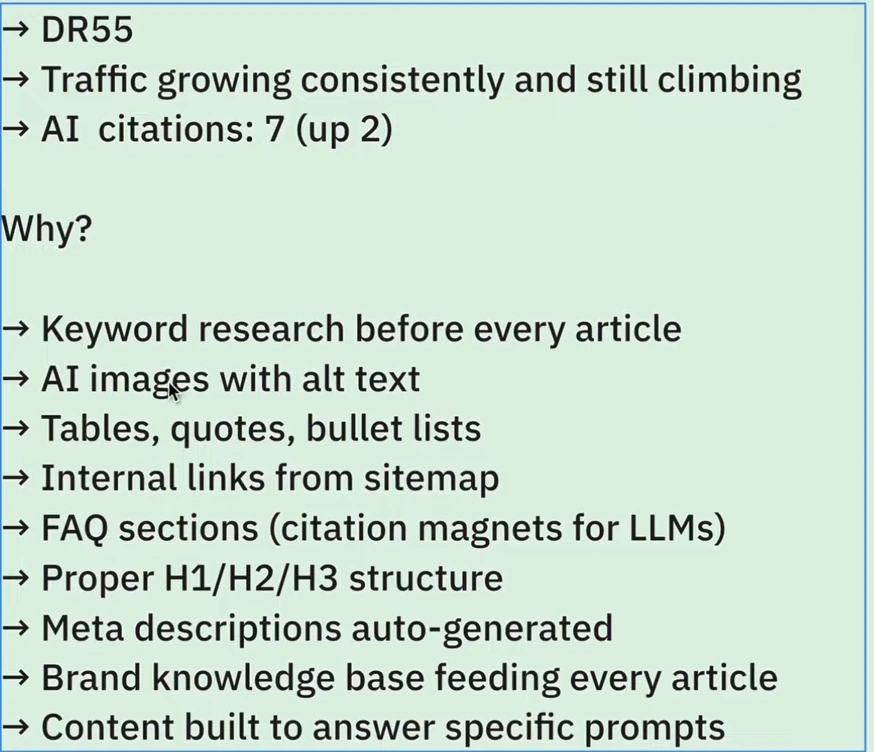
It helps to split that list in two, because the halves do different jobs.
| Substance (what makes a page worth indexing) | Structure (what makes it easy to read and cite) |
|---|---|
| Keyword research before every article | Clear H1, H2 and H3 headings |
| A knowledge base with your own facts feeding each article | Tables, quotes and bullet lists |
| Content written to answer a specific question | Images with alt text |
| A human who reads it before it goes live | Internal links, FAQ section, meta description |
Structure helps readers and AI assistants. It does not rescue a page with nothing in it. A generic article with an FAQ and three images is still generic. Google's term for that is commodity content. The left column is what keeps a site out of trouble.
How to set this up in Arvow
The last part of the video shows the article template settings that produce the second kind of article. The setting that matters most is the knowledge source.
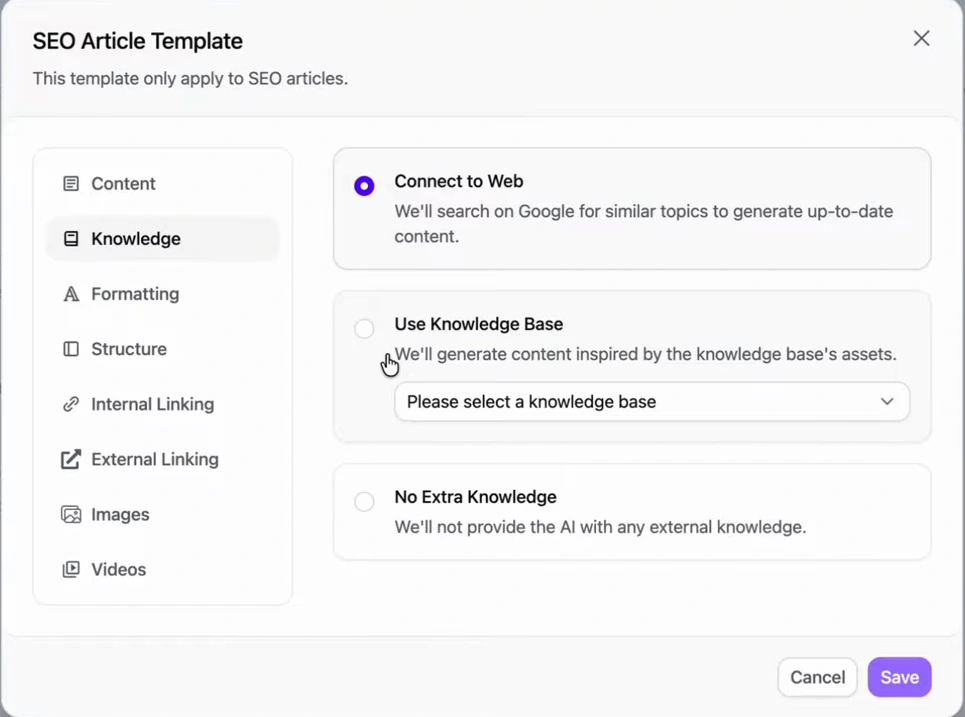
- Knowledge. Choose "Use Knowledge Base" and pick one you built from your site, PDFs, documents and notes. This is where original information comes from.
- Content. Set language, target country, tone of voice and any custom instructions.
- Internal linking. Add your sitemap so each article links to related pages.
- Images and videos. Add AI images with alt text, or upload your own. Relevant YouTube videos can be embedded automatically.
- Integrations. Connect WordPress, Shopify, Webflow, Wix and others to publish directly.
The demo article in the video shows the structure this produces, including an FAQ block.
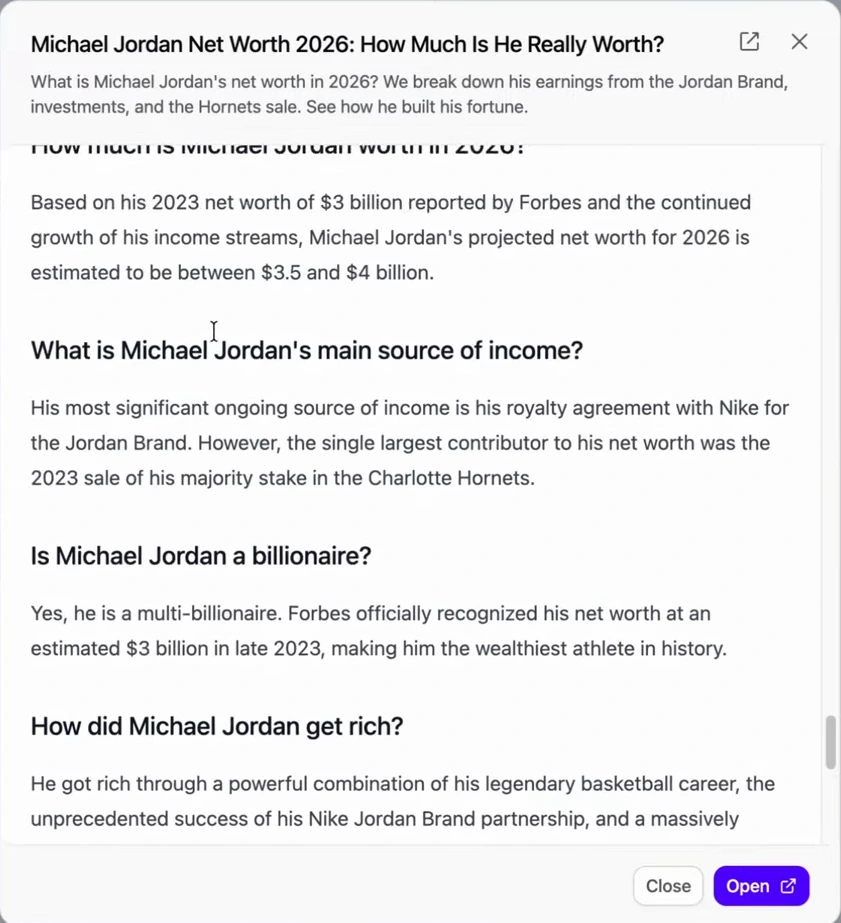
One caution here. The template handles structure for you. Substance is still your job. A celebrity net worth article built from web search alone is the kind of page many other sites already have. Load a knowledge base, pick topics you know, and read each draft before publishing.
A quick check for your own site
If you publish AI content at volume, ask these questions:
- Did a person read each article before it went live?
- Does each article contain a fact, example or number that came from you?
- Was each topic chosen from keyword research, or generated from a list?
- Is there a named author or business behind the site?
- Could you delete half the pages without any reader noticing?
If the last answer is yes, start there. Our guide to content pruning explains how to remove weak pages safely. For more examples of sites that were hit, see the four cases in our write-up of Google's August 2026 spam update.
Want AI articles built on your own knowledge base, with links, images and structure handled? Try Arvow.
FAQ
What is AI slop?
AI slop is low-effort content generated in bulk with no research, review or original information. In SEO it usually means hundreds of unedited AI articles published to target keywords.
Does Google penalize AI content?
Not for being AI-written. Google's spam policy targets pages made at scale to manipulate rankings without helping users, "no matter how it's created".
Can a site recover after being hit for AI slop?
Sometimes. Google says its systems may recognize improvement over a period of months. That means removing or rewriting the weak pages first, then waiting.
How do I know if I have a manual action?
Open the Manual actions report in Google Search Console. Manual actions are listed there. A drop caused by an algorithm update shows nothing in that report.
Is formatting enough to make AI content safe?
No. Headings, FAQs and images help readers and AI assistants, but the page still needs information that is accurate and not available everywhere else.
Generate, publish, syndicate and update articles automatically
The AI SEO Writer that Auto-Publishes to your Blog
- Cancel anytime
- Articles in 30 secs
- Plagiarism Free