
Does AI Content Rank on Google? What 26 Case Studies and the Data Say (2026)

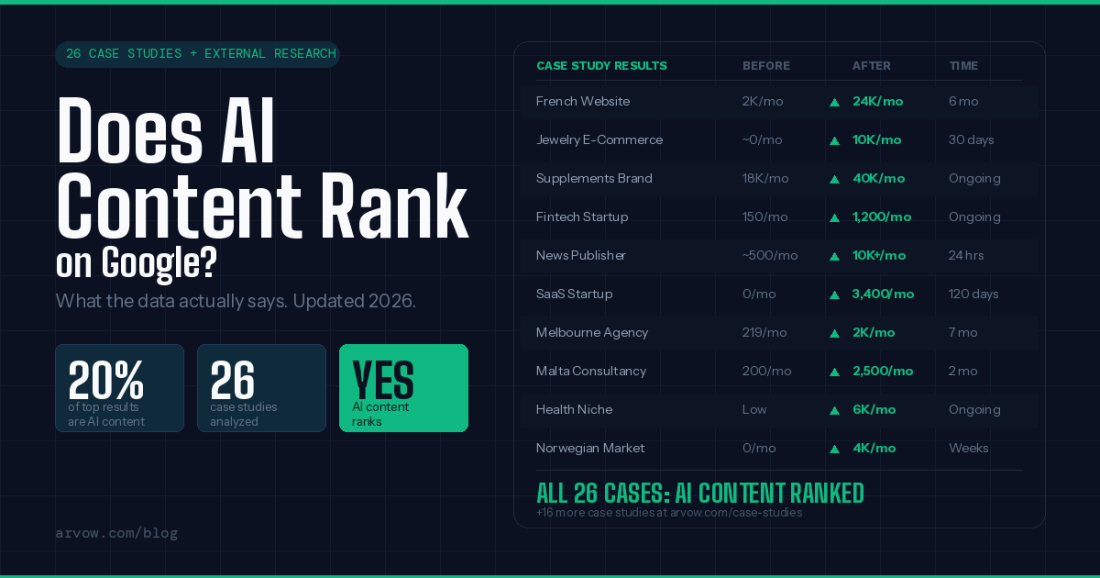
Table of Contents
There is no shortage of opinions on whether AI-generated content can rank on Google. But opinions are not data. We went straight to the source — our own database of 26 published case studies from Arvow users across SaaS, ecommerce, agencies, fintech, health, and local businesses — and combined that with external research from Ahrefs, Semrush, Originality.ai, and Google's own documentation.
The short answer: yes, AI content ranks. But the nuance matters.
Sites Using AI Content | Avg. Traffic Growth | Top Result | |
|---|---|---|---|
Arvow Case Studies | 26 documented | 0 to 3,000+/mo avg | 0 to 26,000/mo |
1. Google's Official Position
Let's start with what Google has actually said, because there is a lot of misinformation:
"We focus on the quality of content rather than how it was produced." — Google Search Central, February 2023 (reaffirmed in 2025)
Google has been clear: using AI to create content is not against their guidelines, as long as the content is not designed to manipulate search rankings. Their spam policies target "scaled content abuse" — mass-produced low-quality content — regardless of whether it was written by a human or an AI.
That said, Google's 2025 Search Quality Rater Guidelines added an important clarification: if a page's content is almost entirely AI-generated with little to no originality added, raters should apply the lowest quality rating. (Originality.ai)
The takeaway: AI-generated content is permitted. Lazy, unedited, mass-produced AI slop is not.
2. How Much AI Content Is Already Ranking?
If AI content could not rank, you would expect to see very little of it in search results. The opposite is true:
19.56% of Google's top search results now contain AI-generated content — an all-time high as of July 2025, up from under 5% in early 2023. (Originality.ai ongoing study)
That means roughly 1 in 5 top-ranking pages has AI-generated content. And the trend is rising, not falling.
More data points:
AI content in search results has risen from ~5% (early 2023) to nearly 20% (mid-2025), despite multiple algorithm updates. (Originality.ai)
Google's March 2024 core update briefly dropped AI content levels to 7.43%, but they rebounded to all-time highs within months. (Originality.ai)
AI Overviews are more likely to cite AI-generated content than human-written content. (Ahrefs, July 2025)
76.1% of URLs cited in AI Overviews also rank in the top 10 organic results. (Position Digital)
Google does not penalize AI content by default. It penalizes bad content. The March 2024 update hit low-quality AI farms hard — but well-optimized AI content not only survived, it has grown to represent nearly 20% of top results.
3. What Our 26 Case Studies Show
This is where it gets concrete. Here is what happened when real businesses used Arvow's AI content tools to publish SEO-optimized articles at scale:
Headline Results
Case Study | Niche | Before | After | Timeframe |
|---|---|---|---|---|
General (French) | 2K/mo | 24K/mo | 6 months | |
E-Commerce | ~0/mo | 10K/mo | 30 days | |
Health | 18K/mo | 40K/mo | Ongoing | |
Fintech | 150/mo | 1,200/mo | Ongoing | |
Publishing | ~500/mo | 10K+/mo | 24 hours | |
SaaS | 0/mo | 3,400/mo | 120 days | |
Marketing | 219/mo | 2K/mo | 7 months | |
Visa Services | 200/mo | 2,500/mo | 2 months | |
Health | Low | 6K/mo | Ongoing | |
Local (Norway) | 0/mo | 4K/mo | Weeks | |
E-Commerce | Low | $150K sales | Ongoing |
Key Patterns Across All Case Studies
Three factors showed up consistently in every successful case:
1. Keyword targeting mattered more than content quality alone. The case studies with the strongest results focused on buyer-intent keywords with manageable competition — not just high-volume head terms. The SaaS case study specifically notes they focused on buyer-intent keywords with commercial value rather than high-volume informational terms.
2. Technical and on-page SEO was non-negotiable. AI-generated content published on a technically broken site does not rank. Every successful case involved proper site structure, internal linking, meta optimization, and indexing. The $10K MRR case study emphasizes that AI blog posts alone are not enough — technical SEO, on-page optimization, and link building all played a role.
3. Volume and consistency created compounding results. One blog post rarely moved the needle. The sites that saw exponential growth published consistently — often 10-30+ articles before seeing meaningful traffic increases. One user went from 137 indexed pages to 981, which correlated with a surge in clicks and impressions. (1,500 clicks/mo case study)
Across all 26 case studies, the pattern is clear: AI content that is keyword-targeted, technically optimized, and published consistently performs as well as or better than manually written content for SEO — at a fraction of the cost and time.
4. AI Content in Non-English Markets
One of the most overlooked findings from our data: AI content performs particularly well in non-English markets, where competition is lower and the content gap is wider.
A Norwegian health site grew to 4,000 monthly visitors in weeks using AI-only blog posts. (Case study)
A French website went from 2,000 to 24,000 monthly visits in 6 months. (Case study)
A video-to-blog strategy targeting French speakers generated 5,400 monthly visits with minimal effort. (Case study)
A Danish B2C SaaS reached 750 monthly organic visitors from near zero, with nearly all traffic from Denmark. (Case study)
External research supports this: translated sites gain 327% more visibility in AI Overviews compared to untranslated sites. (Weglot, October 2025)
If you operate in a non-English market — or your competitors have not invested in multilingual content — AI content creation is arguably the biggest arbitrage opportunity in SEO right now. Arvow supports content generation in 150+ languages.
5. What the External Research Says
Beyond our own data, here is what independent studies have found:
Semrush: 20,000 URL Analysis
Semrush analyzed 20,000 blog URLs to determine whether AI content could rank. Their key finding: content quality indicators — depth, structure, relevance — predicted ranking success, not whether content was AI-generated or human-written.
Google's Algorithm Behavior
Google's January 2026 core update provided a real-world stress test. Sites that lost organic rankings also lost citations in AI tools like ChatGPT and Gemini. The data showed traffic drops ranging from -5.7% to -53.1%, with AI citations declining in parallel. (Lily Ray analysis, Jan 2026)
The conclusion: Google's quality signals apply equally to AI and human content. High-quality AI content that survives algorithm updates continues to perform across both traditional search and AI search engines.
The AI Overviews Factor
AI Overviews now appear in over 50% of US searches. (DemandSage) This matters because:
Organic CTR drops by 61% when AI Overviews appear — but pages cited in AI Overviews earn 35% more organic clicks. (Seer Interactive, 2025)
Case studies and pricing pages are now the best content types for driving traffic in the AI Overviews era, while top-funnel informational content has seen the biggest drops. (Siege Media, September 2025)
6. When AI Content Does Not Rank (and Why)
Not all AI content succeeds. Here is what the data shows about failures:
Thin content at scale. Google's March 2024 update specifically targeted sites that mass-produced AI articles with little value. AI content levels in search dropped from 8.48% to 7.43% after that update. (Originality.ai)
No keyword strategy. AI tools can generate unlimited content, but without targeting keywords with real search volume and manageable competition, that content generates zero traffic. This is the most common mistake we see.
Ignoring technical SEO. Slow sites, broken internal links, missing schema markup, poor mobile experience — these kill rankings regardless of who wrote the content. Arvow's Site Optimizer exists specifically because content alone is not enough.
No backlinks. Domains with over 32K referring domains are 3.5x more likely to be cited by ChatGPT than those with fewer than 200. (SE Ranking, November 2025) Content needs authority signals to rank, especially in competitive niches.
YMYL topics without E-E-A-T. Health, finance, and legal content requires demonstrated expertise. Pure AI-generated content in these niches without expert review, author credentials, or cited sources will struggle.
AI content fails when it is treated as a shortcut instead of an efficiency tool. The businesses in our case studies did not just press "generate" — they combined AI content with keyword research, technical SEO, link building, and (in many cases) human editing.
7. AI Content Beyond Google: LLM Citations
The search landscape is expanding beyond Google. A growing share of discovery now happens through AI chatbots like ChatGPT, Perplexity, and Gemini.
Arvow's own data tells a striking story:
38.1% of Arvow's signups in November 2025 came directly from ChatGPT citations — up from 6.7% just three months earlier. A 5.6x increase. (Case study)
What drives LLM citations? The same things that drive Google rankings: authoritative content, strong backlink profiles, and brand trust.
More LLM citation data:
Commercial intent prompts are 2.8x more likely to trigger web search in ChatGPT (53.5%) than informational queries (18.7%). (Position Digital)
Domains with profiles on review platforms (Trustpilot, G2, Capterra) have 3x higher chances of being cited by ChatGPT. (SE Ranking, November 2025)
Around 93% of AI Mode searches end without a click — making citation and brand mention even more important than clickthrough. (Semrush, September 2025)
8. The Bottom Line
The evidence is overwhelming: AI content ranks on Google when it meets the same quality standards as human-written content. The question was never really about AI vs. human — it was always about good content vs. bad content.
What the data tells us:
Nearly 20% of top Google results contain AI content, and that number is growing.
26 Arvow case studies across diverse niches show consistent organic traffic growth from AI-generated articles.
Google's official position permits AI content that serves users, while penalizing low-quality content regardless of how it was made.
The strongest results come from combining AI content generation with keyword strategy, technical SEO, and consistent publishing.
The businesses winning with AI content are not replacing their strategy with AI — they are using AI to execute their strategy faster and at lower cost.
Try It Yourself
See how AI content performs on your own site. Generate 3 free articles with Arvow — keyword-targeted, SEO-optimized, and ready to publish to your CMS.
Generate, publish, syndicate and update articles automatically
The AI SEO Writer that Auto-Publishes to your Blog
- Cancel anytime
- Articles in 30 secs
- Plagiarism Free