
The 4-Step AI SEO Blueprint That Took a Site From 0 to 1,800 Visits a Month (2026)

Most "AI SEO" advice is a list of tools. This is a process — four steps, run in order, on one real site — and the dashboard at the end of it is worth looking at closely, because it says something more interesting than the headline number does.
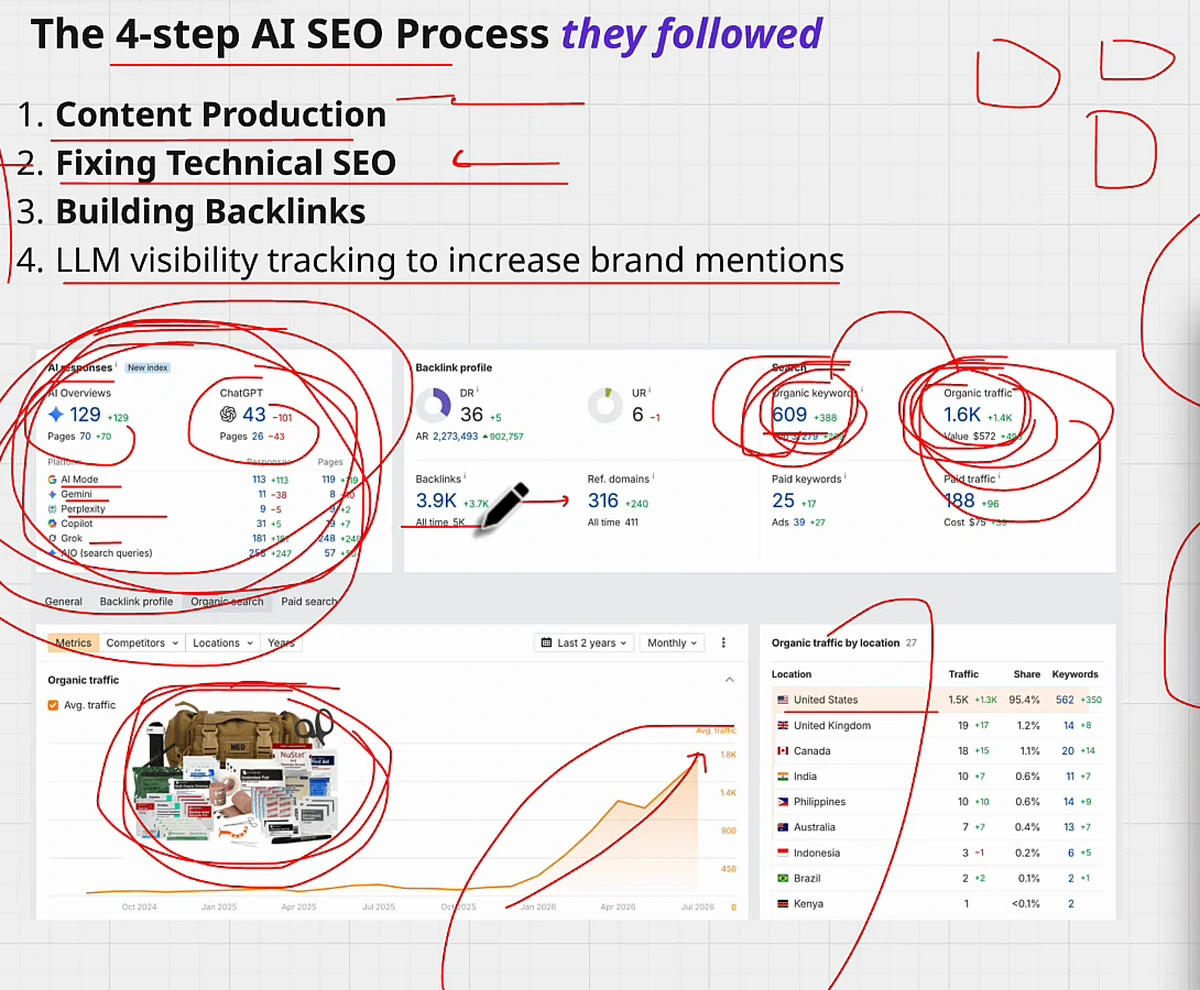
The headline number is this: an e-commerce site in the tactical first-aid niche went from a flat line to roughly 1,600 organic visits a month, peaking near 1,800, in about six months. The more interesting number is buried in the AI panel next to it, where visibility across large language models moved in opposite directions on different platforms at the same time. We'll get to that.
One note on sourcing before the numbers, because it matters for how much weight to give each screenshot. The results below come from the case-study site's Ahrefs profile. The mechanics — the four dashboards showing how each step is run — were demonstrated on Arvow's own project (the breadcrumb reads Arvow (main) — arvow.com), not on the client site. So treat the dashboards as "this is what the step looks like when you run it," not as the client's own counters. Everything is read from a July 2026 walkthrough, so the figures are a snapshot of that date, not live readings.
The scoreboard: what six months actually moved
Here is the Ahrefs summary for the site, with the change figures next to each metric. These are the numbers the rest of the article has to explain.
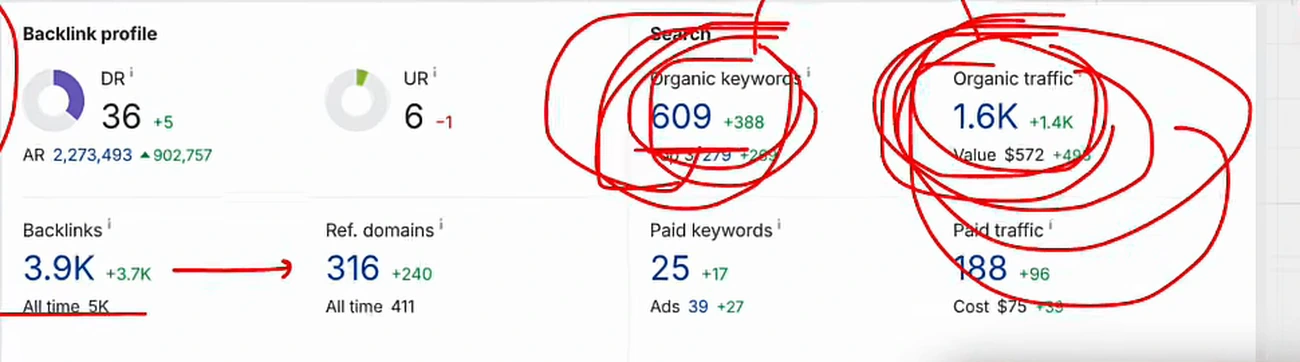
| Metric | Reading | Change |
|---|---|---|
| Organic traffic | 1.6K / month | +1.4K |
| Organic keywords | 609 | +388 |
| Traffic value | $572 / month | — |
| Domain Rating | 36 | +5 |
| URL Rating | 6 | −1 |
| Referring domains | 316 (411 all-time) | +240 |
| Backlinks | 3.9K (5K all-time) | +3.7K |
| Ahrefs Rank | 2,273,493 | +902,757 |
Three things are worth pulling out of that table before anyone copies the plan.
The traffic is almost entirely one country. The location breakdown shows 1.5K of the 1.6K coming from the United States — a 95.4% share, on 562 keywords. The United Kingdom contributes 19 visits, Canada 18, India and the Philippines 10 each. This is a single-market result, not a global one, and the keyword set is narrower than "609 keywords" makes it sound.
Traffic value is $572 a month. Against 1.6K visits, that is roughly 36 cents a visit — normal for informational e-commerce queries, and a useful reality check on what a traffic chart like this is worth before anyone attaches a revenue number to it. If you want the version of this question answered properly, we traced a single $745 sale back through a blog post to a paid invoice rather than stopping at traffic.
URL Rating went down. DR rose 5 points on the strength of 240 new referring domains, but UR — the strength of the specific URL being measured — dropped by one. Link growth at the domain level does not automatically become page-level authority, which is the whole argument for step 3 being about which pages get linked, not just how many links land.
The number that actually matters: AI visibility moved in both directions at once
This is the panel most people skip, and it is the most useful one on the board. Ahrefs' AI responses index breaks visibility out per platform, and over the same period the site's presence grew sharply on some models and collapsed on others.
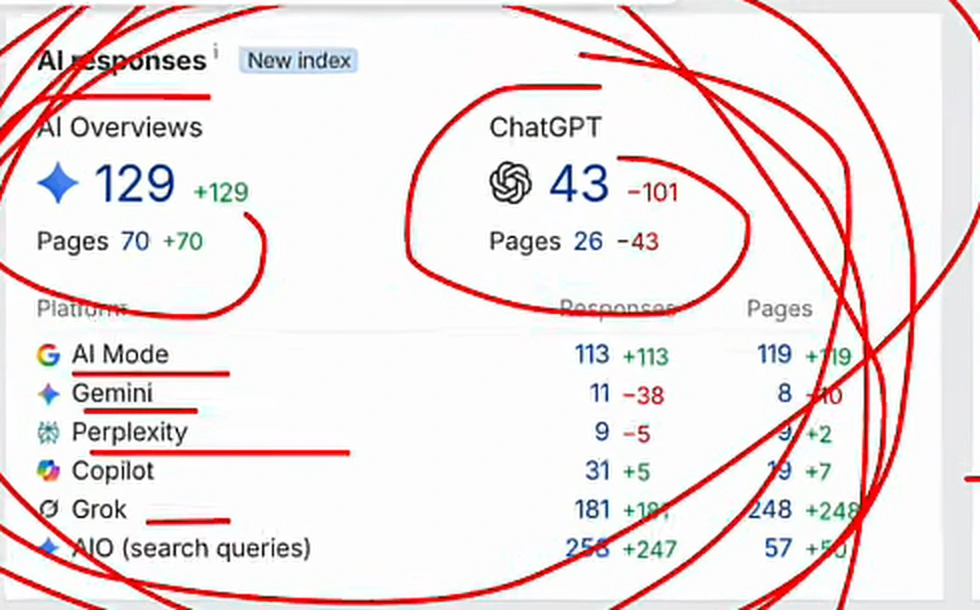
| Platform | Responses | Change |
|---|---|---|
| AIO (search queries) | 258 | +247 |
| Grok | 181 | +181 |
| AI Overviews | 129 | +129 |
| AI Mode | 113 | +113 |
| Copilot | 31 | +5 |
| ChatGPT | 43 | −101 |
| Gemini | 11 | −38 |
| Perplexity | 9 | −5 |
A site that reported only "AI visibility up" would be telling the truth and hiding the story. Google's surfaces — AI Overviews, AI Mode, and AIO on search queries — all went from effectively zero to three-figure response counts, which is what you would expect when a site starts ranking conventionally. Grok did the same. ChatGPT went the other way, dropping 101 responses and 43 pages.
The practical consequence: an aggregate AI visibility score will average away the platform where you are losing. If you only look at one number, you can be up overall and invisible in the one model your buyers actually use. That is the case for tracking per model, which is step 4 — and for treating getting cited by ChatGPT specifically as its own problem rather than a by-product of ranking on Google.
Step 1 — Content production
The first step is volume against a keyword set, published on a schedule rather than in bursts. In the walkthrough this runs as a campaign — a saved definition of how articles get written — with an AutoBlog attached to it that decides when and how many get published.
The campaign settings are where the quality control actually lives. The article template exposes language, tone of voice, point of view, formality, structure, internal linking, images, FAQs, key takeaways, a conclusion and a call-to-action as explicit switches, plus a custom-instructions box. The AutoBlog config on top of it takes an integration (where to publish), an interval, and a batch size — "every day, N articles" — so publishing continues without anyone opening the tool.
Two honest caveats on this step. First, the campaign list in the walkthrough shows several AutoBlogs in a paused state, which is what a real account looks like — you do not leave every campaign running forever. Second, volume is the input, not the outcome: the chart only starts climbing about three months into the period shown, which is the normal lag and worth budgeting for. If this is your starting point, the beginner's guide to AI SEO covers the groundwork this step assumes.
Step 2 — Fix technical SEO
Step 2 is not an audit PDF. It is a queue of specific, page-level changes with a current value and a suggested replacement side by side, batched so they can be approved in bulk.
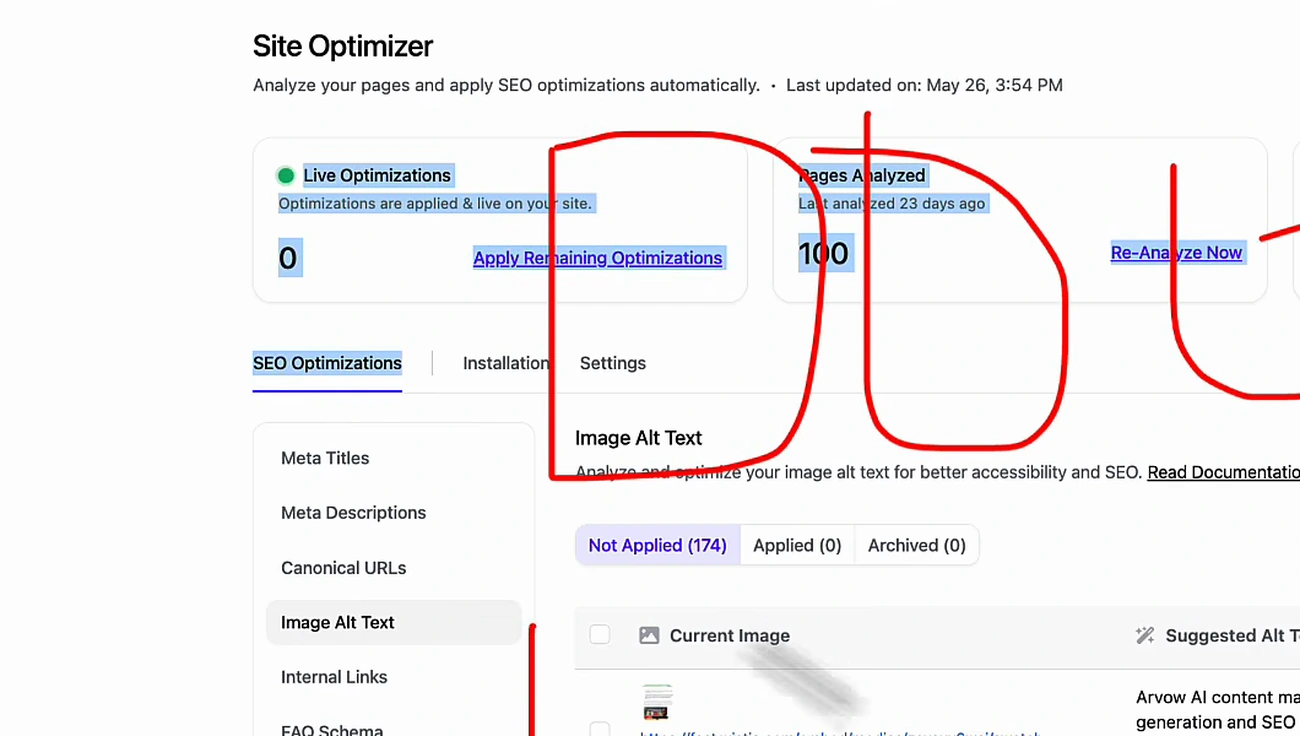
The modules down the left side are the checklist: meta titles, meta descriptions, canonical URLs, image alt text, internal links, FAQ schema and article schema. Each one holds its own Not Applied / Applied / Archived queue. On this project the image alt text queue alone held 174 items — we took that specific queue apart in a separate teardown of fixing 174 missing alt texts, so it is worth reading if that is the module you care about.
Now the part that is easy to miss, and the reason this figure is in the article. The three cards along the top read Live Optimizations: 0, Pages Analyzed: 100, and Traffic from Optimizations: 0 visits. Nothing had been applied yet. The 100 pages were last analysed 23 days before the recording.
So none of the traffic in the scoreboard can be attributed to this module. That is not a criticism of the step — it is the correct way to read the screen, and it is the difference between "here is a technical SEO queue" and "here is what a technical SEO queue earned." A queue of 174 suggestions is potential, not performance, until the Applied column stops reading zero.
The meta title queue is the one worth doing first anyway, because it is the module whose effect you can see in a SERP rather than in a crawler. The walkthrough spends several minutes on exactly that: pulling up a live results page and marking which part of each listing is doing the click-through work versus the ranking work.
Step 3 — Build backlinks
Step 3 in this blueprint is a link network: your published articles carry links to other members' sites, and theirs carry links back to yours, placed automatically as content goes out.
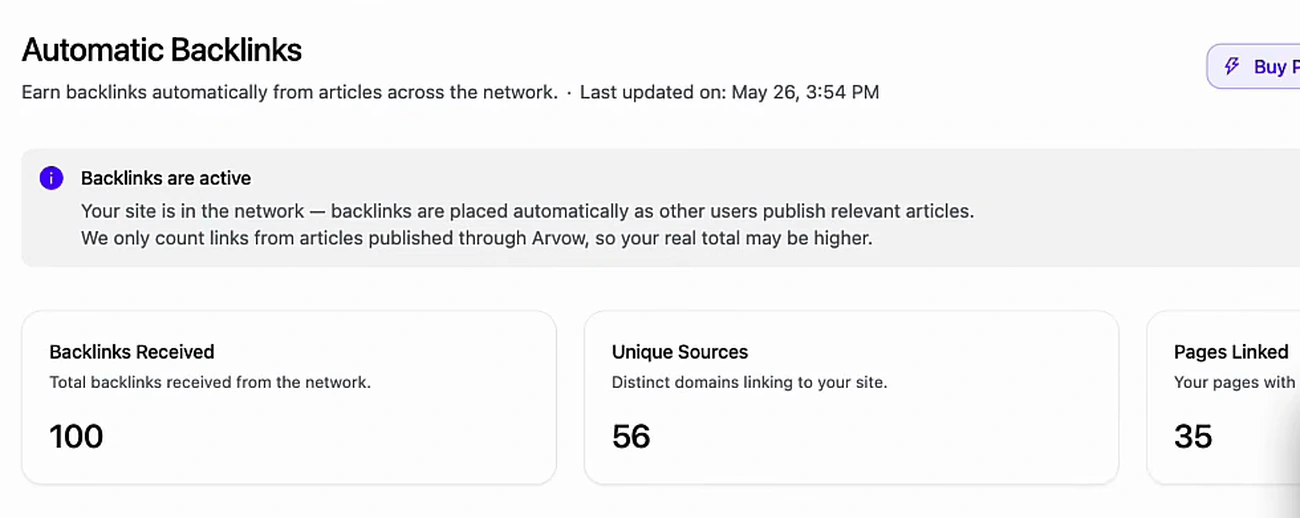
The three counters are 100 backlinks received, 56 unique sources and 35 pages linked. The ratio is the useful bit: 100 links spread over 56 domains and landing on 35 different pages. Links concentrated on a homepage do very little for the long-tail pages that produce this kind of traffic curve; spreading them across 35 URLs is what makes the keyword count move.
The panel also carries its own disclaimer, in the notice at the top: "We only count links from articles published through Arvow, so your real total may be higher." That cuts both ways — it means the counter under-reports, and it means the counter is not a substitute for a third-party backlink check. The case-study site's Ahrefs profile shows 316 referring domains against 411 all-time, which is the number to trust for reporting.
Worth being clear-eyed about the model itself: automated network links are cheap and fast, and they are not editorial links. They are one row in a portfolio. We compared this approach directly against manual outreach in automated agents versus doing it by hand, and the question of how many you actually need is answered from competitor data in how many backlinks do you need to rank.
Step 4 — Track LLM visibility to grow brand mentions
The last step is the one that makes the AI panel from earlier actionable. You define a list of prompts your buyers would actually type, run them across the models on a schedule, and record whether your brand appears, how it is described, and which sources the model cited.
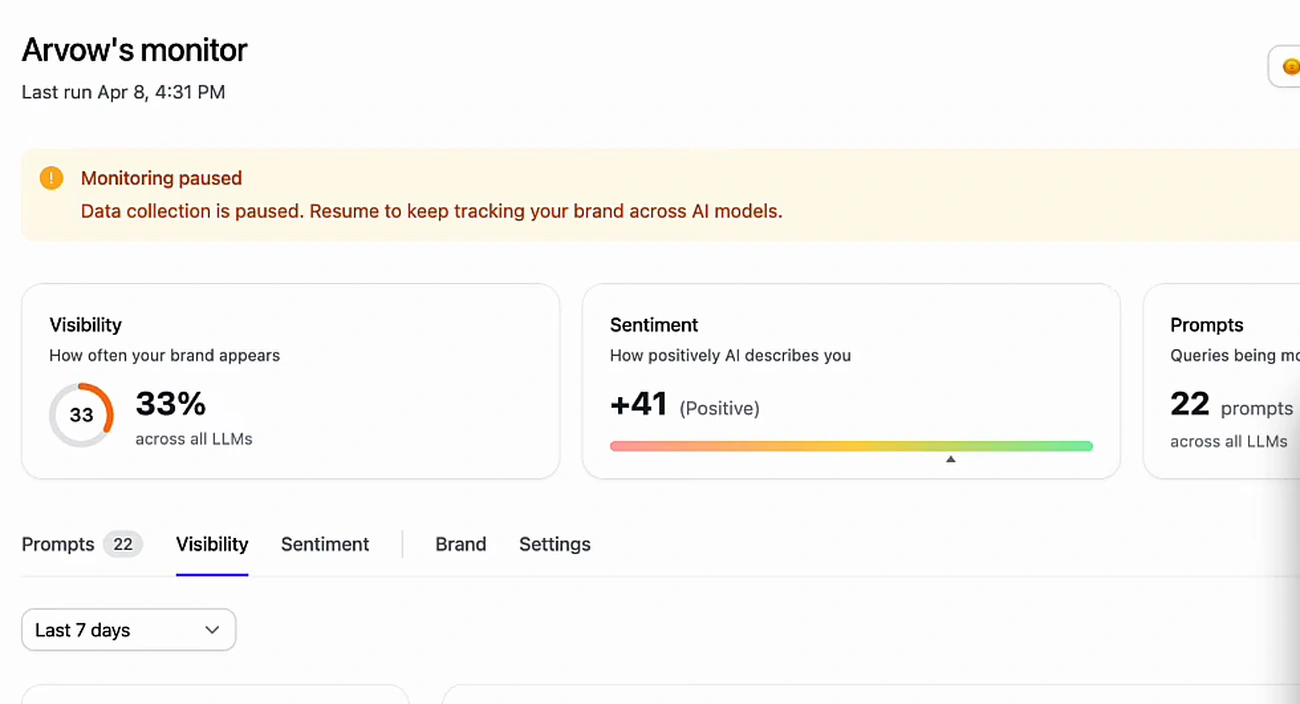
The headline reads 33% visibility across all LLMs, sentiment +41 (positive), 22 prompts monitored. The per-model breakdown underneath is where the number becomes useful: ChatGPT 29, Claude 24, Gemini 31, Perplexity 36, Grok 42. Same brand, same prompts, same week — an 18-point spread between the best and worst model. Averaging those into "33%" throws away the only information you could act on.
The prompt list itself is short and commercial rather than clever — entries like "autoblogging software for wordpress", "backlink exchange saas", "agency seo software", "best autoblogging software for seo". That is the right shape: prompts you want to be named in, not prompts about you.
Then you open a single response and see what the score is made of.
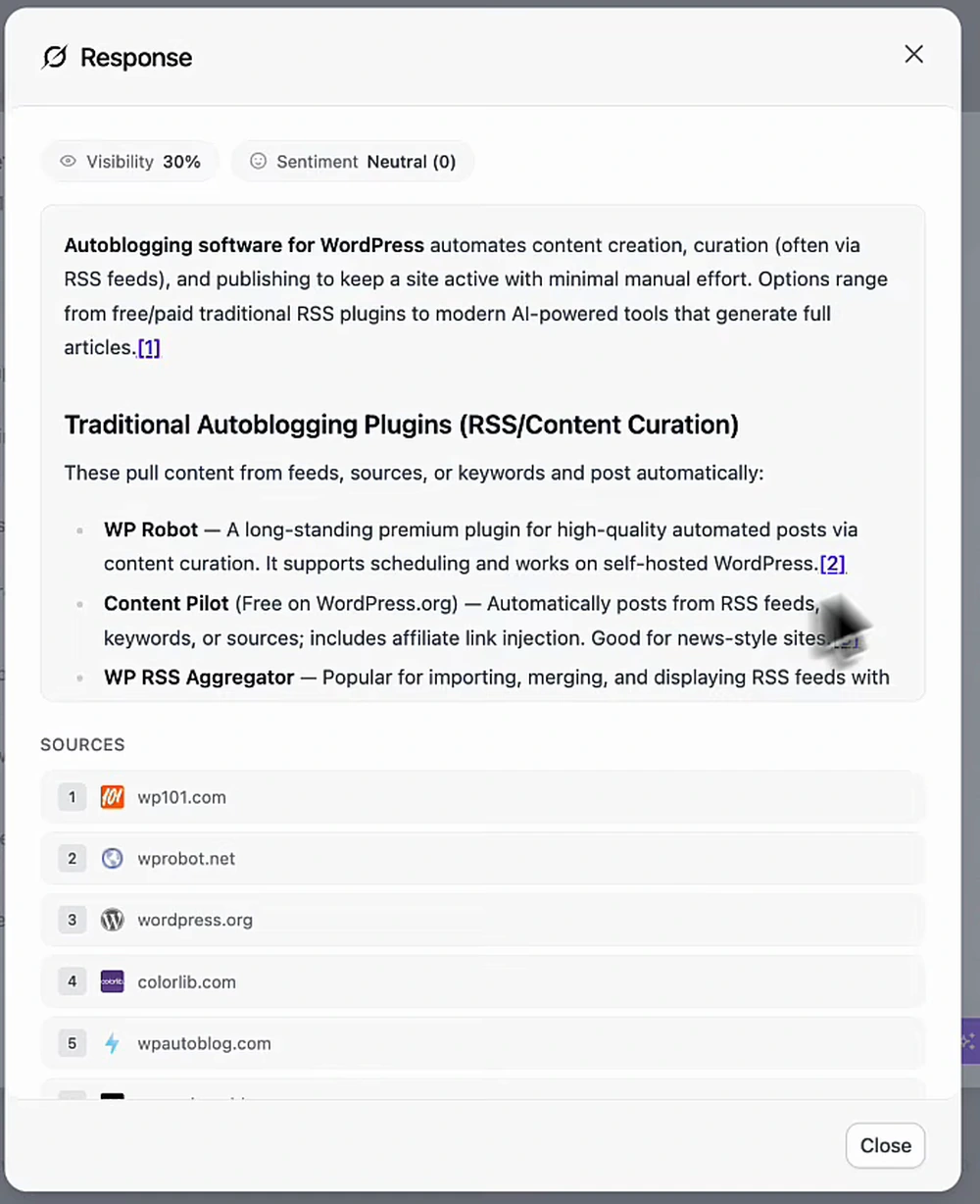
This is a monitored answer to "autoblogging software for wordpress" — scored 30% visibility, neutral sentiment. The model names WP Robot, Content Pilot and WP RSS Aggregator, and lists its sources: wp101.com, wprobot.net, wordpress.org, colorlib.com and wpautoblog.com.
Note whose product is not in that answer. This is Arvow's own monitor, on a prompt Arvow would want to win, and the model recommended three competitors instead. That is the honest version of what a visibility score is for. The aggregate said 33%; the individual response tells you which pages you would have to be mentioned on to change it — and every one of those five cited domains is a concrete outreach or content target. Unlinked mentions on those pages move the model even when a link does not follow, which is the argument we made in brand mentions are the new backlinks.
One caveat on this screen too: the monitor was paused at the time of recording, with a last run several weeks earlier. Prompt monitoring costs credits per run, and a paused monitor produces a stale score — which is exactly the failure mode to design against if you are reporting these numbers to a client. The full guide to AI visibility tracking covers cadence and prompt-set design in more depth.
What the blueprint does not tell you
Four things this case study is genuinely evidence for, and four it is not.
| It supports | It does not support |
|---|---|
| Publishing volume against a keyword set moves organic traffic within ~6 months | Any claim about revenue — traffic value is $572/mo, and no sales data is shown |
| Domain-level link growth (+240 referring domains) tracks DR growth (+5) | That the automated link network caused the DR move on its own |
| Google's AI surfaces follow conventional rankings closely | That ChatGPT does — it fell 101 responses over the same period |
| Per-model tracking reveals spreads an aggregate score hides | That the technical SEO queue contributed anything yet — zero optimizations were applied |
The blueprint is also a single-market, single-site result in a niche with low commercial competition. A 6-point DR gain and 316 referring domains would not move a page in insurance or SaaS. Read it as a process that works, at a scale you should calibrate to your own SERP — and if you want a second data point from a different site, this AI SEO case study went from 3.5K to 13.9K monthly visits while losing keywords, which is a useful counterweight to the "more keywords equals more traffic" reading of the table above.
Running the four steps yourself
- Set the content engine first, then leave it alone. Define one campaign with an explicit article template — tone, structure, internal links, FAQs — and attach a daily AutoBlog with a small batch size. Volume with a fixed template beats volume without one.
- Work the technical queue in order of visibility. Meta titles and descriptions first (they change the SERP listing), then internal links, then alt text and schema. And check the Applied column, not the Not Applied column — a queue of 174 suggestions is worth nothing until it reads Applied.
- Judge links by spread, not count. 100 links across 56 domains landing on 35 pages is a healthier shape than 100 links to a homepage. Verify against a third-party tool; the in-app counter under-reports by design.
- Track LLM visibility per model, on a schedule you do not pause. Twenty-odd commercial prompts is enough to start. Read individual responses, not just the score — the cited sources are your next content and outreach list.
The order matters. Steps 1 and 3 build the thing models and crawlers can find; step 2 makes it legible; step 4 tells you which of the two search systems you are actually winning. Run step 4 first and you will just have a number.
Want to run this loop without stitching four tools together? Arvow handles all four steps — content production, technical fixes, automatic backlinks, and per-model LLM visibility tracking — in one project.
Generate, publish, syndicate and update articles automatically
The AI SEO Writer that Auto-Publishes to your Blog
- Cancel anytime
- Articles in 30 secs
- Plagiarism Free