
AI SEO Case Study 2026: 3.5K to 13.9K Monthly Visits in 60 Days

A site went from roughly 3,500 organic visits a month to 13,900 in about sixty days. That is the headline, and it is real — the dashboard is in the screenshots below.
But there is a second number in the same panel that makes the first one far more interesting. Over the same period, the site's organic keyword count went down by 644, and its top-three rankings dropped by 55. The site got dramatically more traffic while ranking for meaningfully fewer things.
That combination is the actual lesson here, and it is the opposite of how most people plan an SEO campaign. This is a walkthrough of what the site did — content production, technical fixes, and links — and, more usefully, why the growth landed the way it did.
The numbers, exactly as the dashboard reports them
Here is the search panel from the July 2026 snapshot, filtered to changes over the previous six months.
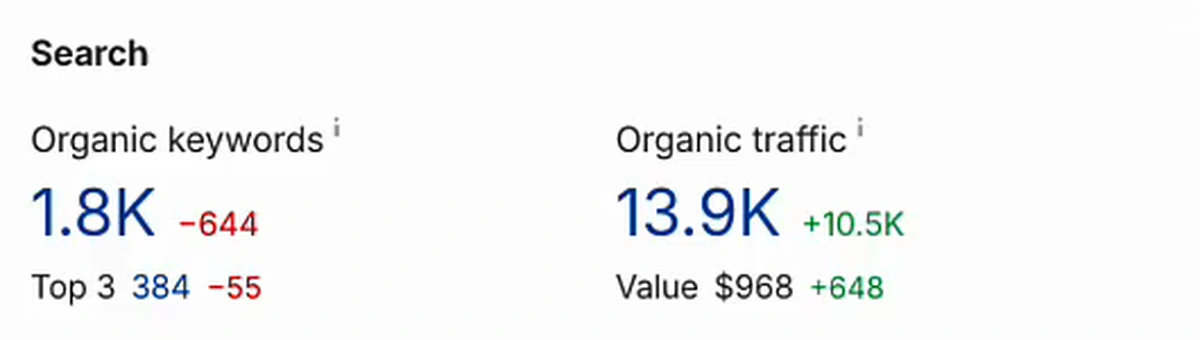
Read the two columns against each other. Traffic more than quadrupled, from roughly 3,400 to 13,900. Estimated traffic value went from $320 to $968. And the keyword footprint shrank — 1,800 keywords, down 644, with 384 in the top three, down 55.
The twelve-month shape matters just as much, because it shows this was not a straight line up from a standing start.
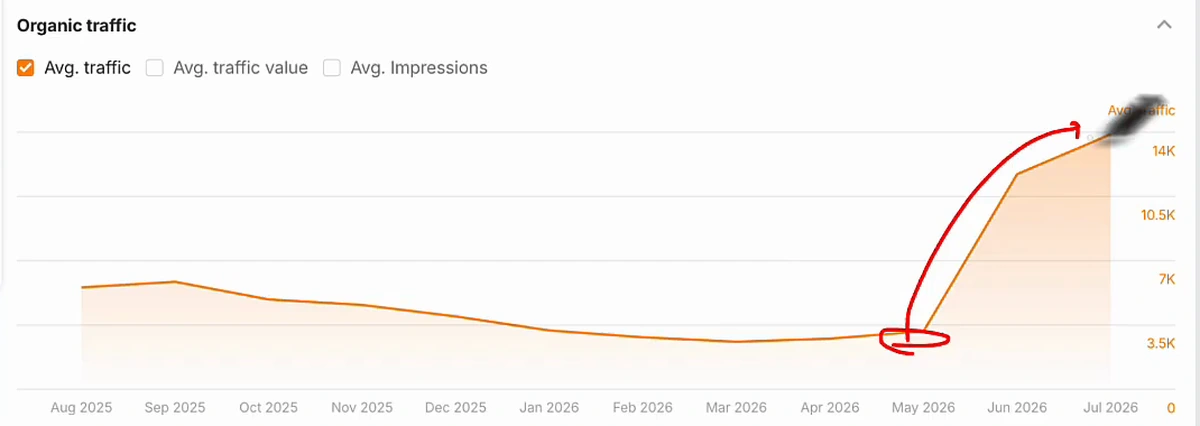
So the honest framing is a recovery that overshot, not a new site taking off. The site had been losing ground for eight months. Whatever changed in May 2026 both stopped the decline and roughly quadrupled the traffic from that floor.
Why traffic tripled while the keyword count fell
The answer is concentration. In the walkthrough, the site's top-pages report is opened and the distribution is brutally top-heavy: one page pulls around 10,000 of the ~14,000 monthly visits. The next one is about 500, then 200, and it tails off quickly from there.
That single page is doing more work than everything else on the site combined. Which explains the paradox cleanly — losing 644 long-tail keywords that sent a handful of visits each costs almost nothing when one page ranks for a term that sends five figures.
The other thing worth noting is how ordinary those pages are. Opened one after another, the top performers all have the same structure: an H1, a stack of H2s, a comparison table, images, bullets, internal links, external links. No custom templates, no interactive tools. They are article pages.
The strategic read: SEO growth is rarely distributed evenly, and planning as if it will be is the mistake. A hundred mediocre pages that each satisfy intent slightly worse than the incumbent will produce a hundred trickles. One page that genuinely beats what currently ranks can outproduce all of them. If you want the full framework this case sits inside, our complete guide to AI SEO automation covers the whole system; this page is about what the numbers looked like when one client ran it.
Step 1: produce content that beats what already ranks
The first step is the unglamorous one. You cannot rank or get cited if there is nothing on the site to rank or cite — and a surprising number of people who want both are not publishing.
On the AI-versus-human question, the position taken in the video is blunt: Google does not care what produced the page. It cares whether the page satisfies the intent behind the queries it ranks for. The page pulling 10,000 visits a month in this case study was AI-produced, and it ranks because it answers the question well, not despite its origin.
The method: deconstruct the SERP before you write
The working process demonstrated is deliberately manual. Take your target keyword, search it, and read what is already winning:
- Format. Is the top result a listicle, a guide, a comparison, a review?
- Structure. How many H2s? Any H3s? Where do images and tables sit?
- Elements. Internal links, external citations, embedded video, original photography?
Then answer one question honestly: can you make something better than this? Google is already telling you what satisfies the query — the ranking pages are the answer key. As noted in the walkthrough, some of those pages look genuinely bad and still pull enormous traffic, which is a useful reminder that "better" means better at answering, not better looking.
What "better" means when the reader is an LLM
The same audit runs against AI citation readiness, and this is where most ranking pages fall over. Here is a page that already ranks for its target term, scored on how quotable it is:
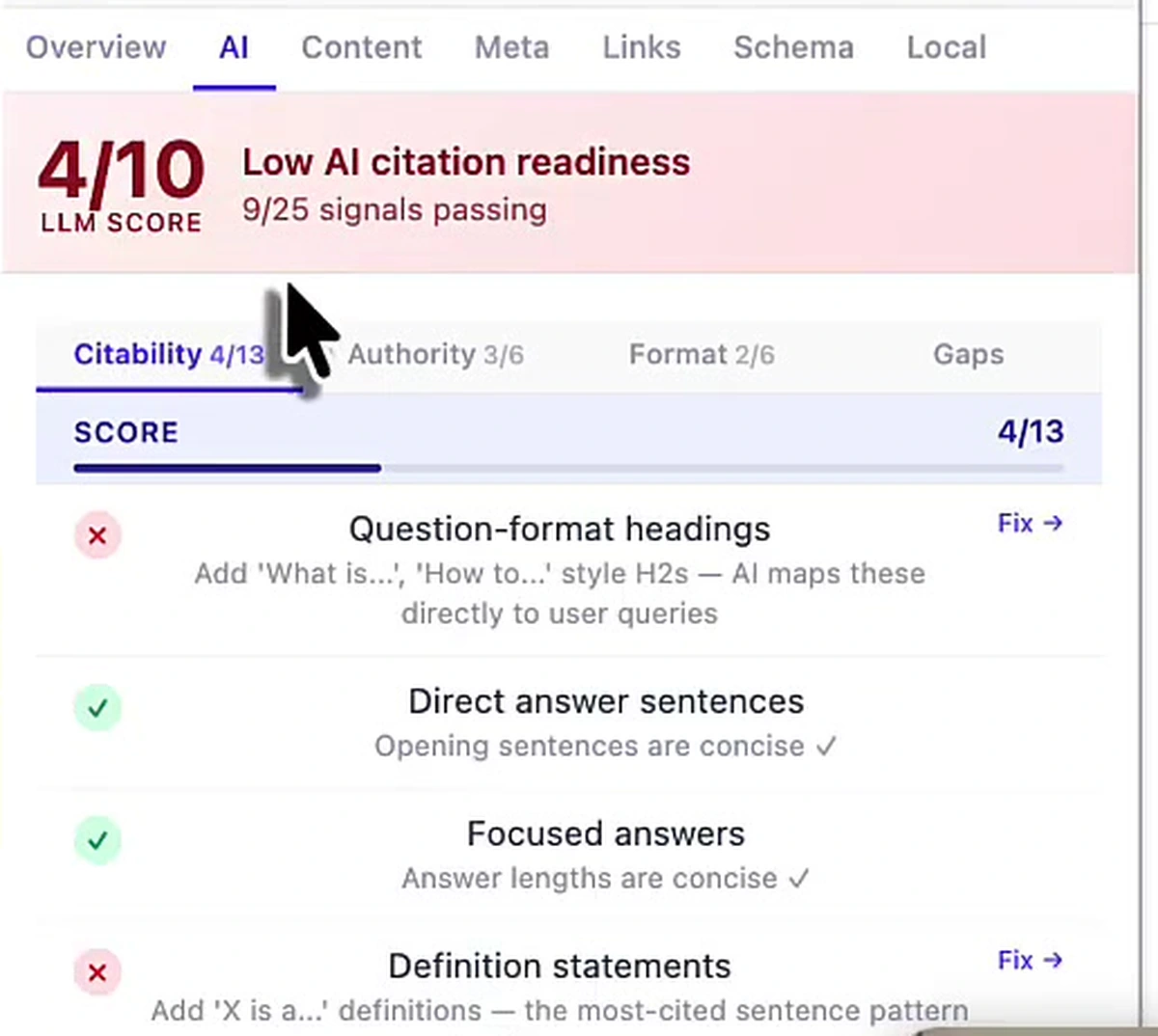
The failing signals are specific and fixable: question-format H2s that map to how people actually ask, "X is a…" definition statements, numbered lists, comparison tables, and a TL;DR block. The passing ones were concise opening sentences and focused answers. None of this is exotic — it is formatting discipline, applied on purpose. Our guide on how to get cited by ChatGPT goes deeper on the citation mechanics.
Step 2: fix the technical layer
Technical SEO is framed here as the pillar people skip because it is boring, and three things get singled out.
Meta titles. Anything past roughly 60 characters gets truncated in the SERP, so the words you wrote past that point are invisible. Worse, the title is doing double duty — it has to carry the keyword for relevance and earn the click. A page can rank above a competitor and still lose, because a lower click-through rate over time pushes it back down.
Schema markup. Star ratings, images, and other rich-result features come from structured data. The argument made is a compounding one rather than a dramatic one: a fraction of a percent of extra CTR, applied across every impression for twelve months, is a lot of additional clicks for a one-time implementation.
Site speed. You can rank first and still lose the visitor if the page is slow, and the advice given is refreshingly unprecious — run PageSpeed Insights, and if the fixes are beyond you, hand the report to a developer. Prioritise the mobile score, because that is where the traffic is.
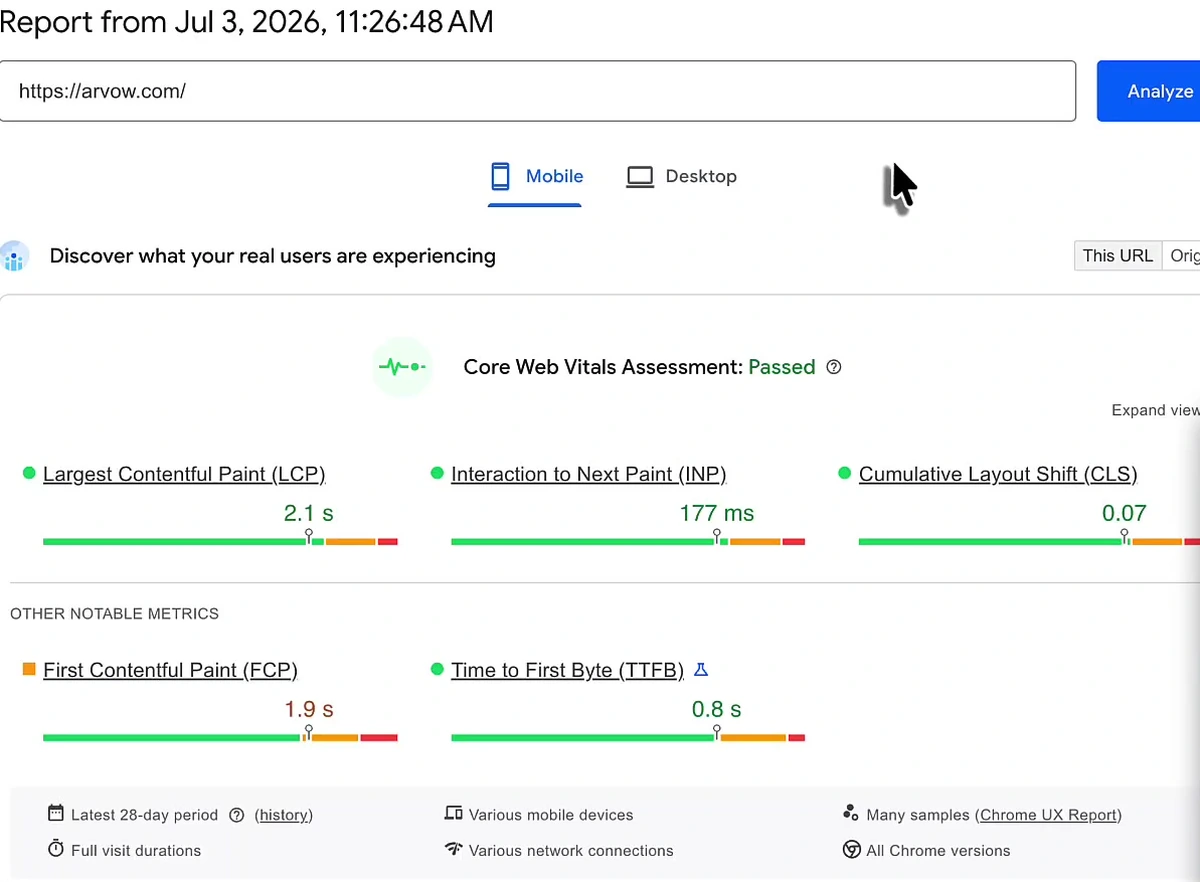
The tooling half of this step is a site-wide audit that scans pages for meta titles, meta descriptions, canonical URLs, image alt text, internal links, FAQ schema and article schema, then proposes a rewrite for each with a stated reason. The value is not the individual suggestion — it is that a hundred pages get checked at once, instead of you remembering to check them.
Step 3: build links, and check the ratio
The client's backlink profile at the time of the snapshot: DR 45, up 19 points over six months, with 11,300 backlinks from 776 referring domains and 105 new domains in the period.
One diagnostic worth stealing: look at links relative to referring domains, not links alone. Eleven thousand links from one domain is a site-wide footer link or a spam network, not authority. The closer that ratio sits to 1:1, the healthier the profile. This site runs around 15:1, which is flagged in the walkthrough as normal for a fast-growing site — rapid growth attracts scrapers and spam links you never asked for, and they are noise rather than a problem.
Mechanically, the links here came from a mix: some bought placements on DR40+ domains, and an automated exchange that places contextual links between sites in a network as other members publish.

Be careful how much weight you put on this one. The 100/55/34 figures above are from Arvow's own account, shown to demonstrate the mechanism. For the client, the video says the feature was enabled and estimates "maybe 60 at most," explicitly declining to give a firm number — so treat links as one of three inputs here, not the cause. If you want the manual version of this, see how to build backlinks with Claude.
The AI visibility side effect
The same snapshot tracks how often the site's pages appear in AI answers, and the six-month deltas are large — but they are not uniform.
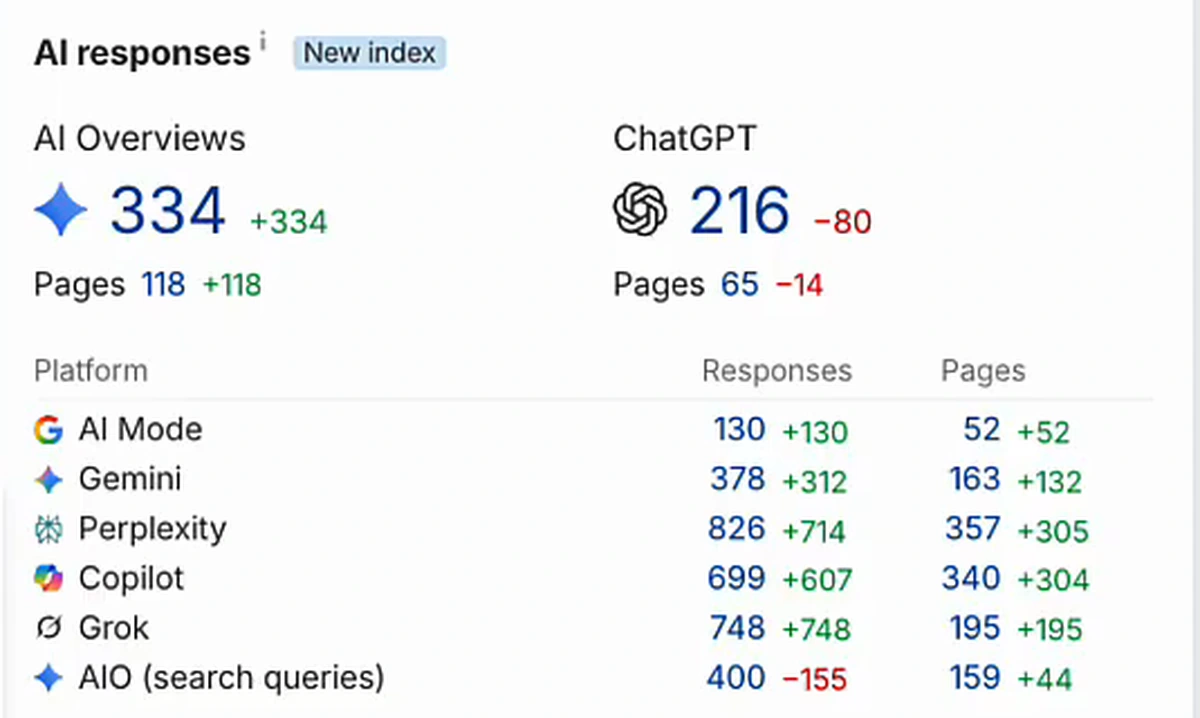
Google AI Overviews went from nothing to 334 responses across 118 pages. Perplexity climbed to 826, Grok to 748, Copilot to 699, Gemini to 378, and Google's AI Mode to 130 — all from a near-standing start.
And ChatGPT fell, from 296 to 216, with the number of cited pages dropping from 79 to 65. The AI Overviews figure sourced from search queries also fell by 155.
That divergence is the most useful thing in the panel, and it would be easy to crop out. Publishing more good content lifted five surfaces sharply and moved one backwards over the same window. The platforms weight sources differently and re-crawl on different schedules, so a single blended "AI visibility" number would have hidden this entirely. If you want to work on this deliberately rather than as a by-product, we covered the direct approach in how to increase AI mentions.
What this case study proves — and what it doesn't
It proves that three fairly ordinary inputs, applied consistently for two months, can quadruple traffic on a site that was previously in decline. None of the three is clever. Publishing content that beats the incumbent, fixing the metadata and speed, and building links is close to the oldest advice in the industry.
What it does not prove is attribution. Three things changed at once, so there is no way to say which produced the result, and the honest answer is probably that the single page doing 10,000 visits a month is carrying the case study. The rest supported it.
Three more caveats worth stating plainly:
- These are third-party estimates, not analytics. Traffic estimates from an SEO tool are directionally useful and frequently wrong in absolute terms.
- The site is an Arvow client, and the tooling shown is our own. The dashboard panels used to demonstrate the mechanics are from our own account, not the client's.
- Sixty days is one window on one site. The keyword decline may partly reflect an algorithm update or index churn rather than anything the site did.
For a longer-run version of the same pattern on a site we can talk about in more detail, see our Claude Code SEO case study.
FAQ
How can traffic go up while keyword rankings go down?
Because keywords are not worth the same amount. Losing 644 long-tail terms that each sent a visit or two is invisible next to gaining or strengthening one term that sends 10,000. Traffic follows the value of your rankings, not the count of them.
How long did the growth take?
The chart moves between May and July 2026 — roughly sixty days from the start of the climb to the July snapshot. The eight months before that were flat to declining, which is the part most case studies leave out.
Does AI-written content still rank in 2026?
The page carrying this case study was AI-produced and pulls around 10,000 visits a month. What matters is whether the page satisfies the intent behind the query better than the pages currently ranking. Production method is not the ranking factor; intent satisfaction is.
Should I fix technical SEO before publishing content?
No — publish first. Technical fixes multiply the performance of pages that exist; they do nothing for a site with nothing to optimise. Get content live, then run the metadata, schema and speed pass across it.
What is a healthy backlinks-to-referring-domains ratio?
Closer to 1:1 is healthier, because it means many distinct sites vouch for you rather than one site linking a thousand times. High ratios on fast-growing sites are usually scraper and spam links arriving uninvited, and are generally noise rather than something to act on.
If you take one thing from these numbers, make it this: the site did not win by ranking for more things. It won by ranking properly for one thing that mattered, and by not being broken everywhere else. Audit your own top-pages report before you plan another hundred articles — the distribution will probably tell you where the next 10,000 visits are hiding.
Generate, publish, syndicate and update articles automatically
The AI SEO Writer that Auto-Publishes to your Blog
- Cancel anytime
- Articles in 30 secs
- Plagiarism Free