
YouTube for Local SEO: How a "Top 5" Video Reached Google's Page One in a Day (2026)

Search for a local service in Google and scroll past the ads and the map pack. Increasingly, there's a YouTube video sitting on page one. For local businesses that's an opening: a short video is much easier to get onto page one than a new website page, and most of your competitors aren't making them.
In the video below, recorded in October 2026, Tim walks through one example: a Ventura plumbing company that published a "top 5 plumbers in Ventura" video and showed up on Google's first page for "top plumbers in ventura" about a day after uploading it. Here's how that video is built, why it works, what it doesn't do yet, and how to get a second piece of content out of it.
The example: a "top 5" video on page one in a day
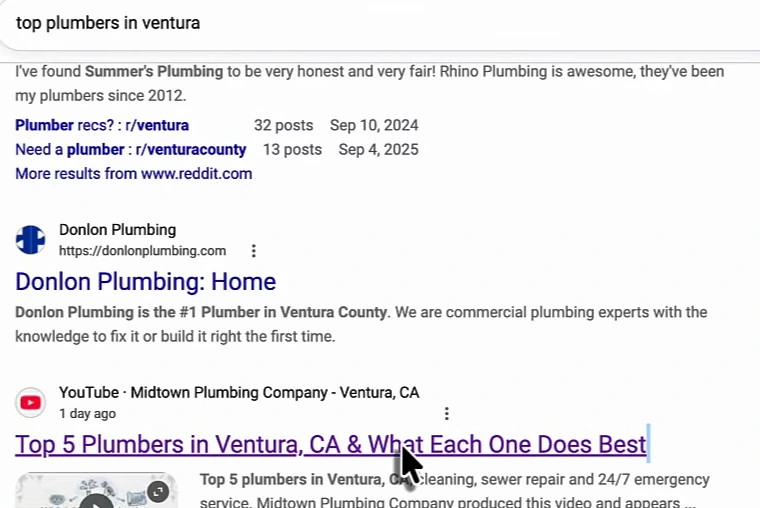
The search is "top plumbers in ventura". Below the sponsored listings, the map pack and the organic results, Google shows a YouTube result: Top 5 Plumbers in Ventura, CA & What Each One Does Best, from Midtown Plumbing Company. When Tim recorded, it was labelled as posted a day earlier. YouTube shows it as uploaded on 2 October 2026, and three days later it had about 60 views. It didn't need an audience to rank; it needed to match the search.
Two things about this result matter for any local business:
- It's a second way onto page one. The map pack has three spots and the organic results are often dominated by directories. A video result is a separate slot, and in a local search there are few competitors for it.
- The title matches the query. "Top 5 plumbers in Ventura" is almost word for word what people search. That's the whole targeting strategy.
How the video is built
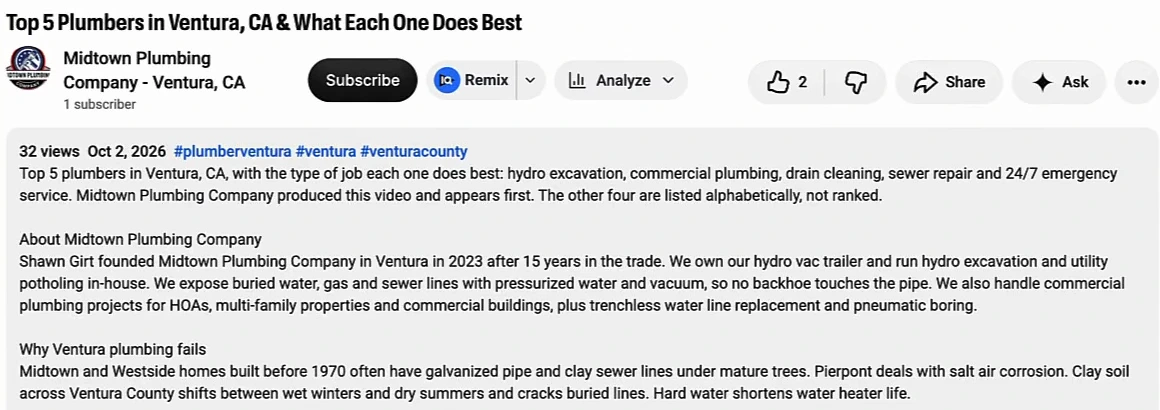
The video is simple. It's an animated explainer about eight and a half minutes long that covers five Ventura plumbing companies and what each one is best at: hydro excavation, commercial plumbing, drain cleaning, sewer repair and 24/7 emergency service. Unsurprisingly, much of it is about Midtown Plumbing, which made it.
The description is where most of the SEO work is done, and it's worth copying almost line for line:
- A one-line summary that matches the search: top 5 plumbers in Ventura, CA, and the type of job each does best.
- A disclosure: Midtown produced the video and appears first; the other four are listed alphabetically, not ranked.
- Who the business is: founder, year founded, years in the trade, and the specific services it does in-house.
- Local detail: why plumbing fails in Ventura in particular (older homes with galvanised pipe and clay sewer lines, salt-air corrosion near the coast, clay soil that shifts and cracks buried lines, hard water).
- A hiring checklist: check the contractor's licence with the state board, ask for the minimum call-out fee, ask who owns the equipment, read the 10 most recent Google reviews.
- Full contact details: business name, street address, phone number, licence number and website, plus links to two service pages.
- Service area: the nearby towns it covers.
That's a better-structured page than many local business websites. It tells Google and AI search exactly who the business is, where it is and what it does.
Keep your business details identical everywhere
Tim's main warning: the business name, address, phone number and website in the video description must match your Google Business Profile, your website and your directory listings exactly. Inconsistent details make it harder for Google to trust that all those mentions belong to the same business, which works against your local rankings. Copy them from your profile rather than retyping them.
The disclosure is not optional
A "top 5" list that you made and that puts you first is self-promotion, and viewers can tell. Midtown handles this well: it says it made the video, it appears first, and the others are in alphabetical order rather than ranked. Don't make claims about competitors you can't support, and don't present a list you produced as an independent ranking. Describing what each company is known for, as this video does, is safer and more useful than scoring them.
How to make your own
- Pick the search. Start with "top 5 [service] in [city]" for your main trade, the way people would type it.
- Choose four other businesses with genuinely different strengths, so each one has a clear "what they do best".
- Make the video. It doesn't need to be polished. Tim suggests using an AI video tool such as Higgsfield, which can be driven from Claude or ChatGPT, to generate it from a script. A screen recording with a voiceover works too.
- Title it with the search: "Top 5 [Service] in [City], [State] & What Each One Does Best" is a good pattern.
- Write the description using the seven-part structure above, with your details exactly as they appear on your Google Business Profile.
- Repeat for your main services. Once the general video is up, make one for each money service: "top 5 companies for drain cleaning in [city]", "top 5 for water heater repair", and so on. Tim's point is that listicles do well both as blog posts and as videos.
If you serve several towns, each town plus service is another video. Our guide to local SEO keyword research covers how to choose which combinations are worth it.
What it doesn't do yet: AI search
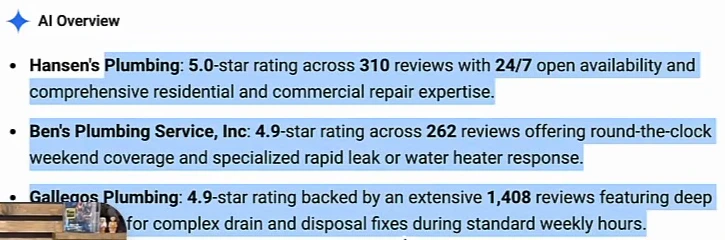
The video's title promises AI citations too, and Tim checks. On the same search, Google's AI Overview recommended three other Ventura plumbers, based mainly on their review ratings and counts. Midtown wasn't in it. As he says, the video was a day old; it may be picked up later, and it may already appear in ChatGPT or Claude answers, but on screen it wasn't in the AI Overview.
That's a useful reminder of what a video can and can't do. It can get you onto page one quickly. Getting recommended in AI answers depends more on your Google Business Profile, your reviews and how widely your business is described across the web. For that side, see our guides on Google Business Profile SEO and ranking in the Google Maps top three.
Turn the video into a blog post
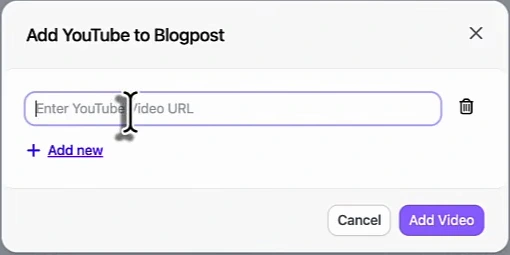
The second half of the strategy is to reuse the video on your own site. A blog post based on the video gives you a page you control, targeting the same search, with the video embedded. Tim does this with Arvow's YouTube to Blogpost feature: paste the video link, generate, and you get a structured article with a meta description, H2s and H3s, and key takeaways.
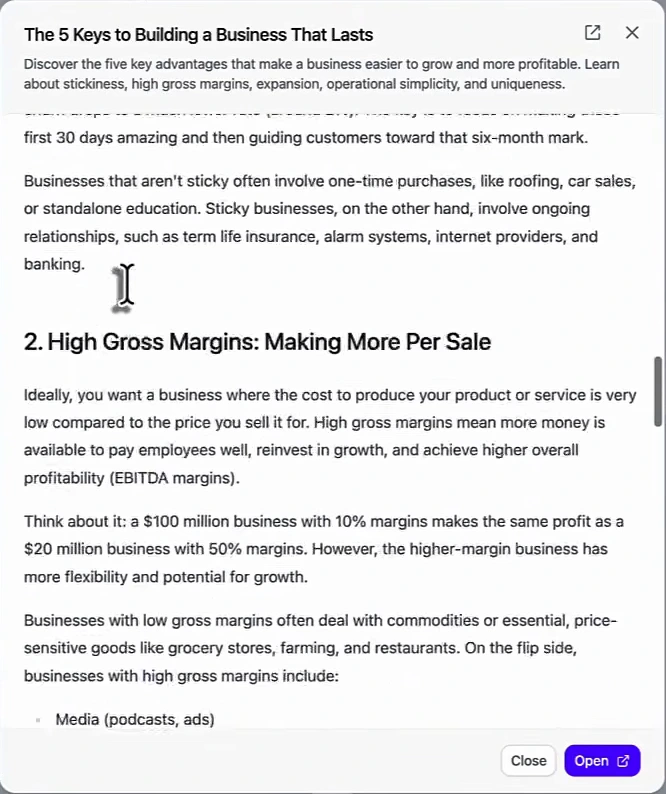
A few things make that article better than a plain transcript:
- Add brand knowledge first. Upload your service pages, case studies and other details to the knowledge base so the article is specific to your business, not generic.
- Link to your money pages. Upload your sitemap so the article can link to the service pages you want to rank, such as the hydro excavation and commercial plumbing pages in Midtown's description.
- Edit before publishing. Use the editor or AI assistant to fix anything that's off, add photos, then publish through a CMS integration.
You can also run this across a whole channel: our walkthrough on bulk converting every video on a YouTube channel into blog posts shows how, and the YouTube video to blog post page covers the feature.
Where YouTube fits in your local SEO
A video won't replace a strong Google Business Profile, service pages and reviews. It's a cheap extra slot on page one and an extra source that describes your business accurately. Tim's closing advice is to start with one general "top 5" video for your main service and city, then expand to your other services once you see it work.
If you're working out where your local rankings are weakest before you start, our guides to fixing local SEO and outranking local competitors are good starting points.
FAQ
Does YouTube help local SEO?
Yes. Google shows YouTube videos on page one for many local searches, so a video whose title matches the search gives you an extra result alongside your map listing and website. The description also lets you publish your business name, address, phone number and services in one more consistent place.
How fast can a YouTube video rank on Google?
In this example, about a day. Midtown Plumbing's video appeared on page one for "top plumbers in ventura" roughly a day after upload, with about 60 views three days after upload. That's one case on a low-competition local search; don't expect the same speed on competitive terms.
Is it OK to make a "top 5" list that includes my own business?
It can be, if you're open about it. Say you made the video and that you appear first, don't rank or score competitors without evidence, and describe each one fairly. Midtown's description does exactly this.
What should a local YouTube video description include?
A summary matching the search, a disclosure if it's a list you appear in, who you are and what you do, local detail, a short hiring checklist, your name, address, phone, licence and website exactly as on your Google Business Profile, links to service pages, and the towns you serve.
Will a YouTube video get my business into AI Overviews?
Not by itself, at least not straight away. In this example the video ranked on page one but the AI Overview for the same search recommended other plumbers based on their reviews. Treat the video as one input alongside your Google Business Profile and reviews.
Turn every local video you publish into a blog post that links to your service pages. Try YouTube to blog post with Arvow.
Generate, publish, syndicate and update articles automatically
The AI SEO Writer that Auto-Publishes to your Blog
- Cancel anytime
- Articles in 30 secs
- Plagiarism Free