
How to Fix Your Local SEO: 3 Fixes That Beat 1,000 Reviews (2026)


A plumber in Memphis with 500 reviews is outranking a competitor with 1,055 reviews and a perfect 5.0 rating. Not by a little — it sits one position above it in the map pack, on the same query, in the same city. Whatever is doing that work, it is not the review count.
Carvalho Marketing Tips walked the live SERP for "plumber in Memphis, TN" and pulled out the three things separating the profiles that get called from the ones that don't. None of them are technical. All three are things most local businesses either skip or do wrong. Here's the teardown, the evidence from the map pack itself, and how to stop doing any of it by hand.
The scoreboard everyone reads wrong
Here is the actual map pack. Read it top to bottom and the review counts stop making sense:
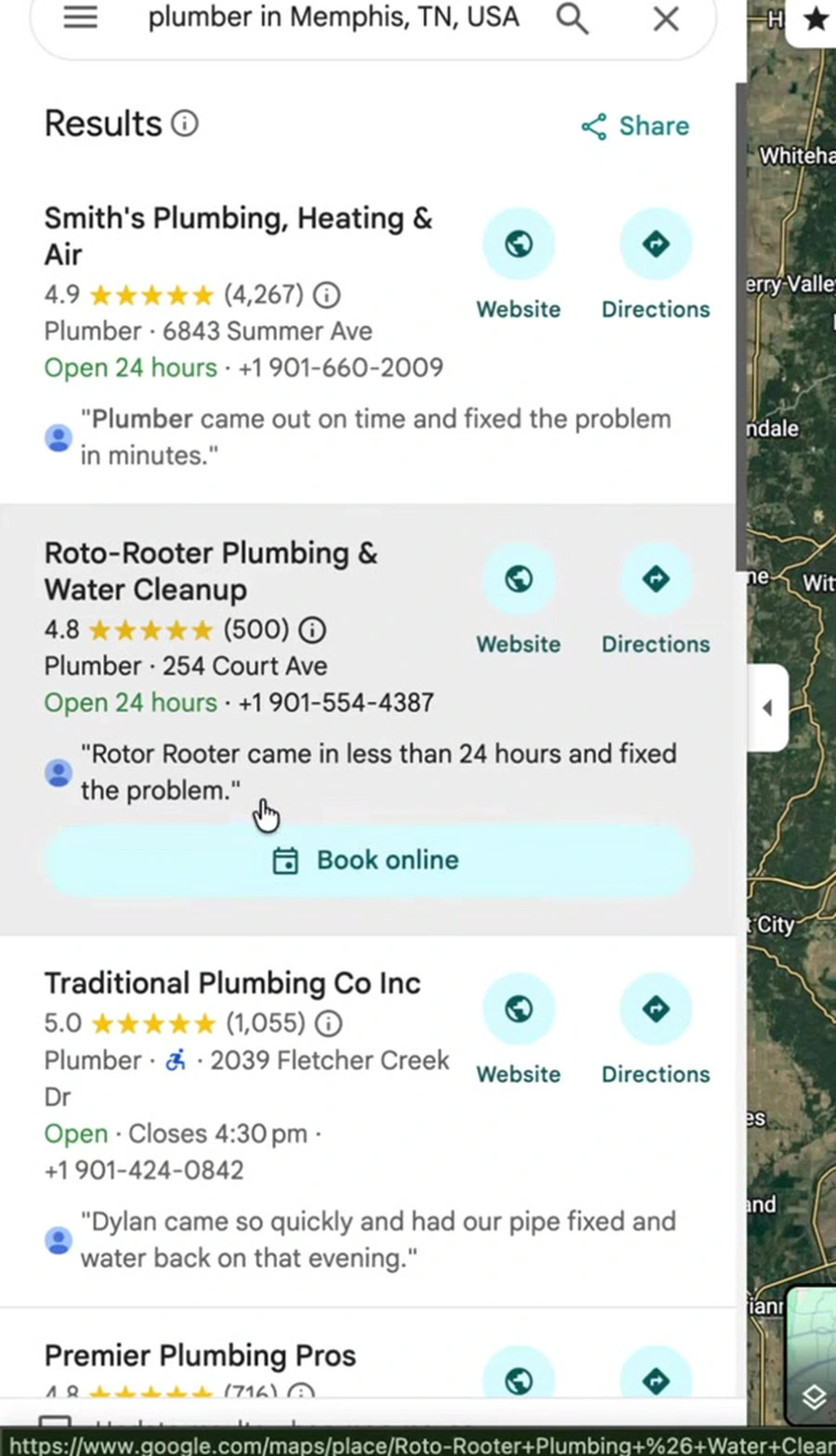
- #1 Smith's Plumbing, Heating & Air — 4.9 ★, 4,267 reviews, open 24 hours
- #2 Roto-Rooter Plumbing & Water Cleanup — 4.8 ★, 500 reviews, open 24 hours, with a Book online button
- #3 Traditional Plumbing Co Inc — 5.0 ★, 1,055 reviews, closes 4:30 pm
- #4 Premier Plumbing Pros — 4.8 ★, 716 reviews
Position 2 has less than half the reviews of position 3 and a lower star rating. It still wins the slot. The three differences below are what the profile actually does differently — and one honest caveat first: this is an observed pattern on one live SERP, not a controlled test. Proximity and hours matter too (#3 closes at 4:30 pm while both profiles above it run 24/7, which for an emergency trade is its own ranking and conversion signal). What follows is what you can control.
Fix 1: Make your name, address and phone identical everywhere
NAP — name, address, phone number. You almost certainly have profiles on more directories than you remember: Yelp, your local chamber of commerce, trade directories, aggregators that scraped you years ago. If the details disagree across them, Google has conflicting records for one business.
That matters more than it used to, because the same inconsistency now feeds the AI layer. ChatGPT, Gemini and Google's own AI surfaces pull from the same messy directory data. When a search engine isn't certain a business exists as described, the safe move is to recommend someone it is certain about. Ambiguity doesn't get you ranked lower for a penalty reason — it gets you skipped.
Two jobs here, and the second one is free money. First, make every listing match character-for-character: the same legal name, the same suite number format, the same phone. Second, if you're not on a directory, get on it — each listing is a backlink from an established domain, which is a rare thing to be able to say about a link you can create yourself in ten minutes. Our Google Business Profile SEO guide covers the field-by-field setup; the common GBP mistakes piece covers what breaks it.
One trap worth naming: hours. The video flags a profile listing itself as open 24 hours and asks whether you can really call that plumber at 4 a.m. For a plumbing or water-damage business, plausible. For a roofer, not — and Google has enough signals to notice a business claiming hours it doesn't keep. Accurate beats impressive.
Fix 2: Post to your profile two to three times a week
Google Business Profile posts are the most under-used surface in local SEO. They work like blog posts, except they publish to your listing instead of your site — image, text, and a button that sends people to a page or a phone number.
The reason to bother: Google treats listings as living entities. A profile publishing new content every few days reads as an operating business. A profile last updated in 2023 reads as one that might not exist anymore. Here's what the #2 profile is actually doing:
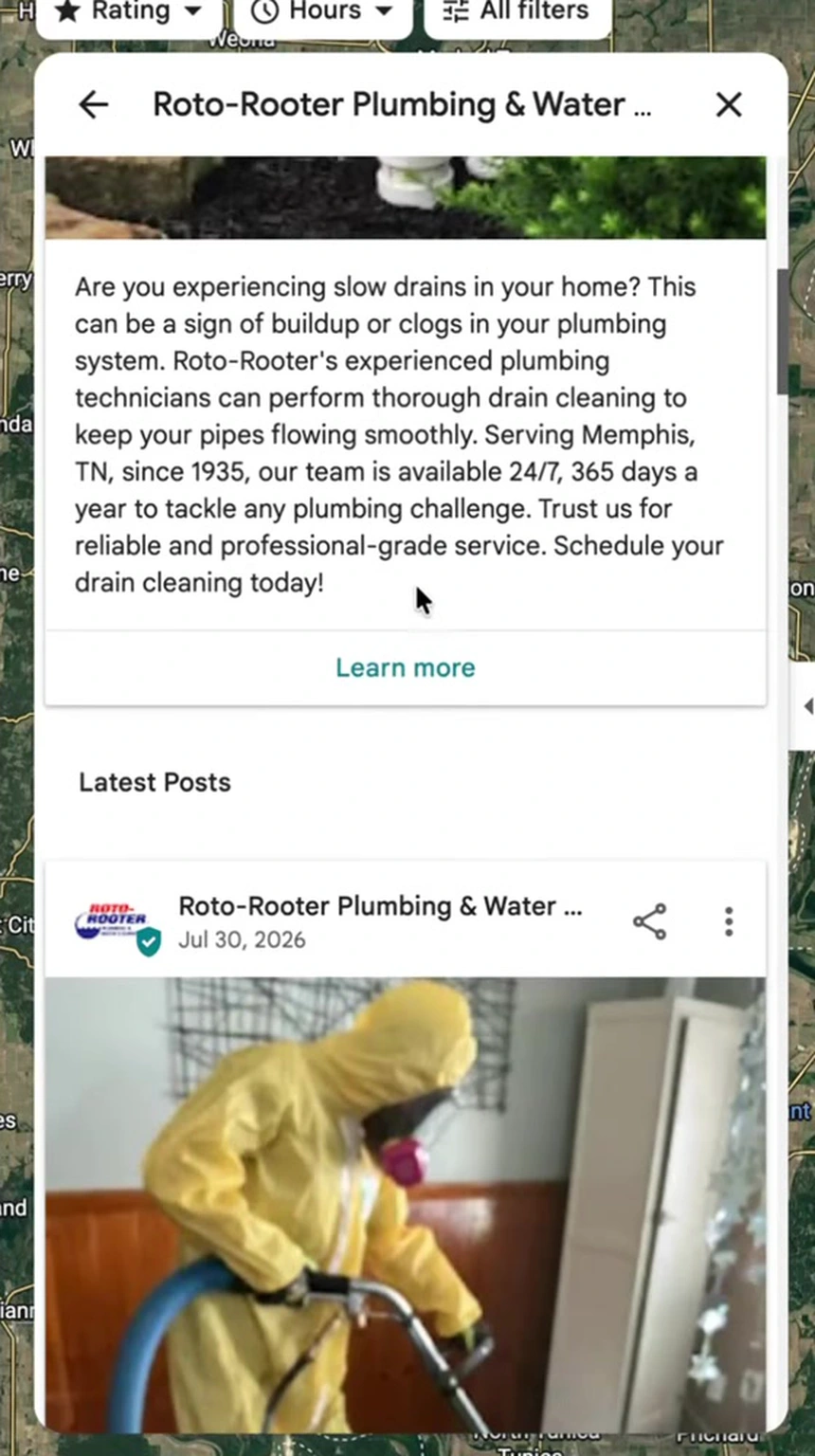
Across the profiles reviewed, the cadence on the winners lands around two to three posts a week. Not daily. Not once a quarter. The #1 listing does the same thing, and goes further with designed graphics and testimonial cards.
Two practical notes. Posts cap out at a limited amount of text, so treat the button as the real payload — if the post is a summary of an article, link the article; if it's an offer, make the button Call now against your tracked number. And post about what you actually do this week: seasonal work, a service you want more of, a job you just finished.
Fix 3: Reply to every review — especially the one-star ones
Getting reviews is the advice everyone already follows. Replying to them is the one almost nobody does, and it's the clearest behavioural split between the top of the map pack and the rest.
The #1 listing has 4,267 reviews at a 4.9 average:

Sort that profile's reviews by lowest rating and the pattern holds where it counts. Here is a one-star review and the owner's response:

The shape of a good negative reply is fixed and worth memorising, because the instinct to defend yourself is exactly wrong here. Thank them first. Acknowledge the specific issue. Say what changes. Never argue, even when you are provably right — the reply isn't for the reviewer, it's for the next hundred people who read it while deciding whether to call you.
Done that way, a one-star review becomes an asset: it's public proof you answer people when something goes wrong. Our Google reviews and SEO guide goes deeper on the ranking side of review signals.
Why the review count is the wrong scoreboard
Put the three fixes back against the map pack and the ordering resolves. The 1,055-review profile has more reviews and a better rating — and shorter hours, and a quieter listing. The 500-review profile posts two to three times a week, offers online booking directly from the map pack, and runs 24/7. The 4,267-review profile does all of that and answers its one-star reviews.
Review count is a lagging indicator of how long you've been in business. Posting cadence, reply rate, and data accuracy are leading indicators of whether you're running the profile at all — and they're the ones you can change this week. That's the same reason ranking #1 on Google Maps rarely comes down to a single lever.
How to automate all three
The honest problem with the advice above is that it's a weekly chore forever. Reply to every review, publish two to three posts, keep listings in sync — that's a recurring job nobody in a busy trade business wants. Both recurring halves can run on rails.
Connecting the Google account that owns the profile pulls the reviews into one inbox with the numbers that actually matter — how many are unanswered, and what share you've replied to overall:

Replies can be written by hand, AI-drafted and published on approval, or fully automated. The part worth setting up carefully is the per-rating rules — because "automate review replies" should not mean the same thing for a five-star and a one-star:

That split is the right default. Positive reviews are safe to answer automatically — the reply is a thank-you with a name in it. Negative reviews should always land in a draft queue for a human, because that's the one reply a prospective customer will actually read closely. Set 1★ and 2★ to draft for approval and leave it that way.
The posting half works the same shape — a dashboard of drafts, live posts, and what's gone out this month:

And the recurring version, which is what actually solves Fix 2 — a schedule, a default button, and a brand brief so the generated posts sound like your business rather than generic trade copy:

One setting there deserves a deliberate choice. The automation can publish straight to Google or create drafts you approve first — and it can be created paused so you can run it manually once and read what it produces before anything reaches your listing. Do that. Review the first two or three posts, then let it run. The same review-then-trust sequence applies if you're running this across several locations, which is its own problem covered in managing multiple Google Business Profiles.
The version you can do this week
- Today — search your main service plus your city. Screenshot the map pack. Write down each competitor's review count, rating, hours, and whether they have a booking button. You now have your actual benchmark instead of a guess.
- Today — open your own profile and fix anything wrong: hours that aren't true, an old phone number, a missing website, no photos.
- This week — list every directory you're on, make the NAP identical across all of them, and create profiles on the two or three big ones you're missing.
- This week — reply to every unanswered review. Start with the negative ones. Thank, acknowledge, state the change.
- Ongoing — two to three profile posts a week, each with a button. Automate it once you've read the first few and they sound like you.
None of this requires a website change, an agency, or an ad budget. It requires the profile to look like it belongs to a business that is currently operating — which, for most of the listings losing to competitors with a fraction of their reviews, is the whole gap.
FAQ
How many Google Business Profile posts should I publish per week?
Two to three is the cadence the top-ranking profiles in this teardown keep. The exact number matters less than the consistency — a listing posting weekly forever beats one that publishes ten posts and then goes silent for six months.
Do I really need to reply to one-star reviews?
Yes, and they're the highest-value replies you'll write. The reply is read by future customers, not the unhappy one. Thank them, acknowledge the specific issue, say what you're changing — and never argue, even when you're right.
Will more reviews fix my local ranking on their own?
Not reliably. In the Memphis map pack above, a profile with 500 reviews outranks one with 1,055 reviews and a 5.0 rating. Review volume is a lagging signal; posting cadence, reply rate, accurate data and complete profile features are the levers you can move now.
What is NAP consistency and why does it matter for AI search?
NAP is your business name, address and phone number as they appear across directories. When those disagree, Google and the AI models that read the same directory data can't be confident which record is correct — and a search engine that isn't confident recommends someone else.
Is it safe to auto-publish AI review replies?
For four- and five-star reviews, yes — those replies are short thank-yous. For three stars and below, set the rule to draft-for-approval so a human reads it first. That's the default split shown above, and it's the one to keep.
Want the weekly half handled? Arvow's local SEO automation connects your Google Business Profile, keeps review replies at a real response rate with per-rating rules, and publishes profile posts on a schedule — so the three fixes above keep happening after the week you start them.
Generate, publish, syndicate and update articles automatically
The AI SEO Writer that Auto-Publishes to your Blog
- Cancel anytime
- Articles in 30 secs
- Plagiarism Free