
Local SEO Keyword Research With One Claude Prompt: 30 Keywords in 8 Clusters (2026)


Most local SEO keyword research guides hand you a tool, a list of modifiers and an afternoon of work. The video below does it differently: one Claude prompt takes a website URL, finds the business's real competitors on Google, maps what those competitors publish, works out what the site is missing, and returns a prioritised content plan — 30 keywords in eight clusters for a four-page commercial cleaning site in Dallas — that gets exported as a CSV and fed into an autoblog. Below: what the prompt does, what it found, where it is honest about its limits, and how the plan became articles.
Why competitor gaps, not a keyword tool
Classic local keyword research starts from a seed list and a volume tool. The workflow in the video starts from the competition. Its logic is that a competitor which already ranks in your city has done the demand research for you: the pages they bothered to build are the pages that get calls. So the prompt reverse-engineers three to five competitors' content, compares it with yours, and treats the overlap you lack as proven demand. Search volume only enters at the end, as a sanity check — and the prompt says so itself, which we come back to.
The presenter's proof that the output is worth having is a dental-niche site he shows in Ahrefs at the start of the video. At the time of recording (mid-2026) it was at roughly 40,000 organic visits a month, up from near zero a year earlier, with an estimated traffic value of about $15,700 a month against $46 of paid spend — and, more to the point for 2026, 2.1K AI Overview appearances across 117 pages plus 639 Google AI Mode responses. The same informational content serves Google and the AI surfaces, which is the argument of our guide to ranking in Google AI Overviews.

What the prompt asks Claude to do
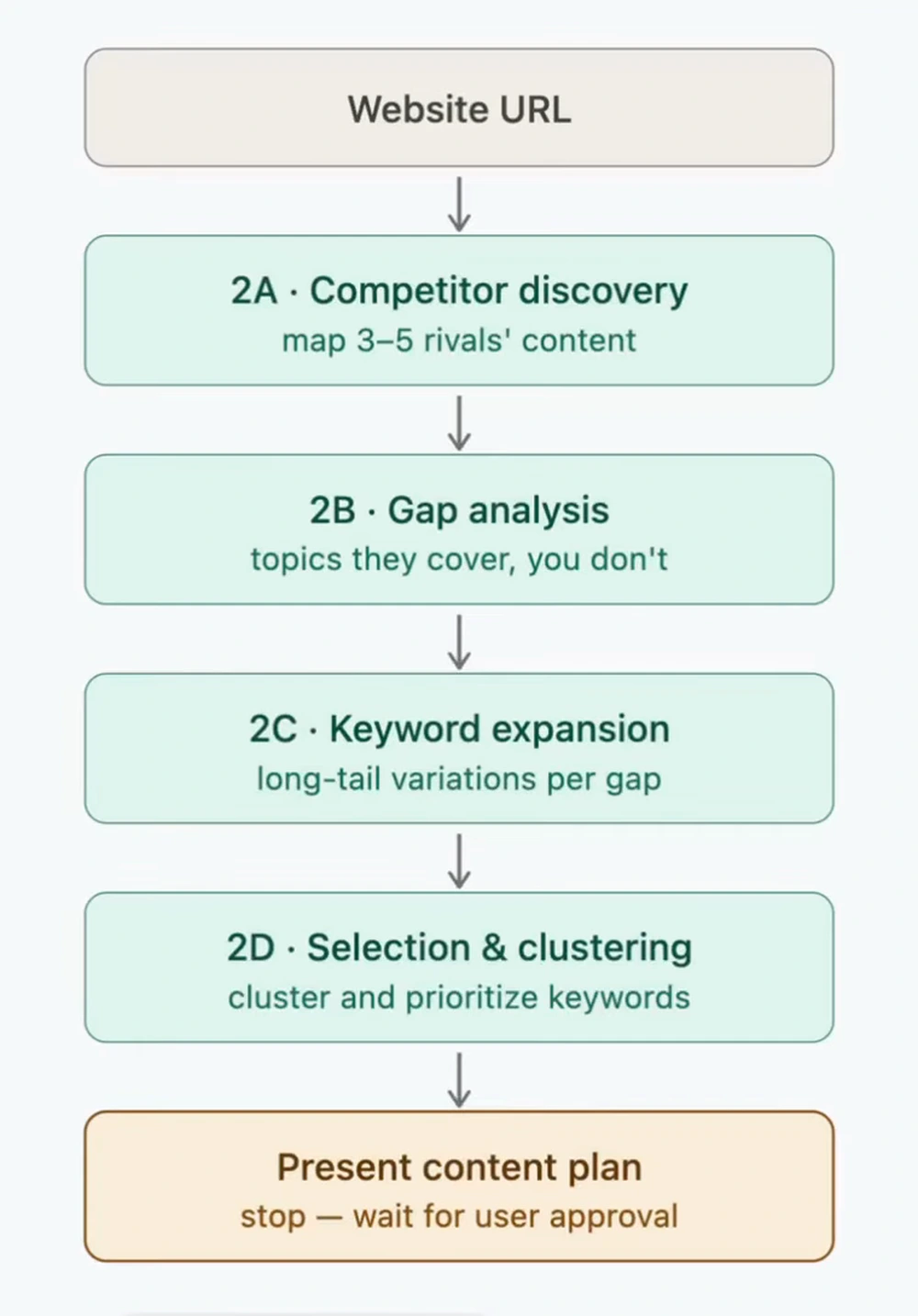
The prompt is written as a skill document — "you are an SEO content strategist and publisher; given a website URL, you autonomously research the niche" — and the keyword-research phase has four numbered steps. The presenter gives the full text away in his comments; the structure is legible on screen:
| Step | What Claude does | Output |
|---|---|---|
| 2A · Competitor discovery | Searches Google for the core service plus location ("roofing company dallas"), picks 3–5 competing sites, fetches each one's sitemap or blog index, extracts URLs and titles | A competitor content map: who they are, what topic clusters they cover |
| 2B · Gap analysis | Compares the maps against the user's existing pages | Topics all competitors cover but you don't → HIGH (proven demand); only 1–2 cover → MEDIUM; nobody covers well → EVALUATE (gap or no demand) |
| 2C · Keyword expansion | For each gap, searches the topic, reads People Also Ask and related searches, tries "how to", "best", "vs", "cost", "near me" and "what is" variants, adds location modifiers | Specific query variations per gap |
| 2D · Selection and clustering | Groups keywords into clusters with a pillar and supports; assigns an article type and size to each (ultimate guide xl, how-to lg, comparison lg, listicle lg, FAQ md, local landing md) | The content plan, with a summary count — then it stops and waits for approval |
Two design choices are worth copying even if you write your own prompt. The priority tiers are defined by competitor coverage, not by volume, which is what makes the output actionable for a small local site where most keywords show "0–10" in a tool. And the article-type mapping is built in, so every keyword arrives already tagged as a landing page, a how-to or an FAQ — the difference between a keyword list and a content plan. If you prefer working in the terminal, the three prompts in our Claude Code SEO prompts post cover the same ground for an existing site with content to audit.
The example: a four-page cleaning site with no content
The test subject is Guerrero Enterprise Cleaning, a commercial cleaning company in Garland, Texas, serving Dallas–Fort Worth. The presenter had just built its site — four pages on WordPress and Elementor, no blog, six services listed as cards on a single page, last content update May 2023 — and states he will do no other SEO on it, so the site is a clean test of this workflow alone. He ran the prompt in the Claude app on a mid-tier model (the picker shows him stepping down from the top option) and notes that the run took a few minutes because Claude is actually fetching sites and searching, not writing from memory.
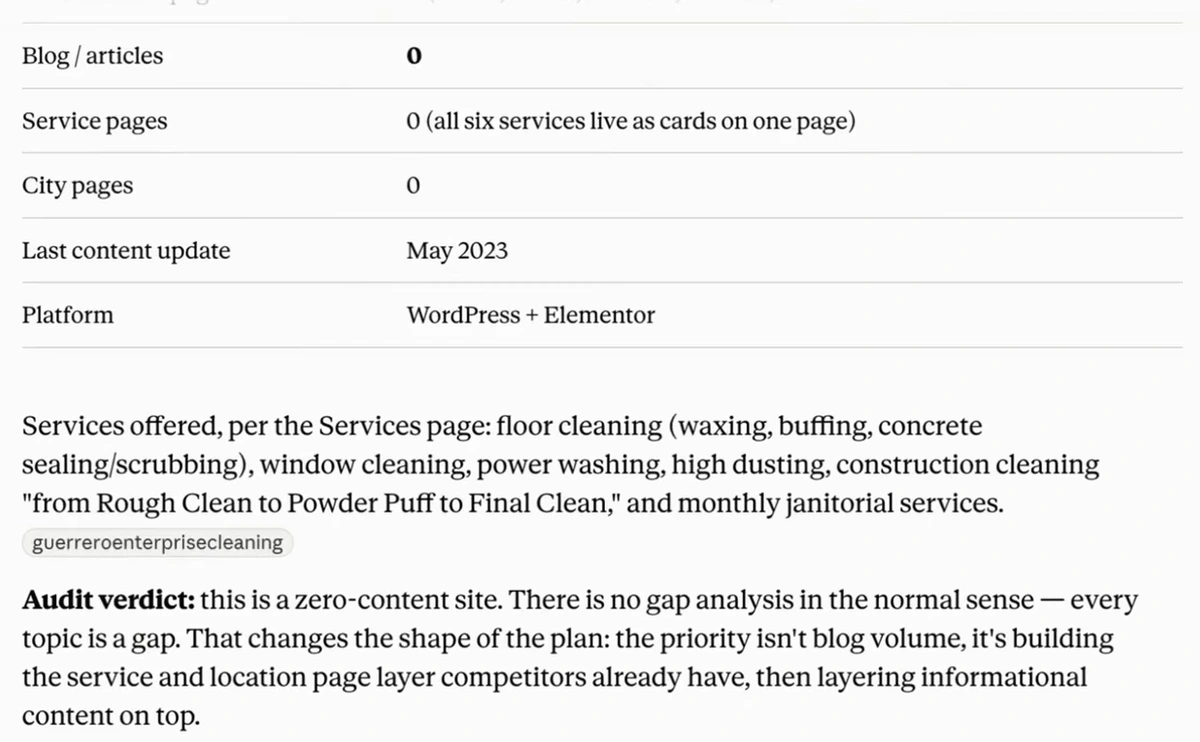
The audit verdict is the first sign the output is more than a keyword dump. Because the site has nothing, Claude says there is "no gap analysis in the normal sense — every topic is a gap", and re-orders the plan around it: service and location pages first, blog content on top.
Competitor discovery
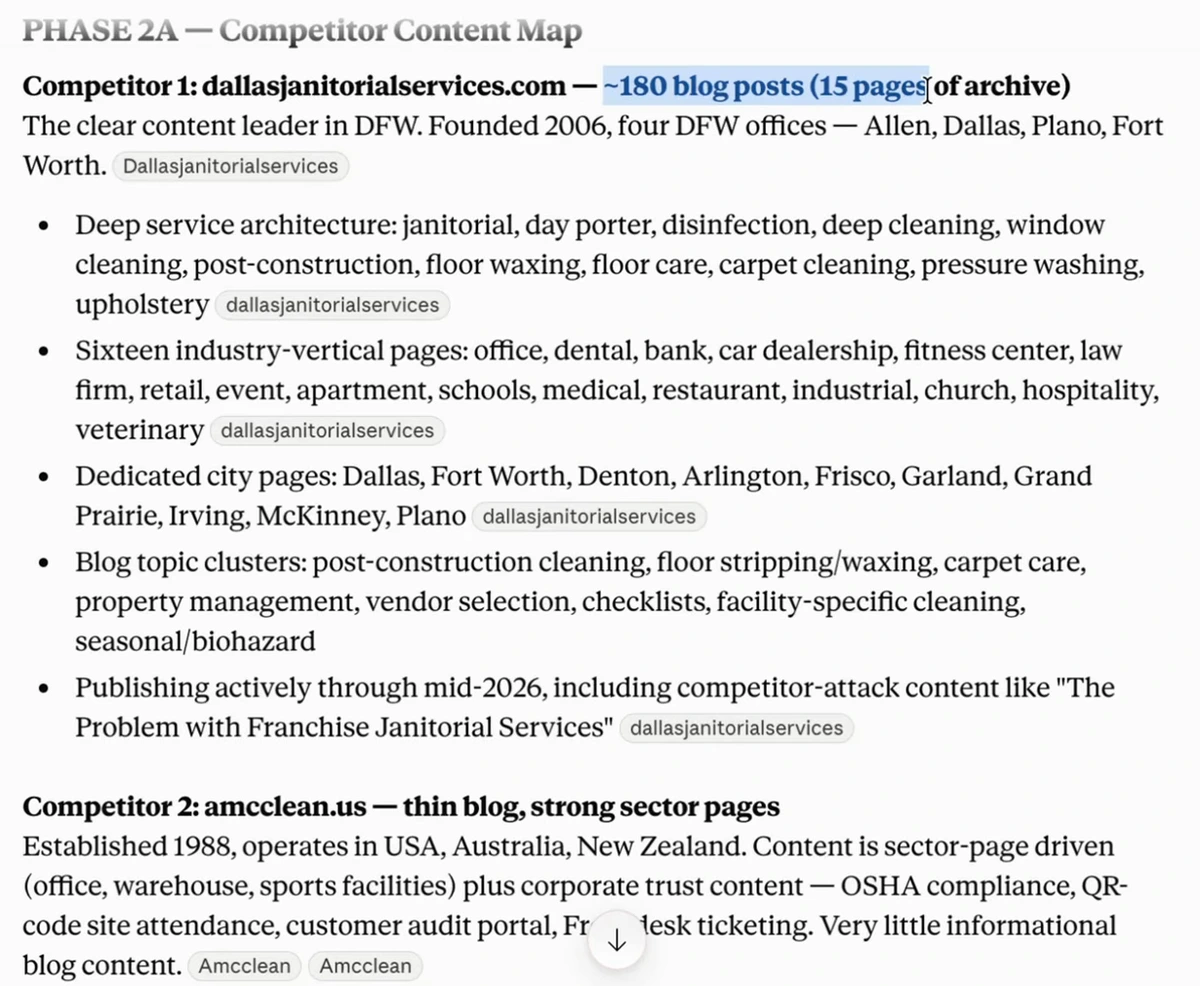
Claude identified five competitors and characterised each one's content. The leader, a Dallas janitorial company, has roughly 180 blog posts across 15 archive pages, sixteen industry-vertical pages (office, dental, bank, car dealership, law firm, restaurant and so on), ten dedicated city pages — including one for Garland, the test site's own home city — and is still publishing competitor-attack content in mid-2026. The others were sorted by what they are actually doing: one with sector pages and a thin blog, one franchise operator with a large blog aimed at franchise recruits rather than buyers, and two national franchise brands ranking on domain authority and templated location pages.
Gap analysis
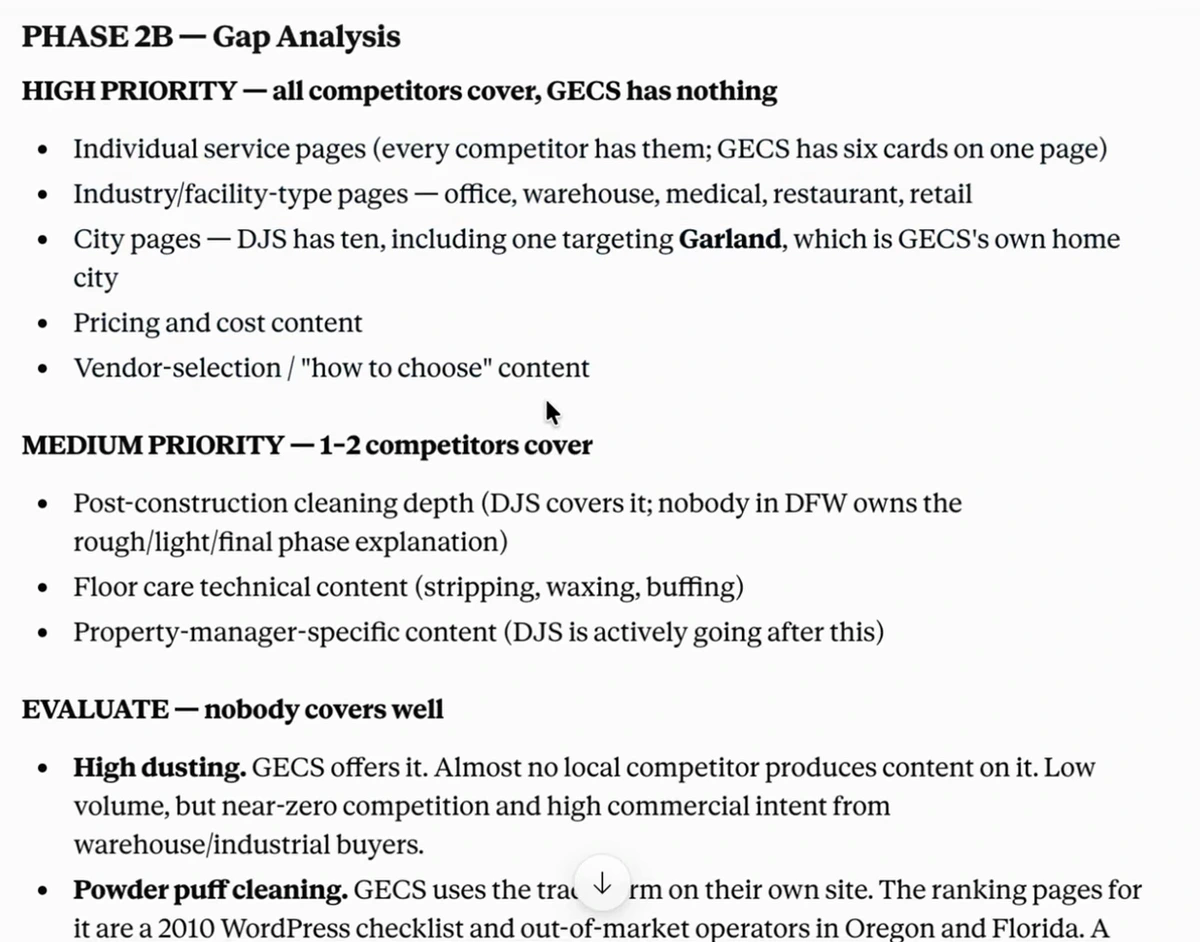
The gap analysis is where the priority tiers do their work. High priority — everything every competitor has and the test site lacks — came out as individual service pages, industry and facility-type pages, city pages (with the pointed note that a competitor already targets Garland), pricing and cost content, and vendor-selection or "how to choose" content. Medium priority, covered by one or two rivals, was post-construction cleaning depth, floor-care technical content and property-manager content. The evaluate tier is the interesting one: high dusting, which the business offers, has near-zero competition and high commercial intent from warehouse buyers, and "powder puff cleaning" is a trade term the company already uses on its own site for which the ranking pages are a 2010 WordPress checklist and out-of-market operators.
Keyword expansion, with a caveat Claude wrote itself
The expansion phase validated the gap topics against live results. Cost queries are "nationally dominated but locally winnable": the unmodified "commercial cleaning cost" term belongs to Angi, HomeGuide and HomeAdvisor and is not contestable, but the Dallas-modified and service-specific versions are. Post-construction phase terminology — rough, light and final clean — is "genuinely open" because the pages ranking for it are thin or geographically irrelevant to DFW. Then comes the line to keep: "these priorities come from SERP inspection and competitor mapping, not from search volume data. The ordering is directionally sound but I'd re-rank against real volume before committing budget."
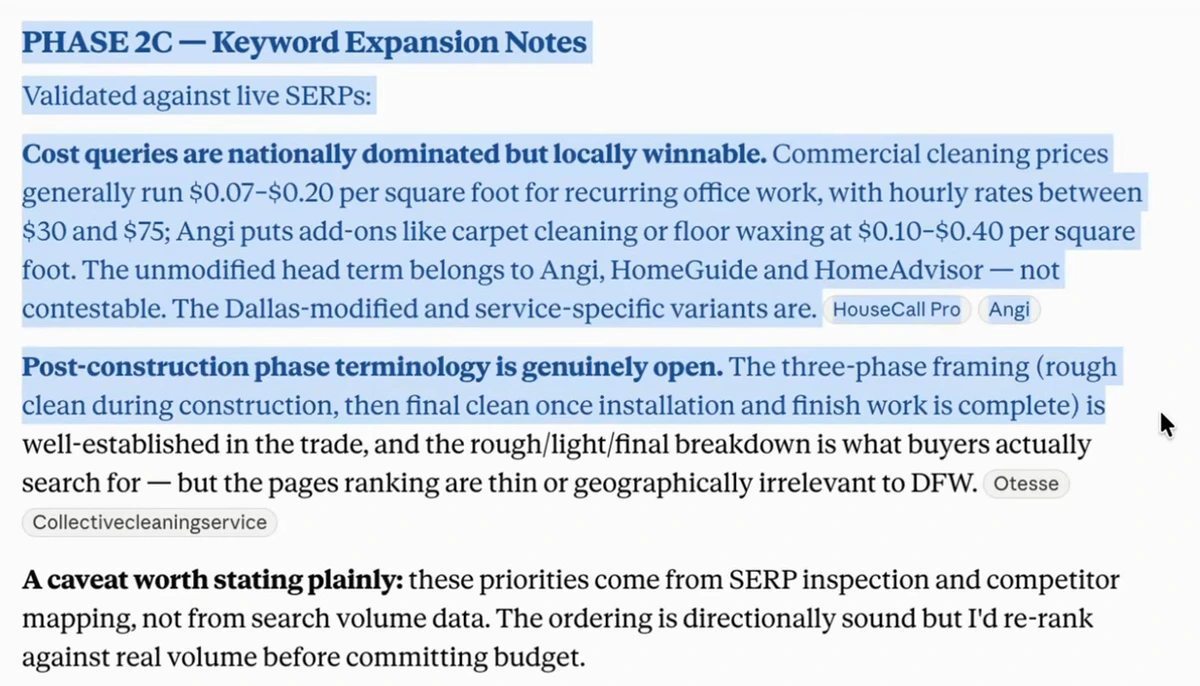
That caveat is the honest boundary of this method. Competitor mapping tells you what the market has decided is worth a page; it does not tell you how many people search for it. If you are going to spend on 30 articles, one pass through a volume source — Google's Keyword Planner, or the automated keyword research built into Arvow — is cheap insurance, and Claude is telling you to do it.
The content plan: 30 keywords, 8 clusters
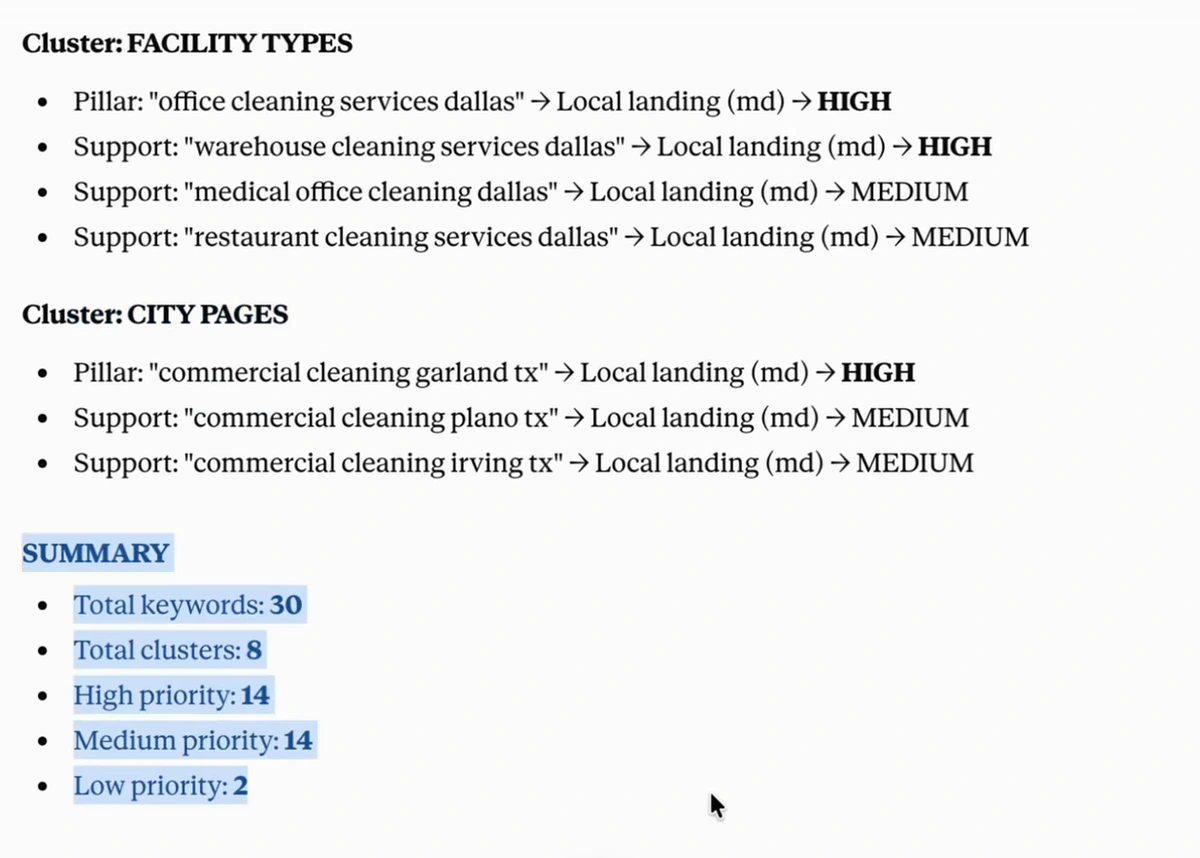
The plan came back as eight clusters — post-construction cleaning, commercial floor care, buying and vendor selection, pressure washing, window cleaning, high dusting, facility types and city pages — with a pillar and supports in each, an article type and size per keyword, and a priority: 30 keywords, 14 high, 14 medium, 2 low. Post-construction cleaning was flagged as the strongest differentiator because the company already has the expertise and the vocabulary; buying and vendor selection carries the highest commercial intent; high dusting is marked uncontested.
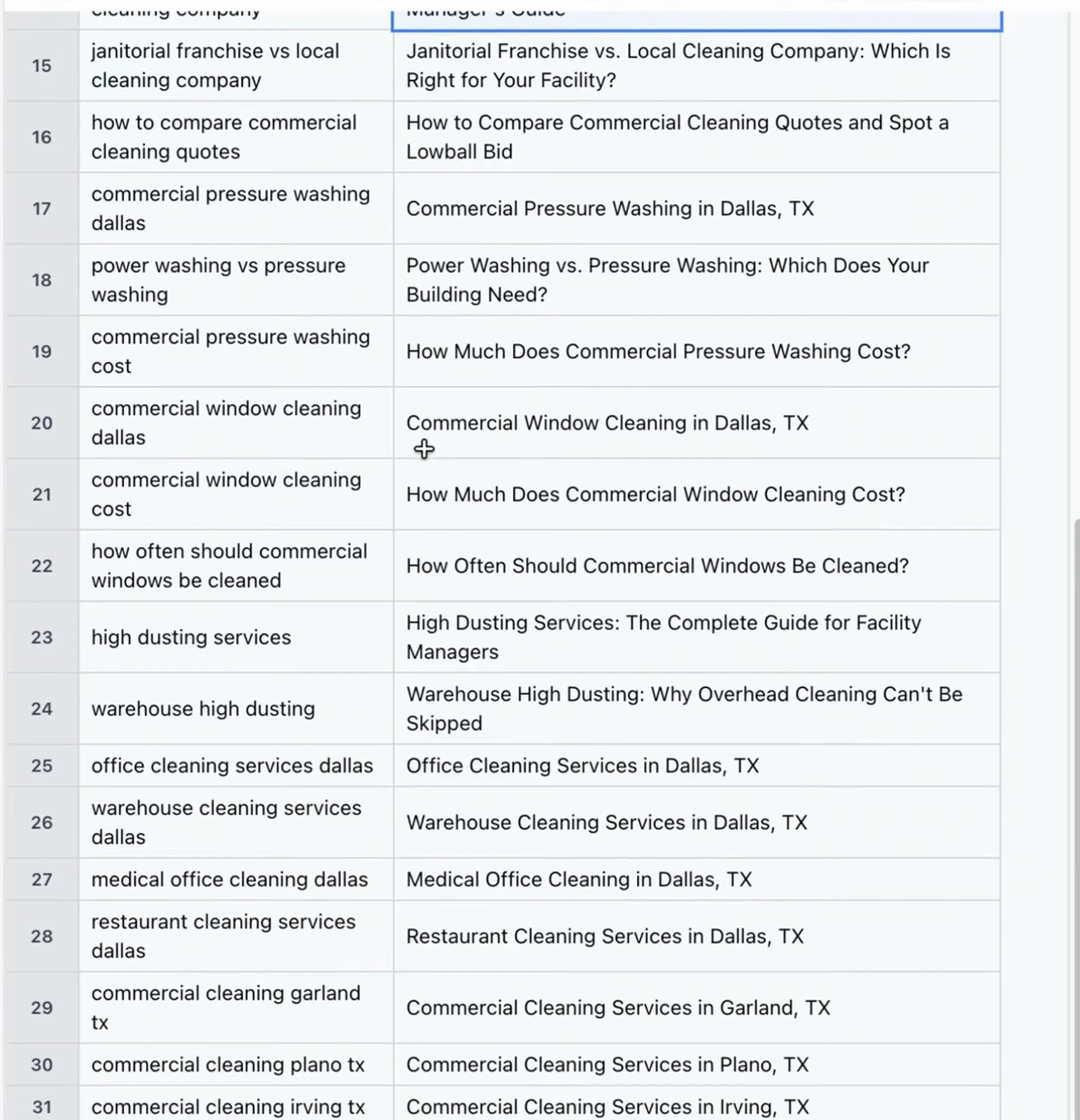
Asked for a two-column CSV — focus keyword plus title — so the plan could go into a content engine, Claude produced 30 rows ordered by cluster and priority and added two warnings of its own. Rows 24–30, the location and facility-type keywords, are "service pages, not blog posts": if they are generated in article format they will read wrong and will not convert, so they need a landing-page template with services, service area and a quote call to action, run separately. And row 2, "post construction cleaning phases", is the one to put the most effort into — the biggest opening in the plan, on a topic where the business has genuine expertise to write from.
From plan to published articles
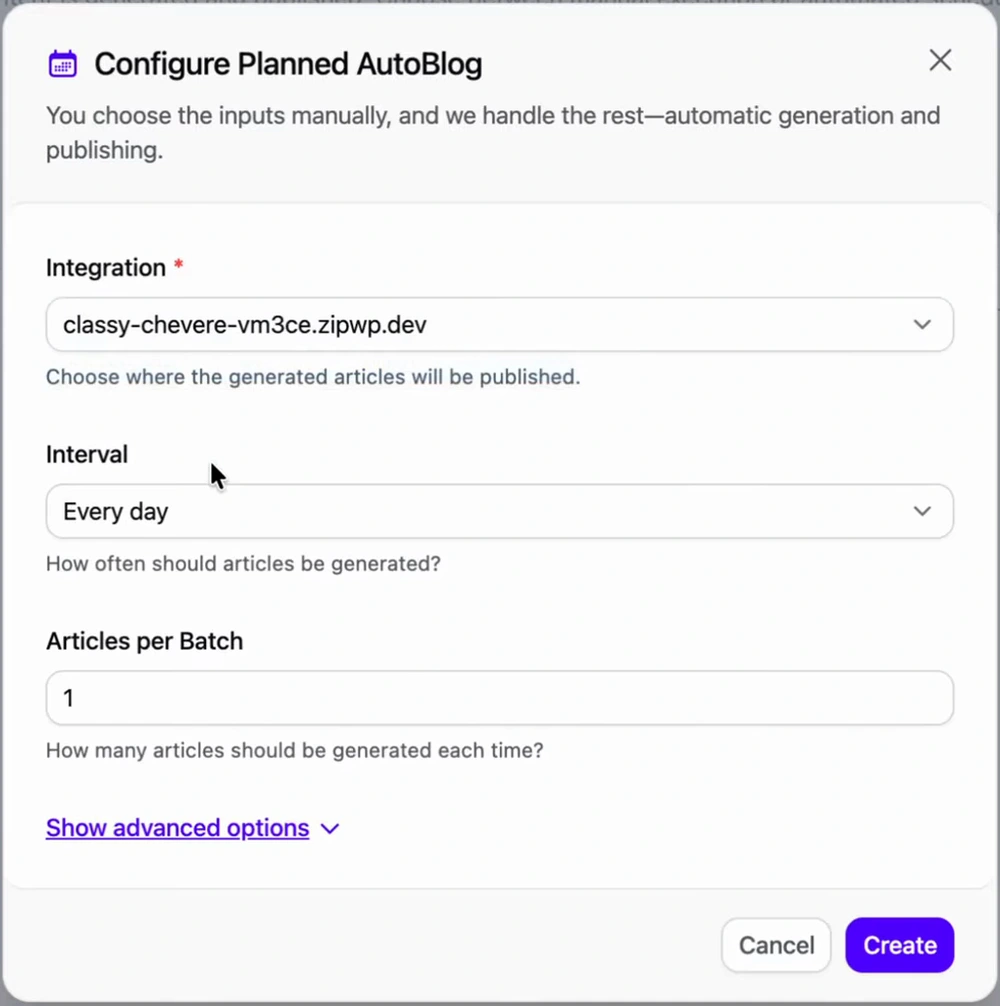
The plan is only useful if the articles get written, and the presenter's estimate is 30 minutes to an hour of setup, after which the publishing runs on its own. In Arvow the steps on screen are: connect the WordPress site through the plugin; fill the knowledge base with the business's services, contact details, reviews and testimonials so the articles are tailored to it; create a campaign as a Planned AutoBlog with the site as the integration, an interval (every day) and an articles-per-batch count — he suggests two a day to keep it from looking spammy; then Add SEO Articles and import the CSV, or paste keywords and titles by hand. Each article still needs your approval before it goes live, which is the oversight step the presenter insists on.
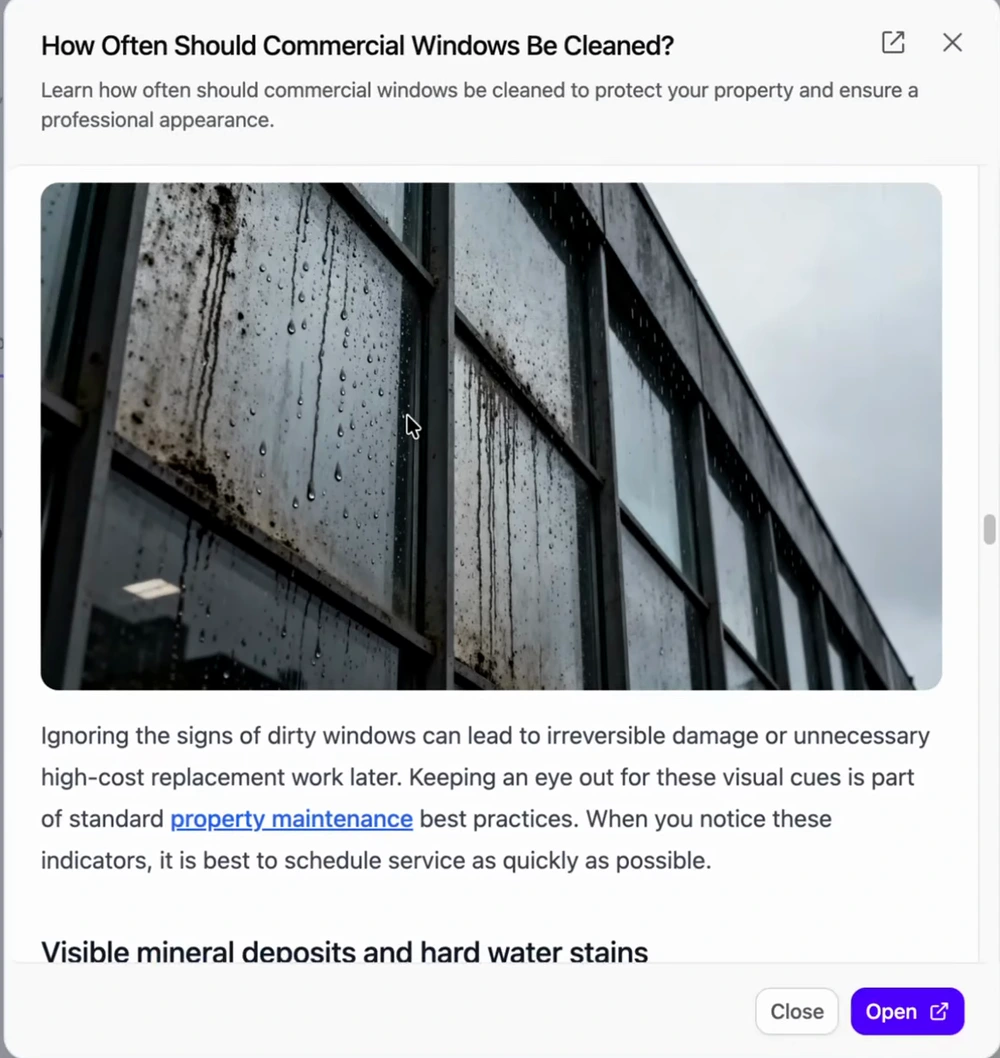
The sample he generates is row 22 of the plan, "How often should commercial windows be cleaned?" — a low-priority FAQ, picked to show the format. The output carries a meta description, generated images, a table of contents, key takeaways, an optimised heading structure, internal links to the site's other pages, a relevant YouTube video near the end, tables, a conclusion and an FAQ section. That is the shape the plan's informational rows are meant to take; the landing-page rows, per Claude's warning, want a different template. Our roundup of autoblogging software compares the tools that can run this kind of scheduled queue.
What this does and does not replace
The video's title says the prompt replaces a $2,000-a-month agency. Taken literally that is not shown: the cleaning site was days old when the video was recorded, so its results are a promise the presenter says he will report back on, and the 40K-visits dental site is evidence that content-led local SEO works, not that this prompt produced it. What the video does prove is narrower and still valuable: a competitor-gap keyword research pass that would take an agency a billable afternoon can be done in a few minutes from a URL, and the output is specific enough — named competitors, tiered gaps, a plan with article types — to act on directly.
It also does not touch the other half of local SEO. Nothing in the plan changes the Google Business Profile, reviews or citations that decide the map pack; for a business that is invisible on Maps, our guide to Google Business Profile SEO is the place to start, and if the profile exists but produces no calls, how to fix your local SEO covers the three fixes that matter. The content plan is the piece that gets a service business found for the questions its customers ask before they search for a name — and, increasingly, the piece that gets it cited when an AI answers those questions instead.
Arvow takes the CSV this workflow produces and turns it into a scheduled queue: connect your site, import the focus keywords and titles, set an interval, and every article arrives with meta tags, images, internal links and an FAQ — ready for your approval before it publishes.
Generate, publish, syndicate and update articles automatically
The AI SEO Writer that Auto-Publishes to your Blog
- Cancel anytime
- Articles in 30 secs
- Plagiarism Free