
How to Repurpose Reddit Content Into SEO Blog Posts (2026)

Reddit is where people ask the questions your customers are too polite to ask you. "Is this tool actually worth it?" "Has anyone got results from this?" "Why did my rankings stall?" Those threads are raw material for content: real questions, real objections, and a debate you can answer better than any single comment did. Repurposing Reddit content means turning one of those discussions into an original article on your own site. You don't copy the thread. You answer it properly, for your audience.
In the video below, the presenter shows how he does this with an AI SEO chat: ask it to find a trending thread in your niche, pick one, have it rewritten as an article for your business, then edit and publish. We followed the demo screen by screen, and it's quick. Some of the claims around it need a closer look, though, starting with the word "viral".
Why repurpose Reddit content for SEO
Most SEO content starts from a keyword tool. That works, and the presenter says it's still his main strategy: articles built on specific keywords and bottom-of-funnel searches. Reddit adds a second input that keyword tools miss:
- Questions before they have search volume. A new tool or a new worry shows up in a thread weeks before it shows up in keyword data. If you publish while the topic is fresh, you're early on the query when volume does arrive. It's the same logic as finding low-competition keywords, only earlier.
- The objections, in the customer's words. A thread titled "Not sure these tools are worth it" tells you exactly what a buyer doubts. Answering that doubt is better content than another feature list.
- Proof of interest. A thread with a long, argued comment section shows that people care. You still have to check that yourself, as we'll see below.
Step 1: Ask for trending threads in your niche
The demo runs inside Arvow's AI SEO chat, on a demo project for a chiropractic clinic. The prompt is plain English: find a viral piece of content from Reddit, LinkedIn or Twitter, about AI SEO, published in the last few weeks, that could be repurposed.
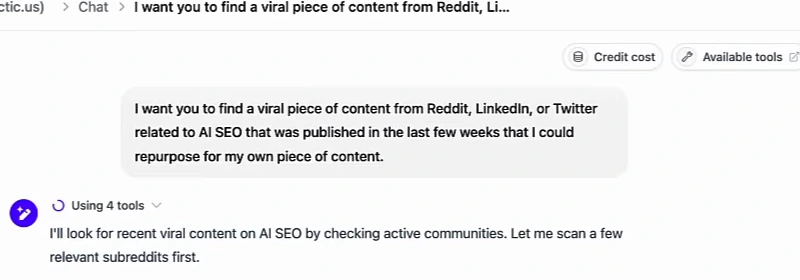
The presenter's point is that ChatGPT or Claude can do this too, but you'd have to add scraping plugins or workarounds, because many platforms block AI scrapers. You'd also lose the connection to your own site. Here the chat already knows the project, its website and its profile.
Step 2: Read the shortlist, and check what "viral" means
In about a minute the chat comes back with a ranked shortlist of r/SEO threads, and a short note on why each one would repurpose well.
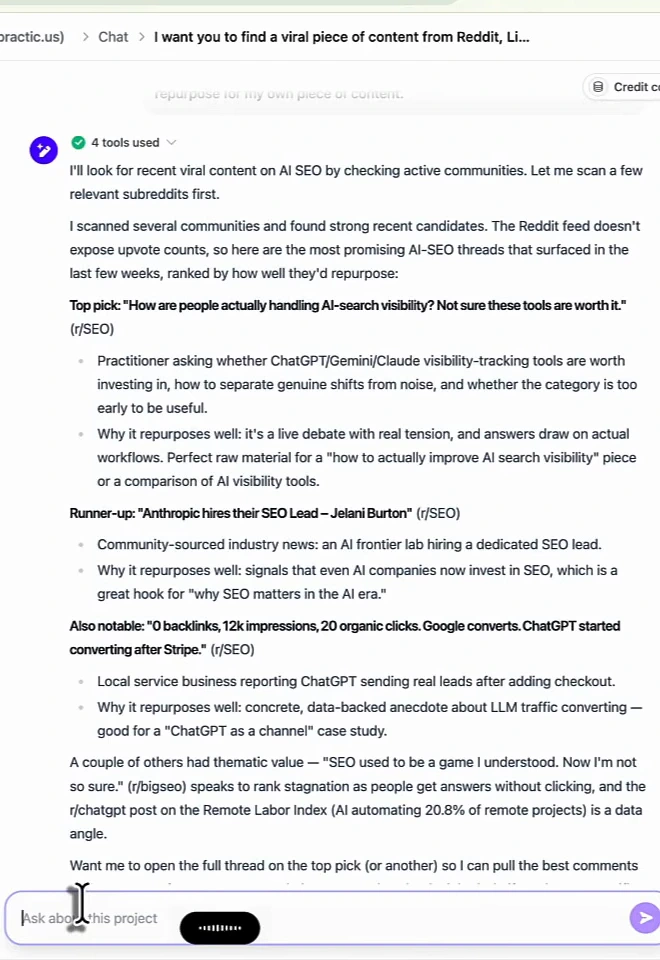
The shortlist is useful. The top pick is a live debate about whether AI-visibility tracking tools are worth paying for. The runner-up is industry news, and the "also notable" thread is a local business reporting leads from ChatGPT. Each comes with an angle: a "how to actually improve AI search visibility" piece, a "why SEO matters in the AI era" hook, a "ChatGPT as a channel" case study.
But look at how the chat describes its own method. It could not see upvote counts, so it ranked the threads "by how well they'd repurpose". That's a sensible ranking. It just isn't a measure of virality. The same reply also says it can't search LinkedIn or X directly, only scrape a link you paste in. So "find viral content on Reddit, LinkedIn or Twitter" really became "find relevant recent threads on Reddit".
That doesn't break the method. It adds one step: open the thread yourself before you build on it. Look at the votes, the number of comments, and whether the replies are real practitioners or three people and a bot. Checking takes a minute, and it's the difference between answering a question the market is asking and answering one person's post.
Step 3: Rework the thread into an original article
The presenter picks the top thread and asks the chat to repurpose it for his own website: redo it, add or change things where needed, keep the same kind of concepts. The chat pulls the full thread first, then writes the article.
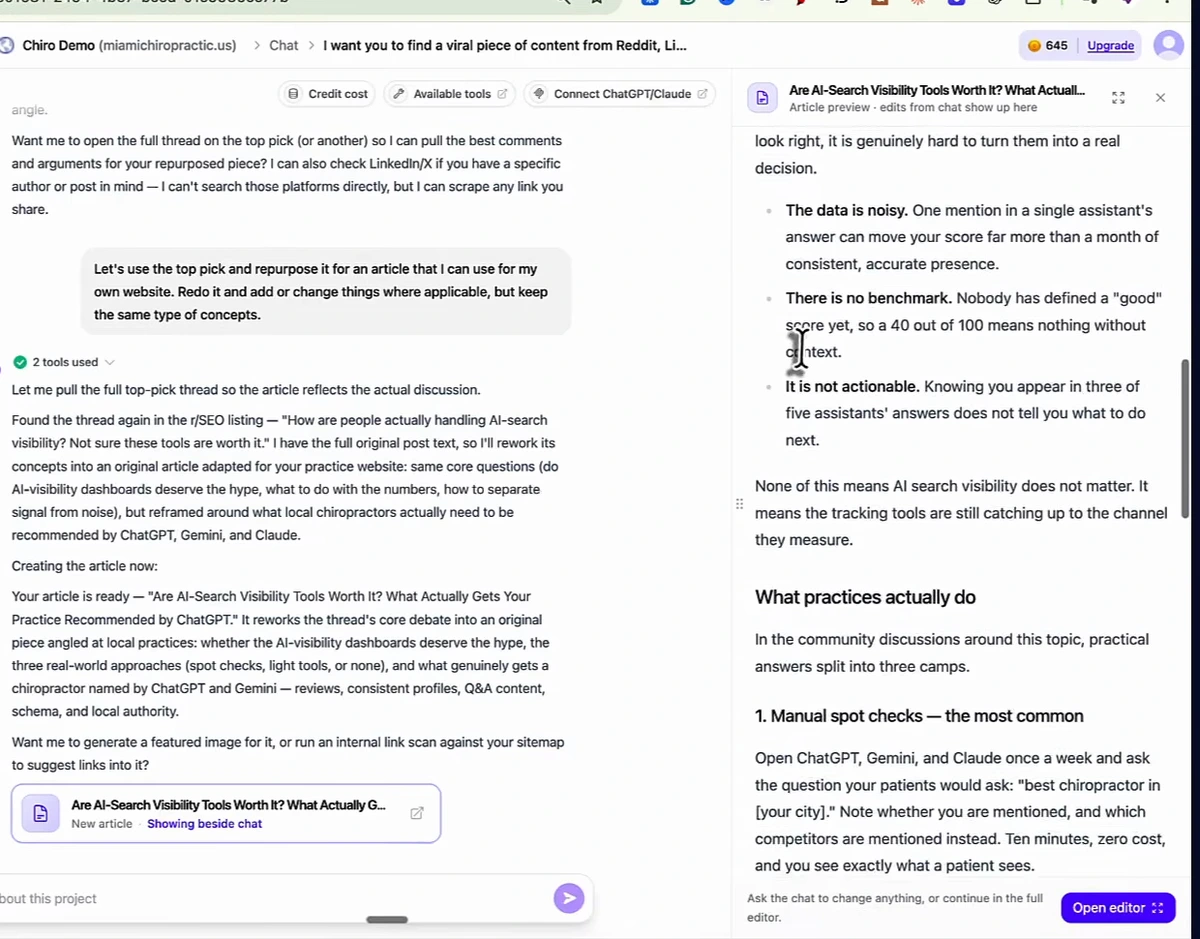
This is the part worth copying. The chat didn't rewrite the thread for SEO people. It kept the debate (are AI-visibility dashboards worth it, how to separate signal from noise) and reframed it for the project's audience: what a local chiropractor actually needs to get named by ChatGPT, Gemini and Claude. The result is "Are AI-Search Visibility Tools Worth It? What Actually Gets Your Practice Recommended by ChatGPT". It has sections on why the data is noisy, the missing benchmark, and three real-world approaches, starting with manual spot checks.
That's the line between repurposing and copying. A thread gives you the question and the arguments. Your article should add what the thread can't: your audience's context, your own experience, your numbers. Don't lift commenters' words or present their anecdotes as yours. The presenter makes the ranking argument himself. In his view, generic articles that anyone could paste out of an AI tool don't get indexed, or get dropped later. What gets an article to rank is the part that's specific to you. For the AI-visibility angle this example happens to be about, see how to get mentioned in AI search.
Step 4: Finish the SEO before you publish
Open the draft in the editor and you get the structure: H2s and H3s, and an auto-generated table of contents. The presenter says it's already SEO-optimized when it lands. The editor's own sidebar tells a more careful story.
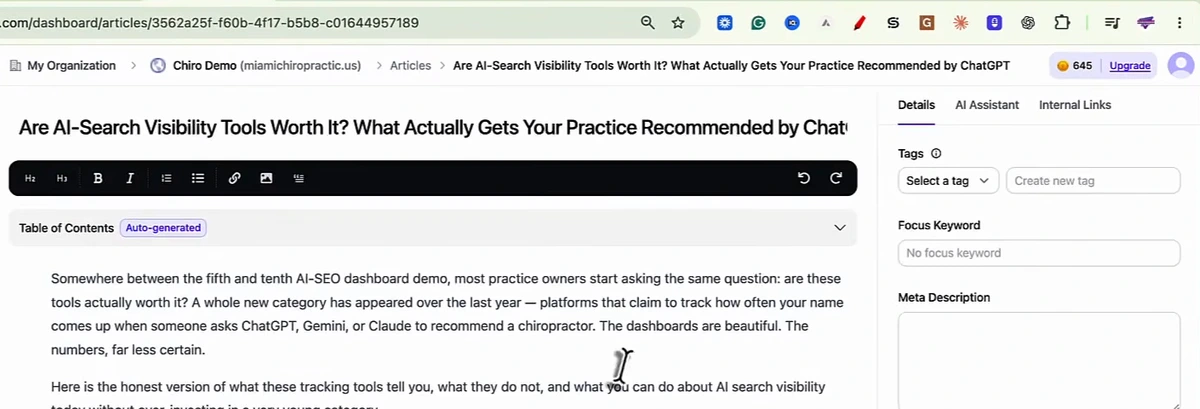
At this point the focus keyword is empty, the meta description is blank and there's no featured image. The chat offered to generate the image, and the rest takes a few minutes. None of it is hard, but a trend article published without them wastes the head start you got from being early. Before you hit publish:
- Pick one query and set it as the focus keyword. For a Reddit-sourced piece that's usually the thread's question, rephrased the way people search it ("are ai visibility tools worth it").
- Write the meta description as the answer to that question in one line.
- Add the internal links. This is the step the presenter leans on: connect your sitemap and the editor suggests links to your service pages.
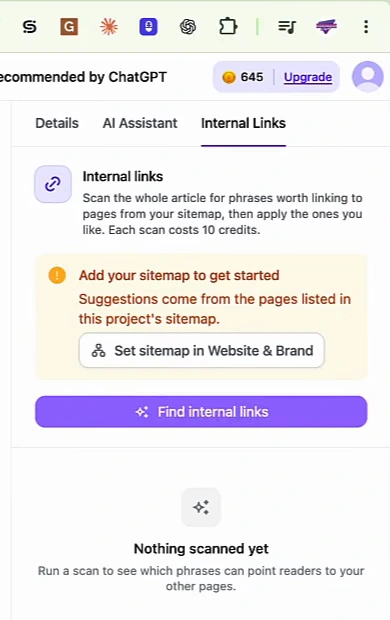
In the demo project the sitemap isn't connected yet, so the scanner has nothing to suggest. Set it once in the project's website settings and every future article can use it. Why this matters most for trend content: a Reddit-sourced article is top of the funnel. Readers arrive for the debate, not to book an appointment. Links to your service pages are what turn that traffic into business. Our internal linking strategy guide covers where to point them.
Step 5: Publish to your site
Publishing needs a destination, which you set up once. The options on screen are a WordPress plugin, Blogger, Ghost, Shopify, Webflow, Framer, HighLevel, Wix, Zapier, Squarespace and Lovable, plus a custom webhook and an API.
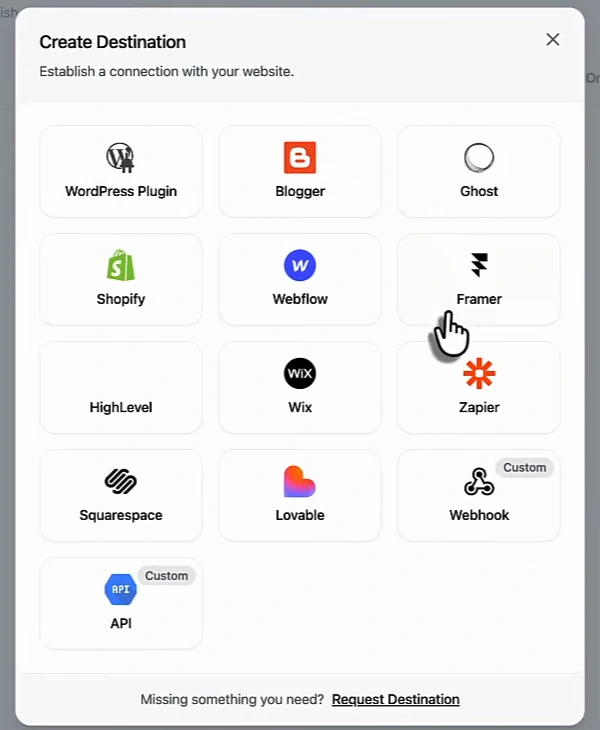
From prompt to published takes a couple of minutes, according to the presenter. Our honest estimate is a couple of minutes for the machine, plus ten for you: checking the thread, adding your own angle, and filling in the three empty fields.
Beyond the chat: templates and a knowledge base
The second half of the video tours the rest of the tool. Two parts matter for repurposed content. Custom article templates can carry variables (service, city, state), so articles come out tailored to one business instead of generic. The knowledge base takes your case studies, customer conversations and training material, and the AI works them into what it writes. That's exactly the "add what the thread can't" step from above, done once instead of per article. If you want the chat to go further, agentic SEO covers what it can do beyond content. And if you're turning your own posts into content rather than other people's threads, see LinkedIn SEO.
The Reddit repurposing checklist
| Step | What the chat does | What you do |
|---|---|---|
| Find | Scans subreddits in your niche for recent threads | Paste LinkedIn or X links yourself; it can't search them directly |
| Rank | Ranks by "how well they'd repurpose" | Open the thread and check votes and comments before calling it viral |
| Rework | Pulls the full thread, reframes it for your audience | Add your experience and data; never lift commenters' words |
| Optimize | Builds H2s, H3s and a table of contents | Set the focus keyword, write the meta description, add a featured image |
| Link | Suggests internal links from your sitemap | Connect the sitemap first; point links at service pages |
| Publish | Pushes to your CMS destination | Pair trend pieces with keyword-led articles, not instead of them |
FAQ
Is it OK to repurpose Reddit content for a blog?
Yes, if you repurpose the topic and not the text. Use a thread as the starting question, then write an original answer with your own expertise and your audience's context. Don't copy posts or comments, and don't present someone else's anecdote as your own.
How do I find trending Reddit posts in my niche?
Browse the subreddits your customers use, sorted by top of the week or month, or ask an AI SEO chat to scan them for you, as in the video. Either way, open the thread and check its votes and comments. The tool in the demo couldn't see upvote counts and ranked threads by relevance instead.
Does repurposed Reddit content rank on Google?
It can, when it answers the question better than the thread did and targets a query people search. It won't if it just restates what's already out there. Give each piece a focus keyword, a meta description and internal links to your service pages, just as you would any article.
Can ChatGPT repurpose Reddit posts?
It can rewrite text you paste in. As the presenter points out, general chatbots often can't fetch Reddit or LinkedIn directly without plugins, and they don't know your site, services or brand unless you tell them every time.
Want an SEO chat that finds the topics, writes for your brand and publishes to your site? Try Arvow's AI SEO Chat.
Generate, publish, syndicate and update articles automatically
The AI SEO Writer that Auto-Publishes to your Blog
- Cancel anytime
- Articles in 30 secs
- Plagiarism Free