
LinkedIn SEO in 2026: How to Rank and Get Cited by AI Search

LinkedIn is the one publishing channel most businesses own, log into weekly, and still treat as a place to shout announcements. That is a mistake with a number attached to it. In July 2026 Semrush estimated 463.86 million monthly organic-search visits to linkedin.com, and in a separate study of 325,000 AI prompts LinkedIn came out as the second most-cited domain in AI search — behind Reddit, ahead of Wikipedia.
This article breaks down the LinkedIn SEO strategy Tim The SEO Guru walks through in the video below: what the citation data actually says, the post format that earns those citations, how to turn one blog article into three posts, and the automation that runs the whole loop weekly.
Why LinkedIn SEO is worth the slot on your calendar
The case rests on three numbers, all from Semrush, all visible in the walkthrough.
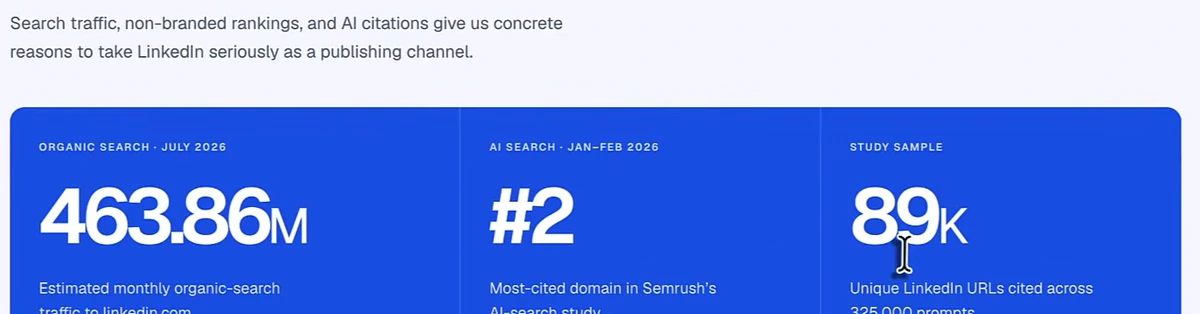
- 463.86M — Semrush's estimate of monthly organic-search traffic to linkedin.com (July 2026).
- #2 — LinkedIn's rank among most-cited domains in Semrush's AI-search study (January–February 2026).
- 89K — unique LinkedIn URLs cited across the study's 325,000 prompts.
The second number is the one that changes how you should think about the channel. A domain rating of 99 has always meant LinkedIn pages inherit trust in classic search. What is new is that language models pull from it constantly — which makes LinkedIn a distribution surface for the same work you already do when you try to get cited by ChatGPT.
LinkedIn is effectively tied with Reddit
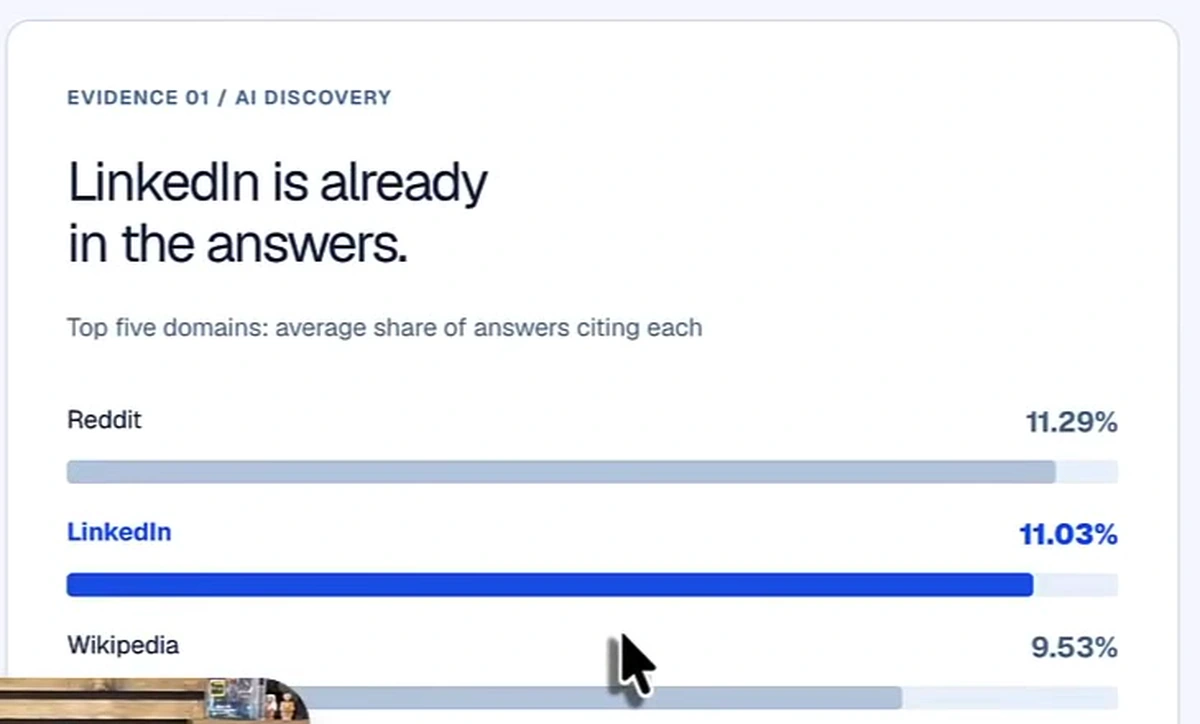
Reddit takes 11.29% of answers, LinkedIn 11.03%. That gap is a rounding error. Reddit, though, is a place where your brand gets discussed by other people and where self-promotion is punished. LinkedIn is a place where you publish under your own name, on a page you control, with no moderator deciding whether your post survives the night.
That asymmetry is the whole opportunity. It is the same logic behind brand mentions being the new backlinks — except here you are the one placing the mention.
The non-branded ranking proof
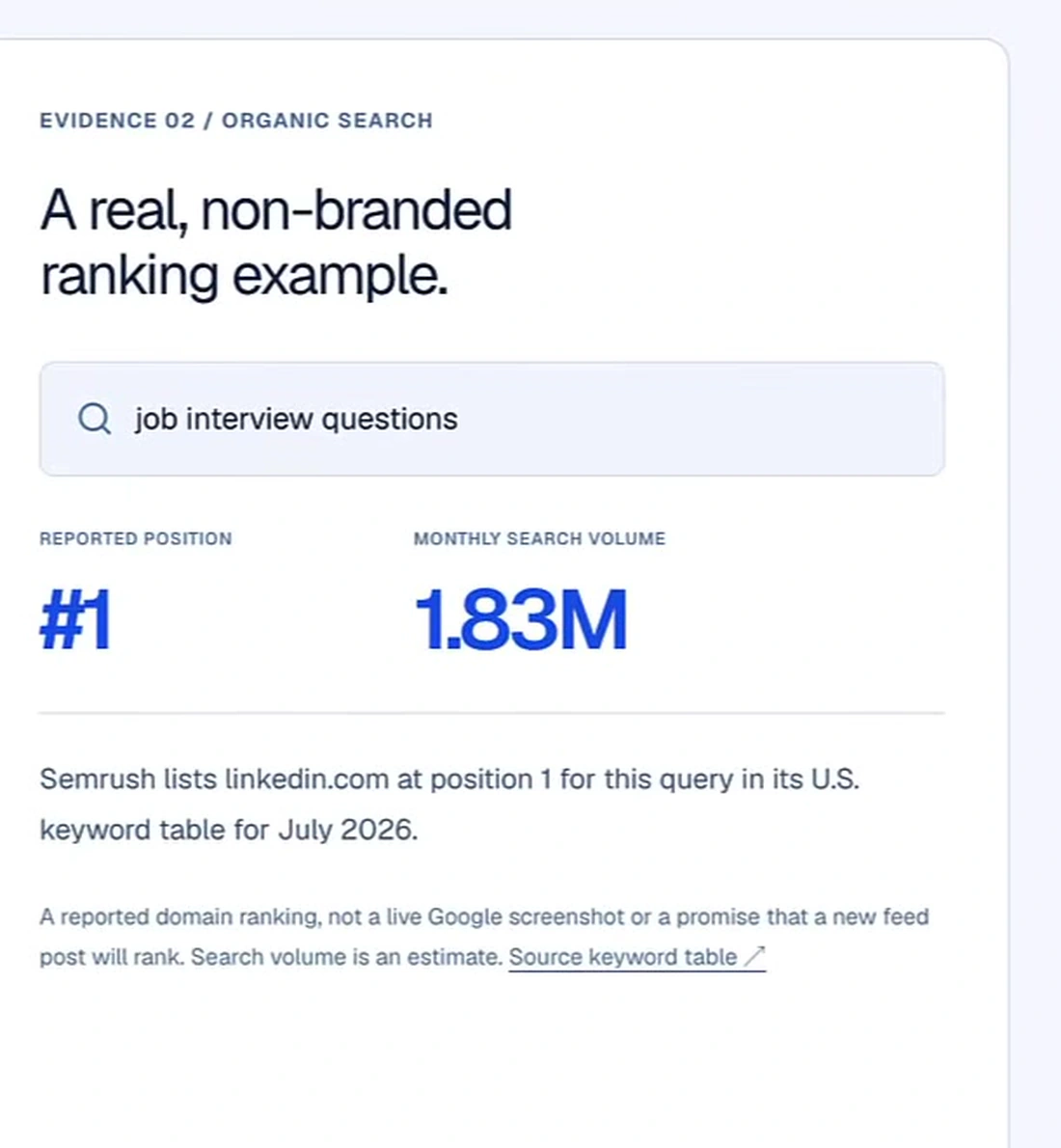
Ranking for your own brand name is table stakes. Ranking at #1 for a 1.83M-volume informational query with no brand in it is a different claim: it means Google treats LinkedIn content as a legitimate answer to general questions, not just as a company directory.
One caveat the video is explicit about, and it is worth repeating: this is a reported domain ranking, not a live SERP screenshot, and it is not a promise that a post you publish tomorrow will rank. It tells you the ceiling exists. Getting near it is the rest of this article.
Make every post worth finding
The format rule is short: answer a question your customers actually care about, make the subject line unambiguous, and say something specific enough to be worth quoting. Four things separate a citable post from a status update.
- Lead with the topic. A natural, specific opening that tells the reader what the post will help them understand. No "thoughts?" openers, no three-line hooks that hide the subject.
- Deliver one useful answer. Explain a process, clarify a mistake, or share a checklist. One post, one answer. Keep the paragraphs short enough to skim.
- Add your perspective. First-hand observations and grounded examples. This is the part a model cannot generate from the open web, and the part that makes the post worth citing rather than another paraphrase.
- Build a steady rhythm. LinkedIn's own guidance is two to three posts per week. Pick a cadence you can hold and leave time for the replies, which is where most of the reach actually comes from.
The reason this format matters for AI search specifically: models cite passages that answer a question cleanly and attribute a claim to someone. A post structured as topic → answer → evidence → perspective is a retrievable passage. A post structured as hook → suspense → "comment 'GUIDE' below" is not.
Turn one blog article into three LinkedIn posts
You are already publishing SEO articles. The video's argument is that you should stop treating LinkedIn as a separate content calendar and start treating it as a second surface for work you have already done.
The split it demonstrates: one article on onboarding a new consulting client becomes three posts on three different angles — the checklist, the mistake, and the perspective. Same source, three hooks, three reasons for someone to stop scrolling.
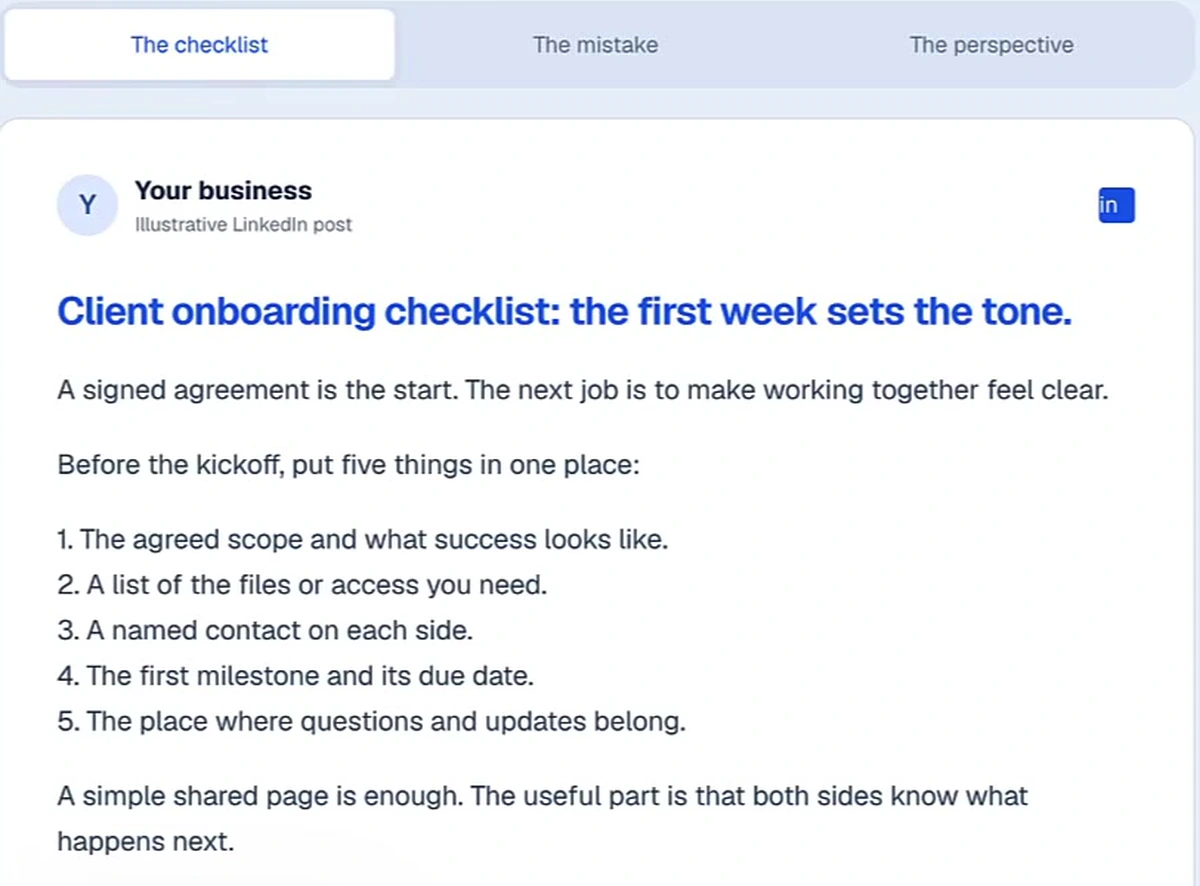
Notice what the example does not do. It does not tease. It does not link out in the first line. It answers the question inside the post, which is exactly what makes it quotable by a model and readable by a human who never leaves the feed.
If repurposing is new to you, the mechanics generalise well beyond LinkedIn — we cover the broader version in our guide to repurposing blog content for social media and the AI-assisted version in AI content repurposing.
The automation layer: blog → RSS → AI → LinkedIn
Doing this by hand for two or three posts a week is a real time cost. The workflow in the video removes almost all of it with four components.
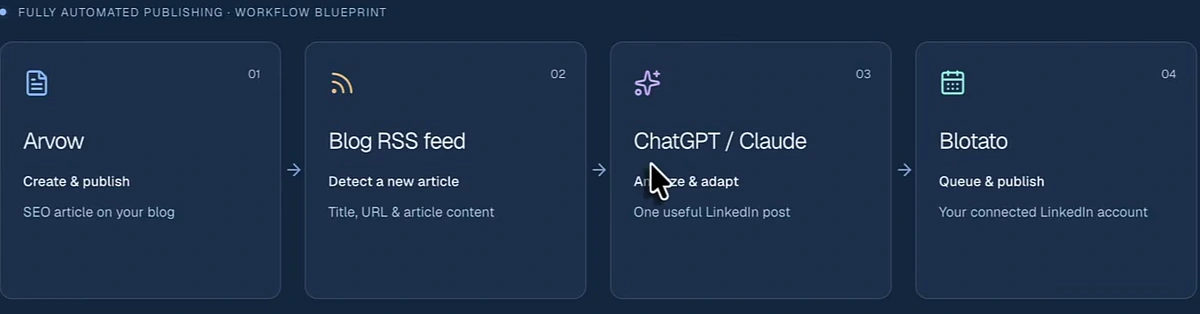
- Create and publish the article. The source content lands on your blog as a normal SEO post.
- The blog's RSS feed detects it. Title, URL and body become the payload — usually
yourwebsite.com/feed/on WordPress. - ChatGPT or Claude adapts it. A rewrite prompt turns the article into one useful LinkedIn post in your voice.
- A scheduler queues and publishes it. The video uses Blotato, connected to the LinkedIn account.
One correction worth making, because the video makes it and it is the kind of detail that quietly breaks these builds: a plain ChatGPT or Claude chat does not watch an RSS feed. Something has to poll it on a schedule — Make, n8n, or an equivalent automation layer — then call the AI step and hand the output to the scheduler. The LLM is the writer in this pipeline, not the trigger.
The video's team runs it once a week and generates the full week of posts in one pass. That is the right cadence: it matches LinkedIn's two-to-three-posts-a-week guidance without turning your Monday into a content shift.
Keep the human part human
Automating distribution is not the same as automating expertise. The step that earns the citation is the one where you add the observation only your business has. Automate the fetch, the reformat and the schedule; keep writing the part that makes the post worth quoting. Automated volume with nothing specific in it is exactly the commodity content AI Overviews already has too much of.
The multiplier: repost what already worked
The last step costs almost nothing. When a LinkedIn post performs well, that is a signal about what your audience cares about — so give the same idea another format.
The move demonstrated in the video is to record a short video of yourself reading the post. Not a production: you, on camera, in your own words, for as long as the post takes. Then adapt it for LinkedIn video, Shorts or Reels. The claim is that around 90% of these do well, for the obvious reason — the idea was already validated by the feed before you filmed it.
So the chain runs: one article → three LinkedIn posts → one short video from whichever post wins → distribution across every video surface you use. One piece of original thinking, five or six placements.
How to start this week
- Pick your three best-performing blog articles. Not the newest — the ones that already earn search traffic.
- Turn each into three posts using the checklist / mistake / perspective split. That is nine posts, roughly a month at LinkedIn's suggested cadence.
- Publish two or three a week and actually reply to comments. Reach on LinkedIn is conversation-weighted.
- After three weeks, look at which post outperformed and record a two-minute video of it.
- Only once the manual loop is working, wire up the RSS → AI → scheduler automation. Automating a process you have not validated just produces bad posts faster.
Track whether it is working the same way you would track any other AI-visibility play: watch whether your brand starts appearing in model answers for the questions your posts address. That is the metric that matters here, and it is the same one behind increasing AI mentions generally.
Want the article half of this loop running on its own? Arvow writes the SEO articles, publishes them to your blog, and tracks whether ChatGPT, Claude, Gemini and Perplexity start citing you.
The short version
LinkedIn earns 463.86M organic visits a month and is cited in roughly 11% of AI answers — statistically level with Reddit, on a surface you fully control. The work is not "post more". It is: answer one real question per post, mine your existing articles for three angles each, add the observation only you can add, and let automation handle the fetching and scheduling rather than the thinking.
The underlying data on which domains models actually cite is worth reading in full in Semrush's most-cited-domains study.
Generate, publish, syndicate and update articles automatically
The AI SEO Writer that Auto-Publishes to your Blog
- Cancel anytime
- Articles in 30 secs
- Plagiarism Free